



Blog
7 Financial Data Providers You Need to Know About
By: Auras Tanase -
22 February 2026


We love our data, and now that you're here, you're one step closer to loving it too.
A wide sample of data, so you can explore what is possible with our data
Choose ->
built with procurement in mind. Focused on manufacturers, products and more
Choose ->
built with insurance in mind. Focused on classifications, business activity tags and more
Choose ->
built with sustainability in mind. Focused on sustainability commitments, and environmental and social governance insights.
Choose ->
built with strategic insights in mind. Focused on market trends, competitor analysis, and industry-specific data
Choose ->

Keep up to date with our technology, what our clients are doing and get interesting monthly market insights.

Need financial data, but not sure where to start?
We get it.
“Financial data” can mean very different things, from real-time market feeds and company financials to estimates, filings, private-company coverage, and alternative data signals.
And with so many providers claiming depth, accuracy, and speed, it’s easy to lose time comparing options before you even know what matters for your use case.
In this guide, we break down seven financial data providers you need to know about.
For each one, you will get a clear snapshot of what it is best for, key features, pros and cons, and what to expect in terms of pricing.
Let’s get started.
Veridion is a modern data-as-a-service (DaaS) provider that uses AI and ML to enrich and verify company data, including financial and company-size signals.
It is built for teams that need clarity at the entity and location level, not just a high-level company record.
Traditional financial data providers are usually strongest on markets, filings, and standardised statements.
Veridion complements them by adding granular context you can use in underwriting, supplier risk, market intelligence, and investment analysis.
Alongside firmographics and operational footprint, Veridion includes attributes such as employee count and revenues (including extracted or modelled values), plus revenue type.
If you are, say, validating a supplier, you can enrich the record with size/financial indicators, then cross-check them against the entity structure and location footprint.
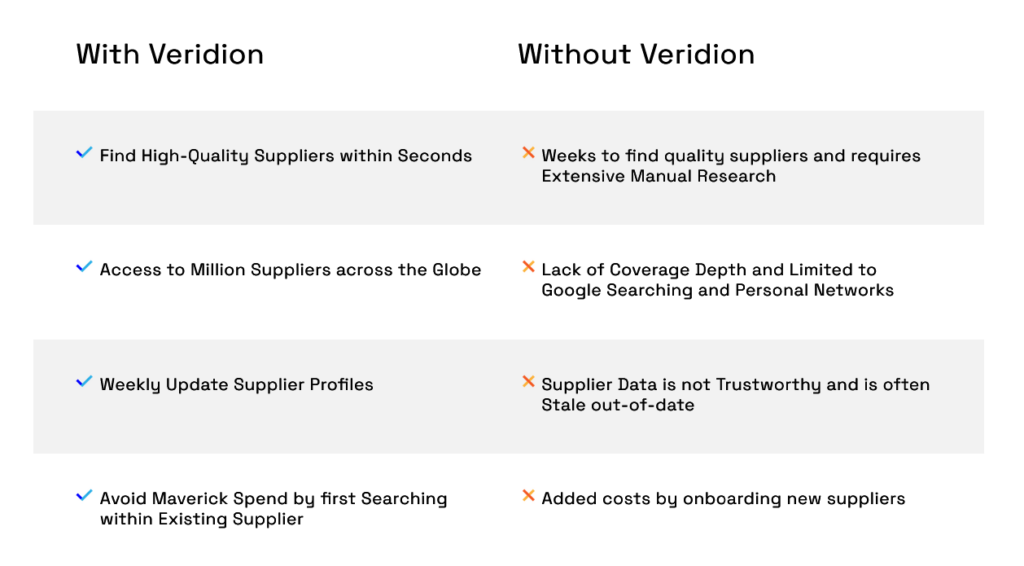
Source: Veridion
This helps you catch mismatches early, like a “small” supplier that operates across many sites, or a group structure that changes the real exposure.
Here’s a quick summary of everything you need to know about Veridion.
| Best for | Enrichment and verification for underwriting, supplier risk, and market intelligence workflows |
| Financial signals | Company size and financial attributes such as employee count, revenue values, and revenue type |
| Differentiator | Entity- and location-level context that complements market-data-first providers |
| Pricing | Quote-based (depends on coverage, attributes, and delivery method) |
Overall, use Veridion when you need verified company-level context that makes financial signals more decision-ready.
Next, we will look at providers that focus primarily on market and securities data.
Bloomberg is a financial data platform built for teams that rely on real-time markets, company financials, news, analytics, and economic indicators in one workflow.
It is best known for the Bloomberg Terminal.
For enterprise teams that want the data inside their own systems, Bloomberg also offers data products and licensing through its Enterprise Data business.
Bloomberg often positions its scale in two headline numbers: 8,000+ enterprise datasets and 100 billion+ data points published daily via Data License (consistent with Terminal data).
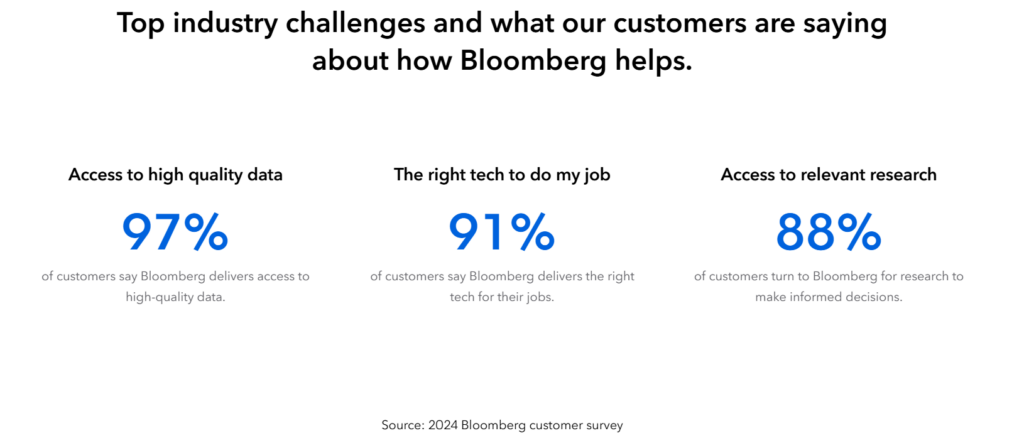
Source: Bloomberg
If your team needs to track market moves and explain them fast, Bloomberg lets you pull live pricing, layer in news, and run analytics in the same environment.
Here’s what else you need to know:
| Best for | Real-time market workflows and research driven by live pricing + news + analytics |
| Data scale | 8,000+ enterprise datasets; 100 billion+ data points published daily via Data License |
| Key products | Bloomberg Terminal; Enterprise Data / Data License |
| Pricing | Not publicly listed. Industry sources often report Terminal pricing at around $32,000 per year (varies by contract and setup). |
This is a different job than what Veridion does, which is focused on verifying and enriching company-level records across entities and locations.
Next, we will look at another provider that is widely used for research and analytics, but with a different product setup and coverage focus.
FactSet is a financial data and analytics platform used for equity research, portfolio analysis, and due diligence workflows.
It brings together market and company datasets with analytics so teams can research securities, monitor portfolios, and run investment analysis in one environment.

Source: FactSet
Compared with Bloomberg, which is often Terminal-first and news-led, FactSet is commonly positioned around research and portfolio workflows, including exposure, risk, benchmarking, and performance analysis.
FactSet’s coverage includes building blocks that research teams use frequently, such as fundamentals, like financial statement data, and ownership datasets, like institutional and mutual fund ownership.
If you are doing investment screening or due diligence, you can pull company fundamentals, check ownership context, and then evaluate portfolio exposure and performance metrics.
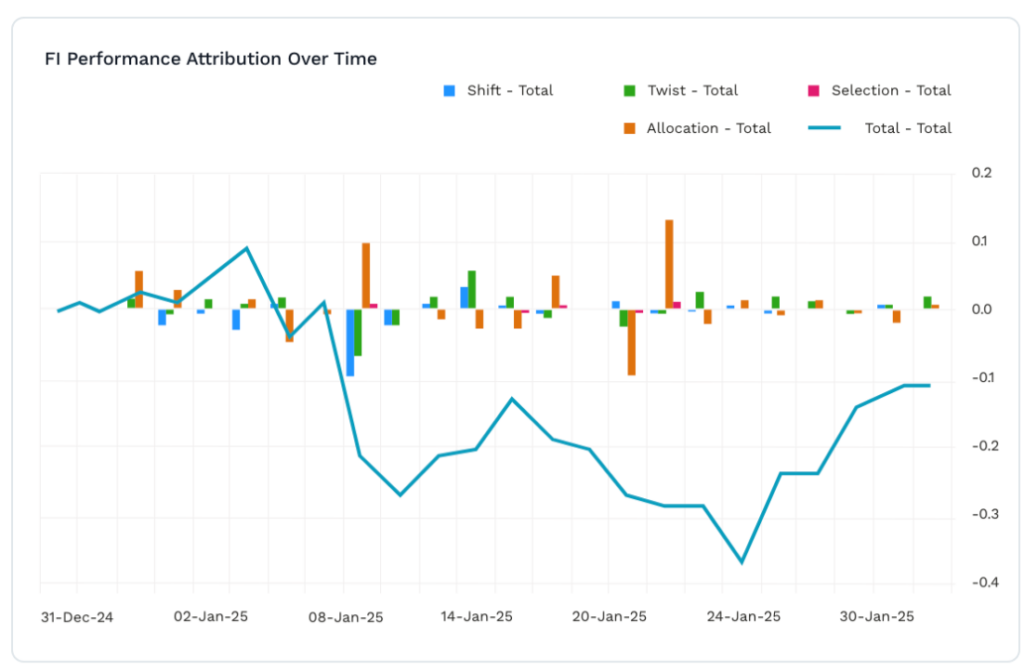
Source: FactSet
All of this can be done in the same workflow using FactSet’s analytics capabilities.
Here’s a breakdown of all key facts about FactSet:
| Best for | Equity research, portfolio analysis, and due diligence workflows |
| Key features | Fundamentals data; ownership data; portfolio analytics |
| Pros | Strong for research + portfolio workflows where analytics and attribution matter |
| Cons | Not positioned as a “news-first, real-time terminal” experience in the same way Bloomberg Terminal is |
| Pricing | Tailored pricing; available on request |
Next, we will look at another provider with broad financial datasets, but with different strengths in credit risk, ratings, and market intelligence.
S&P Global is a data and analytics provider known for credit ratings, market intelligence, company financials, and risk analytics.
This platform is frequently chosen for underwriting and credit workflows because it provides both the necessary data and the analysis required for confident risk assessment and decision-making.
In its Data & Analytics offering, S&P Global highlights “Essential Intelligence”, which combines sector and market data with news and analytics.
It also offers productised platforms like S&P Capital IQ Pro for deeper market and company intelligence, and a Marketplace for fundamental and alternative datasets delivered via cloud, data feeds, and APIs.
Here is the dashboard of S&P Capital IQ Pro.
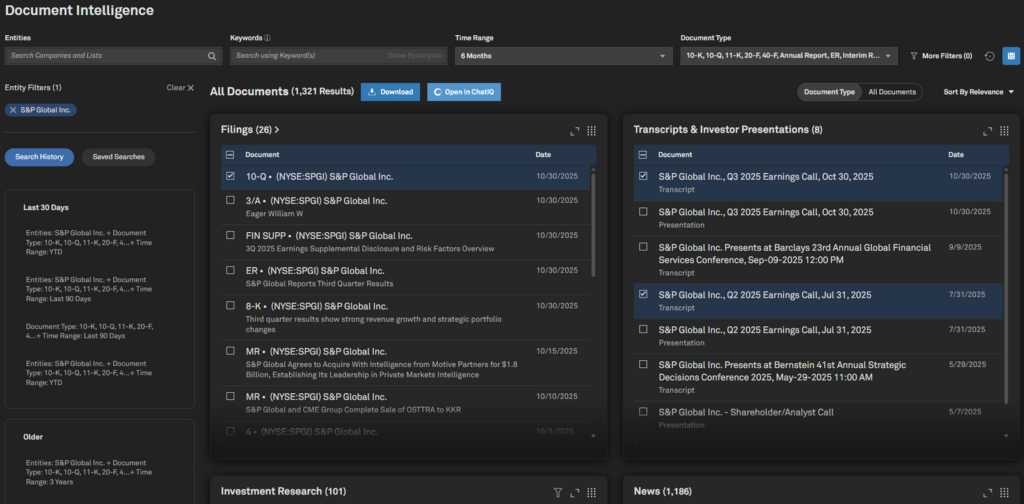
Source: S&P Global
If you are assessing credit risk or portfolio exposure, S&P Global can support the workflow end-to-end, from research and company intelligence to broader datasets that help explain risk drivers across markets and sectors.
This sits closer to risk and ratings use cases than Veridion’s entity-and-location enrichment focus, and is less terminal-first than Bloomberg.
| Best for | Underwriting, credit assessment, portfolio risk management |
| Key products | Data & Analytics, S&P Capital IQ Pro, Marketplace |
| Key features | Sector + market data with news and analytics; proprietary datasets; tools and feeds for enterprise delivery |
| Pros | Strong for risk-led workflows that need data plus analysis |
| Cons | Can be broader and more multi-product than single-purpose datasets |
| Pricing | Available on request (“Request a Follow-up”) |
Next, we will look at a provider that is more specialized in company identity, credit files, and risk signals at the business level.
Dun & Bradstreet (D&B) is a business data and insights provider used for company financials, credit risk assessment, firmographics, and third-party risk screening.
It is commonly used in supplier risk assessment and commercial underwriting workflows.
D&B’s core foundation is the Dun & Bradstreet Data Cloud, which it describes as data intelligence on 600M+ organizations across 250+ markets (plus consumer data in many offerings).
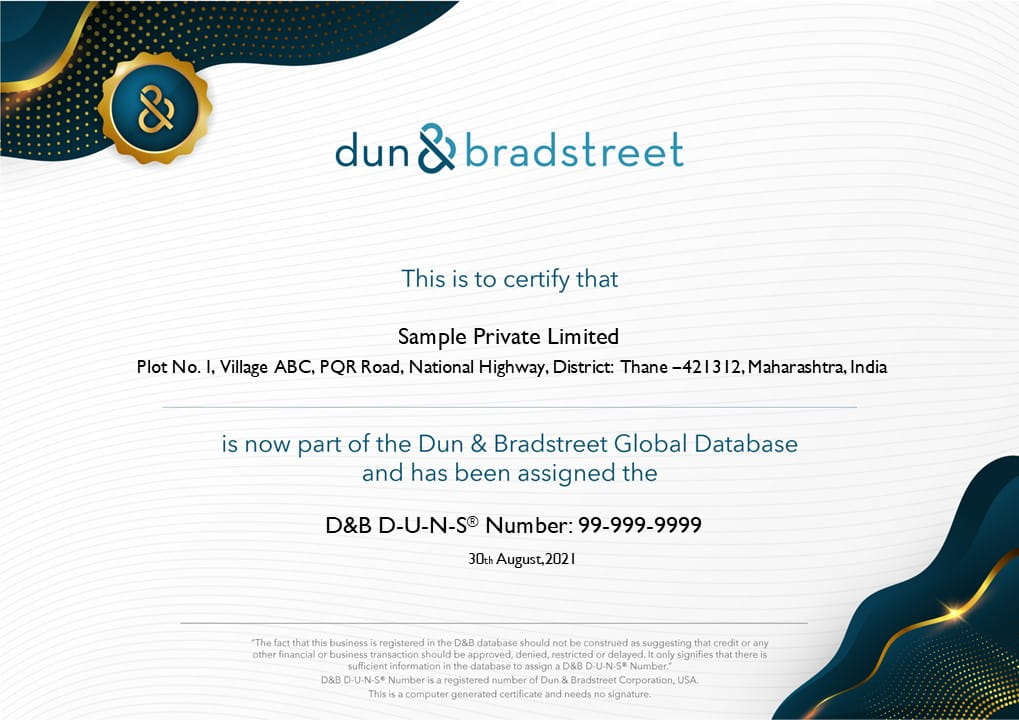
A key identifier in D&B ecosystems is the D-U-N-S Number, a 9-digit unique business identifier tied to D&B’s identity resolution and “Live Business Identity”.
This is often used in onboarding and record matching when you need consistent entity identification.
Here is what a D-U-N-S Number certificate looks like in practice.
Source: Dun & Bradstreet
If you are onboarding a new supplier, you can use the D-U-N-S Number to standardise the record, then layer on D&B’s credit/risk indicators to support supplier risk decisions.
This is a different job than Bloomberg or FactSet (market and securities workflows) and a different emphasis than Veridion (entity- and location-level enrichment).
| Best for | Supplier risk assessment, commercial underwriting, business identity verification |
| Key features | D&B Data Cloud; D-U-N-S Number (9-digit identifier); risk and credit decisioning signals |
| Data scale | 600M+ organizations; 250+ markets |
| Pricing | Available on request (contact/demo flows) |
All in all, if your priority is credit and third-party risk decisioning tied to business identity, D&B is worth looking into.
Bright Data provides large-scale web data collection and ready-to-use datasets for teams that want continuously updated public web data for market intelligence, competitor monitoring, and alternative data workflows.
Instead of a terminal-style experience (Bloomberg) or a research-first financial platform (FactSet), Bright Data is positioned as a web data infrastructure.
You can buy pre-built datasets or collect data on demand using its scraping APIs and delivery options.
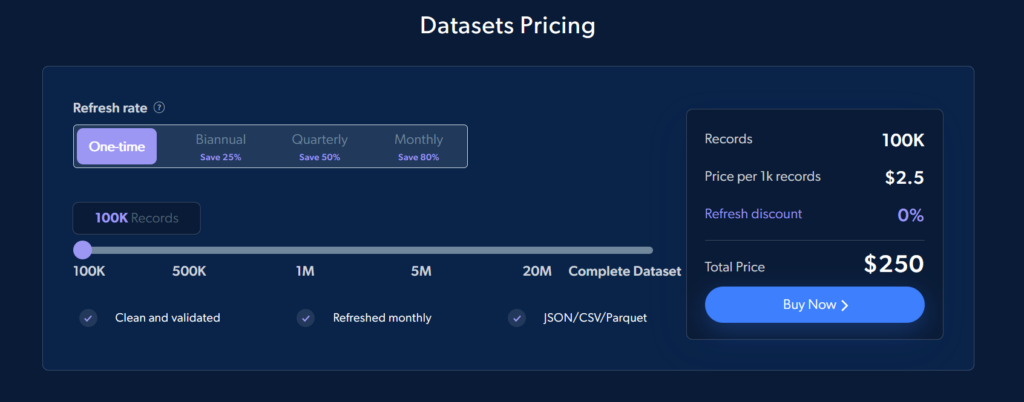
On the financial dataset page, Bright Data highlights access to public financial data for use cases like portfolio management and predictive analytics.
The page also shows an entry price point of $250 per 100,000 records.
Source: Bright Data
If you need an alternative data feed that updates frequently, Bright Data can deliver structured datasets and enable ongoing collection.
Here’s some additional information about Bright Data:
| Best for | Web-sourced alternative data, market intelligence, competitor monitoring |
| Key features | Dataset marketplace + web data collection APIs; structured delivery options |
| Pros | Built for scale and continuous updates from public web sources |
| Cons | Data collection requires careful scoping and QA to match your exact fields and freshness needs |
| Pricing | The financial dataset page shows $250/100,000 records |
Bright Data is worth considering when “fresh public web data” is the core requirement, not traditional licensed market data.
Daloopa is an AI financial copilot designed to extract and standardise fundamental data from filings and disclosures for analyst workflows.
It is built to fit directly into Excel, where most models live.
The focus here is different from Bloomberg or FactSet.
Those platforms are built around markets, research, and broad financial datasets.
Daloopa, on the other hand, is built for the “document to model” step, where accuracy and traceability matter more than live pricing.
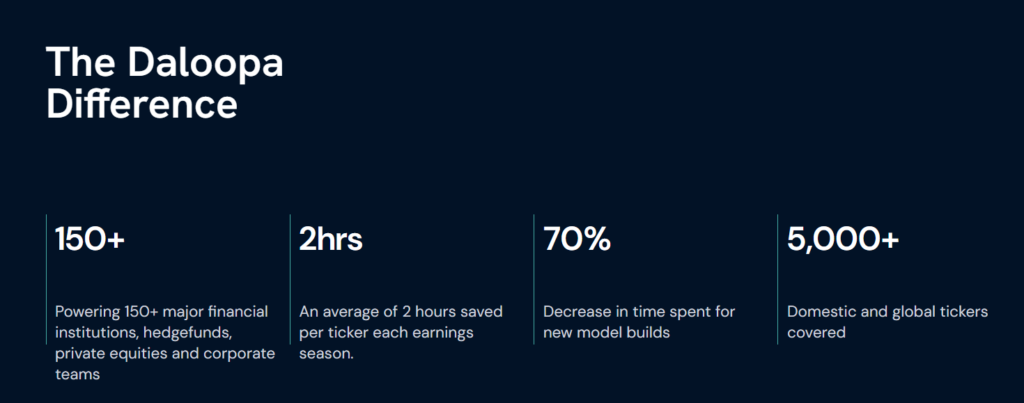
Daloopa highlights auditability as a core feature. It states that every datapoint is hyperlinked back to filings and transcripts, so analysts can verify numbers quickly.
It also publishes an open benchmark on financial retrieval.
In that test, a grounded setup (Claude + Daloopa MCP) achieved 94.2% exact-match accuracy on single-number prompts from official documents.
Source: Daloopa
After earnings, a team can update models faster by pulling newly disclosed metrics from source documents and keeping the links for audit and review.
This is also where Daloopa differs from tools like Veridion.
Veridion is not a filings-extraction layer.
It is a company data enrichment and verification layer, useful when your question is about entity identity, locations, and operating footprint, not only what a filing says.
| Best for | Filing-driven fundamental data extraction and model updates |
| Key features | Excel integration; source hyperlinks; MCP connector benchmarked for grounded retrieval |
| Pros | Auditability by design through source-linked datapoints |
| Cons | Not a real-time market terminal or broad “company profiling” dataset |
| Pricing | Plans are listed (including a Free plan), with details gated behind “Get Started” / demo flows |
All in all, Daloopa’s financial data is ideal for finance professionals like equity analysts, portfolio managers, investment bankers, and data scientists in hedge funds, private equity, and more.
It helps you quickly access, process, and analyze thorough, AI-structured historical financial statements, KPIs, and other data for significantly faster modeling and decision-making.
Financial data powers so many different decisions, so no single provider will fit absolutely everyone.
Besides, the strongest workflows stack layers: market context for the why, risk signals for the so-what, and clean company-level truth for the final call.
That last layer is where teams usually lose time, because entities do not match, coverage is patchy, and the data is already stale by the time it hits a spreadsheet.
So, before making any final decisions, run short pilots with real questions.
When the data stays accurate, current, and consistent across systems, decisions move faster, and they are much easier to defend.