



Blog
6 Leading Data Enrichment Companies of 2026
By: Auras Tanase -
08 March 2026


We love our data, and now that you're here, you're one step closer to loving it too.
A wide sample of data, so you can explore what is possible with our data
Choose ->
built with procurement in mind. Focused on manufacturers, products and more
Choose ->
built with insurance in mind. Focused on classifications, business activity tags and more
Choose ->
built with sustainability in mind. Focused on sustainability commitments, and environmental and social governance insights.
Choose ->
built with strategic insights in mind. Focused on market trends, competitor analysis, and industry-specific data
Choose ->

Keep up to date with our technology, what our clients are doing and get interesting monthly market insights.

Data enrichment is at the heart of strategic, well-informed decision-making across any industry or business function.
It transforms surface-level insights that reveal little, if anything, into rich, detailed profiles of companies, individuals, and more, giving you a true 360-degree view.
That said, not every data enrichment provider will be the right fit for you.
Providers vary widely in the data they offer, their ideal use cases, sourcing methodologies, and more.
That’s why, in this article, we break down six of the best data enrichment services in detail, so you can find the ideal solution for you and your organization.
Veridion is an AI-powered market intelligence platform and data engine that delivers rich, up-to-date, and highly accurate business data.
It’s a versatile solution used by teams across procurement, risk management, ESG, insurance, underwriting, and more.
Here are some key facts about Veridion data:
Veridion covers public companies and large private firms, as well as over 90% of SMBs, including digital-first, unregistered, and micro-businesses that traditional data providers often miss.
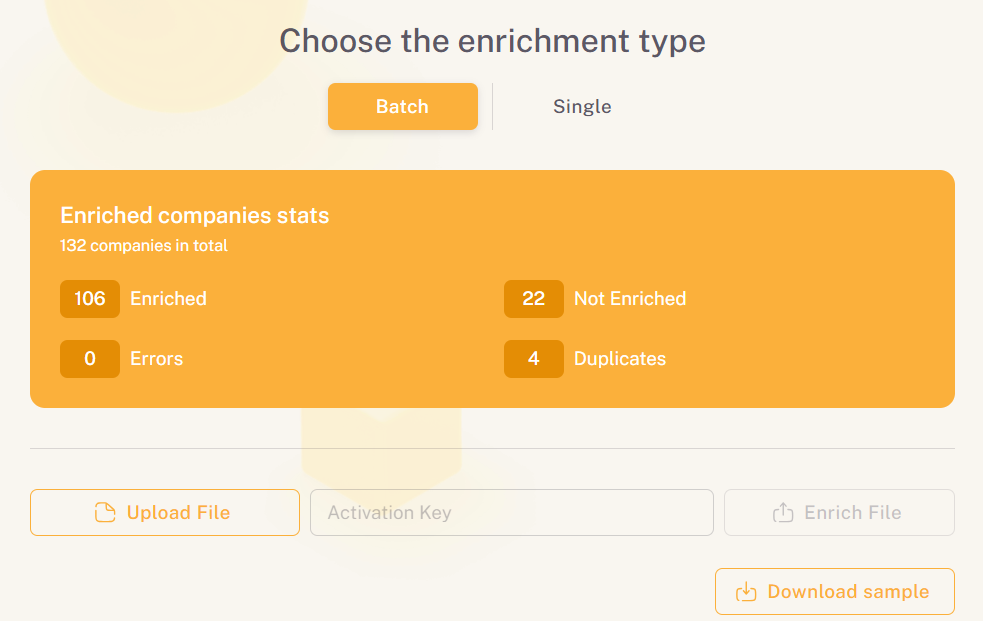
Its Data Enrichment Service uses advanced algorithms to match and enrich existing business or supplier records.
Source: Veridion
It supplements incomplete data, identifies potential risks, removes duplicates, and refreshes outdated information, resulting in a richer, more reliable dataset for advanced analytics and downstream use.
The best part: the process is simple and intuitive. Just enter a company’s name and address, and Veridion does the rest.
You can learn more in the video below:
Source: Veridion on YouTube
With over 300 company attributes, Veridion provides truly deep, actionable business profiles that power strategic decision-making.
Some of the data points you’ll find in these profiles are:
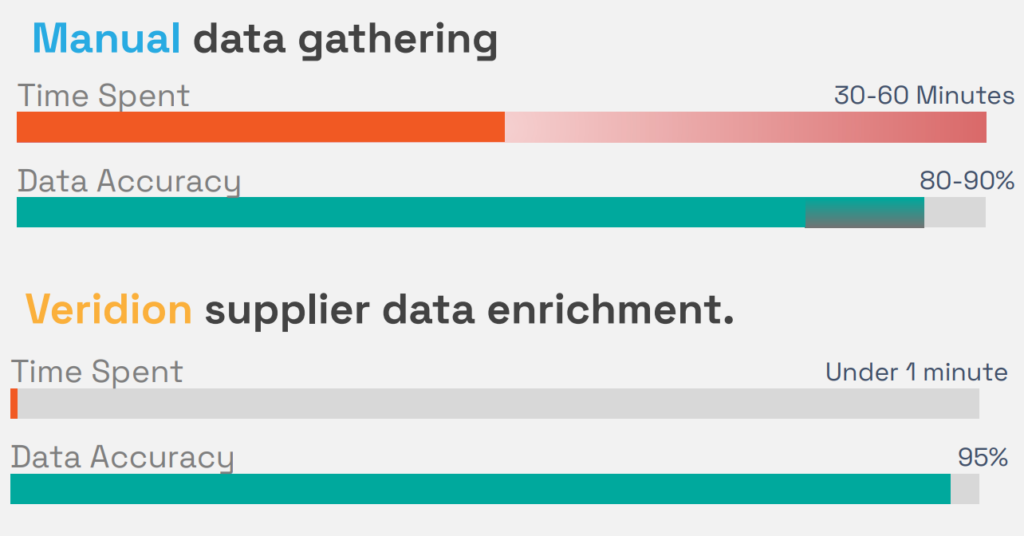
But Veridion’s biggest strength is its data accuracy and reliability, powered by its proprietary data sourcing and aggregation engine.
It continuously indexes and verifies information from company websites, public registries, online product catalogs, social profiles, and trusted news outlets.
Only first-party or publicly accessible data is processed, then validated through advanced AI-driven models to ensure accuracy and relevance.
Veridion maintains full end-to-end control of its data pipeline, from sourcing and extraction to normalization and delivery, without relying on external vendors.
As a result, you get a unified, accurate, and always-fresh view of global businesses.
Source: Veridion
That’s why Veridion is trusted by professionals across industries for anything from supplier sourcing and management to underwriting, market intelligence, and ESG analysis.
And with Veridion’s Startup Program, growing companies can now also access enterprise-grade intelligence without breaking the bank.
If this sounds like the right fit for you, feel free to reach out for a data consultation and learn how you can leverage company data at scale for your business.
Oppora is an AI-powered, all-in-one outbound sales automation platform designed to streamline lead generation, prospect engagement, and CRM management.
It helps businesses find leads, send automated emails, and book meetings without needing daily manual input.
Oppora’s database:
Compared to Veridion and some other tools on this list, Oppora’s database is somewhat smaller.
It doesn’t cover as many companies, and it provides fewer datapoints per company profile.
For instance, Oppora’s enrichment service includes:
Although its dataset may appear smaller compared to some other providers on this list, Oppora delivers additional value by automating the entire end-to-end outbound workflow with its eight AI agents.
Instead of manually handling each step (find → enrich → score → write → send → reply), these agents work together to execute the full process automatically.
You build the workflow once, and Oppora continues running it on autopilot.
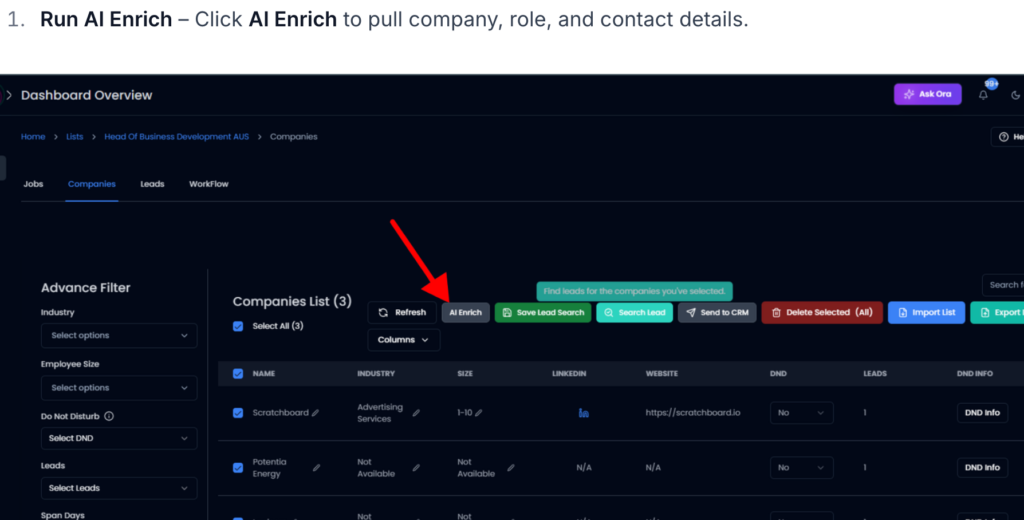
In terms of enrichment itself, the process is intuitive and happens entirely within Oppora’s platform.
You simply select the companies you want to enrich, and Oppora handles the rest, embedding the data into your CRM automatically:
Source: Oppora.ai
Bulk enrichment is supported, too, just like with Veridion.
When it comes to its data sourcing method, Oppora uses waterfall sourcing, which helps maximize coverage and improve accuracy.
However, unlike Veridion, Oppora relies on third-party data providers and does not own the entire data pipeline.
Overall, Oppora is best suited for B2B, sales-led teams that want company data enrichment tightly integrated with sales execution while minimizing manual prospecting work.
Founders, solopreneurs, SDR teams, agencies, IT consultancies, and B2B companies alike can all benefit from this tool.
If you fall into this category, consider visiting Oppora’s website and booking a free demo to learn more.
Apollo.io is a B2B sales intelligence and engagement platform that helps sales and marketing teams find, contact, and close leads.
Similar to Oppora, it positions itself as more than just a data provider, promising to replace your data sources, outreach platform, dialer, enrichment tool, and CRM.
Here’s a brief overview of Apollo’s database:
Like other tools on this list, Apollo enriches records with detailed demographic, firmographic, and verified contact data.
Its database can be filtered by criteria such as:
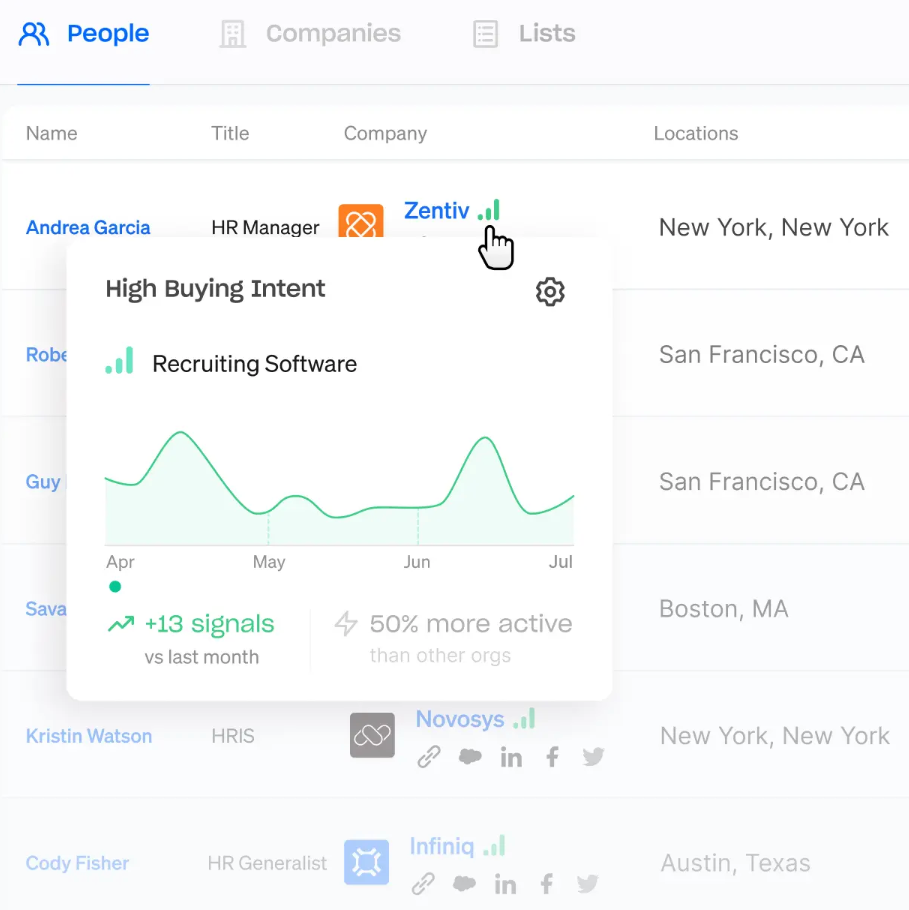
Where Apollo stands out from the previously mentioned data providers, however, is its buying-intent data.
This data identifies companies that have shown interest in solutions like yours and provides insight into when and how often that interest occurs.
This helps sales teams identify when companies are in buying mode and engage at the right moment:
Source: Apollo.io
In terms of data sourcing, Apollo’s methodology is very similar to Oppora’s.
It uses waterfall enrichment, automatically querying dozens of third-party data providers in sequence to retrieve the required information.
This means Apollo also doesn’t fully own its data pipeline in the way that Veridion does.
While this isn’t always a problem, it can sometimes affect data quality, an issue that some Reddit users have reported with Apollo’s data.
Overall, Apollo’s primary use case overlaps with Oppora’s: B2B lead generation, contact discovery, cold outreach, and CRM enrichment.
Here’s where they differ.
Oppora aims to automate the entire outbound workflow end-to-end, while Apollo offers features for each individual step, supporting both inbound and outbound activities.
Apollo also provides a larger dataset than Oppora.
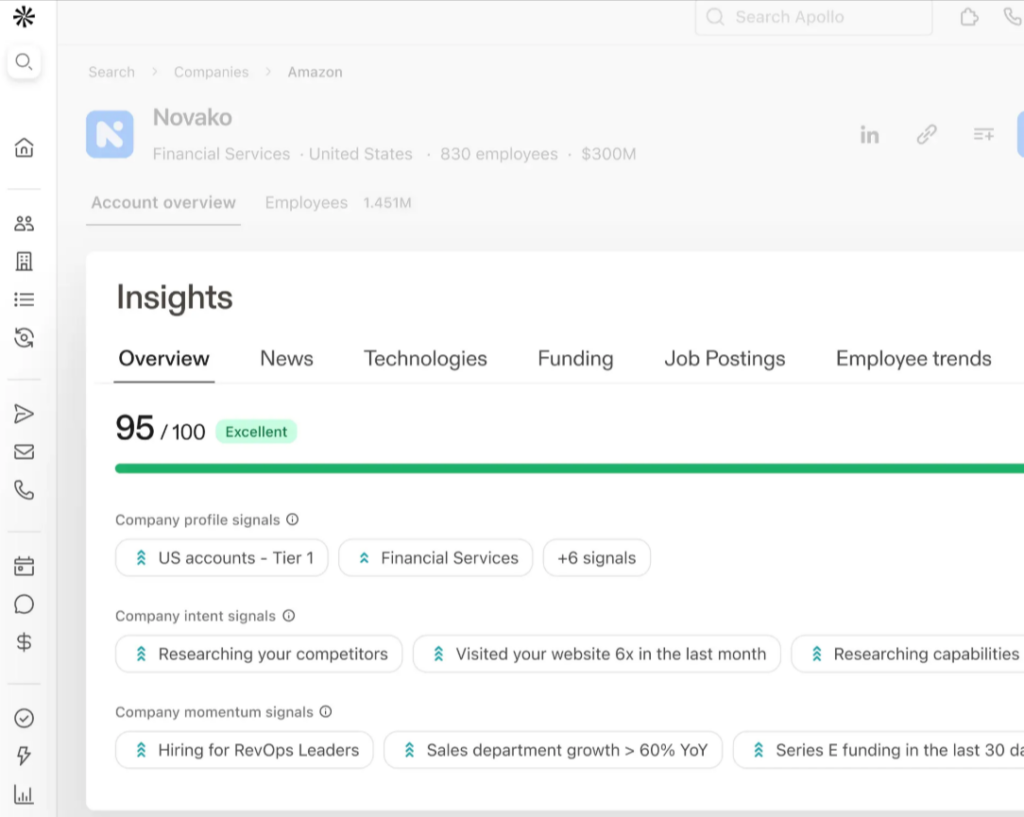
Source: Apollo.io
So, which platform is better for you?
It depends.
If outbound automation and minimizing manual effort are your top concerns, while having the largest possible database isn’t that critical, Oppora may be the better fit.
It’s also a more affordable option.
But if full automation is less important, and you want broader data coverage, especially buying-intent data, Apollo is likely the stronger choice.
And if you’re unsure, Apollo’s free plan makes it easy to explore the platform before making any final decisions.
People Data Labs (PDL) is another B2B data provider specializing in structured, high-volume datasets.
It offers three core products: person, company, and job posting data.
Below is a snapshot of its coverage and capabilities:
PDL has one of the largest databases among the providers on this list, offering broad global coverage and rich attribute depth.
Its person dataset includes over 200 attributes such as name, location, email, phone, education, work history, and social profile information.
Especially worth noting are its professional attributes, though, including:
PDL’s job postings dataset is also a notable differentiator.
Currently in beta, it provides insights into company growth, technology adoption, and hiring trends based on job postings across tens of thousands of companies.
Just keep in mind that its person dataset is updated monthly or quarterly, which is slower compared to many competitors.
PDL sources its data from thousands of inputs that fall into two main categories: proprietary and public sources.
The job listings dataset, however, is sourced exclusively from company career pages rather than third-party or proprietary aggregators to ensure data accuracy.
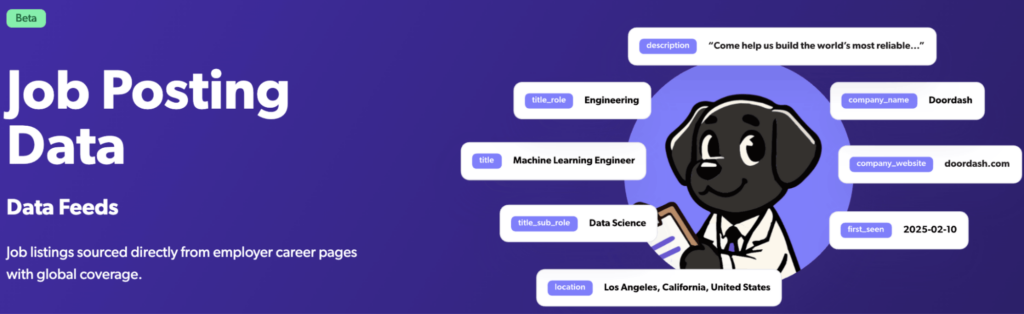
Source: People Data Labs
The company also states that it actively works with suppliers on compliance in order to adapt to evolving data regulations.
All things considered, PDL is best suited for HR teams looking to enrich candidate profiles, identify talent, or train AI-driven talent-matching models using a global workforce dataset.
While it can be used for sales and marketing, its demographic attributes are more HR-oriented.
This is especially true when you compare it to platforms like Oppora or Apollo, which are purpose-built for sales use cases.
If you’re interested, consider reaching out directly to the PDL team to learn more.
FullContact is a customer data and identity resolution platform that helps businesses connect disparate data points to create a unified and real-time view of their customers.
In fact, it positions itself as the world’s first and only real-time identity management solution.
By linking identifiers such as email addresses, phone numbers, and device IDs across channels, FullContact enables personalized marketing, improved ad targeting, and enhanced fraud prevention.
Here are some key insights about their data:
In terms of database size, FullContact is particularly strong in individual-level data.
It provides hundreds upon hundreds of attributes that help businesses better understand their customers’ needs, behaviors, and expectations.
These attributes include:
Unlike other providers on this list, including even those sales-oriented, FullContact also offers data on consumer interests.
It covers areas such as Audio/Visual, Automotive, Computers, Consumer Brands, Dating, and more, making the platform equally suitable for both B2C and B2B use cases.
Its company data, however, is mostly limited to basic attributes like company name, location, employee count, category code, and industry code.
When compared to providers such as Veridion, this aspect is somewhat weaker.
There is also some HR-related data, including professional profiles and employment histories, but it is not as deep as what providers like PDL offer:
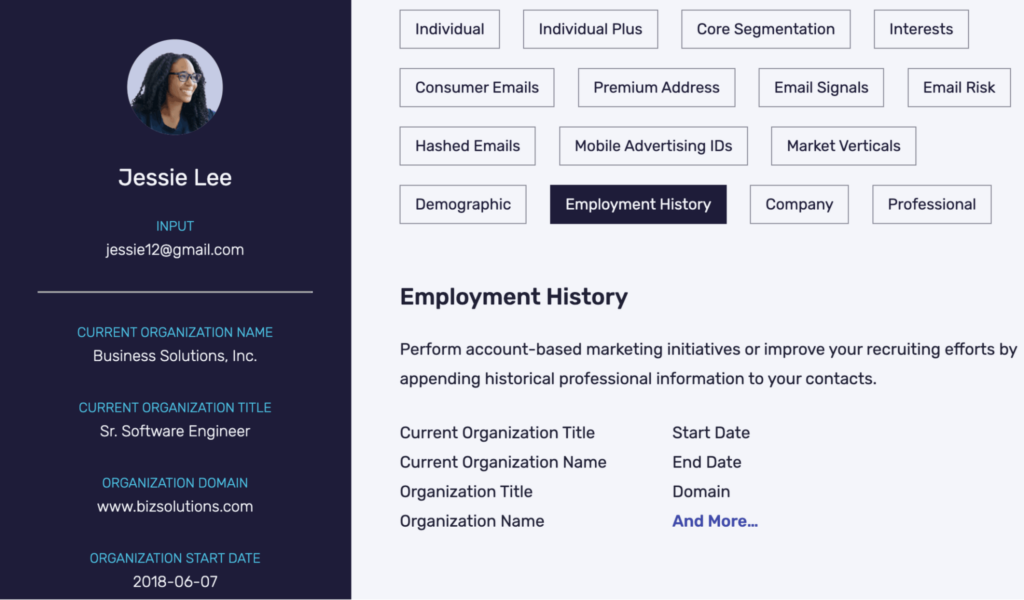
Source: FullContact
Overall, FullContact is best suited for MarTech and AdTech companies looking to help clients create more meaningful and profitable customer interactions throughout the entire customer journey.
It’s also a strong option for individual brands seeking detailed customer insights that will help them improve and personalize customer experiences.
If it sounds like a data provider you’ve been looking for, it’s worth reaching out to the FullContact team directly through their website to find out more.
Enigma is a specialized B2B identity platform developed by Enigma Technologies, with a strong focus on enriching data for small and medium-sized businesses.
Here’s a breakdown of its database:
Unlike many other tools on this list, Enigma focuses specifically on US organizations, helping you monitor their financial and operational risks.
Its data attributes are organized into two main categories: entity attributes and relationship attributes.
Entity attributes describe properties of a business entity, offering fundamental insights, such as brands, operating locations, phone numbers, and websites.
Relationship attributes describe connections between different business entities.
Examples include:
In terms of these company attributes, Enigma is similar to Veridion, offering insights into business operations and affiliations.
However, unlike Veridion, it doesn’t provide ESG or product-related insights.
Enigma sources its data using a proprietary mix of online, offline, public, private, and third-party sources.
It leverages everything from government filings to social media posts to compile actionable data, including business identity, transactions, revenue, profitability, and risk factors.
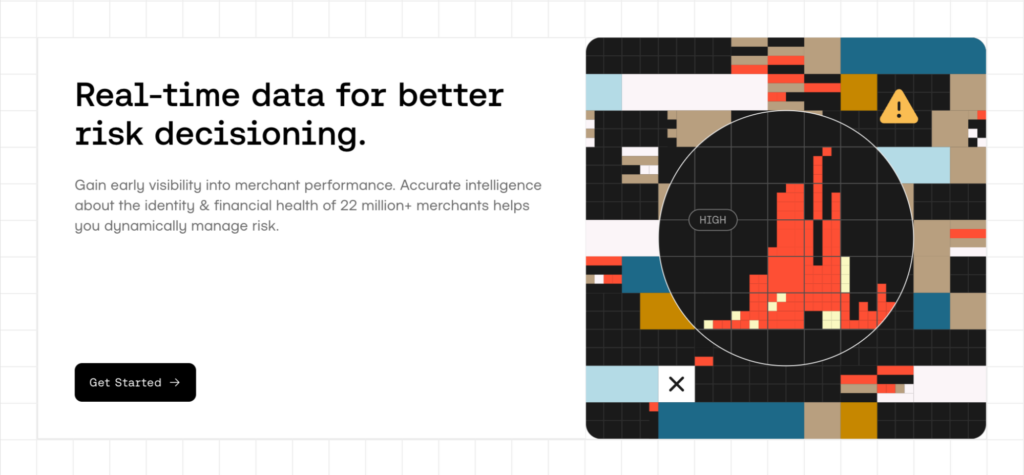
Source: Enigma
This enables users to better identify and target prospects.
However, unlike broader sales intelligence platforms we’ve covered, Enigma delivers granular, attribute-level data specifically for financial and risk use cases.
It’s used by financial institutions, fintechs, and insurance companies for underwriting, onboarding, KYB, and risk management.
If you’re a risk professional, marketer, or data scientist, analyzing the identity, activity, and financial health of SMBs across the United States, you just might benefit from Enigma.
For more information, visit their website to contact them directly.
By now, you likely have a solid sense of the kind of solution you’re looking for and which options might be the best fit.
However, before making any final decisions, be sure to research each data enrichment provider thoroughly yourself.
Review the data points they offer, their refresh rates, and the countries they cover, always keeping your goals for the tool in mind.
It’s also very important to evaluate their data security policies and practices.
When it comes to working with data, compliance needs to be the number one priority.
And if anything feels unclear, don’t hesitate to reach out to their teams. They’re there to help you make the right call.