



Blog
What Are the Top AI Data Collection Companies?
By: Stefan Gergely -
10 March 2026


We love our data, and now that you're here, you're one step closer to loving it too.
A wide sample of data, so you can explore what is possible with our data
Choose ->
built with procurement in mind. Focused on manufacturers, products and more
Choose ->
built with insurance in mind. Focused on classifications, business activity tags and more
Choose ->
built with sustainability in mind. Focused on sustainability commitments, and environmental and social governance insights.
Choose ->
built with strategic insights in mind. Focused on market trends, competitor analysis, and industry-specific data
Choose ->

Keep up to date with our technology, what our clients are doing and get interesting monthly market insights.

The biggest data problem businesses face today isn’t a lack of information.
It’s knowing which data to trust.
As AI data collection companies continue to multiply, it’s becoming clear that they’re not all built for the same purpose.
Some are optimized for sales activation, others for compliance and identity resolution. Then there are those for deep market intelligence at scale.
Each takes a different approach to data quality, enrichment, and activation.
Choosing the wrong platform can lead to fragmented insights, unreliable signals, or data that never translates into action.
This article provides a structured comparison of leading AI data collection and intelligence platforms, breaking down their core strengths, limitations, and ideal use cases before you commit.
Veridion is an AI-powered data engine that scrapes the web for business profiles and supplier information, collecting hundreds of data attributes per company.
Instead of manually piecing together fragmented data from siloed sources, our proprietary machine learning (ML) models crawl and interpret millions of web sources.
This includes company websites, social media, regulatory registries, and public records, all to transform unstructured content into structured, high-quality business intelligence.
What sets Veridion apart is the depth and breadth of our data.
It’s the most complete database of company data, boasting:
While most legacy providers focus on large enterprises, our dataset also covers
Company profiles include detailed attributes such as firmographics, operational footprints, technologies, products and services, industry classifications, locations, and ESG insights.
These profiles are updated weekly to ensure freshness and relevance.
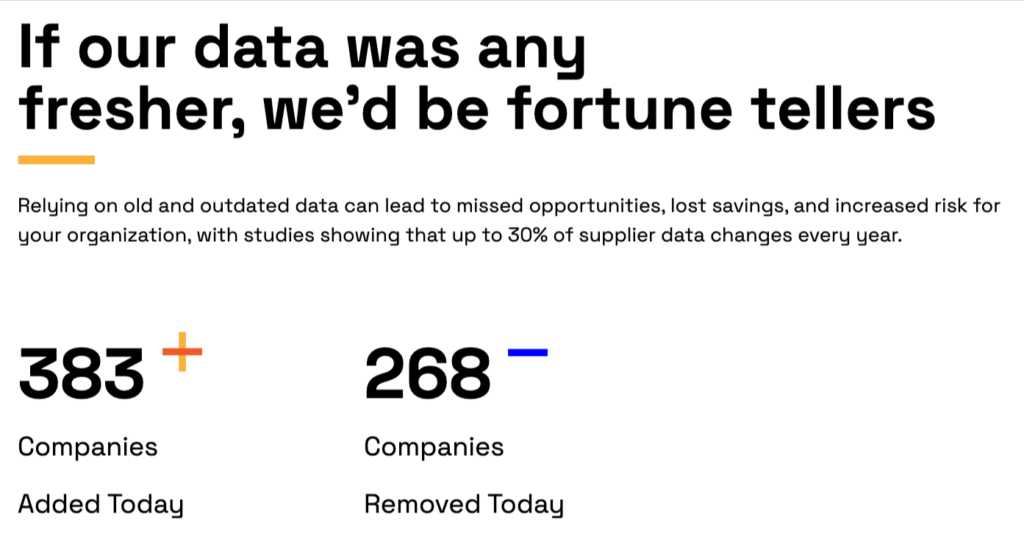
Source: Veridion
Simply put, Veridion doesn’t just identify who a company is.
We understand what a company does.
Our AI models extract and validate detailed insights on products, services, capabilities, and operations, cross-checking sources to reduce noise and keep profiles accurate and up to date.
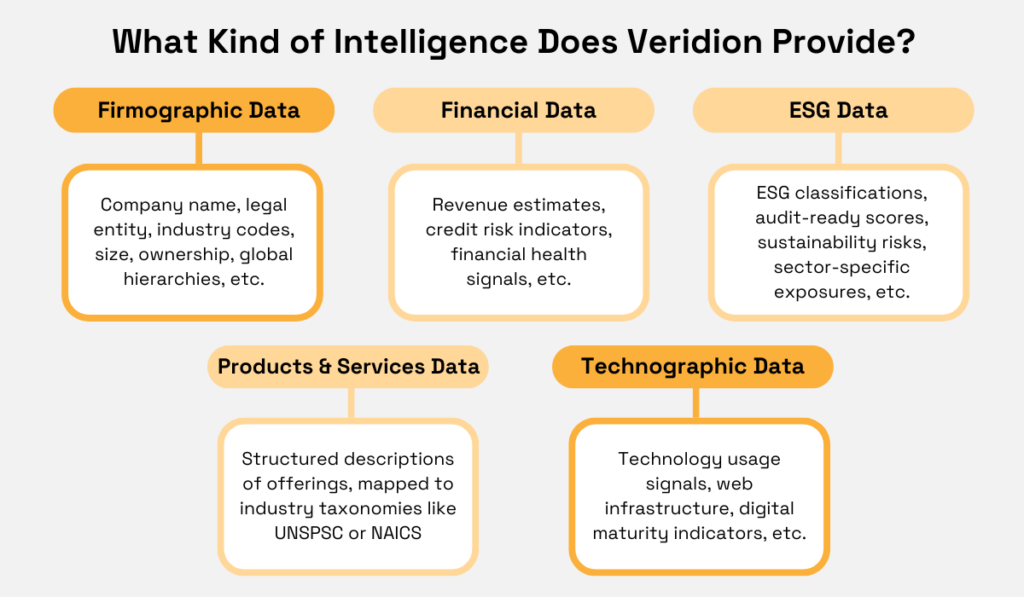
Source: Veridion
This structured depth supports areas where shallow or outdated data isn’t sufficient, including:
The icing on the cake?
You can use our AI data collection capabilities for multiple use cases:
| Use Case | Veridion Application |
|---|---|
| Data & Analytics Foundation (Company Enrichment) | Enrich and update existing business records to support more comprehensive analysis |
| Investment Research (Thematic Research) | Perform custom research and market sizing to help inform strategic decisions and research |
| Sourcing (Deal Sourcing) | Identify and engage companies within specific sectors or niche markets |
Learn more about Veridion here:
Source: Veridion on YouTube
Veridion is best suited for organizations that need rich, AI-curated business data at scale and plan to integrate that data into automated workflows or analytical systems.
Want to see our solutions in action?
Download a data sample from our website or schedule a data consultation to learn more.
Dealfront is a unified sales intelligence and go-to-market (GTM) platform that helps revenue teams identify, prioritize, and engage high-intent buyers primarily across European markets.
While Veridion thrives as an AI-first data collection and enrichment platform, Dealfront is fundamentally sales-led.
It’s optimized to convert data and engagement signals into near-term revenue opportunities.
The platform is built to support core commercial use cases such as:
Rather than focusing on deep, global company intelligence, Dealfront emphasizes speed-to-action.
In short, it helps sales and marketing teams quickly determine who to target and when.
One of Dealfront’s key differentiators is its use of language-specific AI models for data extraction and classification.
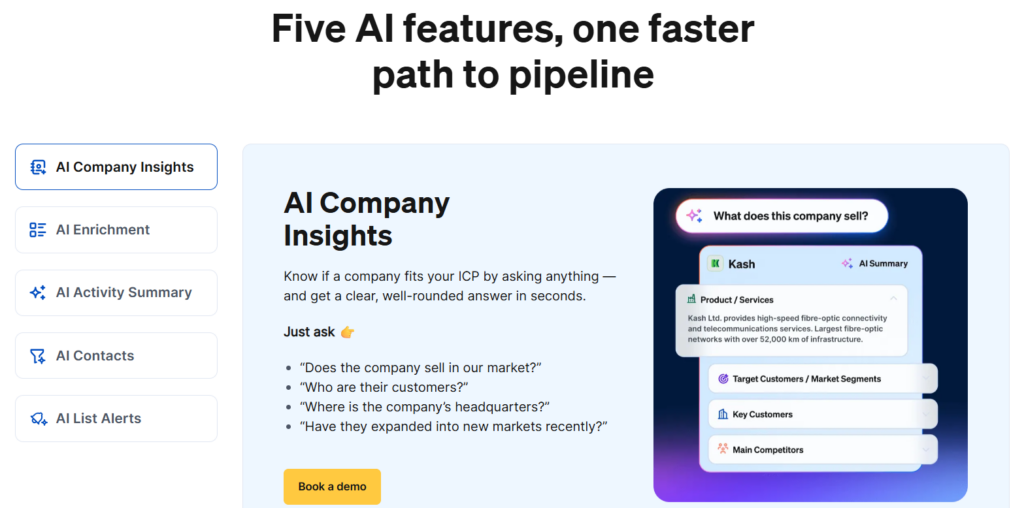
Source: Dealfront
By training their models on local languages and market contexts, Dealfront is better equipped to interpret company websites, content, and behavioral signals that are often missed or misclassified by generic, one-size-fits-all systems.
This localized approach is particularly effective in multilingual European environments, where nuance and context significantly impact data quality.
Unlike Veridion’s global coverage, Dealfront’s primary focus is Europe, where it tracks more than 34 million companies.
While the platform also includes data on over 20 million U.S. companies, its coverage outside Europe is comparatively limited.
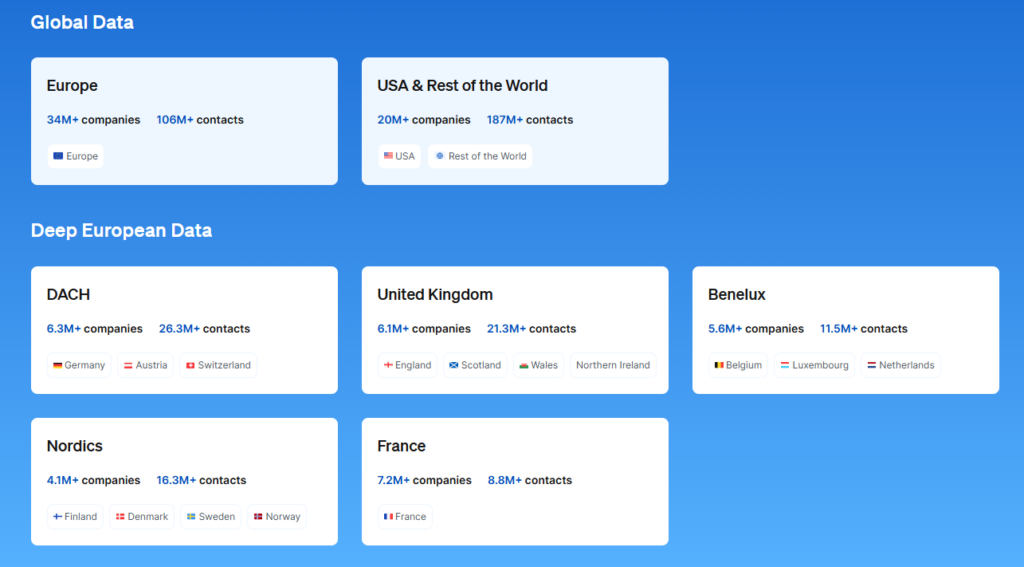
Source: Dealfront
Much of Dealfront’s AI-driven enrichment capabilities overlap functionally with Veridion’s.
However, Dealfront truly stands out in its ability to combine company and contact data with behavioral intent signals, such as website visits and engagement activity.
This feature allows revenue teams to move quickly from insight to action by:
You can learn more about these capabilities here:
Source: Dealfront on YouTube
Dealfront also places strong emphasis on GDPR-compliant data collection and enrichment.
This aligns with European privacy and regulatory requirements, making it well-suited for organizations selling into regulated EU markets.

Source: Dealfront
Overall, Dealfront is best suited for B2B sales and marketing teams targeting European markets that want to combine enriched company data, contact intelligence, and intent signals to drive faster deal conversion.
Users can get started with Dealfront by signing up for a free trial.
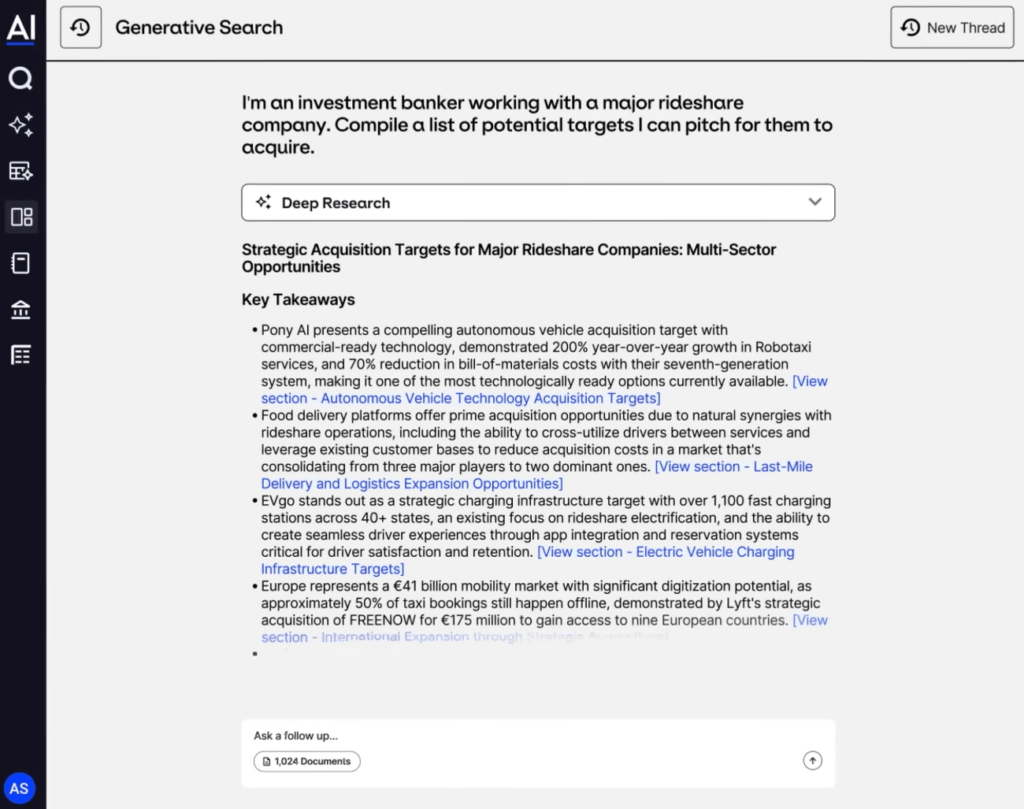
Alphasense is a top-rated AI-powered market intelligence and research platform designed to help businesses extract insights from vast volumes of unstructured content.
Its Deep Research engine is built for qualitative synthesis and expert-level analysis, enabling teams to move beyond surface-level search results to a deeper understanding of markets, companies, and trends.
It doesn’t just return static keyword matches.
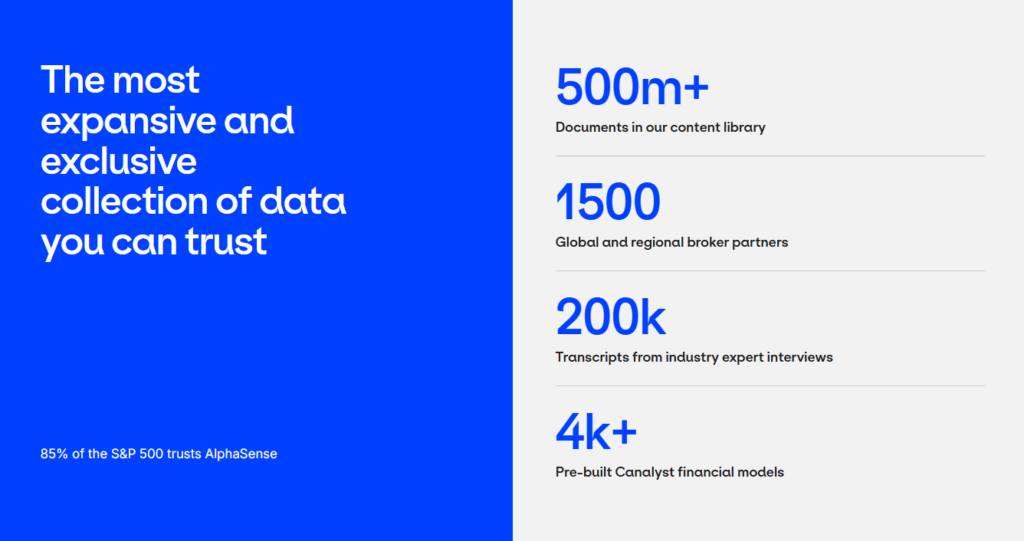
Instead, it systematically analyzes millions of premium business documents, including earnings transcripts, regulatory filings, analyst reports, expert interviews, and global news.
Source: AlphaSense
These sources underpin one of the most comprehensive enterprise-grade market intelligence datasets available, allowing users to explore how topics, companies, and industries are discussed, evaluated, and perceived over time.
Source: AlphaSense
AlphaSense produces structured, narrative-driven insights tailored to complex queries.
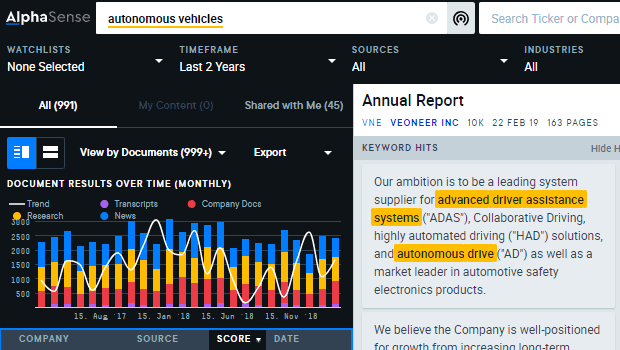
Smart Synonyms™, its proprietary semantic search technology, intelligently expands queries to capture related concepts and terminology that traditional keyword searches often miss.
In other words, Smart Synonyms™ helps deliver the most relevant results, and not just results that match your search keywords.
For example, a search for autonomous vehicles also surfaces relevant insights tied to terms such as self-driving cars, driverless vehicles, and autonomous mobility, improving recall without sacrificing relevance.
Source: Alphasense
AlphaSense supports a wide range of strategic use cases, including:
| Market & Industry Research | Teams use it to understand market size, growth drivers, risks, and competitive dynamics |
| Competitive Intelligence | Strategy and product teams can track competitors’ positioning, messaging, financial performance, and strategic moves |
| Investment & Financial Analysis | Corporate finance teams can use it for equity research, due diligence, and valuation support |
| M&A and Corporate Development | Its Deep Research capabilities support deal sourcing and due diligence by helping teams evaluate target companies, industries, and adjacencies |
| Strategic Planning & Executive Decision Support | Executives and leadership teams use it to stay informed on key topics, monitor emerging risks and opportunities, and support long-term planning with data-backed insights |
| Risk Monitoring & Issue Tracking | Organizations can identify regulatory, operational, or reputational risks by monitoring disclosures, news, and analyst sentiment across industries and companies in near real time |
AlphaSense stands out for organizations that need to interpret sentiment, context, and market signals to better understand how companies, industries, and trends are discussed and perceived.
If you want to explore AlphaSense’s features further, you can fill out this form, and their team member will reach out to set up a trial account.
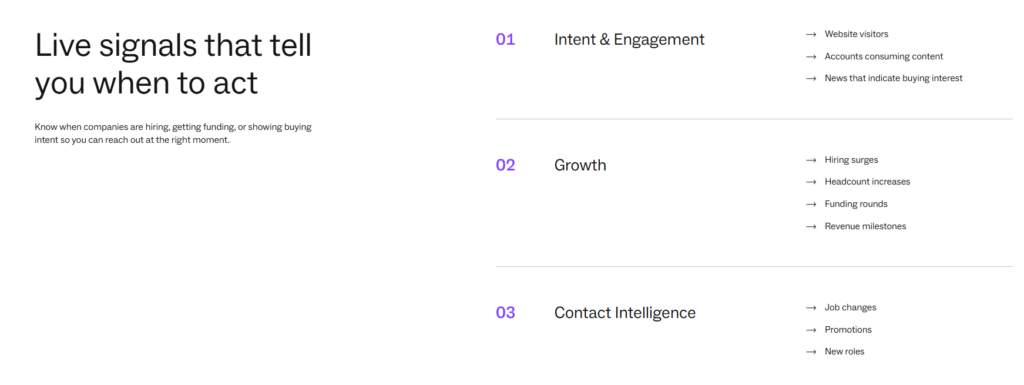
Lusha is a B2B lead generation and data-enrichment platform designed to help revenue teams identify, enrich, and engage decision-makers more effectively.
Its core focus is on delivering accurate contact data, such as verified emails, direct dials, and role information, paired with lightweight firmographic context to support outbound prospecting, lead enrichment, and account-based sales motions.
Source: Lusha
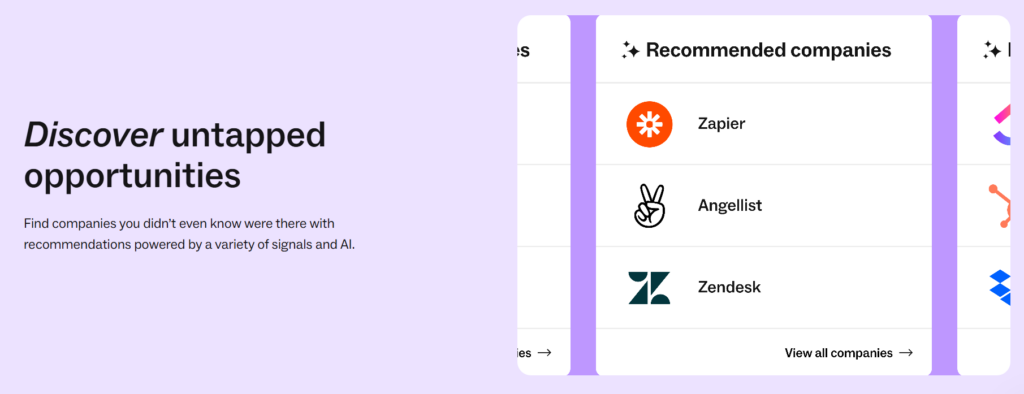
One of Lusha’s standout capabilities is AI Recommendations, which functions as a personalized prospecting assistant.
The system uses machine learning and activity-based signals, such as contacts revealed, companies saved, and CRM interactions, to continuously refine an understanding of each user’s ideal customer profile.
Based on this behavior, it surfaces high-quality, tailored lead suggestions updated daily, helping teams uncover relevant prospects they may not have actively searched for.
Source: Lusha
As users interact with these recommendations, the model adapts, further improving relevance over time.
This makes Lusha particularly effective for sales teams that rely on consistent outbound activity and rapid lead turnover.
Lusha’s strength is in direct outreach enablement.
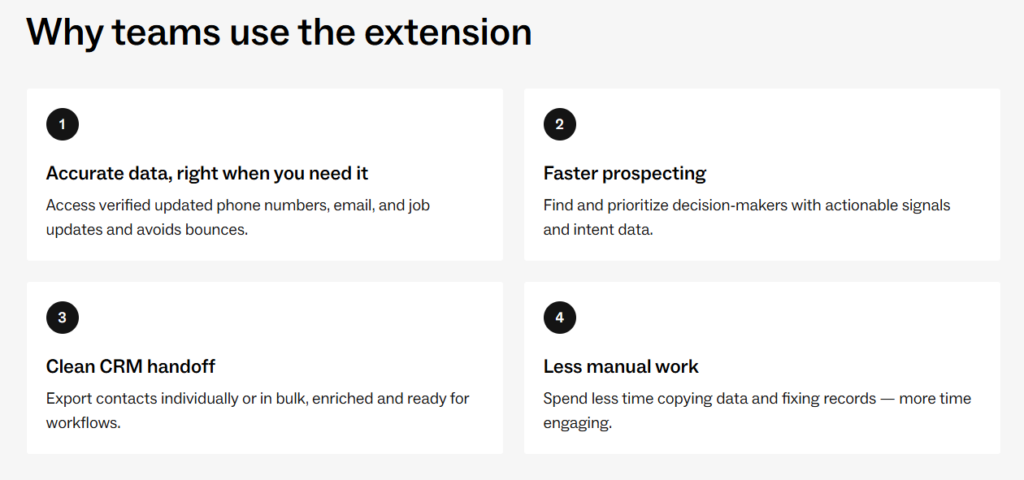
Through browser extensions, native CRM integrations, and in-workflow enrichment, users can access verified contact data and contextual company details without leaving the tools they already use.
This frictionless experience allows revenue teams to move quickly from discovery to engagement with minimal setup or technical overhead.
Source: Lusha
Compared to Veridion, Lusha offers greater workflow-level accessibility for sales teams, enabling contact discovery and enrichment directly within browsers and CRMs across Windows and Mac environments.
Veridion, by contrast, is delivered as a cloud-based data platform with API access, designed for programmatic enrichment and analytical use cases rather than individual prospecting workflows.
Lusha excels when contact-level accuracy and speed of outreach are the top priorities.
This makes it especially valuable for sales development reps (SDRs) and GTM teams focused on outbound engagement.
However, its emphasis on contact and surface-level firmographic data makes it less suitable for deeper company intelligence, large-scale enrichment, or analytical and operational use cases such as risk assessment or market modeling.
In these scenarios, Veridion’s structured, AI-curated company data is better suited to support complex, high-stakes decision-making.
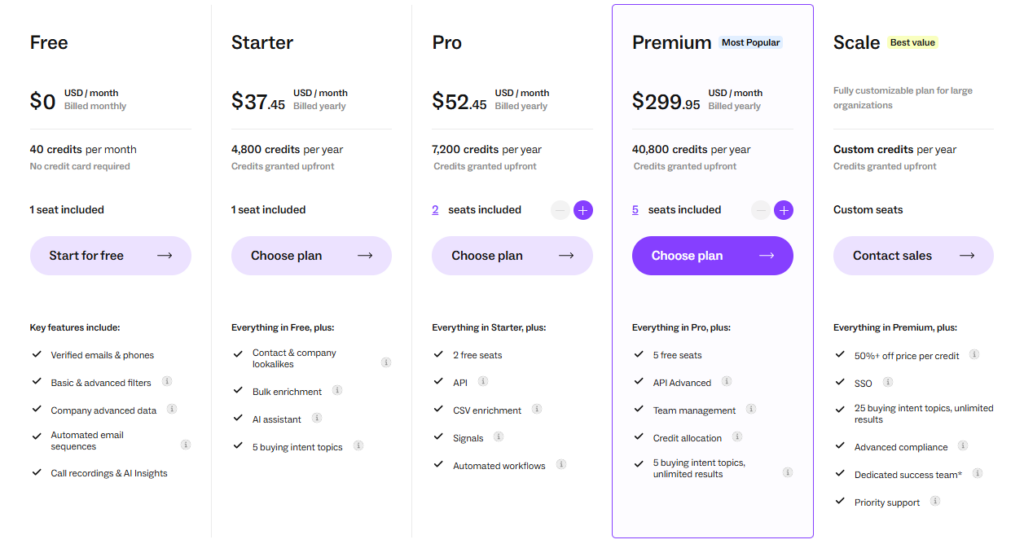
Lusha offers tiered subscription pricing, based on user seats and credit usage.
Source: Lusha
Interested users can begin exploring their platform with a free account, with no credit card required.
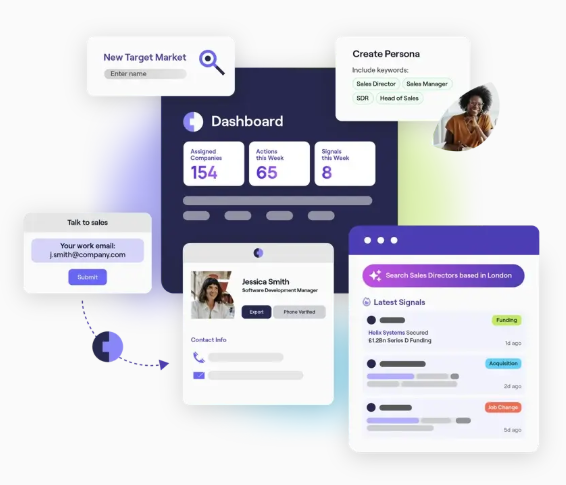
Cognism is a sales intelligence and B2B contact data platform designed to help marketing, revenue, and RevOps teams identify, connect with, and convert their ideal prospects more effectively.
The platform combines verified contact data, account intelligence, and timing signals to support targeted outreach and pipeline generation, with particularly strong coverage across European markets.
Source: Cognism
At the core of Cognism’s data operation is Orion, its AI-powered data collection and validation engine.
Orion underpins the platform’s sales intelligence capabilities through a multi-layered approach to B2B data sourcing, verification, and compliance.
Just like Veridion, Orion gathers information from a broad range of trusted inputs, including:
For each company and contact, Orion processes data from 60-200 data sources, cross-referencing inputs to build enriched contact and firmographic profiles.
Individual data points are scored based on source credibility and consistency, while machine learning models help verify attributes such as email deliverability and mobile phone accuracy.
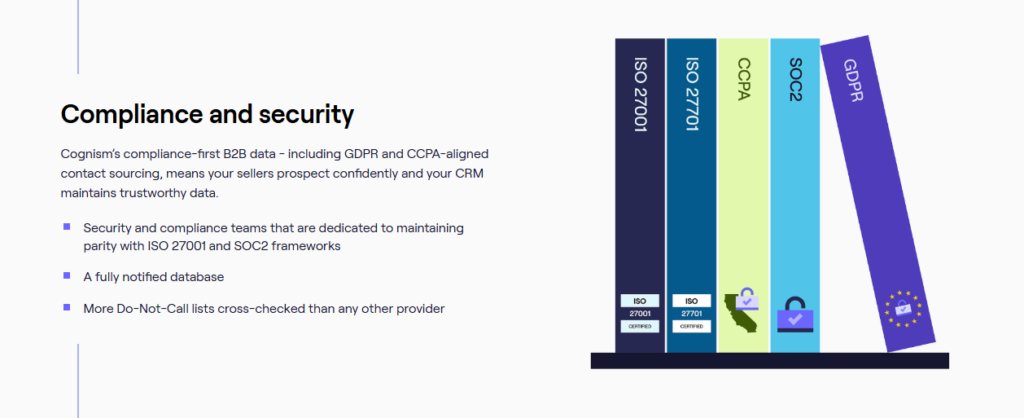
Like Dealfront, Cognism places a strong emphasis on regulatory compliance, adhering to major data protection frameworks including GDPR, CCPA, and other regional regulations.
Source: Cognism
A key differentiator is Cognism’s rigorous compliance layer.
The platform cross-checks contact data against 13 international Do-Not-Call (DNC) lists, helping organizations reduce regulatory risk when executing high-volume outbound and account-based marketing campaigns.
This focus on accuracy and compliance makes Cognism particularly effective in regulated markets where data quality and consent standards are non-negotiable.
In practice, Cognism excels when the primary goal is direct outreach and pipeline generation, where contact quality, compliance, and sales workflow integration are critical.
It accelerates who to contact and when.
On the other hand, Veridion provides a deeper, more holistic understanding of the company itself, making it better suited for organizations that prioritize structured company intelligence, analytical depth, and decision-grade data over outreach volume.
When it comes to pricing, Cognism adopts a custom, quote-based pricing model, with packages tailored to different sales and GTM needs
Interested users can book a demo to see the platform in action.
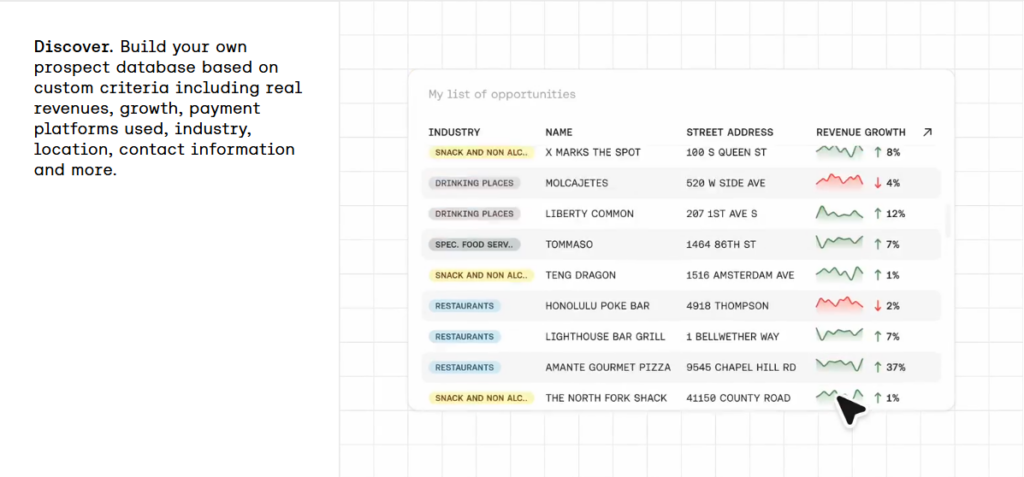
Enigma is a business data and analytics platform focused on delivering deep, reliable intelligence on small and mid-sized businesses.
Powered by advanced data science and proprietary machine learning, Enigma transforms hundreds of online and offline sources into accurate, continuously updated data covering business identity, real-world activity, and risk profiles.
Source: Enigma
Enigma boasts the following:
At the heart of the platform is Enigma Explorer, a discovery interface designed to make finding and understanding small business intelligence faster and more flexible.
Rather than relying solely on predefined filters and rigid taxonomies, Explorer allows users to describe their ideal customer profile (ICP) in natural language.
Enigma’s AI then uses an embedding-based similarity search to surface businesses that look and behave like the target profile, even when they don’t share exact, structured attributes.
This semantic approach enables teams to move from vague descriptions or reference lists to relevant, viable companies in seconds, uncovering businesses that traditional rule-based search often misses.
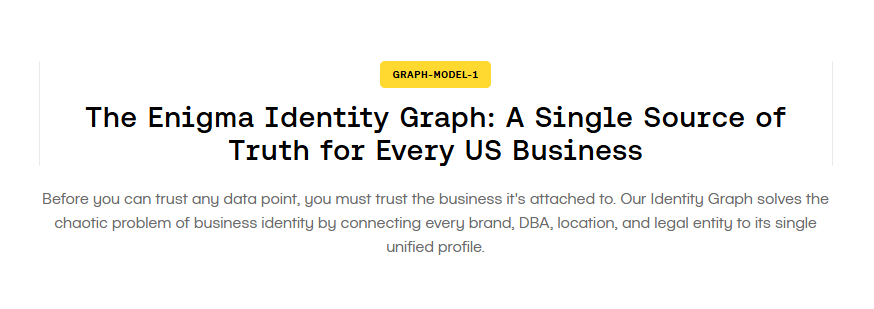
What truly sets Enigma apart is its Identity Graph.
Source: Enigma
The platform resolves fragmented records by linking brands, legal entities, DBAs, and physical locations into a single, trusted business profile.
By reconciling multiple representations of the same company across hundreds of sources, Enigma reduces noise and eliminates “ghost” entities commonly found in legacy datasets, while confirming that a business is active and legitimate.
Because of this foundation, Enigma is purpose-built for high-confidence identity, activity, and risk analysis, making it particularly well-suited for regulated and risk-sensitive environments such as:
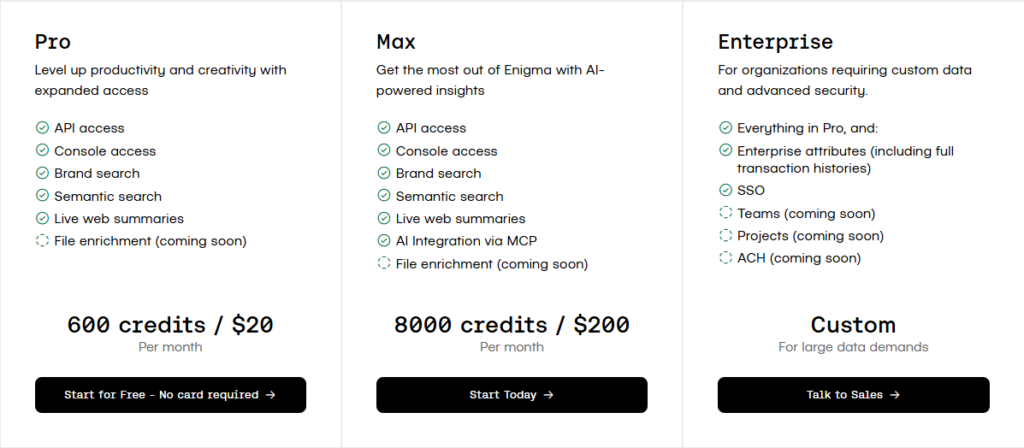
Enigma’s pricing starts from $20 for 600 credits per month.
Source: Enigma
Unlike many tools in this category, Enigma isn’t designed for outbound prospecting, contact discovery, or direct sales enablement.
Its emphasis on verification, entity resolution, and real-world business signals gives it an edge where accuracy and legitimacy matter more than scale alone.
In contrast, Veridion AI-data collection delivers broader global coverage, deeper firmographic enrichment, and a wider set of standardized company attributes that support market mapping, supplier discovery, and large-scale analytical use cases.
Choosing the right AI data collection company isn’t just about who has the biggest database.
It’s about who delivers the most reliable, usable, and context-rich intelligence for your specific goals.
As this comparison shows, each platform brings distinct strengths, whether it’s high-confidence business identity, compliance-ready data, or sales activation.
Ultimately, the real differentiator is how effectively a platform turns fragmented data into a true decision-making engine.
So don’t just choose a vendor.
Choose how you want to understand and act on your market.