



Blog
Main Points of Failure in a Supply Chain Dependent on Vietnam
By: Stefan Gergely -
18 March 2026

We love our data, and now that you're here, you're one step closer to loving it too.
A wide sample of data, so you can explore what is possible with our data
Choose ->
built with procurement in mind. Focused on manufacturers, products and more
Choose ->
built with insurance in mind. Focused on classifications, business activity tags and more
Choose ->
built with sustainability in mind. Focused on sustainability commitments, and environmental and social governance insights.
Choose ->
built with strategic insights in mind. Focused on market trends, competitor analysis, and industry-specific data
Choose ->

Keep up to date with our technology, what our clients are doing and get interesting monthly market insights.

Key Takeaways:
What happens when your most dependable Vietnam supplier is ready to ship, but the container does not move, and stakeholders hear only one thing: delay?
Vietnam offers scale and speed for enterprise sourcing, but reliance on a single market concentrates risk.
One disruption can quickly ripple across lead times, supplier performance, and cost-to-serve, especially when lane and tier visibility is limited.
This article breaks down the most common failure points in Vietnam-dependent supply networks and shows how procurement teams can reduce each one with practical actions that protect continuity and keep sourcing decisions on track.
Vietnam’s export machine operates at speed, but its capacity can be strained easily.
When cargo volumes spike, chokepoints at the port gate and on connecting roads can turn routine shipments into rolling delays.
Cat Lai, Vietnam’s biggest port, has repeatedly faced congestion as traffic and cargo volumes outgrow local infrastructure.
In 2023, an estimated 22,000 vehicles passed through Cat Lai Port each day, and the port was responsible for over 70% of Vietnam’s containerized imports and exports at the time.
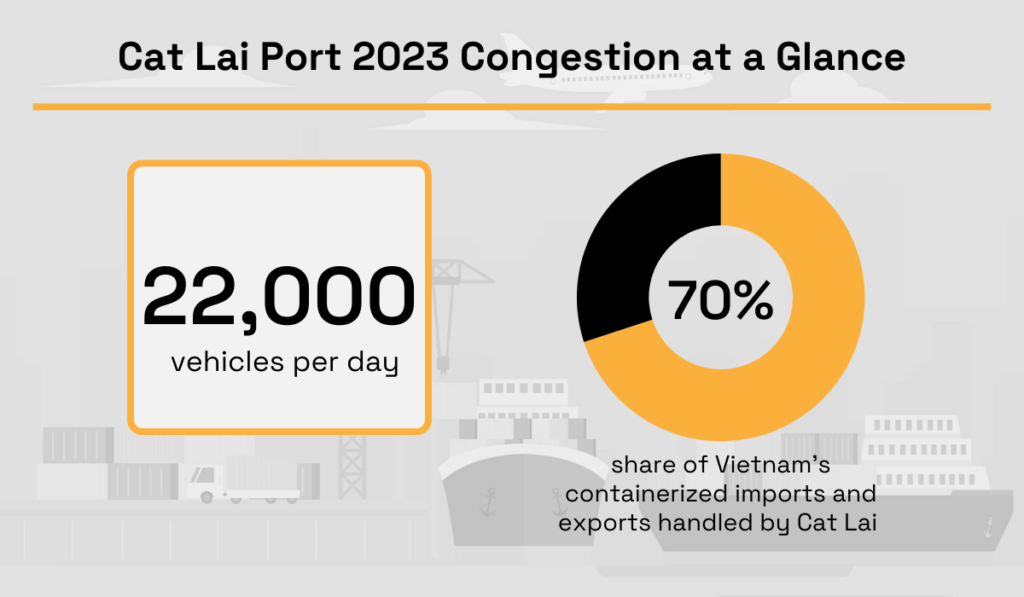
Illustration: Veridion / Data: VnEconomy
For procurement teams, congestion is not a one-day issue. It creates lead-time volatility.
Even when production is finished, containers can still sit at factories, inland depots, or in truck queues outside the terminal.
Port congestion is not a small operational nuisance, as it can trigger significant inventory gaps and real revenue loss when you run lean.
For instance, Gap has publicly linked supply chain constraints to an estimated $550,000,000–$650,000,000 in lost sales during a period of severe disruption.
That is the downstream impact of “a few days at the port” when your model depends on predictable lead times.
Vietnam’s logistics industry is acutely aware of these bottlenecks.
Bui Van Quan, Chairman of the HCMC Goods Transport Association, explains:
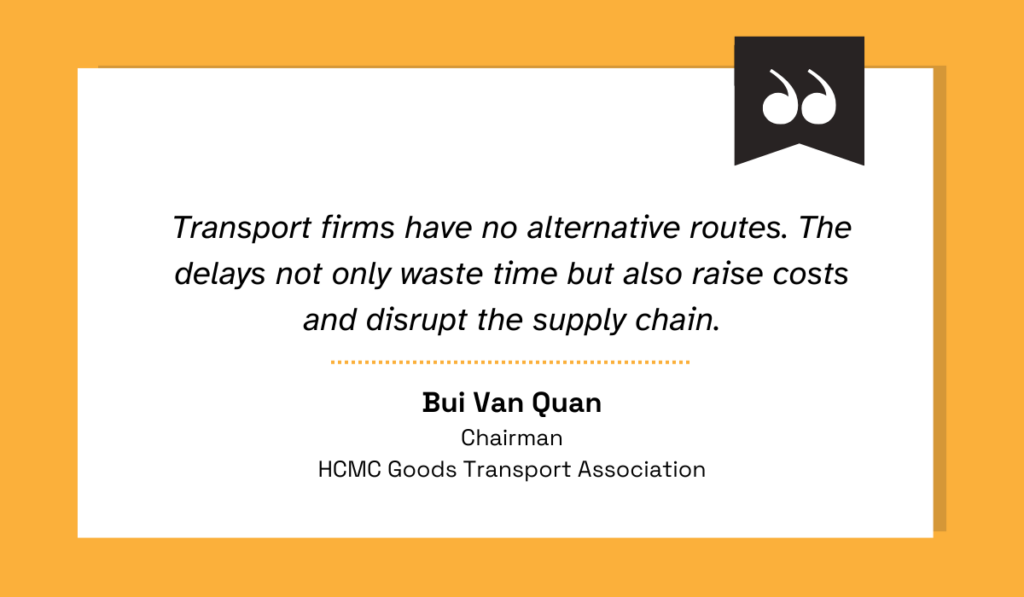
Illustration: Veridion / Quote: VN Express International
So, what can you do to minimize the impact of logistics bottlenecks?
Start by treating logistics as a sourcing variable, not an afterthought.
Build a lane-level risk map and use it to make sourcing decisions, not just logistics decisions.
Start with your last 6 to 12 months of Vietnam shipments for this category.
For each shipment, capture these four basics:
Then, mark which weeks had the biggest dwell time or missed cut-offs.
Next, rank lanes by business impact.
Focus on the SKUs where a one-week slip triggers a line stop, missed launch, or high expedite spend. For those lanes, bake protection into your PO terms and supplier playbook.
Set an earlier factory-ready date, define a cut-off buffer, and agree on escalation triggers if dwell time crosses a threshold.
If a corridor is repeatedly fragile, document a pre-approved alternate routing or port option so you are not making decisions in crisis mode.
And remember: logistics bottlenecks in Vietnam are not random. They cluster around specific gateways and peak windows.
When procurement maps lane risk and builds simple controls into contracts and planning, delays become more predictable and far less disruptive.
Vietnam’s manufacturing growth is pushing electricity demand faster than grid capacity in some regions, especially during hot-season peaks.
Power supply and transmission have struggled to keep pace, creating recurring shortage risk for industrial production.
The Economic Evaluation of LNG Potential in Vietnam report projects demand rising from 330 TWh in 2025 to 1,100 TWh by 2050.
This means that reliability will remain a long-term constraint.
For Vietnam-dependent sourcing, outages do not just slow production; they break schedules.
The aforementioned 2023 power crisis hit industrial hubs such as Bac Ninh and Bac Giang and disrupted factories and industrial parks, with estimated losses of US$1.4 billion.
Many suppliers also lack robust backup power, increasing the odds of a local outage leading to a missed ship date.
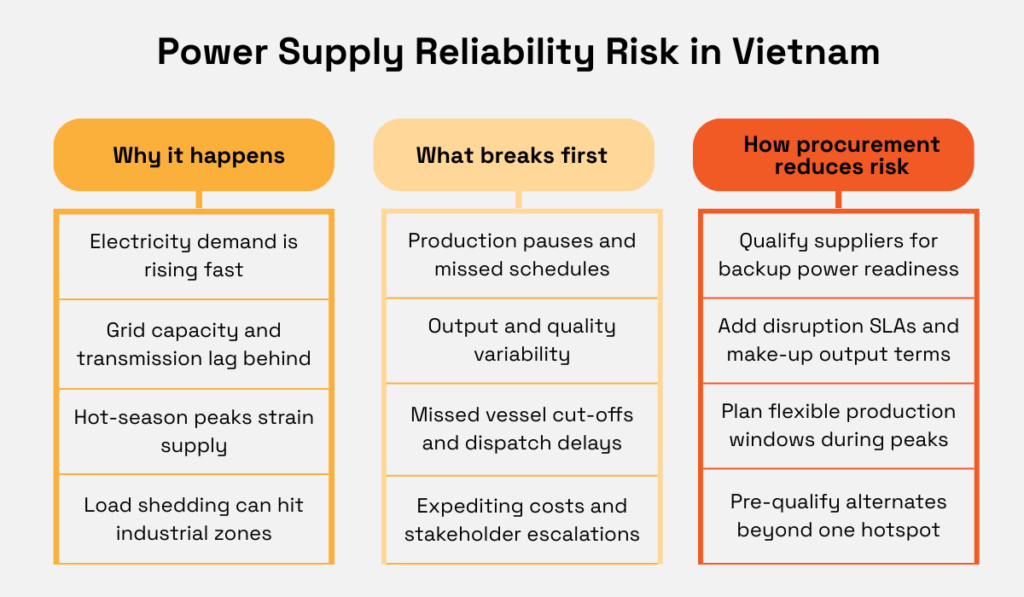
Source: Veridion
Start by making power resilience a non-negotiable part of supplier qualification for your most time-sensitive SKUs.
Ask suppliers to document how they operate during outages or load shedding.
Remember, you want specifics, not general statements.
So, request backup power capacity, how long it can run, what lines it covers, and how fuel is stored and replenished.
Then ask for a realistic restart plan: who approves the restart, what checks happen first, and how long it takes to return to normal output.
Next, translate that information into procurement controls.
Classify SKUs by disruption impact. For items where a 48-hour delay causes line stops, add recovery commitments into the PO terms and the supplier playbook.
In parallel, build an alternate bench outside a single hotspot.
Map suppliers by product and operating location so you can shift volume when reliability dips in one region.
When you qualify suppliers for real continuity and keep alternates ready by region, outages stop being a surprise and start becoming a manageable sourcing variable.
Vietnam’s trade environment is shaped by free trade agreements, shifting enforcement priorities, and evolving compliance rules.
For procurement teams, regulatory change rarely arrives as a tidy update.
It shows up as day-to-day friction, including more document requests, stricter origin checks, and longer clearance cycles.
This becomes especially painful when your sourcing strategy depends on preferential trade terms.
Under the EU-Vietnam Free Trade Agreement, 65% of duties on Vietnamese exports to the EU disappeared on entry into force, and the agreement is designed to eliminate over 99% of tariffs overall.
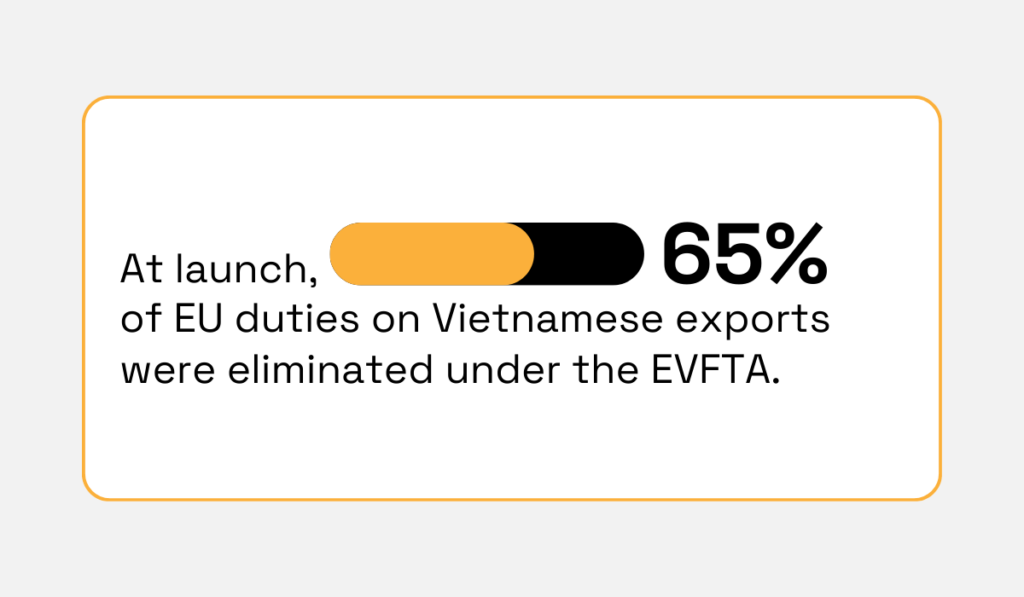
Illustration: Veridion / Data: European Commission
The issue is, those savings only apply when you can prove preferential origin.
If documentation is missing, inconsistent, or late, shipments can be held, and landed cost can revert to non-preferential rates.
Over time, additional changes across customs procedures, labor enforcement, or environmental compliance can also increase cost-to-serve.
The best defense?
Turn compliance into a repeatable workflow, not a last-minute scramble.
Start by building a “trade-ready” documentation pack for each critical category.
Keep it simple and standardized by asking for the following data:
Next, build an alternate bench before you need it.
Do not wait for an enforcement change to trigger emergency sourcing, because regulatory shifts are inevitable.
When documentation is always audit-ready, and alternates are already qualified, policy changes stop being a shipment crisis and become a manageable sourcing variable.
Vietnam’s manufacturing strength often sits atop an upstream dependency that procurement teams cannot control.
As one recent Ministry directive put it, firms should diversify their sources of materials and avoid relying on a single source.
This reflects how exposed manufacturers can be when inputs come from the same upstream markets.
Vietnam’s manufacturing and processing sector depends heavily on imported raw materials, intermediate goods, and production machinery
And, according to the Vietnam Association of Supporting Industries (VASI), the average localization rate in Vietnam is approximately 41.9%, with local businesses contributing only 17.2%.
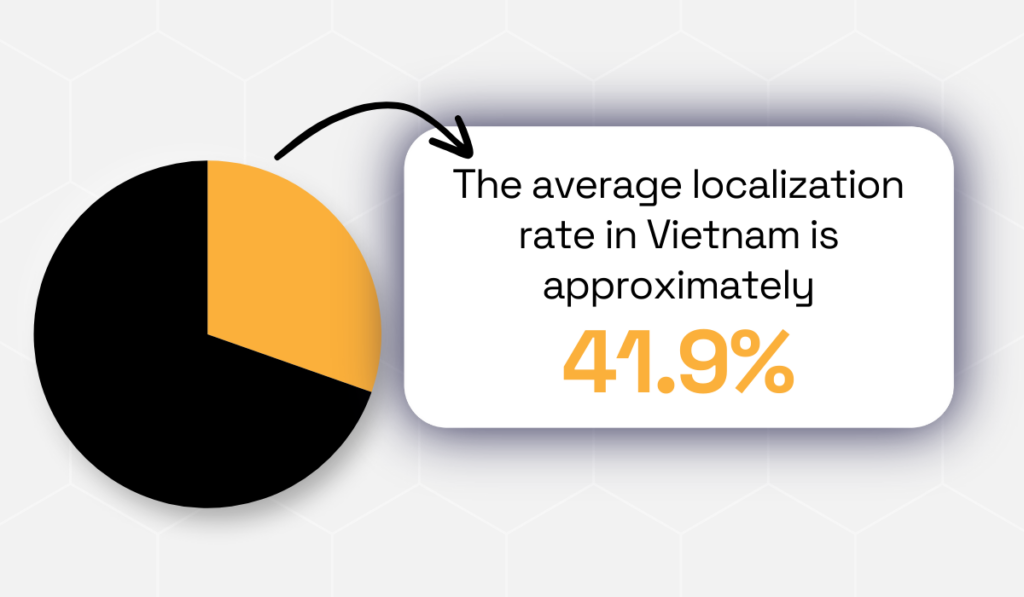
Illustration: Veridion / Data: Vietnam Plus
In practice, that means a disruption outside Vietnam can stop production even when Vietnamese factories are ready to run.
If a key input gets delayed at the origin, held at a border, or hit by upstream policy shifts, your Vietnam supplier cannot ship finished goods on time, regardless of local labor availability or factory capacity.
This risk is easy to underestimate because it is indirect.
Let’s take the textile and garment supply chain as an example.
Pham Van Viet, Vice Chairman of the Ho Chi Minh City Association of Garment, Textiles, Embroidery, and Knitting (AGTEK), says:
“The supply of raw materials for the domestic textile and garment industry meets only about 40 percent of the demand.”
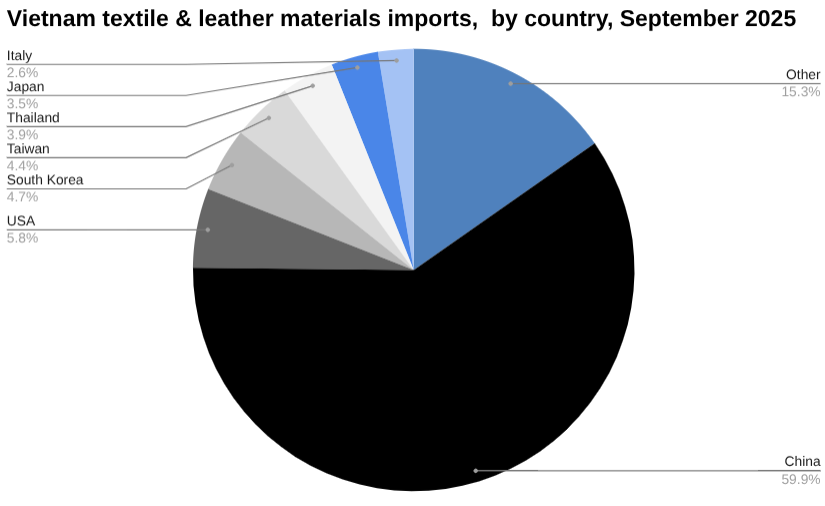
That is why China supplies over half of the input materials, creating a structural reliance on upstream imports:
Source: The Shiv
That same pattern appears across many manufacturing categories where local supporting industries are still developing, pushing suppliers to import critical materials.
Start by treating input dependency as a core part of supplier due diligence.
Ask suppliers to map their top imported materials by country, lead time, and substitution difficulty, then identify the few inputs that would halt production within days.
From there, build resilience in three ways:
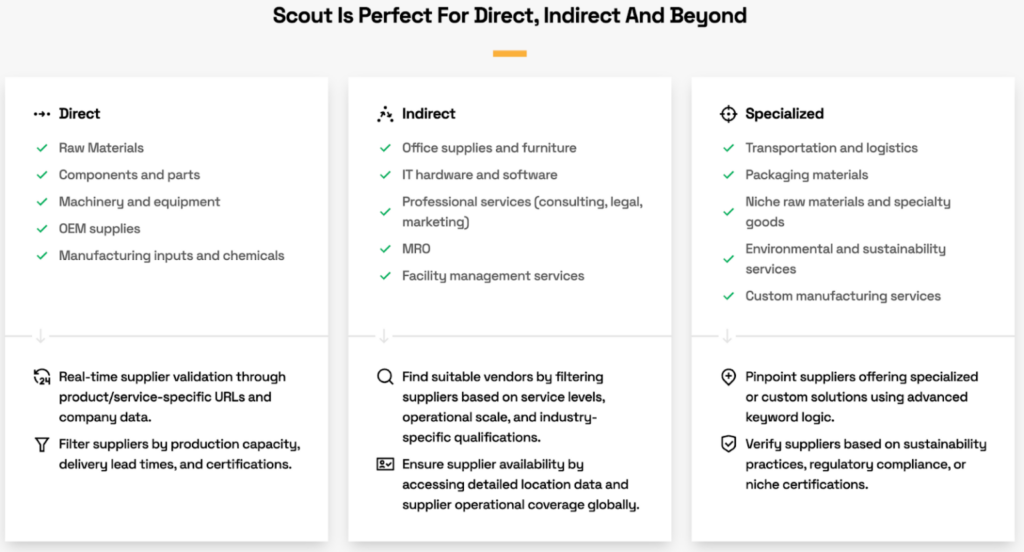
To speed up the process, consider using a data service that can find suppliers by what they actually sell, such as Veridion.
With Veridion, your team can expand the long list using product-level discovery and natural-language search in Scout, then validate alternatives faster when upstream risk shifts.
Source: Veridion
The key takeaway is to map critical inputs by source country and lead time, then qualify alternates before disruption hits.
When you plan for upstream shocks, Vietnam remains a scalable sourcing advantage instead of a hidden single point of failure.
Most procurement teams can name their Tier 1 suppliers in Vietnam.
The problem starts at Tier 2 and below, where visibility drops sharply, even though that is where many constraints sit, including materials, components, packaging, and subcontractors.
A 2024 Maersk and Reuters Events survey found that, in European supply chains, visibility falls to 32% for Tier 2 suppliers and 20% for Tier 3 suppliers.
While these findings reflect European supply chains, the same visibility gaps are often more consequential in Vietnam.
Why?
Because upstream suppliers often cluster in the same industrial parks and corridors.
For instance, if multiple Tier 1 suppliers depend on the same Tier 2 specialist, or share the same utilities and transport capacity, you get a hidden single point of failure.
Mónica Rivas, Senior Analyst at ChainRisk Global, describes many supply chains as cloudy, where direct supplier records show only the tip of the iceberg.
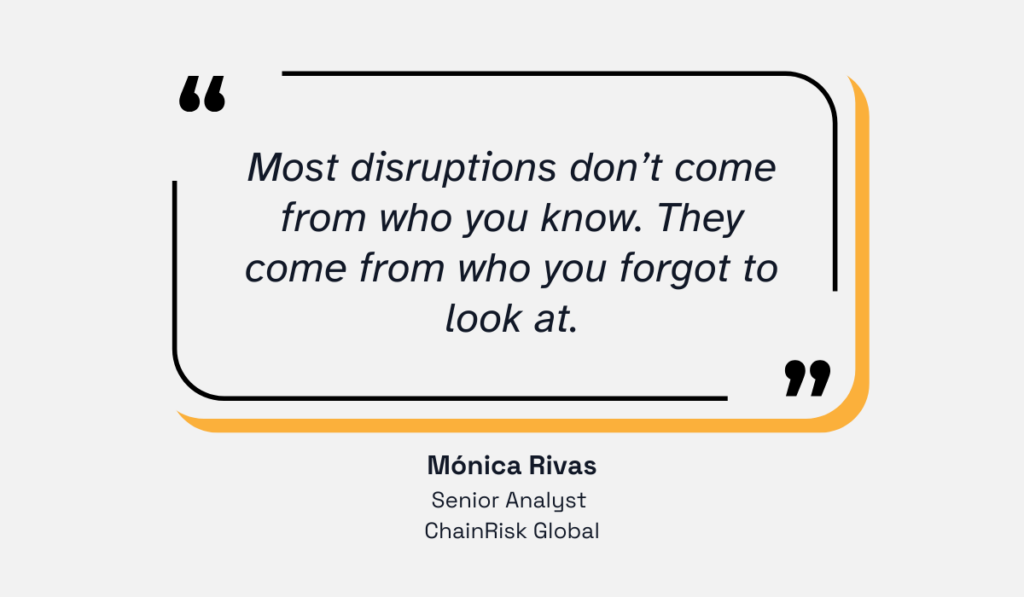
Illustration: Veridion / Quote: EAN Network
Start by treating multi-tier visibility as a sourcing requirement, not a risk project.
Ask Tier 1 suppliers to disclose Tier 2 and Tier 3 sources for your critical SKUs.
Then normalize that data so you can spot concentration patterns, such as the same sub-supplier appearing across “different” vendors.
Next, pressure-test your network for co-location and ownership risk.
Even basic questions like “Which facilities are in the same province?” or “Which suppliers share a corporate parent?” can reveal why disruptions cascade across “unrelated” vendors.
Services like Veridion support this by enriching supplier records with verified operating locations and corporate family structures so that teams can identify co-located dependencies and map concentration risk beyond Tier 1.
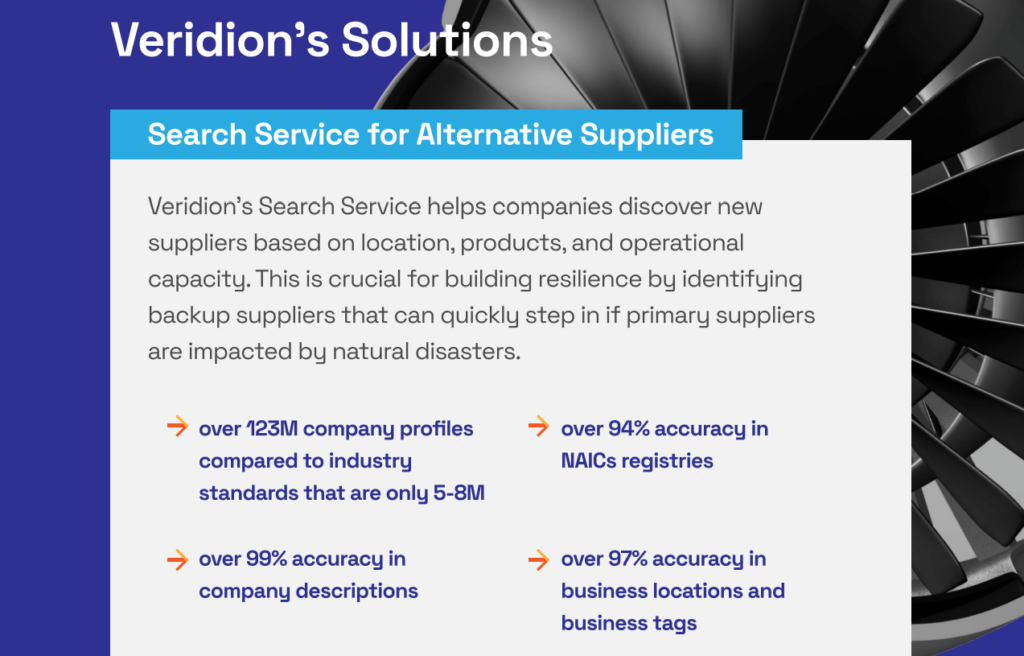
Source: Veridion
Finally, build optionality while you are calm.
Through Veridion’s supplier discovery experience, you can expand your supplier universe, so alternative sources are ready before a disruption forces urgent buying decisions.
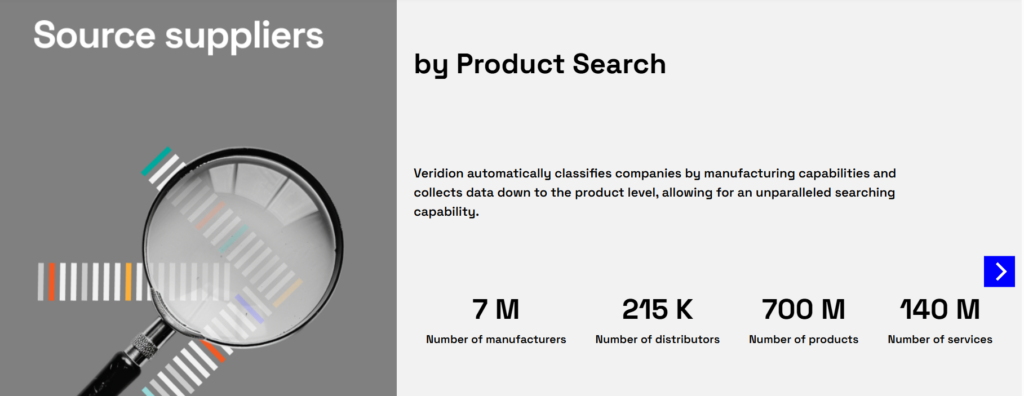
Source: Veridion
Multi-tier visibility is where resilience actually starts.
When you map Tier 2 and Tier 3 dependencies, you spot shared sub-suppliers, co-located risk, and hidden concentration before it turns into a disruption.
Build that view early, and Vietnam stays a sourcing strength, not a blind spot.
Vietnam is highly exposed to climate risks such as flooding, typhoons, extreme rainfall, heatwaves, and sea level rise.
BSR notes that climate-related infrastructure disruptions cost businesses in Vietnam an average of US$280,000,000 each year, which makes this a recurring operational risk, not a one-off event.
Industrial zones near rivers, ports, and coastal corridors can be especially vulnerable when storms overwhelm drainage, damage transport links, or trigger power interruptions.
For procurement teams, the core challenge is that climate disruption cascades.
A single event can pause production, block inland movement, and delay export flows at the same time.
After Typhoon Yagi in 2024, a survey of 216 businesses operating in Vietnam found that 75% experienced disruption, ranging from manageable delays to severe impacts.
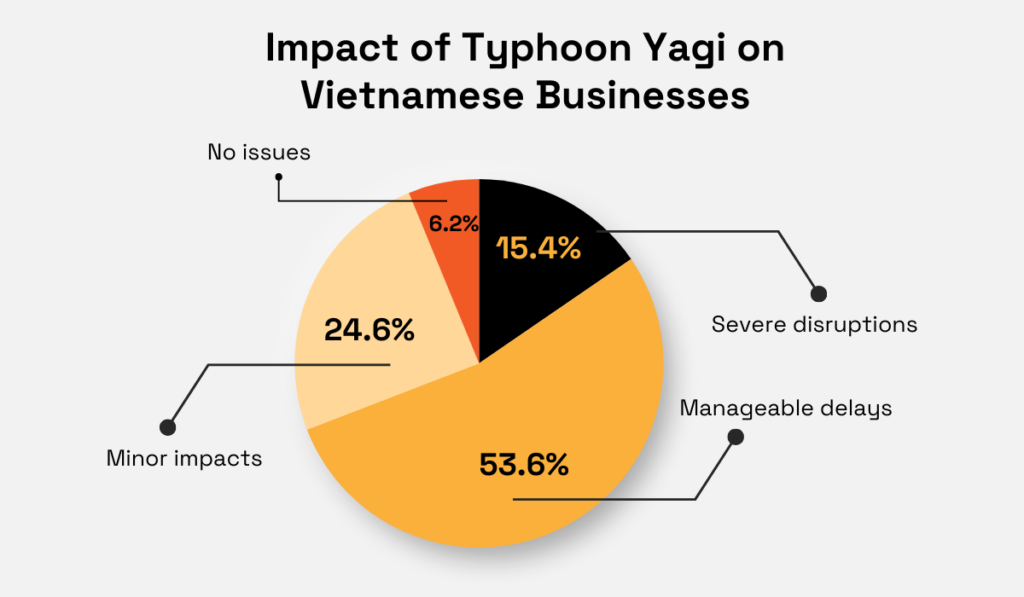
Illustration: Veridion / Data: The Investor
RMIT also highlights that evolving flood risk and more frequent extreme rainfall are raising the bar for preparedness, especially as storms and heavy rain events compound across seasons.
Even if a facility restarts quickly, damaged roads, warehouse constraints, and power instability can stretch lead times well beyond the weather window.
So, how do you minimize the impact?
Start with site-level visibility, not just supplier names.
You need to know where production and storage actually happen and whether multiple suppliers are clustered in the same flood-prone corridor.
You can also perform scenario analysis to prepare for a range of plausible climate outcomes, which helps teams decide where to diversify and what to buffer.
The truth is, climate disruptions in Vietnam are becoming harder to treat as an exception.
Flooding, typhoons, and heat stress can hit production, inland movement, and export routes in the same week, and recovery often takes longer than the storm itself.
Teams that map site exposure, avoid over-concentration in one corridor, and prepare seasonal playbooks and alternates are the ones that keep lead times stable when conditions change.
Vietnam can be a high-performing sourcing market, but Vietnam-dependent supply chains tend to fail in predictable ways.
Logistics congestion, power constraints, regulatory shifts, imported input exposure, limited multi-tier visibility, and climate disruption can all turn a small delay into a category-wide shortage.
The key takeaway is simple: resilience is not luck; it is a procurement capability.
Build visibility beyond Tier 1, qualify alternates early, and use reliable supplier data to act faster when conditions change.
When you plan for these failure points now, Vietnam remains an advantage, not a single point of failure.