



Blog
Best Data Intelligence Platforms
By: Stefan Gergely -
23 March 2026


We love our data, and now that you're here, you're one step closer to loving it too.
A wide sample of data, so you can explore what is possible with our data
Choose ->
built with procurement in mind. Focused on manufacturers, products and more
Choose ->
built with insurance in mind. Focused on classifications, business activity tags and more
Choose ->
built with sustainability in mind. Focused on sustainability commitments, and environmental and social governance insights.
Choose ->
built with strategic insights in mind. Focused on market trends, competitor analysis, and industry-specific data
Choose ->

Keep up to date with our technology, what our clients are doing and get interesting monthly market insights.

The global data intelligence platform market is growing rapidly, driven by the need to manage complex data ecosystems.
For procurement leaders, selecting the right platform is a strategic decision that impacts efficiency, cost, and resilience.
In this article, we compare six leading platforms, covering what the tool does, who it suits, plus its features, pros, cons, and price points.
Let’s get started.
Veridion is an AI-driven data platform that focuses on company intelligence.
It collects and cleans public business data on tens of millions of companies worldwide so you can access detailed firmographics, financials, and market information.
Veridion’s data spans:
On top of that, it is updated weekly, meaning that you’re making all the important business decisions based on the freshest, most reliable data available.
Source: Veridion
Unlike broader platforms such as Collibra or Alation (covered later), which primarily organize internal data, Veridion distinguishes itself in the data intelligence landscape by focusing on external, real-world entity data.
In other words, where other platforms help you find internal reports on supplier spend, Veridion helps you discover third-party partners themselves.
With this tool, you get a powerful source for external business and product data, enabling your teams to identify, vet, and monitor potential partners with precision.
It acts as a critical feed of external intelligence that can power use cases from supply chain mapping and competitor analysis to market expansion and M&A targeting.
Our platform is best for procurement, risk, and insurance teams that need high-quality data.
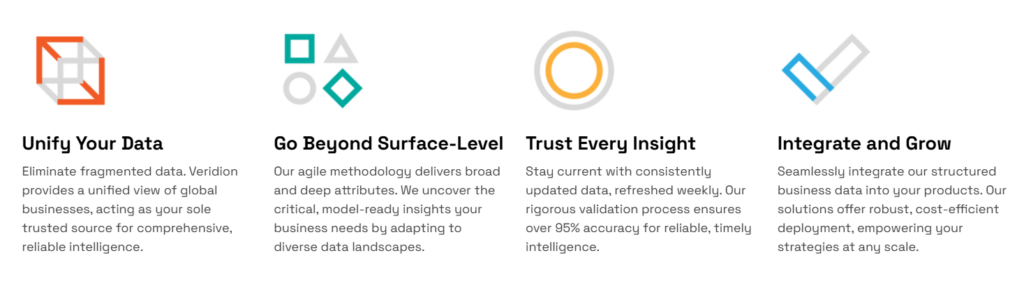
Veridion’s core benefits include the following:
Source: Veridion
Veridion’s foundation is built on a proprietary, AI-driven extraction engine.
It continuously scans and processes data from a vast array of public sources, primarily official company websites and legal registries worldwide.
This is not simple web scraping.
The engine uses advanced machine learning to understand the structure and content of each source, extracting entities, relationships, and attributes with high precision.
Following extraction, the data undergoes rigorous verification.
It is cross-referenced and validated against secondary sources, including social media profiles, public financial filings, and real-time news feeds, all to ensure accuracy and timeliness.
This methodology allows Veridion to maintain a dynamic, self-correcting dataset on tens of millions of businesses, delivering specialized insights that general-purpose catalogs lack.
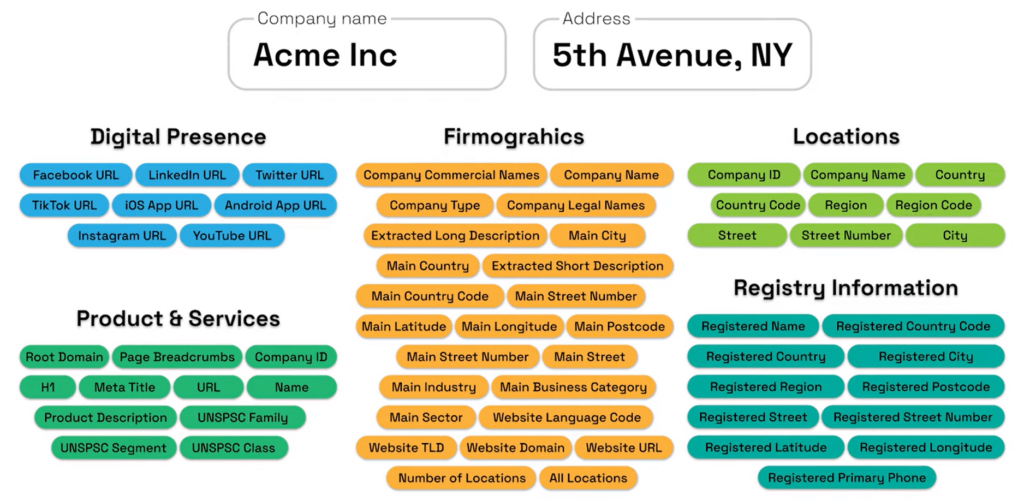
Furthermore, Veridion’s data extends well beyond basic firmographics.
It provides a multi-dimensional view of each company, encompassing hundreds of attributes.
Source: Veridion
This depth allows users to segment and target companies based on very specific, actionable criteria.
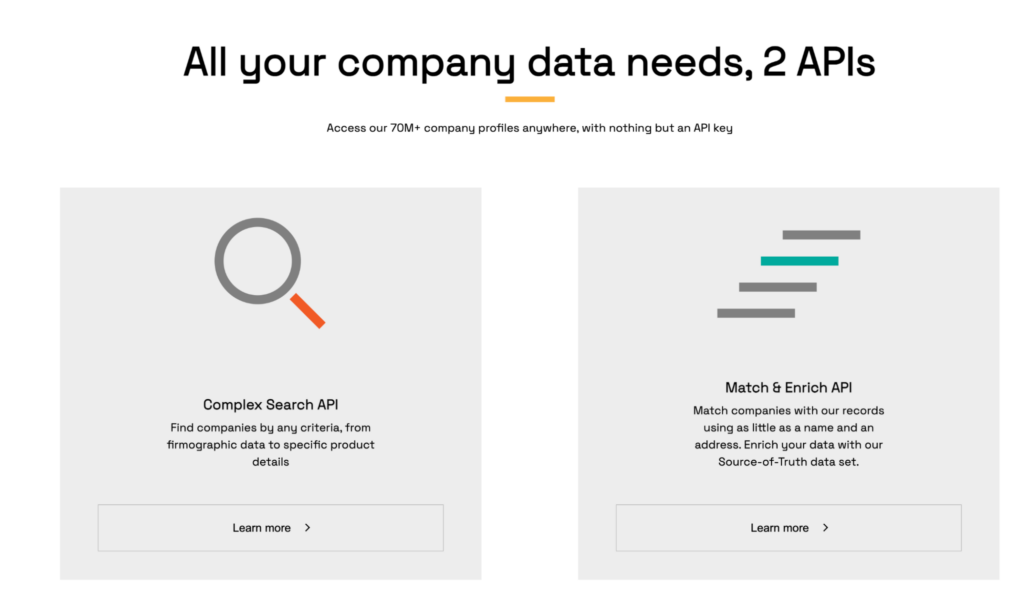
The integration APIs let you plug Veridion into CRMs or analytics tools without much custom coding.
Source: Veridion
The Search API is designed for discovery. It allows you to build complex, multifaceted queries to find companies that meet precise criteria.
In contrast, the Match & Enrich API is built for resolution and augmentation.
If you already have a list of companies—perhaps with inconsistent names, partial addresses, or just a website domain—this API takes those fuzzy identifiers and finds the corresponding, authoritative record in the Veridion database.
Because Veridion focuses on external business data, it does not provide the full data governance or lineage features of a general catalog.
Its value is, therefore, maximized when used as a rich data feed within a broader procurement intelligence workflow.
When it comes to pricing, Veridion operates on a custom-quoted annual subscription model.
If Veridion sounds like a good match for your organization, feel free to download a data sample on our website or get in touch to schedule a custom data consultation.
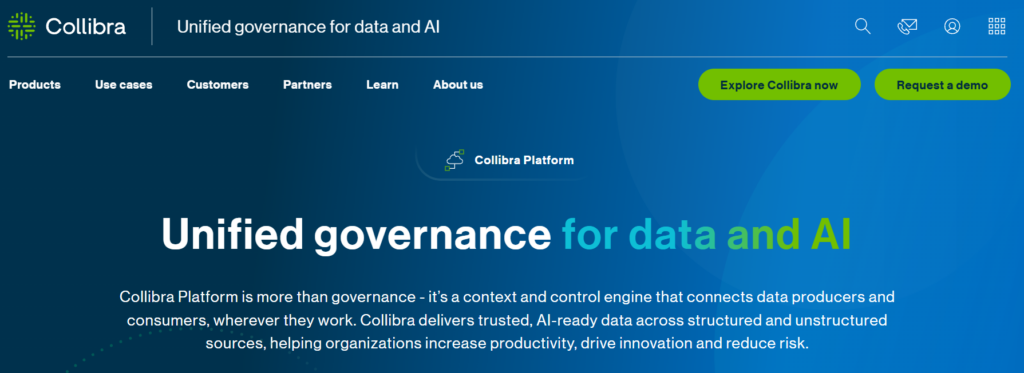
Collibra is a mature data intelligence platform built for enterprise governance.
It offers a unified solution for data cataloging, governance policies, privacy, quality, and lineage.
This platform offers a comprehensive, process-driven governance framework, ideal for large enterprises with strict regulatory requirements.
In other words, Collibra acts as a centralized system for defining and enforcing data policies.
Source: Collibra
Its policy manager and workflow engines are more formalized than those of other platforms.
In practice, Collibra shines on governance, but if you need lightweight analytics or embedded AI search, other tools may be more agile.
For procurement, Collibra is indispensable if the accuracy of spend data, the integrity of supplier scorecards, and compliance with regulations like GDPR are non-negotiable for your organization.
Collibra’s federated model lets distributed teams own their data while scaling governance without slowing them down.
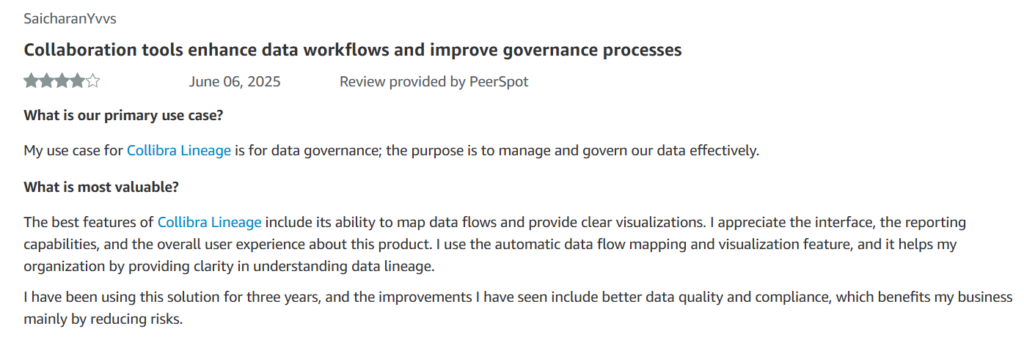
Users praise Collibra’s workflow automation and UI. One customer noted that Collibra provides very customizable workflows and a user-friendly interface.
Another review highlights Collibra’s strong out-of-the-box functionality to realize active metadata management and boost compliance.
Source: Collibra
The platform’s breadth means you can manage governance, quality, and collaboration in one place, making it suitable for complex global enterprises.
As with any platform, Collibra comes with trade-offs.
A major downside is its steep learning curve.
Many users note that its power and flexibility make initial deployment complex. Getting teams up to speed often requires significant training.
Some users also mention that the interface can feel cumbersome until you learn it.
As far as pricing goes, published figures show Collibra licensing starting around $170,000 per year for a 12-month plan, scaling up to over $500,000 for longer contracts.
That premium price reflects its enterprise focus, but it can be prohibitive for smaller organizations.
Databricks is fundamentally a big data and AI platform, often used for unified analytics.
Built on Apache Spark, it handles massive data processing, machine learning, and real-time analytics.
Key features include collaborative notebooks that support Python, SQL, R, and more in one interface, automated cluster and job management, and built-in machine learning with MLflow.
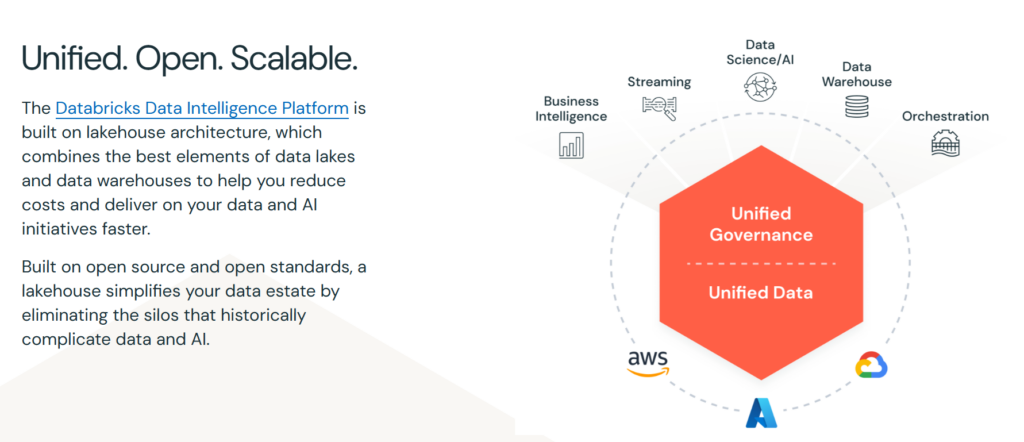
It pioneered the “lakehouse” approach, offering ACID transactions on a data lake so that both analytics and batch processing run on the same storage.
Think of Databricks as a managed lakehouse: it unifies data engineering, data science, and BI under a single architecture.
Source: Databricks
Databricks also includes security features such as fine-grained role-based access controls and audit logging, especially in higher tiers.
On the data intelligence side, Databricks now offers Unity Catalog, a unified governance layer for data and AI assets across clouds and workspaces.
However, that requires a paid plan.
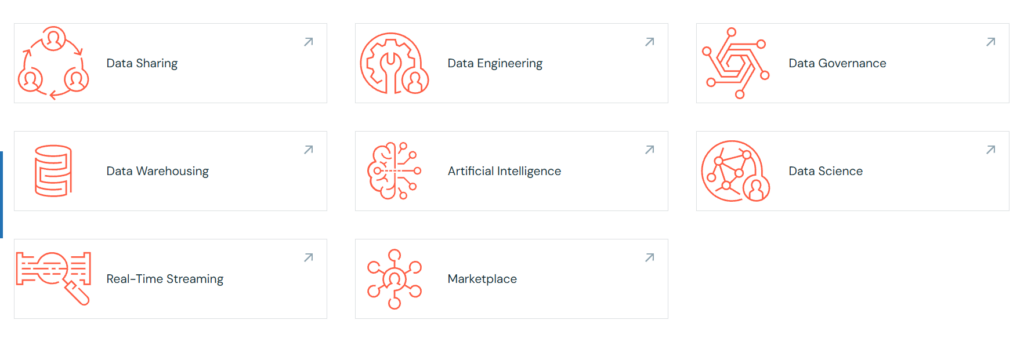
It unifies data engineering, data science, and business analytics on a single platform, breaking down traditional silos.
Databricks facilitates collaboration through interactive notebooks where data scientists and engineers can develop models.
On top of that, it simplifies infrastructure management with serverless compute options that automatically scale to meet workload demands.
Source: Databricks
The platform is also exceptionally powerful for building, training, and deploying machine learning models at scale and delivers strong performance for complex queries on massive datasets.
However, unlocking the platform’s full potential requires a team with skilled data engineers and data scientists.
Databricks assumes technical expertise, meaning that non-technical business users might need more training.
The platform’s extensive capabilities can also introduce unnecessary complexity for organizations with straightforward business intelligence reporting needs.
In terms of pricing, Databricks uses a consumption-based model based on Databricks Units (DBUs).
Each DBU costs roughly $0.20–$0.40, depending on the cloud provider (AWS, Azure, Google Cloud) and the workload type (data engineering, SQL analytics, or machine learning).
In real terms, a continuously running cluster can incur thousands of dollars per month. In other words, it’s pay-as-you-go, but watch your usage.
Actian‘s (formerly Zeenea) offering is a data catalog and marketplace solution engineered for high-performance data integration and management.
It excels at connecting to a wide variety of data sources, blending data in real-time, and enabling rapid analytical querying.
Actian describes itself as a next-generation Data Discovery Platform combining a Data Catalog and an Enterprise Data Marketplace.
In practice, it merges metadata from systems and provides an intuitive catalog that lets users easily find and request data.
It excels at connecting to a wide range of data sources, blending data in real time, and enabling fast analytics.
It’s a strong choice for organizations that need to combine traditional ERP and spend data with real-time streams from IoT sensors in logistics, market feeds, or other operational systems to make immediate decisions.
Actian’s strengths include scalability and governance.
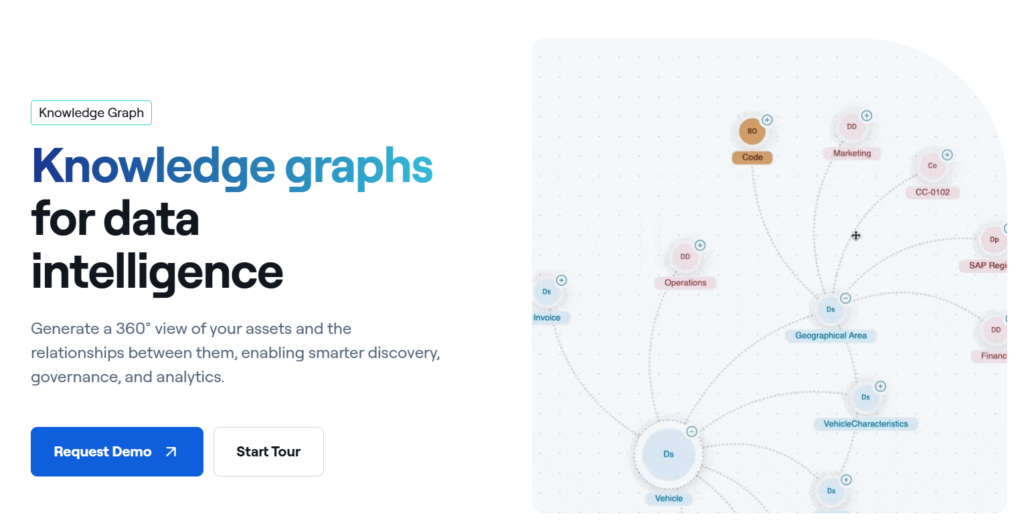
Its Knowledge Graph automatically links metadata, governance, lineage, and trust signals into a single, coherent layer, so you can easily trace relationships between data assets across sources.
This unified approach improves data discovery, strengthens governance, and deepens overall business understanding.
Source: Actian
Additionally, the platform’s data marketplace concept can speed up provisioning. For example, users can request datasets via a governed interface.
Actian also touts strong collaboration: it integrates with enterprise security (RBAC, audit logs) and even supports AI/ML metadata via its graph.
Regarding pricing, AWS Marketplace shows that a basic 12-month contract (including a limited number of stewards and connectors) costs about $120,000 per year.
Pricing scales with users and connectors, so larger deployments will be much higher.
Furthermore, Actian is relatively specialized. So, if you don’t need a full knowledge graph catalog, simpler tools like Secoda or Veridion might be easier to start with.
Secoda is a newer entrant that brands itself as an AI-powered data catalog. It focuses on making data discovery and documentation as easy as search.
It automates the documentation of data assets, making it easier for teams to find, understand, and trust their data.
For procurement analysts, Secoda can dramatically reduce the time spent searching for the correct spend report, understanding metric definitions, or tracing the source of a data discrepancy.
Source: Secoda
Secoda crawls your BI and data tools (such as Snowflake, dbt, Tableau, etc.) to collect metadata, then uses AI to surface insights.
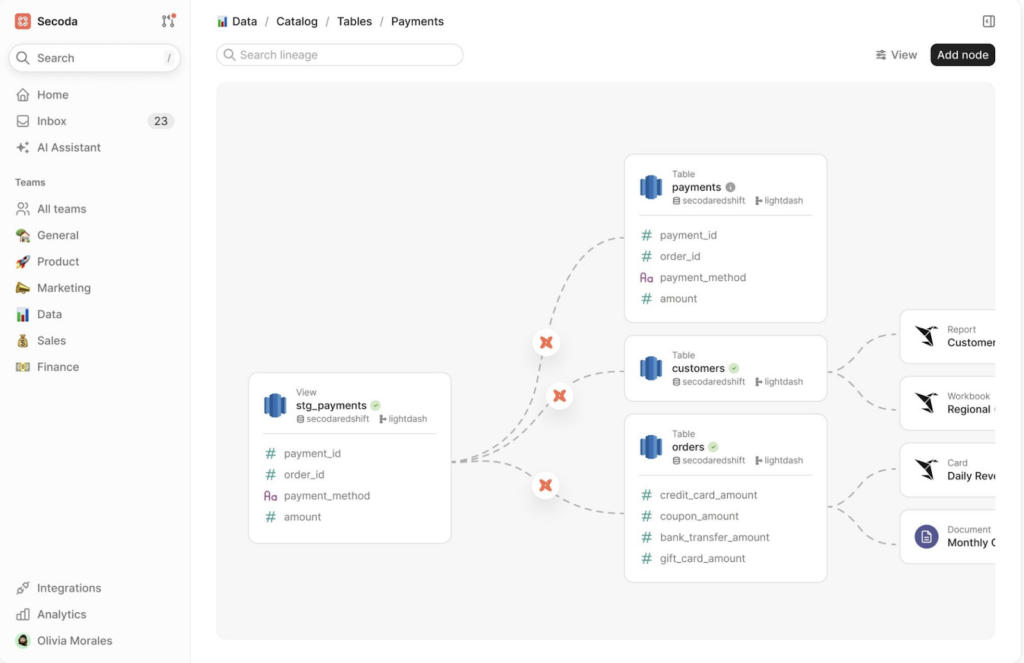
Notable features include an automated data lineage mapper: Secoda creates a map of how data is connected across all your apps.
It builds a complete understanding of relationships among your data resources by analyzing queries, foreign keys, primary keys, and other attributes.
This capability provides visibility into how data flows and connects, regardless of where those resources are located within your systems.
Another standout is automated documentation. Secoda can generate data definitions and query examples from the metadata it collects. This AI-first approach is great if you want quick answers.
According to Secoda’s Co-Founder and CEO, Etai Mizrahi, the platform is designed to make finding and using data easy.
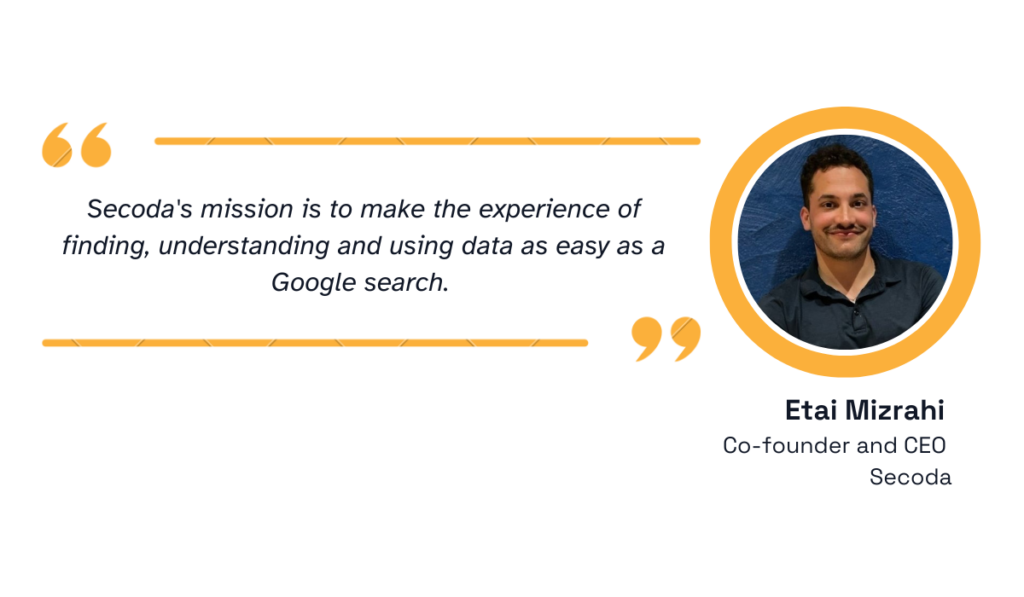
Illustration: Veridion / Quote: TechCrunch
Secoda might be especially appealing to mid-size companies looking for modern catalogs without heavy setup.
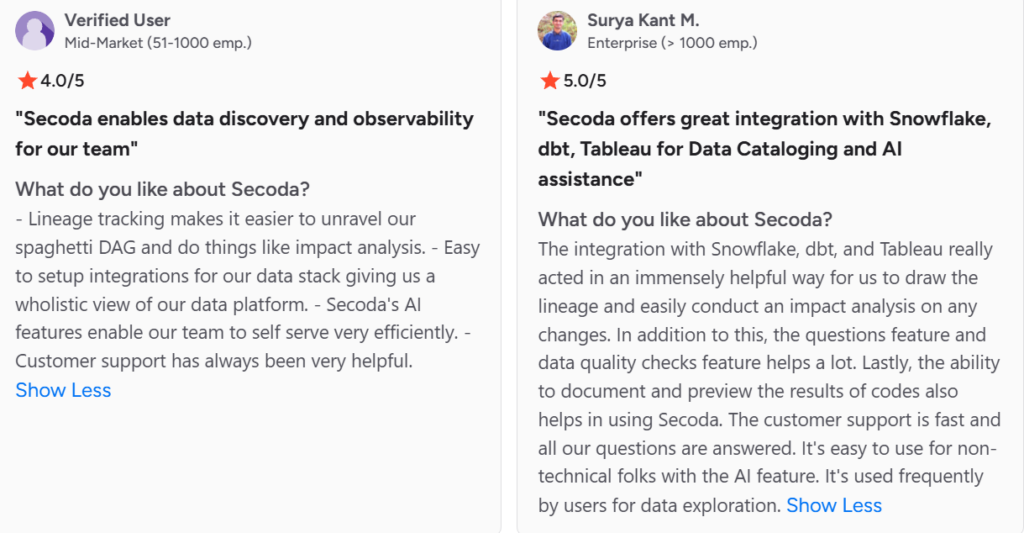
Reviewers praise how it easily integrates with popular data stacks to draw lineage and impact analysis.
It excels at stitching together metadata, with one reviewer saying that Secoda enables data discovery and observability by unraveling complex DAGs.
Source: G2
The AI features help too.
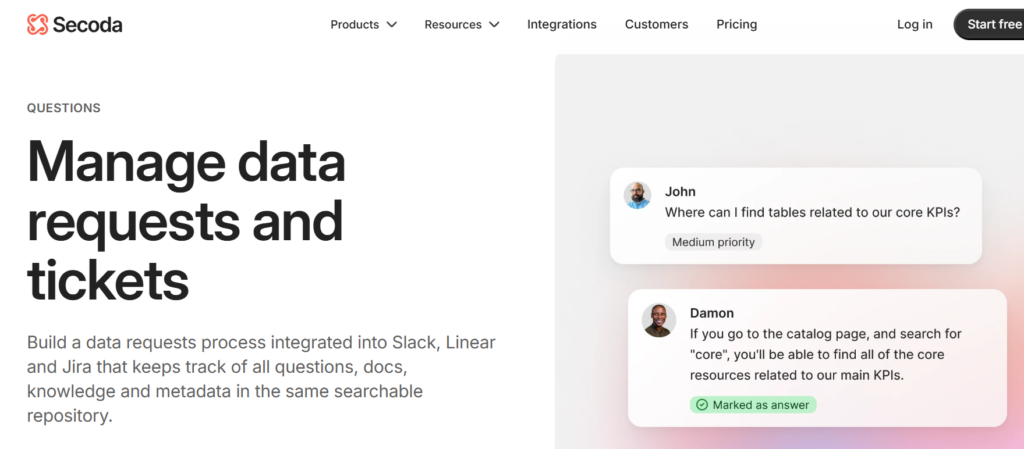
For example, Secoda’s “Questions” feature lets teams share knowledge interactively.
You can build a streamlined data request process directly within the collaboration tools your team already uses, such as Slack, Linear, and Jira.
This integrated workflow automatically captures all related questions, documents, shared knowledge, and technical metadata into a single, centralized repository.
Source: Secoda
Users also appreciate that Secoda’s UI is intuitive and that it starts returning results quickly, which can speed up analytics projects.
Being newer, Secoda still has rough edges.
Multiple users mention bugs and stability issues.
For instance, one user calls Secoda a good AI-powered data catalog with interesting features but a bit buggy. Some say certain advanced functions feel unfinished.
The data quality/monitoring tools are also quite basic right now. In short, you may have to tolerate occasional glitches or missing features.
When it comes to pricing, Secoda offers a transparent tiered SaaS model:
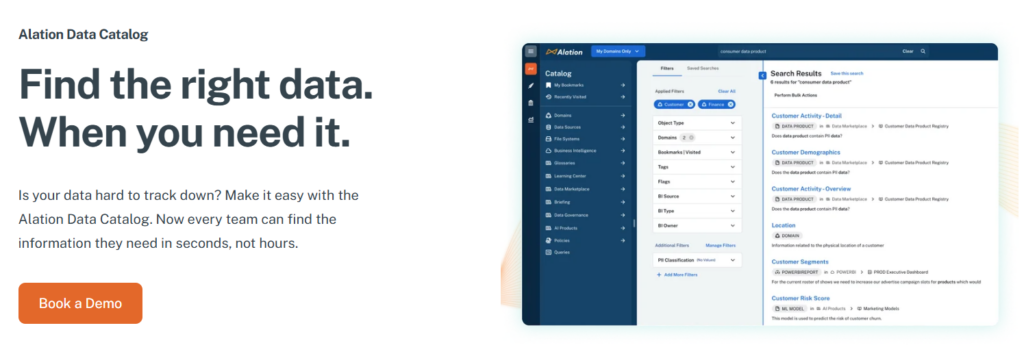
Alation started as a pioneer in data catalogs and has grown into a full-featured data intelligence platform. It’s built around collaboration and smart search.
It leverages machine learning and behavioral analysis to automate data curation, governance, and discovery workflows.
Its central mission is to foster a data-driven culture by making data easy to find, understand, and trust.
Source: Alation
For procurement, Alation helps standardize key metric definitions, track their lineage from source to report, and allows users to find relevant data through natural language conversations.
Alation’s Key Features:
| Behavioral Analysis Engine | Automatically ranks search results by popularity and usage to surface trusted data. |
| Active Data Governance | Embeds policy enforcement and stewardship workflows directly into the catalog. |
| Natural Language Search (“Chat with Your Data“) | Allows users to ask questions in plain language and receive answers with cited data sources. |
| Open Connectivity | Supports over 120 connectors to data sources, BI tools, and cloud platforms. |
A BARC review highlights Aation’s behavioral search and collaboration tools.
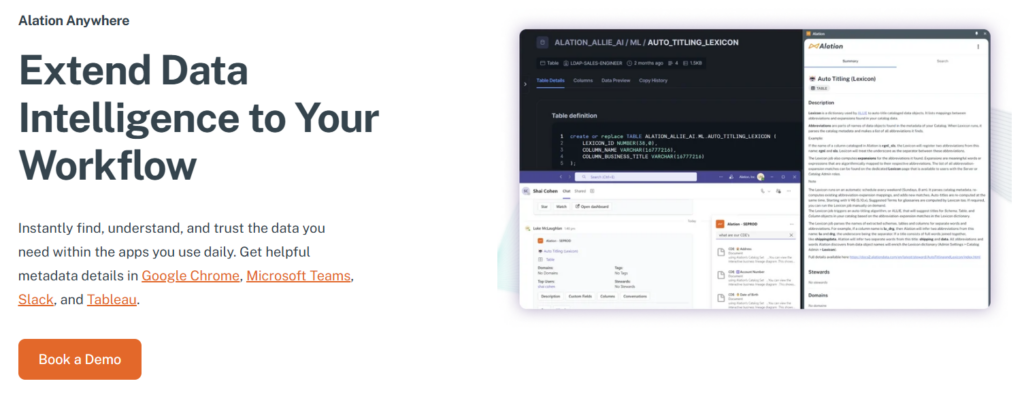
For example, Alation lets business users work in Excel or Google Sheets directly on top of the data catalog through its Alation Anywhere feature.
Source: Alation
Alation’s significant strength is its strong emphasis on user experience and collaboration, featuring a wiki-like interface that encourages collective stewardship of data knowledge.
Its ability to ingest query logs provides unique insight into how data is actually being used across the organization.
It also boasts a large client base (over 570 companies) and has partnerships in the Snowflake and Databricks ecosystems.
As far as pricing goes, in one comparison, a basic 12-month Alation plan (25 creative users on AWS) was around $198,000.
Choosing the right data intelligence platform depends on your priorities.
If you need rich supplier and market data with AI enrichment, Veridion delivers specialized insights. If strict enterprise governance and policies are key, Collibra or Actian are built for that.
Databricks shines when your focus is on big data processing and analytics at scale.
Alation is a favorite among teams that value ease of use, search, and collaboration.
Secoda offers a modern, AI-powered catalog approach that is ideal for rapid setup in mid-size firms.
In the end, the right platform will save your company time and money by making your data more accessible, trustworthy, and useful.