



Blog
6 Big Data Companies to Know About
By: Auras Tanase -
30 March 2026


We love our data, and now that you're here, you're one step closer to loving it too.
A wide sample of data, so you can explore what is possible with our data
Choose ->
built with procurement in mind. Focused on manufacturers, products and more
Choose ->
built with insurance in mind. Focused on classifications, business activity tags and more
Choose ->
built with sustainability in mind. Focused on sustainability commitments, and environmental and social governance insights.
Choose ->
built with strategic insights in mind. Focused on market trends, competitor analysis, and industry-specific data
Choose ->

Keep up to date with our technology, what our clients are doing and get interesting monthly market insights.

For years, the big data conversation centered on one metric: size.
How many records? How many contacts? How many companies?
But database volume is no longer the measure of competitive strength.
Today, information from CRM systems, financial filings, web content, and private markets is more abundant than ever.
Yet actionable insight remains scarce and increasingly difficult to extract.
The real differentiator is not access to data, but the ability to transform fragmented information into structured, decision-ready intelligence.
In this article, we examine several leading big data platforms and explore what truly sets them apart.
Veridion is a data intelligence platform built to power modern analytics, enrichment, discovery, and risk analysis across large-scale datasets.
At its core, Veridion’s AI and proprietary machine learning models continuously scan the web, including websites, news outlets, reports, and other digital sources.
They then transform fragmented, unstructured information into a structured, highly accurate business database.
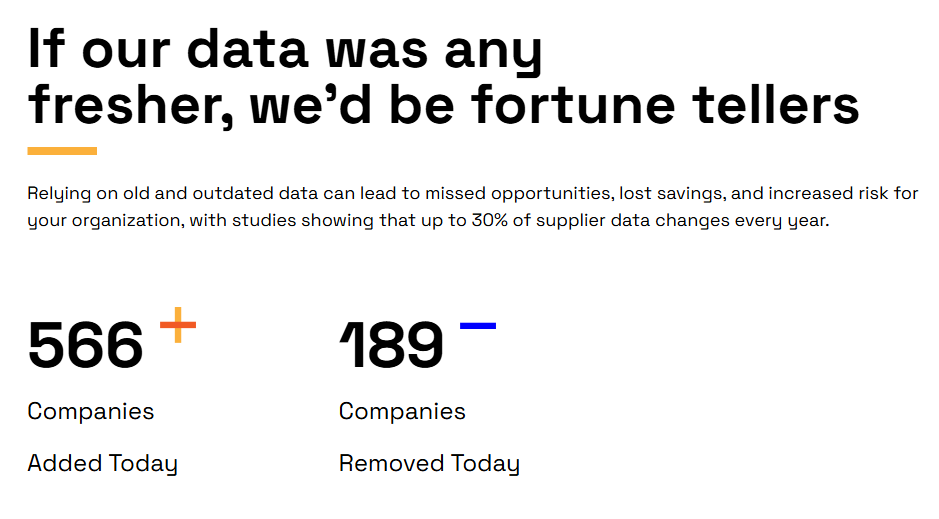
This data is systematically refreshed weekly, ensuring analytical reliability and relevance.
Source: Veridion
What truly sets us apart in the big data category is our ability to deliver AI-enriched, analysis-ready data at scale.
Rather than supplying raw company records, we apply advanced enrichment, normalization, and deduplication to deliver clean, structured datasets that significantly reduce data preparation time for analytics and engineering teams.
Our deep entity resolution capabilities connect subsidiaries, parent companies, and complex corporate hierarchies, enabling more accurate:
Veridion combines global breadth with granular depth.
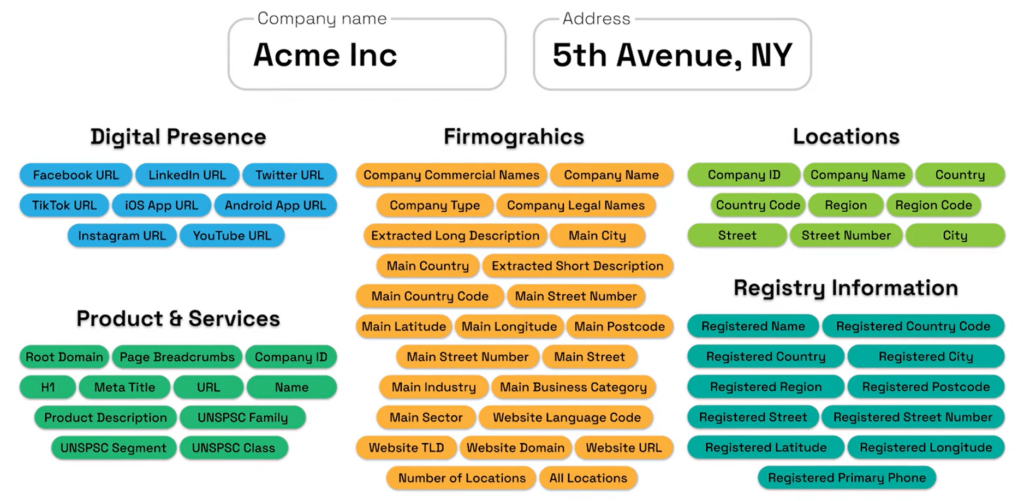
Our platform maintains an extensive database of 130M+ companies across 250 countries, while layering in multi-dimensional attributes beyond standard firmographics, including:
This richness makes Veridion especially valuable for predictive modeling, segmentation, compliance modeling, and advanced risk analytics.
Source: Veridion
Designed for modern data infrastructure, Veridion supports flexible delivery via real-time APIs and batch pipelines.
This allows seamless integration into data lakes, ETL workflows, BI tools, and machine learning environments.
Our API-first architecture includes advanced querying capabilities, such as Boolean logic, nested filters, and multi-dimensional combinations, built specifically for sophisticated big data use cases rather than simple directory lookups.
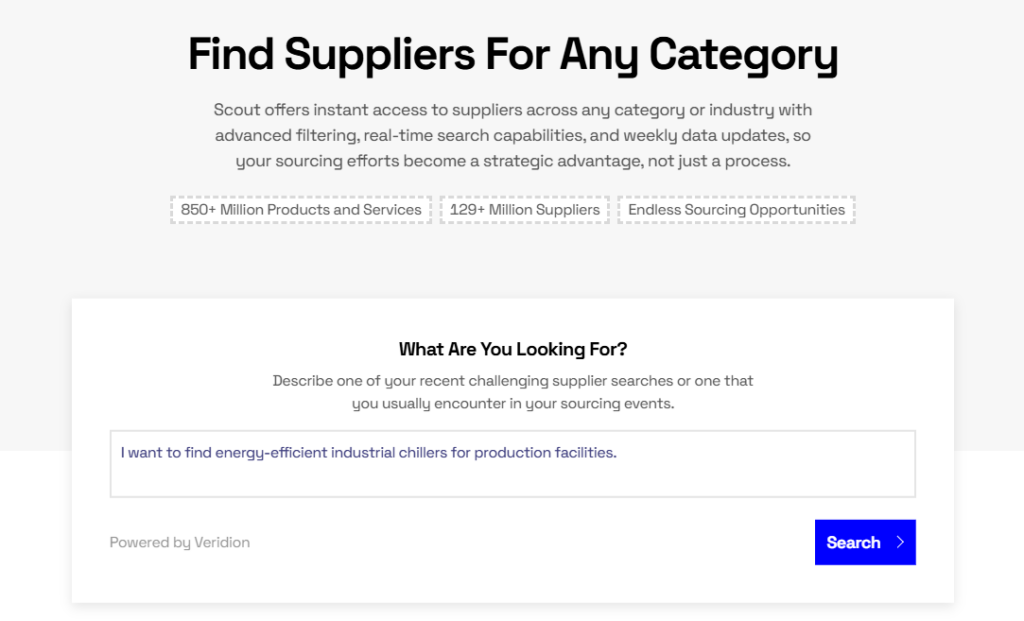
To further democratize access to complex datasets, Scout AI enables non-technical users to perform advanced searches and extract insights without requiring engineering or data science expertise.
Source: Veridion
By combining massive global coverage, deep attribute granularity, structured data quality, and scalable integration, Veridion provides a purpose-built foundation for organizations running modern, analytics-driven big data initiatives.
ZoomInfo is a go-to-market (GTM) intelligence platform best known for its extensive B2B contact and company database, with a strong emphasis on sales, marketing, and recruiting use cases.
While not a traditional big data infrastructure provider, ZoomInfo operates at significant scale and is frequently used by revenue teams that rely on large volumes of business data for prospecting, segmentation, and account-based strategies.
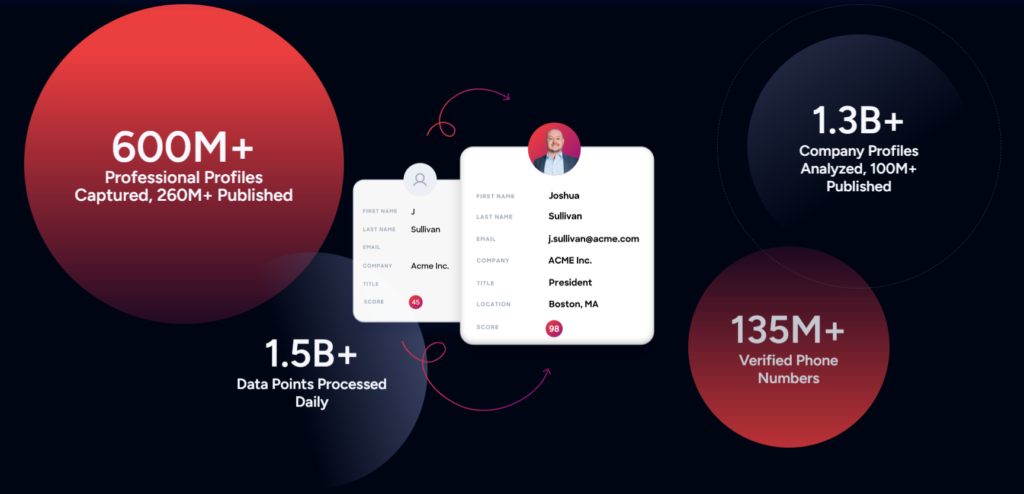
The platform maintains a massive database of over 260M published contact profiles and more than 100M published company profiles, making it one of the largest B2B data providers on the market.
Source: ZoomInfo
While most big data providers focus on company-level firmographics, ZoomInfo goes a step further by delivering highly detailed professional profiles that include:
This level of granularity, knowing not just that a company exists, but exactly who the VP of marketing is and how to reach them, makes it especially powerful for revenue-focused analytics.
ZoomInfo’s real differentiator is its intent and data buying signals.
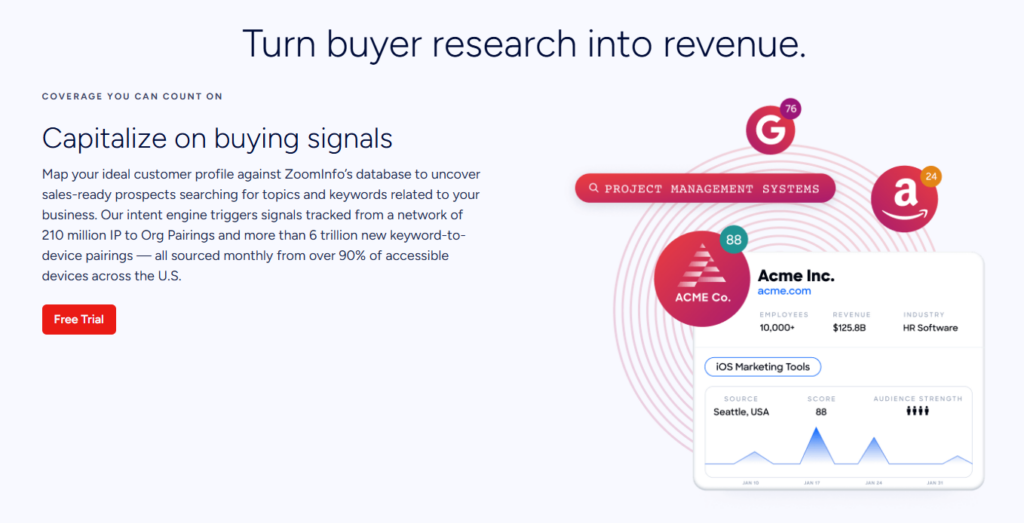
Source: ZoomInfo
By aggregating online research activity and behavioral patterns, the platform identifies when companies are actively exploring solutions within specific categories.
This transforms static datasets into predictive intelligence, enabling proactive outreach and more accurate lead prioritization.
ZoomInfo also offers technographic intelligence, providing visibility into the technologies companies use within their tech stacks.
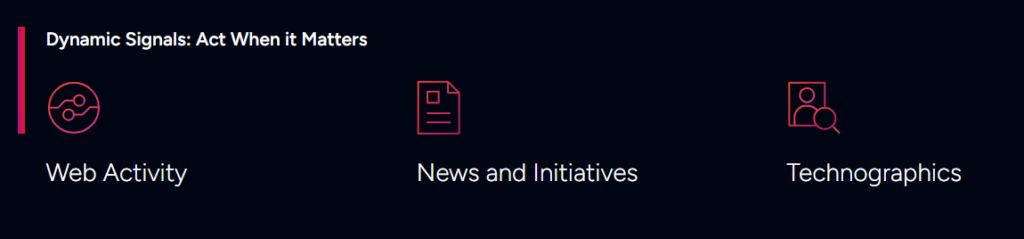
Source: ZoomInfo
Advanced filtering and segmentation tools enable highly granular targeting across large datasets, making the platform particularly strong for:
Beyond data access, ZoomInfo functions as an operational workflow platform.
With deep integrations into CRM, sales engagement, and marketing automation systems, insights can be activated directly within revenue workflows
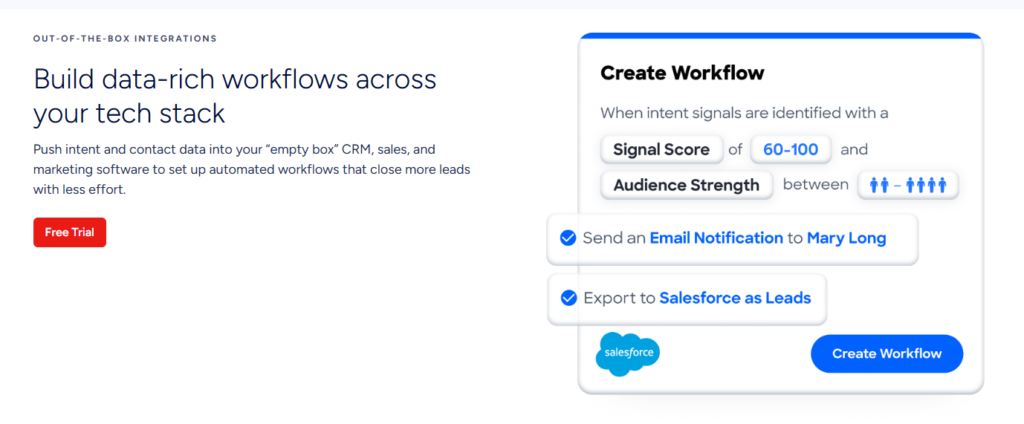
Source: ZoomInfo
Its Copilot AI assistant further enhances productivity by analyzing CRM data alongside ZoomInfo’s database to suggest actions, surface opportunities, and assist with personalized outreach.
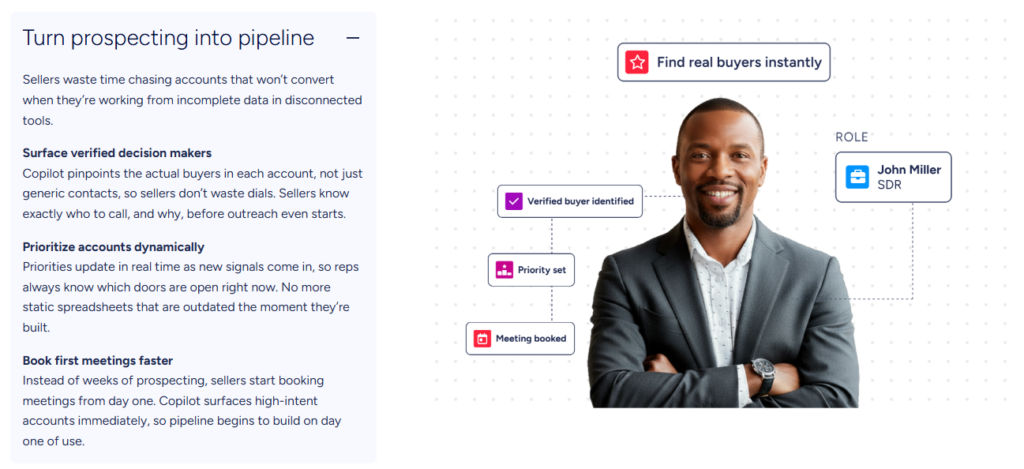
Source: ZoomInfo
While ZoomInfo dominates B2B contact and intent data for North American GTM teams, its core focus remains revenue acceleration.
Organizations that require deep product classifications, ESG insights, supply chain mapping, or broader international coverage may find more globally oriented, analytics-first platforms like Veridion better aligned with complex big data initiatives.
Clearbit is a business intelligence platform that provides real-time company and contact data to help teams improve lead generation, market personalization, and sales prospecting.
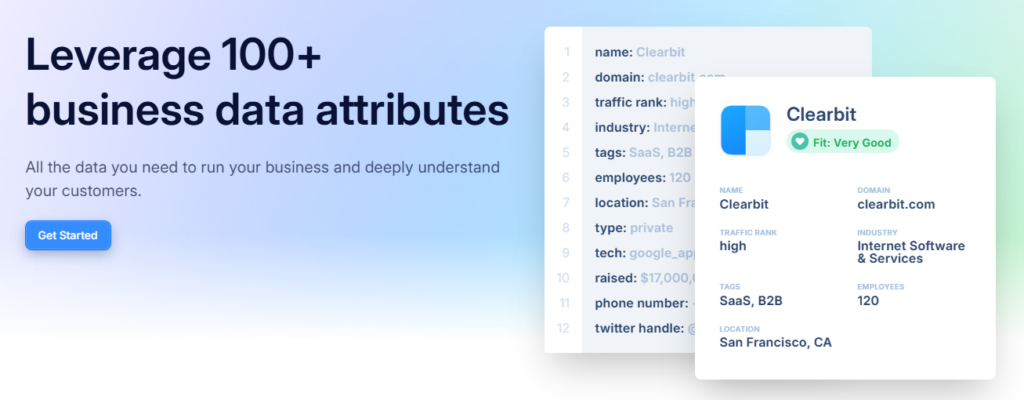
At its core, Clearbit is a real-time B2B data enrichment tool that fills in missing details on leads and customers.
Source: Clearbit
Starting with a simple input, such as an email or domain, Clearbit generates over 100 data points in seconds, including:
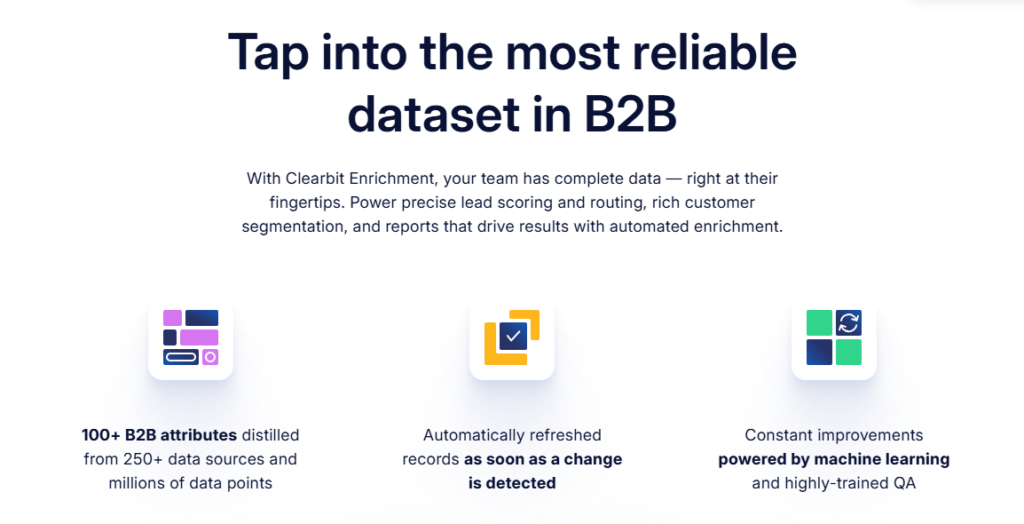
Clearbit’s most distinctive capability is real-time enrichment.
Source: Clearbit
Rather than relying on batch updates or periodic refreshes, Clearbit appends these data points as soon as a lead enters your CRM or submits a form.
For analytics and predictive models where completeness and freshness matter, this real-time enrichment is a meaningful differentiator.
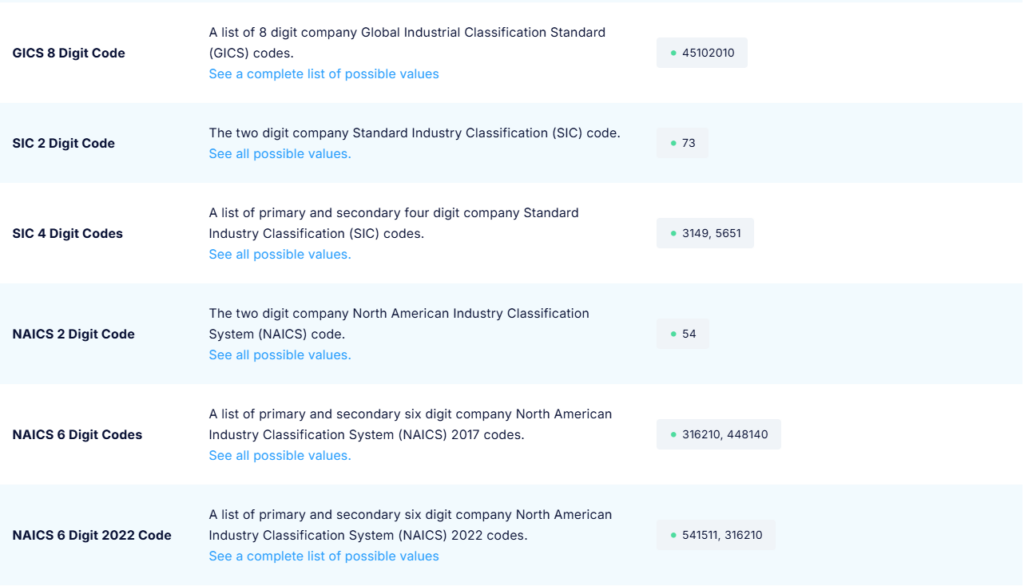
Clearbit also offers granular multi-standard industry classifications, including 6-digit NAICS, GICS, and SIC codes, enabling precise segmentation and richer datasets for ML training and targeted analytics.
Source: Clearbit
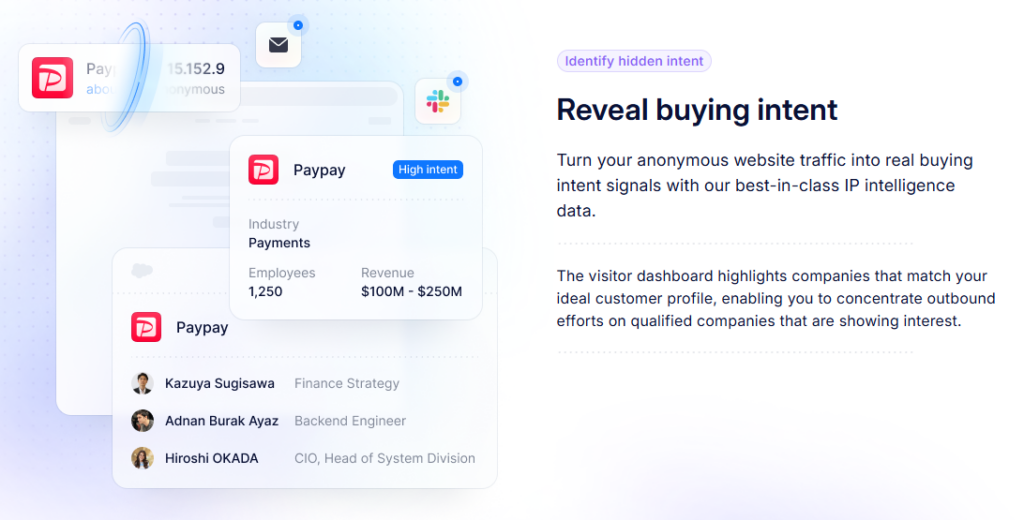
Additionally, the platform can turn your website into a data asset through its IP-to-company resolution, known as Reveal API.
It enriches anonymous traffic with company profiles and behavioral signals to support more informed engagement.
Source: Clearbit
Like Veridion, Clearbit adopts an API-first architecture, allowing teams to integrate enrichment directly into existing workflows without requiring a full platform overhaul.
Following its acquisition by HubSpot in December 2023, Clearbit is particularly well integrated into the HubSpot ecosystem, although its capabilities remain accessible via API to other systems.
While Clearbit excels at real-time enrichment and revenue intelligence, its international dataset is smaller than those of platforms like Veridion and ZoomInfo.
Since its primary focus is on marketing, sales, and revenue operations, Clearbit is a better fit for marketing and sales operations teams than for large-scale analytics, ESG, or risk modeling initiatives.
Apollo.io is a sales intelligence and engagement platform designed to help teams find prospects, enrich data, and execute multi-channel outreach at scale.
It positions itself as a unified workflow solution built on four core pillars:
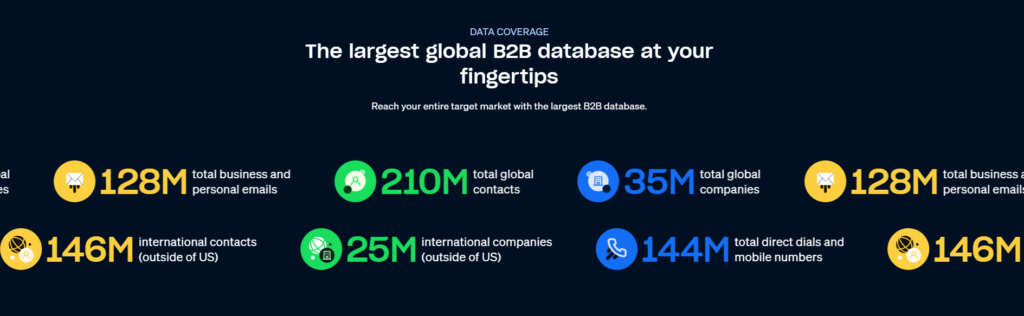
Apollo.io provides access to 210M+ contacts and 30M+ companies, alongside built-in outreach automation, a dialer, meeting intelligence, and pipeline management tools.
Source: Apollo.io
In addition to firmographics and job titles, Apollo.io includes technographic data and company hierarchies, enabling large-scale segmentation and account prioritization.
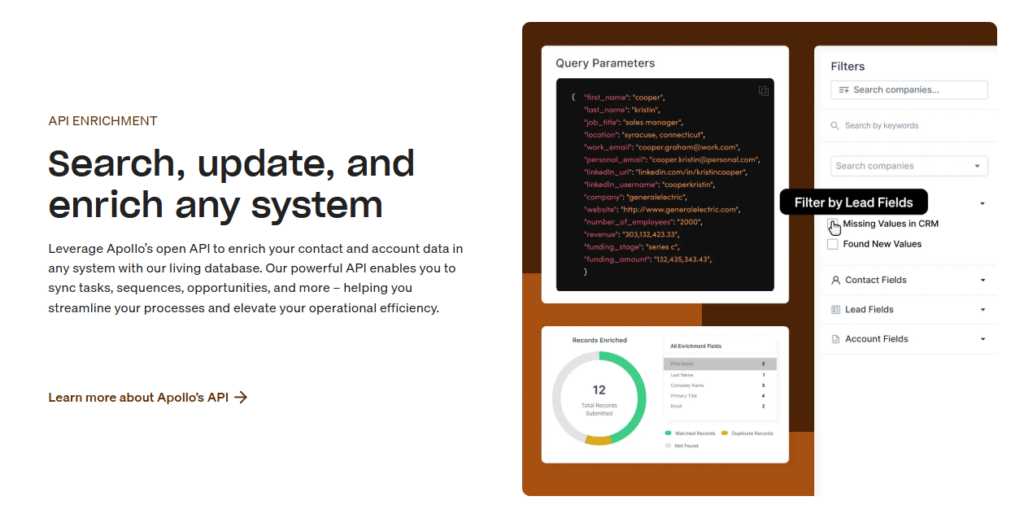
It automatically enriches CRM records by adding missing information, including email addresses, phone numbers, job titles, and company attributes.
Source: Apollo.io
This helps maintain database accuracy and improves downstream analytics, lead scoring, and territory planning.
What truly differentiates Apollo.io in the big data landscape is its integration of data and execution.
While many providers stop at delivering datasets, Apollo embeds its database directly into engagement workflows.
Sequencing, dialing, meeting tracking, deal management, and pipeline analytics are all within the same system, enabling data signals to translate directly into action without switching platforms.
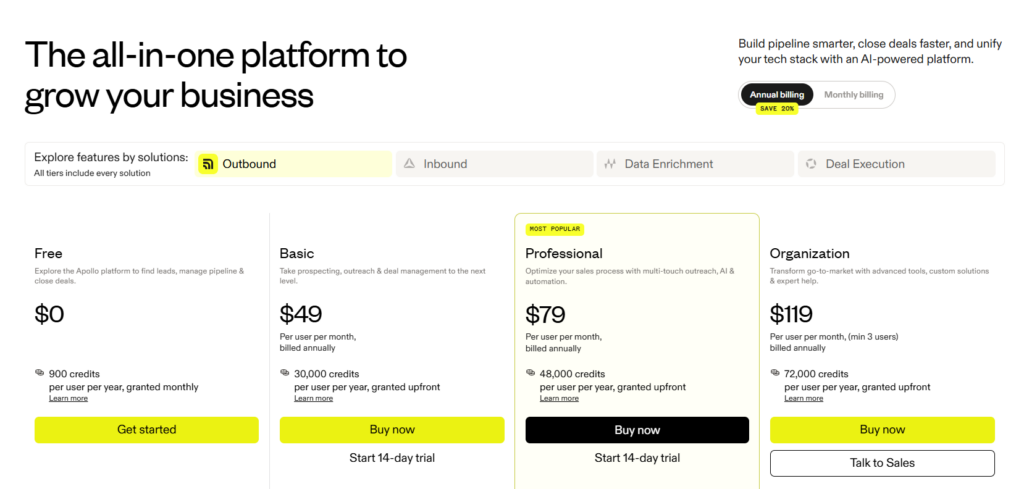
Another structural advantage is its freemium distribution model.
By introducing this model into a market dominated by five-figure enterprise contracts, Apollo.io fundamentally changed who could access B2B intelligence.
Source: Apollo.io
Startups and SMBs that previously couldn’t afford access to other companies’ data can access contacts and run sophisticated outbound operations from day one.
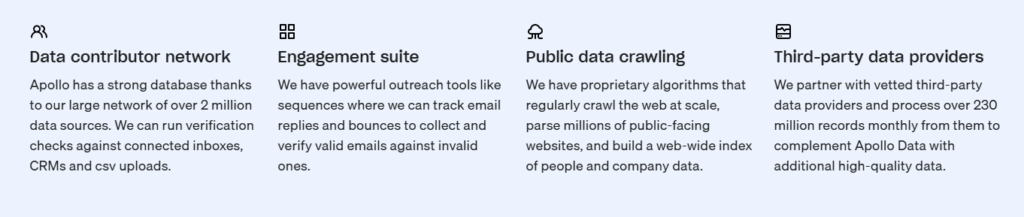
Its large user base contributes to ongoing data validation and refresh cycles, helping maintain broad coverage across company sizes and industries.
Source: Apollo.io
Rather than relying solely on periodic static refreshes, Apollo continuously verifies data through engagement signals, bounce detection, and job-change monitoring.

Source: Apollo.io
This helps ensure that frequently engaged contacts remain current when accuracy matters most.
On the downside, Apollo.io’s breadth comes at the cost of depth.
Organizations seeking deep global coverage, multidimensional analytics, ESG intelligence, or advanced risk modeling capabilities may find platforms such as Veridion or ZoomInfo better suited to complex, analytics-driven big data initiatives.
Apollo.io is best suited for teams focused on prospecting, ABM, and revenue operations that require both structured data and built-in execution capabilities.
AlphaSense is a market intelligence and financial research platform that helps professionals extract insights from vast volumes of unstructured business content.
At its core, it combines a large proprietary content library with advanced AI-driven search capabilities built specifically for financial and corporate analysis.
The platform aggregates more than 500M+ premium business documents, including public company filings, earnings transcripts, broker research, expert call transcripts, trade journals, news sources, and internal enterprise documents.
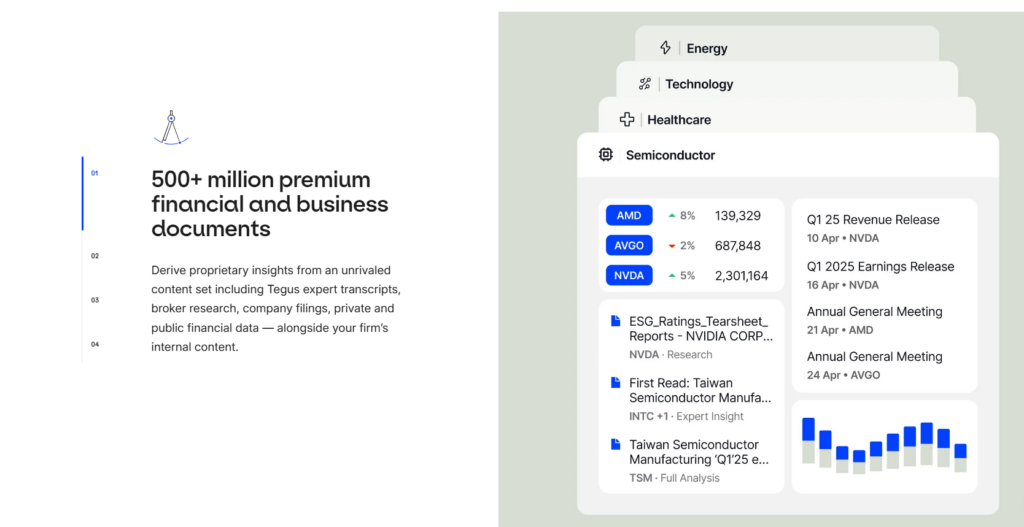
Source: AlphaSense
Its value lies not in contact records or operational datasets, but in the ability to surface relevant insights across millions of structured and unstructured sources with precision.
While most platforms compete on database breadth, Alphasense differentiates through depth of intelligence.
Its AI-powered search and Smart Synonyms™ technology expand queries contextually rather than relying on simple keyword matching.
This allows users to identify emerging themes, risk disclosures, competitive shifts, and strategic inflection points that traditional search tools often miss.
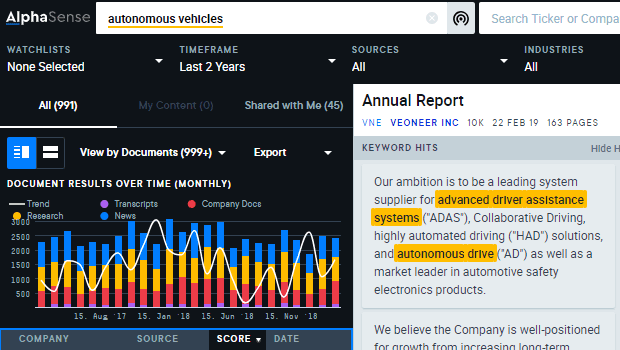
Source: AlphaSense
Unlike general-purpose AI systems, AlphaSense’s models are trained on financial and business language, enabling more accurate interpretation of industry terminology and nuanced corporate disclosures.
Recent innovations include Workflow Agents that automate the entire research deliverables process.
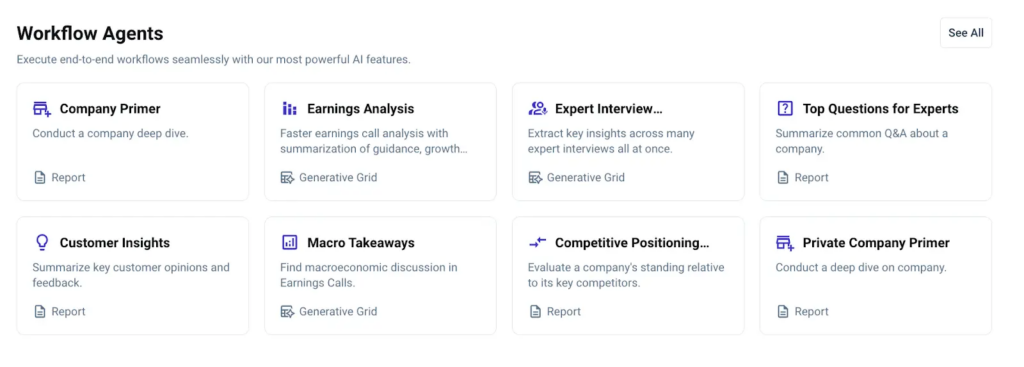
Source: AlphaSense
Analysts can generate company profiles, competitive landscapes, and investment memos in minutes.
The Generative Grid extends this further, allowing analysts to ask multiple natural-language questions across thousands of documents at once and receive structured comparative tables in return.
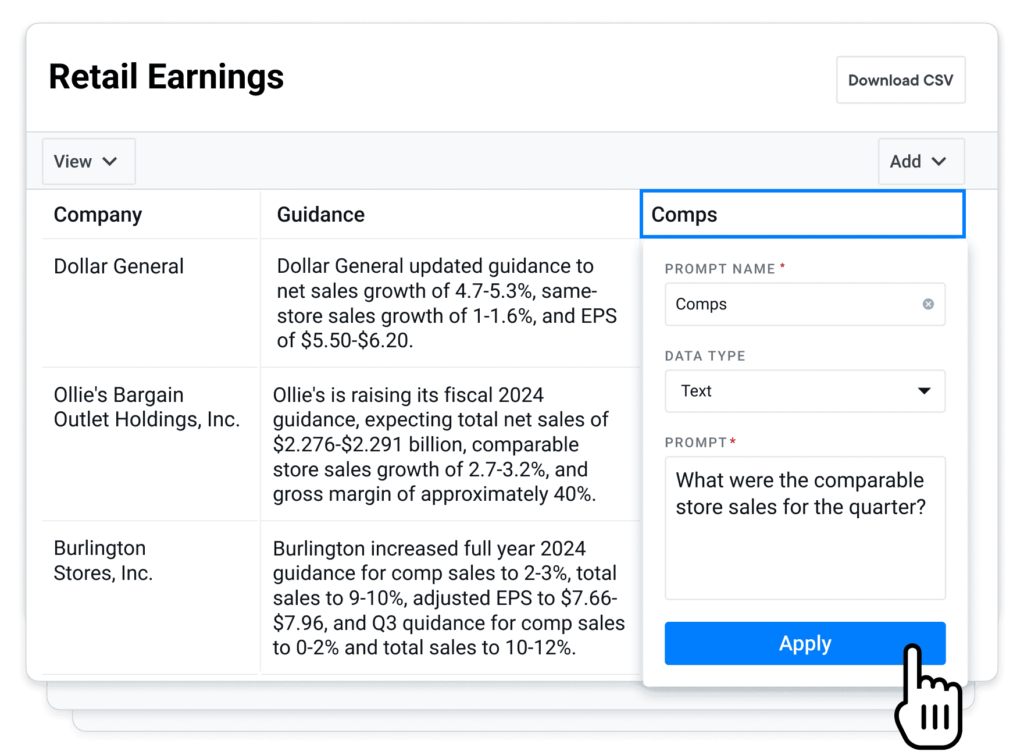
Source: AlphaSense
Beyond search, AlphaSense supports document-level insight extraction, enabling sentiment comparison across reporting periods, automated monitoring of competitor mentions, and longitudinal theme tracking.
Its ability to index internal enterprise knowledge alongside external market content creates a unified intelligence layer for strategy teams and institutional investors.
AlphaSense is built for decision intelligence.
It serves corporate strategy teams, investment professionals, M&A groups, and competitive intelligence leaders who require deep research across financial filings, transcripts, and proprietary documents.
It is not a sales engagement platform and does not provide contact databases, sequencing tools, or CRM enrichment.
Organizations seeking structured operational datasets or revenue execution workflows will find other platforms more suitable.
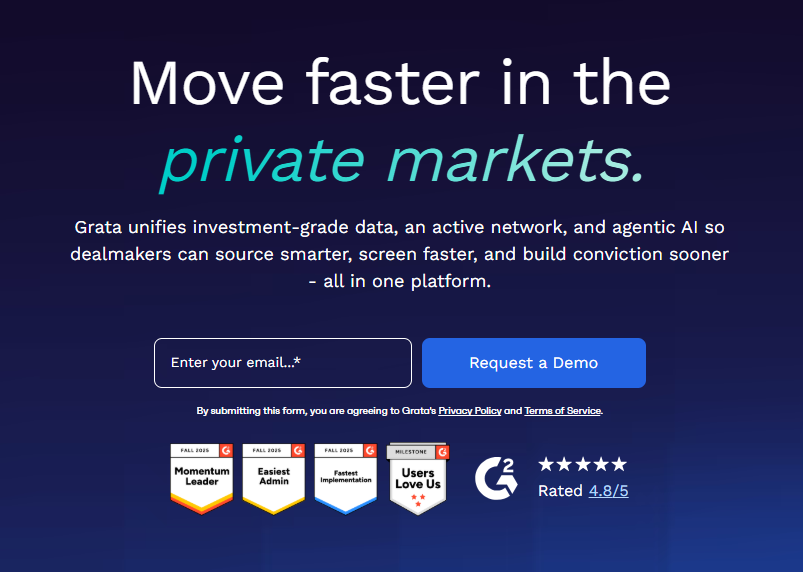
Grata is a private market intelligence platform built specifically for sourcing and researching privately held companies.
While many platforms concentrate on public companies or highly visible enterprises, Grata centers its coverage on more than 19 million private companies, primarily across the U.S. lower middle market.
Source: Grata
These businesses rarely appear in public filings or traditional financial terminals, yet represent a substantial portion of real economic activity.
Grata’s core value lies in making this fragmented segment more searchable and analyzable.
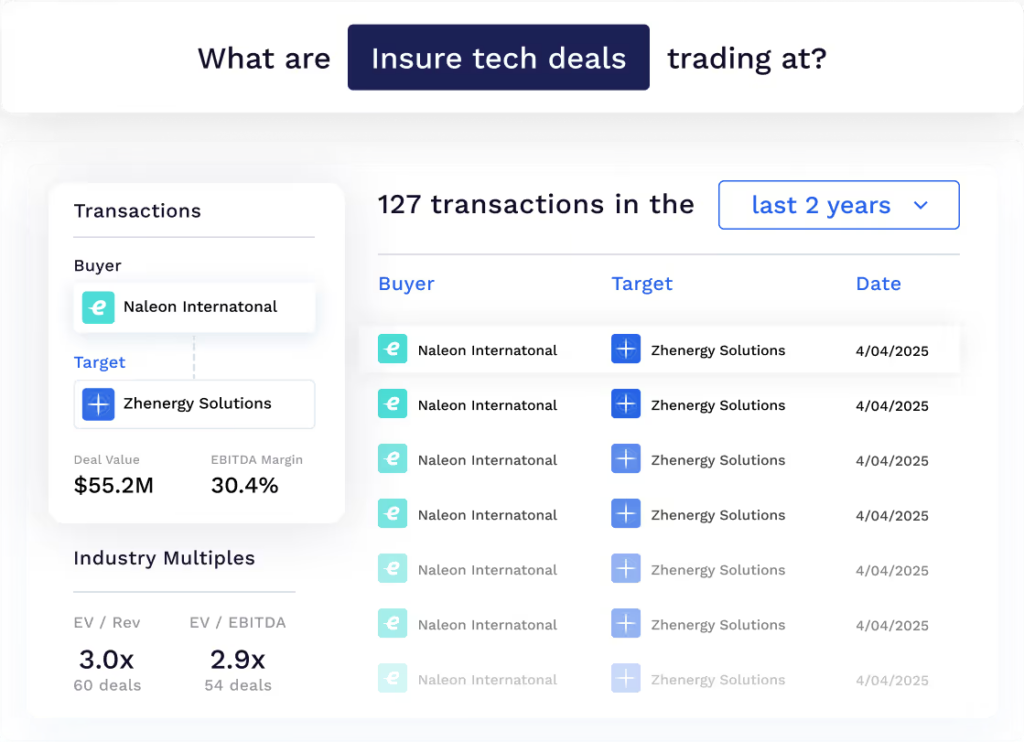
A key differentiator is its AI-powered thesis-driven search.
Rather than requiring rigid filtering criteria, Grata allows users to describe an investment theme in natural language and surfaces relevant companies based on contextual interpretation.
Source: Grata
This shifts the experience from database querying to hypothesis exploration
The company’s merger with SourceScrub introduced a hybrid intelligence model that combines machine-learning-driven discovery with human-curated data from more than 220,000 information sources.
This blend strengthens both the breadth of coverage and data reliability within the private markets ecosystem.
Instead of relying exclusively on legacy industry codes such as NAICS or SIC, it applies a proprietary taxonomy based on how businesses describe themselves online.
This enables:
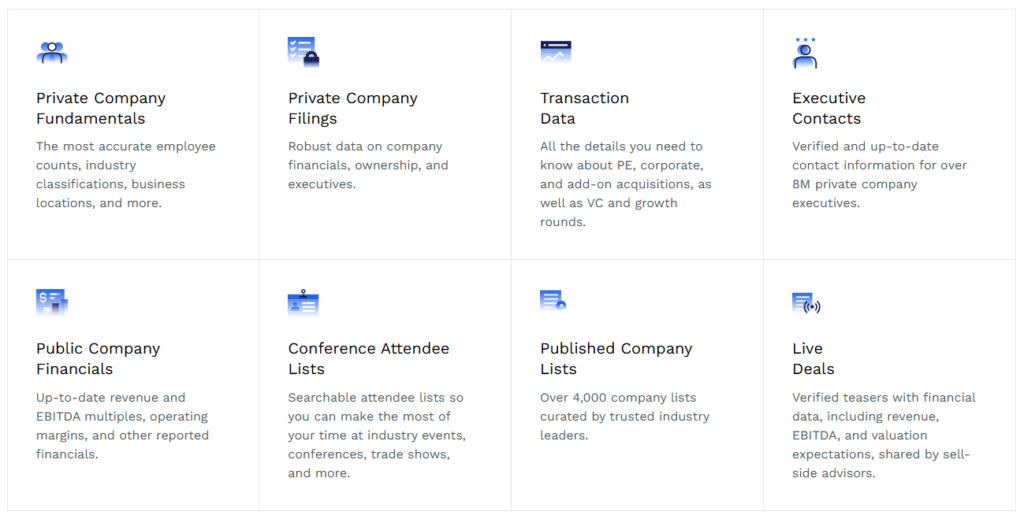
The platform also provides modeled financial estimates, including revenue ranges, headcount, growth indicators, and transaction signals for private companies.
In other words, data that historically required specialized research networks to obtain.
Source: Grata
Following its acquisition by Datasite, Grata now sits within a broader mergers and acquisitions (M&A) infrastructure ecosystem that strategically links pre-deal sourcing intelligence to deal-execution workflows.
Grata is purpose-built for private equity firms, investment banks, and corporate development teams.
Organizations outside M&A workflows that require contact enrichment, operational datasets, or broad global coverage may find other platforms more suitable.
The modern big data landscape is no longer defined by who has the largest database.
It’s defined by who transforms raw, unstructured, and fragmented information into actionable, predictive intelligence.
Each of the platforms we’ve reviewed reflects a different philosophy for what big data should accomplish.
Some are built for revenue acceleration. Others power investment research, private equity sourcing, or enterprise enrichment workflows.
At the end of the day, the best big data platform is one that’s aligned with your strategic objective.
Remember, clarity of purpose matters more than volume of records.
The organizations with a competitive advantage will be those that turn data into direction, and direction into decisive action.