



Blog
Top 7 Platforms Providing Private Company Data
By: Auras Tanase -
01 April 2026


We love our data, and now that you're here, you're one step closer to loving it too.
A wide sample of data, so you can explore what is possible with our data
Choose ->
built with procurement in mind. Focused on manufacturers, products and more
Choose ->
built with insurance in mind. Focused on classifications, business activity tags and more
Choose ->
built with sustainability in mind. Focused on sustainability commitments, and environmental and social governance insights.
Choose ->
built with strategic insights in mind. Focused on market trends, competitor analysis, and industry-specific data
Choose ->

Keep up to date with our technology, what our clients are doing and get interesting monthly market insights.

How much visibility do you really have into the private companies you rely on?
In global enterprises, decisions about procurement, underwriting, investment, and partnerships often hinge on data that isn’t publicly disclosed.
To make matters worse, private company intelligence is fragmented across filings, digital footprints, and myriad third-party sources.
That’s why we’ve compiled a list of the seven best platforms providing private company data.
By the end, we hope you’ll have what you need to make the right choice for your strategies.
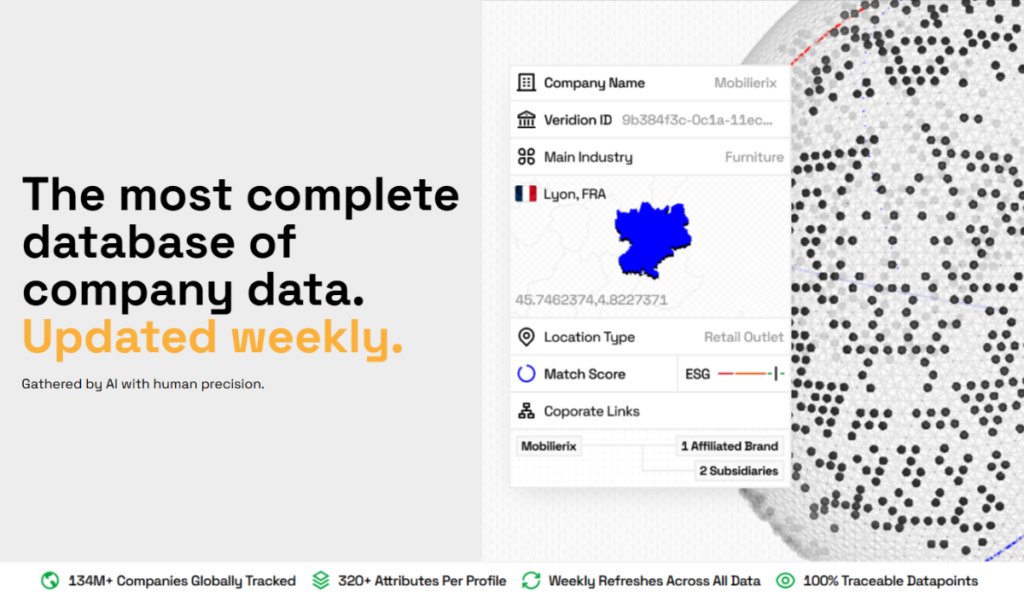
Veridion is an AI-driven company data platform, and it delivers unmatched, comprehensive, up-to-date insights on private businesses worldwide.
And yes, at the moment, it’s the most complete database of company data.
Source: Veridion
How so?
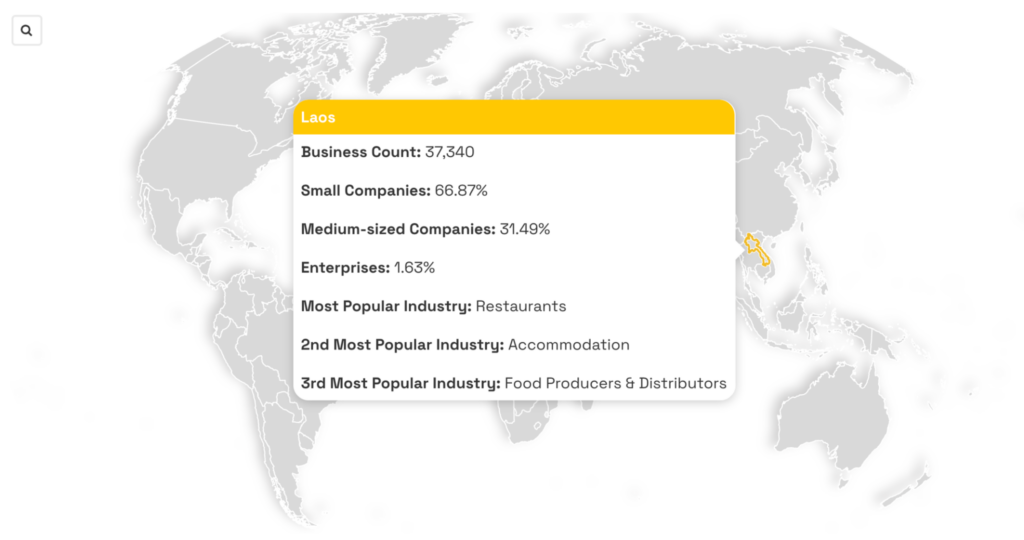
Well, Veridion analyzes over 800 billion web pages weekly to build and refresh detailed profiles of more than 134 million suppliers across 250 countries.
This platform works wonders for procurement leaders, insurance underwriters, market intelligence teams, and risk managers in large enterprises.
It supports:
This comes in handy in complex or fragmented global markets.
One of its best key features is the natural language search through the Scout interface, which means you don’t need to guess exact company names.
You can type something like “wholesale leather boot suppliers in Europe,” and the platform returns verified private companies that match your criteria.
That removes a huge discovery barrier if you’re dealing with fragmented private markets.
What’s more, Veridion also delivers product-level data classified using UNSPSC standards.
So instead of vague industry labels, you see what companies actually sell, down to specific products and services.
And the good news is, access is flexible. You can use the intuitive UI for fast research or integrate APIs directly into your internal systems.
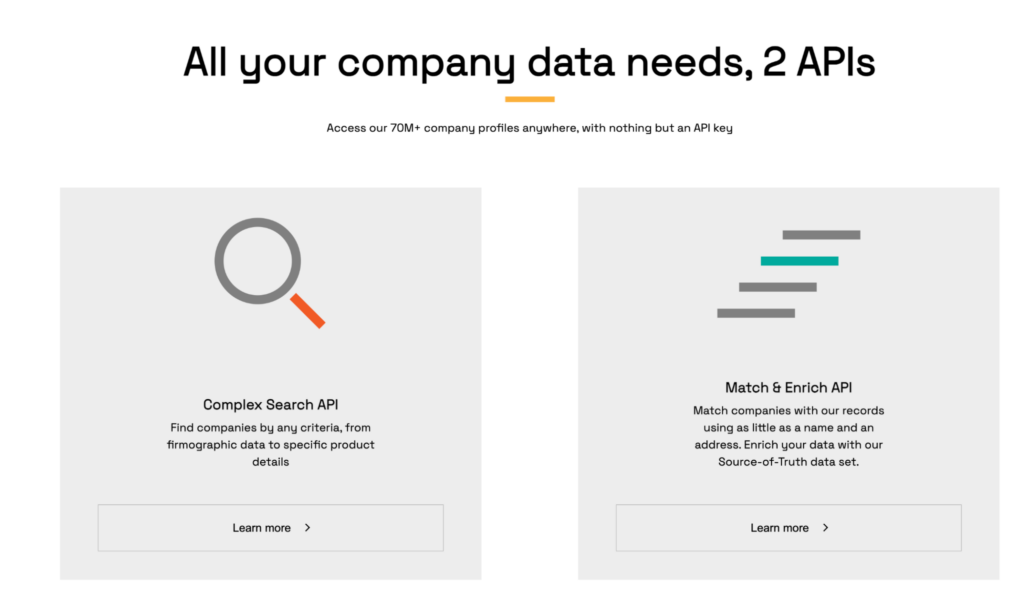
Speaking of APIs, Veridion uses two core models:
Source: Veridion
The Search API lets you find companies using a rule-based logic, like the leather boot supplier example we mentioned earlier.
The Match & Enrich API works in the opposite way, giving you a full, enriched company profile from the only details you know (for example, a company’s name and country).
But perhaps the platform’s strongest point is its balanced mix of global reach and data freshness.
Source: Veridion
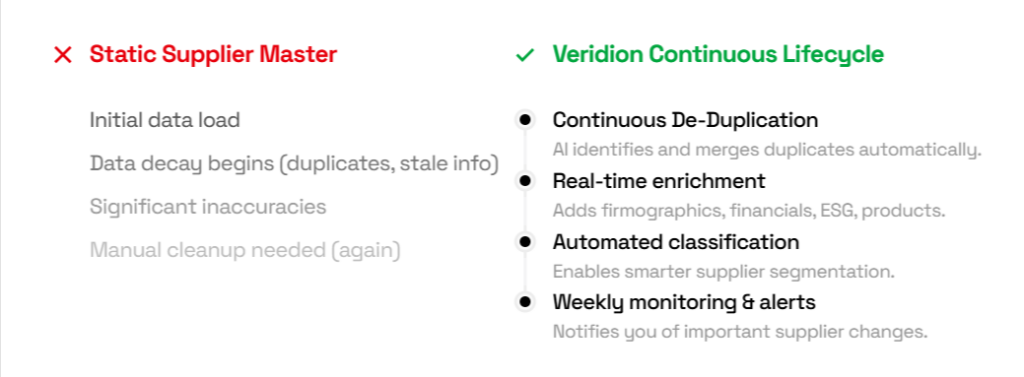
Veridion’s continuous lifecycle model means you don’t have to worry about data accuracy or any sort of manual updates or check-ups.
Source: Veridion
It also integrates with existing enterprise tools like Coupa.
As for limitations, Veridion does not position itself as a full financial market terminal. So it may not replace traditional capital markets datasets for publicly listed firms.
Pricing is customized based on use case, data volume, and integration requirements. But if you’re curious, you can get a free sample today, or better yet, schedule a data consultation.
Use Veridion when you need operational depth at scale.
If your focus leans more toward capital markets and securities data, though, the next platforms in this article approach private company intelligence from a financial markets perspective.
Crunchbase is one of the most recognizable names in company intelligence, especially if you care about who’s scaling fast or who might disrupt your market next.
If you want early visibility into private companies before they become headline news, this is often where you look.
Yep, Crunchbase is all about predictive company intelligence.
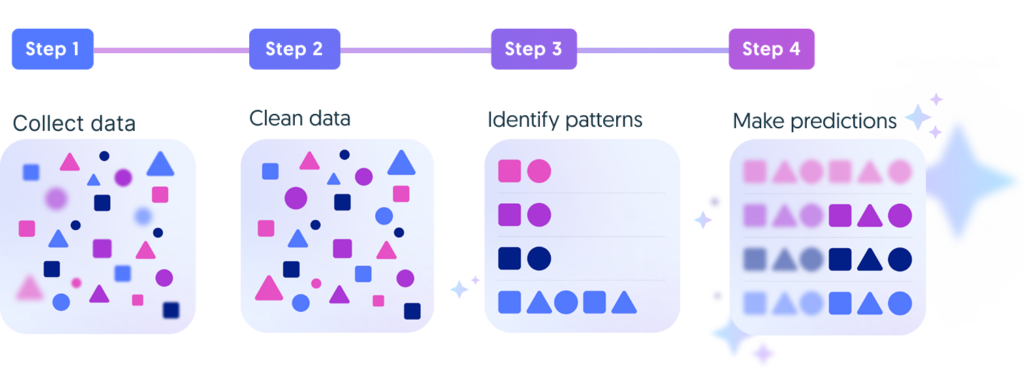
Source: Crunchbase
It’s truly useful for corporate development teams, venture arms, innovation leaders, and executives who need forward-looking insight into emerging players.
If your job involves spotting growth signals before your competitors do, Crunchbase positions itself right at the top of your contender list.
Here’s an example of how their predictive intelligence reports look:
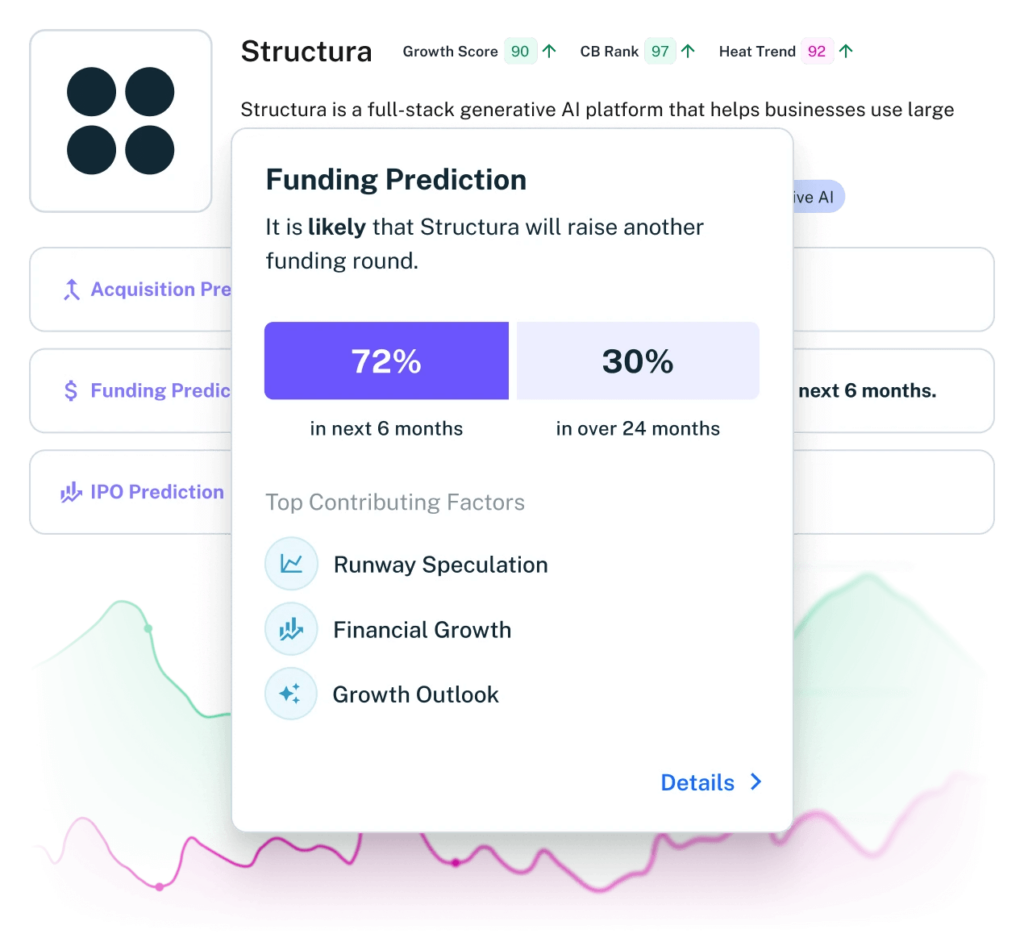
Source: Crunchbase
In short, their most unique features are their predictive growth signals and proprietary forecasting models designed to identify companies likely to raise funding, grow headcount, or experience momentum shifts.
But their key features go beyond this:
And besides its unique key features, Crunchbase has the advantage of a broad coverage of venture-backed and growth-stage firms.
It also offers a user-friendly search functionality, plus API access for teams that want to embed data into internal systems.
However, Crunchbase data is partially crowd-sourced and may rely on company-submitted information.
This means coverage depth for smaller, non-funded private companies can vary.
Their pricing includes three subscription plans, as shown below:
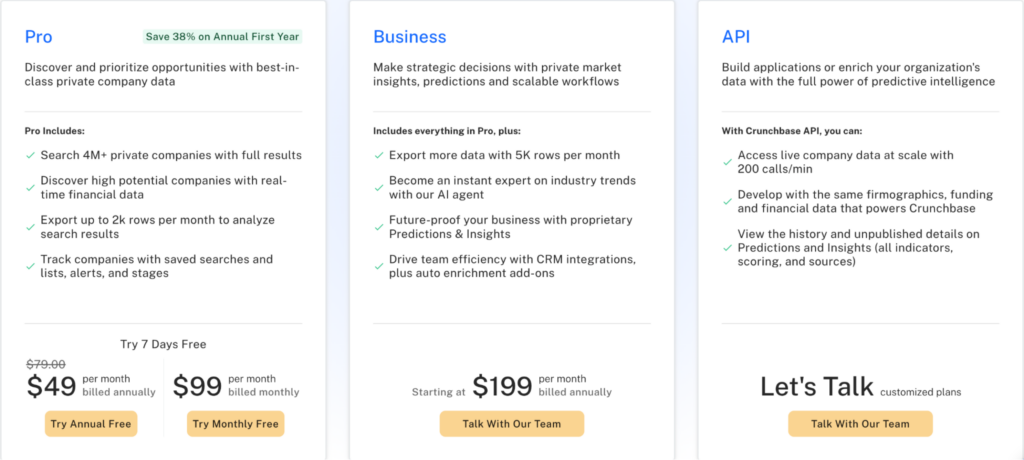
Source: Crunchbase
If you’re researching on your own, Pro (from $49/month billed annually) gives you a solid enough search and export power.
If you’re making team-level strategic decisions, Business adds predictions, AI tools, and CRM integrations.
And the API tier is there if you want to plug Crunchbase data directly into your own systems.
PrivCo positions itself as one of the most comprehensive financial data models for U.S. private companies.
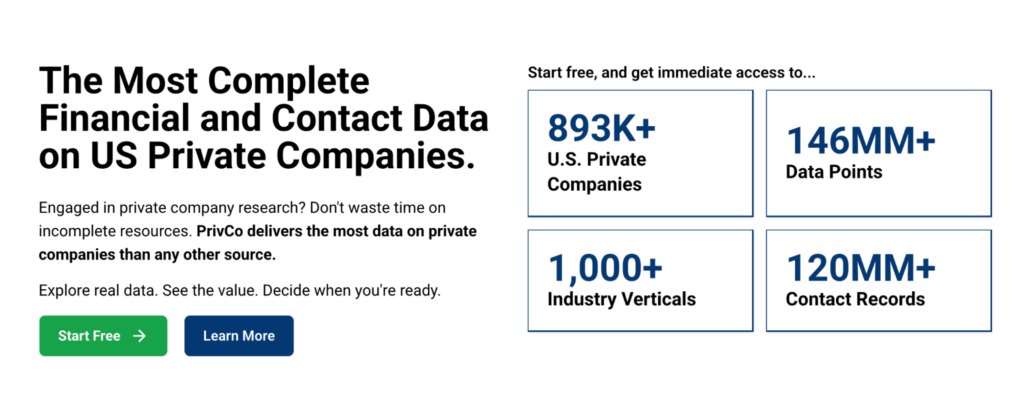
Source: PrivCo
So if your challenge is that private firms don’t publish audited reports the way public companies do, PrivCo steps in with structured financial estimates and deal intelligence to fill that gap.
That’s why this tool is used by a lot of investment banks, private equity firms, credit analysts, and corporate finance teams.
They need defensible revenue and transaction data on privately held U.S. businesses.
When you’re modeling valuations, screening acquisition targets, or benchmarking competitors, you need numbers you can actually work with.
Their key features include:
PrivCo focuses less on global supplier discovery, like say, Veridion, and more on giving you structured, finance-ready intelligence for U.S. private firms.
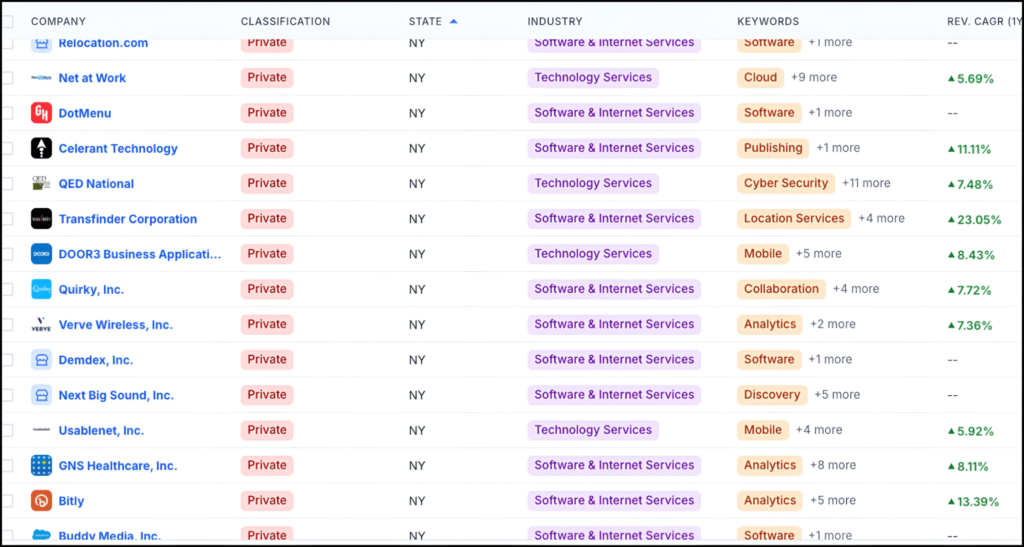
Source: PrivCo
So it’s a solid option if you’re evaluating risk exposure or preparing for deal discussions.
One of its advantages is its dedicated focus on private company financials, which can be notoriously hard to get through traditional market data providers.
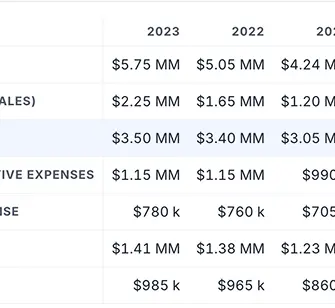
Source: PrivCo
PrivCo offers structured datasets tailored for financial modeling and deal analysis.
Meaning you can plug revenue estimates, EBITDA figures, ownership data, and transaction history directly into valuation models, compare targets side by side, assess leverage and growth potential, and, in turn, make more informed decisions.
On the downside, revenue and financial figures are frequently modeled or estimated rather than officially reported, so you should treat them as directional indicators rather than audited data.
And, just to drive the point home, if you want data on companies outside the U.S., PrivCo is not for you.
Pricing is subscription-based and targeted at institutional users:
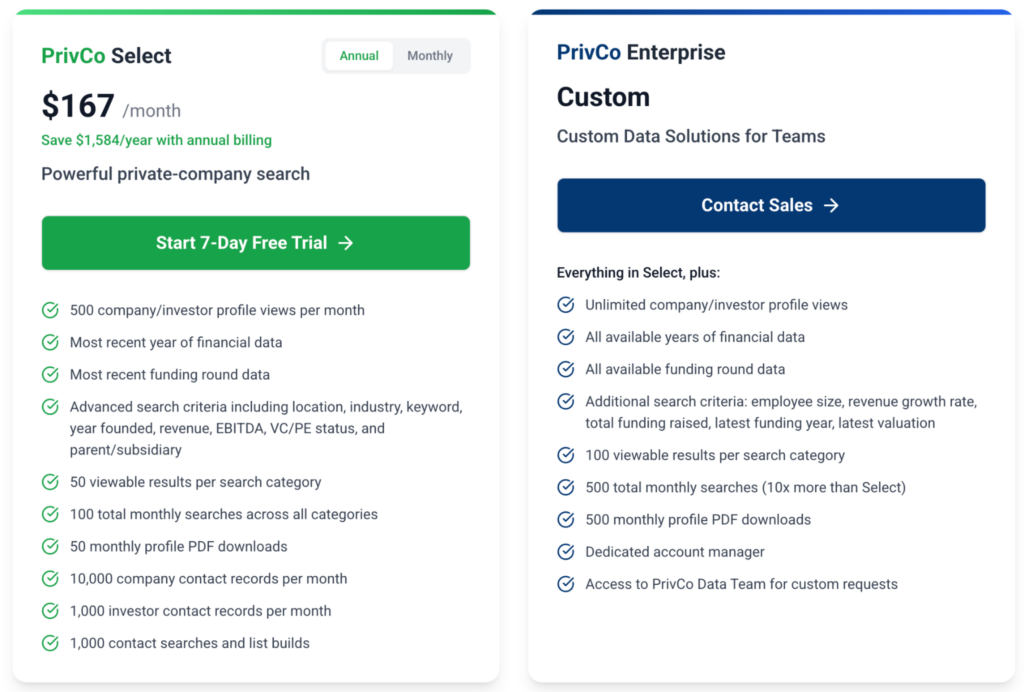
Source: PrivCo
If your priority is finance-ready intelligence on U.S. private companies, PrivCo delivers true depth.
But if you need audited figures or broad global coverage, you’ll need to look elsewhere.
LSEG (London Stock Exchange Group) offers private company data through its wider financial data and analytics ecosystem.
Its datasets are integrated into enterprise-grade solutions used in banking, asset management, and risk functions alike.
But where this platform really shines is for global financial institutions and multinationals that already rely on LSEG infrastructure for market data and analytics.
Key features include:
These are delivered through LSEG Workspace, a platform designed for high-stakes, cross-asset decision-making environments.
One big advantage is that you can assess the impact of key variables, like commodity flows, weather disruptions, vessel movements, etc, in real time.
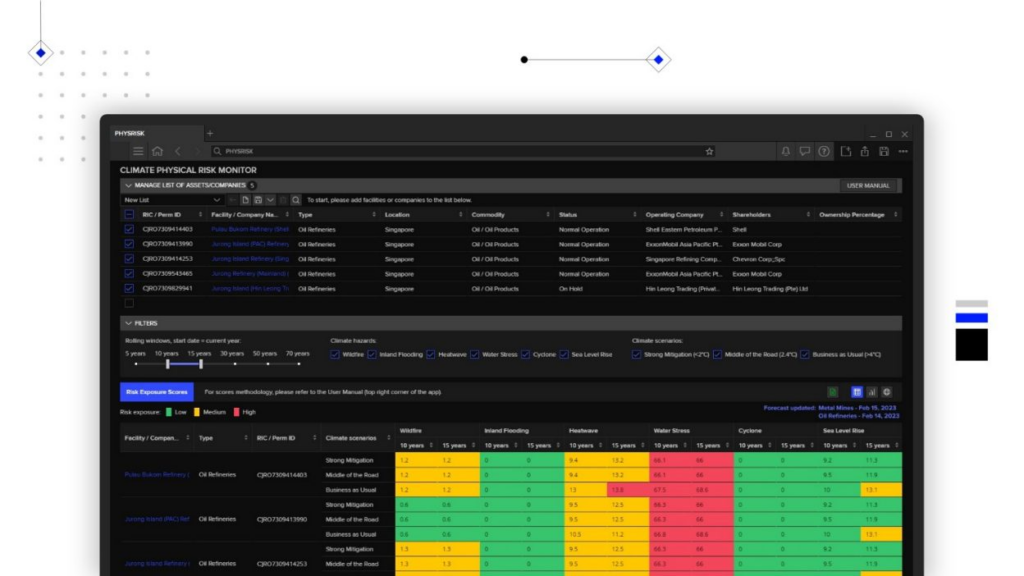
Source: LSEG
This is extra valuable if private suppliers operate in volatile markets.
LSEG’s platform also provides access to advanced research and forecasts on commodities and financial markets.
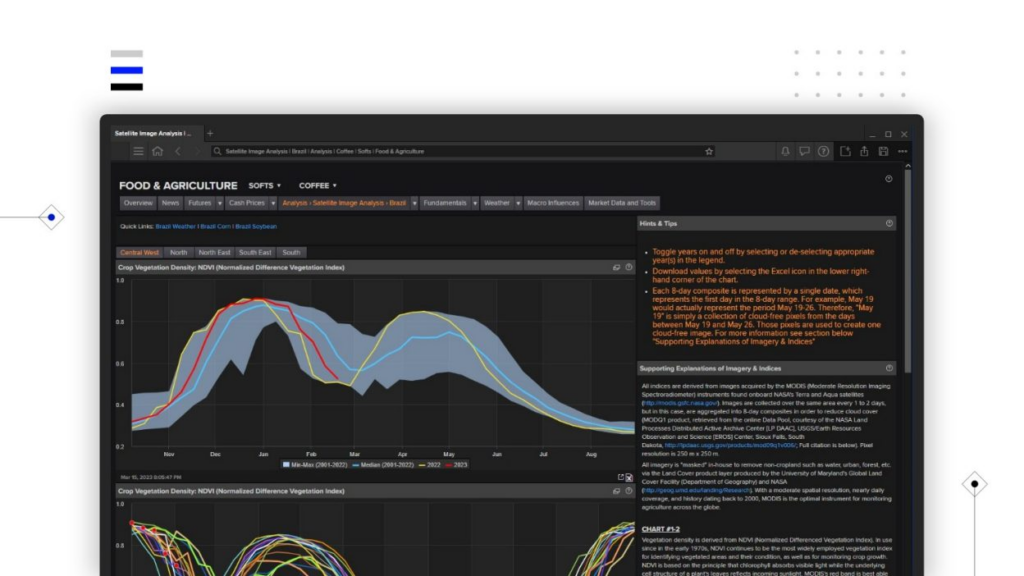
Source: LSEG
If you’re managing risk exposure, this means you can evaluate how macroeconomic shifts, pricing trends, or geopolitical developments might affect private counterparties in your ecosystem.
Another core strength is early insight.
You gain access to broker research, proprietary analytics, and Reuters News, plus over 10,000 authoritative sources. This helps you act before market shifts fully materialize.
LSEG’s platform integrates financial data, analytics, and market-moving news within a user-friendly interface that supports multi-screen workflows.
This unified environment can really reduce friction between analysis and execution, and that’s one of their greatest assets.
However, the platform may be more complex and expensive than standalone tools. Even more so for organizations that don’t already use LSEG products.
And this chapter would be incomplete without Trustpilot’s concerningly low reviews of LSEG over the last few years.
Most complain of non-transparent communication and inefficient customer support.
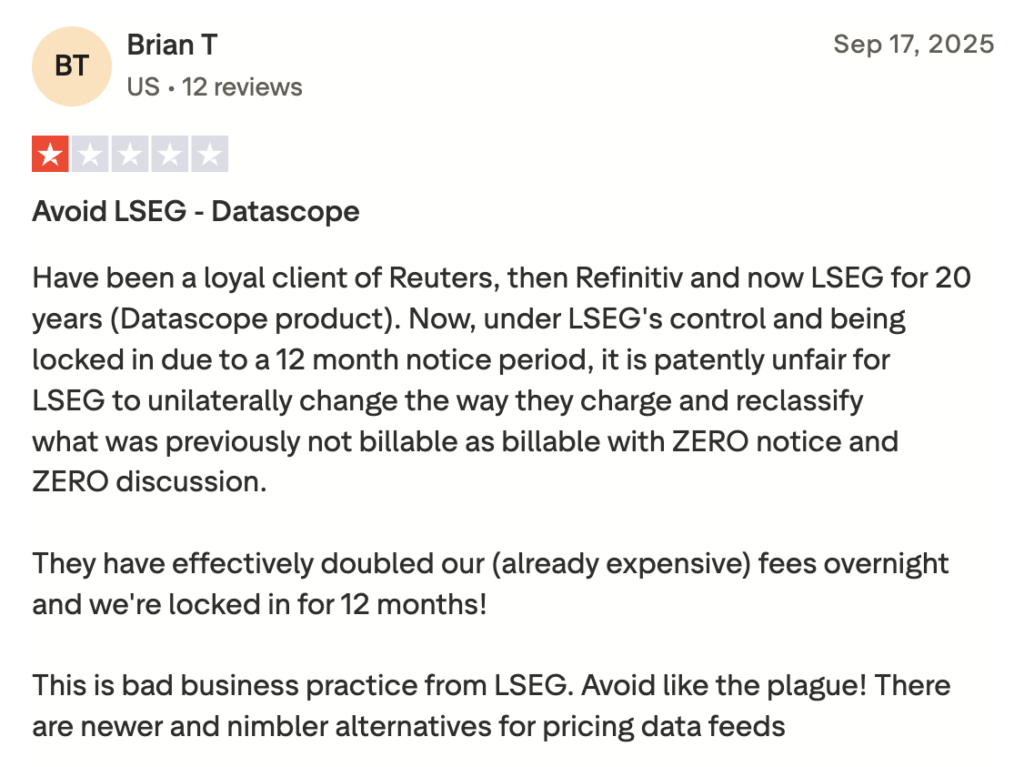
Source: Trustpilot
Pricing is enterprise-level and typically customized, depending on data modules and user access.
If you already operate inside a capital markets ecosystem and need private company data layered seamlessly alongside public markets intelligence, LSEG could be a top choice.
But if you’re looking for a simpler, more procurement-focused, or globally supplier-centric solution, other platforms are better.
S&P Global is known for financial intelligence, credit ratings, and in-depth industry research.
Through its Market Intelligence division—specifically its flagship Capital IQ Pro platform—S&P delivers private company data as part of a wide analytics system.
And its scale is noteworthy:
S&P Global is often used by corporate strategists, risk managers, underwriters, and investment professionals—basically, all those who need consistently accurate financial data on private entities.
Their financials coverage speaks for itself:
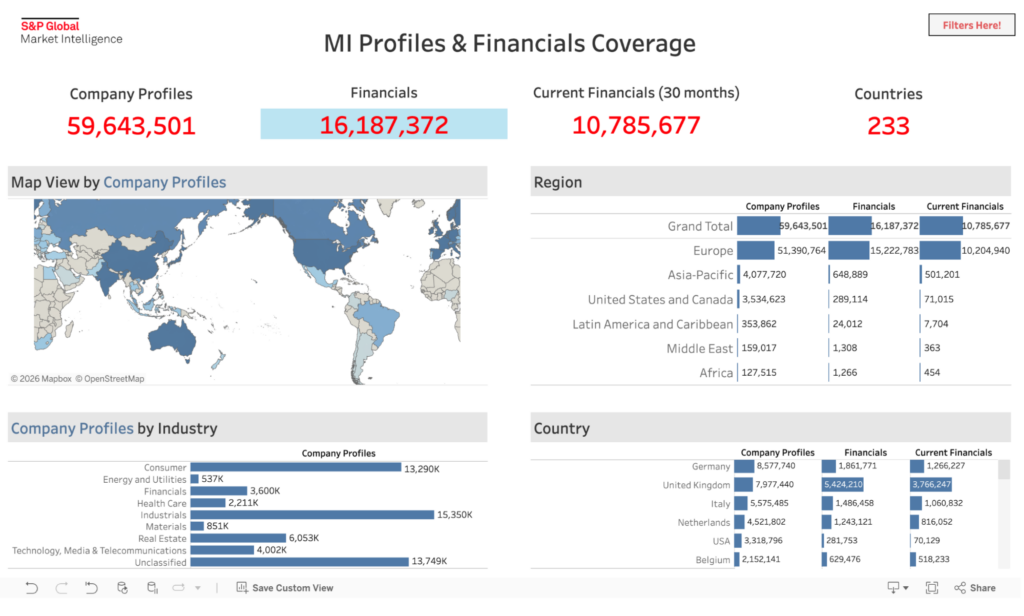
Source: S&P Global
Key features include private company financial estimates, credit risk metrics, industry benchmarking tools, ownership data, and integration with Excel-based modeling workflows.
Its datasets support valuation analysis, peer comparisons, and structured credit assessments.
Plus, the Capital IQ Pro platform has recently upped its research & analysis game using AI.
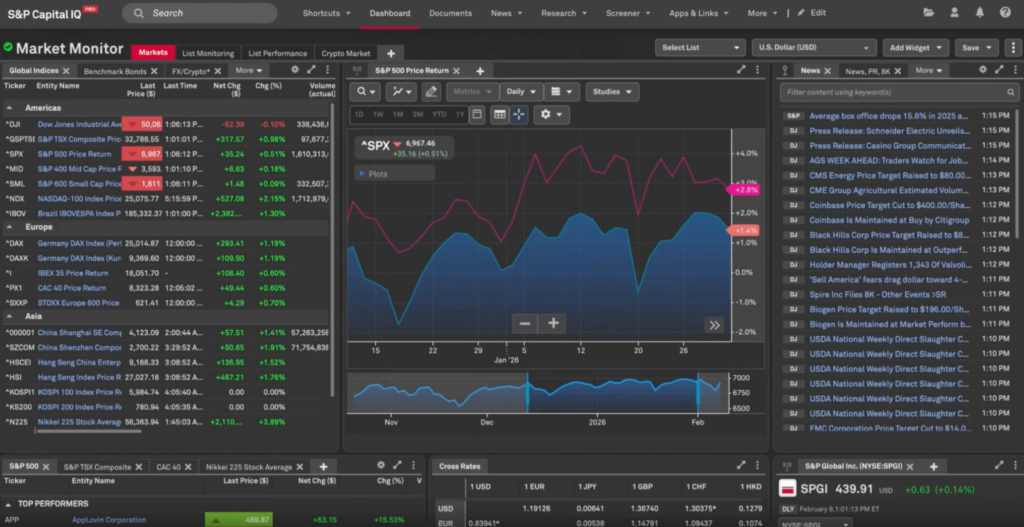
Source: S&P Global
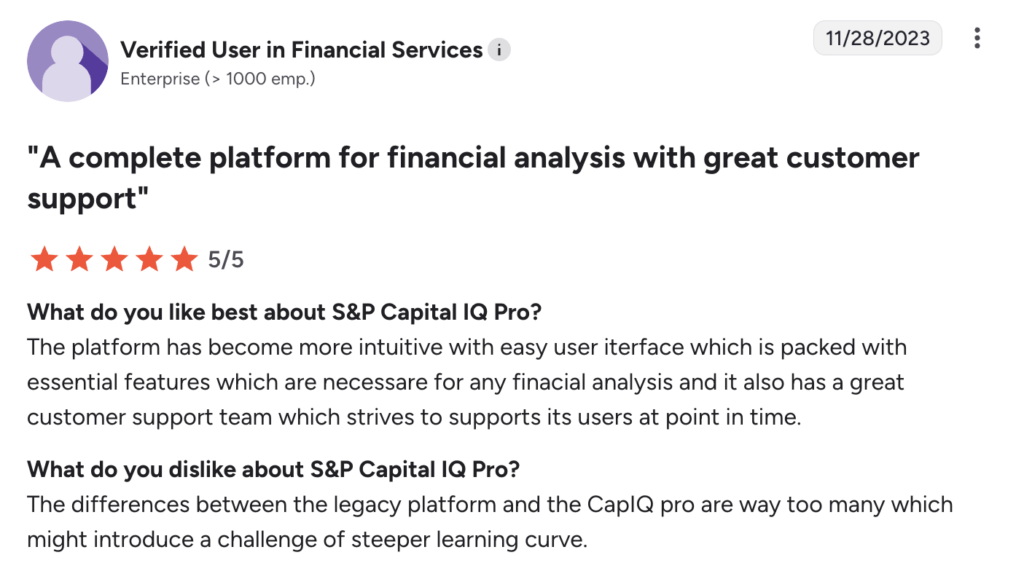
G2 shows a lot of positive reviews for S&P Capital IQ Pro, most centered around great coverage, responsive customer support, and an increasingly better user interface.
Source: G2
But there’s always a trade-off.
In this case, access is typically bundled within larger enterprise subscriptions. This may limit flexibility for smaller teams.
Some reviews confirm this, complaining about the pricing structure as well as the platform’s complexity.
Pricing is not publicly available and is generally structured around enterprise agreements.
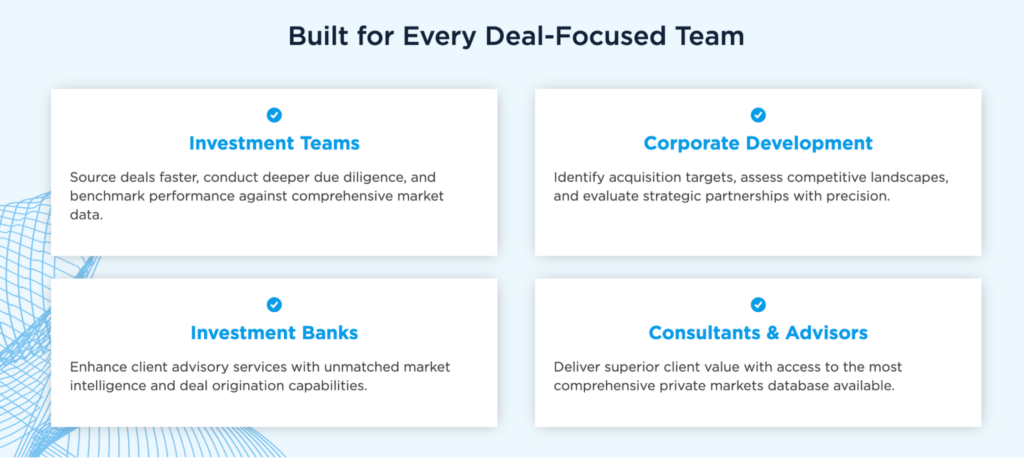
Dakota is a platform focused on private market participants, with a hyper-focus on portfolio companies (portcos) backed by private equity and venture capital firms.
And as their website explains, this platform is built for deal-focused teams:
Source: Dakota
Key features are built specifically for private market professionals and focus heavily on capital flows and sponsor ecosystems:
This structure makes Dakota gold if you’re in fundraising, placement, investor relations, or institutional sales.
In other words, if your strategy depends on understanding who controls capital and where it’s being deployed.
So it’s less about what a private company sells and more about who owns it, funds it, and competes with it in the private capital ecosystem.
However, it may not offer the same depth of operational, supplier, or product-level data as broader company intelligence platforms.
Plus, pricing stands at a whopping $16,500 per year, with $1,000 per additional user.
Dakota is thus great if private capital intelligence directly drives your revenue, but a costly overinvestment if you just need broader private company operational data.
FactSet is built for dealmakers who want private company financials that behave like public market data.
Its edge lies in registry-sourced filings, transparent methodologies, and an exclusive imputed U.S. tax financials dataset that surfaces detailed financial statements most private firms never publish.
If you’re running comps, screening targets, or building valuation decks, FactSet is designed to integrate private markets directly into your existing financial workflows.
Their key features include:
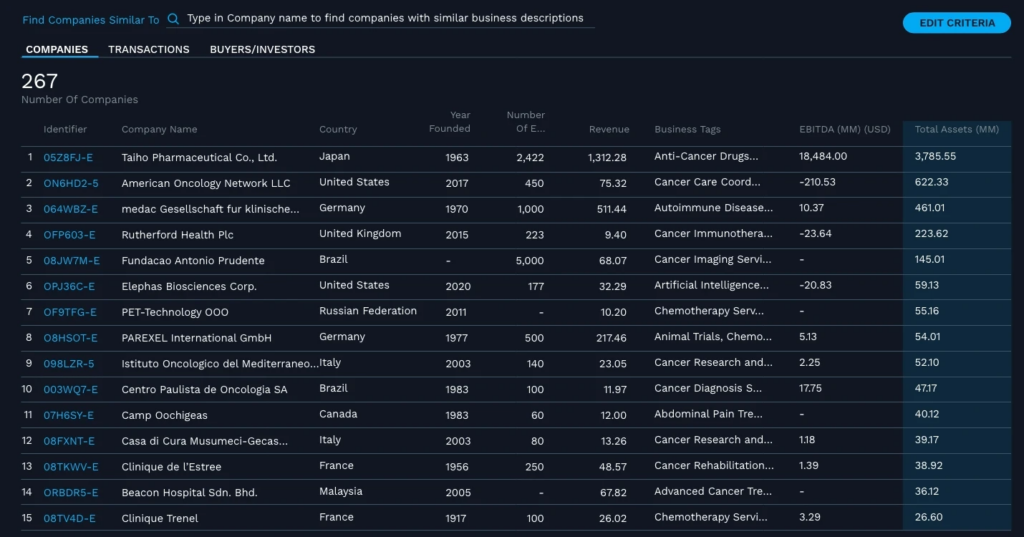
Their AI-powered screening engine is one of the platform’s strongest differentiators. It lets you filter by revenue, employee count, company multiples, and many more.
Source: FactSet
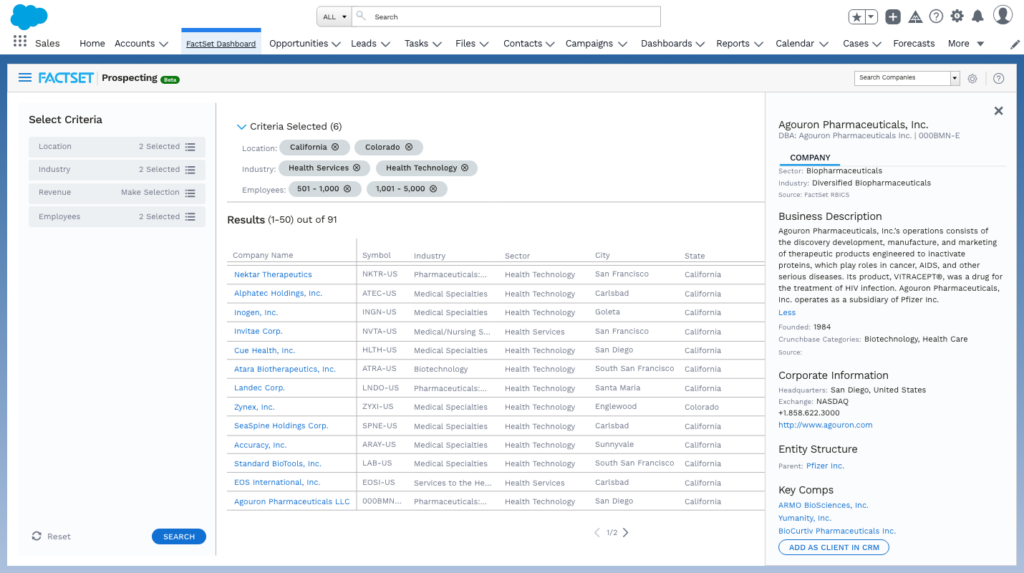
Plus, you can integrate private company data seamlessly into your CRM, internal portals, and other key applications through APIs and data feeds.
Source: FactSet
This, in turn, means simplifying your workflow and making faster, more informed decisions.
Perhaps FactSet’s greatest asset is that it makes data usable and presentation-ready within the same environment where you already analyze public markets.
One limitation is that private company coverage may be strongest for larger or transaction-active firms. So smaller companies may have more limited data depth.
Pricing is enterprise-based and bundled within FactSet’s broader data subscriptions. But you can opt for a free trial before you commit.
Access to reliable private company data is mandatory for enterprise decision-making. And we’re sure you already know this—otherwise, you wouldn’t have made it to the end of this article.
But how do you pick the best one for your goals?
Start by getting clear on what you actually need. Then test before you commit. Most of these platforms offer a demo, so why not take advantage of it?
The right private company data platform should slot naturally into your systems and give your teams the confidence they need to make the right decisions.