



Blog
Climate Risk Modeling: What You Need to Know
By: Auras Tanase -
05 April 2026

We love our data, and now that you're here, you're one step closer to loving it too.
A wide sample of data, so you can explore what is possible with our data
Choose ->
built with procurement in mind. Focused on manufacturers, products and more
Choose ->
built with insurance in mind. Focused on classifications, business activity tags and more
Choose ->
built with sustainability in mind. Focused on sustainability commitments, and environmental and social governance insights.
Choose ->
built with strategic insights in mind. Focused on market trends, competitor analysis, and industry-specific data
Choose ->

Keep up to date with our technology, what our clients are doing and get interesting monthly market insights.

Key Takeaways:
Is your organization prepared for climate risks five, ten, or thirty years from now?
As extreme weather intensifies and regulations tighten, climate risk modeling is becoming central to enterprise decision-making, risk assessment, and long-term strategy.
Yet for many leaders, the concept feels technical and overwhelming.
To help you bridge the gap, this guide breaks down what climate risk modeling actually involves, how to put it into practice, and how it relates to real business use cases.
Climate risk modeling is the process of determining climate-related risks to an organization through a combination of data, technology, and simulations.
According to the U.S. Environmental Protection Agency, climate modeling should assess two types of risks: physical and transition.
Physical risks are more obvious.
They include physical effects of climate change, such as floods, heat waves, or sea level rise.
We can further split them into two categories, acute and chronic, based on whether they are caused by short-term or long-term climate changes.
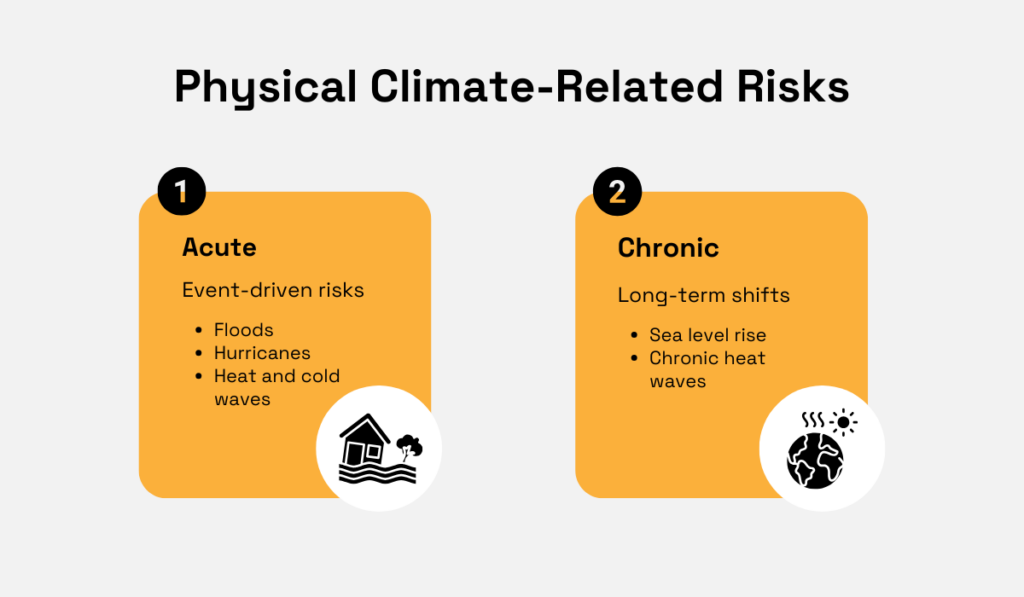
Illustration: Veridion / Data: EPA
In practice, an organization might, for instance, use climate risk modeling to determine how floods or heat waves could impact its operations and facilities.
Usually, climate modeling is used to assess the probability and impact of several risks at once.
For instance, in its self-analysis, KPMG evaluated its offices for exposure to 8 different physical hazards, including soil movement, extreme heat, and extreme wind.
They discovered that, under one scenario, 8% of offices would be at high risk of overall climate change impacts by 2030.
This share was projected to further increase to 17% by 2100.
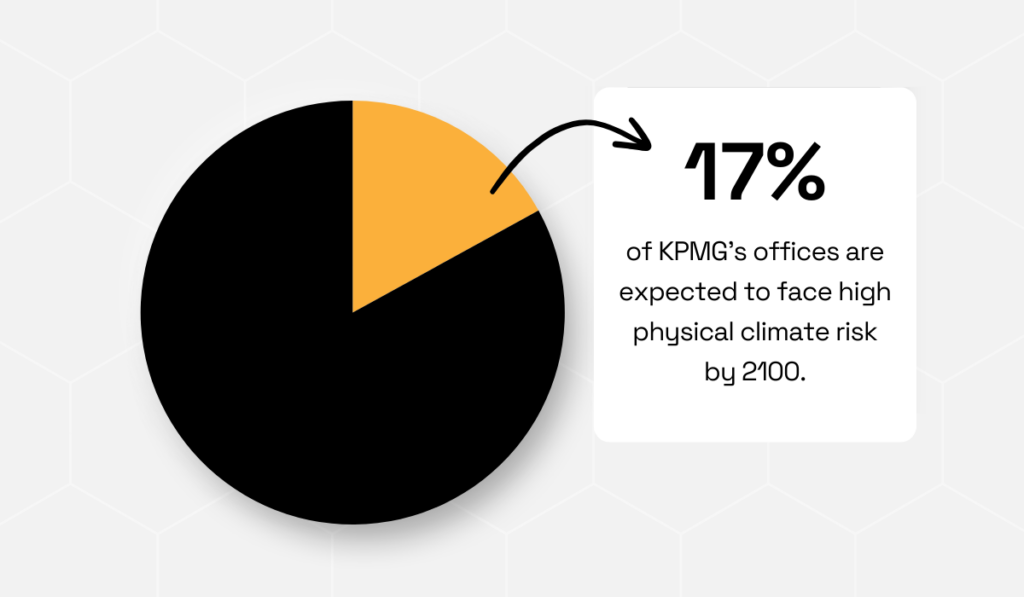
Illustration: Veridion / Data: KPMG
The effects of so-called transition risks, however, may be less evident.
These are risks associated with transitioning to more climate-friendly policies and processes, and they can arise from both adapting and not adapting to climate change.
EPA divides them into four categories: policy and legal, technology, market, and reputation.
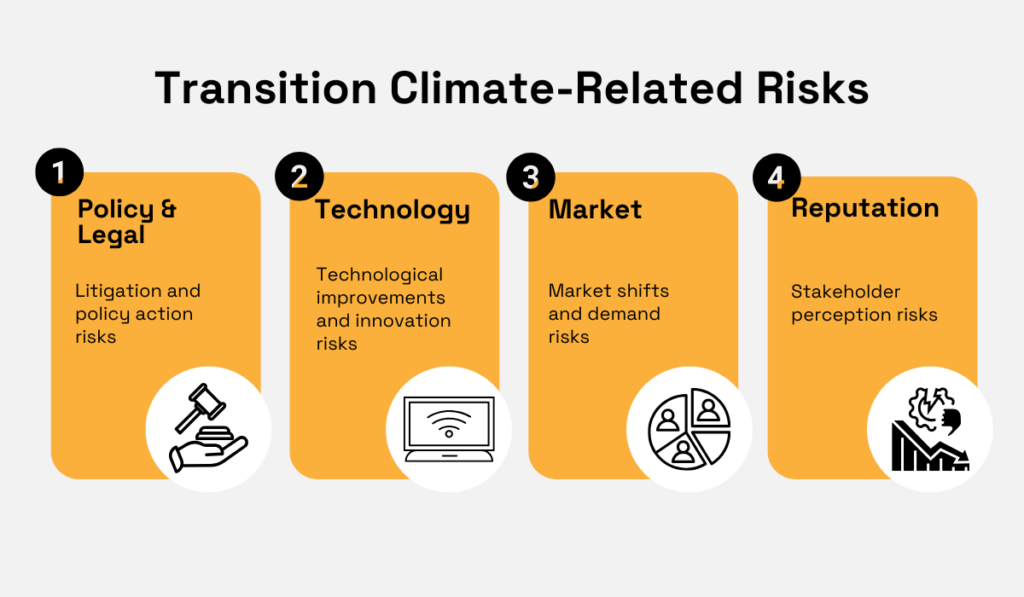
Illustration: Veridion / Data: EPA
In this context, an organization might assess how new regulations impact existing products and services, as well as the costs of transitioning to new, more environmentally friendly technology.
PwC provides an example of how this works in practice.
They describe how one retailer assessed the potential impact of transition risks, like market shifts, new technologies, and reputational damage, on its businesses.
They further mapped them onto specific operations to estimate their financial impact.
One of the key findings was that, under one warming scenario, the retailer’s transportation costs could rise to 18% by 2030.
Additionally, if the company grows as planned, those costs are projected to more than double.
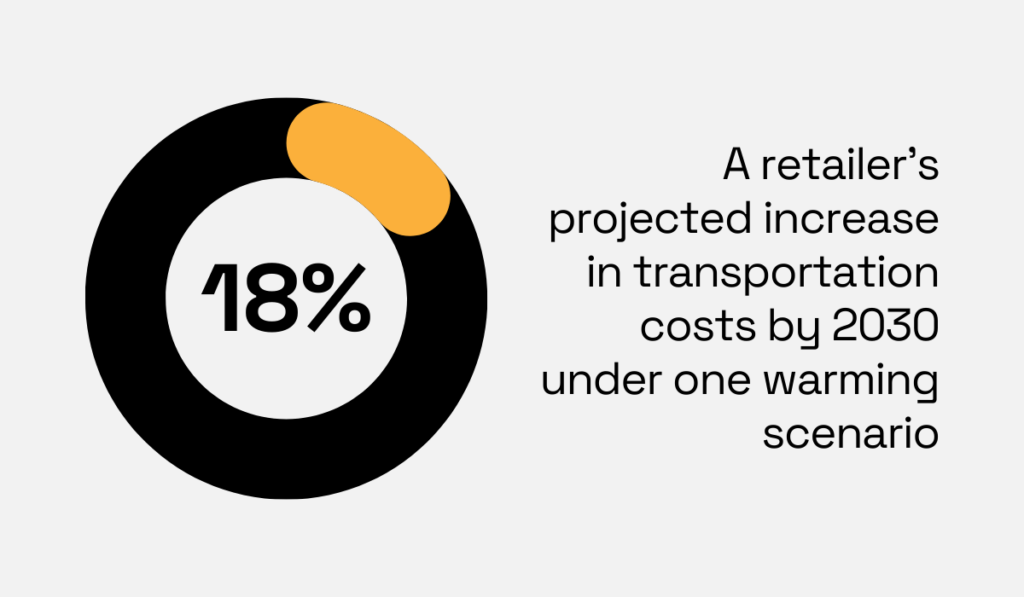
Illustration: Veridion / Data: PwC
One thing to note is that different risks require different risk models.
So, your organization should clearly define its goals before choosing an approach.
For instance, if you want to assess the long-term effects of climate change, you should use climate models.
If, on the other hand, you’re looking to better understand the impact of potential short-term, catastrophic events, like floods, CAT models are a better choice.
We’ll discuss the differences between the two in more detail below.
In 2022, PwC noted that organizations were mainly conducting climate modeling in order to ensure adherence to laws, rules, and regulations that required related climate disclosures.
These requirements have only grown since then.
For instance, in 2024, the SEC introduced more robust climate risk disclosure rules for public companies.
The rules outlined precisely what must be disclosed, as well as mandated that companies include these disclosures in their SEC filings.

Source: SEC
But even back in 2022, PwC reported that companies were slowly recognizing other benefits of climate models.
One that especially stood out was their role in strategic decision-making.
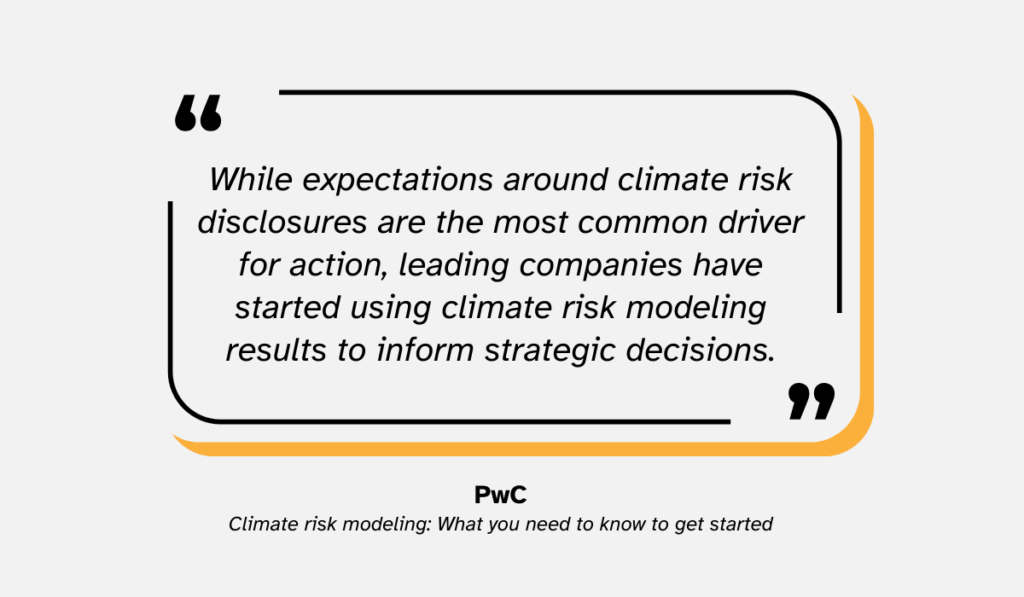
Illustration: Veridion / Quote: PwC
In the meantime, climate risk models have indeed become critical in decision-making, risk management, and long-term planning.
They provide the data needed for stress testing, scenario analysis, and resilience planning, all of which should underpin the above activities.
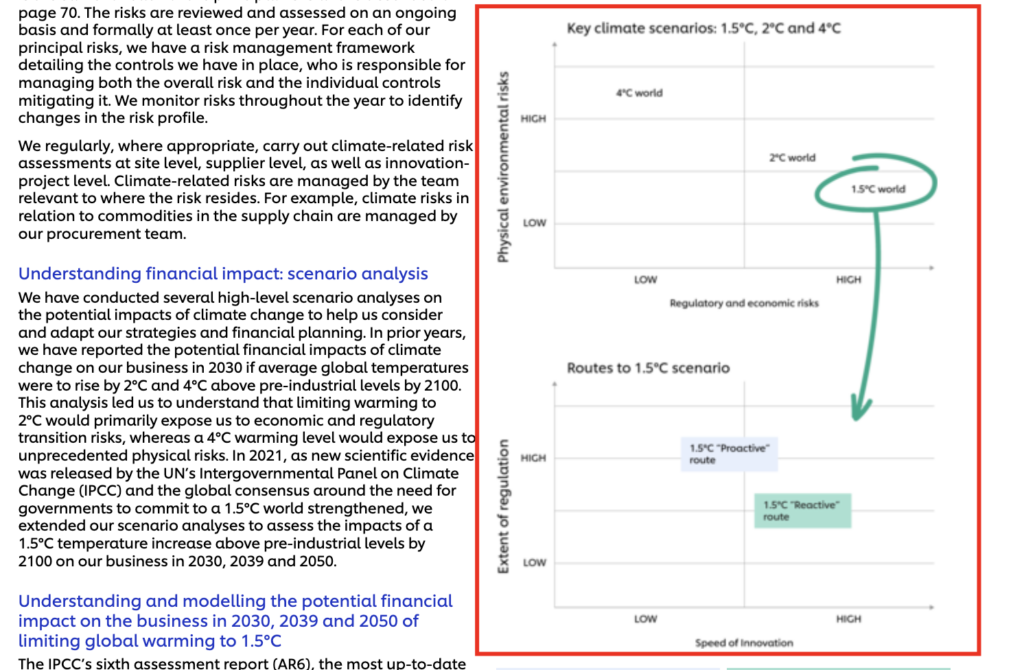
Unilever is a good example of this practice.
In a recent annual report, the company described modelling multiple temperature pathways, including 1.5°C, 2°C, and 4°C, to understand their potential short- and long-term effects on its business.
Source: Unilever
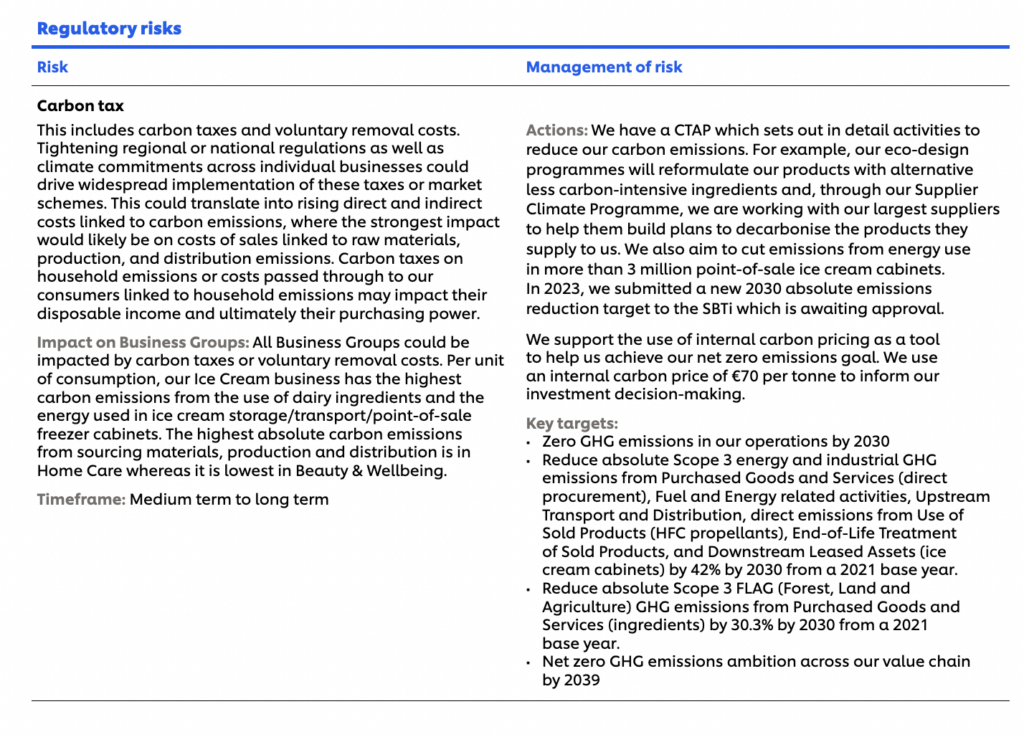
This work helped Unilever identify a diverse range of risks and plan proactive mitigation measures.
Among other things, these include using fewer carbon-intensive ingredients and helping suppliers decarbonize their own products.
Source: Unilever
Of course, commercial enterprises are not the only ones using climate modeling to make decisions or manage risk.
Financial institutions are using it, too, primarily to drive their investment, as well as divestment decisions.
For instance, after integrating climate analysis into its processes, AP2/The Second Swedish National Pension Fund divested as many as 80 companies.
These companies, in the energy and utility sector, were found to pose excessive climate-related financial risks.
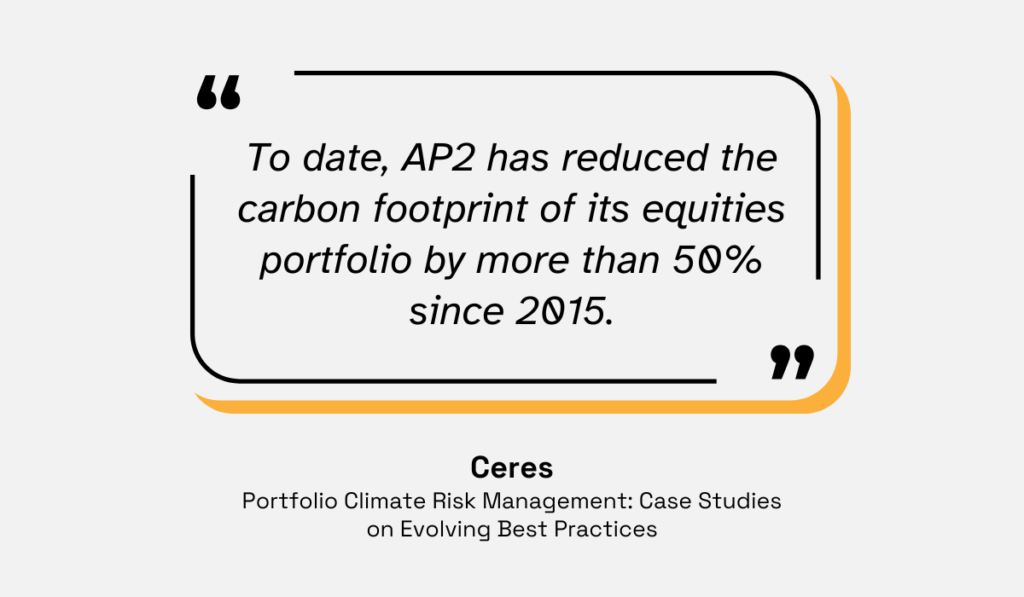
Illustration: Veridion / Quote: Ceres
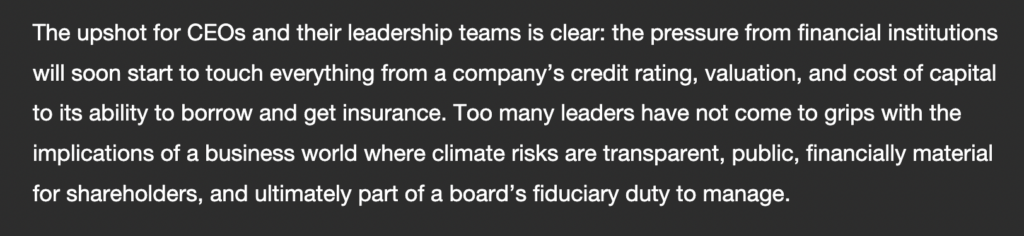
The fact that climate analysis now plays such a major role in investment has far-reaching effects.
PwC notes this will affect businesses in very tangible ways, impacting everything from their credit ratings and valuations to even their ability to get insurance.
Source: PwC
This should make the main benefit of climate risk models clear: by using them in their own assessments, companies can tackle these challenges proactively.
Internal modeling gives them a chance to identify vulnerabilities and take action before investors or regulators do.
Additionally, it helps them boost their resilience and make better decisions, both in the short and the long term.
Climate risk modeling draws on both climate science and data analytics tools.
We briefly survey three key categories of these tools below.
Climate models are, of course, the backbone of climate risk modeling.
They simulate future climate under different scenarios, projecting variables like temperature, rainfall, and storm frequency decades into the future.
Organizations typically use existing, science-backed models, like CMIP6, to accurately assess how these scenarios might impact their future position.
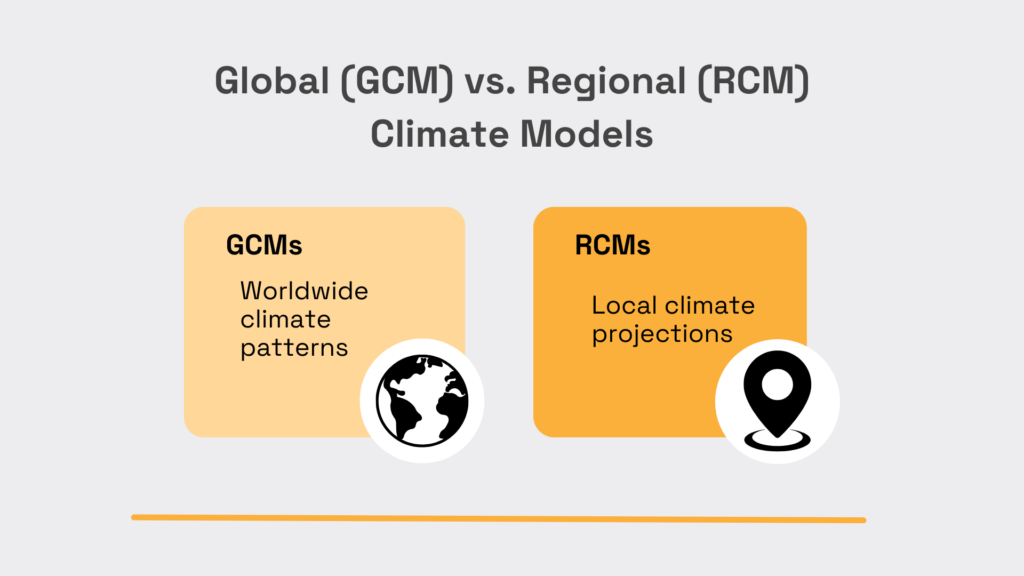
These models can be global or regional:
Source: Veridion
Global climate models (GCMs) give worldwide trends, which are useful for assessing broad and long-term climate risks.
Regional climate models (RCMs), on the other hand, focus on trends in a specific region.
Together, they form the full picture and can be used for even more localized assessments.
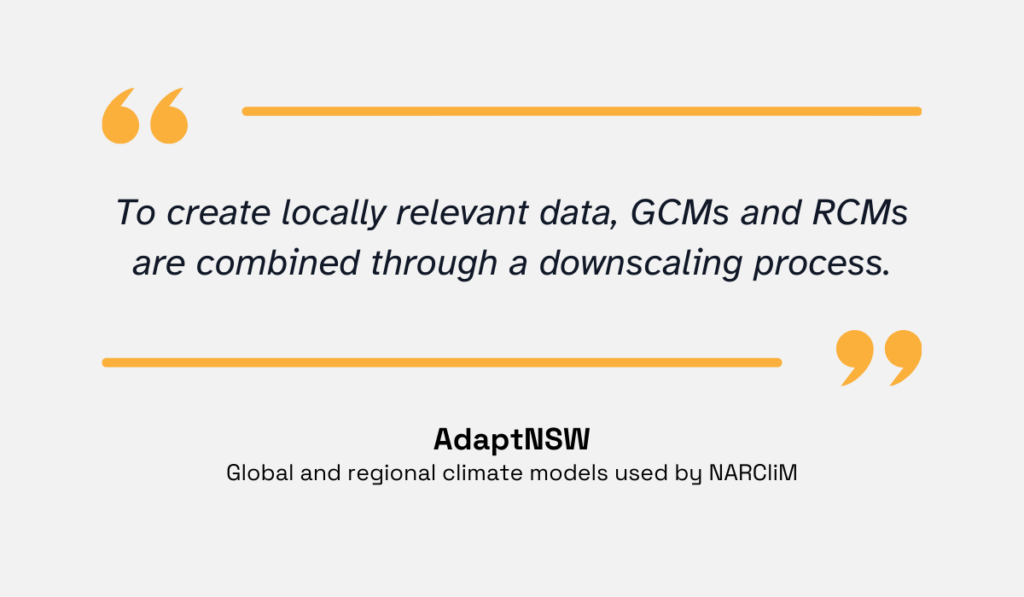
Illustration: Veridion / Quote: AdaptNSW
Downscaling is essential for applying climate projections to real business use cases.
As the professional services firm Aon explains, it’s the first step in making climate projections useful for risk assessment.
It involves making broader models specific enough to apply to a particular region, site, or even asset.
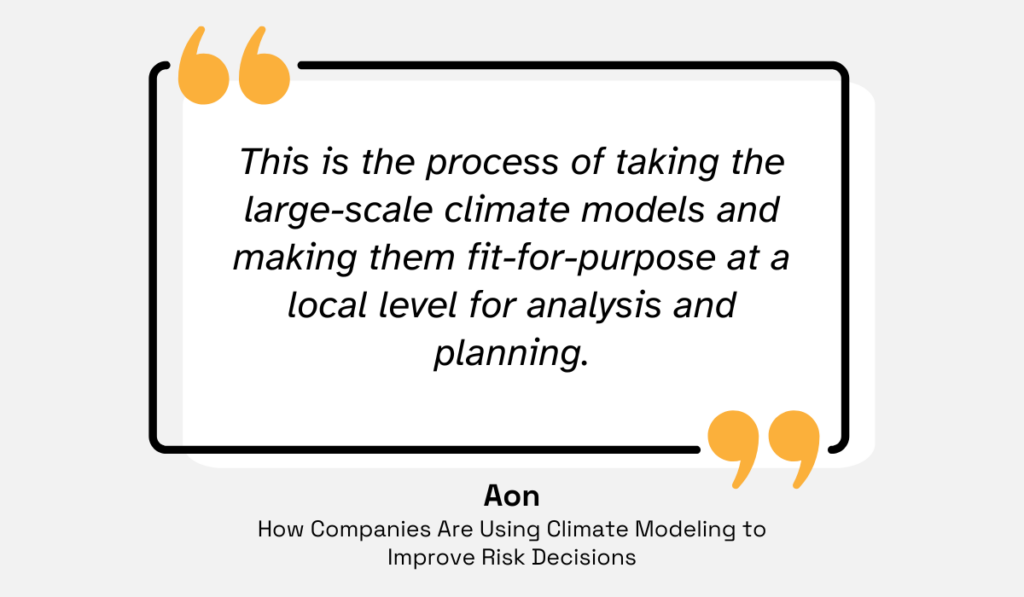
Illustration: Veridion / Quote: Aon
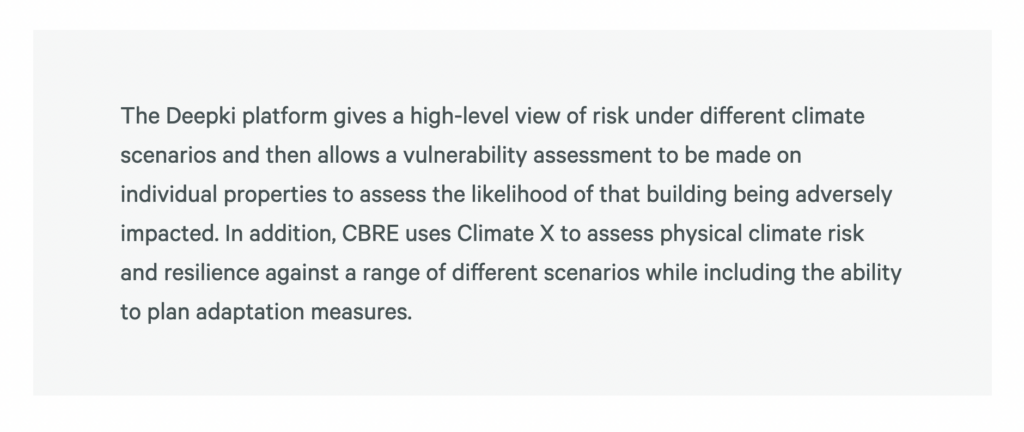
For instance, CBRE, a commercial real estate services company, uses climate models to evaluate potential damage to properties under its management.
More specifically, CBRE first generates a high-level view of physical climate risks under different scenarios.
This overview is then further used to support detailed vulnerability assessments for individual properties, translating general climate projections into asset-level exposure.
Source: CBRE
For CBRE, this work has significant value.
Climate-related damage to buildings, such as that from floods or wildfires, could erode their value and make them less attractive to prospects.
By identifying these risks in advance, CBRE can provide timely, expert advice to its clients.
Other organizations can, of course, use this approach to protect their own assets and operations.
Catastrophe (CAT) models are specialized risk models for acute climate events, such as hurricanes, floods, wildfires, and earthquakes.
Joyce C. Wamalwa, Underwriting Manager at Policymart Ins. Brokers explains how they differ from the last type.
Unlike climate models, CAT models focus on large, low-frequency events that are difficult to predict and much more severe.
For insurers, for example, they could suddenly result in hundreds of claims being filed at once.
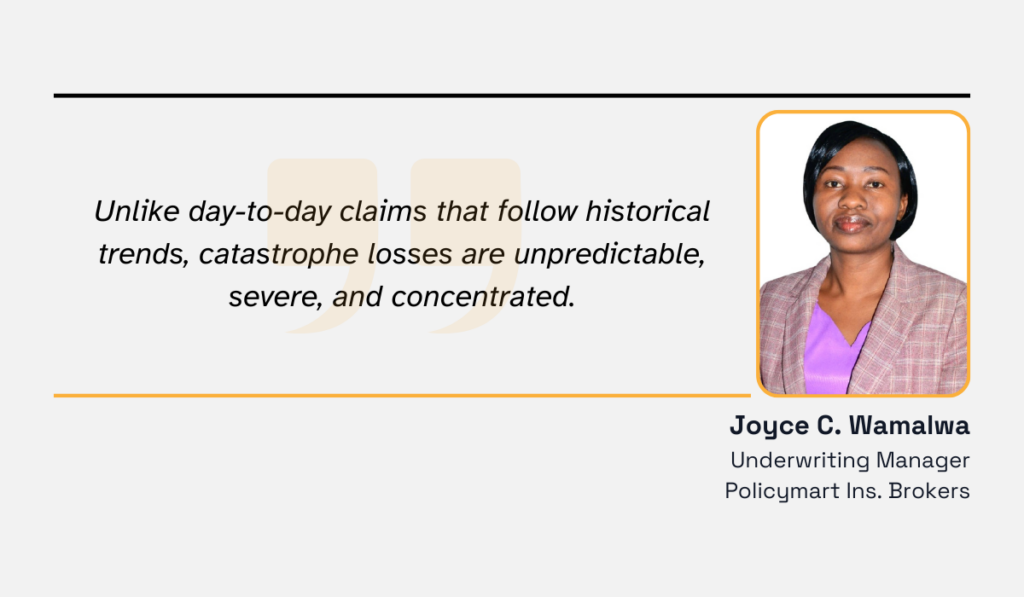
Illustration: Veridion / Quote: LinkedIn
Commercial organizations can suffer similar impacts from these events.
For instance, floods could simultaneously damage multiple company facilities at once, halt operations, and force costly repairs and temporary relocations.
This can obviously lead to massive financial losses.
CAT models can’t help companies avoid them, but they can help minimize them.
Their role is not so much to predict potentially harmful events, but rather to estimate what would happen if they did occur.
The question is not “what is likely to happen?” but rather “how will we be impacted if it does?”
To answer that, CAT models use four dimensions: the hazard, exposure, vulnerability, and loss.
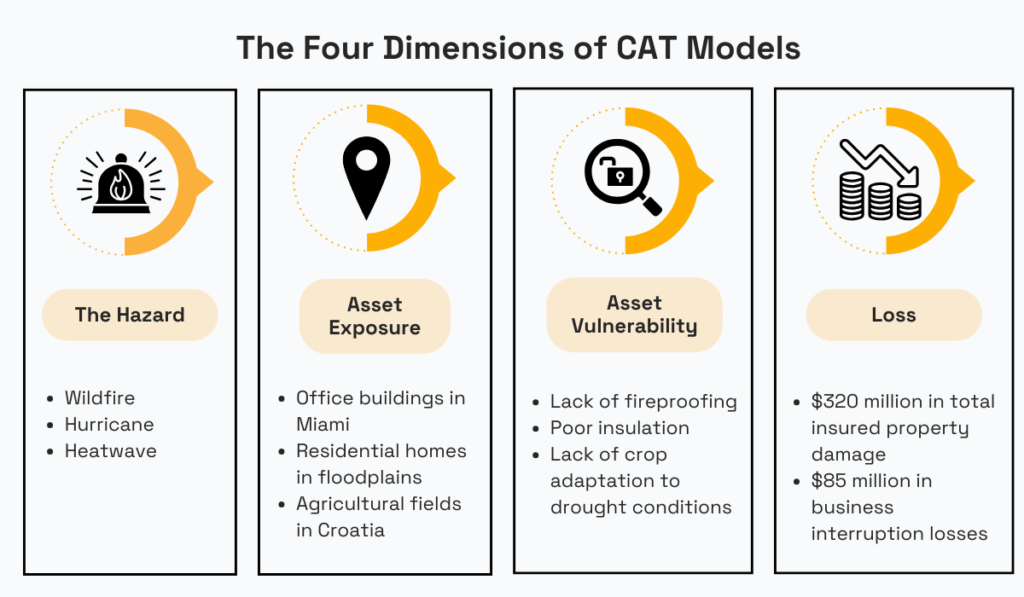
Illustration: Veridion / Insights: LinkedIn
Let’s briefly break them down:
So, CAT models don’t just take the hazard into account.
They also consider which assets are in the path of the event and how susceptible they are to damage. This allows for a more accurate risk estimate.
On top of that, the loss module ensures that risk is quantifiable.
According to Wamalwa, that’s exactly the main point of these models:
“CAT models don’t predict when a disaster will happen. They estimate financial severity if it does.”
With that, the business value of CAT models is clear, especially for insurance, infrastructure, and any asset-heavy industries.
However, for best results, organizations should use both climate models and CAT models.
Combining the two is essential for a good balance between long-term, strategic planning and targeted preparation for more acute, high-impact events.
So far, we’ve looked at climate and CAT models, which simulate physical events and their impacts.
Unlike those, machine learning (ML) and AI are not climate models per se, but rather analytical tools that help improve them.
Machine-learning and AI systems can ingest and normalize vast datasets, thus accelerating and improving the accuracy of traditional scenario analysis.
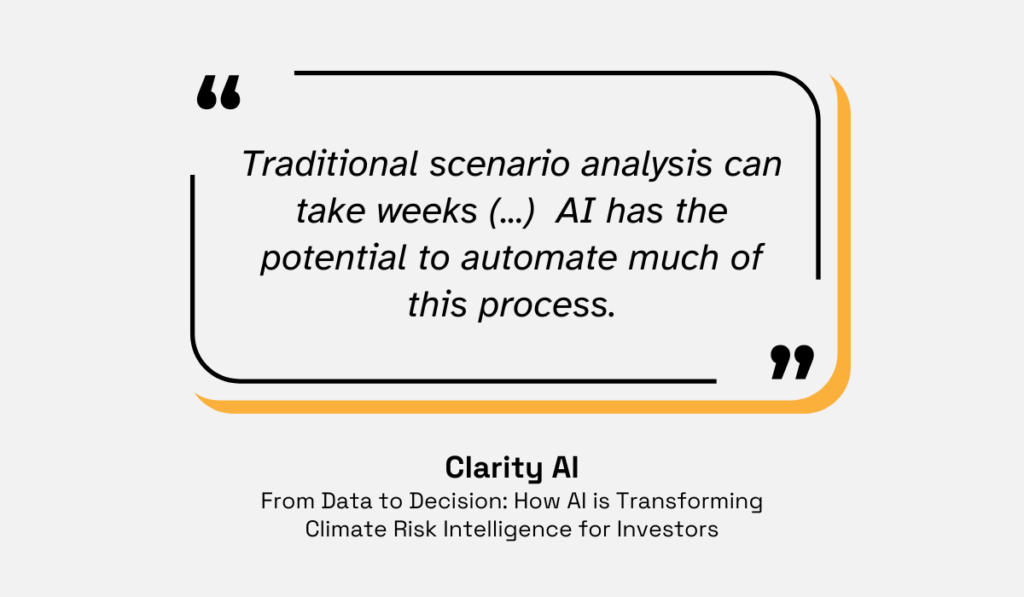
Illustration: Veridion / Quote: Clarity AI
This results in a faster and more transparent analysis, as well as decision-ready insights.
One research paper helps clarify why that’s the case.
According to it, the main benefit of AI systems is their ability to ingest and combine a wide range of datasets, which improves predictive accuracy.
For instance, they can combine satellite, sensor, and historical data for more comprehensive insights.
ML systems, on the other hand, excel at using that data to identify complex patterns, enhance spatial and temporal detail, and generate real-time predictions.
Based on these insights, systems can even suggest appropriate, data-driven actions.
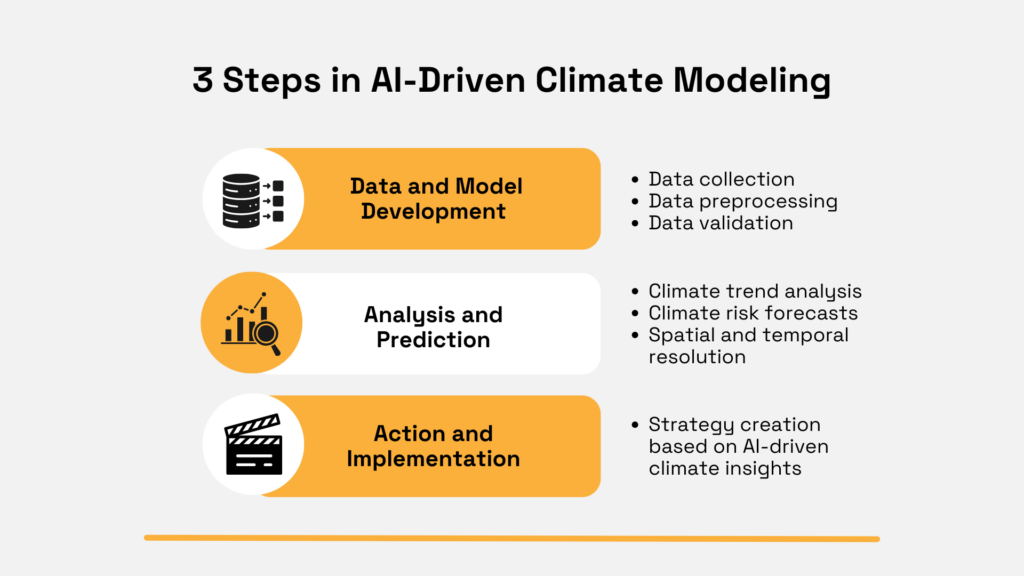
Illustration: Veridion / Data: National Library of Medicine
To illustrate potential results, the same paper mentions how Google’s AI model improved wind energy forecasting by 20%.
However, companies considering using AI-driven climate modeling should be aware of its limitations and challenges.
The paper mentions two most impactful ones: data quality and model transparency.
| Data Quality | AI systems require high-quality training data. “Garbage in, garbage out” is very much true here. |
| Transparency | Many AI systems lack transparency, making it difficult to understand how they reach their predictions and ensure accountability. |
With that in mind, the best current practice is probably using AI to augment existing, science-based models, rather than relying on it as a foundation.
Regardless of which model or tools you use, your input data will determine the accuracy of the predictions.
In other words, large-scale, high-quality data is non-negotiable.
Beyond just the data you’d need to characterize the climate hazards, you also need data that helps connect them to real-world business exposure.
This includes everything from data on your assets and facilities to comprehensive information on your supply chain and third parties.
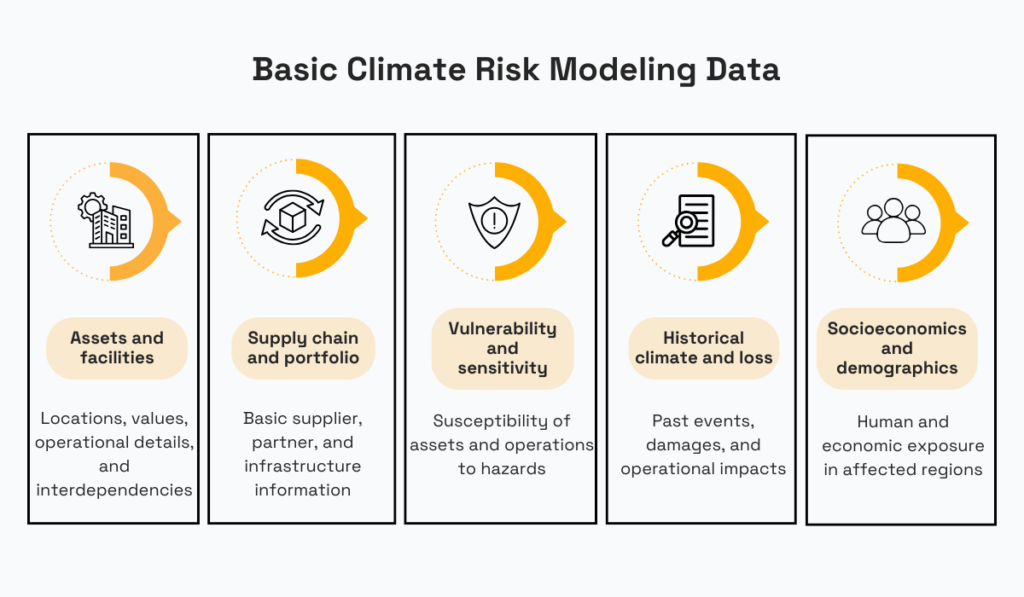
Source: Veridion
However, many organizations are facing severe data quality issues.
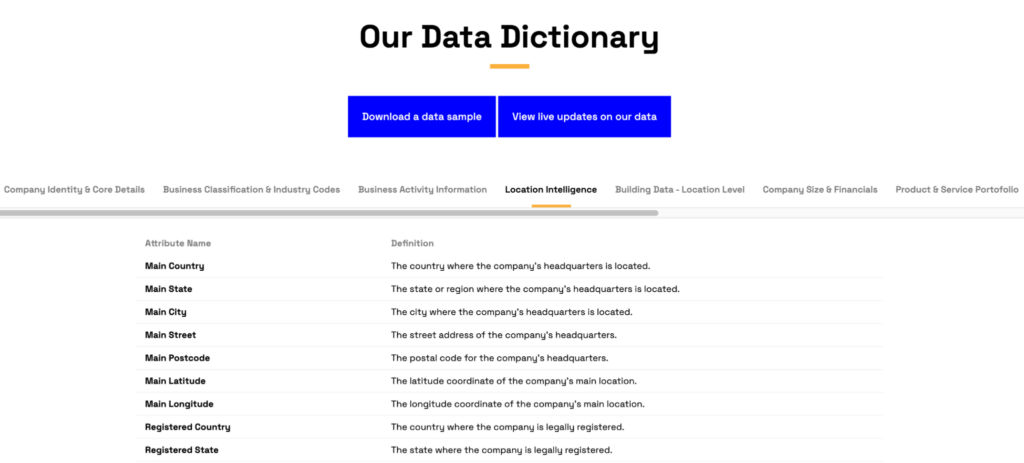
These stem from three common causes: data fragmentation, inconsistent identifiers, and incomplete location intelligence.
| Data fragmentation | Information about assets or suppliers is stored across multiple systems or departments. |
| Inconsistent identifiers | Different naming conventions or codes prevent matching data across datasets. |
| Incomplete location intelligence | Missing or imprecise geographic information hampers spatial risk analysis. |
To address these issues, organizations often turn to business data platforms like Veridion for standardized, location-level company and facility data.
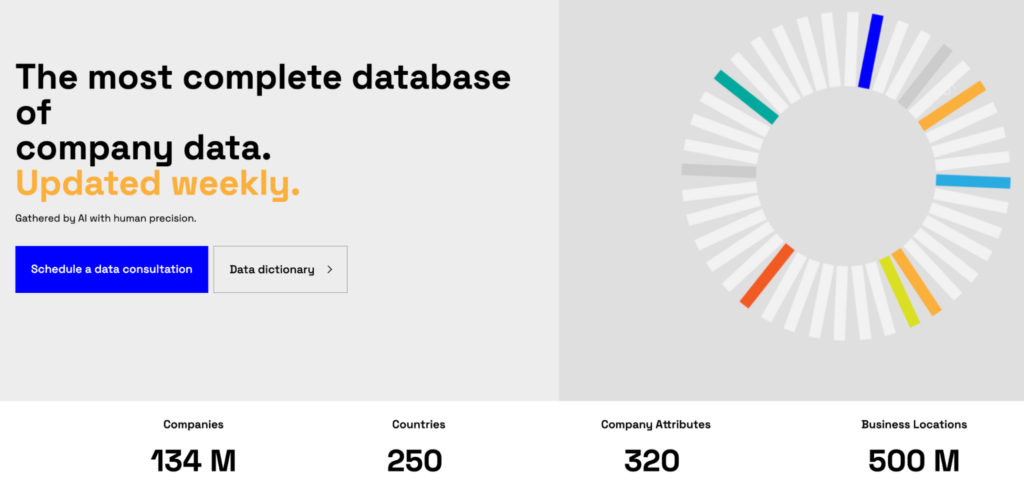
Source: Veridion
Veridion equips companies with comprehensive coverage of over 134M global companies.
The platform collects data across as many as 320 different company attributes, including:
Integrating these datasets into your climate risk workflows allows you to make more accurate predictions and determine real business impact.
Source: Veridion
Veridion’s ESG data can be especially helpful in both climate modeling and everyday decisions.
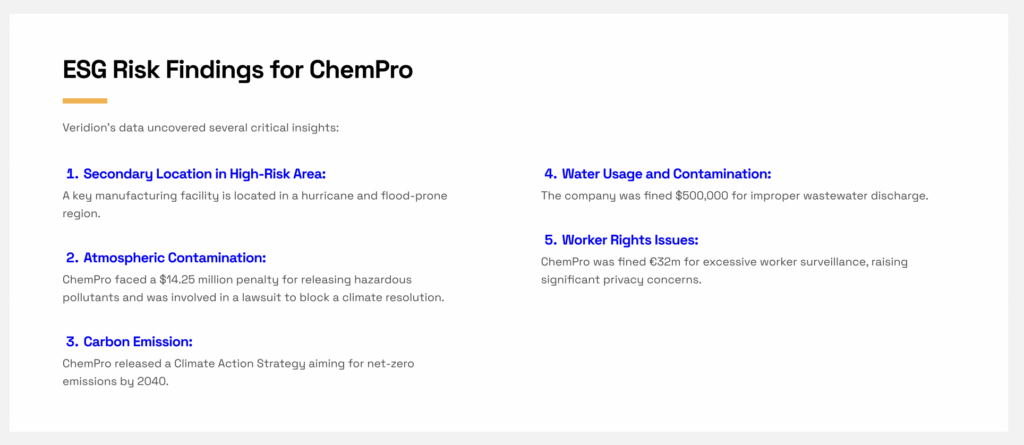
For example, after leveraging our ESG data, one insurer realized that a potential client might carry more risk than initially assessed.
Some of the key insights they uncovered included the client’s history of ESG‑related penalties and fines.
Source: Veridion
This allowed the insurer to make appropriate premium and policy adjustments and better align coverage with the client’s actual risk profile.
With the right data at hand, your organization can mitigate risk and boost financial performance in similar ways.
Climate risk modeling may sound overly scientific or technical at first, but its value is fundamentally commercial.
At its core, it helps organizations understand where they are exposed, how that exposure could evolve, and what it means for revenue, costs, and long-term growth.
From stress-testing supply chains to informing capital allocation, the use cases are concrete and financially material.
As long as you pair climate modeling with clear business objectives, this can give you a clear competitive edge.