



Blog
Where to Get Climate Risk Intelligence
By: Stefan Gergely -
12 April 2026


We love our data, and now that you're here, you're one step closer to loving it too.
A wide sample of data, so you can explore what is possible with our data
Choose ->
built with procurement in mind. Focused on manufacturers, products and more
Choose ->
built with insurance in mind. Focused on classifications, business activity tags and more
Choose ->
built with sustainability in mind. Focused on sustainability commitments, and environmental and social governance insights.
Choose ->
built with strategic insights in mind. Focused on market trends, competitor analysis, and industry-specific data
Choose ->

Keep up to date with our technology, what our clients are doing and get interesting monthly market insights.

Climate risk is now a boardroom issue, but finding intelligence you can actually use is another story.
We know the challenge.
“Climate risk intelligence” can mean anything from physical hazard models and transition scenarios to regulatory exposure, supply chain vulnerability, and asset-level impact projections.
Many risk intelligence providers promise foresight, precision, and decision-ready insights. Yet the most important differences are rarely obvious upfront.
That’s why this guide explains where leading organizations are getting climate risk intelligence today.
You’ll see what each source is best suited for, how it fits into enterprise decision-making, and what to consider before committing your resources.
Let’s take a closer look.
Veridion is a global company data platform that brings ESG and climate risk intelligence directly into your decision-making workflows.
It collects information on over 100 million active companies worldwide, including public and private firms, to support procurement, risk, and ESG teams.
While most tools on this list focus purely on physical climate hazards (floods, fires, heatwaves), Veridion centers on company-level ESG performance and risk factors.
Here are some of the topics covered by Veridion:
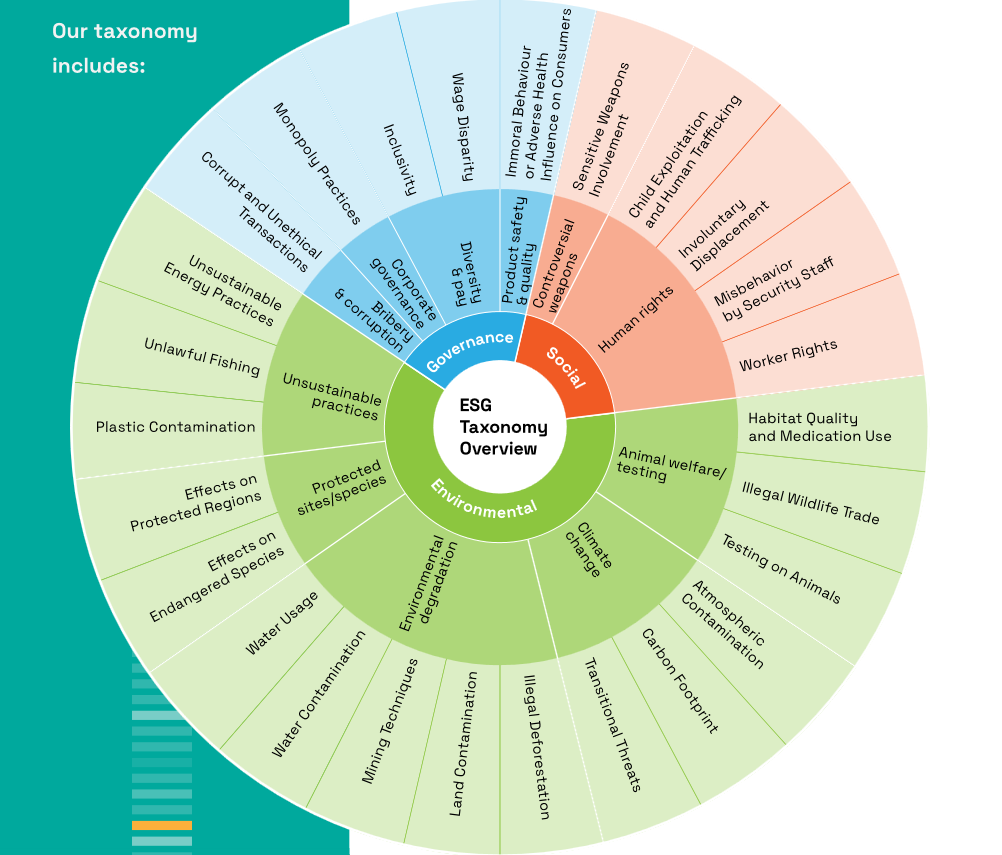
Source: Veridion
And here’s a deeper breakdown of Veridion’s key capabilities:
| Regulatory Alignment | Built to support EU CSRD, the EU Corporate Sustainability Due Diligence Directive, Australia’s ASRS, and other international frameworks. You get ESG scores and targets that actually satisfy compliance requirements |
| Decarbonization Tracking | Monitors how companies are progressing on greenhouse gas reduction. It validates emission mitigation strategies for scoring and disclosure |
| Supply Chain Visibility | Uses granular location and industry data to show you how climate hazards threaten your suppliers and customers. Think floods disrupting a key vendor’s facility or wildfires affecting a customer’s operations |
| Deep ESG Insights | Goes beyond static ratings. You get asset-level scores for environmental, social, and governance risks that flag real-world exposure. |
| Global Private Company Coverage | Most data providers focus on public companies. Veridion covers private firms worldwide with weekly updates and AI-powered datasets. |
This is beneficial when you’re evaluating suppliers, underwriting portfolios, or managing vendor relationships across complex supply chains.
Of course, like any other tool on this list, Veridion is not for everyone.
So let’s break down some of its advantages and disadvantages, starting with the pros:
And here are some of the cons:
You won’t find geospatial hazard layers here like you would with Climatig or EarthScan.
All in all, you’ll get the most value from Veridion if you need broad corporate ESG data at scale.
Insurers underwriting large portfolios use it. Banks rely on it for ESG compliance. Supply chain managers benchmark vendors with it.
The large database and regulatory support make it especially useful for multinationals managing complex supplier networks.
While Veridion helps you assess company data globally, Climatig focuses on physical assets.
It’s a climate intelligence platform built for property and infrastructure risk. Think buildings, facilities, and infrastructure projects that face hazards like heat stress, floods, and wildfires.
One standout thing about Climatig is its precision.
Its interface provides asset-level analytics and maps across multiple scenarios. It uses machine learning to downscale climate projections (RCP4.5 and RCP8.5) to 10 meters.
That’s really detailed and granular enough to assess individual properties.
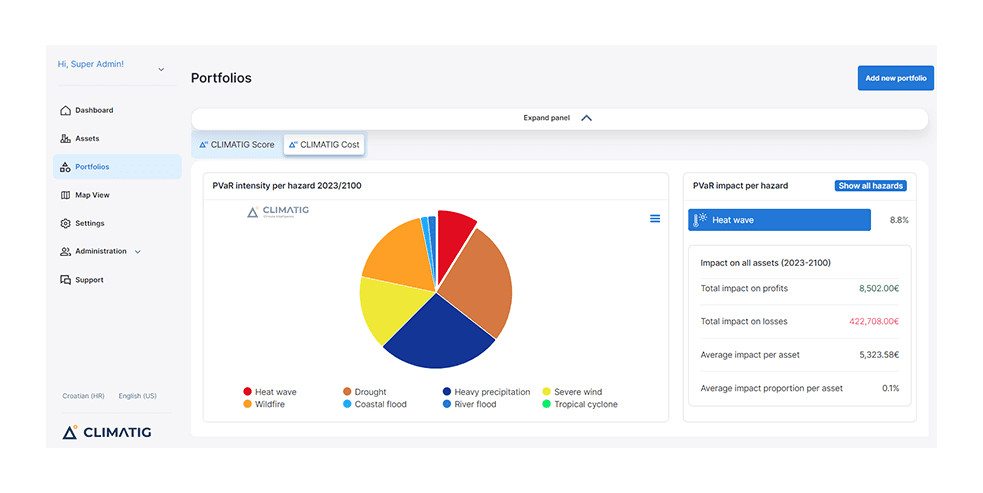
Source: Climatig
Here are some of its other notable features:
| High-resolution Risk Modeling | Computes physical risk scores at 10m resolution for any asset location, using advanced satellite and historical climate data, AI, and machine learning. |
| Asset Management System | Ready-to-use dashboards show you climate hazard scores and financial impact for your assets and portfolios. |
| Multi-hazard Coverage | Scores several climate risks across hazards like heat, drought, flooding, and more, and aggregates them by location |
| “What-If” Analysis | You can modify parameters like elevation or proximity to water to see how adaptation measures affect asset risk. This feature is unique among the tools listed here. |
| APIs and Portfolio Tools | Offers an API for bulk queries, plus features for drawing asset polygons, grouping assets into portfolios, and visualizing risk on maps. |
In short, Climatig helps you transform climate risk into actionable intelligence.
These are some of its pros:
And the cons:
Overall, this platform is best for firms with physical assets that need detailed climate risk exposure analyses, such as real estate portfolios, infrastructure projects, and utilities.
Insurance companies use it. City planners and developers rely on it for environmental compliance and resilient asset design.
ClimaTwin takes the infrastructure-focused approach of Climatig and adds AI-powered natural language querying.
It’s designed specifically for large asset portfolios: power grids, transportation networks, water systems, telecom infrastructure.
You can ask plain-English questions like “Which assets face the highest flood risk by 2035?” and get data-backed answers linked to maps and metrics.
This makes it more accessible than purely technical platforms.
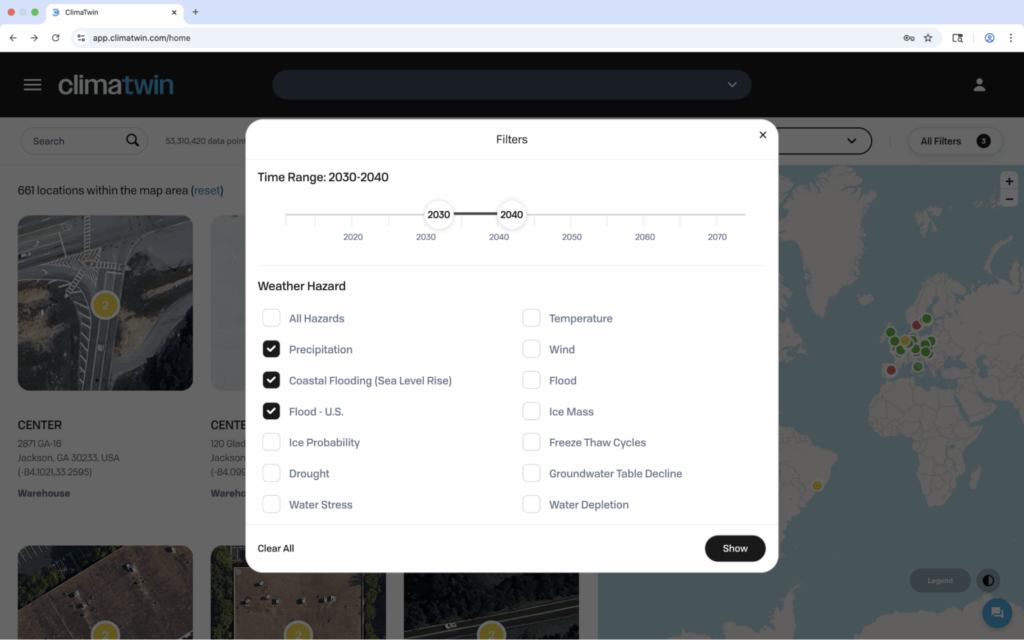
Source: Climatwin
These are some of its key capabilities:
| AI Insights and NLP Querying | Ask questions in natural language and get immediate answers. No need to dig through raw data or build custom queries. |
| Asset & Portfolio Visualization | Interactive dashboards and “asset cards” display risk scores, climate threat summaries, and financial exposures for each asset. |
| Advanced Filtering and Tagging | Filter and tag assets by hazard, location, scenario, regulatory zone, etc. |
| Threat Modeling & Scoring | Assigns simple risk scores (1–5) per hazard per asset, then aggregates to portfolio summaries. Based on forward-looking climate models aligned with standards. |
| Critical Dependencies Analysis | Maps how assets depend on power, water, transport, and other infrastructure. It flags vulnerabilities when external systems fail. |
| Regulatory Alignment | Outputs align with ISSB, CSRD, and other climate disclosure standards. |
The platform empowers infrastructure owner-operators, engineers, consultants, investors, and insurers alike to make smarter, future-ready decisions.
Let’s take a look at some of its pros:
…and cons:
Ultimately, infrastructure owners, utilities, and public agencies managing complex, interconnected systems will benefit from this platform the most.
Energy companies and water authorities use it. Financial institutions and engineering firms also use it for due diligence on infrastructure projects.
If your assets depend on each other (like power grids relying on water for cooling), ClimaTwin’s dependency analysis becomes invaluable.
Climate Scale takes a different approach from the platforms above: rigorous, physics-based climate modeling.
It’s a scientific climate analytics engine built by climatologists. Originally academic, it specializes in downscaling global climate models to provide hyper-local climate scenarios.
While Climatig provides 10m resolution and ClimaTwin adds AI querying, ClimateScale emphasizes scientific rigor.
It assigns IPCC-style confidence scores to every projection, showing you how robust each forecast is.
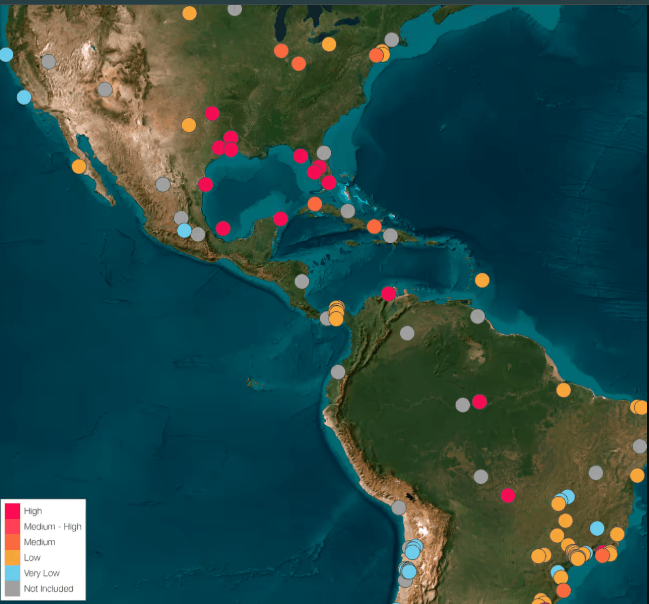
Source: Climate Scale
Some of the features worth mentioning include:
| Hyper-local Climate Data | Downscales CMIP5/6 model outputs to resolutions up to 3–25km globally, calibrated with decades of observations. |
| Regulatory-aligned Reports | Auto-generates physical risk reports tailored to CSRD, TCFD, and other climate disclosure frameworks. |
| Sector-specific Modules | Industry modules like ENERGY+ for wind and solar projects include specialized metrics (e.g., hub-height wind speeds) essential for renewable energy planning. This is unique among the tools listed here. |
| Portfolio & Project Screening | Screens climate hazards across portfolios, building risk matrices that combine acute risks and chronic risks (sea-level rise, drought). |
| Custom Data Delivery | Provides time series, regional maps, or API feeds for integration into your enterprise tools. |
| Scientific Confidence Scoring | Every projection includes IPCC-style indicators showing forecast robustness. |
Using this platform unlocks a myriad of pros:
Some of its cons, on the other hand, are:
In the end, Climate Scale works best for organizations with large physical assets needing evidence-based climate risk projections.
Banks, insurers, and asset managers in finance use it extensively.
Renewable energy developers rely on the ENERGY+ module. Real estate portfolios use it for due diligence on capital-intensive projects.
If you need to defend your climate projections to regulators, investors, or boards, Climate Scale’s scientific credibility might just be what you were looking for.
ClimateAi bridges short-term weather forecasting and long-term climate projections in a single platform.
Its ClimateLens platform and LensConnect weather API help companies incorporate climate and weather forecasts into investment, supply chain, and operational planning.
Though ClimateScale centers on scientific rigor and Climatig on physical assets, ClimateAi emphasizes operational integration.
You get advanced forecasting up to 6 months out, plus scenario analysis for decades into the future.
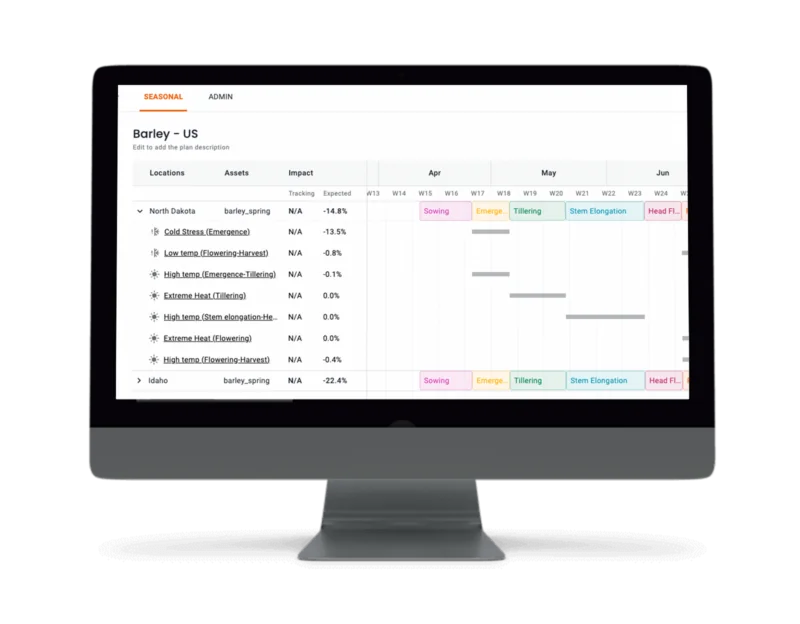
Source: ClimateAi
Key capabilities include:
| Portfolio Risk & Asset Diligence | Identifies vulnerabilities and opportunities across investment portfolios. Models hazards from one to fifty years out and computes financial impacts. |
| Sustainability/ESG Reporting | Scenario-based analysis aligned with IPCC pathways (RCP scenarios) for TCFD reporting. Generates disclosure-ready risk reports with minimal manual work. |
| Weather API (LensConnect) | Provides historical weather and forecasts at resolutions down to 1km. Useful for procurement, agriculture, and short-term operations planning. |
| Water Risk Analytics | Specialized tools for water availability and hydrology tied to specific site locations. |
| Cross-industry Support: | Used beyond finance in agribusiness, manufacturing, and retail for demand planning and supply chain resilience. |
They position themselves as The World’s First Enterprise Climate Resilience Platform for Food & Agriculture.
Users across the food and agriculture value chain can quickly onboard using their templates, receive key alerts and insights, and build custom, shareable dashboards within minutes.
Some of the pros include:
And here are the cons worth considering:
All in all, financial firms (asset managers, banks, insurers) and businesses with climate- or weather-sensitive operations will likely find this platform useful the most.
Agriculture companies use the weather API. Retailers use it for demand planning, and manufacturers optimize supply chains with it.
If you need both next-quarter weather forecasts and 2050 climate scenarios, ClimateAi delivers what the other tools on this list don’t.
ESGSignals flips the script on ESG data.
Instead of relying on companies to self-report their environmental performance, it uses satellite imagery and geospatial data to generate independent, objective ESG metrics at the asset level.
Company-reported ESG data can be incomplete, delayed, or inconsistent. But ESGSignals gives you third-party verification of what’s happening.
Veridion aggregates company ESG data at scale, and ESGSignals validates it with satellite observations.
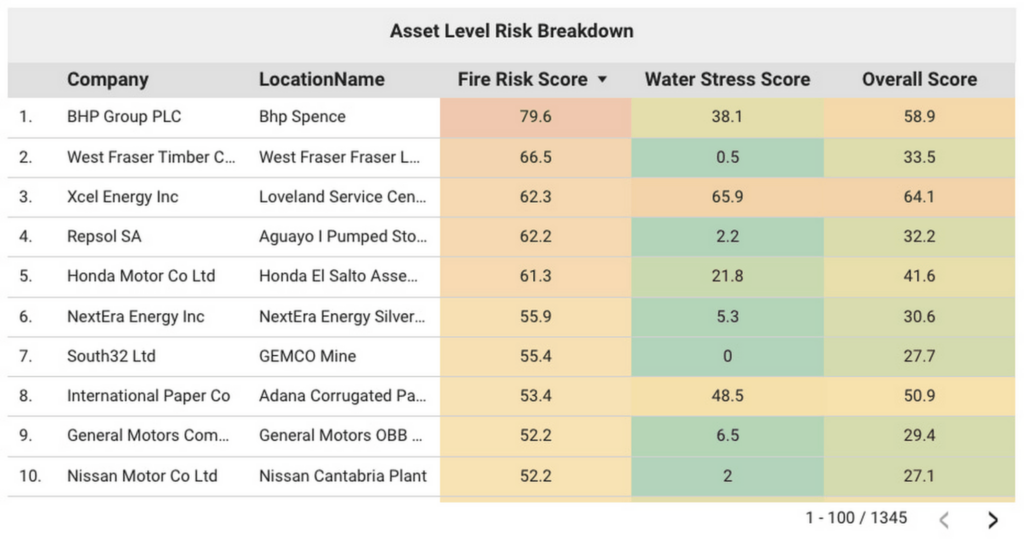
Source: RS Metrics
Other features worth exploring are:
| Granular Metrics | Provides specific indicators (water stress, land cover change, biodiversity risk) at the level of individual facilities or plots. |
| Benchmarking and Filtering | Filter and compare metrics at asset, company, sector, or portfolio levels. Benchmark against competitors using standardized methodology. |
| Corporate ESG Integration | Designed to supplement or replace self-reported ESG data. Gives investors and rating agencies independent, objective environmental data. |
| Regulatory Support | Fits SFDR disclosures for asset managers and CSRD reporting for corporates by offering verifiable third-party metrics. |
| Visual Dashboards | GIS-backed dashboards let you scan many assets quickly and drill into any asset’s details. |
But before committing to the purchase of this platform, carefully weigh its pros:
…against its cons:
If you’re an investor, asset manager, or financial analyst who needs independent ESG and climate data on company assets, this tool might be for you.
Also useful for corporates and index providers seeking standardized environmental metrics that meet disclosure rules.
If you’re verifying vendor ESG claims or conducting due diligence, ESGSignals gives you ground truth.
EarthScan (by Mitiga Solutions) is built for speed.
It’s a cloud platform for physical climate risk analytics that emphasizes “scan and report” capabilities.
You upload asset coordinates and get back risk scores for floods, droughts, heat, wildfire, storms, and more, within seconds.
ClimateScale emphasizes scientific depth, and ClimaTwin adds AI querying, but EarthScan prioritizes ease of use and compliance automation.
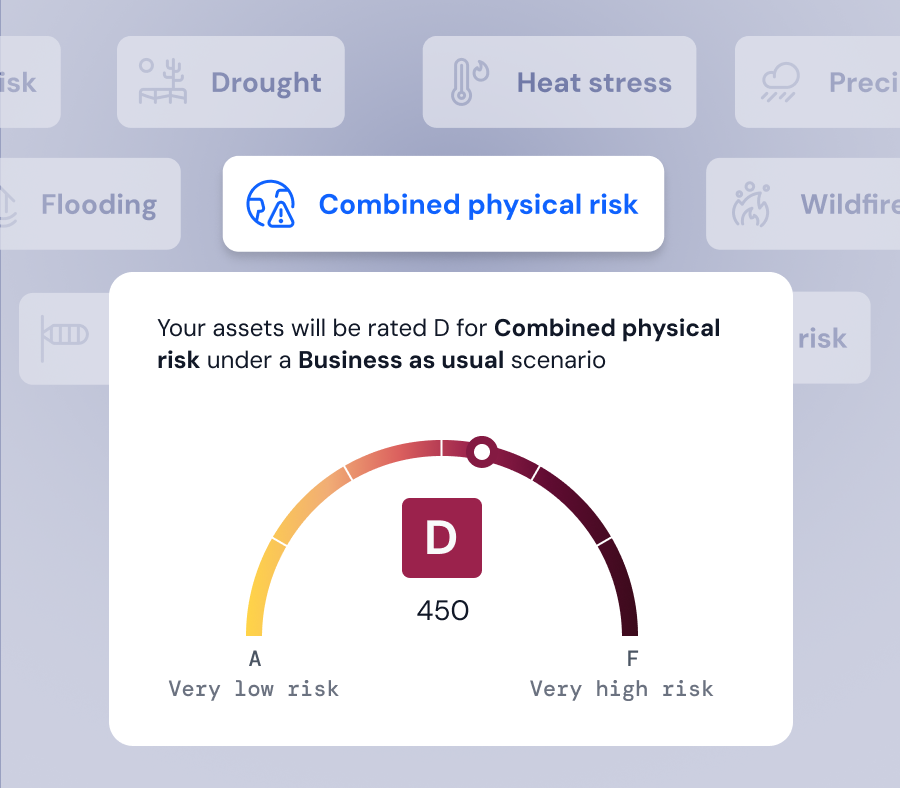
Source: EarthScan
Here are some of its key features:
| Rapid Risk Scanning | Analyzes flood, drought, extreme temperature, and other risks at each asset or location in seconds. |
| Global Coverage | Supports locations worldwide with a single standardized methodology. |
| Multi-hazard and Multi-scenario | Computes risks under multiple climate scenarios out to 2100 in 5-year steps. |
| Asset & Portfolio Insights | Calculates “climate value-at-risk” for portfolios. It lets you compare risks across your entire asset base. |
| Regulatory Reporting | Auto-generates reports aligned with CSRD, TCFD/ISSB, and IFRS S2 disclosure requirements. This streamlines compliance. |
| Easy Onboarding | Assets are input via CSV. Outputs include summary dashboards and downloadable formal reports. |
Some of the pros worth considering are:
And these are some of the cons:
Enterprises with diversified physical assets needing fast climate risk overviews for compliance and decision-making will benefit from this platform the most.
Asset managers conducting due diligence use it. Retailers and manufacturers use it for ESG reporting.
If you need climate risk reports quickly without deep technical expertise, EarthScan delivers.
Climate risk intelligence is part of how modern enterprises protect value and plan growth.
No single provider will answer every strategic question.
The strongest organizations combine forward-looking scenarios, asset-level exposure insights, and decision-ready analytics that leaders can actually act on.
Where companies tend to lose momentum is in integration. Data sits in silos, methodologies don’t align, and insights arrive too late to impact capital, operations, or strategy.
Before committing at scale, test providers against real business decisions: portfolio shifts, site investments, supply chain redesign, or regulatory planning.
The right intelligence should connect seamlessly to your existing workflows and stand up to scrutiny across teams.
When climate risk signals are clear, consistent, and operationally relevant, strategy starts influencing what comes next.