



Blog
Top Data Collection Companies
By: Auras Tanase -
19 April 2026


We love our data, and now that you're here, you're one step closer to loving it too.
A wide sample of data, so you can explore what is possible with our data
Choose ->
built with procurement in mind. Focused on manufacturers, products and more
Choose ->
built with insurance in mind. Focused on classifications, business activity tags and more
Choose ->
built with sustainability in mind. Focused on sustainability commitments, and environmental and social governance insights.
Choose ->
built with strategic insights in mind. Focused on market trends, competitor analysis, and industry-specific data
Choose ->

Keep up to date with our technology, what our clients are doing and get interesting monthly market insights.

Bad data rarely fails loudly. It fails quietly inside your CRM, supplier records, risk models, and dashboards until teams stop trusting the numbers and decisions start slowing down.
That is why choosing a data collection company is so important.
But the problem is that there are so many of these providers out there, and they do not solve the same need.
Some enrich company records. Some support outbound prospecting. Others help with supplier risk, structured datasets, or live public web data.
This guide compares six top data collection companies by use case, strengths, trade-offs, and pricing, so you can choose the right fit for your workflow.
Veridion is a data-as-a-service provider built for teams that need verified company and supplier intelligence, not just a list of contacts.
Its dataset covers 134+ million companies across 250 countries, with 320 attributes per profile and 500+ million business locations, and the company says profiles are refreshed weekly.

Source: Veridion
This is where Veridion sits differently from some of the other names on this list.
As you’ll see later in the text, Apollo is built around prospecting and outreach workflows, while Coresignal is closer to a structured public-web dataset for analytics and product teams.
Veridion is more of a decision-grade search and enrichment layer for procurement, insurance, and market-intelligence workflows, combining Search with Match & Enrich and exposing confidence-scored matching.
If you are screening a supplier or checking a business record, you can enrich that record with company size and financial attributes, then cross-check it against hierarchy, locations, products and services, and business activity.
Veridion’s data dictionary explicitly includes:
So, Veridion is strongest when the real question is who a company is, how it operates, and whether the record is trustworthy.
That makes it a better fit for supplier discovery, risk screening, and company verification than for pure outbound execution.
Here’s a quick summary of everything you need to know about Veridion:
| Best for | Supplier discovery, company verification, and enrichment workflows in procurement, insurance, and market intelligence. |
| Key features | 134M+ companies, 250 countries, 320 attributes per profile, 500M+ locations, weekly refreshes, Search, Match & Enrich, confidence-scored matching. |
| Pros | Broad global coverage, product- and location-level context, and matching workflows that are easier to operationalize because confidence scores are included. |
| Cons | Not an all-in-one outreach platform, and teams may need technical setup for integration and tuning. |
| Pricing | Quote-based / custom. Veridion pushes demo and custom-sample flows rather than public self-serve pricing. |
If you’d like to learn more, feel free to visit our website or schedule a data consultation.
Apollo is an AI-native sales intelligence and engagement platform built for teams that want prospect data and outbound execution in one place.
On its official product pages, Apollo positions itself around a living B2B database with 210M+ contacts, 35M+ companies, and 65+ filters.
The exact figures vary across pages, but the core point is clear: Apollo is built for scale in prospecting and outreach.
That’s what makes Apollo different from Veridion.
Veridion is stronger when it comes to supplier discovery, company verification, or enrichment for procurement and risk workflows.
But Apollo is stronger for outbound pipeline generation and SDR productivity, because the data, sequencing, CRM sync, and calling tools sit inside one workflow.
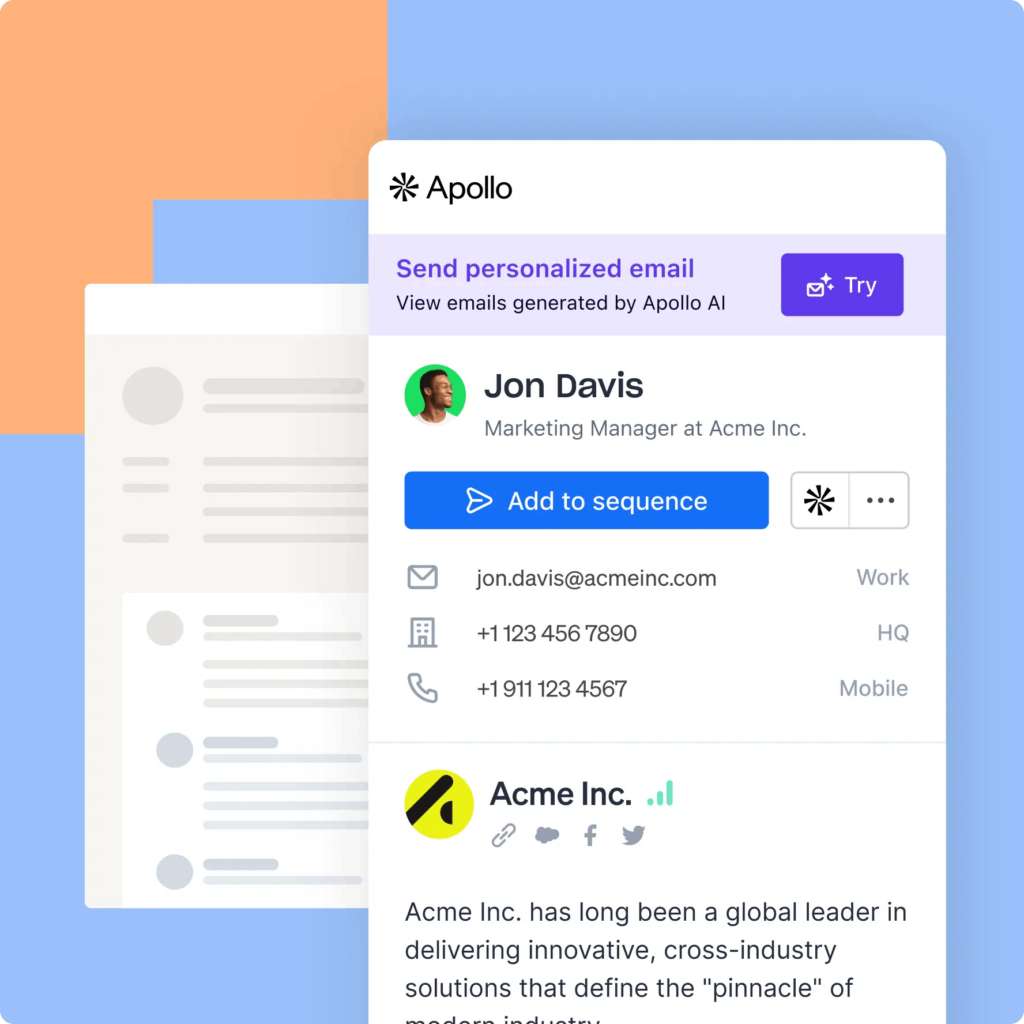
Source: Apollo.io
A good example is list building for outbound. Apollo lets a team search verified contacts, filter by firmographics, job title, and signals, then move directly into sequences and CRM updates.
That is one reason it is frequently chosen by startups and mid-market sales teams that do not want to stitch together separate databases, dialers, and engagement tools.
The user sentiment backs that up.
Apollo has a 4.7/5 rating on G2 from 9,407 reviews, and G2’s review summary repeatedly points to strong filtering, helpful CRM integrations, and time saved in prospecting.
At the same time, reviewers also flag recurring issues around credit restrictions, tier-gated features, and data accuracy that sometimes need manual checking, especially as usage scales.

Source: G2
So, Apollo is a strong fit when speed matters more than perfect data purity.
If your team wants one tab for prospecting plus outreach, it makes sense.
If you need deeper company-level verification or more flexible raw datasets, some other providers on this list might be a better fit.
| Best for | Outbound-heavy B2B sales teams that want prospect data, sequencing, CRM sync, and calling in one platform. |
| Key features | 210M+ contacts and 35M+ companies on core search pages, 65+ filters, sequences, CRM integrations, and built-in engagement workflows. |
| Pros | Strong all-in-one workflow, good value relative to larger incumbents, and high user satisfaction on G2. |
| Cons | Credits can become restrictive, some features are locked behind higher tiers, and data accuracy can vary by segment or region. |
| Pricing | Free plan available. Paid Basic and Professional plans, plus sales-led Organization or Custom plans. |
But not every team wants data and outreach bundled together.
Some teams need something lower-level: structured company, employee, and jobs data they can feed into their own models, products, or research workflows.
That is where Coresignal makes more sense than Apollo.
Coresignal is a public web data provider built for teams that want structured datasets and APIs, not a finished sales workflow.
Its current database boasts 75M+ enriched company profiles, 500+ data points, and global coverage, while its self-service discovery pages include 73M companies across 70+ industries.

Source: Coresignal
This makes Apollo well-suited for prospecting and outreach. Meanwhile, some other tools on this list, like Veridion, are stronger in company verification, supplier discovery, and enrichment.
Coresignal sits closer to the data infrastructure layer, giving technical teams access to company, employee, and jobs data they can plug into their own analytics, AI, and product workflows.
Its company data can be combined with its multi-source employee dataset, which the company says now contains 839M+ records, and with jobs data that is refreshed in real time.
That combination is useful when you want to track hiring momentum, organizational change, or company growth signals over time.
Coresignal gives you more raw flexibility than, say, Apollo.
Source: Coresignal
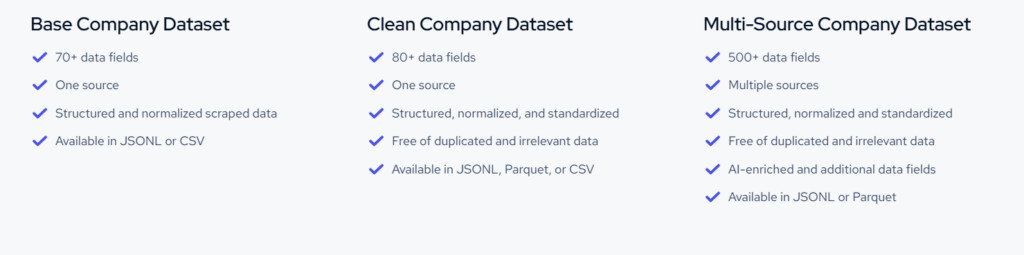
You can choose Base, Clean, or Multi-source company data, plus API or bulk delivery, which is great for data teams but less plug-and-play for operators who just want answers quickly.
And here’s what else you need to know:
| Best for | Data science, AI, HR intelligence, market research, and product teams that want structured company, employee, and jobs data in APIs or bulk files. |
| Key features | 75M+ enriched company profiles, 500+ data points, company API, bulk dataset delivery, plus related employee and jobs data. |
| Pros | Strong fit for analytics and AI workflows, flexible delivery options, and useful multi-dataset combinations for trend analysis. |
| Cons | Less plug-and-play than Apollo, and many teams will still need preprocessing, modeling, and internal QA before the data becomes workflow-ready. |
| Pricing | Free trial, then API plans from $49/month, with higher tiers from $800 and $1,500, while datasets start at $1,000 per dataset. |
For teams that want raw, multi-source datasets, Coresignal makes sense.
But if your world is much more specific to Europe-first sales, finance, and CRM workflows, a regional specialist can be more useful than a global dataset.
That is where HitHorizons comes in.
HitHorizons is a European company data platform built around one clear job: helping teams work with structured company records across Europe without stitching together dozens of local registries and APIs.
Its core database covers 80M+ companies across 50 European countries and exposes 100+ data points for CRM enrichment, lead generation, invoicing, and market analysis.
That focus makes it different from the tools above.
Apollo is stronger when you want contacts, outreach, and outbound execution in one tab.
Coresignal is stronger when you want broader public-web datasets for analytics and product teams.
HitHorizons is strongest when your company’s data problem is operational and Europe-specific.
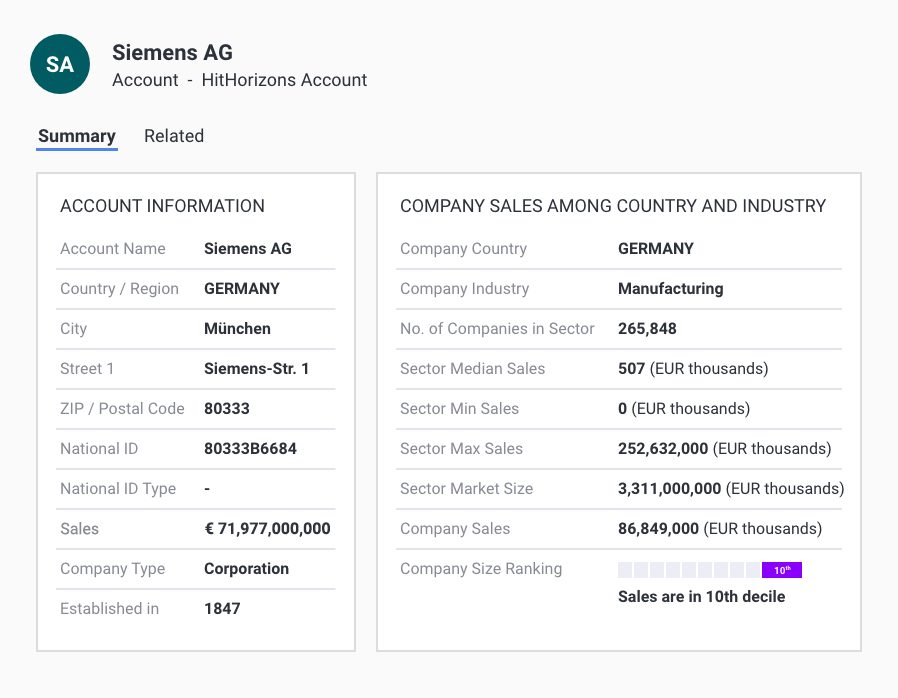
For example, if you need to enrich CRM records with VAT-ready company details, screen EU companies by revenue or headcount, or benchmark against peers in the same region or SIC code.
Source: HitHorizons
HitHorizons’ Sales & Marketing Data API can pair existing records using company name, national ID, or VAT number, then autofill fields such as address, industry, SIC code, sales, employee count, and social profile links.
Its Invoicing Data API is built to pull legal names, local legal forms, addresses, and VAT numbers from official state registers for selected countries, reducing errors in billing workflows.
This is also where HitHorizons becomes more practical than a generic global provider for some readers.
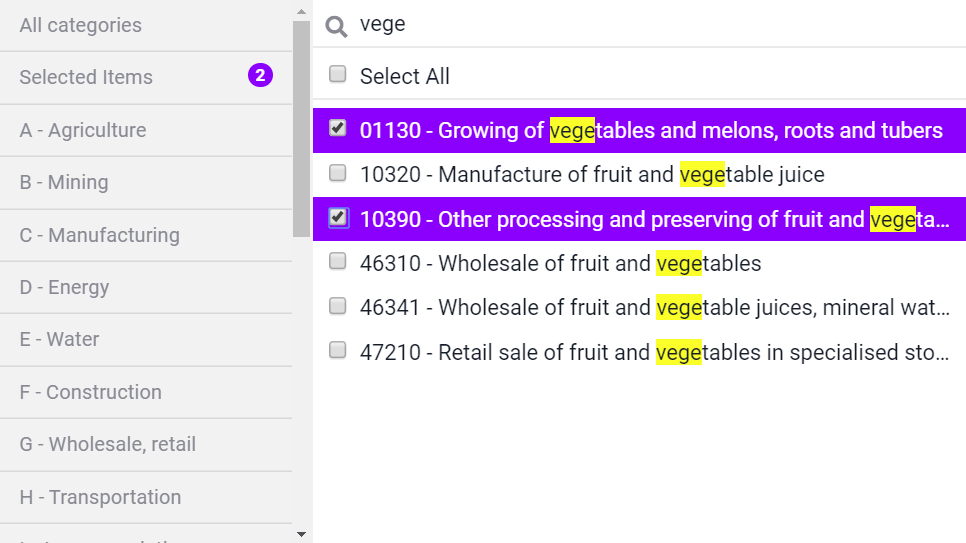
Its Screener lets users filter by country, region, industry, SIC code, sales, employees, and website, then export up to 50,000 records in one CSV.
Source: HitHorizons
It also layers in benchmarking and country or industry statistics, so the data is not just searchable. It is easier to interpret in a market context.
However, here’s the trade-off.
HitHorizons is excellent if your ICP is European and your sales, finance, and compliance teams all care about clean company records.
But if most of your pipeline is outside Europe, or you need real-time outreach tooling, Apollo will feel more complete, and Coresignal will feel more global and flexible.
Here are some quick facts about HitHorizons:
| Best for | Europe-first sales, CRM enrichment, invoicing accuracy, and regional market analysis. |
| Key features | 80M+ companies, 50 countries, 100+ data points, Sales & Marketing Data API, Screener API, Invoicing Data API. |
| Pros | Strong European specialization, registry-style invoicing data, CSV exports up to 50,000 records, and built-in benchmarking context. |
| Cons | Europe-focused coverage, invoicing API only for selected countries, and no built-in outreach workflows. |
| Pricing | Quote-based. API documentation also shows package-based VAT validation limits and caching rules, but public price tiers are not listed. |
If HitHorizons helps you standardize European company records, Sayari helps you understand the networks behind those records.
That matters when the question is no longer just who a company is, but who owns it, who it trades with, and what risk may be hiding beyond the first tier.
Sayari is a corporate and trade risk intelligence platform built for teams that need visibility into ownership structures, supplier networks, and trade relationships.
Sayari brings together 10.6B + records, 500M+ companies, 600M+ unique individuals, and 2B+ entity relationships to help users uncover hidden risk in corporate and trade networks.

Source: Sayari
Here’s what makes Sayari different from the other tools in this list.
Apollo is built for outbound execution. Coresignal is stronger as a structured public web dataset for analytics. HitHorizons is focused on European company operations and invoicing data.
Veridion is stronger in company search, supplier discovery, and enrichment.
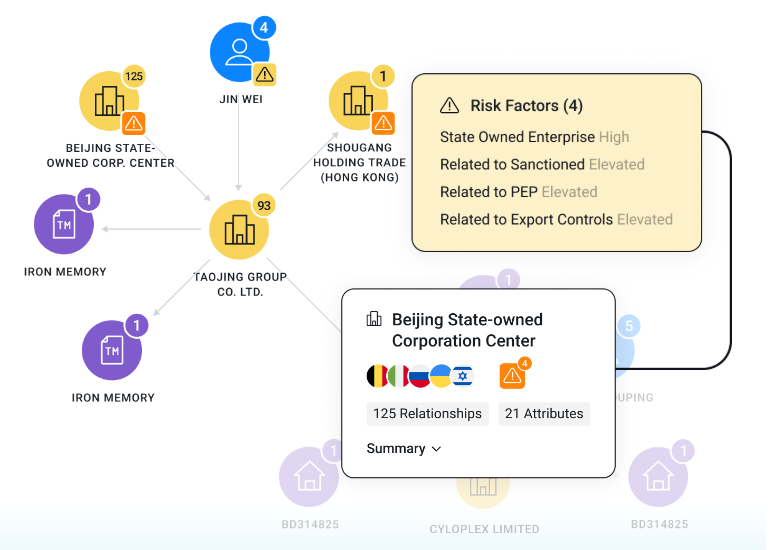
But Sayari goes deeper into ownership, trade, and n-tier risk, which is why it is more relevant for trade compliance, investigations, and supplier-risk teams than for standard CRM enrichment.
Sayari Map allows teams to upload up to 25,000 suppliers at a time, screen them against 100+ risk factors, and automatically map sub-tier supply chains using corporate, trade, and risk data.
Sayari says this helps organizations catch critical vulnerabilities in seconds rather than relying only on supplier testimony or first-tier visibility.
Under the hood, Sayari Graph is the core investigation layer.
Sayari says Graph uses graph technology to connect data on 2.7B entities from 250+ jurisdictions, resolved from 7B+ structured and unstructured records, and that first-time users typically find their target of interest within five minutes.
Source: Sayari
For operational workflows, Sayari Signal pushes risk data into ERP and compliance systems and is explicitly designed to go beyond static regulatory lists by adding non-obvious risk context.
So, Sayari is strongest when you need to see beyond the direct counterparty.
If the real problem is hidden ownership, forced labor exposure, sanctions adjacency, or n-tier supply chain risk, it is much more useful than a standard company-data provider.
But if you mainly need contact data, outreach tooling, or broad marketable datasets, Apollo, HitHorizons, or Coresignal will usually be easier fits.
Have a look at what Sayari offers:
| Best for | Trade compliance, investigations, supplier-risk, sanctions screening, and n-tier supply chain visibility. |
| Key features | Sayari Graph for ownership and trade network analysis, Sayari Map for automated supply chain mapping, and Sayari Signal for ERP-ready risk data. |
| Pros | Strong network visibility, 100+ risk factors, product-level supply chain mapping, and deep relevance for compliance-heavy workflows. |
| Cons | More specialized than general company-data tools, likely excessive for simple lead generation or CRM cleanup, and pricing is not public. |
| Pricing | Quote-based / demo-led. Sayari does not publish standard public price tiers on its product pages. |
So, Sayari is most useful when the hidden network matters more than the visible company record.
Bright Data is a web data collection platform built for teams that need fresh public web data, not just a static business database.
Its strength is infrastructure:
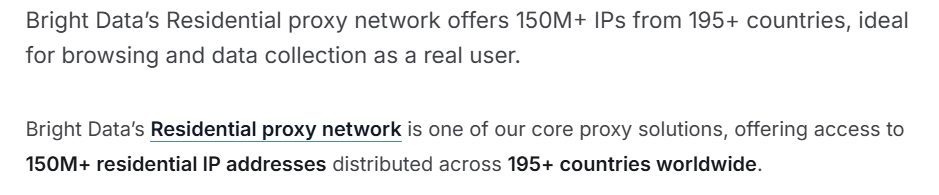
Bright Data says its residential network includes 150M+ IPs across 195+ countries, and its fast proxies page highlights a 99.95% success rate for large-scale extraction workflows.
Source: Bright Data Docs
That makes it different from the tools already covered.
For example, Veridion is stronger when you need verified company and supplier records. Apollo is stronger when you want prospecting plus outreach. Coresignal is stronger when you want packaged public datasets for analytics.
Bright Data is the better fit when the data you need is still sitting on websites and changes too often to rely on a fixed database alone.
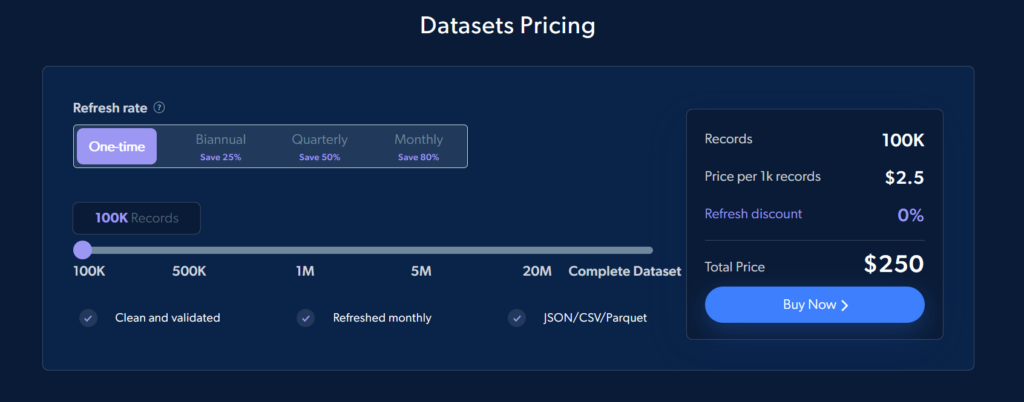
Bright Data’s financial dataset currently lists 521K+ records, 54 data fields, and a starting point of up to $0.0025 per record with a $250 minimum order.
Source: Bright Data
But the bigger differentiator is not just the dataset marketplace.
Its Web Unlocker API is designed to handle blocks, CAPTCHAs, headers, and proxy rotation for you.
In the standard Unlocker flow, Bright Data bills only for successful requests, but some custom Unlocker features can change that logic and bill for all requests, including failed ones.
That is useful when you need a live collection without building your own proxy and unblocking stack.
There is a trade-off, though.
Review platforms repeatedly praise Bright Data’s proxy quality and support, but they also flag the same friction points: higher pricing, setup complexity, and a steeper learning curve for non-technical teams.

Source: Software Advice
That is why Bright Data feels more like a data infrastructure than a plug-and-play tool.
Here’s what else to consider
| Best for | Live public-web data collection, competitor monitoring, alternative data, and AI or analytics workflows that need fresh external data. |
| Key features | 150M+ residential IPs, 195+ countries, Web Unlocker API, browser and scraping tools, and a large dataset marketplace. |
| Pros | Strong global collection infrastructure, flexible delivery models, and useful support for teams that need hard-to-collect public web data. |
| Cons | More technical than most providers on this list, with higher setup effort and pricing that can climb as usage grows. |
| Pricing | Product-specific and usage-based. The financial dataset starts at $250 minimum order, while historical financial datasets start at $400/month for subscription or $1,200 one-time on the cited product page. |
If your team has developers and needs live public-web coverage, it can be powerful.
But if you mainly need ready-to-use company profiles, Veridion, Coresignal, or HitHorizons will usually get you to value faster.
These providers do not solve the same problem.
Some help you enrich company records. Some help you collect live public web data. Others help you uncover ownership, trade, or supplier risk.
That is why a short pilot beats a long shortlist.
Test each option against the questions your team asks every week.
When the data holds up in real workflows, decisions get faster, cleaner, and much easier to trust.