



Blog
A Practical Look at How Data Analytics is Used Across Capital Markets
By: Auras Tanase -
15 June 2026


We love our data, and now that you're here, you're one step closer to loving it too.
A wide sample of data, so you can explore what is possible with our data
Choose ->
built with procurement in mind. Focused on manufacturers, products and more
Choose ->
built with insurance in mind. Focused on classifications, business activity tags and more
Choose ->
built with sustainability in mind. Focused on sustainability commitments, and environmental and social governance insights.
Choose ->
built with strategic insights in mind. Focused on market trends, competitor analysis, and industry-specific data
Choose ->

Keep up to date with our technology, what our clients are doing and get interesting monthly market insights.

Key Takeaways:
What separates the fund that saw the 2008 crash coming from the one that didn’t?
Or the bank that spotted the fraud before it hit $100 million, from the one still filling out the post-incident report?
In capital markets, data analytics has become the answer to almost every version of that question.
Here is what it actually looks like in practice.
Risk has always sat at the center of capital markets.
What’s changed over the years is how fast it moves and how much data it now generates.
Traditional risk management relied on historical models, lots of manual reviews, and backward-looking frameworks.
The 2008 financial crisis made it painfully clear how badly that approach could fail under real-world pressure.
Since then, firms have been rebuilding risk operations around data.
Mark Batten, Banking and Capital Markets Leader at PwC UK, explains why this matters so much:
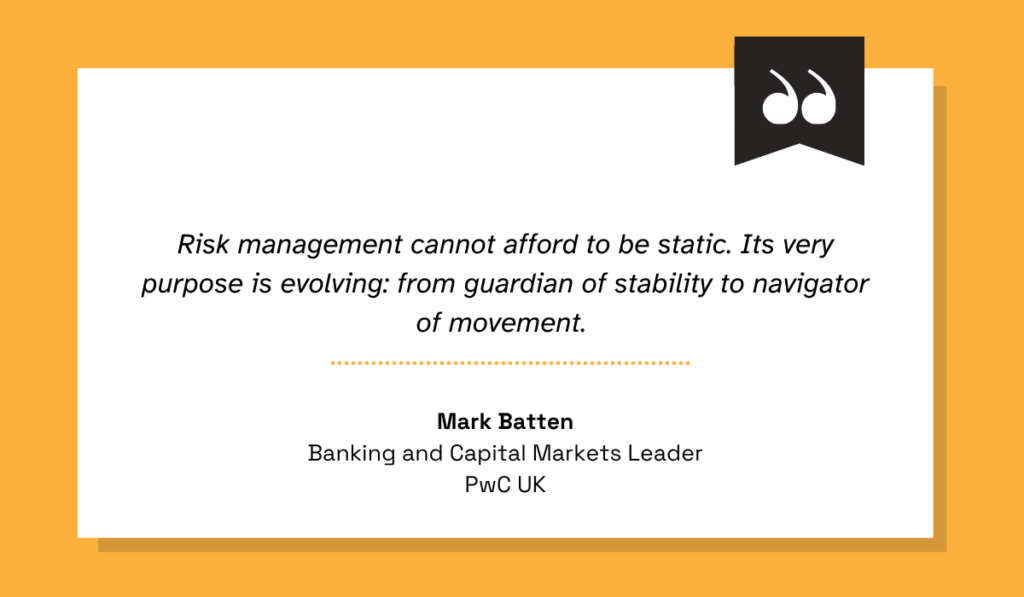
Illustration: Veridion / Quote: PwC
Generali Asset Management, which manages over €375+ billion in assets, is probably one of the best examples of what data-driven risk management looks like in practice.
Until recently, its risk technology (or lack thereof) was holding it back.
Daily reporting runs took more than ten hours. The risk team couldn’t get timely insights, exposing the company to significant risk.
So Generali rebuilt its risk analytics framework from the ground up.
The firm partnered with MSCI to integrate data better, speed up calculations, and handle larger workloads. The results were striking:
Ultimately, this unlocked much greater agility for the company, allowing quicker scenario reruns and data corrections, supporting faster and more confident decisions.
Taula Capital is another example of importance here.
The firm deployed a real-time risk analytics platform focused on Value at Risk (VaR) and stress testing.
Source: Asset Servicing Times
Risk managers can now run ‘what-if’ scenarios on the fly. They can adjust positions and see instant updates to capital usage, and can also slice into granular risk data going back years.
Do you see the pattern?
Instead of looking at what went wrong after the fact, data analytics-powered platforms flag exposures in real time, stress-test portfolios against hundreds of scenarios, and model tail risks before they become losses.
So, analytics is not just catching problems faster. It’s building systems that make certain types of errors structurally impossible.
However, that only happens when the data powering those systems is accurate.
You can have sophisticated dashboards, real-time alerts, and predictive models. But if the underlying business data is outdated or incomplete, or worse, inaccurate, it can expose firms to unnecessary risk.
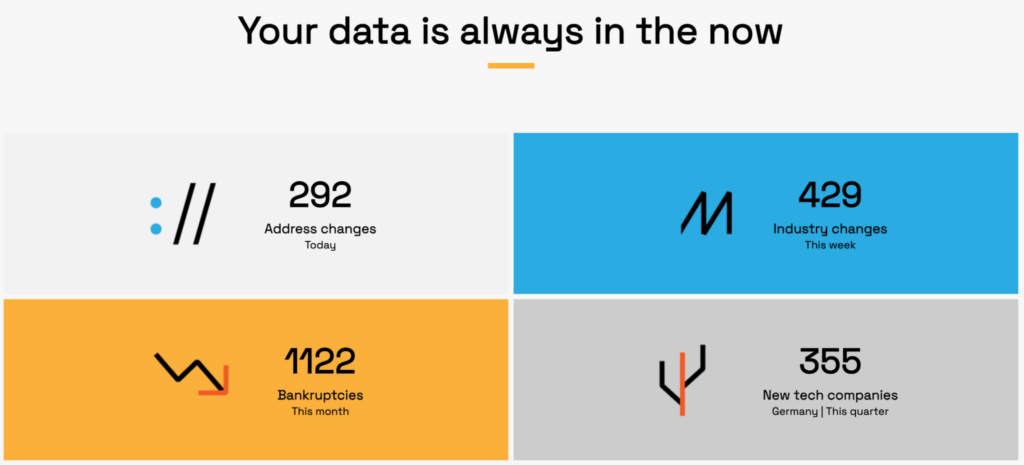
Veridion helps solve this challenge by providing large-scale company intelligence built from AI-powered analysis of websites, press releases, and other publicly available sources, even social media.
Not to mention, it creates detailed profiles covering business activities, company ownership structures, geographic presence, products and services, and corporate affiliations.
This gives firms a much deeper understanding of the kind of risks they work with.
Source: Veridion
Risk teams, in fact, need deeper visibility into foreign influence risks, operational resilience, and financial stability.
Veridion’s enriched datasets help organizations identify these risks earlier, improve due diligence efforts, and support more confident decision-making across their risk management programs.
And most importantly, its data is refreshed weekly, meaning it empowers you to always stay in the (k)now.
Regulatory pressure on capital markets has never been tighter. And the consequences of noncompliance are more than just reputational.
Global regulatory fines hit a record $19.3 billion in 2024, according to the Corlytics database.

Source: fintech.global
In the US alone, regulators issued over $4.3 billion in financial penalties, with North America accounting for 95% of global enforcement actions, per Fenergo’s annual analysis.
Banks bore the heaviest load. Penalties targeting banks surged 522% to $3.65 billion, and transaction monitoring violations alone exceeded $3.3 billion, a 100% year-over-year increase.
Now, the problem isn’t that firms don’t want to comply.
The problem is that compliance at scale, across thousands of transactions per day, is functionally impossible without data analytics doing the heavy lifting.
Take trade surveillance, for instance.
There are now AI-powered monitoring systems that process millions of transactions simultaneously, flagging unusual trading patterns against real-time benchmark data.
Without this kind of technology, the task becomes virtually impossible.
HSBC, one of the world’s largest financial services organizations, with roughly 980 million transactions monitored monthly, ran straight into this problem.
Its traditional rules-based AML system generated enormous volumes of false positives (innocent transactions flagged for review), forcing investigators to spend most of their time chasing dead ends instead of real financial crime.
So HSBC partnered with Google Cloud to build an AI-powered Anti-Money Laundering system trained on its own vast global transaction data.

Source: Celent.com
The results, published directly by Google Cloud, were significant:
This case study brings a good point to the surface.
Today, data analytics doesn’t just reduce compliance risk. It changes what compliance teams can actually do with their time.
Let’s also not forget the emerging compliance landscape: MiFID II in Europe, Regulation S-P data security requirements in the US, AML obligations across jurisdictions.
All of them demand a structured, auditable, real-time data analytics infrastructure.
Firms today, trying to manage these requirements with spreadsheets and manual workflows, could be running out of road very soon.
But, the firms that are building analytics-first compliance infrastructure?
They won’t just avoid fines; they’ll move faster when regulations evolve (and they will), because the infrastructure is already there.
Capital markets are in the middle of a generational technology shift.
And data analytics is at its center.
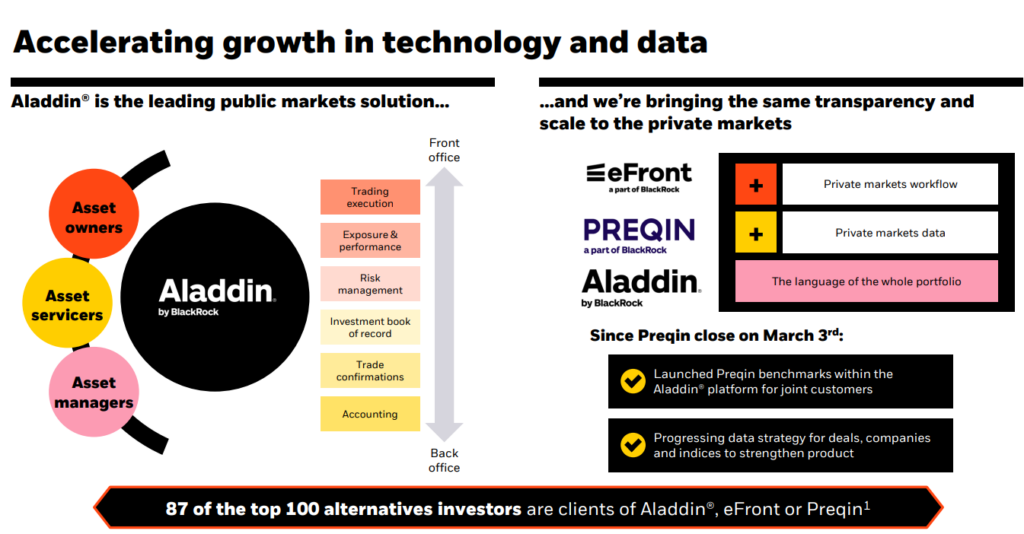
BlackRock’s Aladdin platform, an investment management operating system used by institutional investors worldwide, is a good case study of what this looks like in practice.
Aladdin unifies the investment management process through a common data language, providing firms with a single view of their entire portfolio across both public and private markets.
In early 2026, BlackRock integrated Preqin’s private markets data directly into eFront, part of the Aladdin stack.
Source: BlackRock Investor Day 2025 Presentation
For the first time, institutional investors could manage pre-investment intelligence and post-investment analytics in one platform.
It removes the fragmentation that has long slowed down private markets’ decision-making.
We see the rise of tech across many industry leaders already.
For example, Goldman Sachs partnered with AWS to build Goldman Sachs Financial Cloud for Data, a suite of cloud-based analytics solutions designed to reduce the need for firms to build and maintain foundational data infrastructure themselves.
The collaboration allows investment firms to access advanced quantitative data analytics across global markets without rebuilding their entire engineering stack.
Source: Goldman Sachs
Also, consider what JPMorgan Chase has committed financially. The firm’s technology budget is predicted to be around ~$20 billion in 2026, arguably the highest ever from a financial institution.
In every sense, the broader industry signal is really hard to miss, which is how aggressively banks and capital markets firms are investing in the tech transformation right now.
And data analytics is the common thread, providing the insights needed to modernize infrastructure, automate operations, improve decision-making, enable AI adoption, and measure the value of technology investments.
What’s the secret of the firms that move first on a market trend?
They often just see the signal earlier, and that comes down to data.
Take the case of Renaissance Technologies, or RenTec, a quantitative investment firm founded by mathematician Jim Simons, known for applying statistical models to financial markets.
Renaissance’s Medallion Fund, built entirely on mathematical models and data analytics, has delivered an average annual net return of 39.9% since 1988, through crashes, rate cycles, and geopolitical shocks.

Source: Quatr
The method is entirely data-driven.
Renaissance processes historical and real-time market data: prices, volumes, order flows, and alternative datasets like weather trends and shipping data to identify statistical patterns that humans would never notice.
It’s safe to say that the fund’s performance didn’t come from gut instinct. It came from processing patterns in market microstructure data that other participants couldn’t see or act on fast enough.
Quick fun fact: The Medallion Fund has never had a negative return year in its 31-year track record, including during the dot-com crash and the 2008 financial crisis.
So, data analytics didn’t just help them spot trends. It protected them from catastrophic ones.
Medallion Fund arguably is the clearest possible case for what rigorous data analytics can do.
In simpler words, firms don’t need to be right on big calls.
They need to be right slightly more often than not, at a very high frequency, on signals nobody else is using.
And data analytics is arguably the only way to do it today.
Every investment decision in capital markets is ultimately a bet on incomplete information.
The question isn’t whether you have uncertainty, because absolutely every firm deals with that. It’s just how well you use the data available to you.
Take the case of Bridgewater Associates, one of the world’s largest hedge funds, founded by Ray Dalio, which built its edge on systematizing investment judgment.
Rather than letting individual analysts make calls based on intuition, Bridgewater developed quantitative models that translate economic data like growth indicators, inflation rates, and credit conditions into structured investment signals.
Human analysts, of course, then layer in a qualitative context.
So, what’s the result?
Well, the firm has consistently delivered results for institutional investors across multiple market cycles, including periods where most macro funds failed to call the direction correctly.
Dalio once commented:
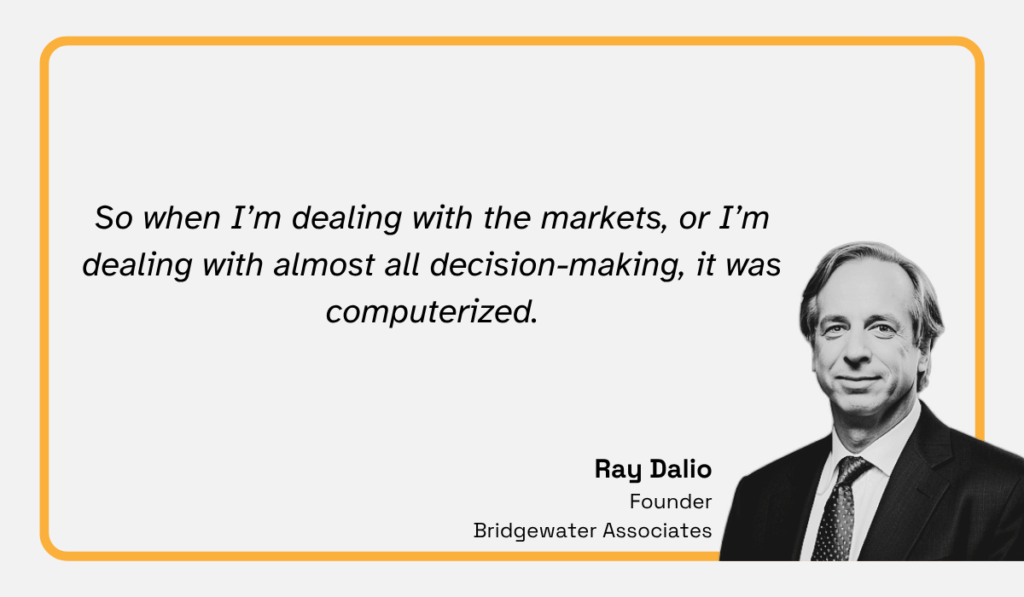
Illustration: Veridion / Quote: HBR IdeaCast
The numbers also support data analytics-based decision-making.
For example, in developed equity markets, algorithms now account for 80–85% of total trading activity globally.
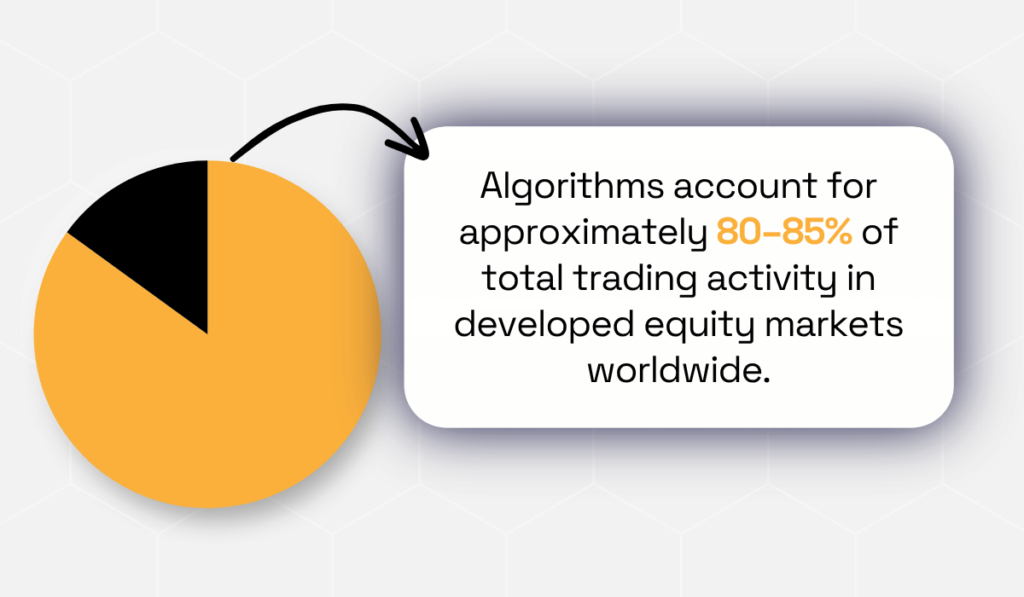
Illustration: Veridion / Data: Latent View
And all this is not just about speed.
It’s truly and fully about the quality of the decision itself.
When firms integrate alternative data like corporate hierarchy changes, supplier network shifts, executive transitions, ESG metrics, and product portfolio changes into their investment models, they gain a fuller picture of company health than public filings alone ever provide.
They’re also analyzing better because their models are built on better inputs.
This type of quality business intelligence can become a competitive lever.
And the companies doing this well are making decisions with lower information asymmetry and greater confidence in the signals they’re acting on.
Kazi Islam, Global Assurance Strategy & Growth Leader at PwC US, agrees:
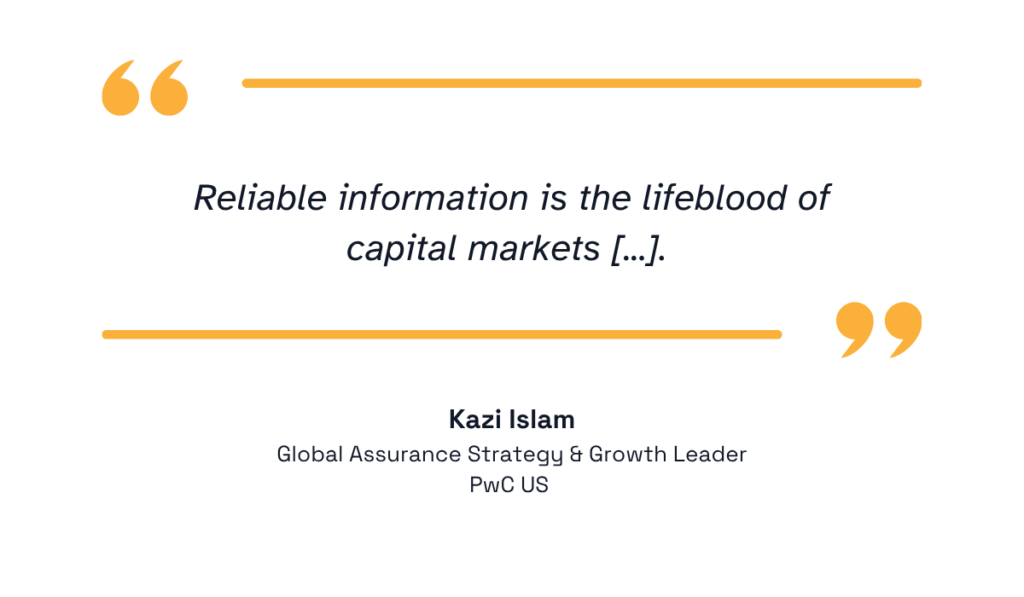
Illustration: Veridion / Data: PwC
So, data analytics, in that sense, has become the whole infrastructure of modern risk, compliance, and investment management.
Not just a tool on the side.
Data analytics is not a nice-to-have in capital markets anymore.
Firms treating it as a core operational capability across risk, compliance, technology, and investment decisions are pulling ahead in measurable ways.
The evidence is consistent across every area covered here: faster fraud detection, cleaner regulatory responses, better investment signals, and more competitive returns.
The gap between data-mature firms and those still catching up is widening every year.
So ask yourself: does your firm have the data infrastructure to compete at the level that 2026 and beyond require?
Because the firms that have already built it are not waiting around.