



Blog
AI vs Supplier-Validated Supply Chain Mapping
By: Auras Tanase -
15 March 2026

We love our data, and now that you're here, you're one step closer to loving it too.
A wide sample of data, so you can explore what is possible with our data
Choose ->
built with procurement in mind. Focused on manufacturers, products and more
Choose ->
built with insurance in mind. Focused on classifications, business activity tags and more
Choose ->
built with sustainability in mind. Focused on sustainability commitments, and environmental and social governance insights.
Choose ->
built with strategic insights in mind. Focused on market trends, competitor analysis, and industry-specific data
Choose ->

Keep up to date with our technology, what our clients are doing and get interesting monthly market insights.

If you’re responsible for managing risk, compliance, or visibility across a complex supply chain, you’ve likely encountered two approaches to mapping: AI-driven supplier-validated mapping.
Both aim to solve the same problem: helping procurement teams understand who their suppliers are, where risks exist, and how disruptions might ripple across tiers.
But they don’t work the same way, and those differences matter a lot at enterprise scale.
Should you rely on AI to automatically expose supplier relationships and hidden tiers? Or is supplier-validated data still the most reliable way to achieve accuracy and trust?
And what happens when speed, scale, and regulatory pressure collide?
In this article, we’ll explore how AI-based and supplier-validated supply chain mapping actually work, where each approach excels, and where the trade-offs begin to show.
By the end, you’ll have a clear framework for deciding which model best supports your procurement strategy, risk management goals, and long-term supply chain resilience.
AI-driven supply chain mapping uses machine learning and big data to infer relationships across your supplier network.
Instead of waiting for suppliers to tell you about their sub-tier sources, AI systems scan massive amounts of public and third-party datasets to uncover hidden connections for you.
It pulls from trade records, bills of lading, customs filings, company websites, news articles, and procurement contracts to piece together who supplies whom.
This is what we call an “outside-in” approach, and it builds multi-tier maps even when direct data is missing.
According to McKinsey, only 2% of companies have visibility beyond their second-tier suppliers.
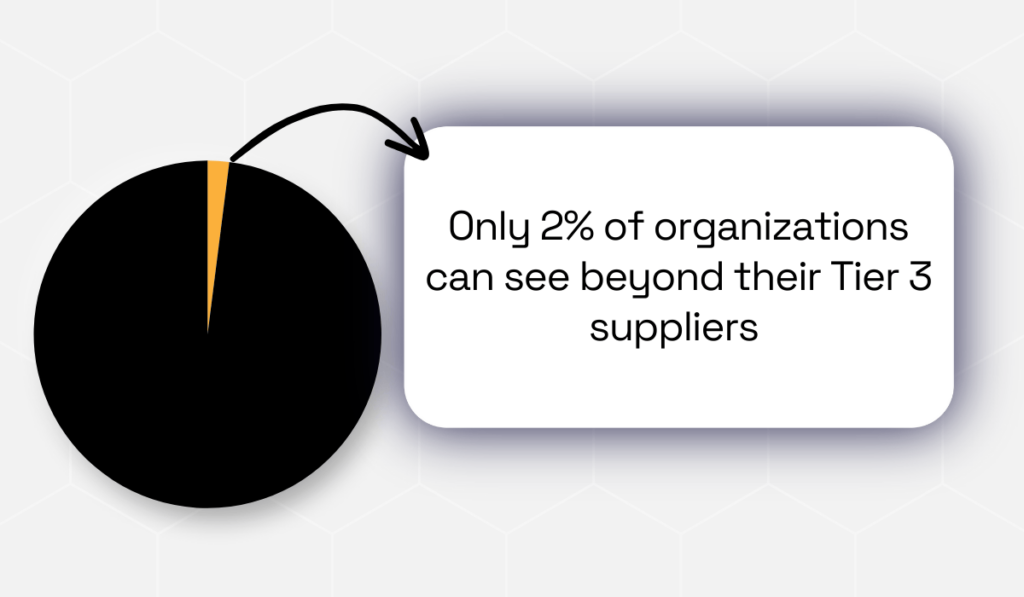
Illustration: Veridion / Data: McKinsey
AI helps you fill that massive blind spot.
That’s because AI mapping excels at speed and scale. Advanced algorithms can process billions of records in minutes.
They handle the messy work and detect patterns across large volumes.
Within hours or days, you can have a tentative map of sub-tier nodes and flows that would otherwise take months to build manually.
Because AI pulls data from so many public and private sources, it spots relationships that never show up in official disclosures.
For example, a news article might mention a supplier partnership, import/export data ties buyers to shippers, while social media can reveal business connections.
AI connects these dots for you in early assessments.
This breadth helps you triage risk faster. Instead of surveying dozens of suppliers right away, you let AI propose likely sub-tier suppliers first. Then you verify the most critical relationships.
AI mapping also updates continuously as new data arrives.
Take Veridion, for example.
This AI-driven supplier intelligence platform regularly scrapes the web, processing petabytes of structured and unstructured web data to build rich, weekly-updated supplier profiles.
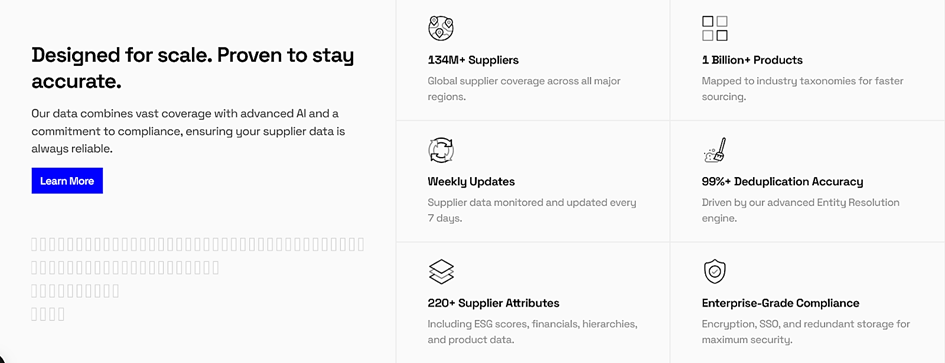
Source: Veridion
This allows you to adapt your supply chain maps quickly if market conditions change.
Veridion enriches supplier records with verified operational footprints, ownership structures, and real-world activity signals. Each supplier profile reflects:
More specifically, each of these enriched profiles includes over 220 supplier attributes spanning location data, firmographic details, ownership structure, compliance records, and even emission estimates.
See how Veridion’s data enrichment works in the video below:
Source: Veridion on YouTube
This grounding in verified, operational reality improves the quality of inputs AI models rely on when inferring supplier relationships.
By combining structured attributes with real-world signals, the system reduces noise and false positives that often occur in purely inference-based mapping.
With solutions like this, organizations can easily map out their sub-tier suppliers, their location, and the role they play.
The result is greater transparency and more reliable decisions in supplier sourcing, risk assessment, and compliance.
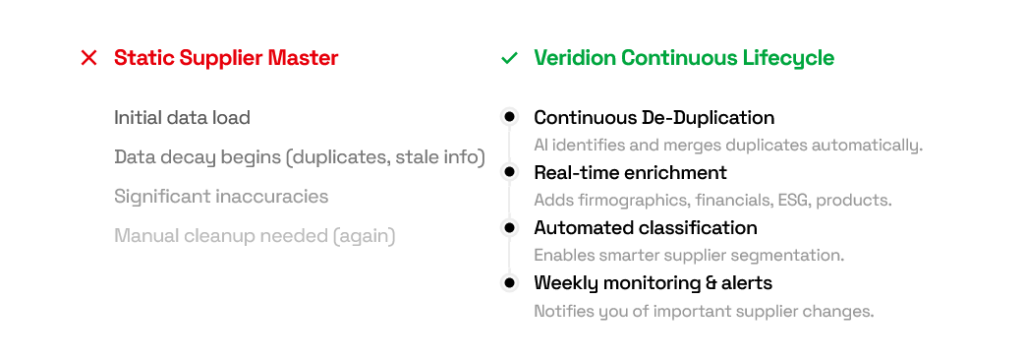
Source: Veridion
In other words, your map reflects current information without waiting for manual updates.
If market conditions shift, you will know quickly.
This is the “inside-out” approach, where you go straight to the source.
Supplier-validated mapping is the process of creating an overview of the individuals and organizations in a company’s supplier network, based on the direct input from suppliers.
This is an effective way to combat the lack of supply chain visibility, which is a widespread issue nowadays.
Apparently, over 45% of supply chain leaders say they have no visibility into their upstream supply chain, according to a recent McKinsey report.
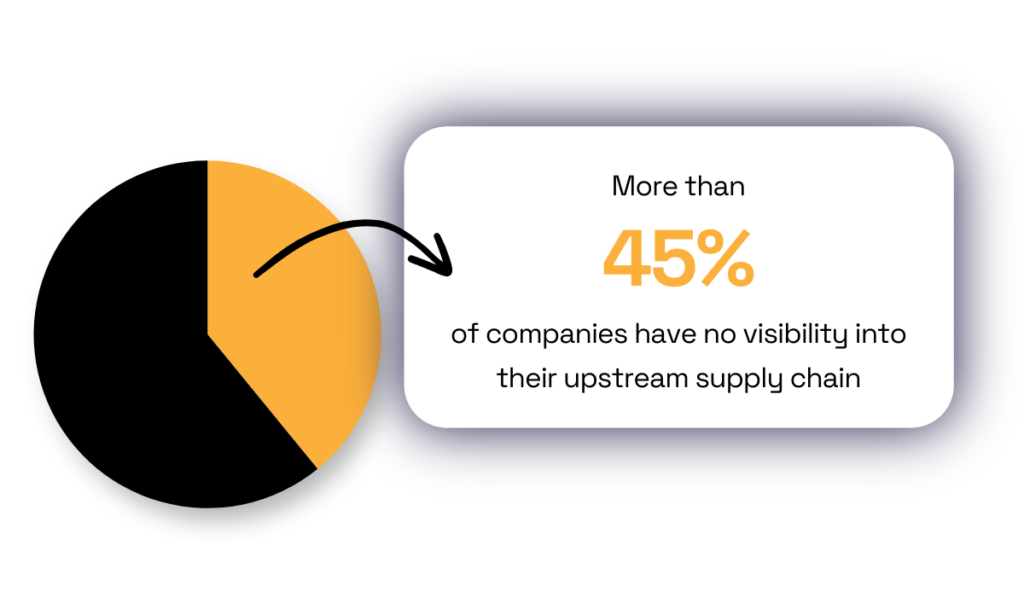
Illustration: Veridion / Data: McKinsey
To close that gap, companies turn to supplier-validated mapping by going directly to the source of truth.
You ask each first-tier supplier to share details about their sub-tiers: production sites, parts, capacities, and alternative sourcing options.
This usually happens through structured questionnaires or cascading Requests for Information (RFIs) that move up the chain.
Tier one reports on tier two, tier two reports on tier 3, and so on.
Because suppliers report their actual relationships, the data is precise and yields unmatched accuracy.
You learn:
This level of detail is critical for risk management and compliance.
Another key benefit is the detail and context that suppliers provide.
Suppliers can share nuanced information that’s impossible to find publicly, such as testing protocols, quality certifications, or internal operational vulnerabilities.
In some supply chains, over 5,000 data fields are exchanged between partners, yet fewer than 100 are actually unique, making supplier context essential for separating accurate insights from redundant noise.
This inside knowledge gives you greater accuracy and builds trust and collaboration, making supplier-validated mapping widely considered the gold standard for supply chain visibility.
However, it comes with trade-offs. Supplier-validated mapping requires significant effort and sustained cooperation.
Response rates to supplier questionnaires and RFIs can drop as low as 40%. That leaves major gaps in the map.
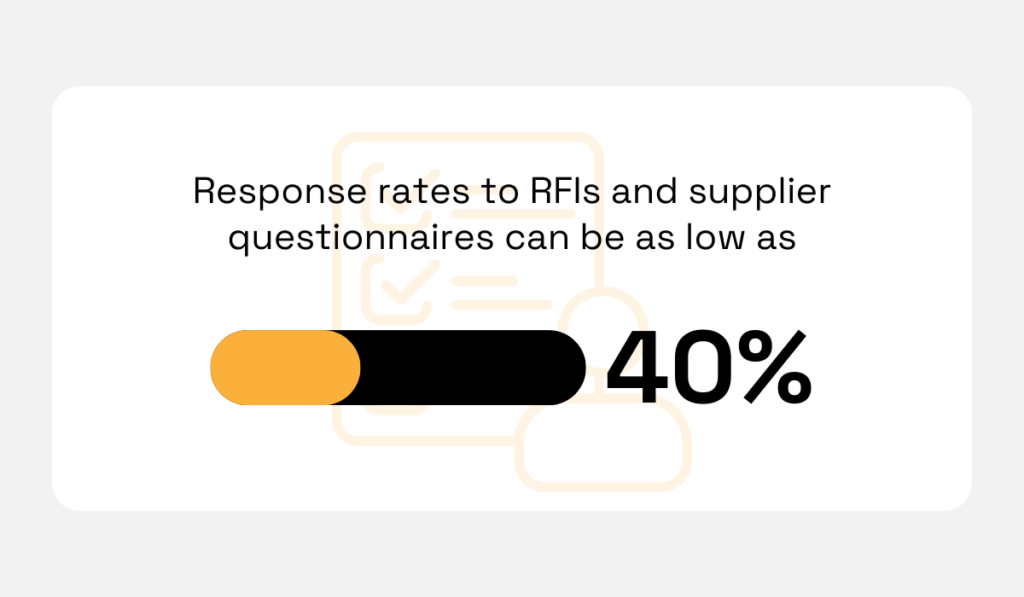
Illustration: Veridion / Data: Sayari
Many suppliers, especially in deeper tiers, are reluctant to share proprietary information. Others simply lack the time or systems to respond accurately.
Data quality is another challenge.
According to Sphera, as much as 70% of the data flowing in from Tier 2 to Tier 4 suppliers is incorrect or unreliable, increasing the burden on procurement teams to validate, clean, and reconcile responses.
Collecting and verifying this information is resource-intensive: your procurement team must send questionnaires, follow up on responses, clean up, and consolidate the data.
It may take weeks or months to cascade an RFI up to Tier 3 or beyond.
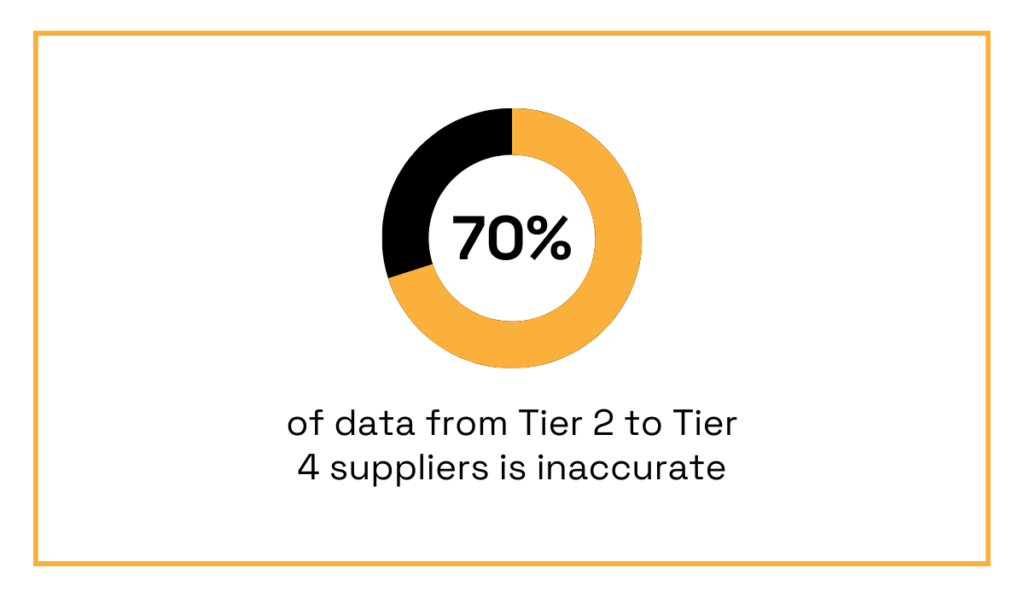
Illustration: Veridion / Data: Sphera
Besides, Tier 2 and Tier 3 firms often have no incentive to share data with you. When that happens, manual mapping efforts can stall completely.
In short, supplier-validated mapping gives you exact answers about your supply chain.
But it depends entirely on your suppliers’ willingness to participate and the quality of data they provide.
Yes.
Most companies use both approaches together because they complement each other’s strengths and weaknesses perfectly.
AI mapping reveals the broad network quickly and shows you where to look. Supplier-validated mapping gives you direct, verified input from suppliers.
The best practice is combining both approaches because they serve different purposes.
Use AI tools to map upstream suppliers at scale automatically. Then focus your supplier-validated mapping on the most important cases.
For instance:
The outside-in approach gives you access to larger datasets.
It’s more objective, faster, and cheaper because it runs on automated data ingestion. You get continuous monitoring as new events occur.
The inside-out approach produces highly accurate results when suppliers engage. It catches nuances that automated scraping might miss.
Together, they give you both breadth and depth of data, which is an absolute must for informed decision-making in today’s volatile landscape.
Sayan Debroy, Associate VP at The Smart Cube, a global provider of sector-specific research and analytics solutions, puts it best:
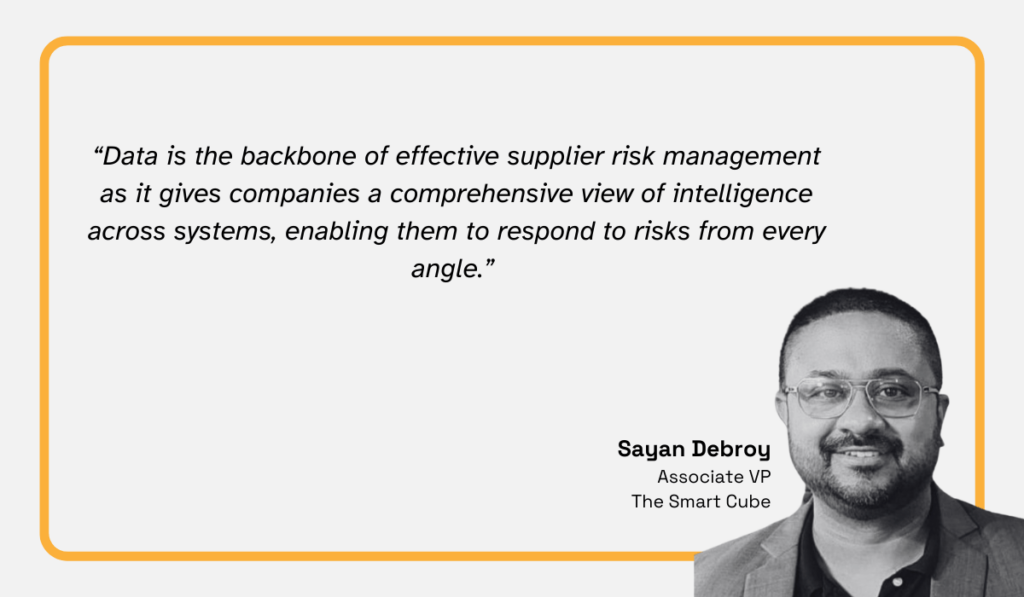
Illustration: Veridion / Quote: Supply Chain Digital
So, AI might highlight a Tier 3 semiconductor manufacturer in Japan. Your supplier then verifies the company’s output volumes and ISO certifications.
Without AI, you might never discover that remote factory. Without your supplier’s data, you wouldn’t know how much output you can rely on.
Use AI mapping technology first to automatically identify upstream suppliers. Your compliance and analyst teams can batch screen these suppliers and only follow up manually on high-priority gaps.
This workflow saves massive amounts of manual effort, and you get more complete data than either method alone could provide.
Ultimately, the roles are complementary. You don’t have to choose between them. Using both creates a tiered approach that maximizes your visibility across the entire supply chain.
AI and supplier-validated supply chain mapping are not competing approaches; they are complementary ones.
AI mapping delivers speed, scale, and early visibility across complex, multi-tier networks, which helps companies understand the rough shape of their supply chain and spot areas requiring concern.
Supplier-validated mapping adds the precision, context, and trust that only direct engagement can provide.
Relying on just one leaves gaps; combining both gives you a clearer, more resilient view of your supply chain.
Start broad with AI to surface risk and hidden dependencies, then go deep with supplier validation where it’s most important.
When you combine technology with trusted supplier insight, visibility becomes actionable, smarter, and faster decisions naturally follow.