



Blog
6 Best Data Enrichment APIs
By: Stefan Gergely -
08 April 2026


We love our data, and now that you're here, you're one step closer to loving it too.
A wide sample of data, so you can explore what is possible with our data
Choose ->
built with procurement in mind. Focused on manufacturers, products and more
Choose ->
built with insurance in mind. Focused on classifications, business activity tags and more
Choose ->
built with sustainability in mind. Focused on sustainability commitments, and environmental and social governance insights.
Choose ->
built with strategic insights in mind. Focused on market trends, competitor analysis, and industry-specific data
Choose ->

Keep up to date with our technology, what our clients are doing and get interesting monthly market insights.

Key Takeaways:
Is your enterprise making decisions without a complete view of your data? This approach can silently undermine your strategy.
The problem is, internal records are rarely enough. Most enterprises need to supplement them with third-party data.
The best way to do so is to leverage a data enrichment API, so insights get automatically integrated across your systems.
In this article, we’ll help you choose the one that best supports your goals.
To do so, we’ll compare the six top choices based on data breadth, quality, use-case focus, and other key factors.
Let’s dive in!
Veridion’s API is one of the most robust solutions on the market, especially for master data management (MDM), entity matching, and global company profile enrichment.
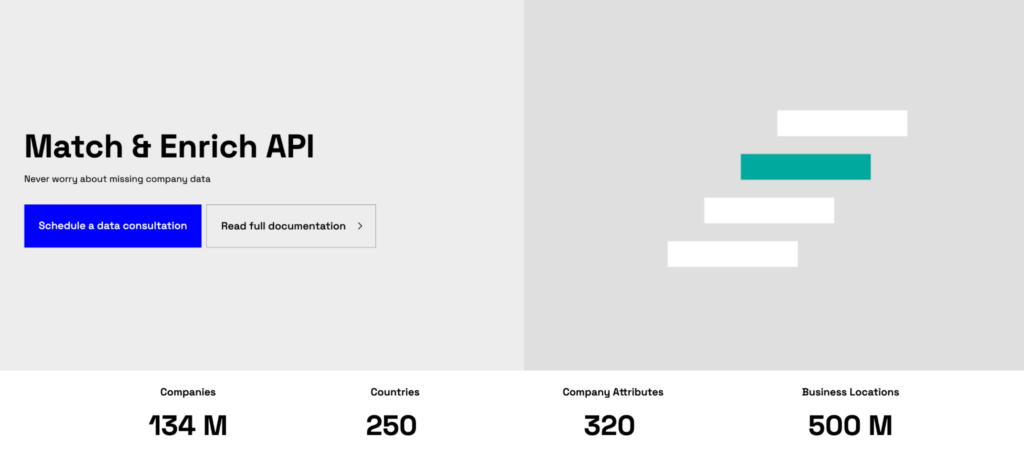
Its Match & Enrich API stands out in several key ways, including global coverage, high-precision data, scope, freshness, and depth of insights.
Unlike most other APIs on this list, it collects data on a vast range of global companies.
More precisely, Veridion’s data library covers over 134M entities in 250 countries.
Source: Veridion
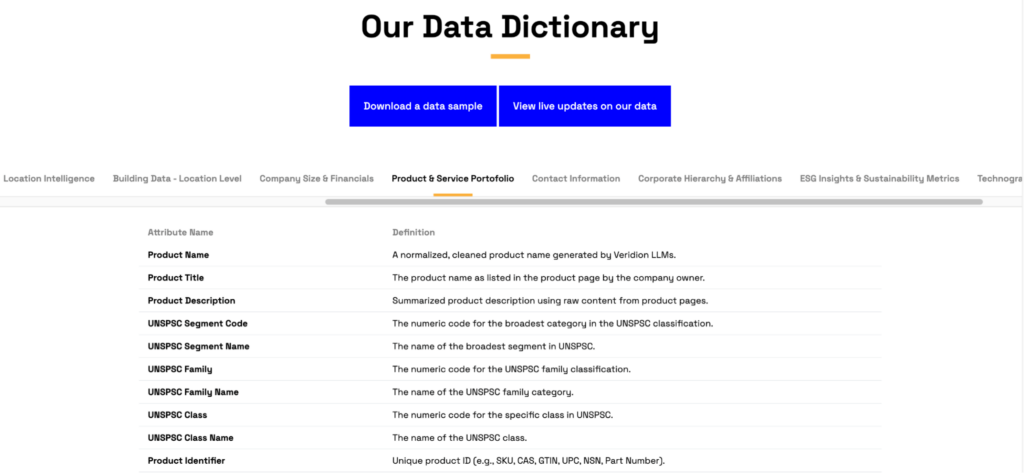
It captures as many as 320 different company attributes, ranging from basic firmographics to detailed product-level insights, location intelligence, and ESG and sustainability metrics.
This data is extracted from a wide range of both structured and unstructured sources, like company websites and local news sites.
Such a robust approach enables comprehensive, cross-functional analyses of current and prospective third parties.
Additionally, the API can enrich existing records using just two data points: the company name and the country in which it is registered, headquartered, or operates.
Source: Veridion
Veridion also ensures the data is accurate, fresh, and complete through weekly data updates.
Any potential changes associated with a third party, such as updates to their product portfolio or ESG risk, are automatically captured and reflected in your systems.
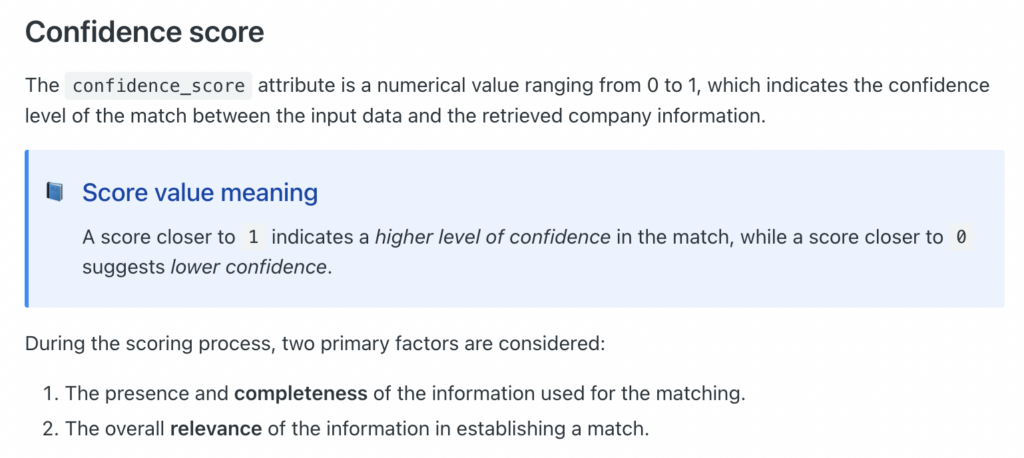
Teams can further assess data credibility by checking automatically-assigned confidence scores.
These are calculated based on two key factors: relevance and completeness.
Source: Veridion
These features make Veridion’s API particularly suitable for enterprises seeking comprehensive, AI-driven supplier insights.
Its main function is to help procurement maintain accurate master data, streamline supplier discovery, and gain better sourcing insights.
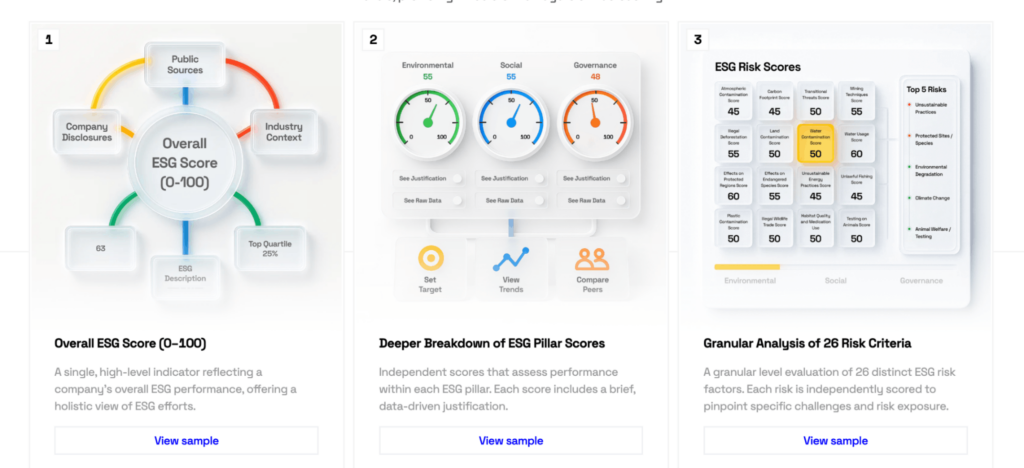
In this area, its main strength might be its robust ESG and sustainability data, allowing procurement to align with broader corporate responsibility goals.
Source: Veridion
With that, Veridion’s API can be just as helpful in enabling general market intelligence and both internal and external risk assessments.
Explorium’s data enrichment API is another strong option, but it leans toward different use cases compared to Veridion.
It is primarily built for AI-driven marketing, sales, and GTM processes, but can also help with recruiting.
Its AgentSource API can be used for data enrichment, prospect matching, and business intelligence.
Today, it is mainly positioned as the go-to API for companies building GTM agents.
Source: Explorium AI on YouTube
While Explorium is well-suited for GTM-related workflows, it may lack the data needed by other business functions.
For example, it doesn’t provide information about a company’s products or services, nor does it offer location intelligence.
On the other hand, it delivers GTM-focused data that cross-functional APIs, like Veridion’s, might lack.
This includes information on relevant business events, prospects’ professional history, and their social media presence.
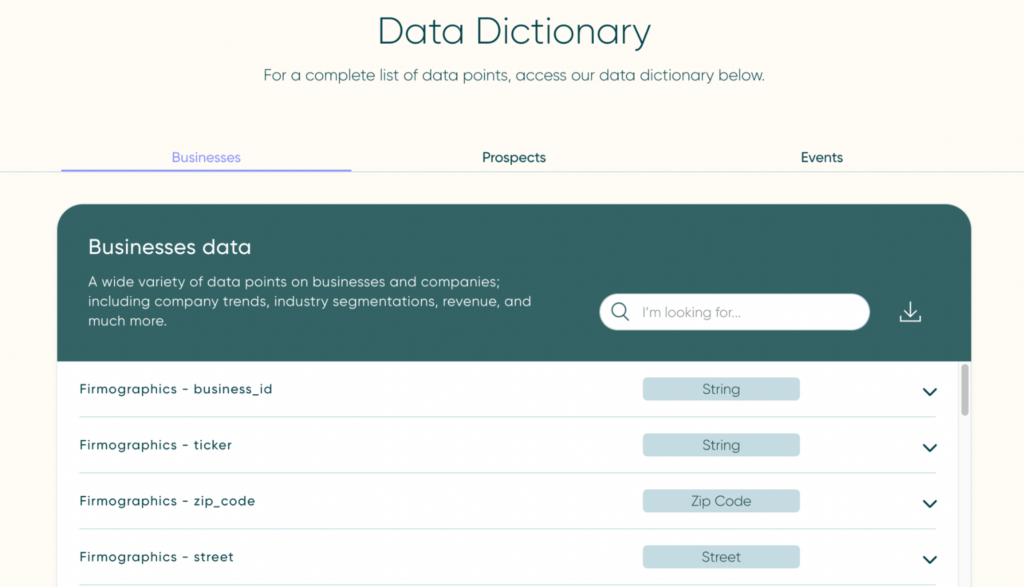
Source: Explorium
Like Veridion, Explorium provides extensive, global coverage, with its database currently encompassing over 150M companies and more than 800M people.
According to the provider, this data is extracted from an equally impressive data pool, featuring over 100 sources.
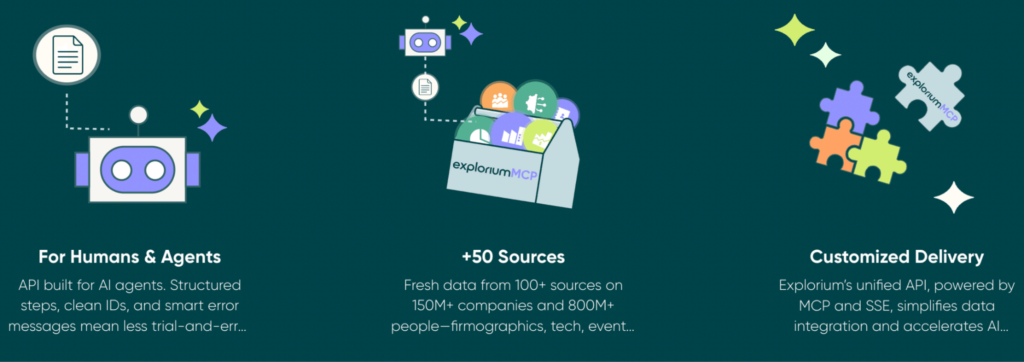
Source: Explorium
Overall, Explorium is oriented heavily toward lead discovery, GTM, and segmentation.
This differentiates it from solutions more heavily focused on MDM and enterprise-wide business intelligence, such as Veridion’s API.
What differentiates it from other GTM-oriented solutions, on the other hand, is its strong focus on AI-driven workflows and AI agents.
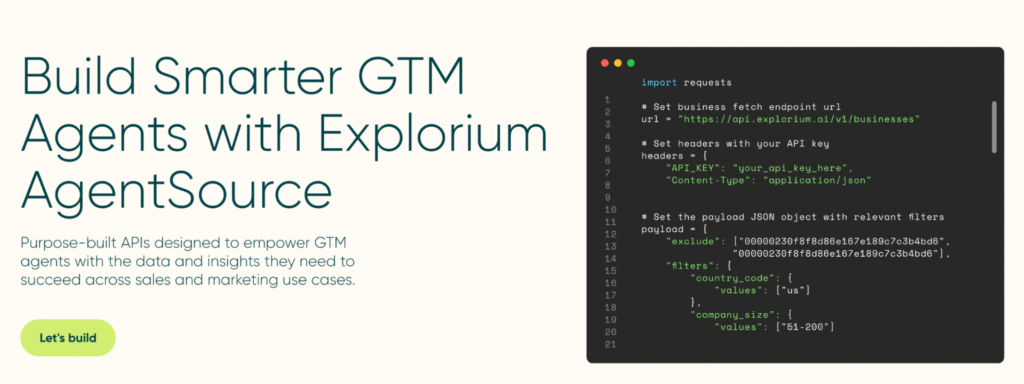
Source: Explorium
Its strength lies in turning vast, disparate B2B data into structured insights, making it the best fit for enterprise sales and marketing teams building AI-powered workflows.
With that said, Explorium can also work well in any use case that requires person-level data.
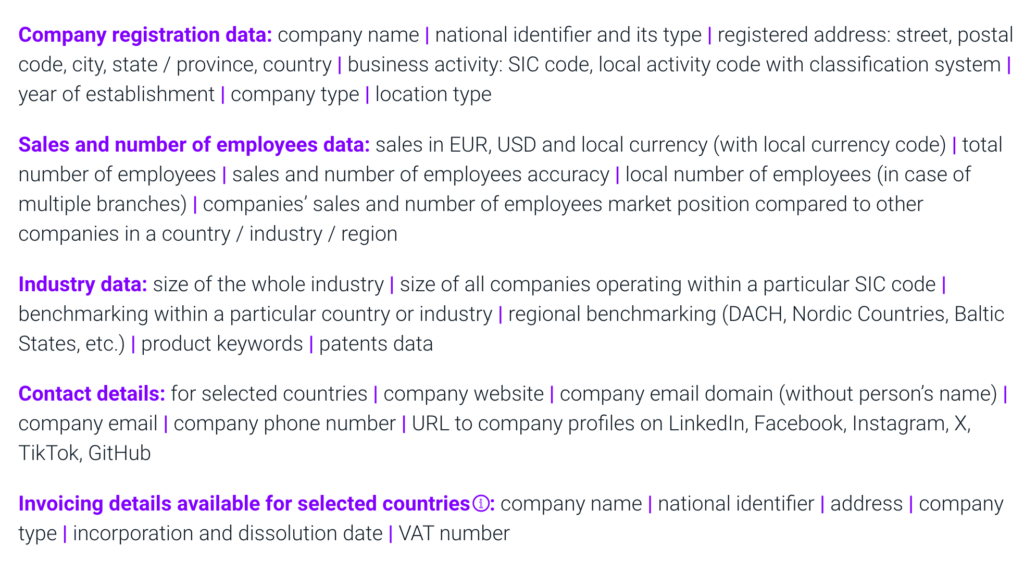
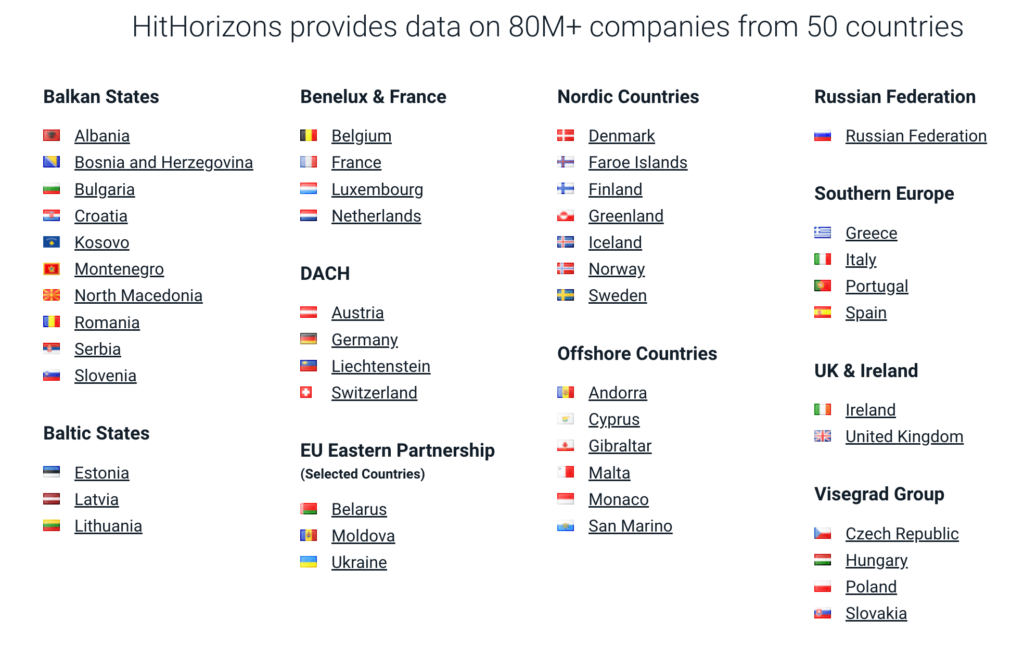
HitHorizons offers another robust data enrichment API, providing over 100 data points on 80M companies.
In terms of use cases, it aligns more closely with Veridion than Explorium, as it primarily focuses on company profile enrichment, CRM/ERP integration, and business intelligence.
However, unlike the last two options, HitHorizons API collects data solely on European companies.
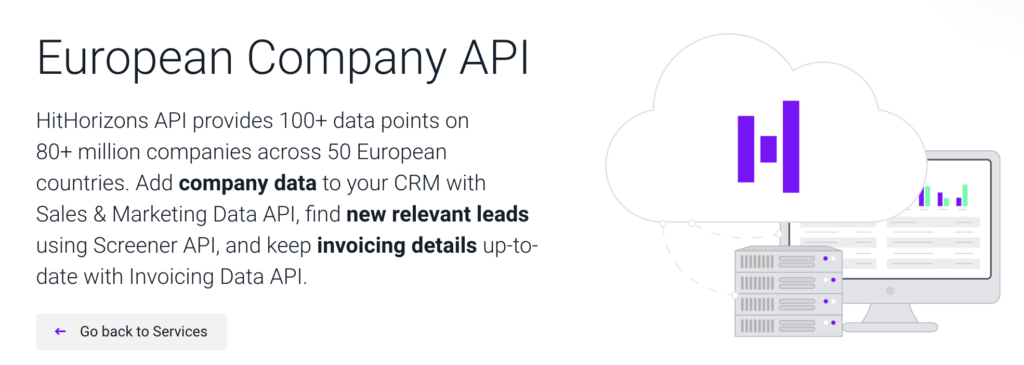
Source: HitHorizons
It collects five major data types:
With this in mind, it lacks some insights that might be key for both MDM and supplier discovery, such as those offered by Veridion.
This includes product and services portfolio data, sustainability metrics, and more comprehensive location intelligence.
Source: HitHorizons
Nonetheless, HitHorizons API can be an excellent solution for teams specifically seeking pan-European business intelligence.
Compared to it, other APIs might feel more US-centric, or may charge more for data teams don’t actually need.
Source: HitHorizons
Additionally, HitHorizons can be a good fit for enterprises that need invoicing data on existing and potential third parties.
Unlike other APIs on this list, HitHorizons provides companies’ names, legal forms, addresses, and VAT numbers, all ready to be used for invoicing purposes.
At the moment, however, this data is available only in select countries.
Clearbit’s API is another solid option for B2B data enrichment.
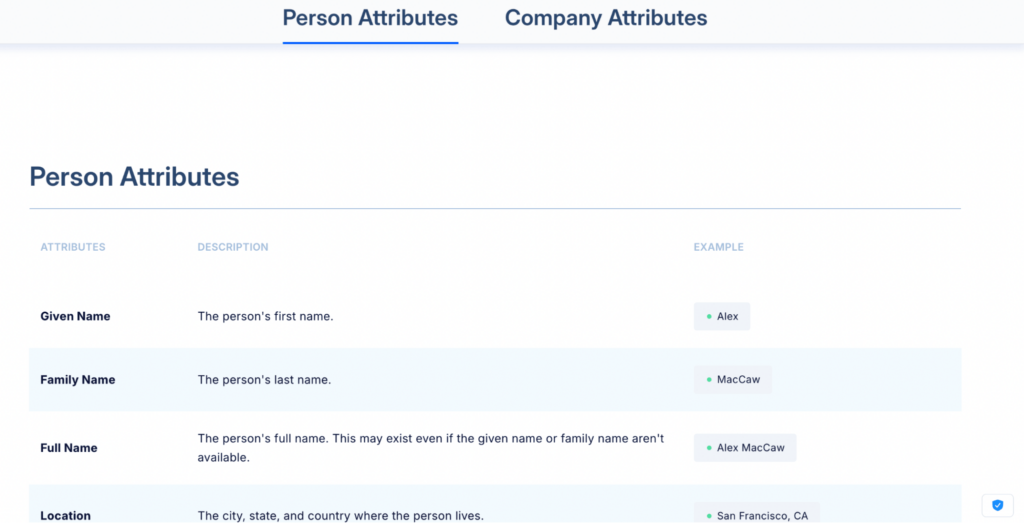
It boasts over 100 business data points divided into two categories: person and company attributes.
This provides a nice balance for enterprises that need it.
For instance, unlike APIs we’ve reviewed so far, Clearbit’s enables teams to enrich profiles for both operational data management and GTM workflows.
Source: Clearbit
Person attributes include—apart from the most basic information—a person’s social media handles, follower count, and email provider.
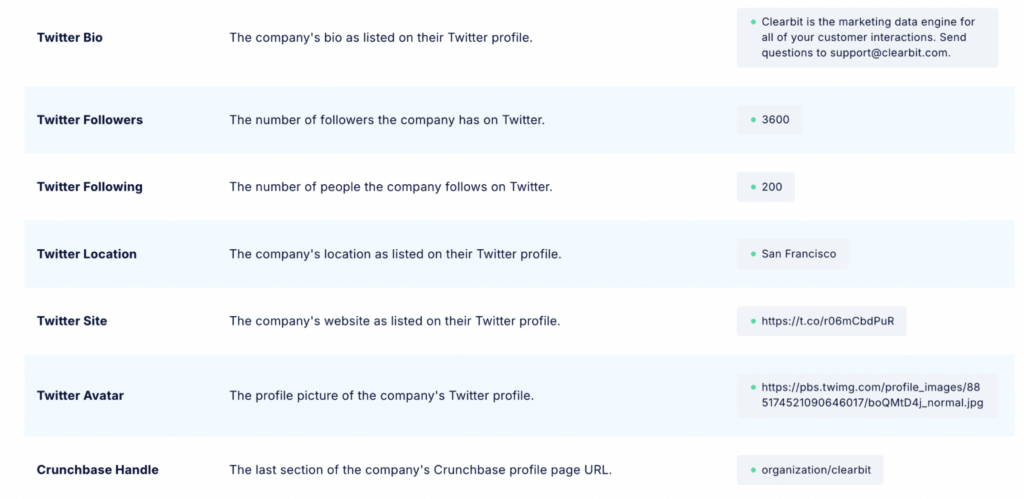
At the company level, the data largely mirrors the types we’ve seen in other APIs.
This includes everything from basic firmographics and technographics to data pertaining to a company’s social media accounts.
Source: Clearbit
With that said, company attributes are much less comprehensive compared to more MDM-friendly solutions like Veridion.
Person attributes also feel somewhat limited compared to specialized marketing and sales solutions like Explorium.
For some organizations, this might be enough. For others, however, it will feel like they’re not getting real value in either category.
What certainly helps, however, is that Clearbit is now a part of HubSpot.
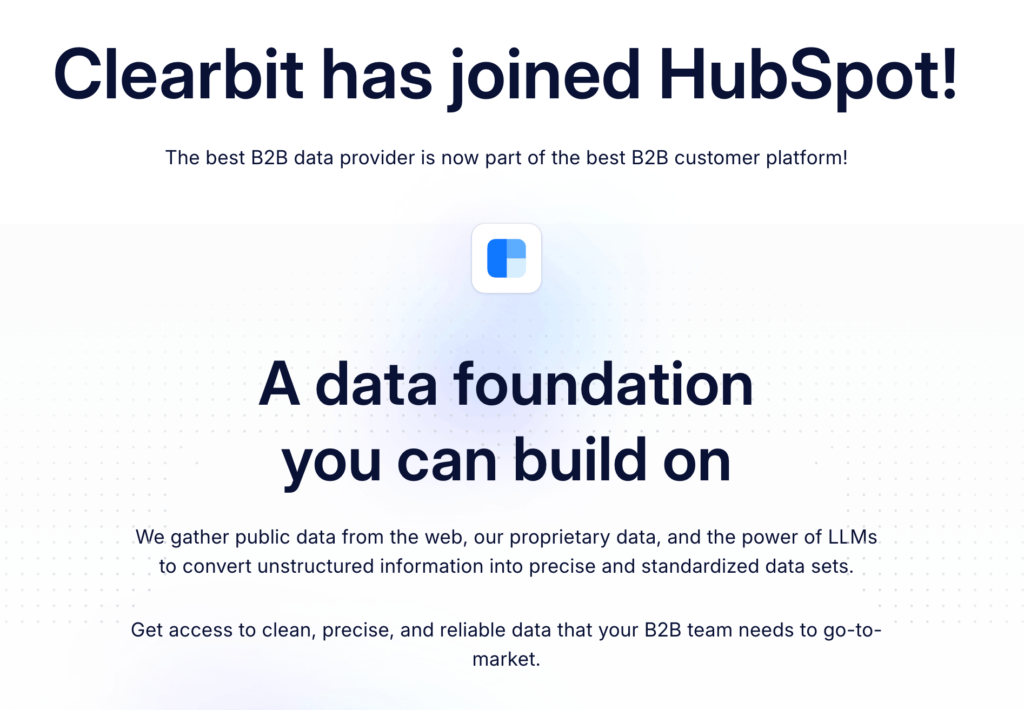
Source: Clearbit
So, for enterprises that already use HubSpot’s CRM, Clearbit often stands out as the most straightforward and seamless API to implement.
It’s already available in HubSpot, so using its API to integrate it with other systems is an easy extension.

Source: Clearbit
As for the geographical coverage, Clearbit provides global company and contact data in any language, making it a strong choice for companies targeting international markets.
Clearbit also claims to update its databases automatically as soon as a change is detected.
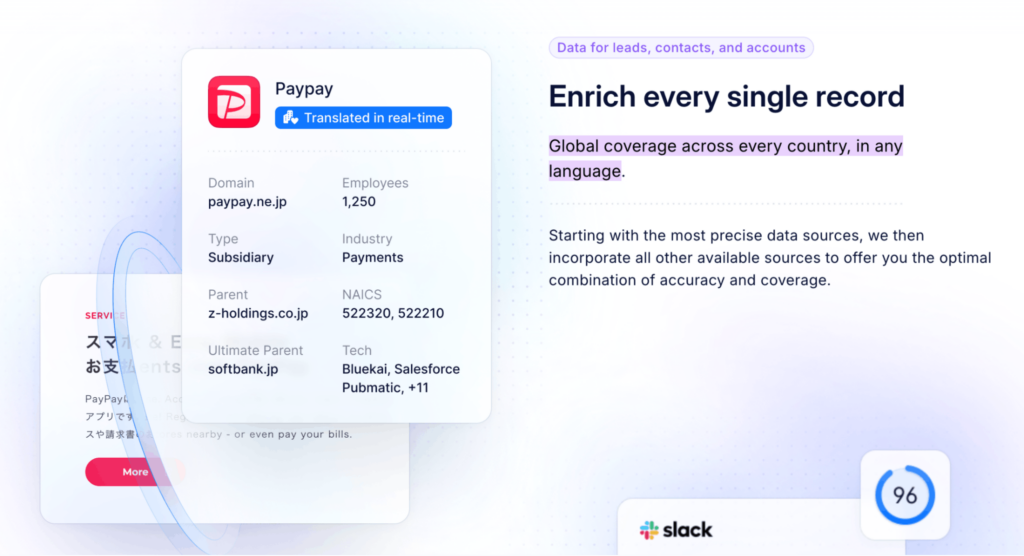
Source: Clearbit
Overall, Clearbit is most comparable to Explorium in its typical use cases.
Both are primarily used by sales and marketing teams to enrich lead, contact, and account profiles.
Explorium, however, additionally supports AI-driven targeting and custom GTM signals.
Demandbase markets its API primarily for applications that require trusted B2B data.
While teams can and often do use it to enrich internal records, the range of use cases is somewhat limited.
Since it’s mainly focused on GTM data, Demandbase is unlikely to be as effective for functions outside sales and marketing.
Source: Demandbase
For GTM purposes, however, it performs exceptionally well.
What sets Demandbase apart is the quality of its data—an area in which it is likely superior to other GTM-focused APIs analyzed so far.
Demandbase approaches data collection in a highly focused way, ensuring all data types collected contribute to robust account intelligence.
This includes five major data types, from basic ID and company information to complex intent data.
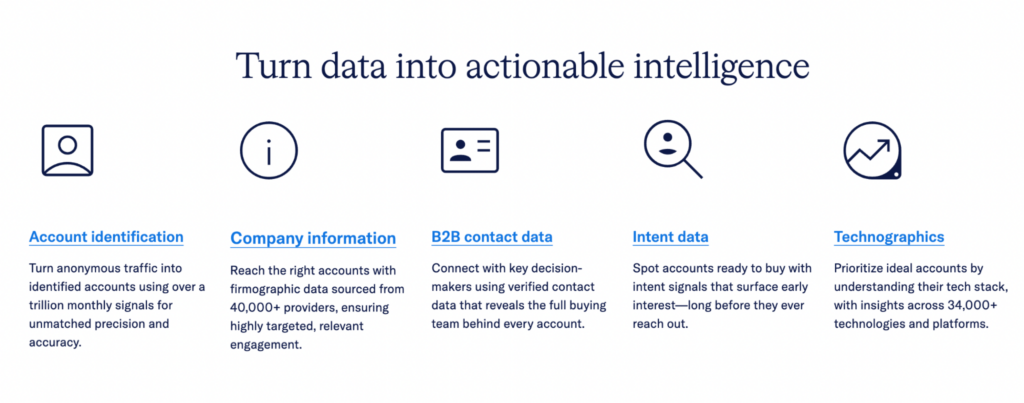
Source: Demandbase
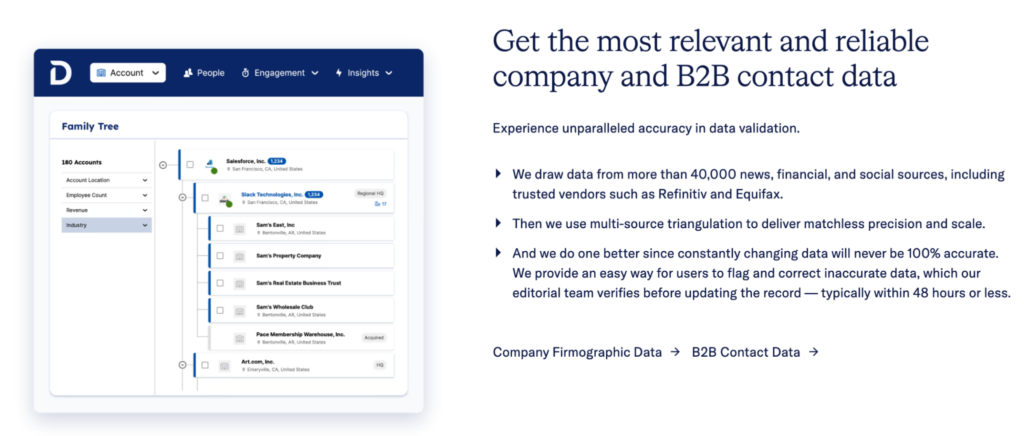
This data comes from a broad mix of third-party and proprietary sources, spanning more than 40,000 providers.
These include news, financial, and social data streams, as well as established vendors like Equifax.
To enhance accuracy, Demandbase reconciles conflicting data points using multi-source triangulation.
It also goes further than most GTM-focused APIs by having a dedicated editorial team review and correct inaccuracies flagged by users.
Source: Demandbase
Overall, Demandbase stands out for the impressive quality and focus of its data.
The breadth, however, will likely be too narrow for teams looking to use it beyond GTM.
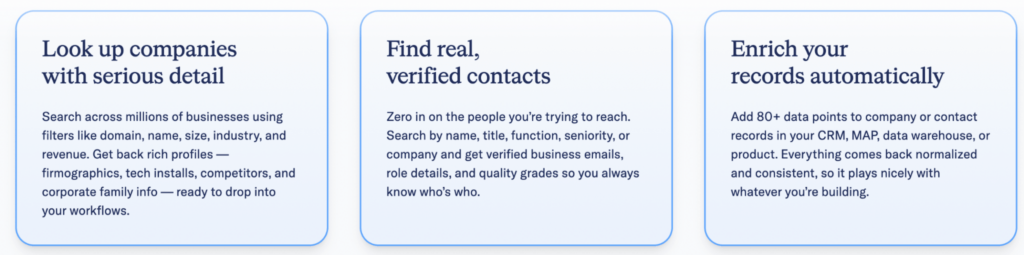
As mentioned, Demandbase takes a deliberately focused approach to data collection, prioritizing roughly 80 attributes that directly support sales and marketing.
This wanes in comparison to Veridion’s 320 company data points, and is also slightly below the 100+ attributes available through providers like HitHorizons or Clearbit.
Source: Demandbase
But Demandbase simply prioritizes relevance over quantity.
For revenue teams, those 80+ attributes may be not only sufficient, but better aligned with day-to-day GTM execution.
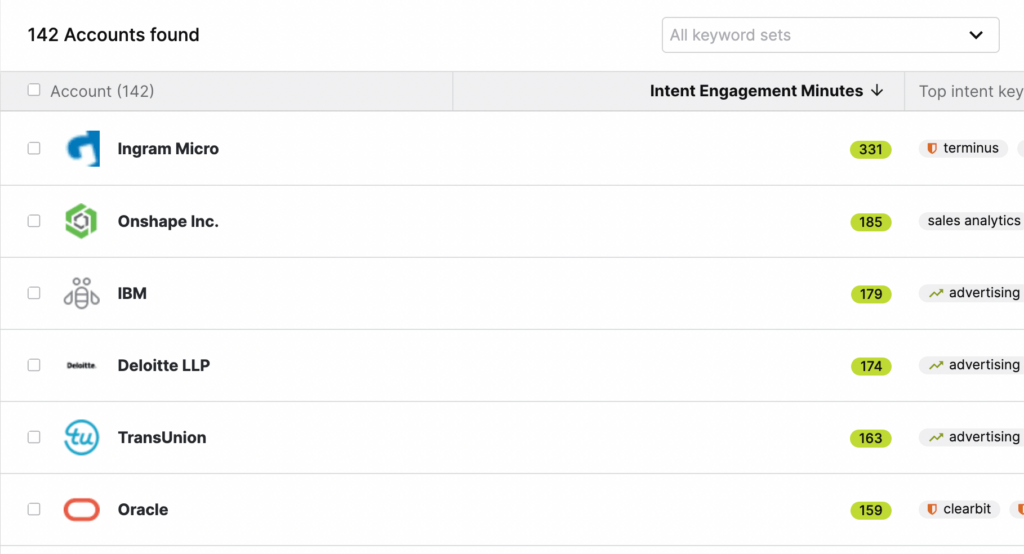
Compared to most APIs in this category, Demandbase stands out for its intent data.
This data indicates when a company is actively researching specific topics, solutions, or categories, often before they engage directly with a vendor.
Based on it, teams can prioritize accounts that are more likely to be in an active buying cycle.
Source: Demandbase
To summarize, Demandbase delivers extremely powerful GTM signals and data, but might lack the breadth of more general-purpose company intelligence providers.
This makes it best suited for revenue teams, and less suited for cross-functional data use.
HG Insights is another data enrichment API primarily built for GTM.
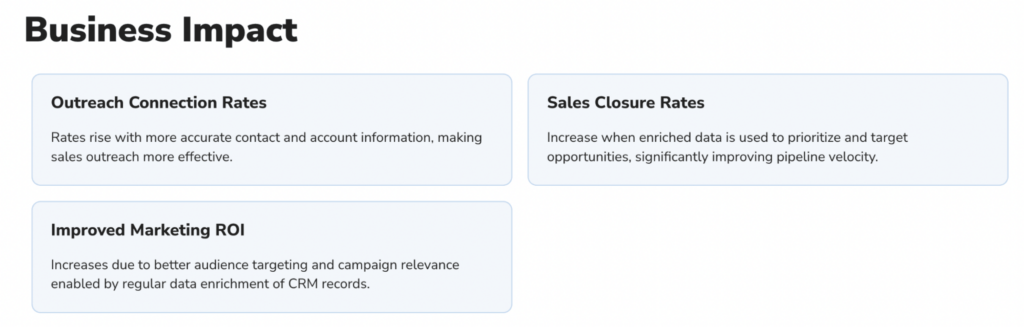
It positions itself as the go-to tool for enriching customer and account profiles while catering specifically to RevOps and data teams.
More precisely, it focuses on enabling data-driven sales, marketing, and outreach.
Source: HG Insights
Despite its targeted purpose, HG Insights offers a database of extensive breadth.
It encompasses over 120M organizations worldwide and draws from a global repository of over 20B external data points.
This information is then organized into several key data categories.
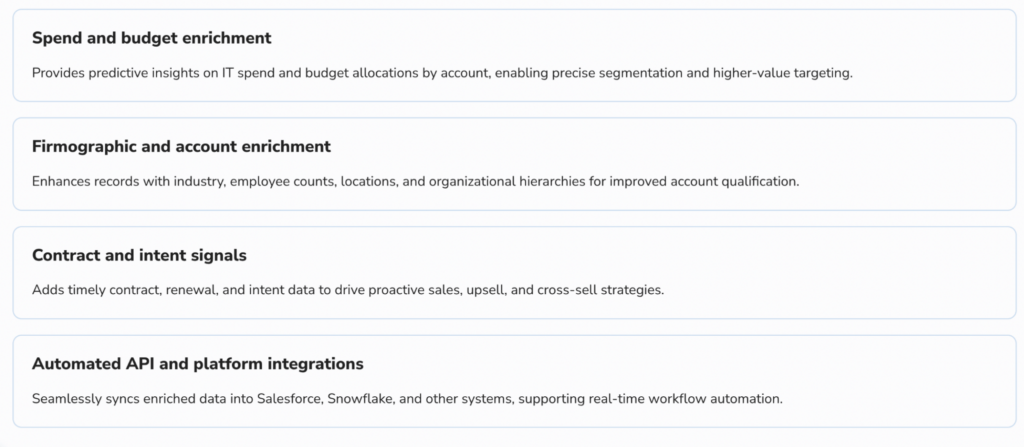
Some are more basic, such as firmographics and contract data, while others are highly advanced, like intent signals or predictive insights on IT spend and budget allocations.
Source: HG Insights
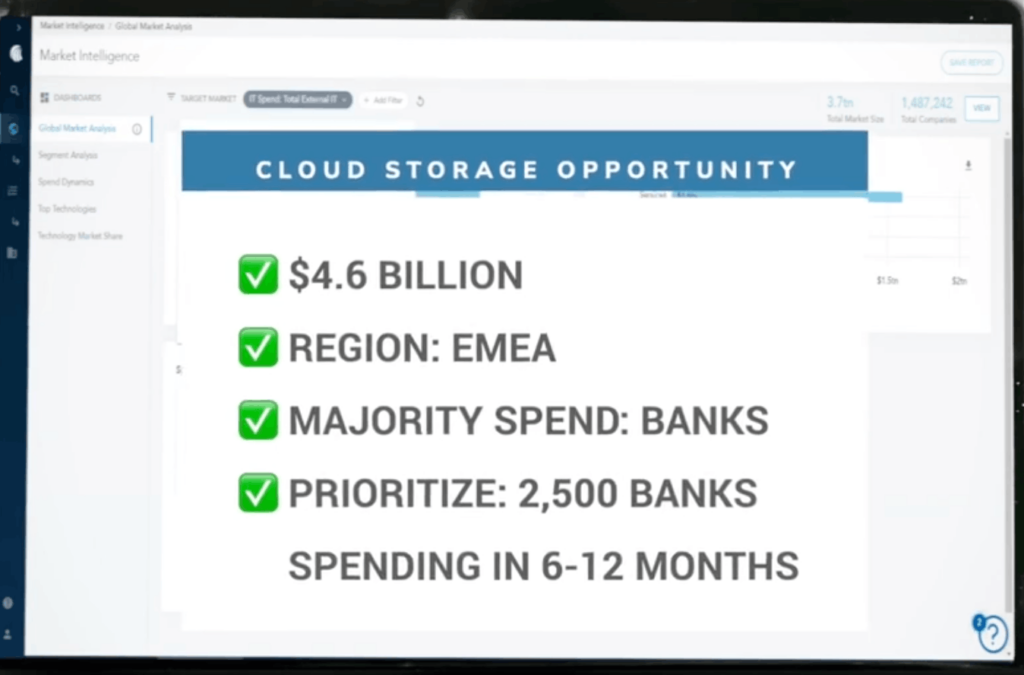
Much like Demandbase, HG is mainly focused on ABM and intent data that helps align GTM strategies with actual pipeline signals.
It combines market-level insights with account-level data, helping companies determine not just which markets or companies to prioritize, but also how to tailor their messaging to maximize the chances of winning business.
Source: HG Insights on YouTube
Ultimately, HG Insights is a strong choice for any enterprise looking to enhance account intelligence and market signals.
What particularly sets it apart is its focus on B2B technology insights, a feature rarely offered by other comparable solutions.
However, for those looking for APIs offering broader company intelligence, APIs like Veridion’s will be a stronger alternative.
We’ve reviewed six strong choices for data enrichment APIs. The decision ultimately comes down to your goals.
For MDM, entity matching, deduplication, and global company profile enrichment, Veridion’s API stands out as the clear winner.
In contrast, for actionable GTM insights, Demandbase or HG Insights may be a better fit.
Other factors may also be relevant. For example, if you work exclusively with European companies, solutions beyond HitHorizons could be overkill. Meanwhile, Explorium might be the best choice for AI-driven GTM workflows.
In any case, you now have the insights you need to make an informed decision.