



Blog
The Importance of Business Data for Your Organization
By: Stefan Gergely -
28 March 2026


We love our data, and now that you're here, you're one step closer to loving it too.
A wide sample of data, so you can explore what is possible with our data
Choose ->
built with procurement in mind. Focused on manufacturers, products and more
Choose ->
built with insurance in mind. Focused on classifications, business activity tags and more
Choose ->
built with sustainability in mind. Focused on sustainability commitments, and environmental and social governance insights.
Choose ->
built with strategic insights in mind. Focused on market trends, competitor analysis, and industry-specific data
Choose ->

Keep up to date with our technology, what our clients are doing and get interesting monthly market insights.

Key Takeaways:
Every business decision you make is only as good as the data behind it.
Yet, in many large enterprises, that data often sits in silos, goes stale, or conflicts across systems, which turns sourcing, onboarding, and monitoring into slow, risky guesswork.
This article explains why this is such a problem, and why accurate, regularly refreshed business data is non-negotiable for organizations.
You will see how it strengthens decisions, improves risk assessment, supports compliance, and boosts operational efficiency.
High-quality business data gives you a factual foundation for decisions across the entire organization, including those related to suppliers, customers, investments, or insured entities.
When you can trust what you see, you make fewer assumptions and more decisions that you can explain, defend, and repeat.
And when you can’t, the consequences can be severe.
For example, Gartner notes that poor data quality costs organisations at least $12,900,000 per year on average, reflecting how quickly incorrect inputs turn into expensive decisions.
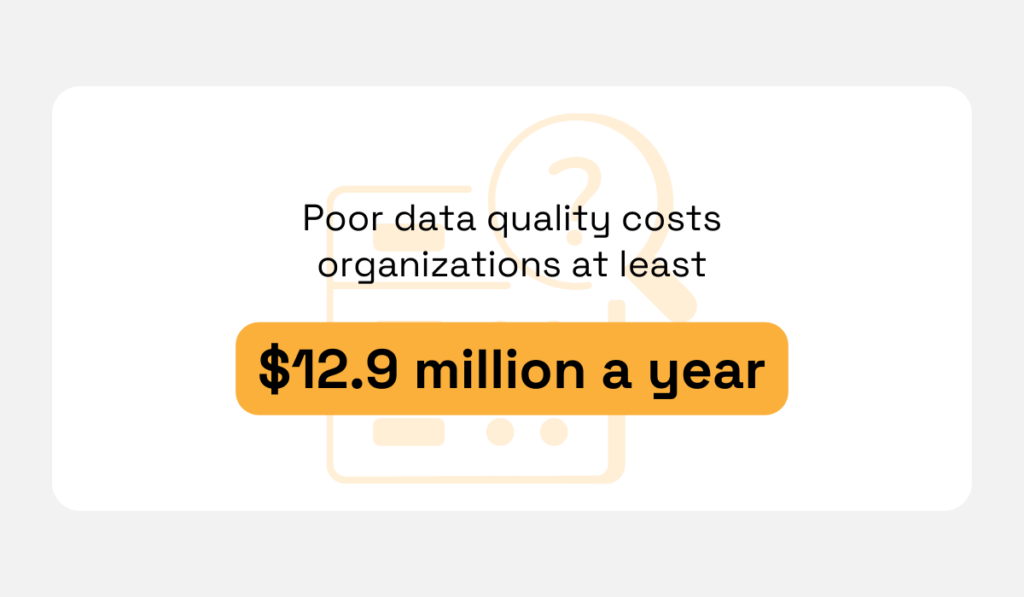
Illustration: Veridion / Data: Gartner
That’s because, in large enterprises, decision-making is shared across teams.
Procurement, legal, finance, risk, and operations all need to agree on who a company is, what it does, and whether it meets your requirements.
When your supplier records conflict across systems, you get inconsistent outcomes. One team approves a vendor while another delays onboarding because the legal entity name looks different.
A simple example shows why this matters.
You shortlist a supplier for a time-sensitive category, and your record shows a legitimate registered address and company name.
Later, you discover the registered address is not where the company actually operates, and the true operational site is in a different region with different logistics constraints and risk exposure.
Business data that clearly distinguishes a registered address from a main operational address helps avoid this kind of misjudgment.
When your organisation bases decisions on accurate, complete, and current business data, you reduce costly errors and align decisions across departments.
Once your teams are aligned on the same facts, better outcomes naturally follow.
This consistency also strengthens another thing leaders care about: better risk assessment.
Business data plays a critical role in third-party risk assessment because it tells you what you are really exposed to.
Risk is rarely one-dimensional. It can be operational, financial, geographic, or regulatory, and it often sits in the gaps between what your partner says and what your records actually show.
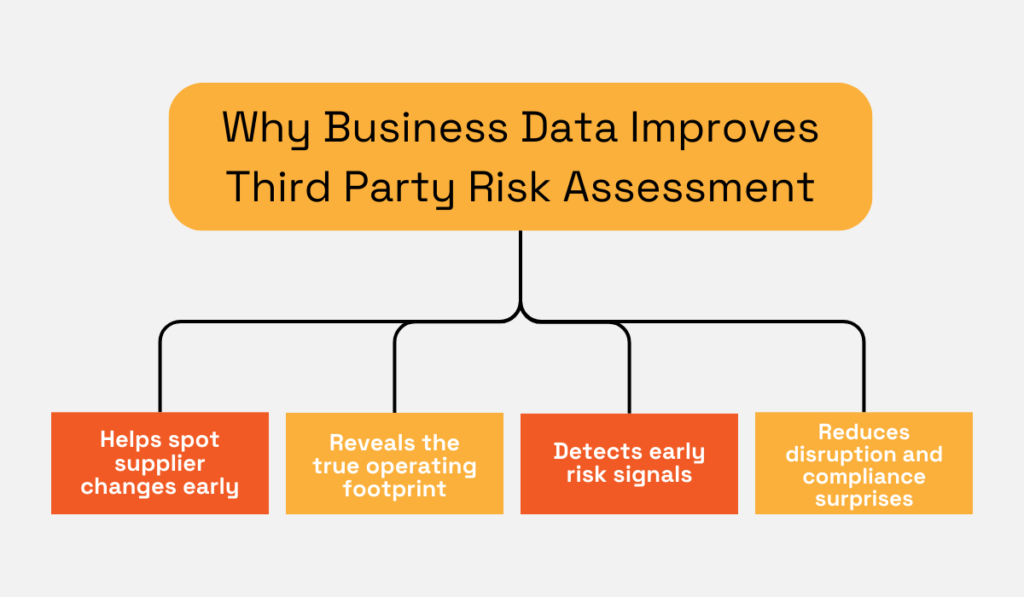
The first reason business data improves risk assessment is simple: businesses change, and static profiles fall behind reality.
Research suggests that around 70.8% of business contacts experience some form of change within a 12-month period, which is one indicator of how quickly B2B data can become outdated if it is not maintained.
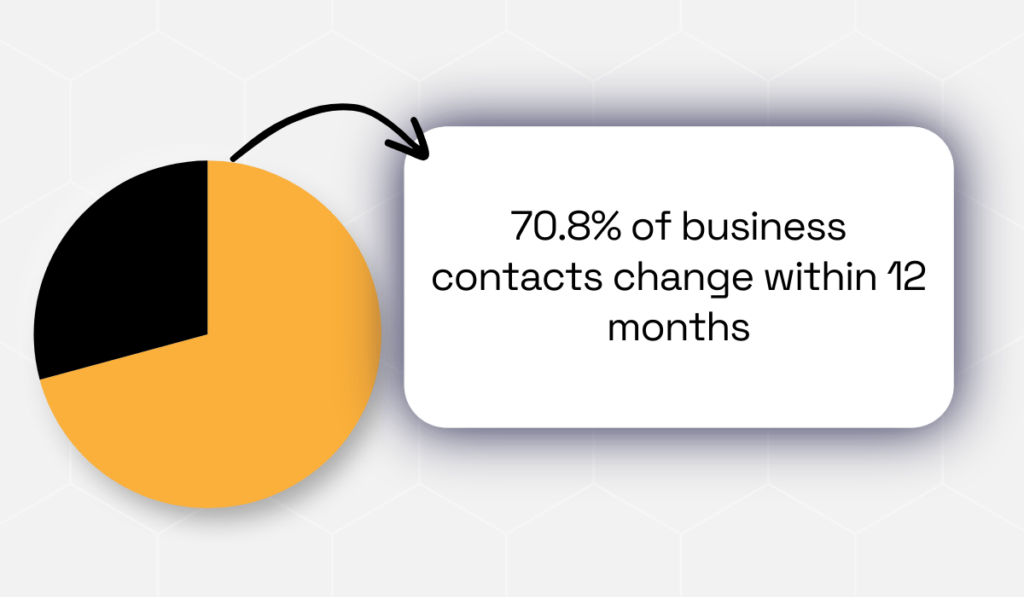
Illustration: Veridion / Data: IndustrySelect
In procurement, for example, those changes show up as inactive supplier contacts, lapsed certifications, or unrecognised mergers and acquisitions.
Each one can turn into a real risk when you need to reach a supplier during a supply disruption or compliance checks.
The second reason is visibility into the true operating footprint of a company.
Many risks come from confusing legal identity with operational reality.
For example, a registered address can be a legal location, while the main address reflects where the business actually operates.
That distinction matters for logistics, continuity planning, and physical risk exposure.
If your data does not clearly separate these, you can underestimate geographic concentration risk, miss cross-border regulatory exposure, or misunderstand where disruptions would hit first.
The third reason is early signal detection.
Risk rarely arrives as a single headline event. It builds through small signals that are easy to miss when you rely on periodic, manual checks.
Examples of risk signals include a company website going offline, a domain expiring, a sudden drop in employee count, or a change in primary business activity.
These signals can indicate distress, restructuring, or operational drift that may affect delivery reliability and compliance posture.
Source: Veridion
Finally, business data strengthens risk assessment because modern supply chains are exposed to lower-tier dependencies that you do not always see in first-tier relationships.
In fact, disruptions most often originate in tier 2 and tier 3 suppliers.
Platforms like Veridion mitigate all these risks by enriching internal records with AI-driven insights on business activities, ownership structures, and geographic footprints, no matter how deep in the supply chain an entity is.
Veridion profiles every company with a digital footprint and covers over 123 million businesses, 872 million products, and 168 million services, which helps teams build risk profiles with broader coverage and fresher context.

Source: Veridion
Our business profiles cover all aspects of a business activity, from financial and ESG performance to geographical and FOCI risks.
You can learn more about Veridion’s enrichment service in the video below:
Source: Veridion on YouTube
In the end, better risk assessment is not only about scoring suppliers. It is about having business data that reflects how a company operates today so you can spot vulnerabilities early and avoid preventable surprises.
With stronger risk profiles, you can move from reactive firefighting to proactive monitoring, especially as companies change ownership, locations, or operations.
Comprehensive business data supports regulatory compliance because most compliance obligations depend on one thing: proving you know exactly who you are doing business with, and that your view stays valid over time.
Supplier onboarding and ongoing monitoring are evidence-based processes where you may need to show legal entity identity, ownership, and operating reality to internal governance teams, auditors, or regulators.
This is especially true for KYC and AML-style controls, where entity transparency and ongoing monitoring are central expectations.
Compliance pressure is also expanding into ESG due diligence.
The EU’s Corporate Sustainability Due Diligence Directive, for example, sets expectations around identifying and addressing adverse human rights and environmental impacts in operations and value chains.
This increases scrutiny on what you know about business partners and their operations.
A recent analysis by ESG Book confirms this, revealing that global ESG regulations have increased by 155% over the past decade.
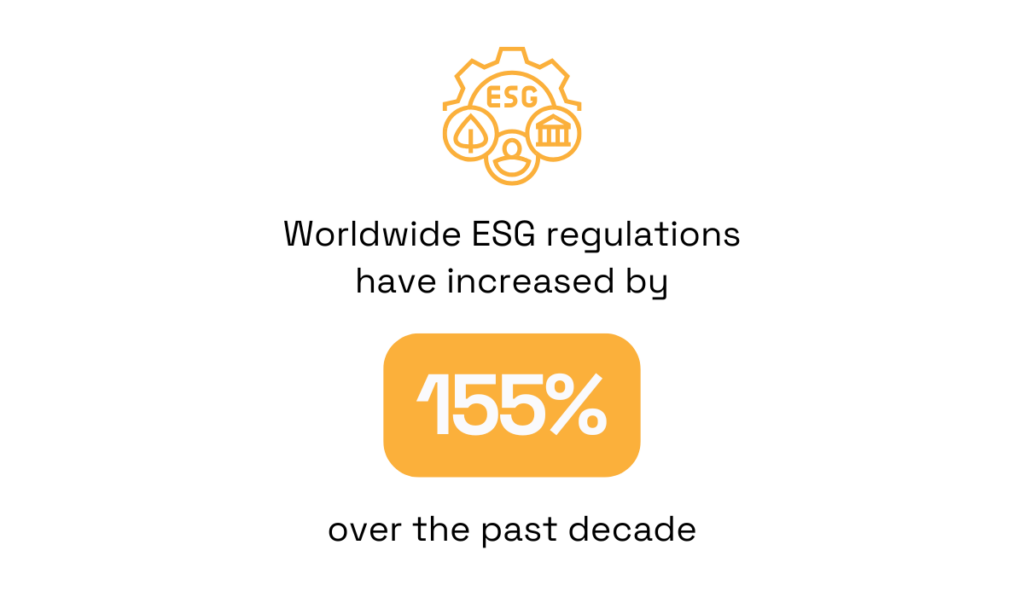
Illustration: Veridion / Data: ESG Book
Even if you are not directly in scope today, your organisation may still be asked for verifiable supplier information by customers, prime contractors, insurers, or auditors who are.
All in all, the compliance risk is often in misidentification and missing context:
In practice, this is why compliance teams and procurement leaders increasingly push for traceable records and clear documentation, not just a final pass or fail outcome.
When your business data is complete, verifiable, and easy to retrieve, compliance becomes easier to demonstrate and harder to dispute.
You spend less time recreating evidence during reviews and more time making decisions with confidence.
It also reduces the hidden workload of repeated checks and reconciliation, which leads directly to the next reason business data matters: improved operational efficiency.
Reliable business data improves operational efficiency because it removes the hidden work that builds up around uncertainty.
When teams do not trust what is in the system, they compensate by rechecking, retyping, and reconciling.
That time does not show up as a single line item, but it quietly slows onboarding, procurement cycles, underwriting decisions, and partner evaluations.
As MIT’s Michael Stonebraker puts it:
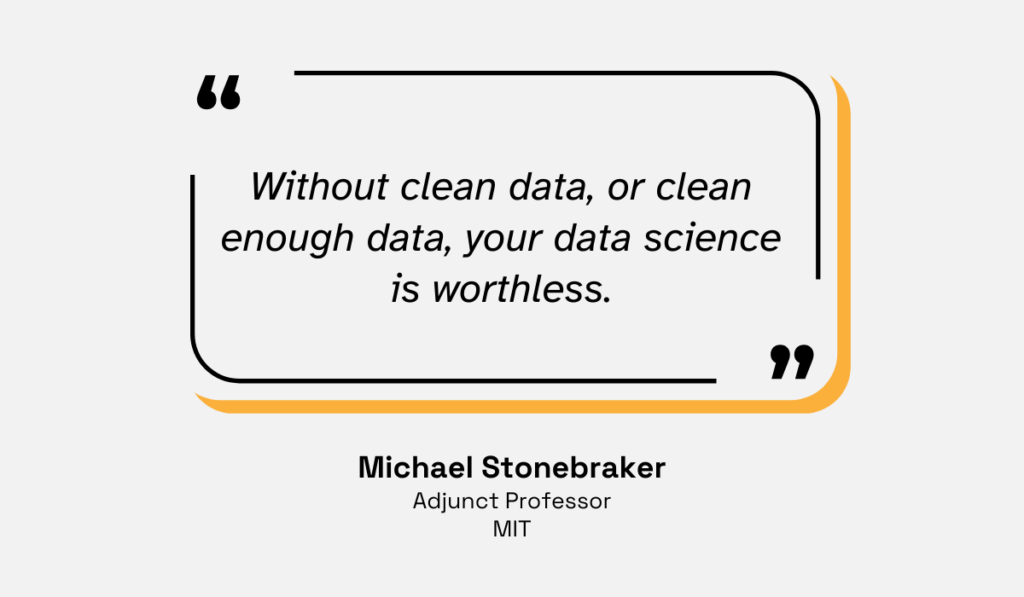
Illustration: Veridion / Quote: MIT Sloan School
If your supplier record is incomplete, inconsistent across systems, or out of date, the workflow becomes manual by default because people have to fill gaps before they can move forward.
And this can be a huge waste of time.
For instance, Glean shows that many American workers already spend about 25% of their workweek looking for information and documents they need to do their job.
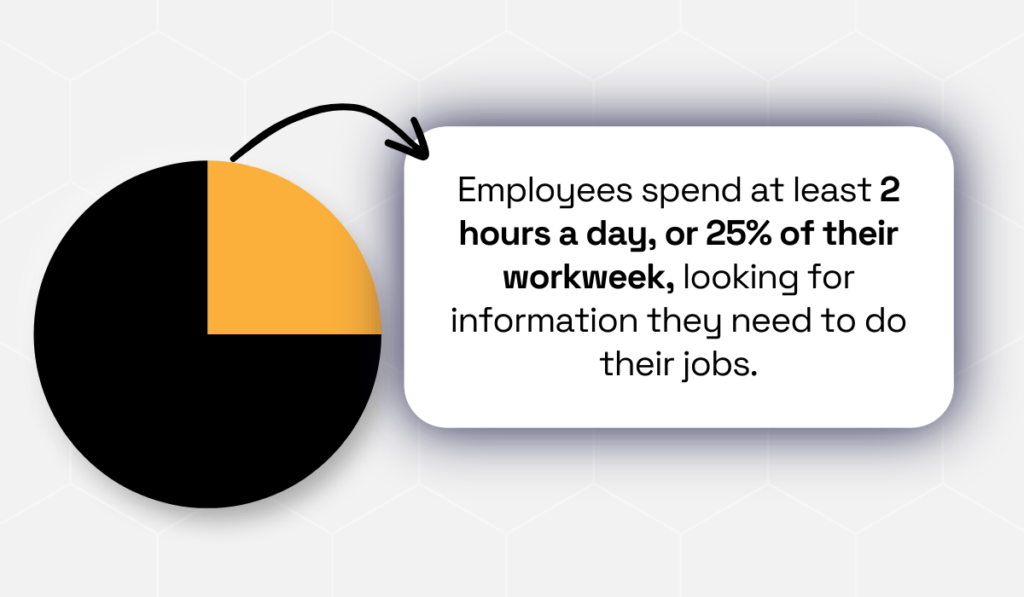
Illustration: Veridion / Data: Glean
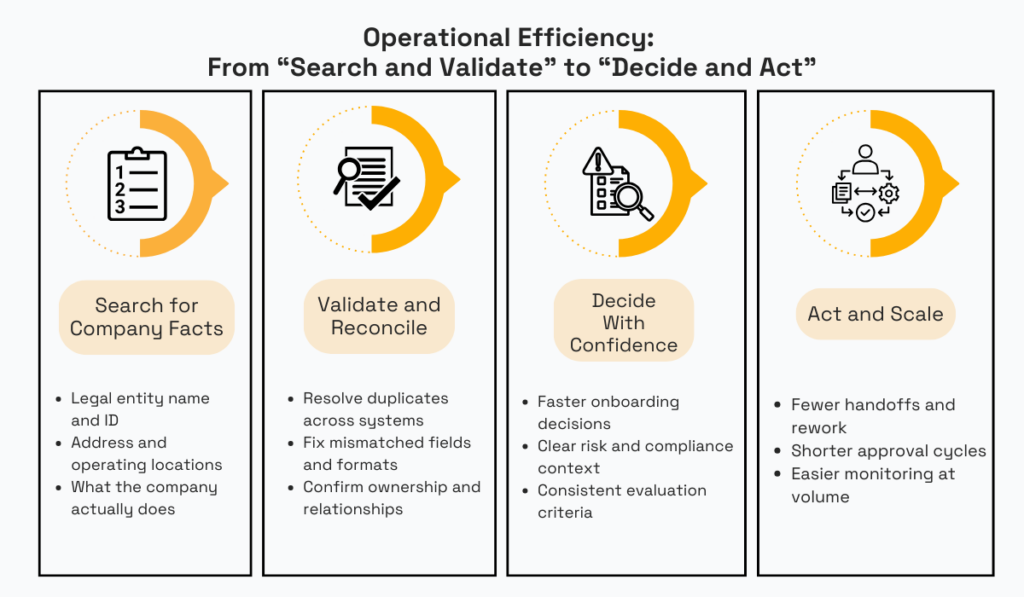
Naturally, this translates to significant efficiency losses, particularly in three key areas.
First, onboarding slows down because each stakeholder needs a slightly different version of the truth.
Procurement needs capability and category fit. Risk needs structure and exposure signals. Finance needs a legal entity and payment details. Legal needs contracting entities.
When underlying business data is fragmented, each team runs its own verification loop, and mismatches create rework.
Second, evaluation becomes resource-intensive when information is not consistent across systems.
If a supplier appears as two entities in different tools, teams spend time reconciling records rather than deciding.
If core attributes like industry classification or ownership are missing, reviews take longer because assessors must reconstruct context from scratch.
Third, scaling becomes harder.
As supplier volumes rise and monitoring requirements tighten, the organisation either adds headcount or accepts slower cycle times.
Source: Veridion
A simple example shows the difference.
If your procurement team creates a vendor record with one legal name, but finance holds a different version, and risk stores another, the next change request triggers three separate updates and a round of emails to confirm what is correct.
Centralized, consistent business data reduces the back and forth because the organisation is not debating identity every time it needs action.
When business data is reliable and consistent, your workflows require fewer manual checks, fewer reconciliations, and fewer delays.
Over time, that translates into lower operational costs and faster scaling without turning procurement into an administrative bottleneck.
Business data is the foundation that shapes every decision you make.
When your company and supplier data is accurate, complete, and current, you choose partners with more confidence, spot risk earlier, meet compliance expectations, and run faster workflows with less rework.
The strongest procurement teams treat business data as a strategic asset, not a cleanup task.
Invest in better data now, and you give your organisation a calmer, faster, and more resilient way to operate.