



Blog
4 Types of Business Data Your Company Needs
By: Stefan Gergely -
21 March 2026

We love our data, and now that you're here, you're one step closer to loving it too.
A wide sample of data, so you can explore what is possible with our data
Choose ->
built with procurement in mind. Focused on manufacturers, products and more
Choose ->
built with insurance in mind. Focused on classifications, business activity tags and more
Choose ->
built with sustainability in mind. Focused on sustainability commitments, and environmental and social governance insights.
Choose ->
built with strategic insights in mind. Focused on market trends, competitor analysis, and industry-specific data
Choose ->

Keep up to date with our technology, what our clients are doing and get interesting monthly market insights.

Key Takeaways:
Stakeholders are watching every supplier decision more closely than ever, putting immense pressure on procurement to act quickly and achieve the best outcome every time.
The problem? Teams often don’t know how to make the right decisions.
They either lack the necessary data or have too much, leaving them unsure what to prioritize.
To reduce that uncertainty, we’ll cover the four key types of data your company truly needs to both collect and use in procurement.
Of course, there’s always room for more insights, but these are the ones to prioritize.
The first type of data you need is the most foundational one: firmographic data.
This data defines the basic characteristics of an organization. It provides the foundational “who, what, and where” of a company.
Crunchbase offers a helpful comparison: what demographic data is to individuals, firmographic data is to companies.
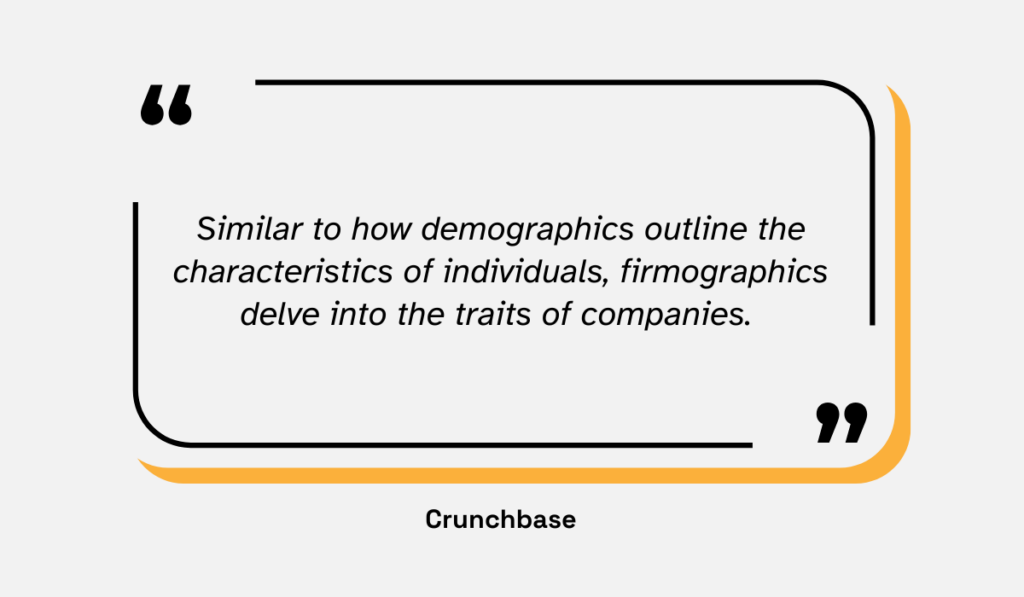
Illustration: Veridion / Quote: Crunchbase
That’s why some also call it “firm demographics.”
Firmographics typically include information about a company’s:
While it’s generally recommended to have all of this data on each potential supplier, your company might only need a subset.
The opposite can also be true: on top of this data, you might also need additional pieces.
It’s important to consider what matters to you.
So, it might be useful to consider what some of these categories look like in practice:
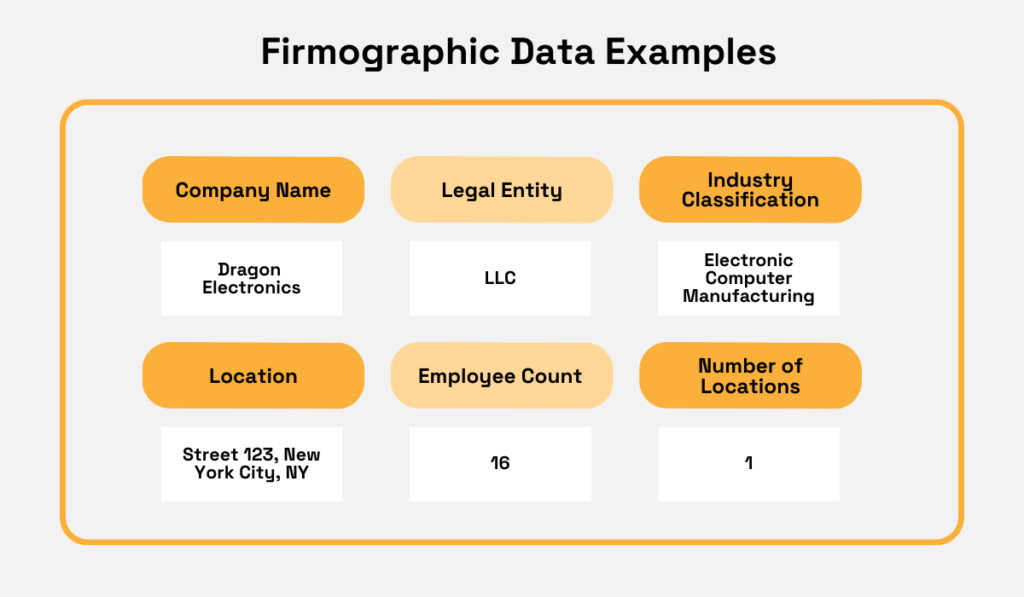
Source: Veridion
In any case, what all firmographic data has in common is that it helps you establish the basic context of any company you’re considering adding to your network.
Without it, you lack critical information, such as what the company does and where it operates.
The importance of these insights is pretty self-explanatory.
So, let’s focus on how firmographics remain useful even after supplier selection.
Their core benefits include tracking changes in key company attributes, reconciling data across platforms, and ensuring consistent identification across teams.
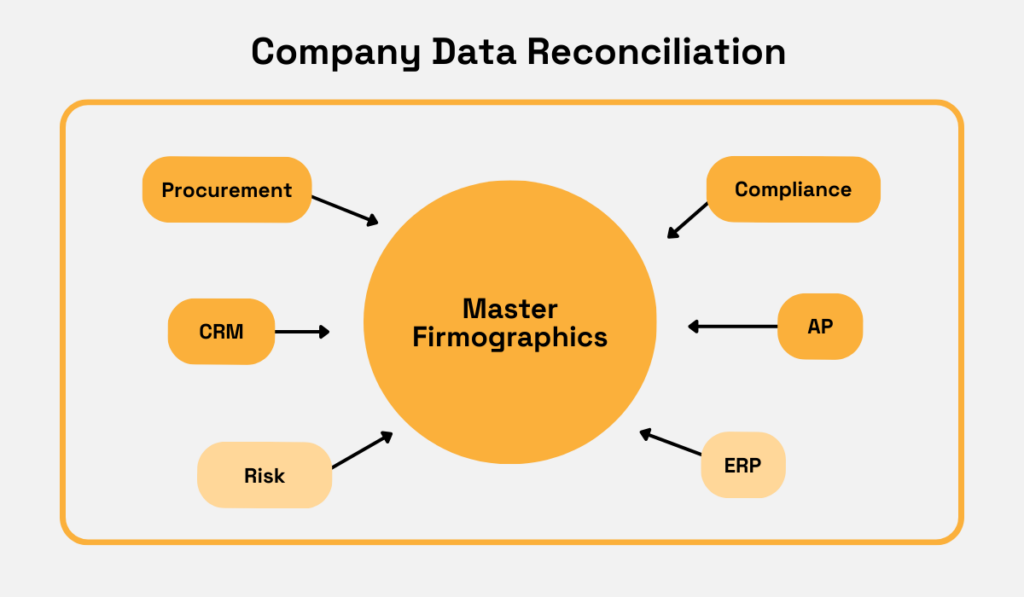
Source: Veridion
In the long run, this helps the entire company:
For example, if teams use different firmographics, or some don’t use them at all, one team might miss crucial risk indicators that another has already identified.
So, reconciled firmographics help keep everyone in the company on the same page and as efficient as possible.
Additionally, they form the basis for advanced analysis, risk assessment, and strategic decision-making.
However, keep in mind this is indeed just the foundation. Teams that rely solely on this basic company information are at high risk of overlooking key details.
That’s why you shouldn’t stop there, but rather combine this data with the remaining three types.
The second type of data you’ll need is technographics.
Technographic data describes a company’s tech stack, which includes software, hardware, cloud infrastructure, and other IT systems in use.
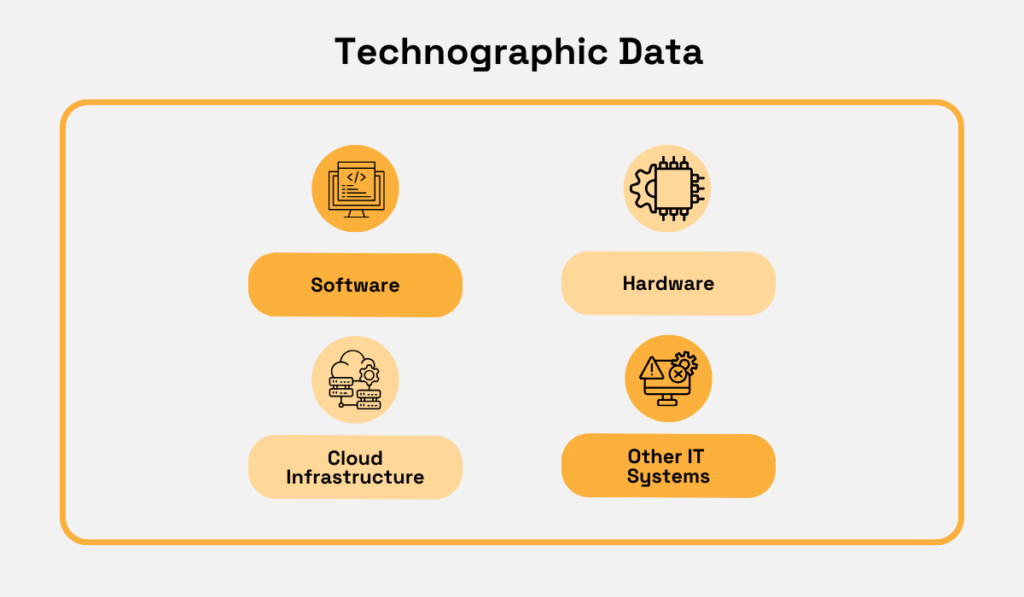
Although procurement often overlooks this data, it’s important to consider it for several reasons.
Firstly, there’s the most obvious, direct benefit: technographics on potential partners help you understand their tech stack.
They give you a clear picture of the exact technology your partners use in their operations, but that’s not the ultimate goal.
The real objective is translating that information into deeper insights:
Still, these insights might not seem as critical as many others, such as those derived from financial data.
That is, until you realize that cyberattacks through third parties are common enough to have their own name: supply chain attacks.
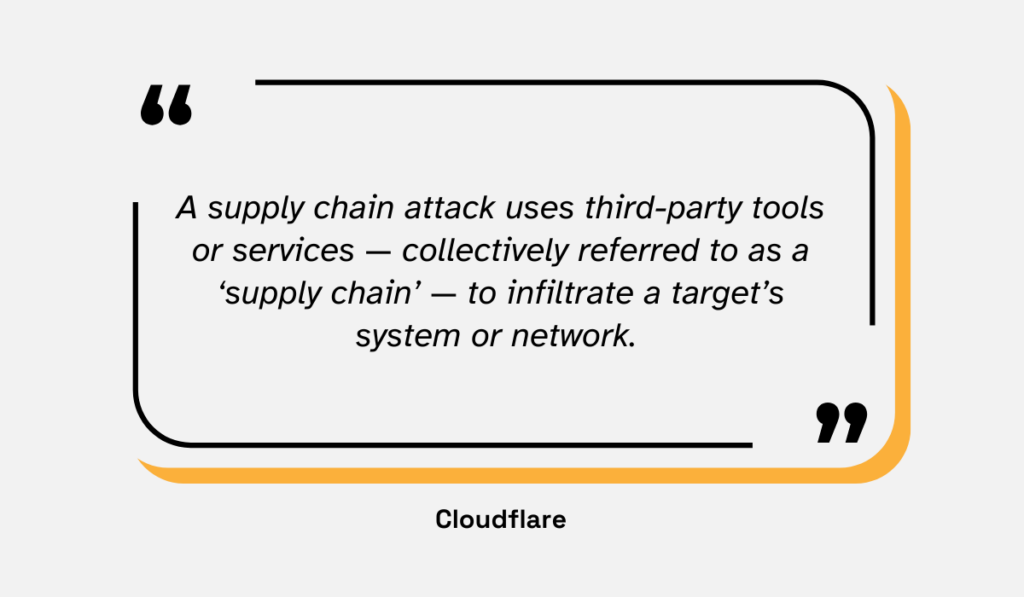
Illustration: Veridion / Quote: Cloudflare
In supply chain attacks, malicious actors infiltrate other companies’ systems through not just their software providers, but also other third parties.
For instance, they can gain access to your company’s system or data through your logistics provider’s tracking platform.
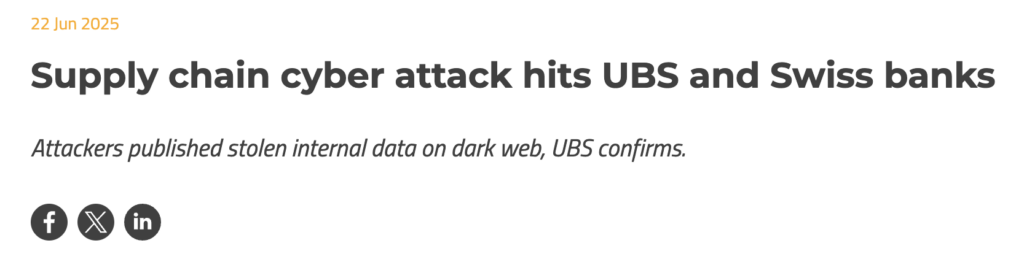
UBS and Swiss banks experienced a similar attack first-hand in 2025.
Source: The GIP Digital Watch
According to UBS, an attack on their service provider, Chain IQ, allowed malicious actors to access information about the company.
Although the client data was supposedly not affected, internal information was.
It was also published on the dark web afterward.
However, the consequences don’t always have to be this grave to be worth mitigating, nevertheless.
For example, in procurement or partnership decisions, technographic insights can also reveal dependencies on specific platforms or vendors that may create bottlenecks.
While the outcome might not be as severe, it’s still something you’ll likely want to avoid.
Many procurement professionals would probably argue that financials are the most important type of third-party data.
They provide insights into several crucial areas, including the company’s stability, performance, and creditworthiness.
All of these aspects can heavily impact your own operations.
As Thornton & Lowe’s Chris Turner notes, a supplier’s financial stability is a good indicator of whether you can rely on them for goods and services.
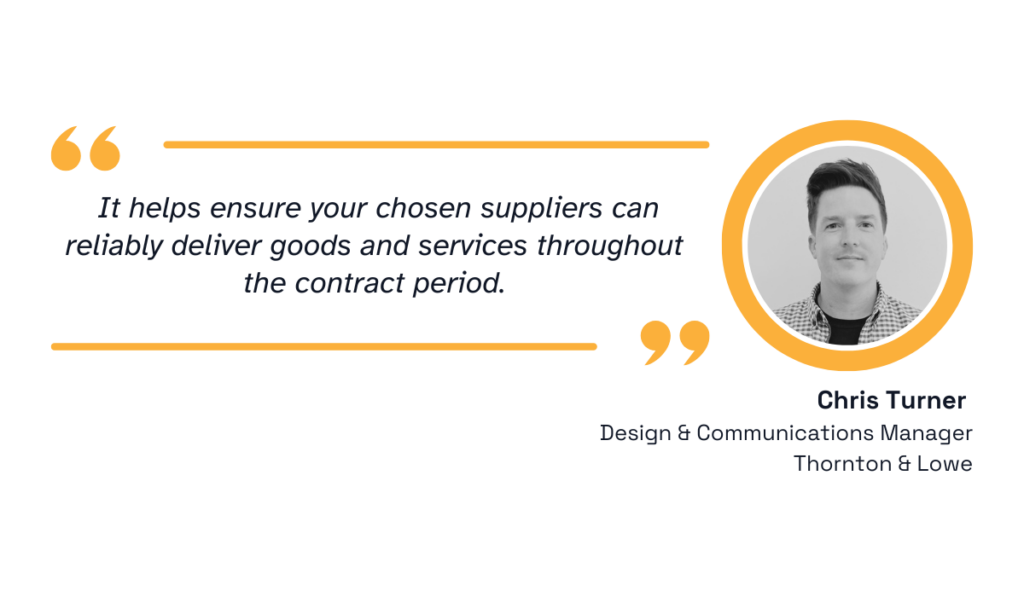
Illustration: Veridion / Quote: Thornton & Lowe
For example, if your supplier’s financial stability is threatened, they might not be able to pay their own vendors, and, consequently, deliver the goods to you on time.
The effects might be even worse than that, as key suppliers might even force you to pause your production.
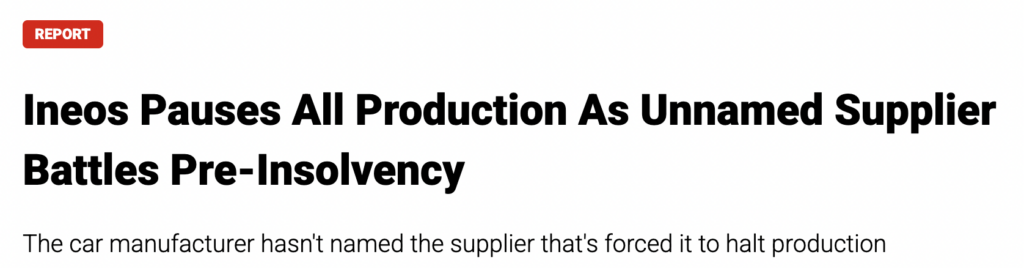
Ineos Automotive experienced this directly.
In September 2024, this car manufacturer had to pause the production of two of its vehicle models due to a key supplier’s pre-insolvency situation.
Source: Carscoops
It took the manufacturer several months to find a solution, later announcing that production would be restarted in early January 2025.
That’s five months of lost production.
This shows how important it is to not just collect financial data on your third parties, but also to monitor it continuously.
As James H. Gellert, Executive Chair at RapidRatings International, explains, bankruptcy is just the last straw.
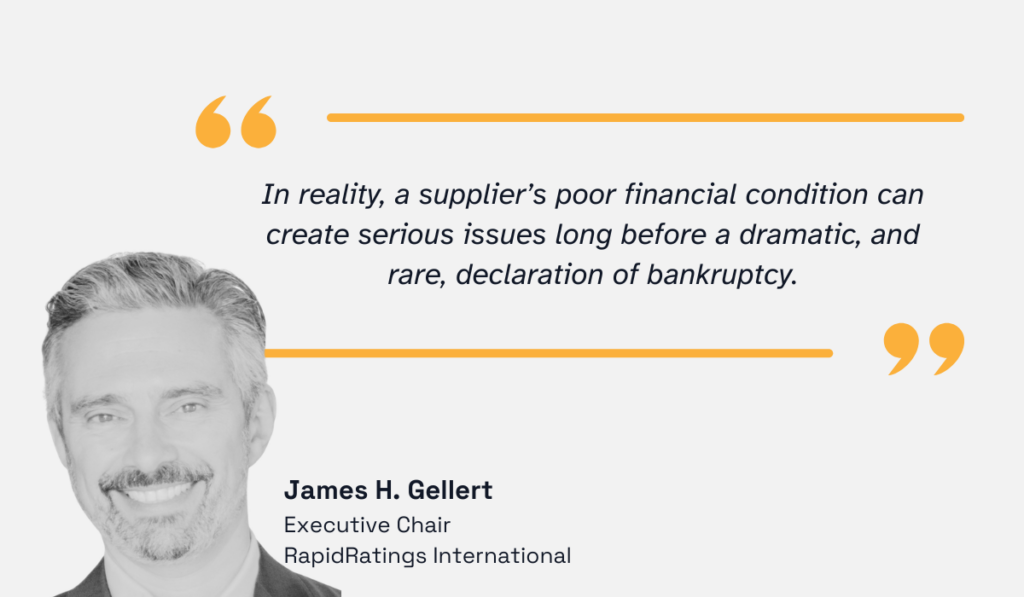
Illustration: Veridion / Quote: RapidRatings
There are almost always smaller, earlier signs indicating financial issues.
By detecting them on time, your company has a chance to mitigate risk before it materializes, and could even help the at-risk supplier.
With that said, what should you monitor, exactly?
We suggest starting with basic financial indicators, such as:
Of course, other financial metrics could be relevant, too, and might vary somewhat depending on the industry.
In any case, access to accurate financial data could not just improve your risk assessment, supplier qualification, and underwriting, but also pricing and investment decisions.
The last type of data we consider crucial is sustainability data: indicators covering third-party environmental, social, and governance performance.
That’s why it’s also often called ESG data.
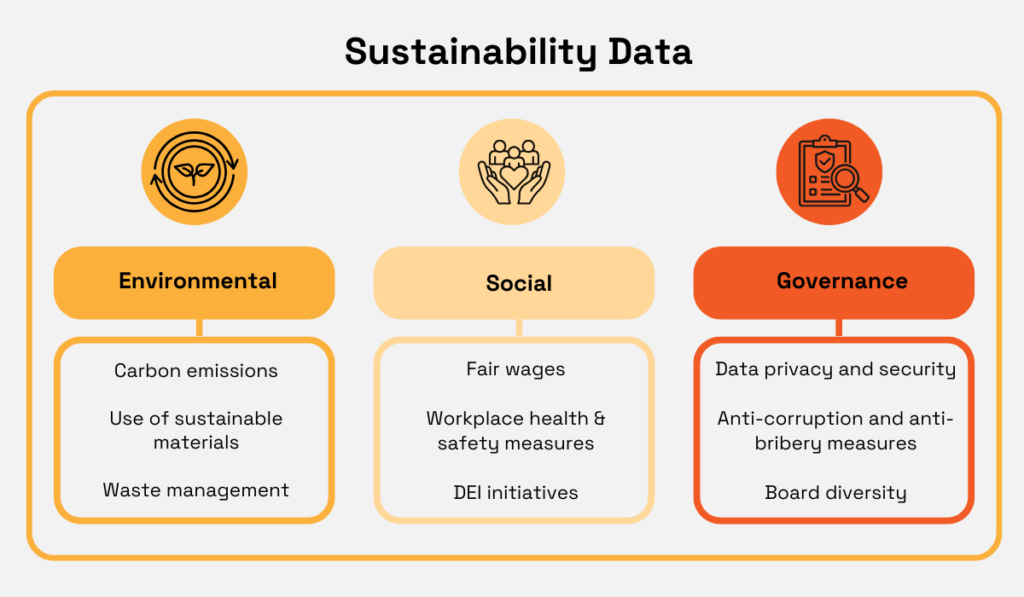
For a better idea of what this might include, see this brief overview of examples for each ESG dimension:
Source: Veridion
So, for example, collecting data on your supplier’s carbon footprint falls under the environmental category.
Data on their labor practices falls under social, while any regulatory compliance data speaks to the suppliers’ governance practices.
This data is key to assessing a supplier’s, and consequently your own:
Unfortunately, some companies still treat ESG data as less important and, quite frankly, perhaps even optional.
However, most investors, customers, and employees would care to disagree.
All three groups increasingly consider ESG when deciding where to invest, who to buy from, and who to work for.
Additionally, in many countries worldwide, sustainable procurement is even becoming legally required.
Suzie Dekker of EcoVadis, a leading ESG ratings firm, explains this shift best.
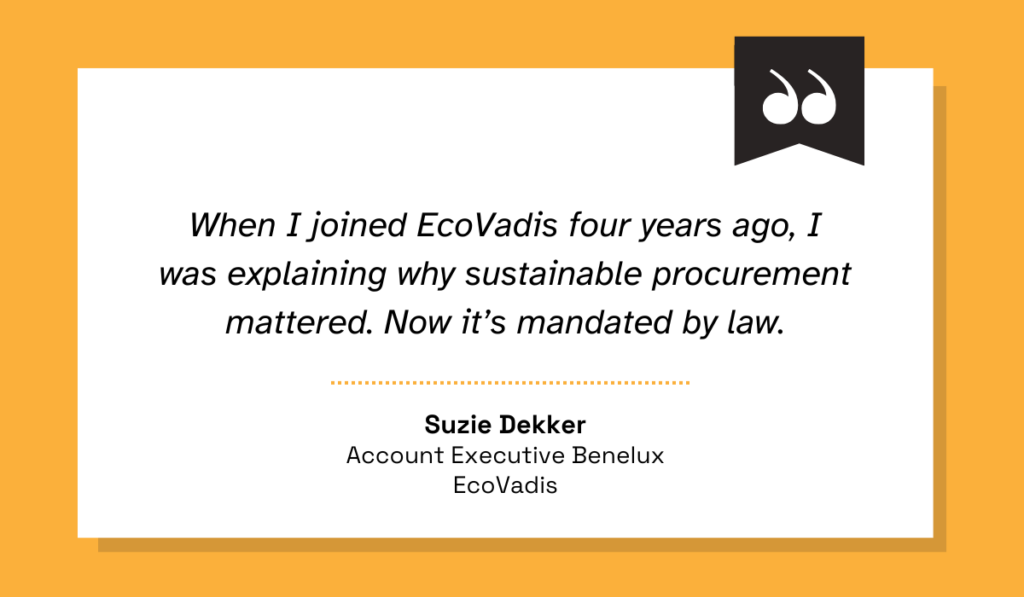
Illustration: Veridion / Quote: Onventis
So, Dekker suggests that the importance of ESG in procurement has rapidly increased in recent years.
This trend is also confirmed by industry surveys, like Thomson Reuters Institute’s 2024 Global Trade Report.
In the survey, as many as 97% of US global trade professionals rated ESG as “important or very important” in supplier selection.
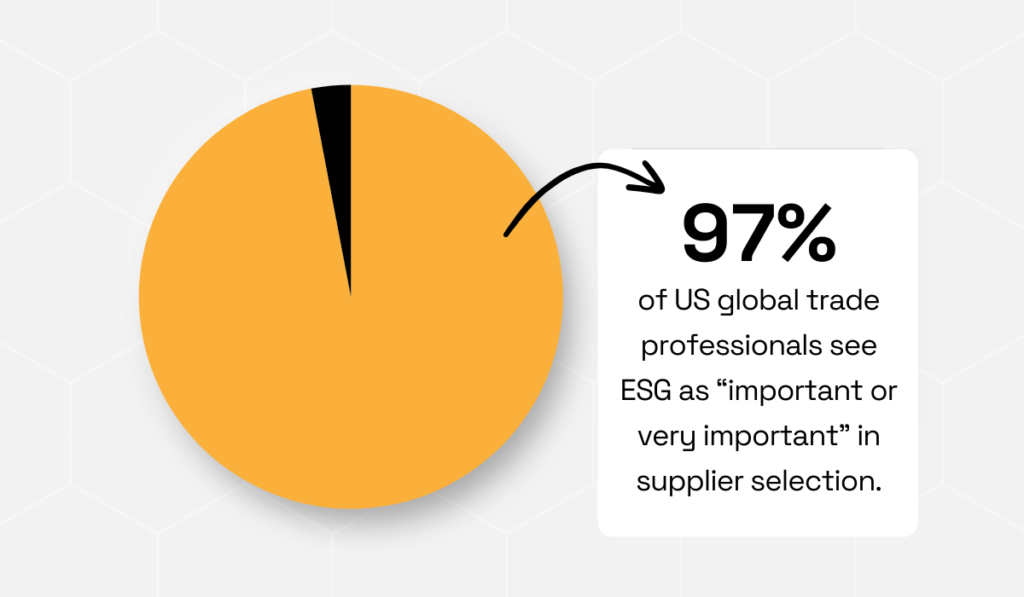
Illustration: Veridion / Data: Thomson Reuters Institute
This implies that procurement is increasingly using sustainability criteria in practice, and not just on paper.
One could only expect this trend to continue in the future, with more rigorous ESG practices potentially required by both law and market forces.
In practical terms, this means buying organizations need detailed sustainability profiles of their suppliers.
These, however, need to be grounded in real data in order to work.
A lack of real supplier data is one of the main reasons why so many companies fail to meet their sustainability objectives.
Illustration: Veridion / Quote: EcoVadis
Ultimately, sustainability data feeds both risk management and strategy.
It informs responsible sourcing, investment screening, and meeting both internal and external reporting requirements.
Most companies would like to have robust, comprehensive supplier data. That’s not the issue.
What is the issue is that supplier data is notoriously difficult to collect, let alone keep updated over time.
Plus, different teams may have different data, which only adds to the confusion.
This is where the right data partner, like Veridion, makes all the difference.
Veridion helps companies easily create robust supplier profiles.
All of the data types discussed above are provided in a single, structured platform:
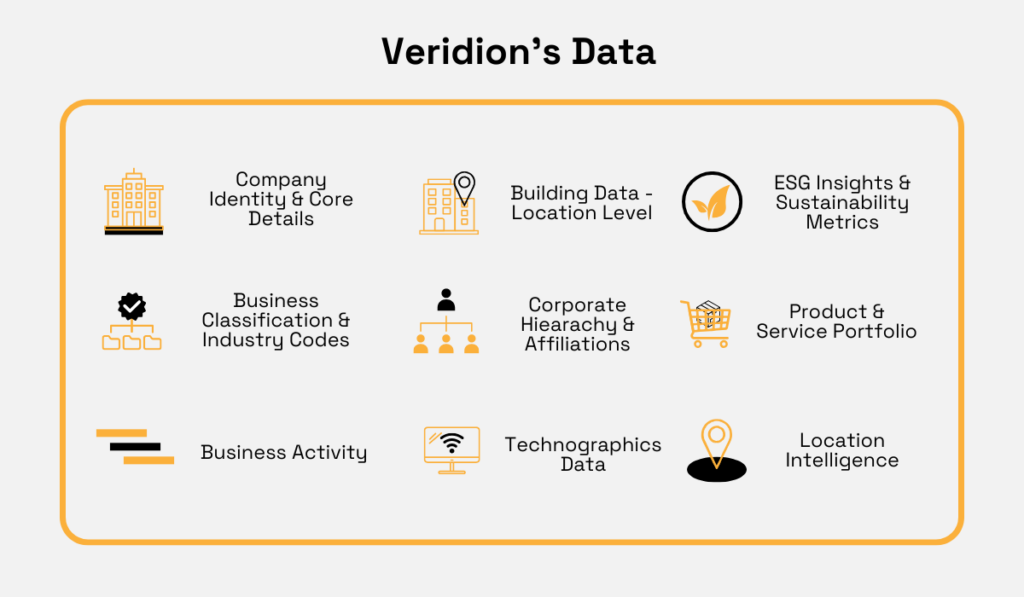
Source: Veridion
As a third-party data provider, Veridion collects, verifies, and regularly updates supplier data with complete reliability.
Companies get comprehensive, accurate views of potential partners across hundreds of data attributes.
They use it to make strategic decisions faster, monitor suppliers over time, and mitigate risk before it escalates.
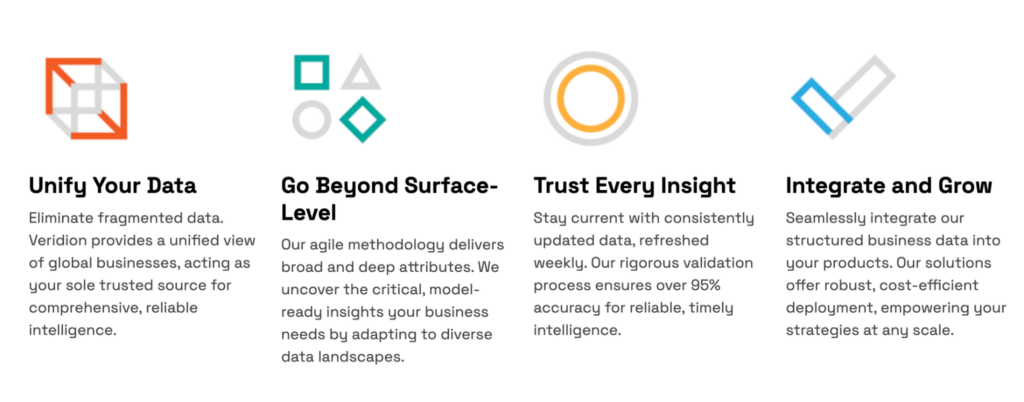
Source: Veridion
For best results, we recommend combining Veridion’s verified external intelligence with your internal records.
This allows you to enrich and cross-reference the data from both sources for an added layer of accuracy.
Veridion simplifies the process by integrating both through APIs.
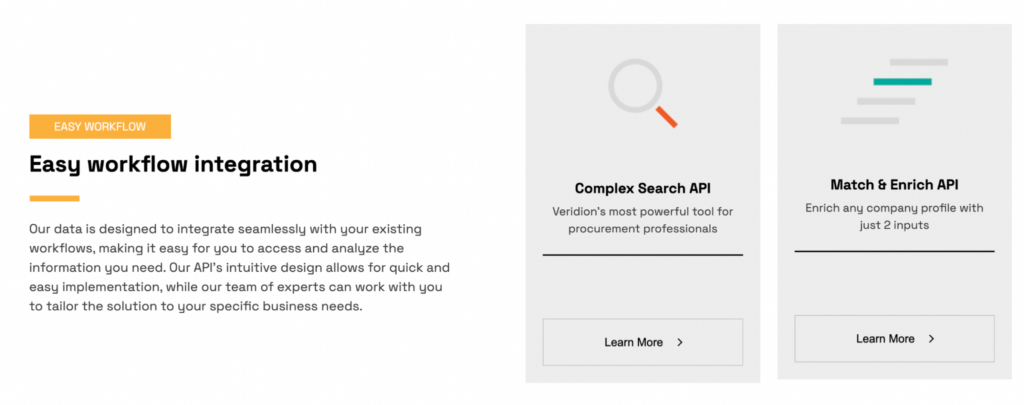
Source: Veridion
This robust approach to data will accelerate your operations across procurement, underwriting, and supply chain management, all while ensuring accuracy.
With a comprehensive data set in hand, you’ll make faster, more confident, and consistent decisions.
The next step is collecting the data, verifying its accuracy, and unifying it across your organization.
We already recommended combining third-party data with internal records for this purpose.
All that’s left to do is find a trusted provider.
Pick the one that integrates with your systems, and you’ll be up and running in no time.