Insights / Articles
Data Companies to Know About in 2026
Looking for data companies to follow in 2026? This guide will introduce key players shaping the future of data and analytics.

Enterprise strategy runs on data, but knowing which companies actually deliver reliable intelligence is becoming harder every year.
The challenge isn’t access, but clarity on which tool to deploy.
Today’s data ecosystem spans everything from company and supply-chain intelligence to market signals, firmographics, location data, and real-time operational insights.
Providers advertise deeper visibility and smarter decision-making, but the differences that actually affect enterprise outcomes rarely surface until you’re deep into evaluation.
That’s why this guide focuses on the data companies worth knowing in 2026.
You’ll see what each provider specializes in, the kinds of business problems they help solve, and where they typically fit within enterprise data and analytics strategies.
Let’s get into it.
Veridion
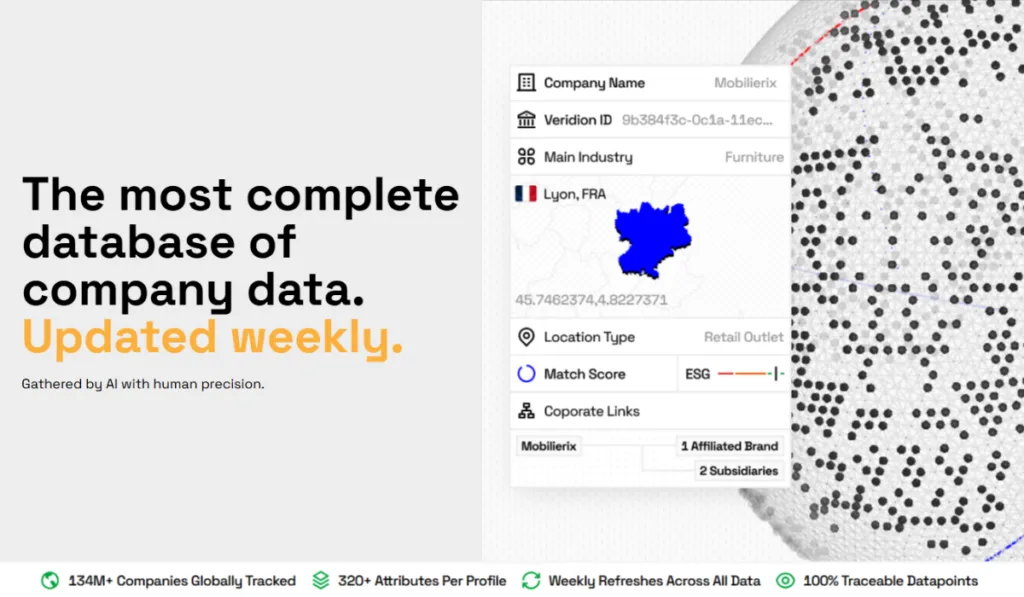
Veridion is a global company data platform built for teams that need both scale and specificity.
It tracks over 693M companies across 250 regions. That includes public and private firms, with especially strong coverage of small and medium businesses.
Source: Veridion
Most data providers struggle with SMBs. They’re harder to verify, update less frequently, and often operate under multiple names or without formal registration.
Veridion tackles this by continuously scanning the web and transforming unstructured data into structured company profiles.
The platform uses a dual-view model.
The Operating View captures real-world digital footprints: websites, social signals, product mentions, while the Legal View pulls datasets from official registries and filings.
Together, these views enable more accurate entity resolution, even when businesses operate under different names across jurisdictions.
Each company profile covers 461 data points, including:
- Firmographics (size, revenue, location)
- Industry classifications (NAICS, SIC, NACE)
- Corporate hierarchies (ultimate parents, subsidiaries, affiliates)
- Product and service portfolios
- ESG metrics and risk indicators
The database updates weekly, with over 99.7% accuracy across core fields.
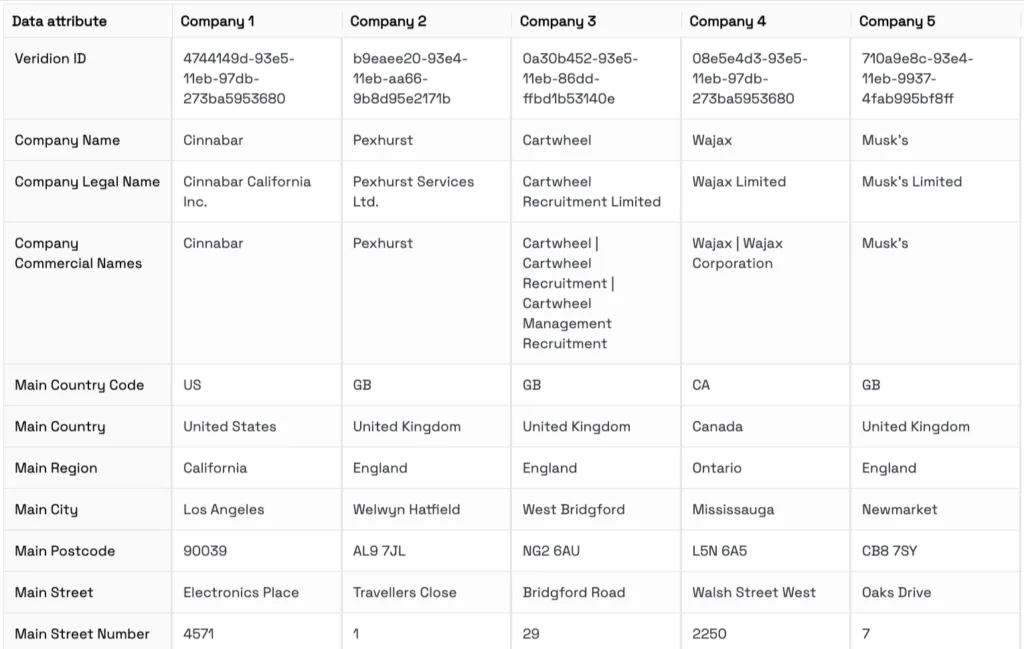
Check out this small portion of a typical Veridion data sample, which emphasizes location datapoints:
Source: Veridion
Unlike many providers, Veridion deliberately prioritizes company intelligence over contact data.
This makes it better suited for procurement, risk assessment, and ESG workflows than for outbound sales.
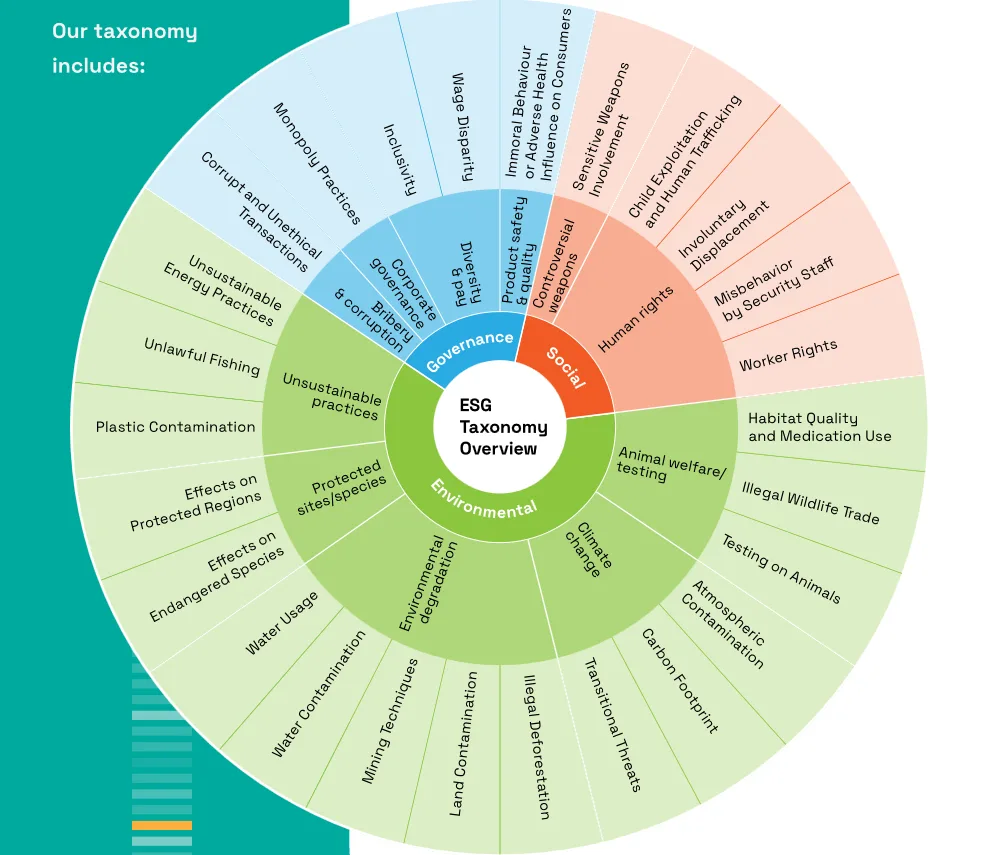
Its ESG capabilities deserve specific attention.
The platform provides sustainability commitments, emission tracking, environmental news, and compliance indicators.
These are valuable as regulatory pressure mounts around supply chain transparency and Scope 3 emissions reporting.
Source: Veridion
Where CleverMaps (covered next) specializes in location intelligence, and Enigma focuses on U.S. business data and financial health signals, Veridion brings global ESG and operational context that most competitors don’t offer.
The platform offers three access methods:
- a Search API for discovering companies using natural language queries
- a Match & Enrich API for expanding existing records with just a company name and country
- batch delivery for large-scale data refreshes
Here are some of Veridion’s pros and cons worth considering:
Pros | Cons |
|---|---|
Strong private company data, especially for SMBs | Enterprise pricing is not publicly available; pricing is usage- and custom-based |
ESG data aligned with major regulatory frameworks (CSRD, ASRS) | Requires technical integration for full value |
Flexible integration via REST APIs or Snowflake | Complexity may require expert support to interpret fully |
Insurers use Veridion to underwrite commercial policies and validate risk classifications, while banks rely on it for KYB (Know Your Business) processes and ESG compliance reporting.
Procurement teams use it to discover suppliers, benchmark vendor ESG performance, and monitor supply chain risk.
CleverMaps
Granted, Veridion helps you assess companies globally, but CleverMaps focuses on where those companies operate.
It’s a Location Intelligence platform built for teams that need to understand spatial dynamics. Think retail, logistics, banking, and insurance.
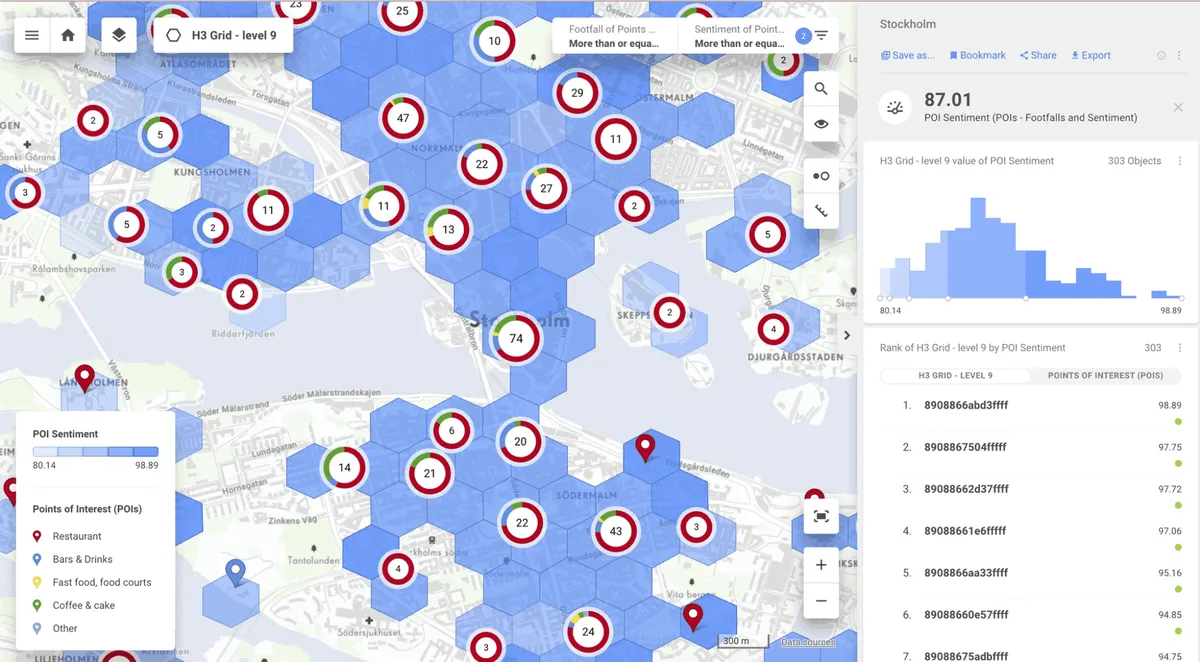
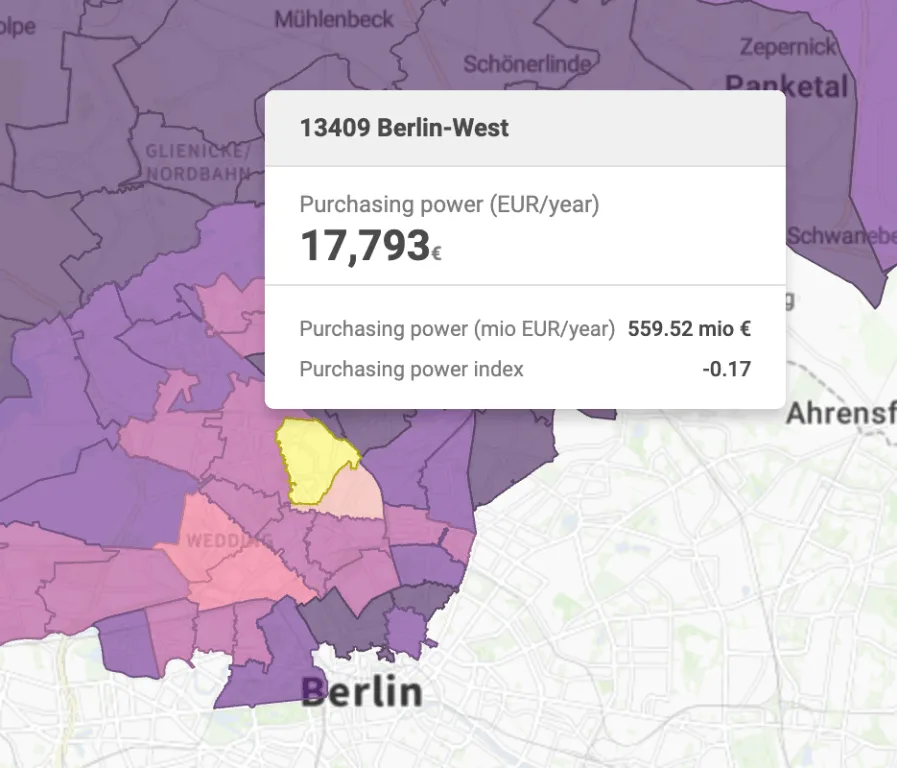
The platform connects your internal business data with external location datasets, like demographics, purchasing power, traffic patterns, points of interest, and consumer segments.
Source: CleverMaps
CleverMaps centers on its Data Marketplace: a curated library of verified spatial datasets ready for immediate use.
These datasets cover:
- Administrative boundaries
- Mobility patterns
- Demographic breakdowns
- Retail exposure indices
- Transaction data
- Traffic statistics
- Economic indicators
- Points of interest
Unlike traditional GIS platforms that require specialized expertise, CleverMaps emphasizes accessibility.
Source: CleverMaps
Data analysts and business owners can build location intelligence projects without SQL or geospatial programming skills.
The platform’s proprietary Retail Exposure Index stands out.
It uses point count and significance to assess location attractiveness, essentially quantifying how many relevant businesses exist around a given location.
We’re talking competitors, complementary services, and foot traffic drivers.
This is invaluable for site selection decisions.
While Veridion might tell you which suppliers operate in a region, CleverMaps shows you whether that region makes commercial sense based on actual activity and consumer behavior.
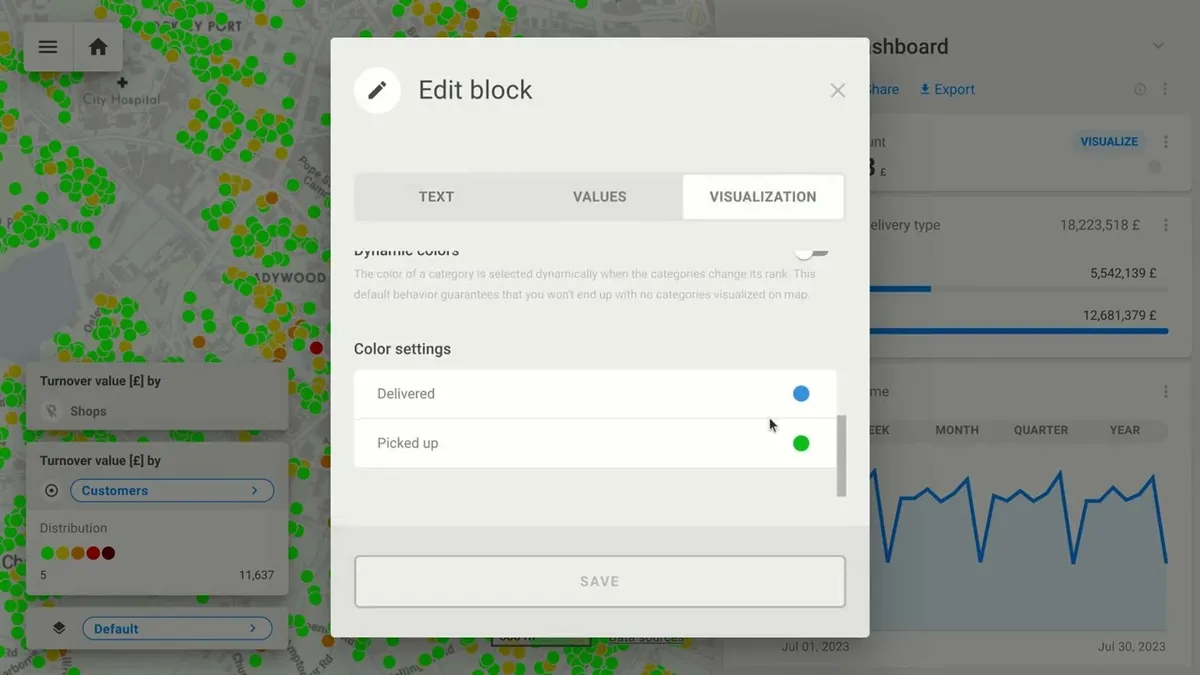
CleverMaps Studio is one of its key capabilities. It is the visualization and analysis interface.
Here, you can create interactive dashboards and perform spatial queries through an intuitive web application.
Source: CleverMaps
The platform’s Semantic Layer sits underneath, handling complex geospatial calculations and ensuring consistent metrics across different views.
That said, CleverMaps also has other advantages and limitations. Here’s a breakdown of some:
Pros | Cons |
|---|---|
No-code interface accessible to non-technical users | European market focus: coverage and data quality outside Europe can be limited |
Flexible data export formats (CSV, GeoJSON, Shapefile, and more) | Provides location intelligence only |
SOC 2 and ISO 27001 compliant | Doesn’t provide company-level ESG data like Veridion |
Retailers use CleverMaps for site evaluation, catchment area analysis, and competitive positioning.
Banks apply it to branch network optimization and market penetration studies.
Insurance companies leverage it for risk modeling tied to geographic exposures.
Delivery services use it for route planning and demand forecasting.
If your decisions are based on “where,” not just “who,” CleverMaps delivers clarity that purely company-focused platforms can’t match.
Enigma
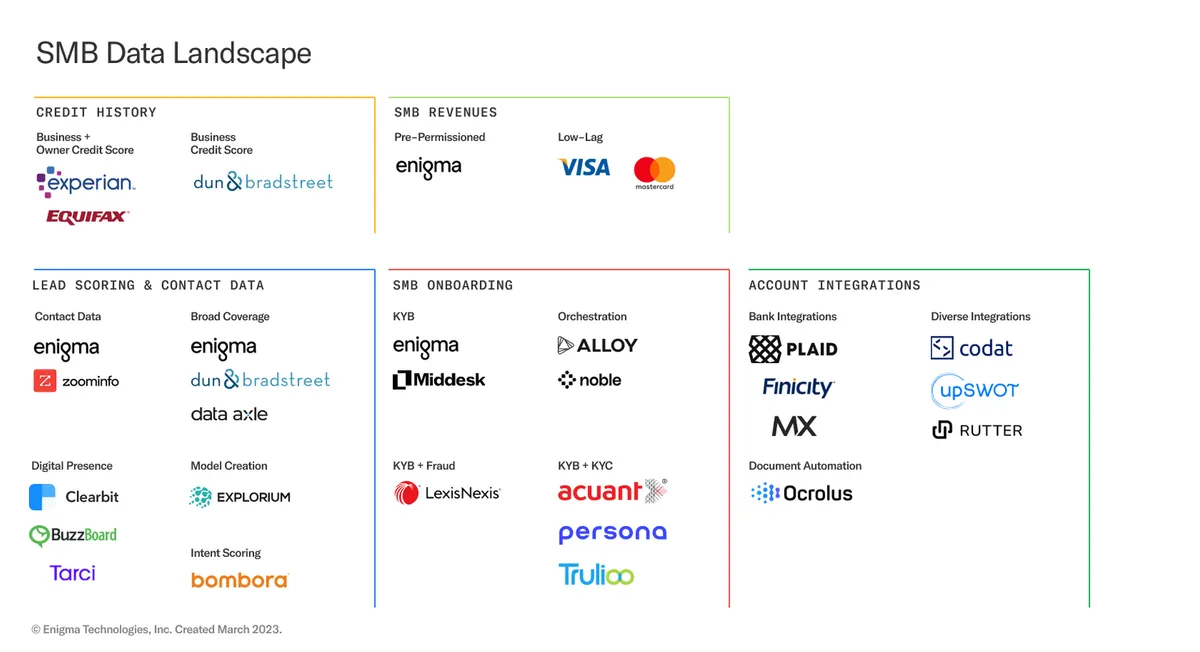
Enigma specializes in U.S. small and medium business intelligence, focusing on financial health signals that most data providers miss.
The platform covers over 49 million U.S. businesses, combining hundreds of public and third-party sources into unified profiles.
It has exclusive access to transaction-level revenue data derived from a panel representing over 40% of U.S. payment card transactions.
We’re talking more than 30 billion transactions totaling $4.5 trillion annually.
Source: Enigma
This isn’t modeled or estimated revenue; it’s observed spending aggregated from real credit and debit card activity.
The data you get:
Financial Signal | What It Shows |
|---|---|
Monthly and annual card revenues | Actual transaction volumes |
Revenue growth rates | Month-over-month and year-over-year trends |
Average transaction sizes | Customer spending patterns |
Payment technologies | Platforms used (Square, Stripe, Shopify, etc.) |
Sub-industry classifications | Granular business categorization |
This real-time financial visibility transforms risk decisioning for financial institutions underwriting merchant accounts or lenders evaluating business creditworthiness.
Enigma also emphasizes operational verification.
The platform cross-references corporate registration records, websites, and other activity signals to confirm businesses are active and real.
This eliminates “ghost” businesses that appear in registries but don’t actually operate.
This verification layer is critical for KYB compliance, particularly in financial services where regulatory requirements demand proof of operational status.
Source: Enigma
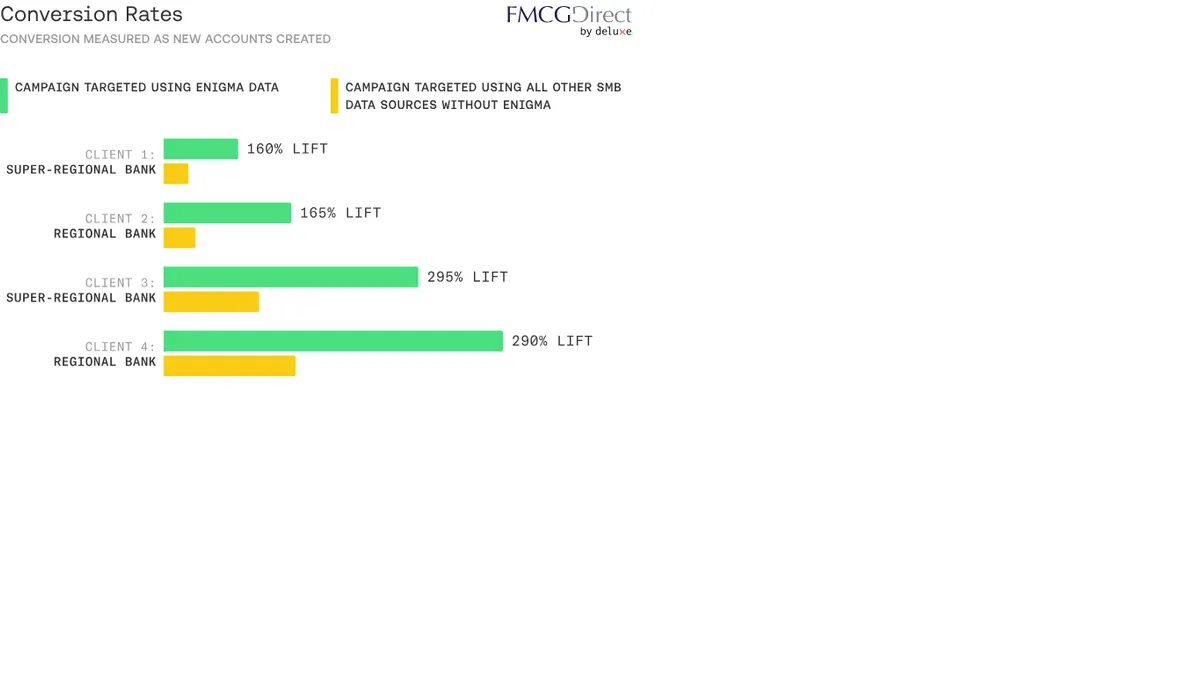
You can see how a business’s revenue is trending month-over-month, which payment platforms it uses, and how transaction volumes compare to industry benchmarks.
Enigma doesn’t compete on contact data. If you need decision-maker emails or phone numbers for outbound sales, platforms like ZoomInfo or Apollo are better suited.
These are some of its pros and cons:
Pros | Cons |
|---|---|
Provides GraphQL API and Data Share options for flexible integration | U.S.-only coverage (no international data) |
Used by major institutions (American Express, Truist, PayPal) | Requires technical integration to maximize value |
Compared to Veridion’s global reach and ESG focus, Enigma emphasizes comprehensive data within the U.S. market.
This makes it a limitation for organizations needing global information.
Overall, banks use Enigma to automate KYB processes and make faster, more confident underwriting decisions for business loans and merchant accounts.
Fintechs rely on it to onboard SMB customers without manual documentation reviews.
B2B marketers use the revenue and growth signals to build precise target lists and prioritize high-growth prospects.
Payment processors leverage it to identify merchants with strong transaction volumes and capture competitive volume.
The platform’s strength is U.S.-specific, but within that geography, it provides business intelligence that’s both timely and difficult to replicate.
Databroker
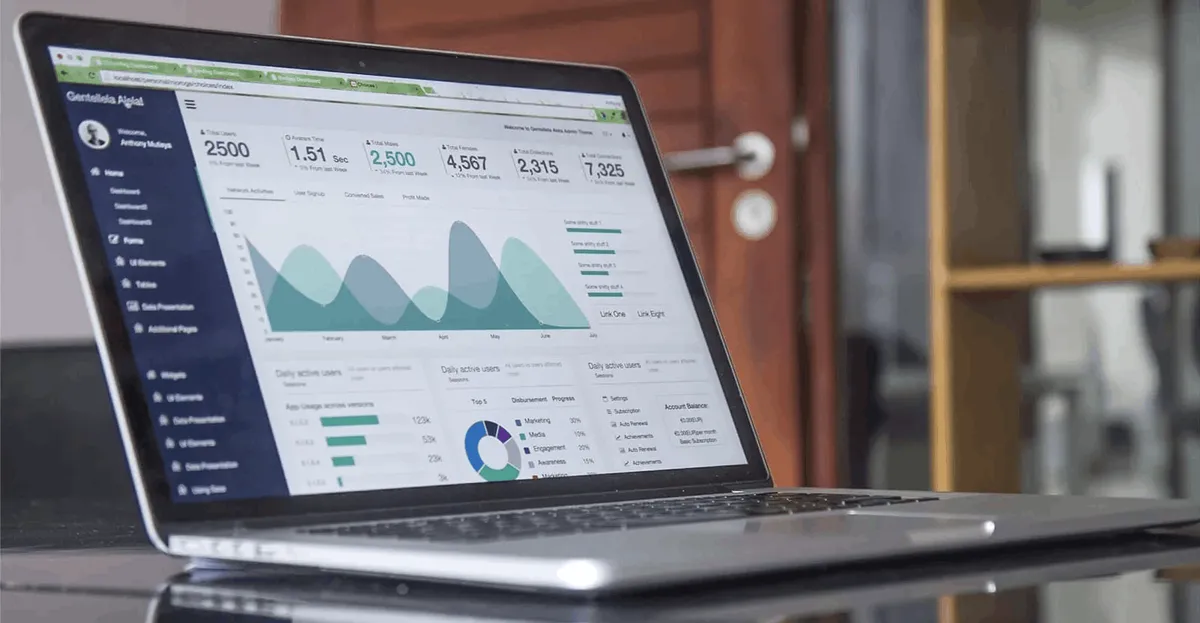
Databroker is a list brokerage service.
Founded in 2009 and based in Altrincham, UK, Databroker functions as an intermediary between you and multiple data suppliers.
The company sources B2B marketing lists from several compliant data providers across the UK and globally.
Then it curates bespoke lists according to your specific campaign requirements.
Source: Databroker
Because Databroker isn’t tied to one data source, it can shop around to find the best match for your brief.
If you need:
- telemarketing records in manufacturing
- email lists for professional services
- direct mail addresses for retail
Databroker finds the right supplier.
The company’s team has over 70 years of combined experience and acts consultatively.
They help you define target audiences, avoid brand damage, and maximize campaign ROI.
Additionally, Databroker is a DMA member and ICO-registered.
All suppliers undergo regular compliance checks. The company was audited by the DMA corporate members in 2019 with high marks for transparency and industry-leading practices.
So, data is regularly updated and vetted for GDPR compliance.
The company maintains 4.8 out of 5 stars on Feefo across over 100 reviews, reflecting consistent client satisfaction.
Beyond list provisioning, their services include:
- Data enhancement
- Data cleansing
- Data appending
This helps standardize records for better segmentation.
Unlike Veridion, CleverMaps, and Enigma, which are technology companies offering API-driven access to proprietary datasets, Databroker is a service business offering human expertise and supplier access.
You’re not licensing a database; you’re engaging a broker who sources the right data on your behalf.
This creates clear advantages and limitations:
Pros | Cons |
|---|---|
Personalized consultation and strategic guidance | Working with aggregated third-party data rather than a unified platform |
Access to fragmented UK data market without managing multiple vendor relationships | Refresh cycles and data quality depend on the underlying suppliers |
Compliance oversight across all supplier data | No API access or real-time updates |
Flexibility across multiple data suppliers | Limited to the UK and select international markets |
UK-based marketing agencies use Databroker to fuel client campaigns without maintaining in-house data teams.
SMBs needing one-off list purchases for product launches or regional expansions depend on Databroker’s consultative approach.
Telemarketing firms source phone-verified records through the service.
The value proposition is access and expertise rather than technology differentiation.
Overall, if you need a technology platform with APIs, real-time updates, and global coverage, tools like Veridion might be a better fit.
But, if you need a trusted advisor to navigate the UK’s B2B data market and assemble compliant, targeted lists for specific campaigns, Databroker delivers exactly that.
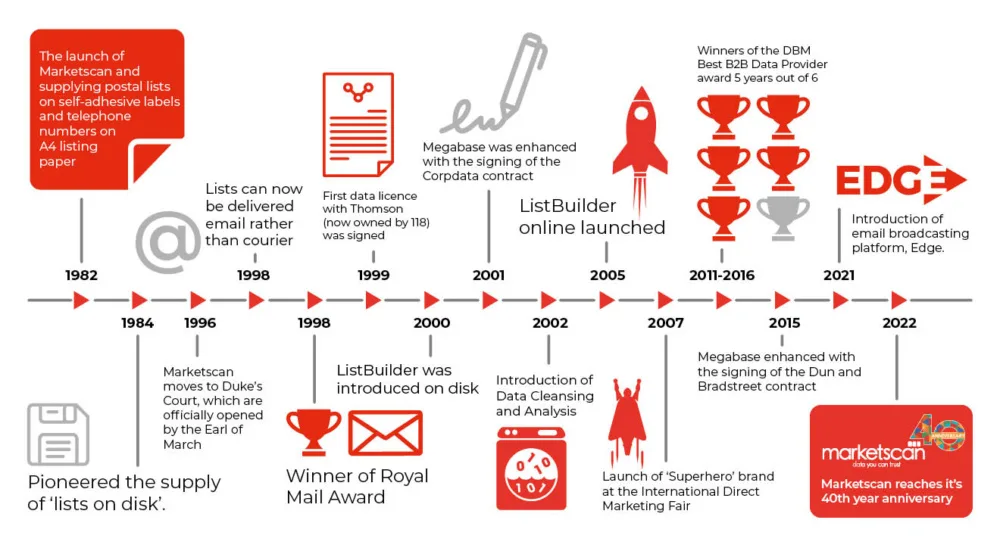
Marketscan
Marketscan operates in the same UK B2B data market as Databroker, but with a different structure.
It owns and maintains a proprietary master database.
Founded in 1982 in Chichester, West Sussex, Marketscan has spent over 40 years building the Megabase™.
This is a unified database created by blending five top UK data sources into a single file.
The result? Access to over 7 million B2B decision-makers across different industries.
Source: Marketscan
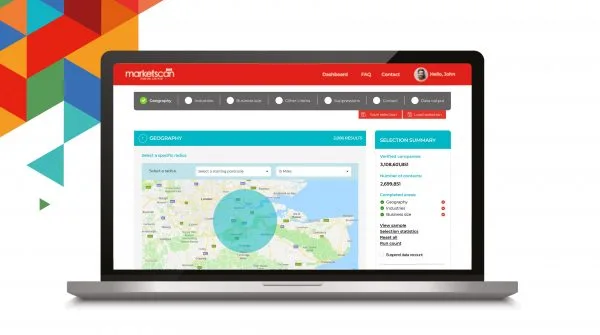
Marketscan applies a proprietary business classification system that goes beyond standard SIC codes or directory categories.
This enables more granular targeting, which is critical when you’re trying to reach UK manufacturers of specific component types.
Its access options are another standout feature of the platform.
The platform offers both full-service and self-service access.
In the full-service option, Marketscan’s team builds bespoke lists based on campaign objectives, geography, company size, industry, and other criteria.
But in the self-service option, Marketscan Online (previously called ListBuilder) provides a portal where you select targeting parameters, view sample data, and download records on demand.
The tool checks data against the Telephone Preference Service (TPS) and Corporate Telephone Preference Service (CTPS) registers every 24 hours to ensure compliance.
Beyond data supply, Marketscan also runs Marketscan Edge, an email marketing platform designed for B2B campaigns.
Source: Marketscan
This extends the company’s value into campaign execution, though it remains UK-market-focused.
Compared to Databroker’s brokerage model, Marketscan’s owned-database approach provides consistency and control.
You’re not dependent on third-party supplier availability or varying data quality across sources.
Pros | Cons |
|---|---|
Large sample size | UK-specific |
Diverse access options | Monthly data updates |
Compared to other global platforms on this list, like Veridion, Marketscan is UK-specific but offers unmatched local depth.
UK-based B2B marketers deploy Marketscan for lead generation campaigns targeting specific industries or regions.
Telemarketing agencies use the TPS/CTPS-checked phone records.
Direct mail specialists leverage the 98% deliverability warranty to minimize waste, while email marketers use Marketscan Edge for compliant outreach with high inbox placement rates.
Marketscan delivers depth that generalist global platforms can’t match for businesses whose primary market is the UK and whose campaigns demand reliable, up-to-date local business contacts.
Conclusion
Data has become one of the most valuable assets inside modern enterprises.
But no vendor will solve every use case across your organization.
Organizations that move fastest combine multiple sources of intelligence: market signals, company data, supply-chain visibility, and operational insights, to create a clearer view of the environments they operate in.
Before committing to a data provider at scale, evaluate how well their intelligence connects with real business needs: identifying market opportunities, monitoring competitors, assessing partners, or guiding expansion into new regions.
The best platforms supply data and deliver clarity that leaders can use to move confidently in fast-changing markets.
And in 2026, that clarity is quickly becoming a competitive advantage.
Articles
Discuss how these trends affect your organization.
Our analysts are available for a short call. Bring a specific question and we will ground it in the data.