



Blog
6 Data Enrichment Tools You Need to Know About
By: Stefan Gergely -
09 December 2025


We love our data, and now that you're here, you're one step closer to loving it too.
A wide sample of data, so you can explore what is possible with our data
Choose ->
built with procurement in mind. Focused on manufacturers, products and more
Choose ->
built with insurance in mind. Focused on classifications, business activity tags and more
Choose ->
built with sustainability in mind. Focused on sustainability commitments, and environmental and social governance insights.
Choose ->
built with strategic insights in mind. Focused on market trends, competitor analysis, and industry-specific data
Choose ->

Keep up to date with our technology, what our clients are doing and get interesting monthly market insights.

Data enrichment tools transform raw data into actionable insights, adding an essential layer of firmographics, technographics, intent signals, and behavioral context.
Choosing the right platform means balancing data quality, AI-driven enrichment, integration options, and suitability for your workflows.
In this article, we’ll be showcasing six standout tools that transform data enrichment capabilities and can help guide your decision-making and go-to-market strategy.
Veridion delivers top-tier accuracy, completeness, and classification, and we’re not saying that just because it’s our own platform.
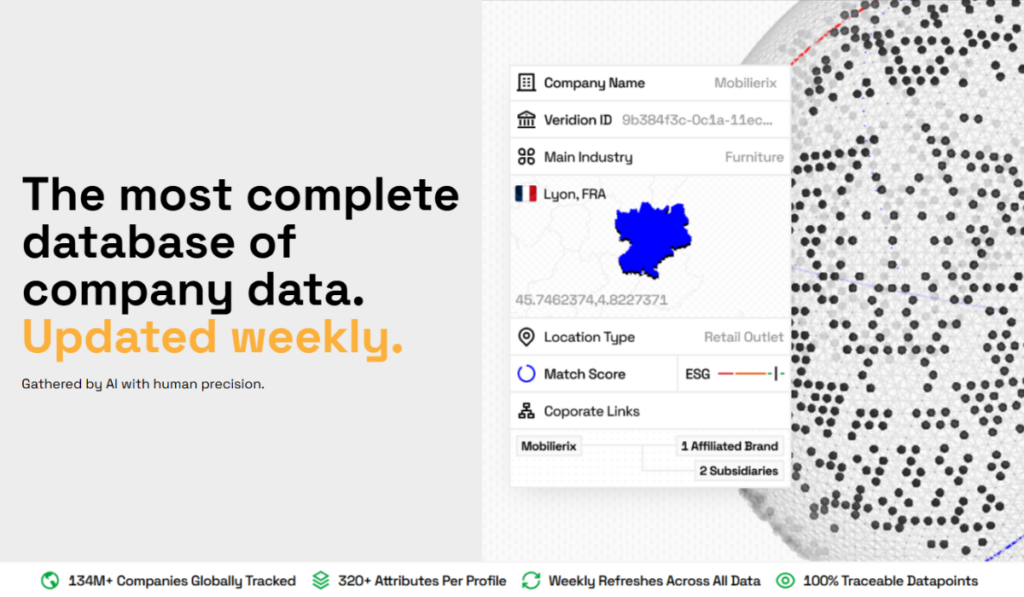
Trusted by leading teams in procurement, risk, insurance, and sustainability, Veridion is an AI-powered business intelligence and data enrichment solution offering unmatched company data across more than 134 million companies worldwide.
Source: Veridion
This includes extensive coverage of public companies and large private firms, plus over 90% of SMBs, many of which are digital-first, unregistered, or micro-businesses that traditional providers routinely miss.
Moreover, our data is updated weekly, so you’re consistently working with the freshest and most reliable information possible.
Here’s how data enrichment works in practice:
Source: Veridion on YouTube
Pretty neat, right? But Veridion’s true strength lies in data depth.
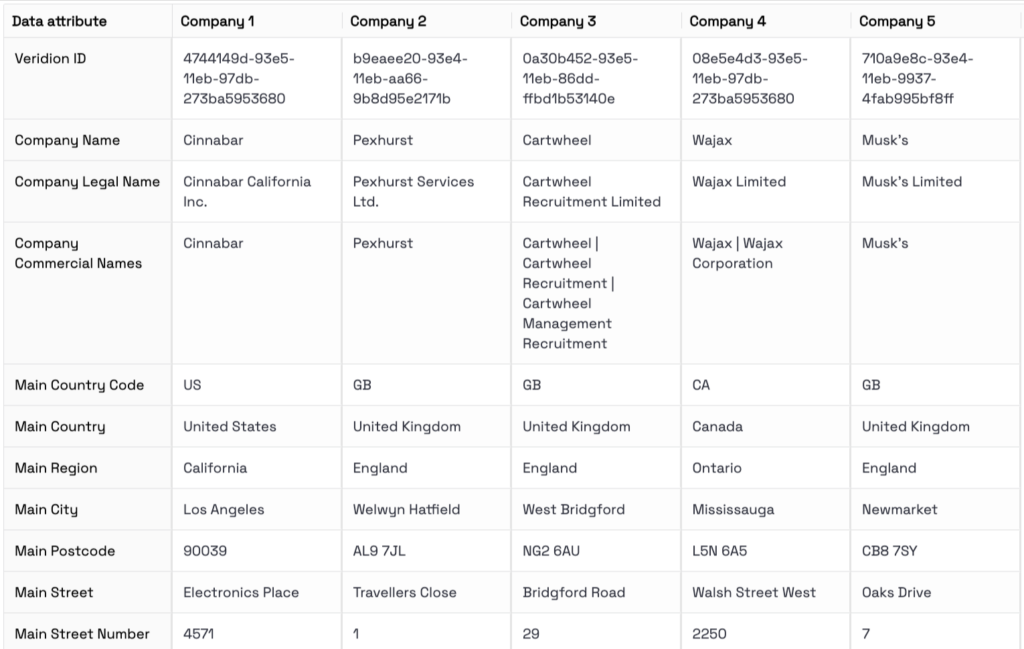
Each company profile includes 320+ attributes, going well beyond basic firmographics.
You get enriched insights into:
This level of detail supports advanced segmentation, precise risk modeling, and highly tailored market analysis.
Here’s a small portion of a typical Veridion data sample, focusing on location datapoints:
Source: Veridion
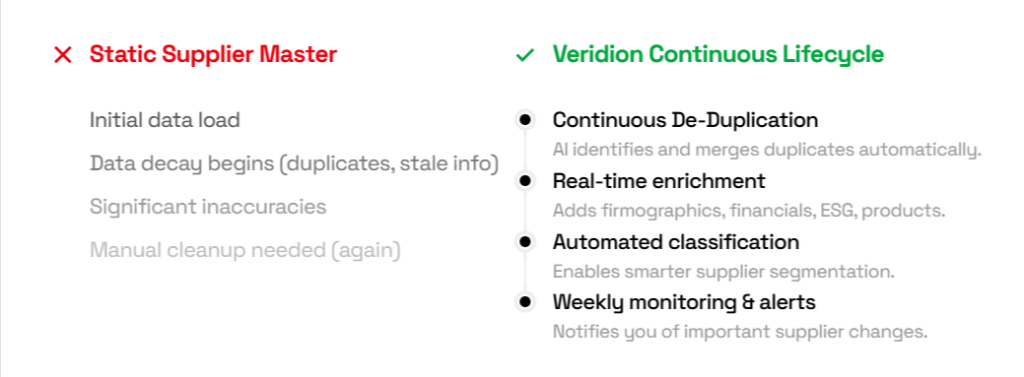
Most importantly, Veridion’s proprietary sourcing methodology ensures you won’t have to worry about data accuracy.
A fully custom, end-to-end data pipeline means control over every stage, from sourcing and extraction to normalization and delivery.
We combine primary sources like company websites and legal registries with validated third-party data, including news feeds, social signals, and public filings.
Continuous client feedback loops and machine-learning refinement further improve both accuracy and relevance over time.
Source: Veridion
Of course, data is only valuable if teams can use it effectively.
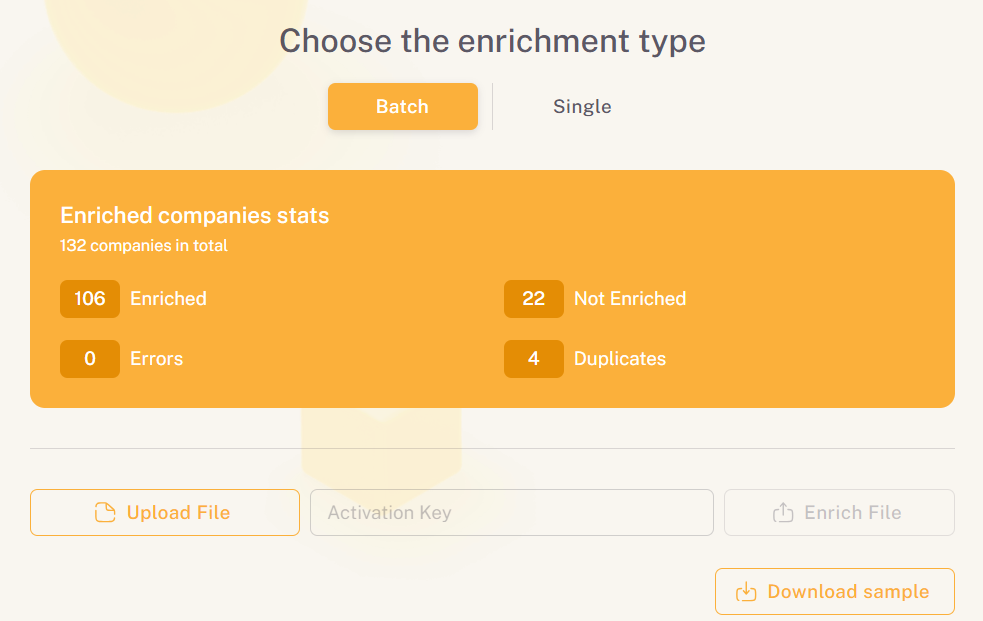
Veridion makes this easy with natural language search, intuitive dashboards, and configurable enrichment workflows.
You can choose enrichment type, track quality, and match rates, and maintain clean, unified records with advanced matching and deduplication.
Source: Veridion
Flexible delivery options let you integrate Veridion data into BI tools, analytics workflows, procurement platforms, or internal data lakes.
Whether you’re enriching your CRM, conducting market or risk analysis, or optimizing procurement, Veridion delivers the quality, depth, and reliability your enterprise workflows demand.
Curious to learn more? Download a free sample today or schedule a data consultation.
ZoomInfo is one of the most established data-enrichment providers on the market.
They are particularly popular with sales and go-to-market teams aiming to improve lead scoring, segmentation, targeting, and outbound relevance.
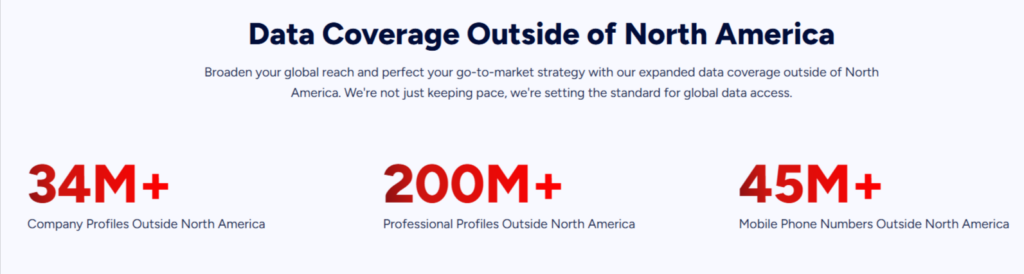
While their coverage outside North America is smaller compared to more globally focused providers like Veridion, ZoomInfo still maintains 34M+ company profiles internationally.
This reflects ongoing expansion and strong ambitions for broader global reach.
Source: ZoomInfo
Where ZoomInfo truly stands out is its depth of individual contact data.
Beyond basic firmographics, the platform provides department org charts, decision-maker hierarchies, direct dials, and verified business emails.
This is especially valuable for securing high-value deals, renewals, and expansion opportunities where knowing “who is who” matters as much as the account itself.
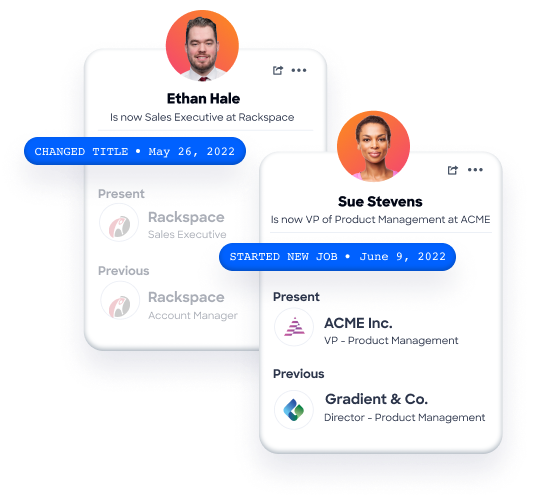
It also lets you track role changes, new hires, and departures across key accounts.
This helps teams identify risk, engage stakeholders at the right moment, and get wind of any changes impacting existing or future business relationships.
Source: ZoomInfo
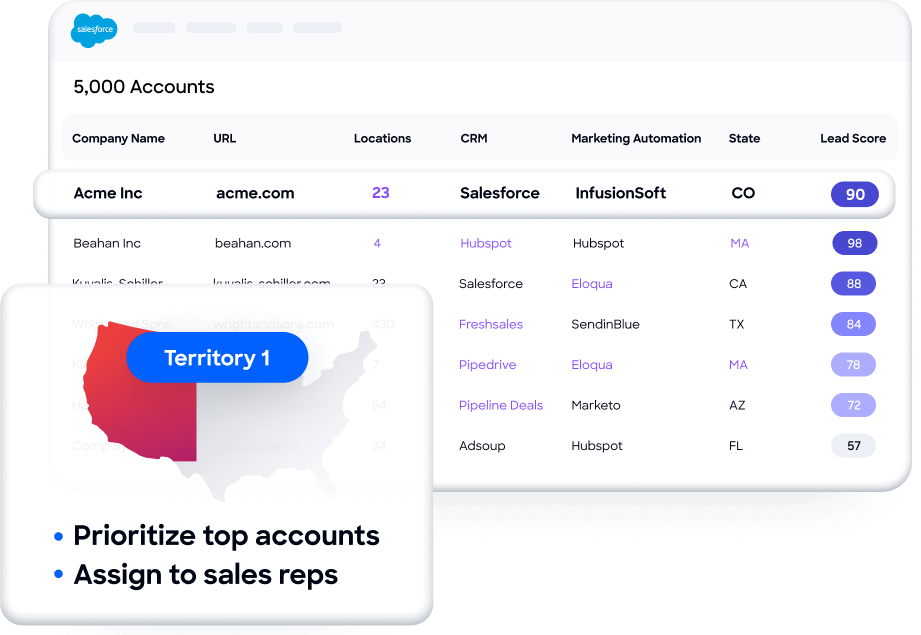
On the enrichment side, ZoomInfo offers an intuitive dashboard and seamless configurations with Salesforce, HubSpot, Marketo, Eloqua, and Microsoft Dynamics.
Their 360-degree cleansing process deduplicates, normalizes, and segments records before enrichment, ensuring that the resulting dataset is accurate, unified, and actionable.
Sales teams can quickly prioritize top accounts and assign them directly to reps for follow-up.
Source: ZoomInfo
One major differentiator is ZoomInfo Copilot.
It takes enrichment beyond static fields by enabling signal-based selling: combining intent data, technographics, buying-stage indicators, and org charts to automatically surface in-market accounts.
Copilot also supports AI-driven account planning with real-time alerts, at-risk deal signals, and automated account tracking, helping your teams focus on the highest-value opportunities.
Source: ZoomInfo on YouTube
While Veridion enhances your data layer, ZoomInfo provides a broader GTM Workspace, which unifies CRM records with intelligence on 100M+ companies and 260M+ professionals while streamlining research, planning, and outreach.
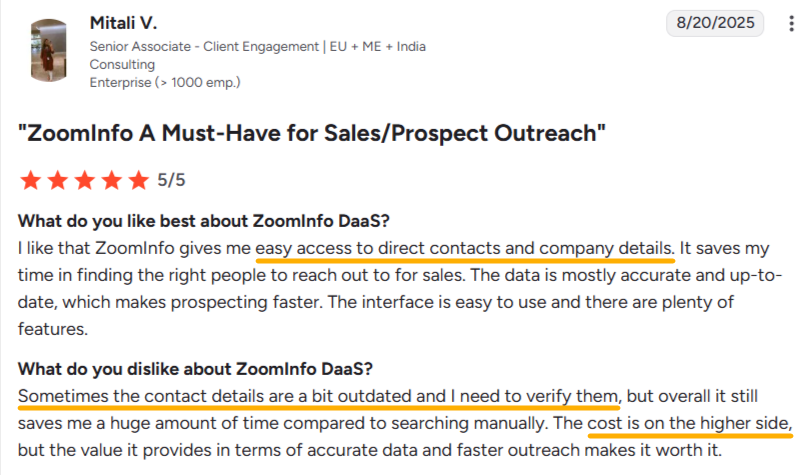
Users frequently highlight ease of use, though some note the need for periodic manual verification due to occasional outdated entries.
Source: G2
Like with most intelligence solutions, pricing will vary based on your unique needs, but overall, ZoomInfo remains a reliable DaaS solution with robust enrichment capabilities and strong alignment with sales and revenue operations.
Cognism is a GTM-focused B2B data platform known for its strong EU-centric coverage, strict compliance posture, and solid enrichment workflows.
While its dataset is smaller than that of US-oriented providers, Cognism offers some of the most reliable contact data within the UK, DACH, Benelux, Nordics, France, and Spain, making it a popular option for teams focusing on the EMEA region.
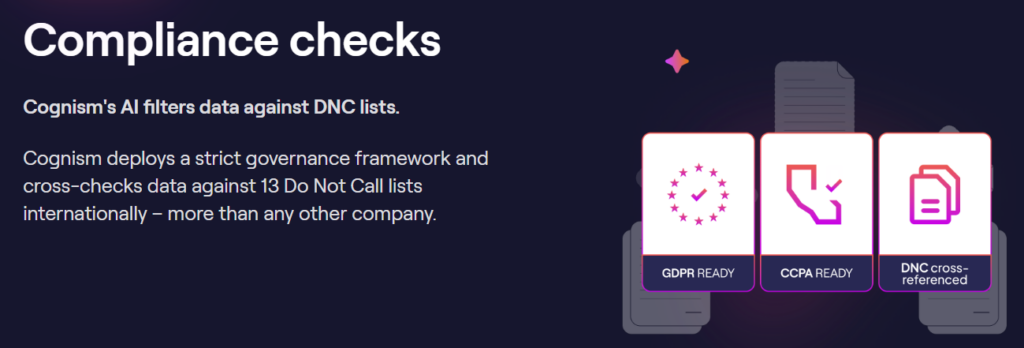
The reason for this lies in Compliance is one of Cognism’s biggest differentiators.
Built for GDPR-era regulations, the platform cross-checks records against 13 international Do Not Call lists, which is more than any other major vendor.
Source: Cognism
Their AI automatically filters and validates contact data to reduce risk, a valuable edge for teams in tightly regulated regions.
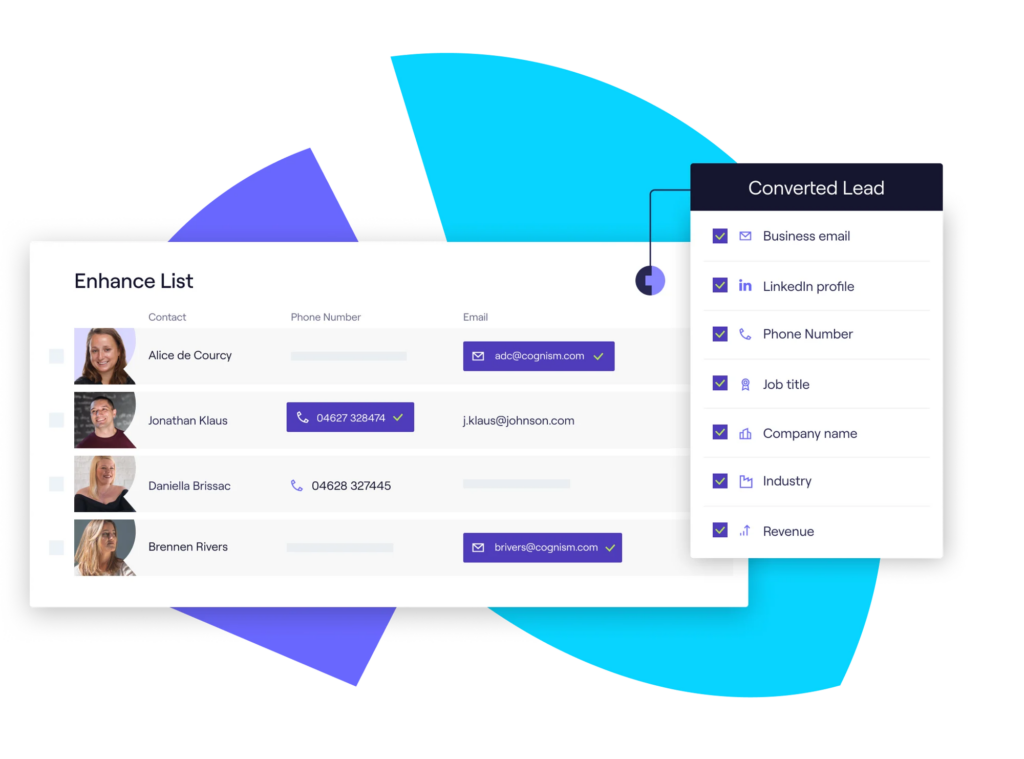
The enrichment workflow is simple and intuitive.
Users can upload datasets directly, let the system match and update records, and push results back into their CRM or outreach tools.
Source: Cognism
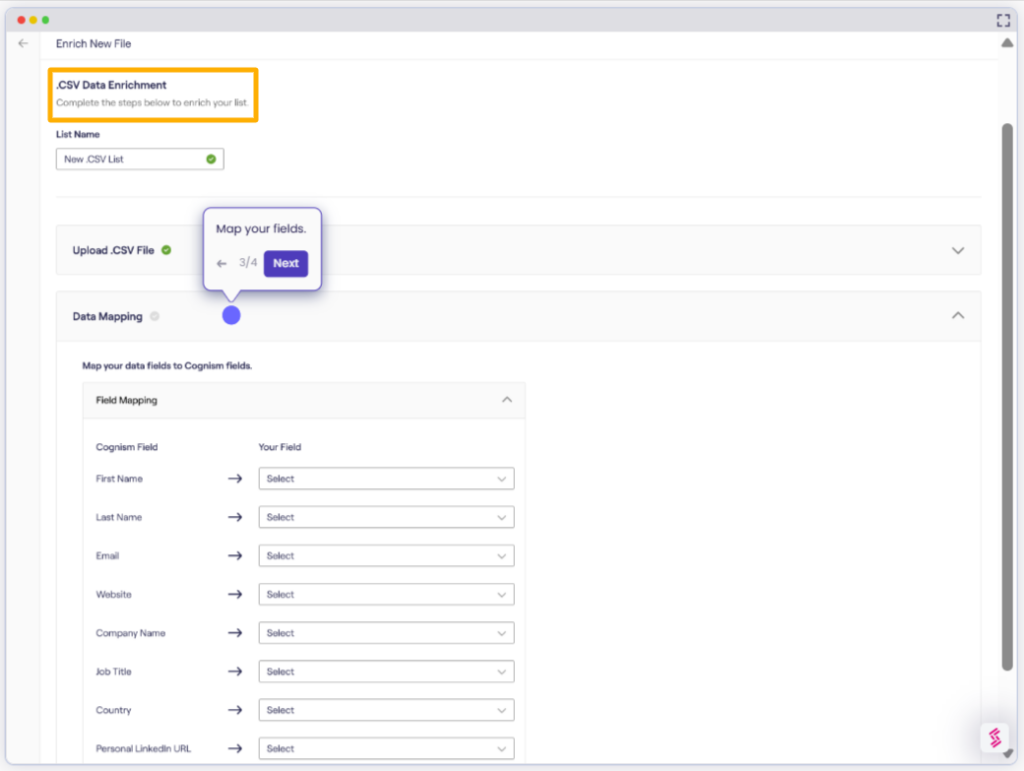
Like ZoomInfo, Cognism enriches both company and individual profiles.
A CSV-based enrichment flow and real-time or scheduled updates via API, flat files, or integrations with Snowflake, S3, Databricks, or Google Cloud make it flexible for both SMB and enterprise teams.
Source: Cognism
Reps can enrich contacts without leaving tools like Outreach, and operations teams can define their own structure, frequency, and delivery logic.
Cognism has long leaned on AI to expand and refine its dataset, delivering insights such as:
All of these are essential for outbound personalization and timing.
The platform’s interface and workflow automation are frequently praised.
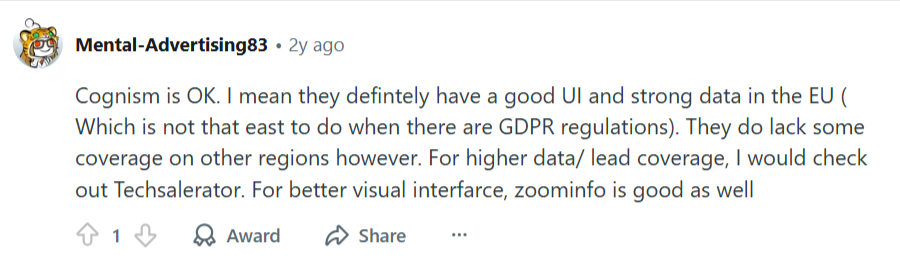
However, one Redditor hints at a more nuanced picture: while Cognism excels within Europe, coverage and data freshness outside the region can be inconsistent.
Source: Reddit
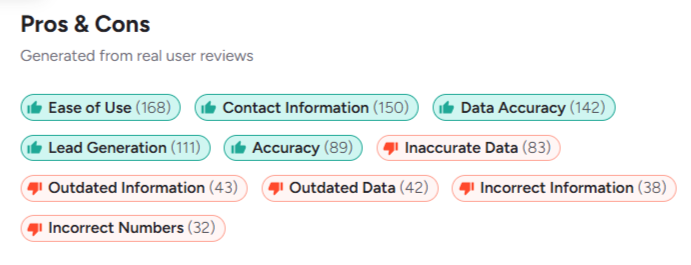
The user also mentions the need for manual verification compared to more globally oriented platforms, which corresponds to the G2 pros & cons overview, which shows a mixed track record when it comes to data accuracy and freshness.
Source: G2
Still, with a 4.6 rating on G2 from 1,100+ reviews, Cognism remains a strong contender, especially for teams selling into Europe or requiring rigorous compliance screening.
Keep in mind that pricing isn’t publicly available, but detailed plan breakdowns are accessible on their website.
Clearbit is a marketing intelligence and data-activation platform designed primarily for demand generation, website personalization, and real-time enrichment.
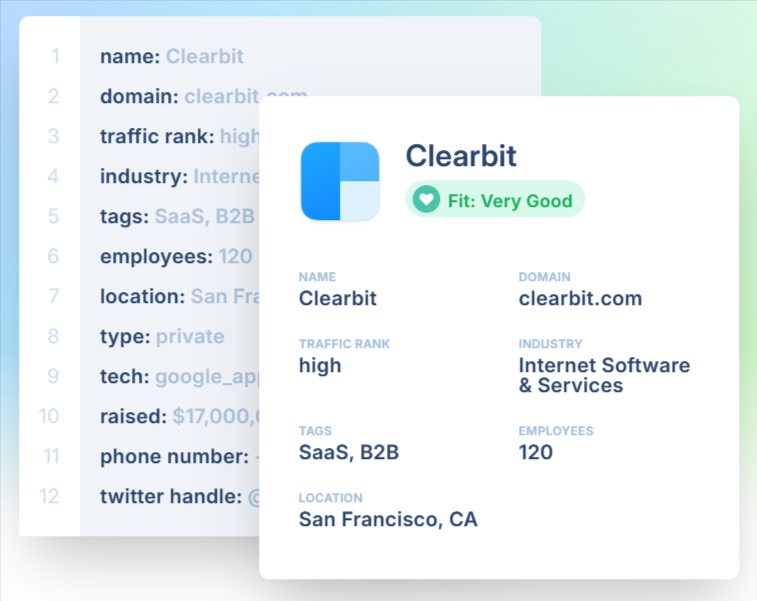
Clearbit’s dataset includes 100+ attributes, which is smaller compared to broader providers like Veridion or ZoomInfo.
Source: Clearbit
But the platform’s strength lies in the quality and granularity of these fields, especially for industry and company metadata.
Clearbit offers:
While Clearbit does not compete at the same scale as Veridion or ZoomInfo in terms of raw coverage or global contact datasets, its real-time enrichment is fast and precise, with intent-aware enrichment embedded directly into digital funnels.
Namely, Clearbit is deeply integrated with HubSpot, which acquired the platform in late 2023.
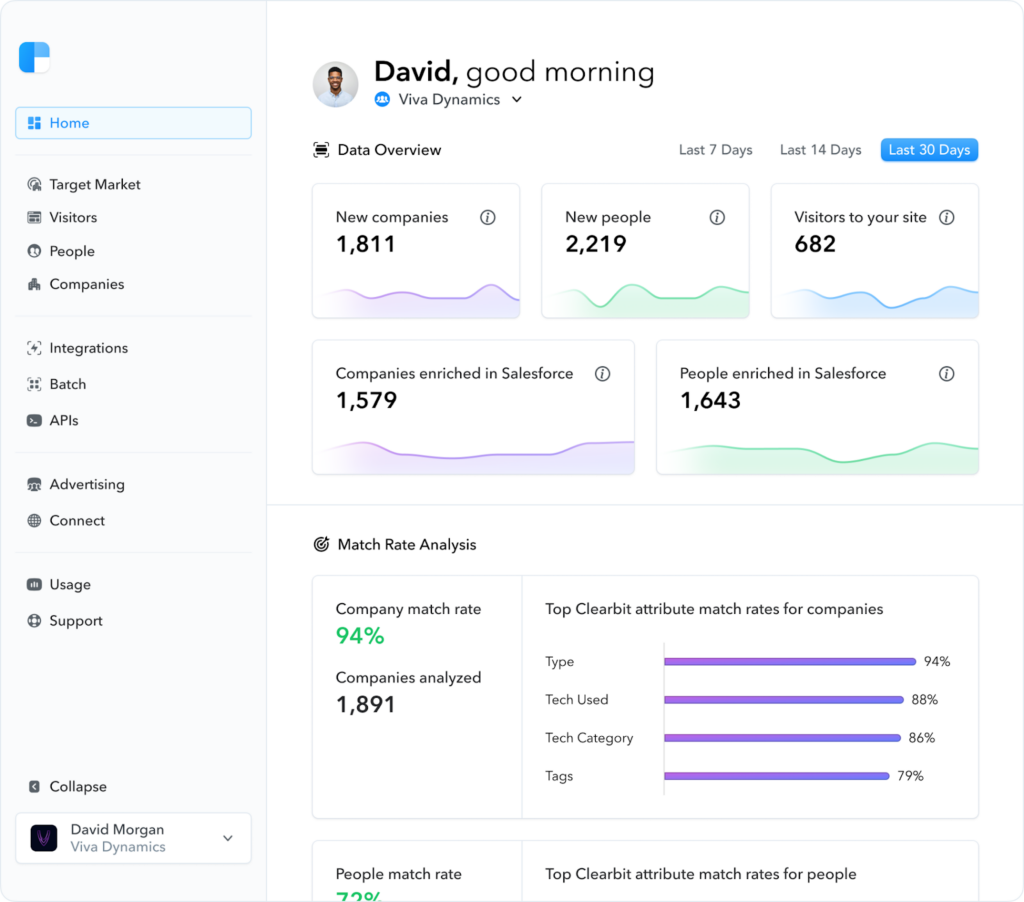
This means enriched data flows natively into HubSpot’s CRM, workflows, and automation tools, making it easy for marketing and RevOps teams to power campaigns, scoring models, and audience segmentation with minimal setup.
The result? You get all the essential data at your fingertips.
Source: Rb2b
Where Clearbit truly stands out is in personalization and intent.
API-first architecture enables developers and marketers to insert enrichment anywhere in the funnel, from form shortening to personalized website experiences.
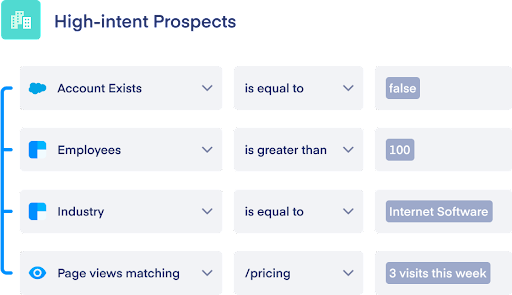
With its Data Activation Platform, teams can build dynamic audiences using both Clearbit data and CRM/CDP attributes.
For example, you can target internet software companies with 100+ employees that visited the site three times this week.
Source: Clearbit
Clearbit has recently expanded into AI with Breeze Intelligence, offering enrichment, form optimization, and buyer intent.
Meanwhile, Breeze AI Assistant contextualizes CRM data to support meeting prep, content creation, and strategic planning—all within HubSpot.
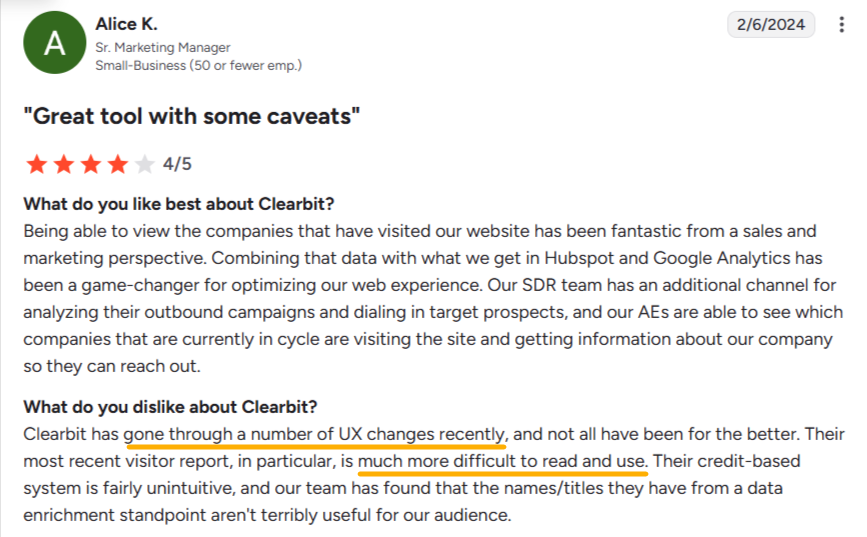
User feedback highlights strong connectivity and ease of setup, though some mention UX friction and pricing tied to database size.
Source: G2
As with most providers on this list, full pricing requires contacting Clearbit directly. However, one older review states that the pricing is/was based on database size.
To sum up, Clearbit is best suited for marketing and growth teams that prioritize real-time personalization, web conversion, and HubSpot-native activation.
Leadspace is a B2B data and intelligence platform built for enterprise revenue teams seeking clean, connected, and actionable insights.
It excels at unifying fragmented data and operationalizing segmentation across marketing, sales, and RevOps.
The platform’s Customer Data Graph, fueled by 30+ premium third-party B2B sources, is one of its standout features that helps teams map people to accounts and buying centers for enhanced targeting.
What you can expect is regularly updated, multi-source validation for 200M+ companies, 700M+ contacts, and 120M mobile numbers.

Source: Leadspace
That translates to a broad yet organized view of potential targets.
Leadspace requires structured inputs, such as job title, company, and domain, to maximize match accuracy, but be sure to check out the video for a closer look at enrichment options.
Source: Leadspace on YouTube
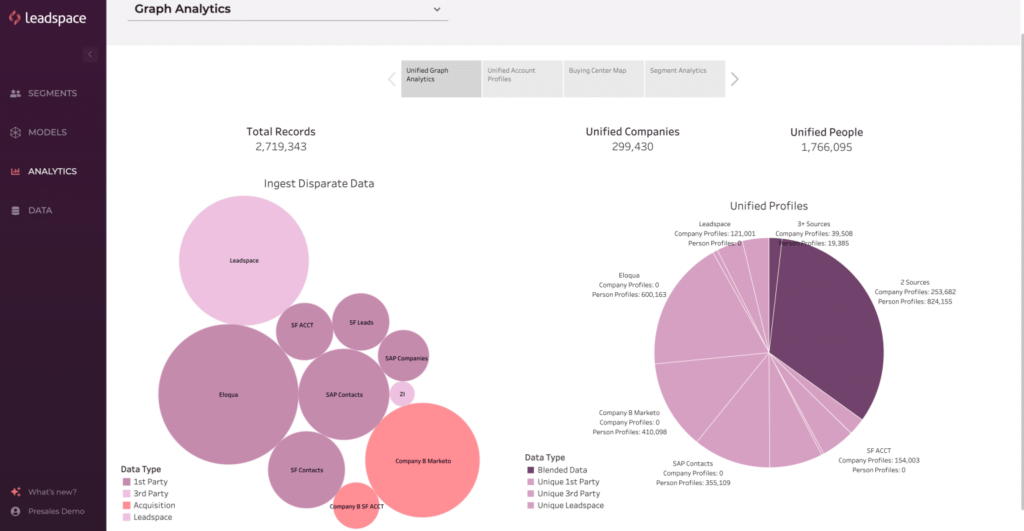
Once enriched, the data flows into dashboards like Graph Analytics, which visualize unified companies and contacts.
This helps teams quickly identify duplicates, overlaps, and hidden connections, ensuring the right leads are prioritized and segmented for campaigns.
Source: Leadspace
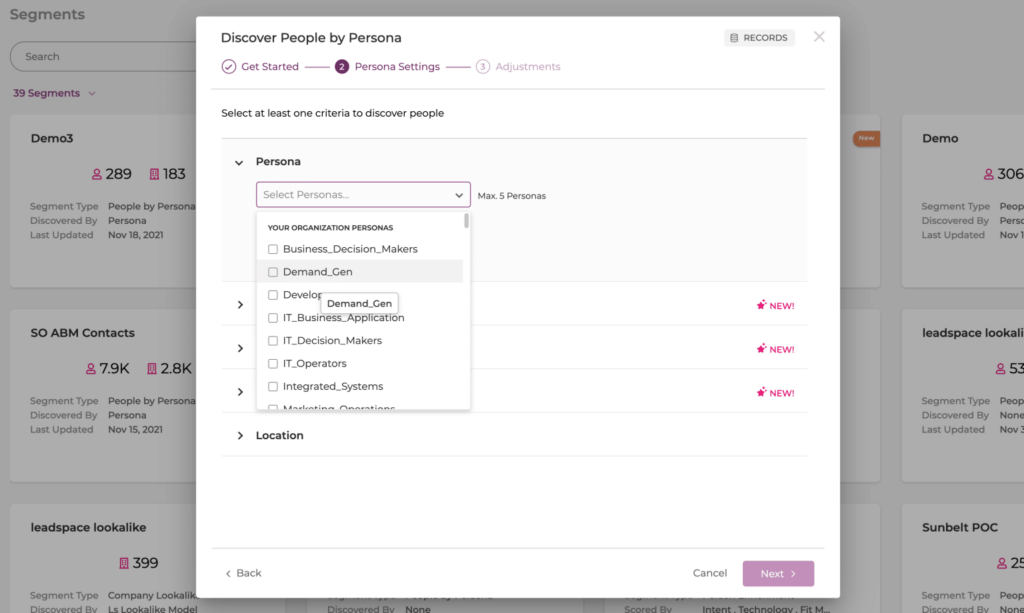
Another key differentiator is Persona and Buyer Profile modeling.
Leadspace provides 80 pre-built persona templates, which can also be fully customized, enabling teams to discover contacts by role, seniority, department, or technographics.
Source: Leadspace
Persona scoring ranks leads based on fit and engagement signals, helping sales and marketing teams focus on high-value prospects.
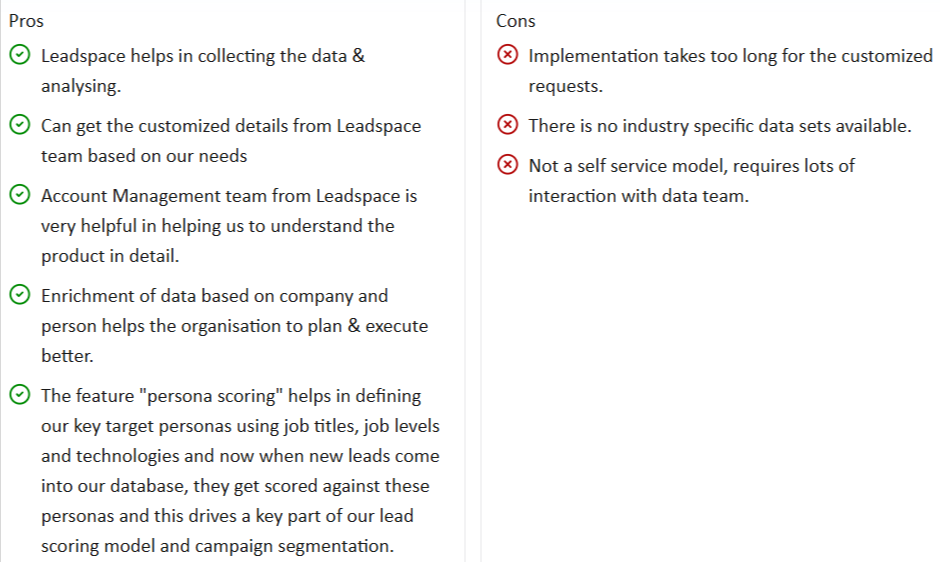
Persona-driven workflows and data enrichment capabilities, in general, are praised by users, as seen in this Trust Radius review.
However, the same user also highlights that customization tends to require time and collaboration with the data team, which is a drawback compared to more self-service-oriented tools.
Source: TrustRadius
Of course, this is partially offset by Leadspace’s depth in connecting multiple data sources and providing actionable insights for complex, multi-channel campaigns.
Pricing is not publicly listed, but Capterra cites a starting point of roughly $25,000/year.
To sum it up, Leadspace could be a good choice for enterprises that need a unified, persona-focused data strategy, combining multiple B2B sources into one actionable system, and prioritizing precise targeting and segmentation over sheer dataset size.
Let’s wrap up our list with Crunchbase, an AI-powered company intelligence platform primarily focused on funding data, investors, and startup activity.
Crunchbase specializes in identifying funding rounds, M&A events, and emerging opportunities, which makes it the go-to resource for investor and investment-focused insights.
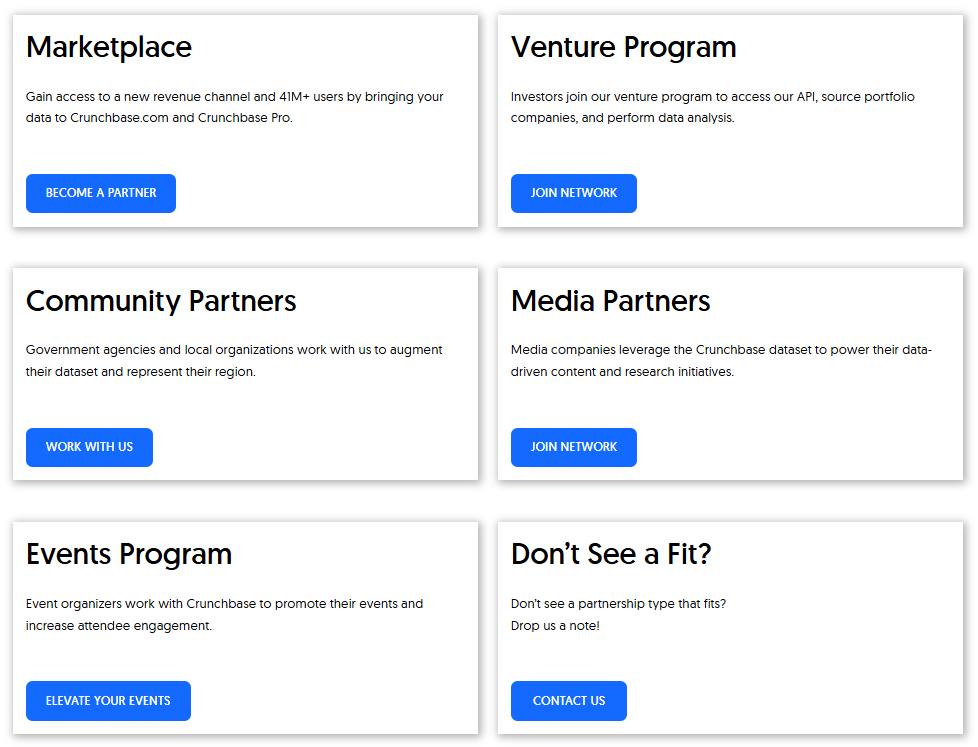
The platform itself draws data from its investor network, contributor community, and company submissions, resulting in a rich dataset of companies, technologies, and areas of innovation.
Source: Crunchbase
While this community-driven model gives Crunchbase unique depth in funding and deal activity, it can also lead to duplicate entries, outdated data, or inconsistencies.
This is an important point to consider when comparing against platforms like Leadspace or Veridion.
Although it doesn’t provide the same advanced GTM workflows found in ZoomInfo or Cognism, Crunchbase can help you identify key contacts within startups and smaller companies, supporting prospecting, deal sourcing, and outreach.
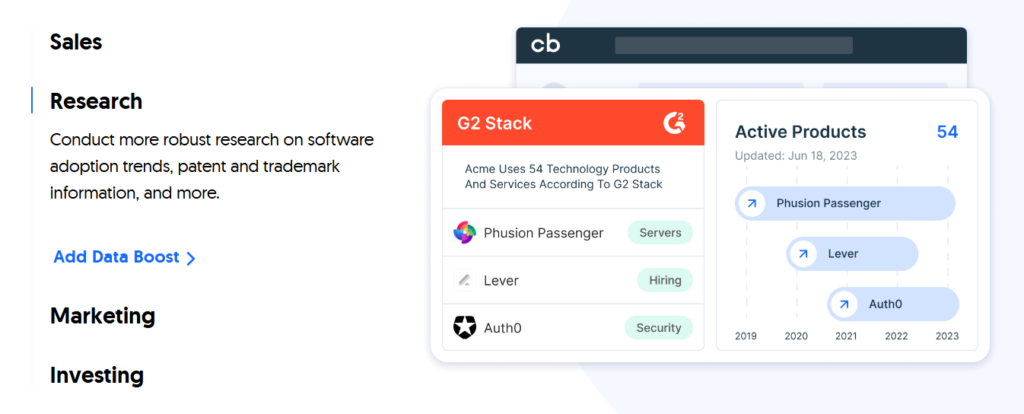
For firmographic or technographic enrichment, users can opt for supplementing data with a special Crunchbase data boost.
Source: Crunchbase
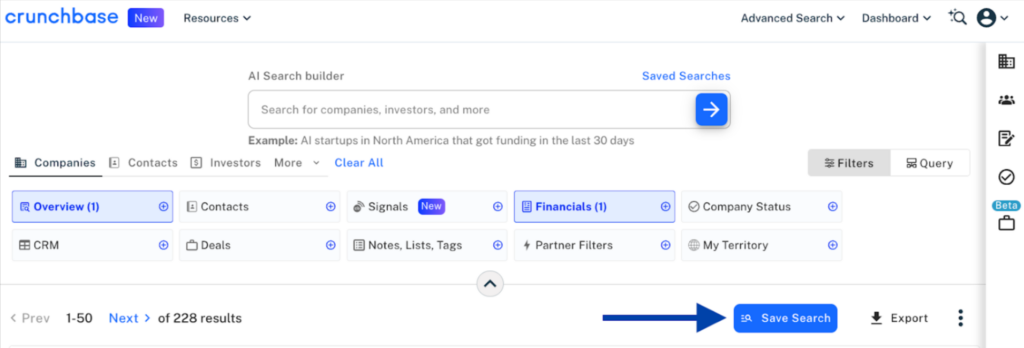
The platform’s advanced search allows users to filter and save lists of companies based on multiple criteria, including funding stage, industry, location, and investor activity.
This makes it a highly practical tool for teams tracking opportunities and monitoring emerging markets.
Source: Crunchbase
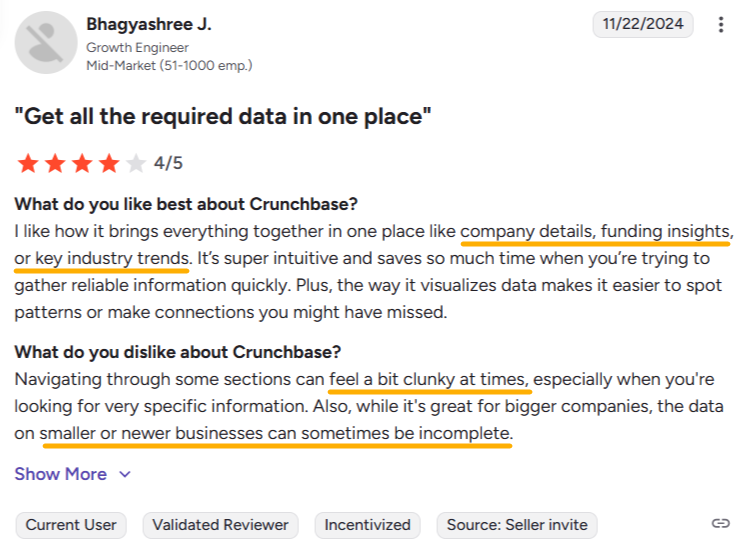
Reviews on G2 and similar sites show that Crunchbase excels at delivering comprehensive data and helping companies gain access to key funding insights and industry trends.
Despite high ease-of-use ratings, some users note clunky navigation, as well as limited coverage for SMBs or very new startups.
Source: G2
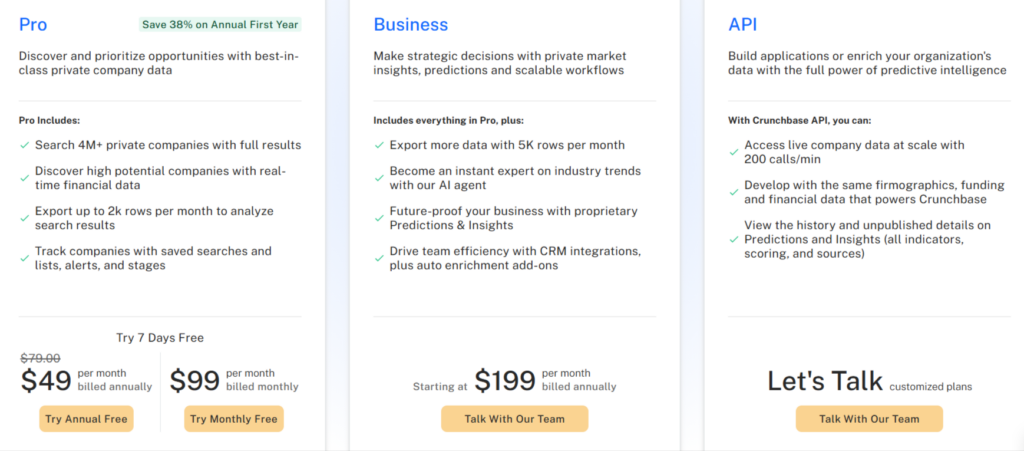
Another important differentiator is the platform’s free version, which offers basic company and funding information, ideal for individuals and smaller teams.
Meanwhile, paid plans such as Crunchbase Pro and Business add advanced search, saved lists, and workflow features.
The pricing is mostly transparent, with only the API plan requiring a quote.
Source: Crunchbase
Keep in mind that the aforementioned Data Boost add-on costs an additional $30 per month.
As a whole, Crunchbase is a user-friendly and cost-effective solution for organizations that want to monitor funding, investors, and early-stage opportunities, rather than make use of comprehensive sales enrichment workflows.
Selecting the right data enrichment tool accelerates sales, enhances marketing, and restructures workflows by ensuring cleaner, more reliable datasets.
Each platform we reviewed offers unique advantages, from global coverage and GTM focus to persona-driven segmentation and funding insights.
So, how do you choose the one that’s right for you?
Evaluate your priorities, sign up for free trials or demos, and pick the tool that best aligns with your data strategy, workflows, and growth goals.
Start today, and you’ll see the difference reflected in actionable insights and results.