



Blog
Data Governance vs. Master Data Management: Key Differences
By: Auras Tanase -
23 January 2026

We love our data, and now that you're here, you're one step closer to loving it too.
A wide sample of data, so you can explore what is possible with our data
Choose ->
built with procurement in mind. Focused on manufacturers, products and more
Choose ->
built with insurance in mind. Focused on classifications, business activity tags and more
Choose ->
built with sustainability in mind. Focused on sustainability commitments, and environmental and social governance insights.
Choose ->
built with strategic insights in mind. Focused on market trends, competitor analysis, and industry-specific data
Choose ->

Keep up to date with our technology, what our clients are doing and get interesting monthly market insights.

Key Takeaways:
Ever feel like the terms “data governance” and “master data management” get thrown around interchangeably?
You’re not alone.
Messy, inconsistent data can derail everything from sourcing and compliance to basic vendor onboarding. So, this confusion between the two terms comes at a real cost.
Both matter, but they solve very different problems.
So let’s figure out what each one actually does, how they differ, and why most procurement teams need both to keep their supplier and vendor data accurate, compliant, and decision-ready.
Think of data governance like your organization’s rulebook: the policies and decision-making structures that determine how data is collected, defined, accessed, secured, and maintained.
Frank Cerwin, the President and Managing Principal of Data Mastery Inc., puts it simply:
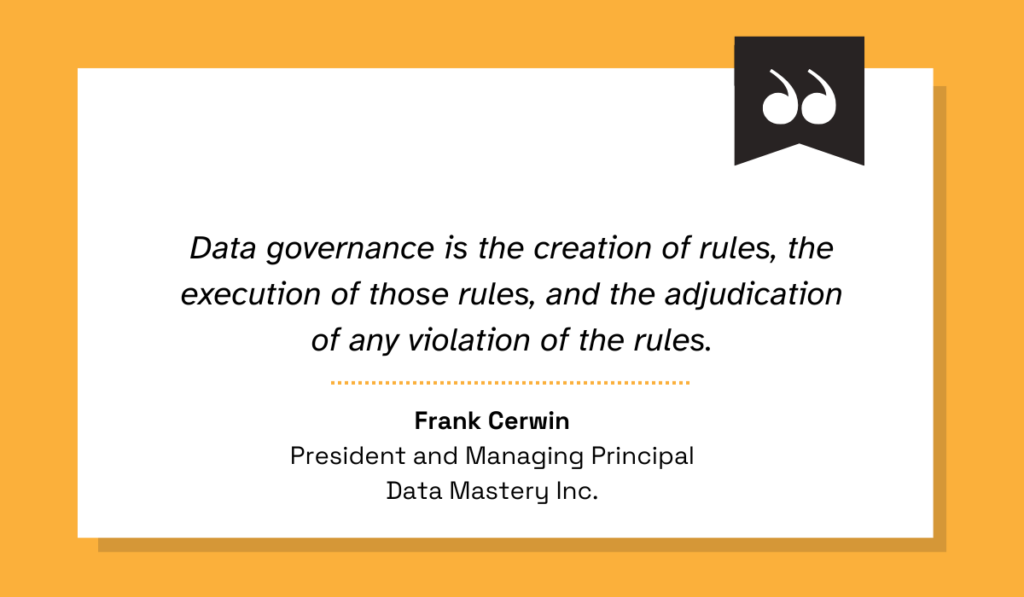
Illustration: Veridion / Quote: Dataversity
In large enterprises, good data governance provides the clarity and accountability needed to ensure that data is accurate, consistent, traceable, and ethically handled across the organization.
And the benefits are easy to see.
For starters, governance programs significantly improve data quality. Clear rules around ownership, usage, and quality expectations then reduce operational risk.
Governance also supports regulatory compliance, and with so many global privacy regulations multiplying each year, that’s a non-negotiable.
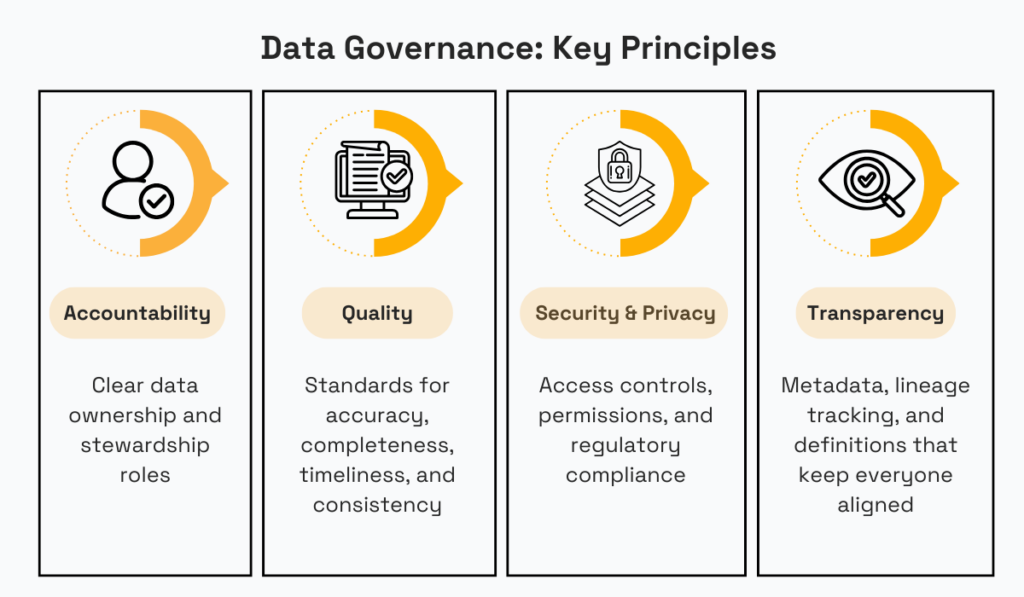
Most governance frameworks revolve around a few central principles, outlined below:
Source: Veridion
To sum up, data governance decides how data should be processed, who is responsible, and what “good data” really means.
It’s the strategic oversight that keeps the entire data ecosystem aligned and trustworthy.
Now, let’s see how MDM puts those rules into action.
If data governance writes the rules, MDM does the work.
Master data management is the operational engine that builds a single, consistent “golden record” for your core business data.
Think vendors, customers, products, locations, and everything you need to keep track of, together.
MDM systems ingest data from myriad internal and external sources.
The greatest perk here? MDM matches and deduplicates records and standardizes attributes.
That’s a big win because every system finally speaks the same language: no more “Inc.” in one place and “Incorporated” in another.
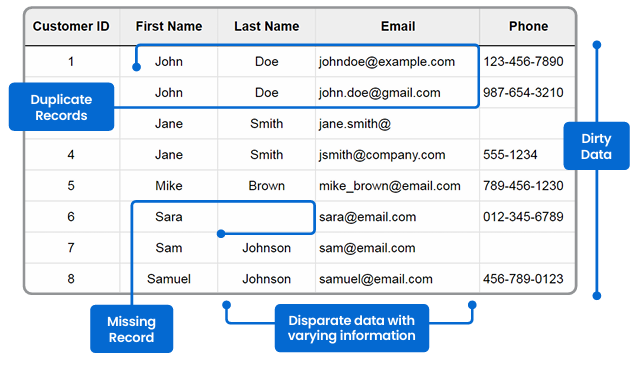
Here’s an example of how inconsistencies can end up looking when there’s no MDM in place:
Source: WinPure
This kind of dirty data can have severe consequences for your organization, from overpayments and missed savings to compliance risks, procurement delays, and more.
MDM, on the other hand, synchronizes master data across your ERP, procurement suite, CRM, and analytics tools.
In other words, everyone works from the same source of truth.
All those times when Finance sees one supplier name while Procurement sees three versions of it finally become a thing of the past.
Here are some of the greatest benefits of MDM done right:
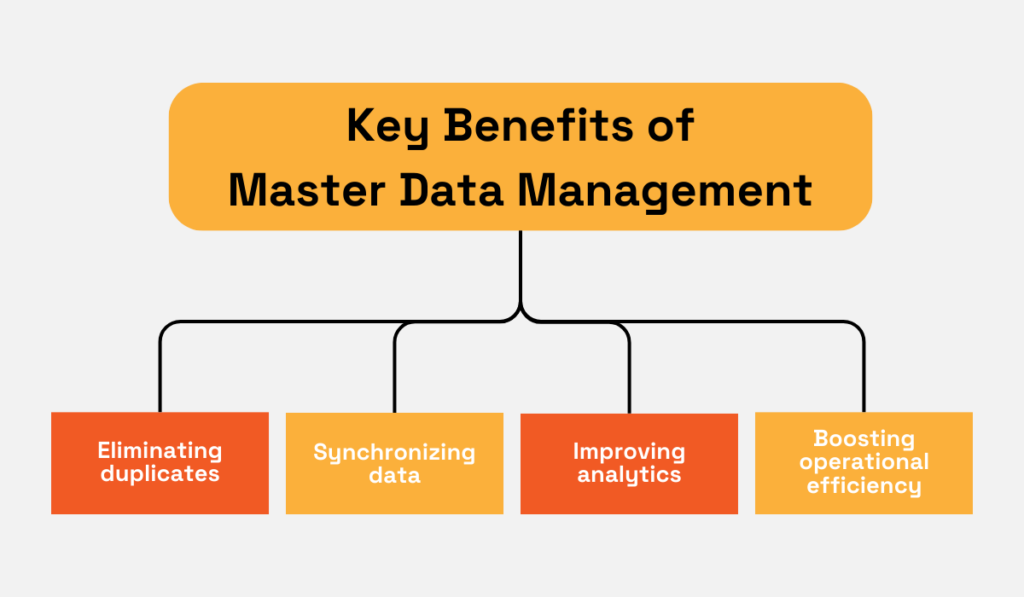
Source: Veridion
And these benefits are not independent of each other, either.
They work together in the background to catch errors, resolve inconsistencies, and keep updates flowing smoothly across your systems.
Simply put, they make your governance policies actionable instead of purely theoretical.
But how does MDM work together with data governance?
Here’s how Bill O’Kane, former Gartner analyst and Profisee VP & MDM strategist, explains it:
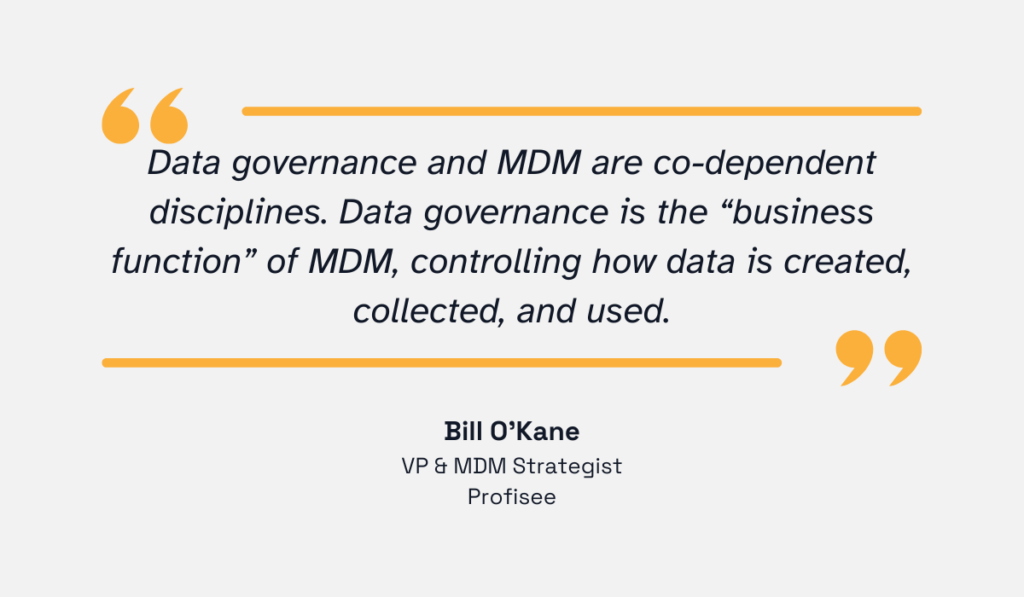
Illustration: Veridion / Quote: Profisee
And that is exactly what procurement teams rely on to translate governance principles into reliable, day-to-day data.
In practice, MDM becomes the backbone of procurement visibility.
If you can’t rely on your supplier data to be accurate and unified, you’re flying blind on spend analysis, supplier risk, and even basic vendor onboarding timelines.
So how do these two disciplines stack up side by side?
Before diving into specifics, here’s the simplest way to view the two disciplines:
Data governance is strategic, while MDM is operational.
Governance defines the “why” and “how” of data management. MDM, on the other hand, executes the “what” and “where” to make that valuable data usable.
Both aim to improve quality and consistency, but they operate at different layers of the organization.
Let’s explore their key differences in mode depth.
Data governance focuses on policy, accountability, and oversight.
Its objective is to ensure that your organization handles data responsibly, ethically, and in compliance with internal and external standards.
It defines what “good data” is, then tells you who owns it and how it should be protected and maintained.
Master data management, in contrast, zeroes in on creating accurate, unified master data records.
Its main goals are to eliminate duplicates, fix inconsistencies, and sync information across systems so operational teams work with one reliable source of truth.
When these two disciplines work in tandem, organizations can move from simply defining standards to actually operationalizing them with accurate, high-quality data.
This need for unified, well-governed information is driving innovation across the industry.
Take Schneider Electric, an energy and automation digital solutions provider, as an example.
They recently expanded their EcoStruxure Resource Advisor platform to help global enterprises manage complex, multi-entity data and keep up with fast-moving regulatory requirements.
As Steve Wilhite, President of Schneider Electric’s Sustainability Business, explained:

Illustration: Veridion / Quote: ESG Today
This is precisely the kind of scenario where MDM is needed to bring new governance rules to life.
And the cost of poor data quality goes far beyond inconvenience.
According to a Gartner study, bad data costs organizations an average of $12.9 million every year.
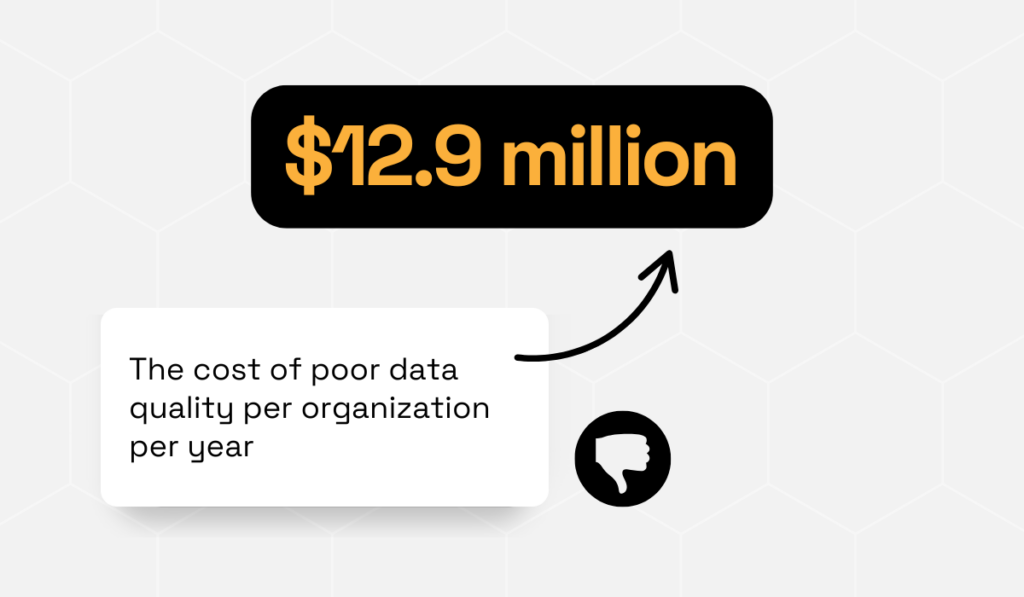
Illustration: Veridion / Data: Gartner
These staggering costs are a result of teams making bad decisions based on conflicting, outdated, or incomplete information.
A dramatic but all too real example comes from Target Canada.
Back in 2015, incorrect item attributes, mismatched supplier records, and unreliable inventory data led to empty shelves, operational chaos, and a whopping $5 billion in losses.
Target CEO Brian Cornell ended up pulling the plug on the entire Canadian expansion. And 10 years down the line, its lessons are still echoing in the press.
Source: Retail Insider
In short, governance ensures you use data correctly. MDM ensures the data itself is correct.
Governance processes revolve around strategy and control. MDM, meanwhile, handles the hands-on technical work.
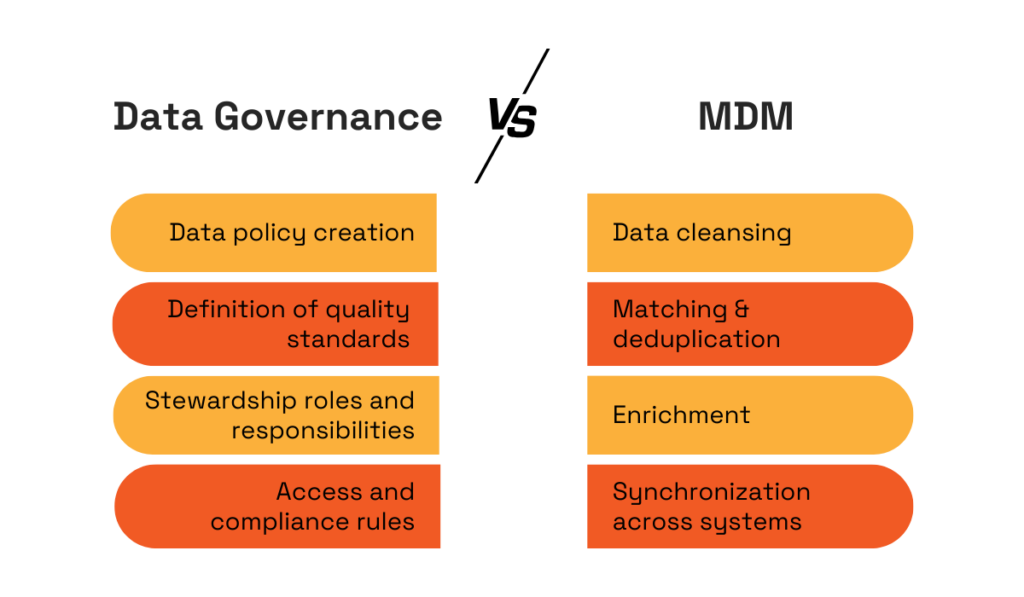
Source: Veridion
From there, MDM workflows push clean, validated data out to your ERP, procurement platform, CRM, and analytics tools.
And it goes without saying, they keep everything in sync as changes come in.
So governance is the one that decides how data should be managed, but without MDM in place, there’s no technical work to actually manage the data according to said rules.
And the gap these processes are trying to close is huge.
A joint report by Drexel LeBow University and Precisely found that 67% of respondents don’t trust their organization’s data, and 64% cite poor data quality as their biggest challenge.
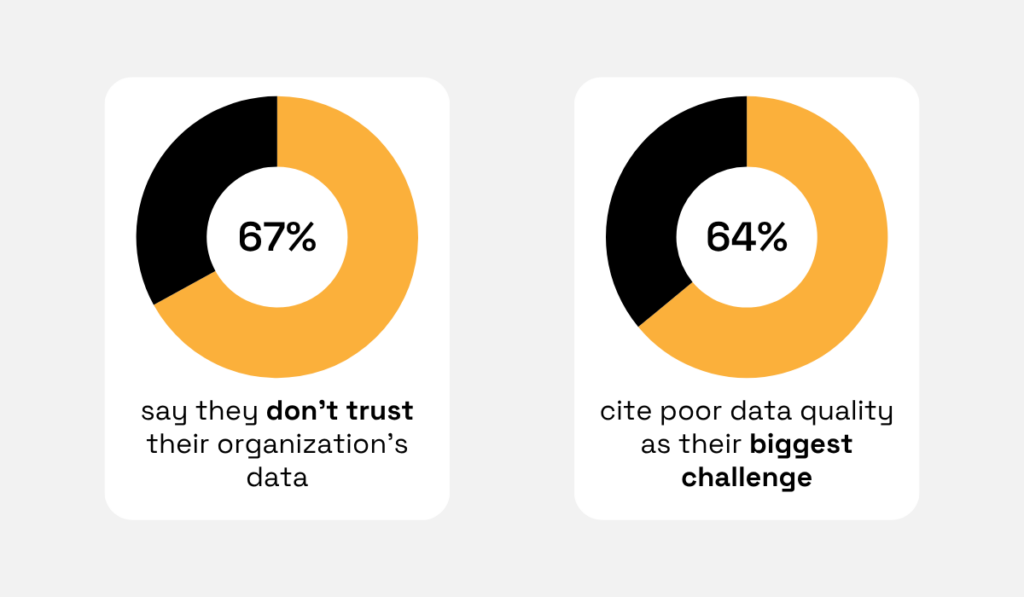
Illustration: Veridion / Data: Precisely
It’s becoming more and more clear that a big enterprise can’t rely on gut decisions, or arguably worse, decisions made on poor data that people don’t actually trust.
Bottom line: even if governance defines the standards and responsibilities clearly, you need proper MDM to enforce those standards record by record.
Governance technologies support visibility, control, and traceability.
Typical tools include:
These systems help you see what data exists, who owns it, and how it flows through the enterprise.
MDM technologies are, once again, more execution-focused:
So, that’s what organizations use to govern and manage data day to day.
But how do you do all this at scale?
That’s where industry leaders keep stressing the need for modern, AI-driven tooling.
Mike Ferguson, CEO of Intelligent Business Strategies and Europe’s Leading Industry Analyst, drives the point home:
“One thing is clear, you no longer can do this manually. There is too much data, too many data stores and files (often millions), and people are not prepared to take on this challenge without the help of AI-automation built into the tools they are using.”
Here’s where Veridion comes into the picture.
MDM initiatives depend heavily on verified external data sources to validate and enrich internal records, especially when we’re talking about supplier and vendor data.
Veridion strengthens the MDM stack.
Source: Veridion
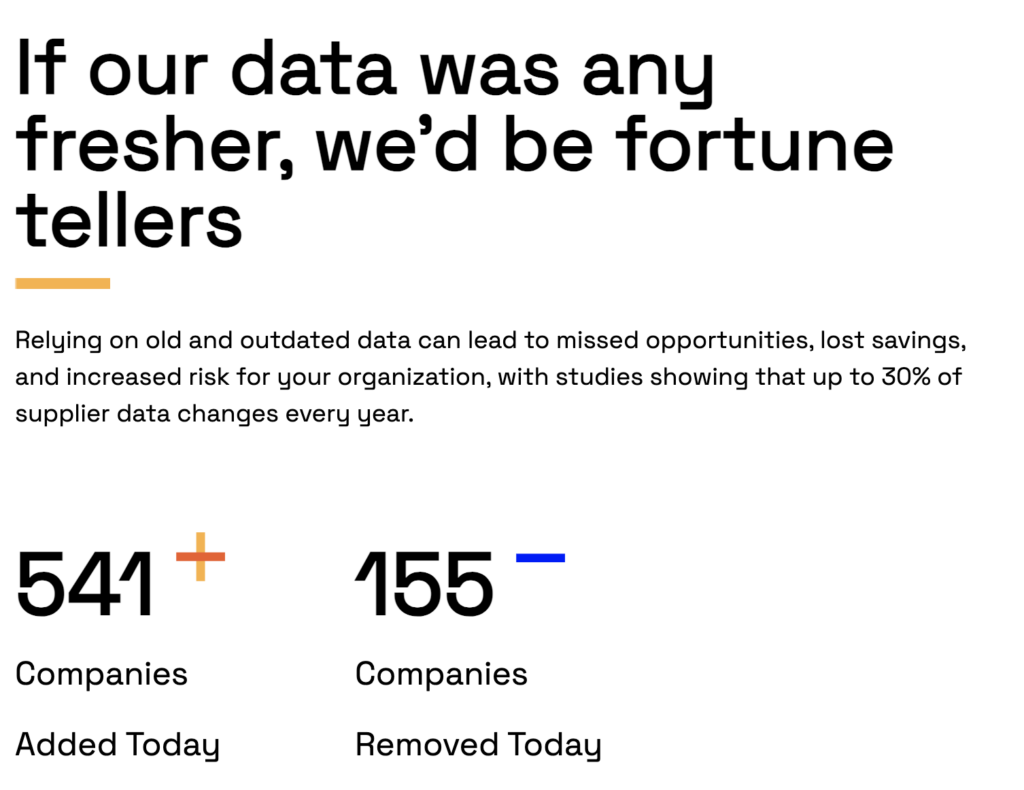
It analyzes billions of web pages weekly and maintains updated profiles for over 134 million suppliers worldwide.
This means it provides the authoritative data procurement teams need to:
Speaking of enrichment, Veridion doesn’t add data every so often. It does so continuously.
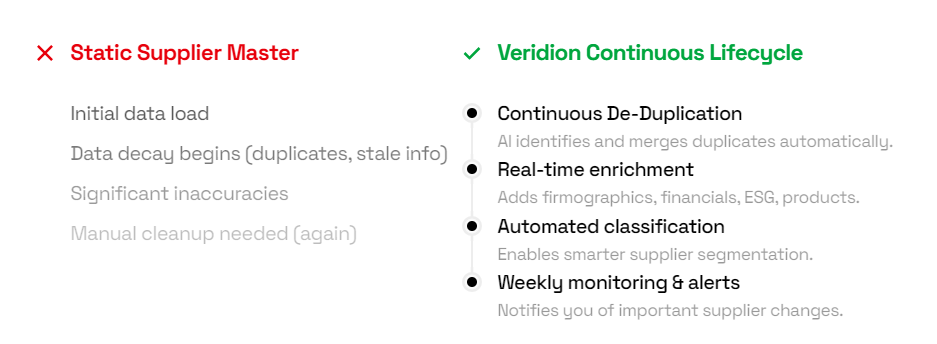
Source: Veridion
By feeding continuously refreshed supplier data into MDM, your enterprise can keep cleaner records and reduce risky manual cleanup.
Down the line, this can improve vendor selection and monitoring accuracy by a great deal.
Now, the million-dollar question: do you need both?
In almost every large organization, the answer is yes.
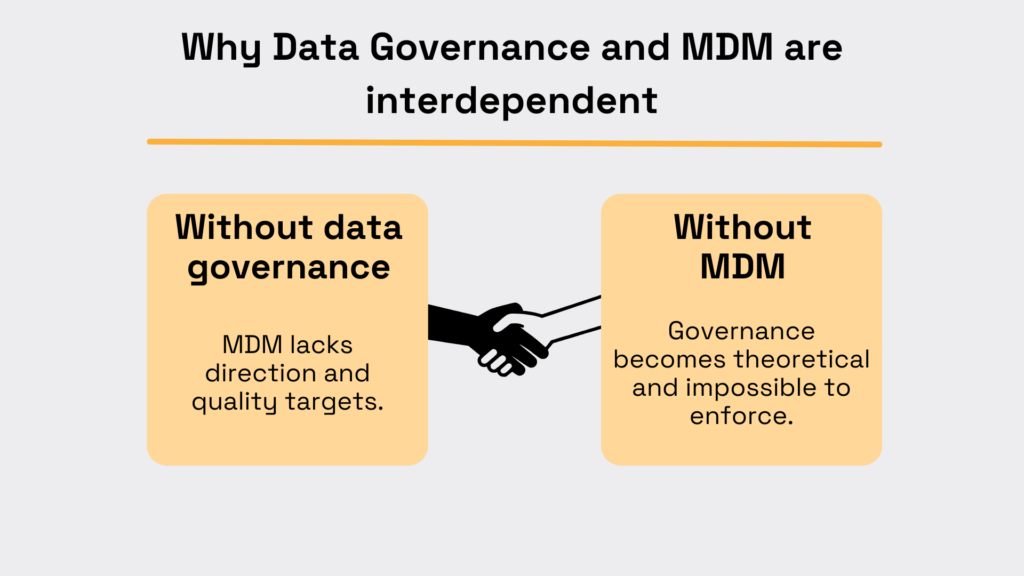
Data governance and MDM serve different purposes but are deeply interdependent.
Governance establishes the rules, quality expectations, responsibilities, and ethical guidelines for data use.
Simply put, it makes sure your business aligns with definitions, regulatory requirements, and acceptable risk levels.
MDM then operationalizes those rules by cleansing, validating, and synchronizing master data so it meets the standards that data governance defines.
It’s easy to see how either one without the other becomes ineffective:
Source: Veridion
We can’t stress how relevant this is for big companies working with third-party vendors.
A Cyber GRX and ProcessUnity survey found that more than 60% of organizations experienced a vendor-caused cyber breach.
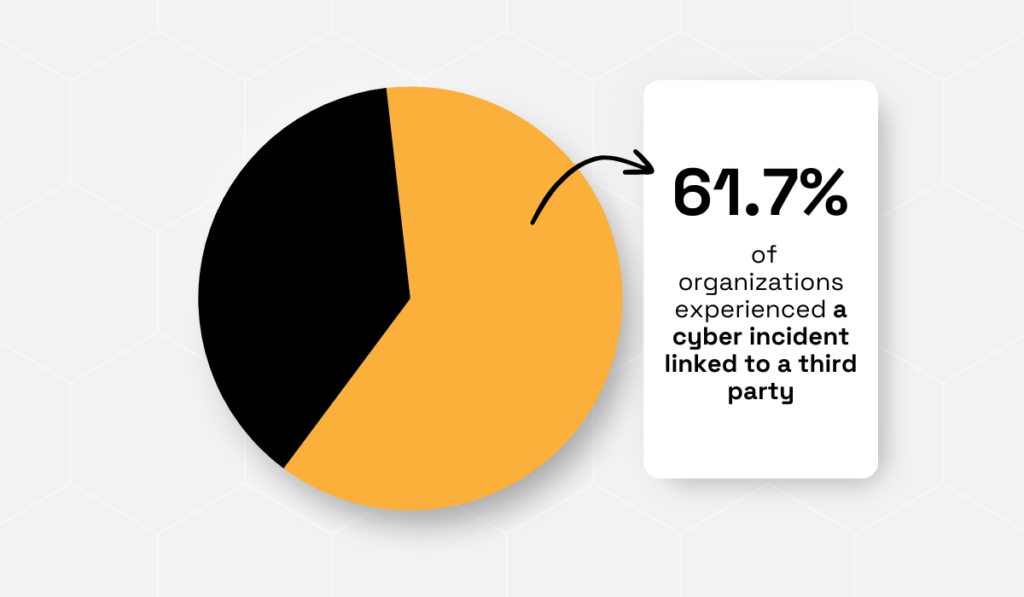
Illustration: Veridion / Data: Cyber GRX
Too often, that’s because inconsistencies or gaps in vendor data prevented teams from spotting risk trends early.
Conversely, companies with both strong governance and operational MDM pipelines are much better positioned to identify, track, and mitigate these vendor risks.
That’s how governance and MDM work together to give your organization a reliable data framework that supports procurement, compliance, analytics, and risk management day to day.
Getting data right is the backbone of every smart procurement decision you make.
Pairing strong data governance with effective MDM matters because together, they keep your supplier data clean, compliant, and ready for action.
Not to mention, your teams will now have the clarity and confidence to make the right decisions and save a lot of resources in the process.
It’s a simple shift that delivers precious long-term results.