



Blog
Data Mining: Definition, Process, and Use Cases
By: Auras Tanase -
13 April 2026


We love our data, and now that you're here, you're one step closer to loving it too.
A wide sample of data, so you can explore what is possible with our data
Choose ->
built with procurement in mind. Focused on manufacturers, products and more
Choose ->
built with insurance in mind. Focused on classifications, business activity tags and more
Choose ->
built with sustainability in mind. Focused on sustainability commitments, and environmental and social governance insights.
Choose ->
built with strategic insights in mind. Focused on market trends, competitor analysis, and industry-specific data
Choose ->

Keep up to date with our technology, what our clients are doing and get interesting monthly market insights.

Key Takeaways:
In business, there are issues that can’t be solved with surface-level analysis of their data sets or, worse, guesswork. This goes especially for big businesses that serve thousands of clients or more.
To figure out, for example, what demand will look like in six months, how to identify high-value customers, or what the blind spots are in your supply chain, you must dive deep into your datasets.
The best way to do that is with data mining.
In this article, we will break down the process, step by step, and show you how data mining works in the real world.
Let’s get down to the basics and define this process.
Data mining means using a company’s raw data to find connections, trends, and insights that can help them in almost all aspects of business, from market research to risk assessment and strategic planning.
Or to put it simply:
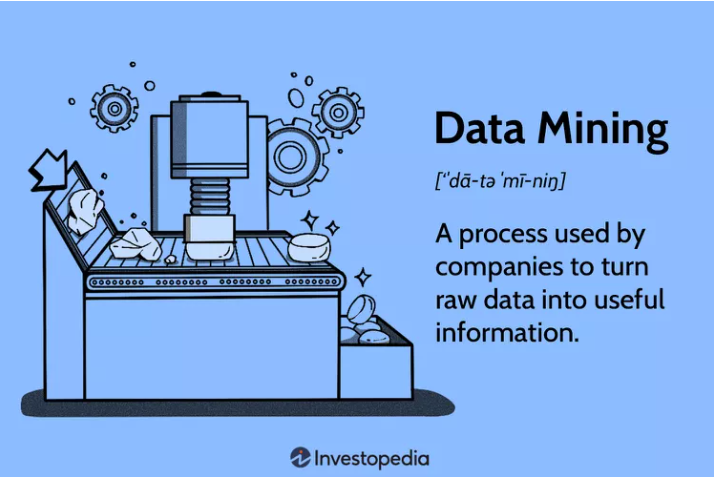
Source: Investopedia
For example, say you want to find out what type of users in your database of past buyers would most likely buy a new product.
With data mining, you can find connections in your database that’ll make it easier to build a profile of these potential buyers.
Because of a growing worldwide need for data, it’s become a powerful industry, best illustrated by its financial results.
For example, Mordor Intelligence reports that the global data mining market size in 2026 is estimated at USD 1.66 billion, growing from a 2025 value of USD 1.49 billion, with 2031 projections showing USD 2.82 billion.
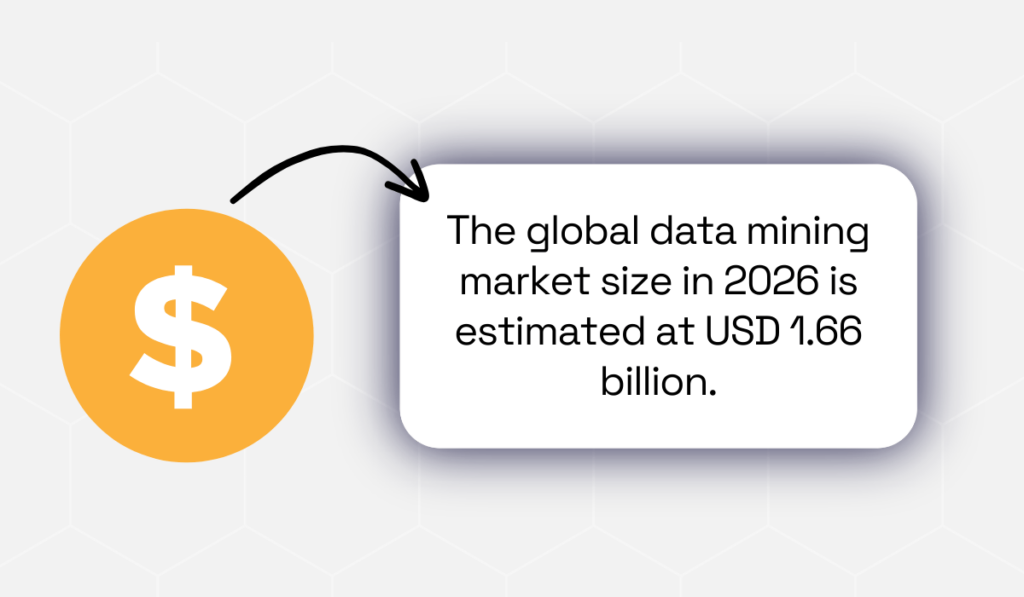
Illustration: Veridion / Data: Mordor Intelligence
As data grows, the need to effectively manage it is also on the rise. This is why using new automation technologies is so crucial.
Data mining is done with a range of tools, from programming languages like Python, ML models, AI, statistical tools to visualization tools.
Tools like IBM’s SPSS Modeler, for example, accelerate this process even more because of their user-friendliness.
It supports different aspects of data mining, like data preparation, statistical analysis, and the development of machine learning models.
Source: IBM
All in all, data mining powered by state-of-the-art technology is an important part of any business that wants to leverage data for industry relevance, user satisfaction, and profitability.
Now that we got the theory out of the way, let’s take a closer look at how this process works.
Although it can be complicated because it depends on outside factors like the quality of data, data storage, etc., the general process can be distilled into six steps.
We’ll show how it works on a specific example.
Let’s say an enterprise company executive wants to decrease the user churn rate.
In order to do that effectively, the data analyst digs into existing raw data to find patterns in user segments that have already churned.
| Steps | Explanation | Example |
|---|---|---|
| Decide On a Goal | Choose a pressing problem or a business goal. | E.g., “Which customers are most likely to churn?” |
| Select Data | Choose and collect relevant data. | E.g., churn user profile data, product usage history, financial data, etc. |
| Clean and Transform Data | Identify missing data; remove duplicates, irrelevant, corrupt, or inconsistent data. | |
| Analyze Data | Train and test ML or AI models to find patterns, trends, and relationships in the cleaned dataset. It’s important to use different models in order to see which one is the best fit. | |
| Evaluate Findings | Determine how well the results can be used in decision-making. | Results show users with two unresolved tickets in a 30-day window are 40% more likely to churn. |
| Deploy | Use reviewed insights in decision-making. | Lower the churn rate by flagging risk accounts 45 days before renewal and notifying customer service so they can focus on better customer service. |
As we said earlier, you can use a range of mining frameworks and techniques.
The most common industry models are
| Cross-Industry Standard Process for Data Mining (CRISP-DM) | Business-focused and used across different industries. It guides projects from defining business objectives to deploying and monitoring models. |
| Knowledge Discovery in Databases (KDD) | Focused on selecting, preparing, transforming, and mining data to extract meaningful patterns and knowledge. |
| Sample, Explore, Modify, Model, and Assess (SEMMA) | Modeling-focused and highly technical. Designed for building, testing, and optimizing predictive models through statistical analysis. |
Choosing between these three frameworks or combining them depends on your goals and business type.
But the core is the same: if you want to leverage your data sets for business success, they have to go through a process where every step counts.
Still, in order for these frameworks to be implemented correctly, it’s important to use relevant mining techniques.
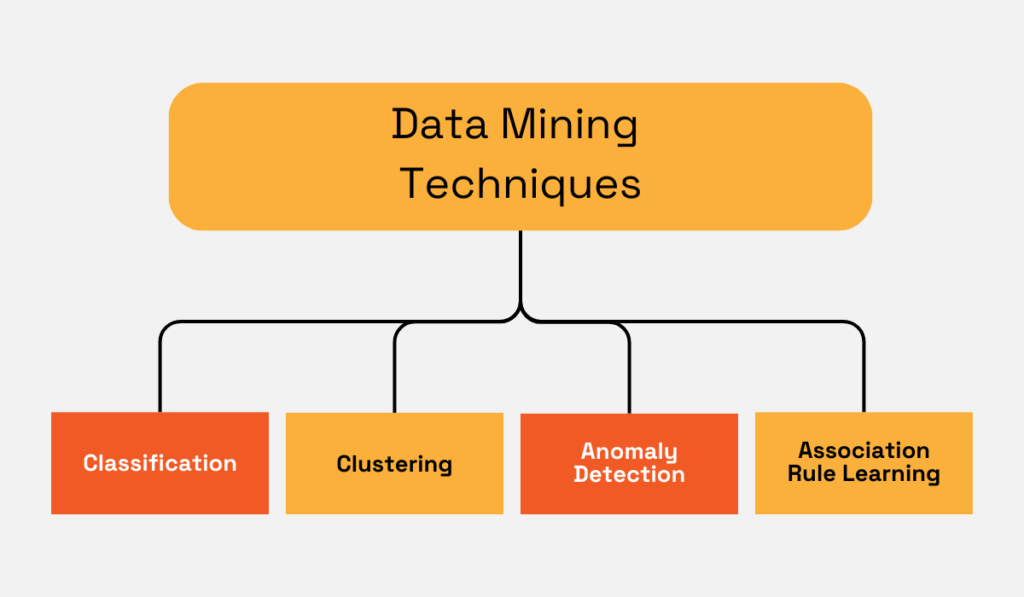
Source: Veridion
The choice of a mining technique or more of them depends on your goal and available data.
For example, if you want to leverage data for forecasting trends or user behavior, it’s best to use regression, which predicts numerical outcomes based on input variables.
Other factors also come into play, such as your data availability, computational resources, or time constraints.
That’s why it’s crucial to choose your tools wisely so they’ll lead you to accurate and relevant insights about your data.
Now that we’ve covered the theory, let’s see what successful data mining looks like in specific business situations, along with a few case studies that’ll help to illustrate its power.
Data-based market research is one of the backbones of a healthy business. Also, it’s the difference between a successful and a failing business.
Just look at the findings from Hanover Research’s survey conducted on over 400 executives.
Companies that base their business on market research are 1.3x more likely to grow revenue by over 15%.
But if you do it without strong data points or your data points lead you in the wrong direction, it can backfire so easily.
That’s what happened to Walmart when it tried to take a piece of Germany’s retail industry in the late 90s.

Source: The Guardian
They didn’t adapt their business model and branding to the German market.
According to The Guardian, one part of the reason was cultural. Local shoppers and employees just couldn’t adapt to Walmart’s signature perky and always-at-hand customer service.
And what’s worse, their pricing model was deemed predatory and potentially detrimental to small businesses.
If they had done more robust and data-based market research, this and similar failures in the Japanese or South Korean market wouldn’t have happened.
The most reliable way to prevent reputational and financial damage like this is with data mining.
For example, enterprise businesses that deal with a lot of segmented audiences can identify high-value prospects by analyzing behavioral patterns, demographics, firmographics, and purchasing trends.
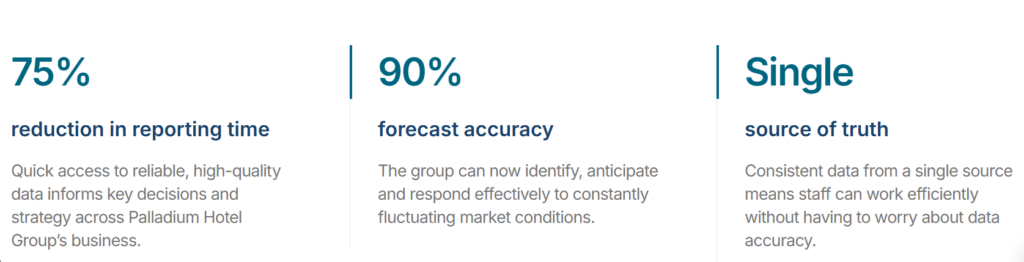
A great real-world example is the Ibiza-based Palladium Hotel Group.
They wanted to be more data-centric in order to effectively manage and respond to their guests’ expectations and to provide them with a luxury experience.
So they teamed up with Qlik, a software solution for analytics and data integration, and used data mining.
The results were improved data quality and accurate and reliable insights into its operations.
Source: Qlik
The lesson here is clear: the more relevant data you leverage, the more precise your targeting and, by proxy, your ROI is likely to be successful.
Another area that thrives with data mining is supply chain management.
The global market is becoming more turbulent each day, what with tariffs, increasing climate, and political risk. Not to mention the pressure brought on by strict regulations and ever-growing cyber risk incidents.
In order to stay resilient against these onslaughts and keep both customers and suppliers happy, companies must put their data to maximum use.
The importance of data in navigating the supply chain is highlighted in PwC Global’s blog article The smart moves your supply chain needs now.
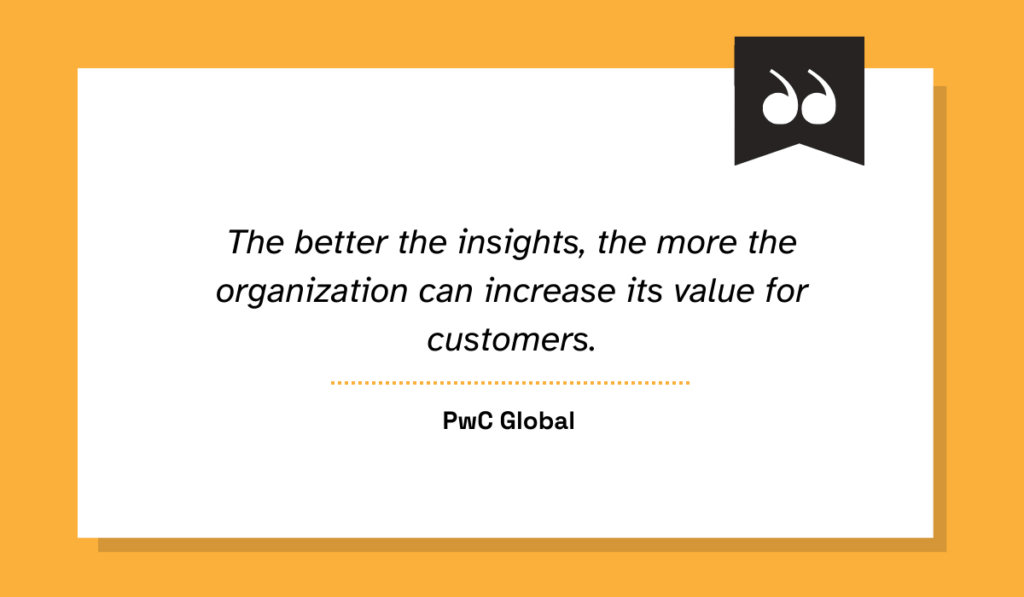
Illustration: Veridion / Quote: PwC
Companies that are always in control of their data use it strategically so that it provides them with actionable insight.
The result is tangible—a payoff in an average of 22 months.
Data mining plays a critical role in this transformation. It enables companies to:
When supplier and operational data are properly structured and analyzed, they reveal patterns that would otherwise remain invisible.
For example, let’s take businesses dependent on supply networks.
By analyzing historical demand alongside supplier performance data, they can anticipate disruptions before they occur and proactively adjust inventory levels.
In order to be as accurate as possible, additional help is needed, especially from tools like Veridion.
Veridion is an AI-powered big data platform that provides structured intelligence on suppliers, operational footprints, and business relationships to enrich datasets used for supply chain analysis.
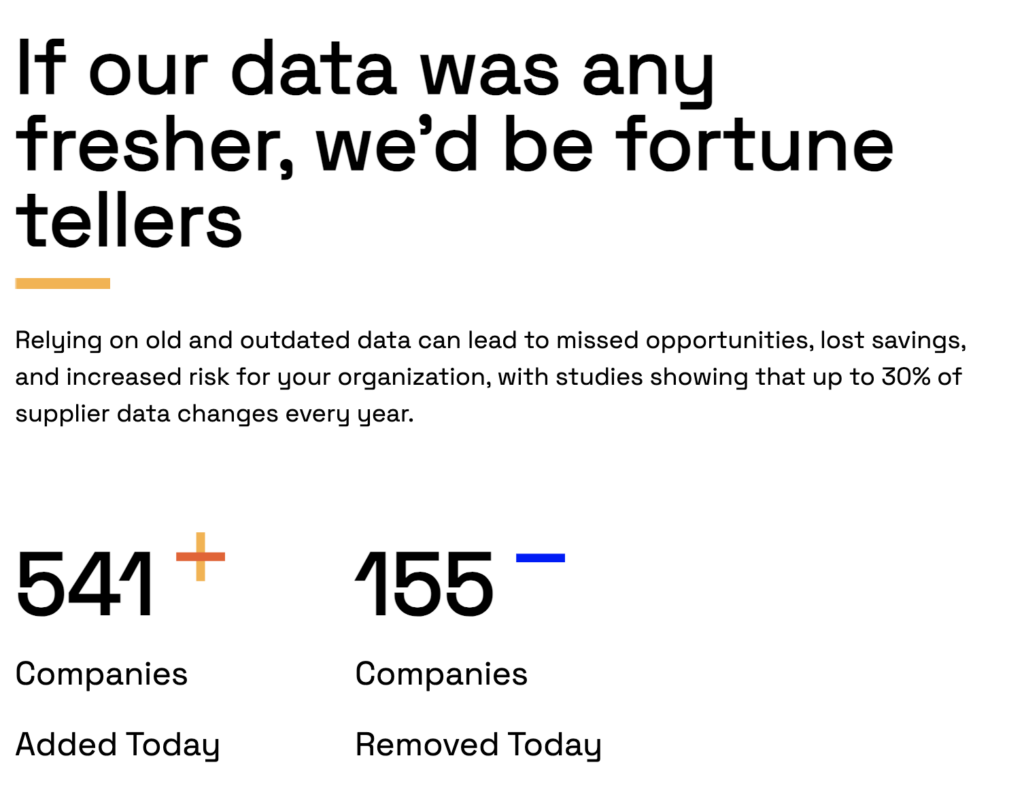
In terms of specific figures, Veridion collects data on 134M+ global companies and offers unbiased insights across 320+ different company attributes.
Also, it’s updated on a weekly basis, so companies can make important decisions based on the freshest data available.
Source: Veridion
Accurate, fresh, actionable data is the sine qua non of effective supplier management.
And with Veridion, you have everything you need to start your data mining efforts.
Data can be used to analyze past decisions or present trends in your company, but it’s also powerful for predicting future trends, market shifts, and operational needs.
Mining supports forecasting by identifying historical patterns and trends that inform predictions about future demand, market shifts, and operational needs.
Businesses influenced by supply chain issues can therefore, with the use of machine learning and AI-powered tools, anticipate fluctuations, optimize inventory levels, and align production with expected demand.
This type of forecasting will spell the difference between the big and small industry players in the near future.
For example, Gartner reports that 70% of large-scale organizations will adopt AI-based forecasting to predict future demand by 2030.
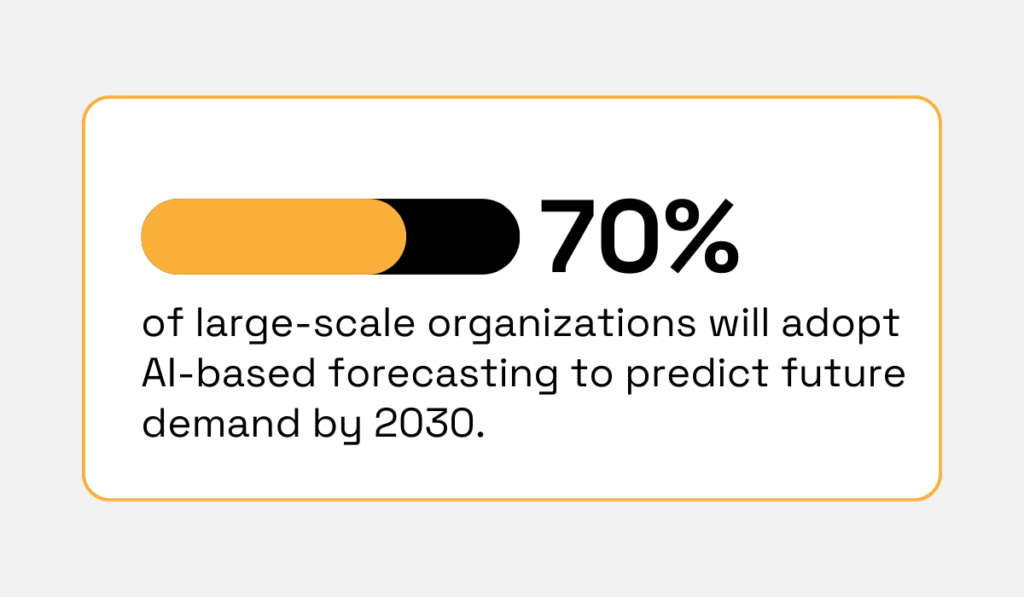
Illustration: Veridion / Data: Gartner
But it’s already happening, and with impressive results.
Look no further than More Retail Ltd. (MRL), one of India’s largest retail companies.
They teamed up with the data company Ganit in 2020 to improve the accuracy of forecasting their inventory levels for their fresh produce.
Source: AWS
Until then, it was done manually by store managers and traditional statistical methods, with poor results: their accuracy level was a mere 24%.
That’s why they built an automated ordering system based on AWS’s own forecasting model, powered by machine learning.
Their efforts yielded these results:
Cases like this are a powerful reminder of how using data for accurate forecasting can have a sweeping influence on your business results.
And there you have it—a comprehensive overview of data mining.
Remember, without a holistic view of your data, you’re just sitting on a mountain of gold that’ll eventually rot.
Also, to get the most out of it, it’s important to ask the right questions that correspond to your business goals.
With a solid base, data mining that turns into actionable insights will set your company up for success.
Only companies that systematically extract value from their data will stay resilient and ahead of the curve.