



Blog
ESG Data Analytics: A Guide
By: Auras Tanase -
28 February 2026


We love our data, and now that you're here, you're one step closer to loving it too.
A wide sample of data, so you can explore what is possible with our data
Choose ->
built with procurement in mind. Focused on manufacturers, products and more
Choose ->
built with insurance in mind. Focused on classifications, business activity tags and more
Choose ->
built with sustainability in mind. Focused on sustainability commitments, and environmental and social governance insights.
Choose ->
built with strategic insights in mind. Focused on market trends, competitor analysis, and industry-specific data
Choose ->

Keep up to date with our technology, what our clients are doing and get interesting monthly market insights.

Key Takeaways:
CEOs today face a high-stakes puzzle: global supply chains, regulatory pressures, and ESG risks that can impact both reputation and profits.
Traditional analytics often fail to capture these risks, and investors are no longer satisfied with quarterly earnings alone.
They want proof of sustainable, responsible practices.
The issue is, many organizations struggle to provide this evidence.
ESG data analytics solves these challenges by turning scattered ESG metrics, disclosures, and supplier information into actionable insights.
In this article, we’ll look at what ESG data analytics is, its impact on decision-making, and tools to help you streamline the collection, organization, and interpretation of ESG data.
ESG data analytics is the collection, integration, and analysis of environmental, social, and governance data to help organizations measure performance, identify risks, and drive more responsible business decisions.
It brings together both structured data, such as carbon emission metrics, energy consumption, workforce diversity statistics, and safety records, with unstructured data from sources like news coverage, corporate disclosures, regulatory filings, supplier reports, and third-party databases.
By combining these data types, ESG analytics platforms create a more comprehensive, real-time view of an organization’s sustainability and ethical impact across its operations and value chain.
Organizations use ESG data analytics to:
As expectations around corporate transparency and accountability continue to rise, ESG analytics is increasingly used not just for reporting, but to drive better day-to-day and strategic decision-making.
This shift is already visible in practice.
Workiva Inc.’s 2025 Executive Benchmark Survey found that 97% of global executives say sustainability reporting will be a business advantage within the next two years, and that 96% of investors agree it strengthens financial performance.
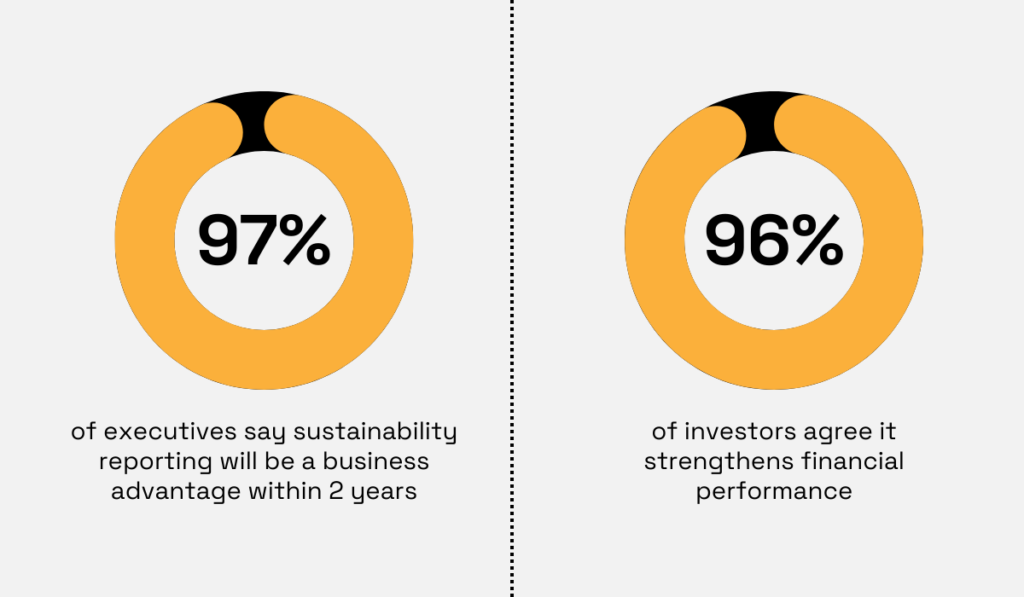
Illustration: Veridion / Data: Workiva
These findings highlight how sustainability disclosure has evolved from a compliance exercise to a core business priority.
Julie Iskow, CEO of Workiva, an AI-powered platform for data-driven finance, risk, and sustainability, reinforces this shift:
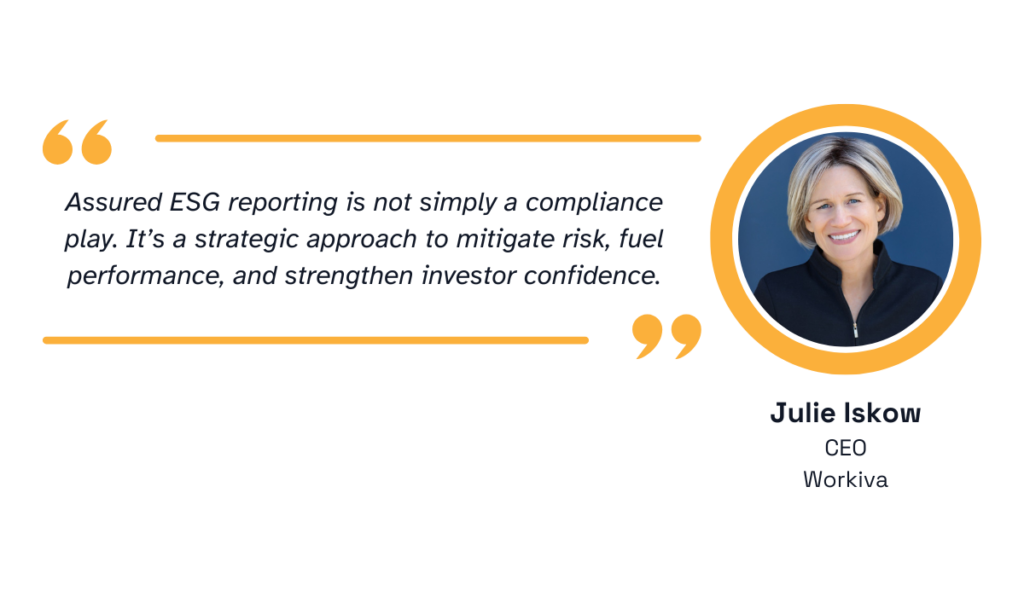
Illustration: Veridion / Quote: Workiva
As a result, ESG analytics has become a critical capability for companies looking to operate transparently, manage risk exposure, and build resilient, future-ready businesses.
ESG data analytics is increasingly shaping how organizations make strategic and operational decisions.
An SG Analytics survey found that 74% of financial institutions cite client demand as the primary driver of ESG integration, while 65% point to regulatory risk as a major adoption factor.
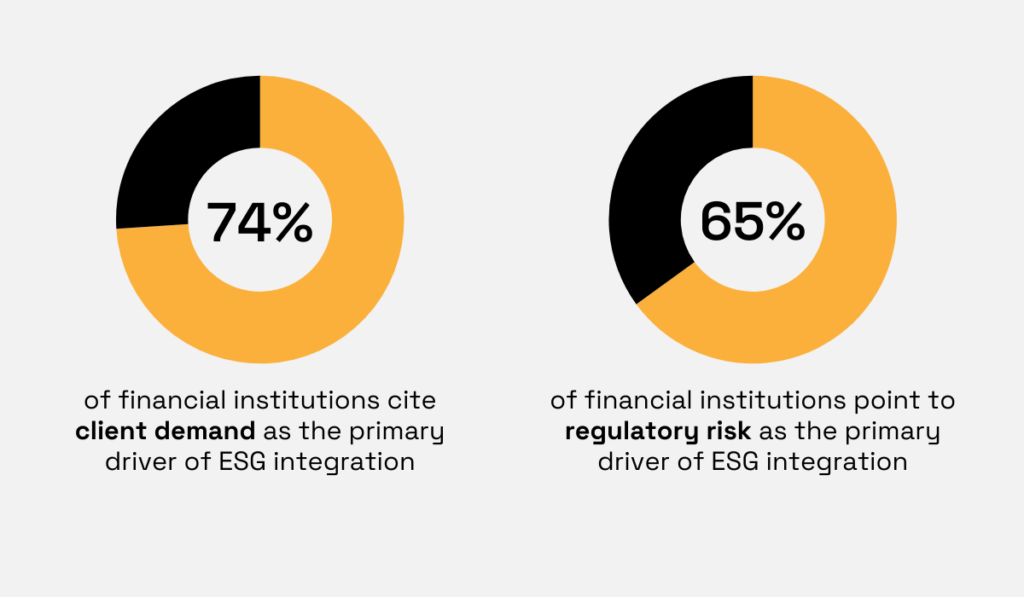
Illustration: Veridion / Data: SG Analytics
These pressures are pushing ESG insights directly into risk management, investment, and governance decisions across the enterprise.
One of the most immediate and valuable impacts of ESG analytics is its ability to surface hidden risks before they become costly problems.
Let’s explore this in more detail.
Traditional financial analysis often fails to capture ESG risks that can materially affect an organization’s stability and reputation.
ESG data analytics fills this gap by identifying exposure across areas such as:
Doug Dwyer, Managing Director at Moody’s Analytics, explains:
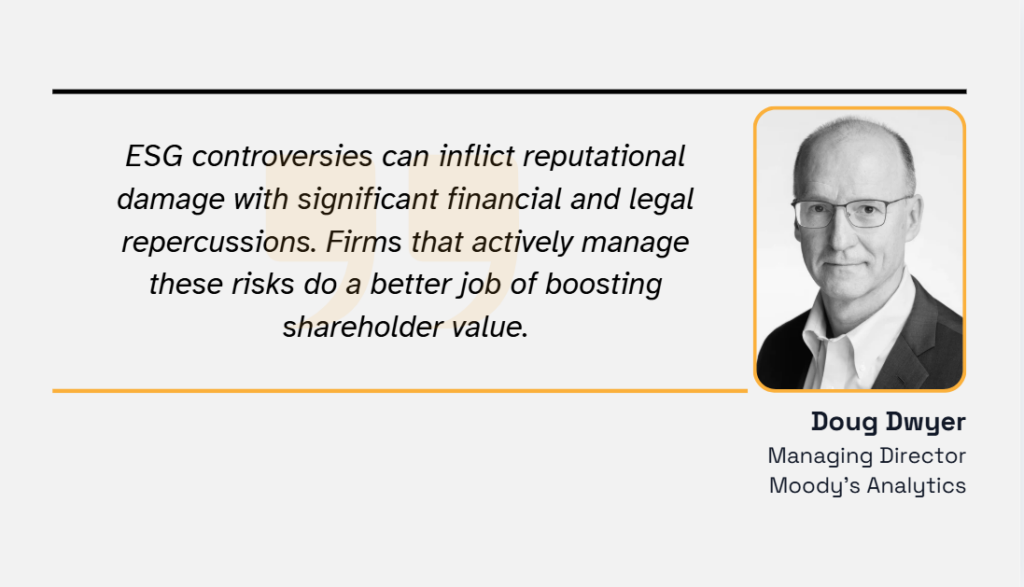
Illustration: Veridion / Quote: Business Wire
This underscores how effective ESG analytics directly supports risk mitigation and long-term performance.
Organizations are already seeing measurable impact.
A recent study by Gjeta shows that 65% of organizations say integrating data analytics has enabled them to identify potential ESG risks more effectively, including supply chain, emissions, and social impacts, enabling more proactive mitigation.
A real-world example comes from Enel Green Power.

Source: Enel Green Power
The global renewable energy leader worked with specialist ESG analysts to map risks across its complex global supply chain.
By applying tailored ESG metrics and analytics, they identified high-risk hotspots in the sourcing of critical minerals and gained visibility into environmental, social, and regulatory risks across materials such as cobalt, lithium, and nickel.
These insights enabled more informed sourcing decisions and stronger regulatory preparedness.
This shows how structured supply chain data, combined with ESG risk indicators, can be assembled into a digital risk profile that reduces exposure and strengthens ethical procurement strategies.
Today, investors demand greater insight into corporate ESG commitments.
According to a PwC survey, 83% of investors say it’s crucial for ESG reporting to include detailed information on progress toward ESG goals.
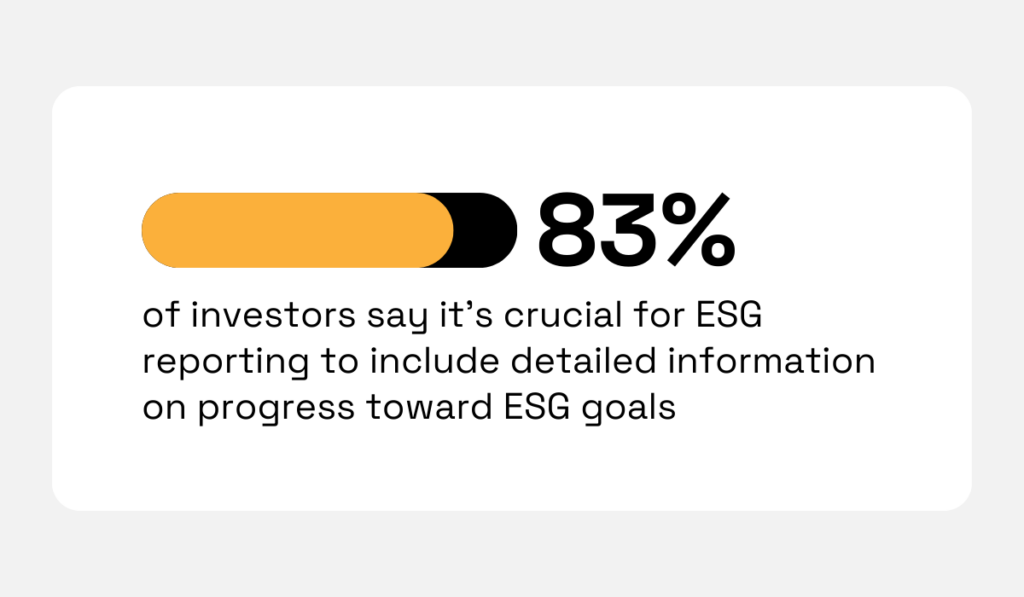
Illustration: Veridion / Data: PwC
Data-driven ESG insights enable organizations to communicate sustainability progress and performance with greater credibility and confidence.
By grounding ESG claims in verifiable analytics, companies can provide investors, regulators, customers, and employees with a clear, evidence-based view of their environmental and social impact.
Transparent reporting, backed by reliable ESG data, builds confidence in sustainability commitments and reduces skepticism about greenwashing.
Over time, this builds stronger stakeholder relationships, enhances brand reputation, and positions the organization as a responsible, trustworthy industry leader.
As Nadja Picard, Global Reporting Leader at PwC Germany, explains:

Illustration: Veridion / Quote: PwC
ESG data analytics helps organizations align sustainability goals with broader business and financial strategies.
By turning ESG performance into measurable, comparable, and decision-ready insights, leadership teams can evaluate sustainability initiatives through the same lens as growth, profitability, and risk management.
Grounding ESG programs in reliable data allows executives to prioritize actions that support long-term value creation, whether:
This data-driven approach ensures ESG efforts are embedded into core planning and governance processes, rather than treated as standalone initiatives or purely compliance-driven activities.
The impact of aligning ESG with business strategy is also measurable.
According to Kroll’s ESG and Global Investor Returns Study, companies with strong ESG ratings enjoy a 4.3% higher average annual return globally and an even greater 6.4% advantage in the U.S., compared to peers with weaker ESG performance.
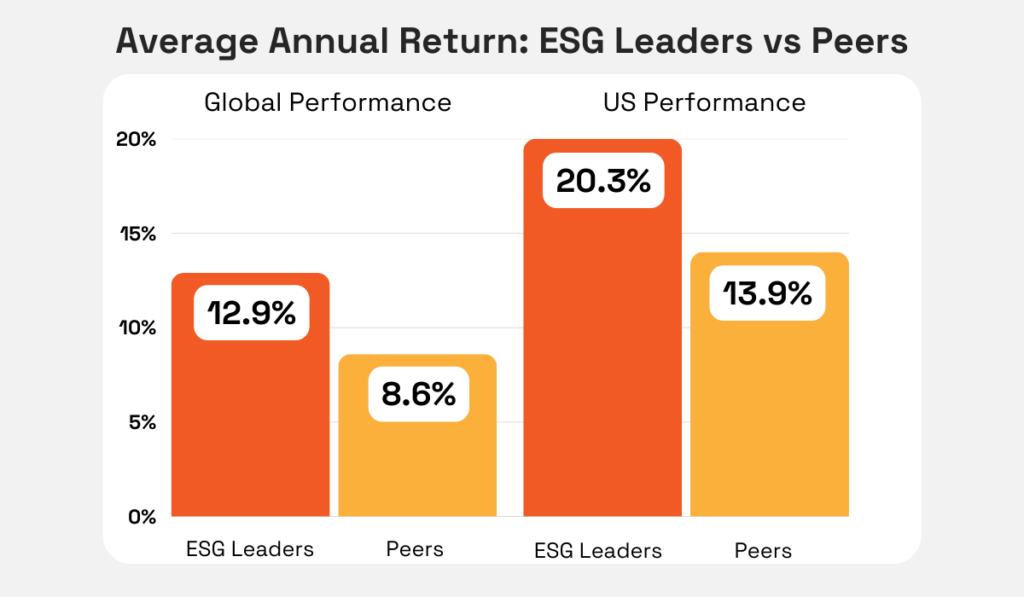
Illustration: Veridion / Data: Kroll
Let’s say you run a mid-sized global electronics manufacturing company aiming to reduce its carbon footprint while maintaining strong financial performance.
Using ESG data analytics, you identify that your highest-emission suppliers are concentrated in a handful of regions.
The analytics also reveal opportunities to switch to lower-carbon, cost-competitive, and supply-chain-resilient materials.
Armed with ESG insights, you embed sustainability into every procurement and investment decision.
Capital is directed toward renewable energy for major facilities, and suppliers are motivated to implement greener practices, creating measurable environmental and business impact.
Within two years, you reduce supply chain emissions by 25%, avoid regulatory penalties, lower operational costs, and strengthen brand reputation.
This scenario illustrates how ESG analytics can transform sustainability from a standalone initiative into a strategic lever that drives both environmental impact and business value.
Effective ESG data analytics relies on more than internal reporting systems.
Organizations need specialized tools that collect, enrich, and analyze ESG-related data across their operations and extended value chains.
Together, ESG data providers, ESG software platforms, BI tools, and AI-driven analytics form the core ESG data management technology stack that enables scalable, auditable, and insight-driven ESG analytics.
ESG data providers play a critical role in strengthening ESG analytics by augmenting internal data with external, real-world intelligence on companies, suppliers, and assets.
The issue is, many ESG metrics still rely heavily on self-reported data.
According to an OECD report, roughly two-thirds of ESG metrics and more than 80% of social and labor rights indicators are based solely on company self-reported data, with little to no independent verification from supply chain stakeholders.
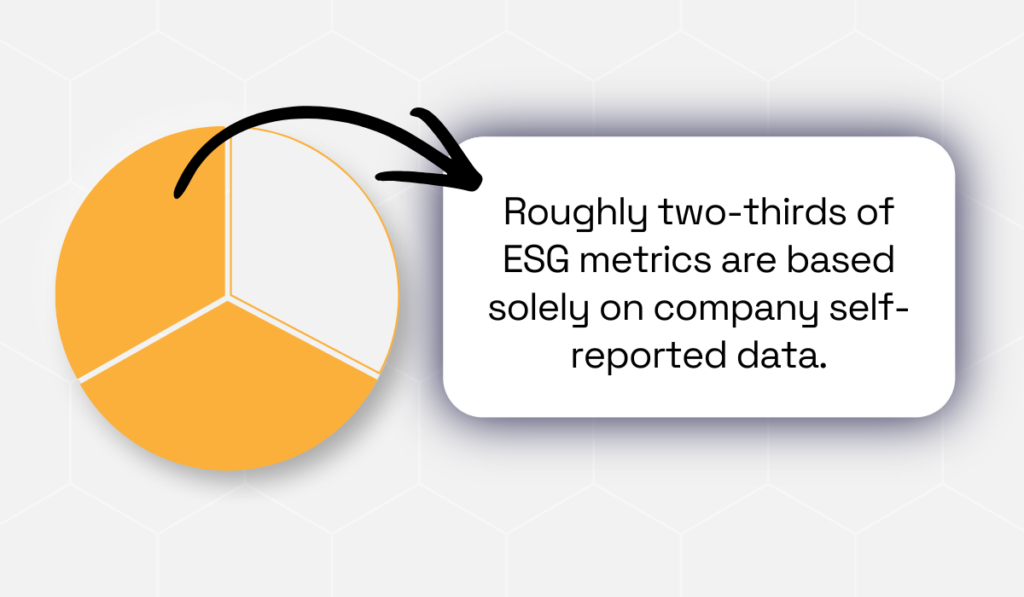
Illustration: Veridion / Data: PwC
However, relying only on internal reporting creates blind spots in ESG risk analytics, such as:
In practice, these blind spots can materially distort ESG risk assessments and decision-making.
External ESG intelligence platforms address these gaps.
They add an independent layer of verification and context, enabling organizations to identify risks and exposures that may otherwise go undetected.
Philipp Aeby, CEO of RepRisk AG, underscores the need for external data sources that provide independent verification and context:
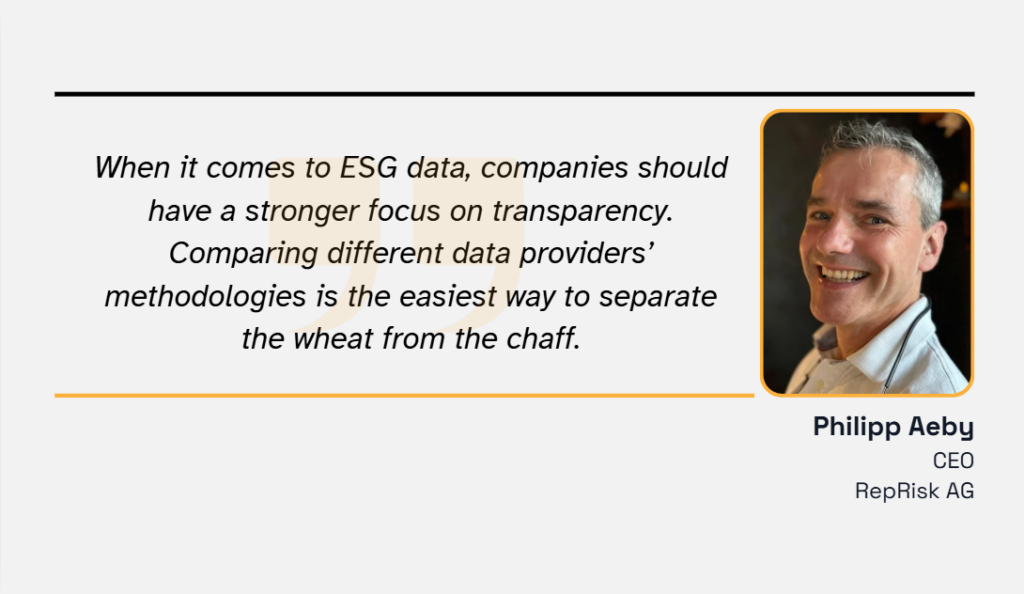
Illustration: Veridion / Quote: LinkedIn
Veridion is one example of an ESG data provider that helps address these challenges.
But our platform goes beyond just ESG scores.
With Veridion, you get explainable ESG data that goes deeper than static ratings.
From emission and ethics to commitments and controversies, our platform covers what companies actually do, not just what they say.
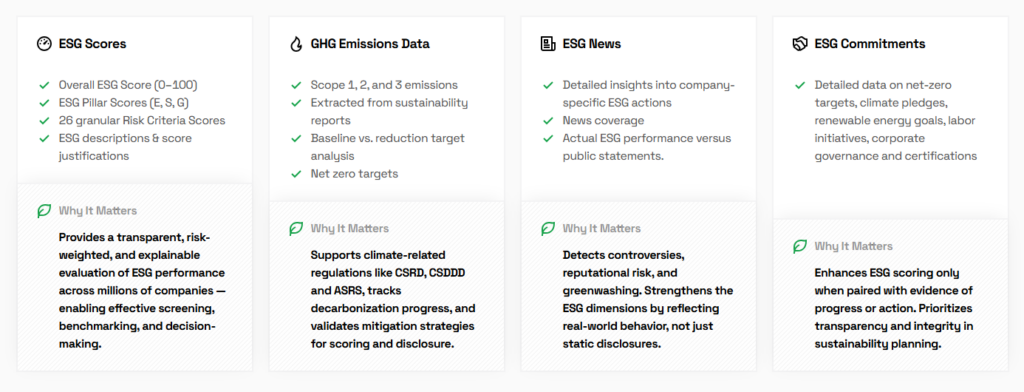
Source: Veridion
Veridion extracts and analyzes data from multiple sources, including company websites and news sources, to build comprehensive ESG profiles.
It enriches ESG analytics by supplying verified business data at scale, including:
By mapping how companies are connected across subsidiaries, suppliers, and geographies, Veridion enables organizations to build a more accurate, holistic view of ESG exposure across complex value chains.
It gives you access to the following enriched data to help you gain deeper insight into operational risks:
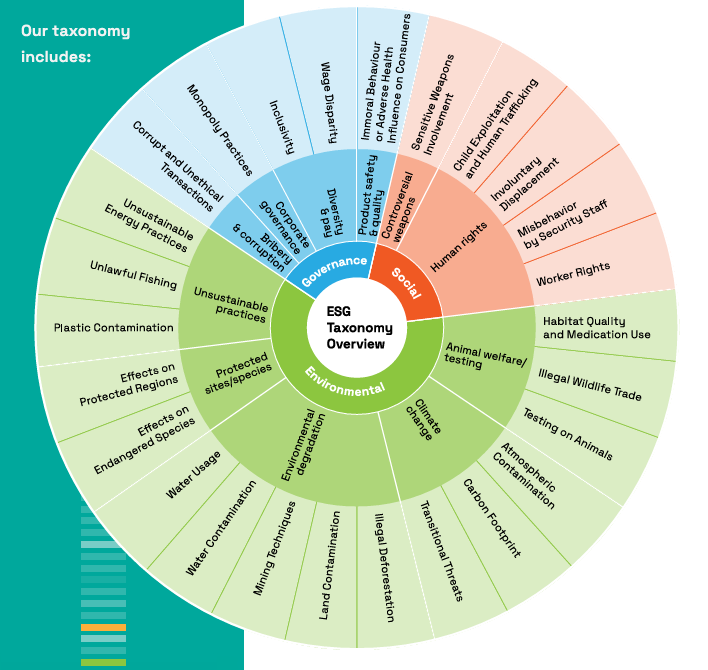
Source: Veridion
With access to externally verified business intelligence, organizations can assess ESG performance and risk more accurately, support more robust reporting, and make better-informed decisions based on real-world business activity.
As organizations collect ESG data from multiple internal functions and external data providers, spreadsheets and fragmented tools quickly become difficult to manage and audit.
ESG software platforms address this challenge by centralizing ESG data into a single, structured environment.
They help operationalize ESG data analytics by providing a unified system of record for ESG information.
These platforms support core ESG data management capabilities, including:
Many ESG software solutions also include built-in reporting workflows aligned with widely used frameworks and regulations such as GRI, SASB, and CSRD.
This helps organizations map data points to specific disclosure requirements more efficiently.
By consolidating ESG data into a single system, organizations improve consistency across metrics, reduce manual errors, and increase insight into how ESG data is sourced and calculated.
This centralization also strengthens regulatory readiness by making it easier to validate data, respond to audits, and produce accurate, timely ESG disclosures as reporting requirements continue to expand.
The Hershey Company’s experience illustrates the operational impact of moving from fragmented tools to a centralized ESG platform.
More than 100 subject matter experts contribute to Hershey’s 130-page sustainability report.
On top of that, there are half a dozen additional disclosures that cover more than 800 metrics.
Before adopting ESG software, the team had to manually reconcile 800+ comments across 35 PDFs, taking 2 weeks to reach the external design agency.
Rachael Staab, Hershey’s Manager of ESG and Sustainability Reporting, said:
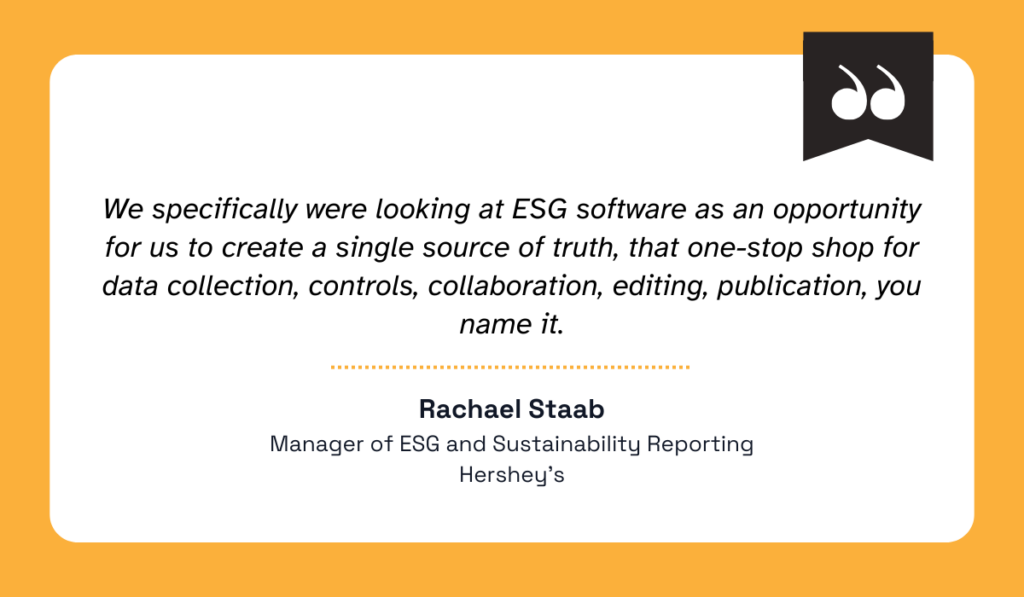
Illustration: Veridion / Quote: Workiva
After implementing an ESG software platform, Hershey was able to resolve more than 600 comments in just six hours, enabling the design agency to deliver a finalized report within 48 hours.
This example illustrates how centralized ESG platforms enable organizations to scale ESG reporting efficiently while freeing internal teams to focus on strategic insights rather than administrative overhead.
ESG data providers and ESG software platforms focus on collecting, enriching, and governing ESG data.
Like most organizations, your team then needs to analyze, visualize, and interpret that data across the business.
Carly Fiorina, former CEO of Hewlett-Packard, believes that business intelligence is more than just gathering data:
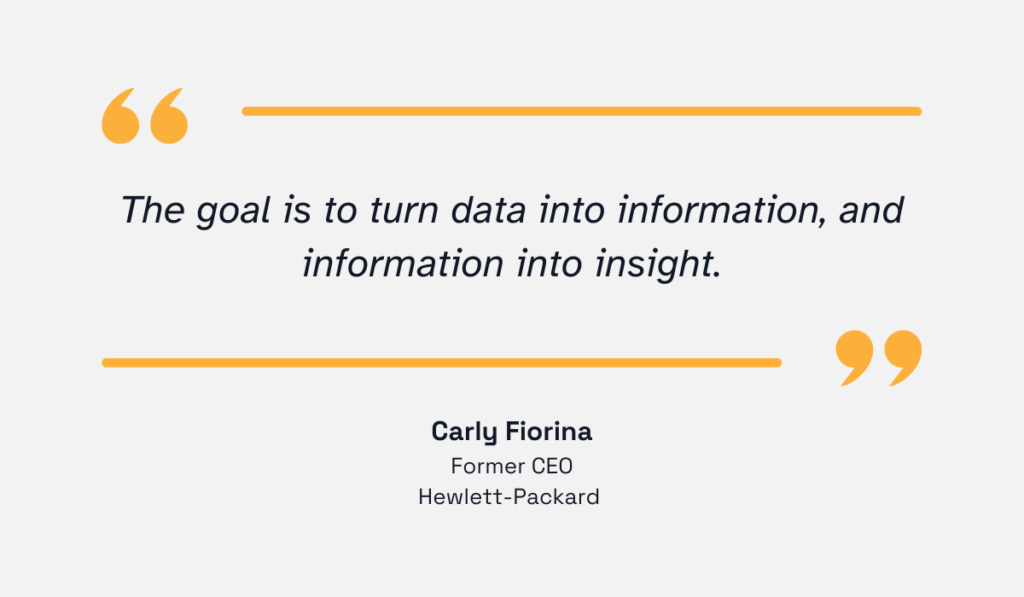
Illustration: Veridion / Quote: HP
In other words, data alone has limited value unless it is interpreted in context.
BI tools help bridge the gap between data and insight.
They use dashboards, scorecards, and interactive reporting features to help teams track ESG performance over time and identify trends, patterns, or outliers across business units, suppliers, or investment portfolios.
By breaking down data silos and bringing ESG metrics into analytics environments, these tools support more data-driven decision-making.
ESG performance can be analyzed alongside financial, operational, or risk indicators, such as:
For example, procurement and risk teams can use BI dashboards to monitor supplier ESG risk across regions, identifying overexposure to high-risk jurisdictions or suppliers with recurring compliance or environmental incidents.
Similarly, investment and strategy teams can analyze ESG performance at the portfolio level, linking emissions intensity, governance risk, or regulatory exposure to asset performance and long-term value creation.
This integrated view helps organizations understand how sustainability factors intersect with broader business outcomes.
AI-powered advanced analytics tools elevate ESG intelligence by uncovering patterns, correlations, and emerging risks that traditional analysis might overlook.
They process vast volumes of structured and unstructured data, from internal systems, supplier reports, news sources, regulatory filings, and social media.
This allows organizations to detect insights at scale and with greater accuracy.
Machine learning models can identify ESG risk hotspots across the value chain, forecast potential impacts, and support scenario analysis for areas such as climate risks, supply chain disruption, or evolving regulatory requirements.
According to a 2024 Pierag report, 84% of organizations that adopted AI-driven ESG analytics achieved 30–40% faster reporting cycles and reported improved data accuracy.
This demonstrates the measurable impact of these tools on ESG operations.
Ian Hong, Partner at KPMG ESG, connects AI’s analytical power to strategic ESG decision-making:
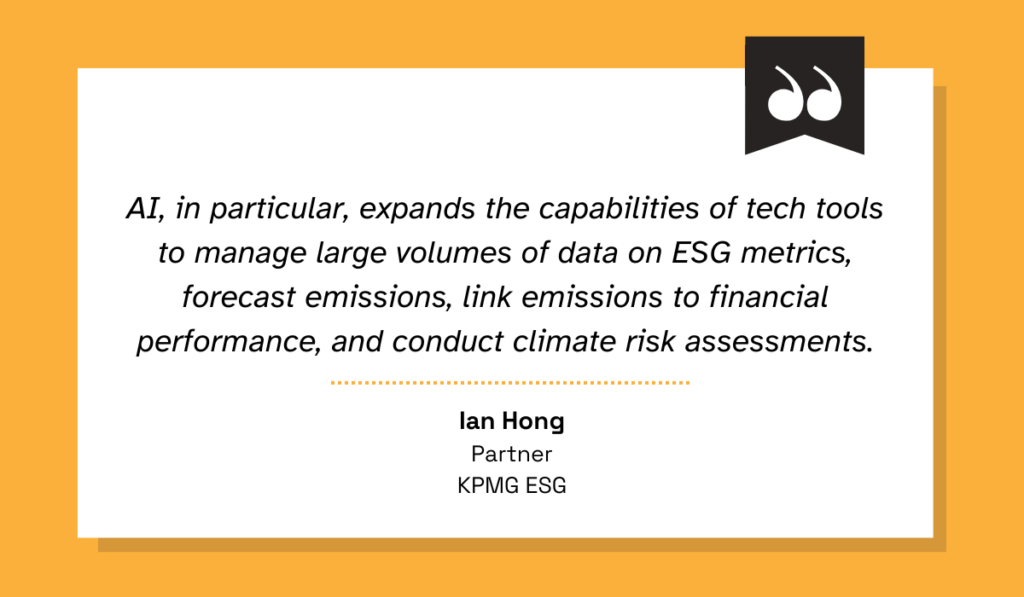
Illustration: Veridion / Quote: Business Times
For example, an AI system might:
Leveraging AI for ESG analytics helps organizations to shift from reactive reporting to proactive decision-making.
Rather than reacting to ESG incidents or emerging regulations, teams can anticipate risks, prioritize mitigation actions, and evaluate strategic trade-offs before exposures materialize.
This forward-looking approach enhances resilience, strengthens risk management, and allows sustainability initiatives to be fully integrated into business strategy, creating measurable long-term value.
The power of ESG lies not in the data itself, but in how it’s used.
Leveraging ESG providers, software platforms, and BI and AI analytics enables organizations to uncover risks, forecast impact, and make informed, future-ready decisions.
Don’t let ESG data sit in spreadsheets and silos. Instead, integrate it, analyze it, and act on it.
Those who embrace ESG analytics will not just comply.
They’ll innovate, build resilience, and lead the way toward a more sustainable, profitable future.