



Blog
Top 6 Sources of ESG Market Intelligence
By: Stefan Gergely -
04 March 2026


We love our data, and now that you're here, you're one step closer to loving it too.
A wide sample of data, so you can explore what is possible with our data
Choose ->
built with procurement in mind. Focused on manufacturers, products and more
Choose ->
built with insurance in mind. Focused on classifications, business activity tags and more
Choose ->
built with sustainability in mind. Focused on sustainability commitments, and environmental and social governance insights.
Choose ->
built with strategic insights in mind. Focused on market trends, competitor analysis, and industry-specific data
Choose ->

Keep up to date with our technology, what our clients are doing and get interesting monthly market insights.

Finding reliable ESG data can feel like searching through endless sources without knowing which ones actually deliver value.
In fact, many teams waste hours jumping between platforms that either lack depth or cost too much for what they offer.
That’s why, in this article, we’ll identify the best sources of ESG market intelligence out there.
We’ll walk you through six key platforms, explaining what makes each one useful so you can choose the right tools for your needs.
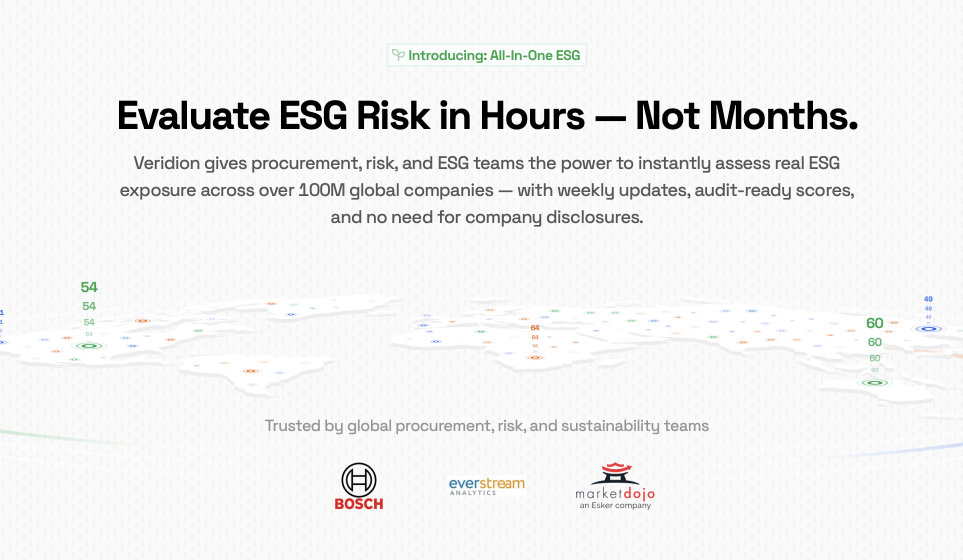
First off, we have Veridion, a category disruptor in ESG data that leverages proprietary AI and machine learning models to deliver weekly-updated ESG market intelligence.
Source: Veridion
Where legacy platforms typically cover 10,000-20,000 primarily public companies, Veridion captures over 120 million public and private companies with a digital footprint across 250+ geographies.
This massive difference in coverage matters when you need visibility into smaller suppliers, regional partners, or private entities that traditional ESG databases tend to overlook.
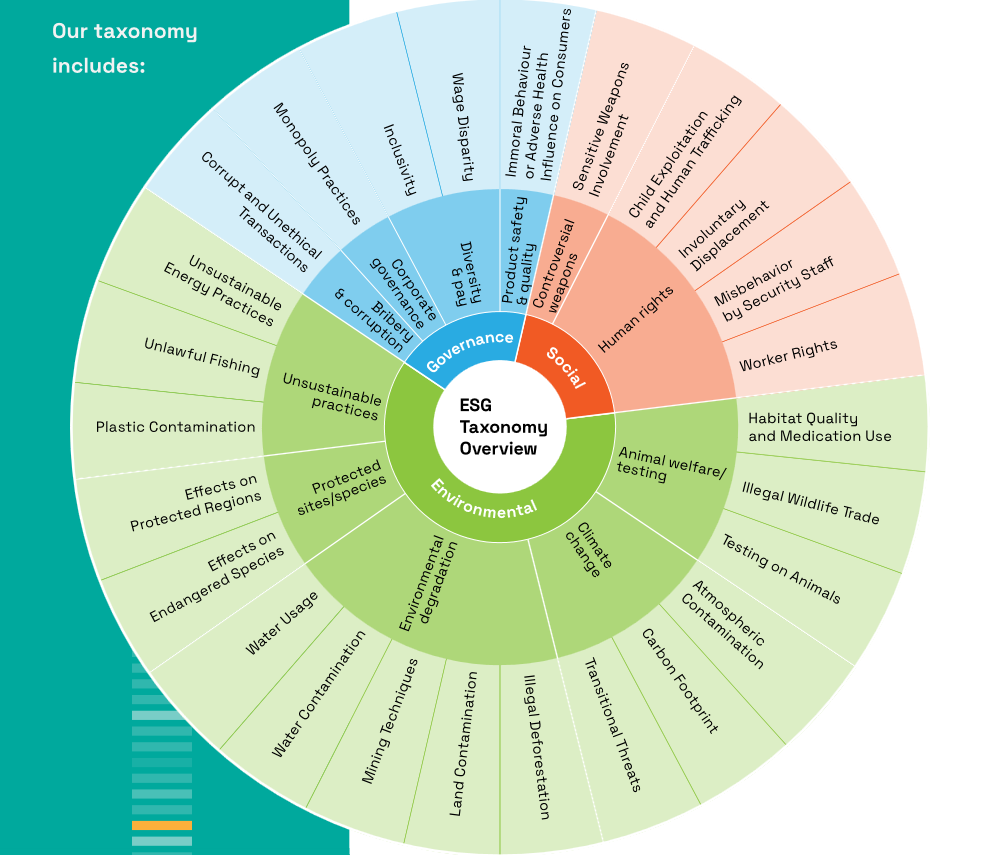
The platform tracks 60-80+ data points per company, with its ESG data taxonomy shown below.
Source: Veridion
What makes Veridion distinctive is its ESG scoring methodology.
Instead of relying on corporate sustainability reports at face value, the system prioritizes verified actions over corporate claims.
Special large language models (LLMs) analyze company disclosures to distinguish genuine ESG initiatives from marketing language, helping you see through greenwashing attempts.
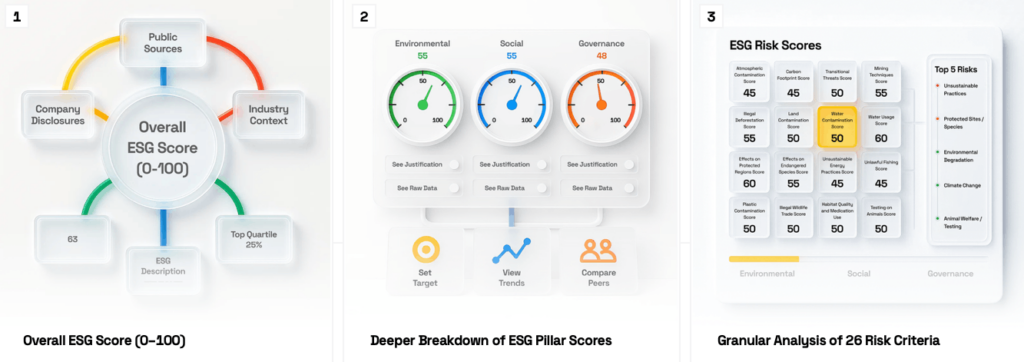
Based on that data, there are three progressively detailed ESG scores, illustrated below.
Source: Veridion
There’s a straightforward overall score for rapid screening purposes, making it easy to quickly filter large supplier lists.
The platform also generates separate pillar scores for Environmental, Social, and Governance aspects, allowing you to focus on specific areas of concern.
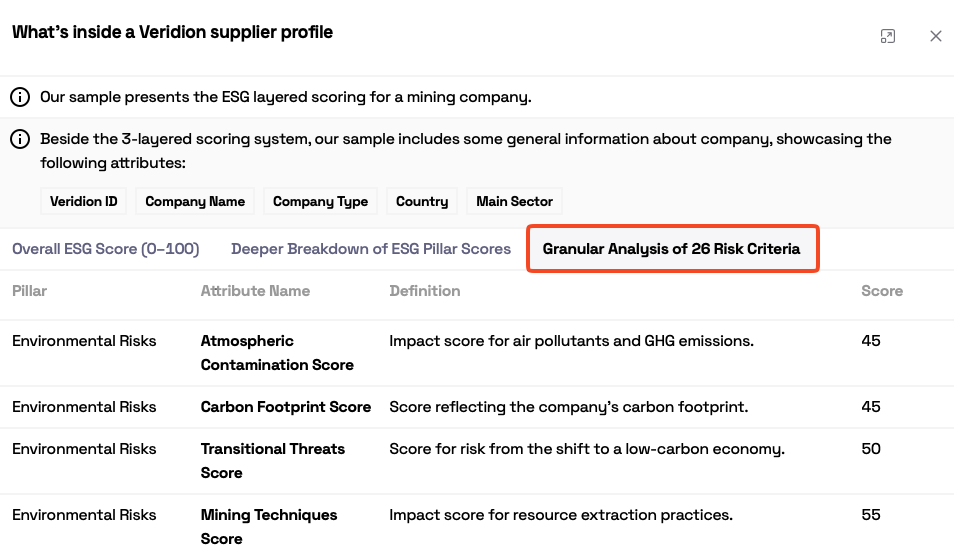
Finally, you get granular scores across 26 ESG risk factors, including atmospheric contamination, illegal deforestation exposure, child labor risk, and modern slavery indicators.
Source: Veridion
Other key ESG intelligence features include:
This combination of features enables teams to detect greenwashing by comparing stated commitments against actual performance data.
Beyond ESG data, Veridion’s Match & Enrich API reconciles messy supplier records using simple identifiers like company name, address, or website, returning full company profiles.
Source: Veridion on YouTube
These records include firmographics such as revenue, employee count, and founding date, along with industry codes (NAICS, NACE, SIC, ISIC), technology stack identification, and corporate hierarchy data.
With this in mind, Veridion is the ideal choice for procurement teams conducting supplier due diligence, third-party risk management (TPRM) professionals, insurance underwriters, and sustainability teams needing real-time intelligence rather than stale annual reports.
For fresh, comprehensive ESG intelligence across entire supply bases, Veridion offers unparalleled breadth, depth, and data freshness.
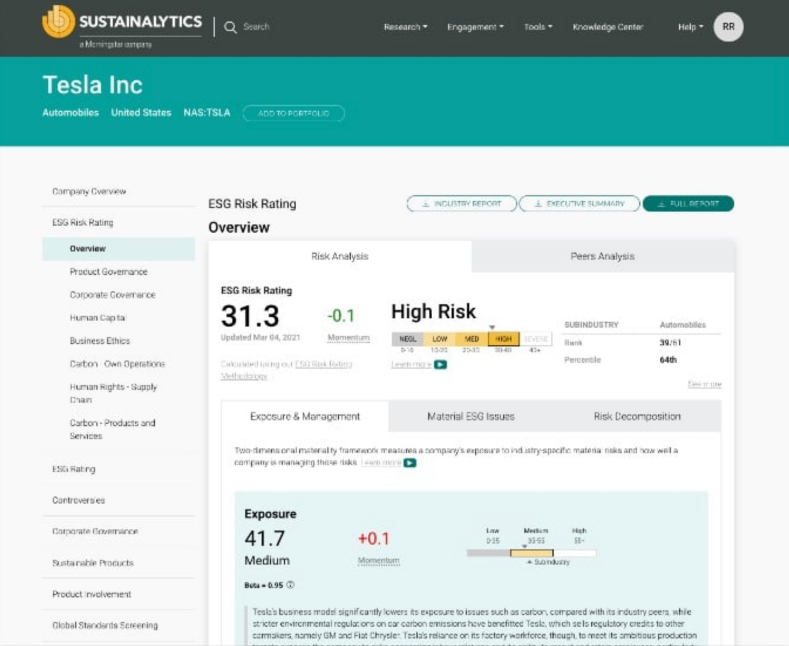
A Morningstar company with years of ESG research heritage, Sustainalytics provides the institutional-grade risk analytics that asset managers and pension funds require for portfolio construction and regulatory compliance.
Source: Sustainalytics
The platform covers 16,000+ companies across 169 countries with assessments built on 1,800+ data points per company and 200+ indicators.
While this database is notably smaller compared to sources like Veridion, Sustainalytics takes a different approach to data quality.
Instead of relying primarily on quantitative scores, the platform employs a team of 800+ ESG research analysts who deliver qualitative assessments of company ESG data.
This human-driven analysis adds context and nuance that automated systems often miss.
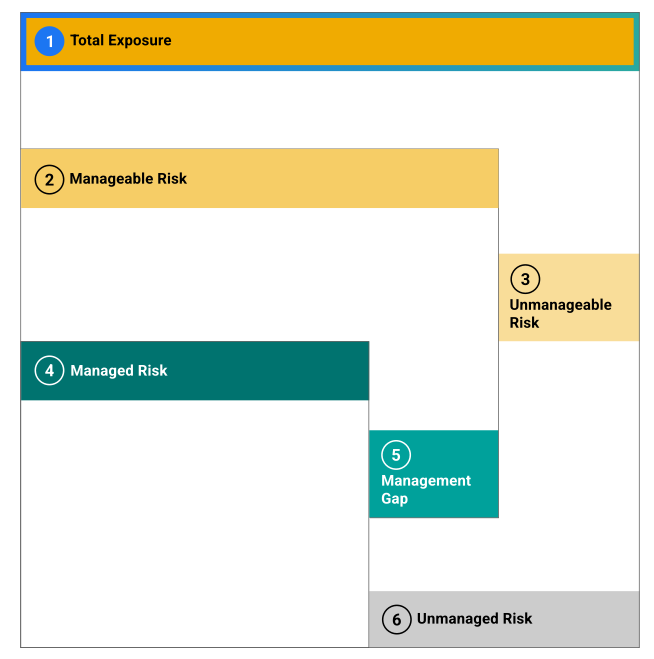
What sets Sustainalytics apart is its distinctive two-dimensional framework.
The system evaluates both an organization’s exposure to material ESG risks and how well it manages those risks.
By comparing these two factors, Sustainalytics calculates the unmanaged risk that remains after accounting for a company’s mitigation efforts.
Source: Sustainalytics
These capabilities make Sustainalytics best suited for asset managers integrating ESG into investment decisions, along with banks needing SFDR-compliant data.
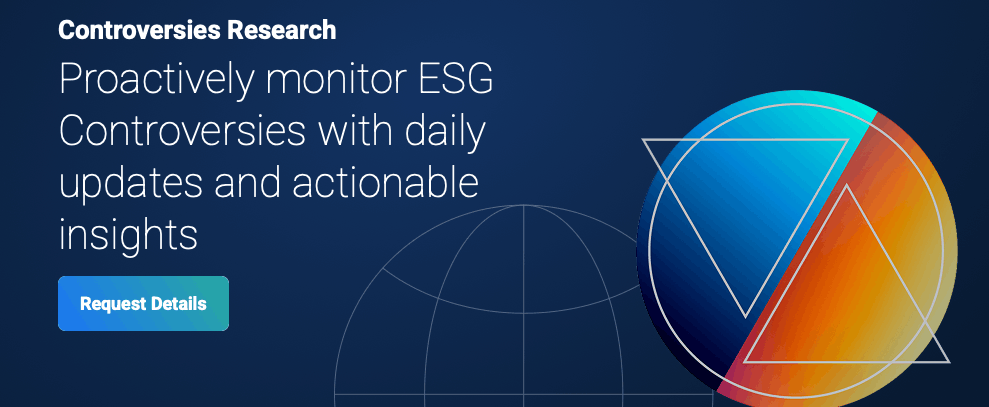
Beyond static ratings, the platform monitors 70,000+ media sources and processes 200,000+ news items daily, tracking 1,500+ ESG-related incidents monthly.
The platform’s controversy capabilities process incidents within 48 hours through a dual-scoring system.
Its Risk Event Scores align controversies with potential financial impact, while the Impact Event Scores assess severity, scope, and remediation.
Source: Sustainalytics
In practical terms, this means you can understand both the real-world harm caused by an incident and the potential financial consequences for your portfolio.
Beyond core ESG Risk Ratings, Sustainalytics offers:
The bottom line is this: if your ESG market intelligence needs to withstand investor scrutiny, stay current as incidents emerge, and support portfolio-style reporting, Sustainalytics is a strong enterprise benchmark.
Next up, we have Bloomberg.
The platform leverages its 40+ years as the dominant financial data platform to deliver ESG intelligence seamlessly integrated into Bloomberg’s other key offerings.
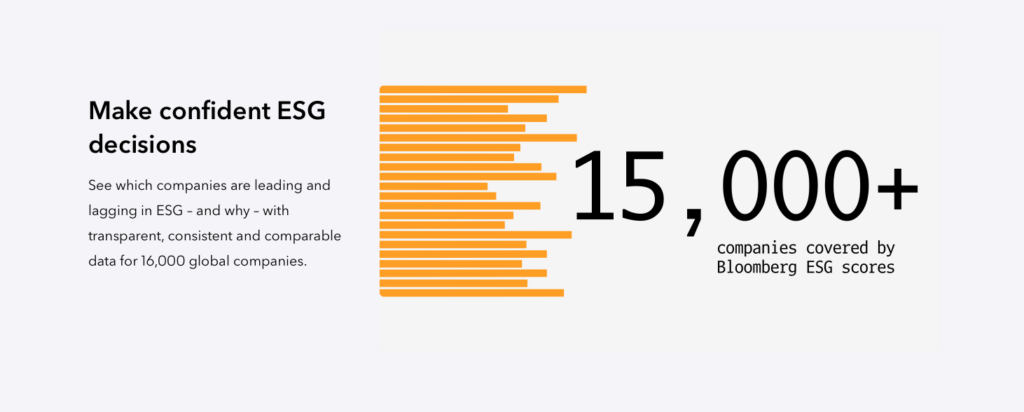
The ESG database offers 5,400+ ESG data fields covering 15,000+ companies across more than 70 countries, with 900+ ESG fields spanning key sustainability topics and governance items like board structure and shareholder rights.
You also get access to up to 10 years of historical data, allowing you to track trends and changes in company ESG performance over time.
Source: Bloomberg
For carbon specifically, the coverage extends to 130,000+ companies with reported and estimated emissions.
Bloomberg also states it captures ESG data only from direct sources such as corporate social responsibility reports, annual reports, proxy statements, and company websites.
Data undergoes validation through 5,000+ sophisticated, multi-layer quality control systems, with information included only if it represents over 80% of company operations and workforce.
This ensures any ESG scores reflect key business activities rather than peripheral disclosures.
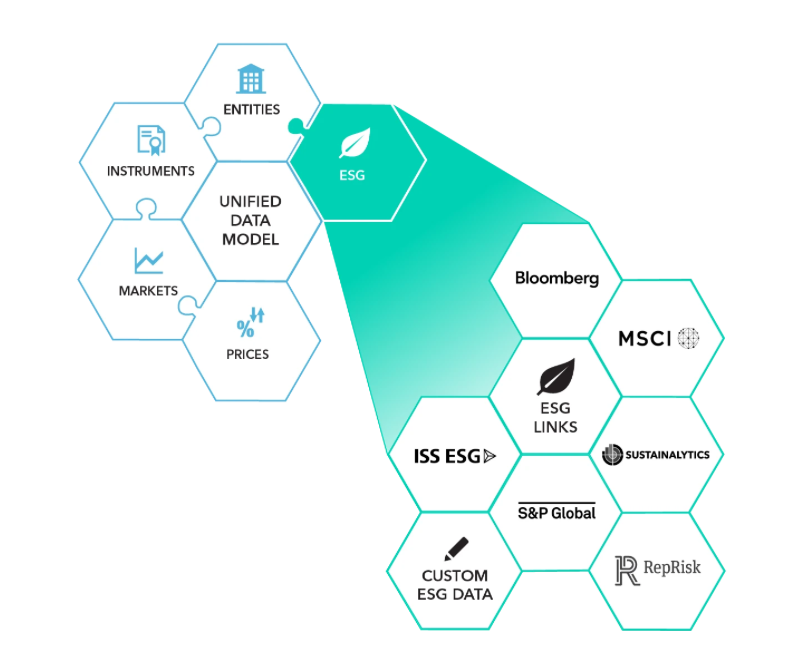
A core offering worth highlighting is Bloomberg’s DL+ ESG Manager.
This is a fully managed, cloud-based data management solution that solves multi-vendor complexity.
It aggregates ESG data from multiple providers, including Sustainalytics, alongside Bloomberg’s proprietary data.
Source: Bloomberg
This model has self-service configuration, data tracing to source files, and cloud delivery to enterprise data warehouses, eliminating some of the data integration work that is a challenge with some standalone ESG platforms.
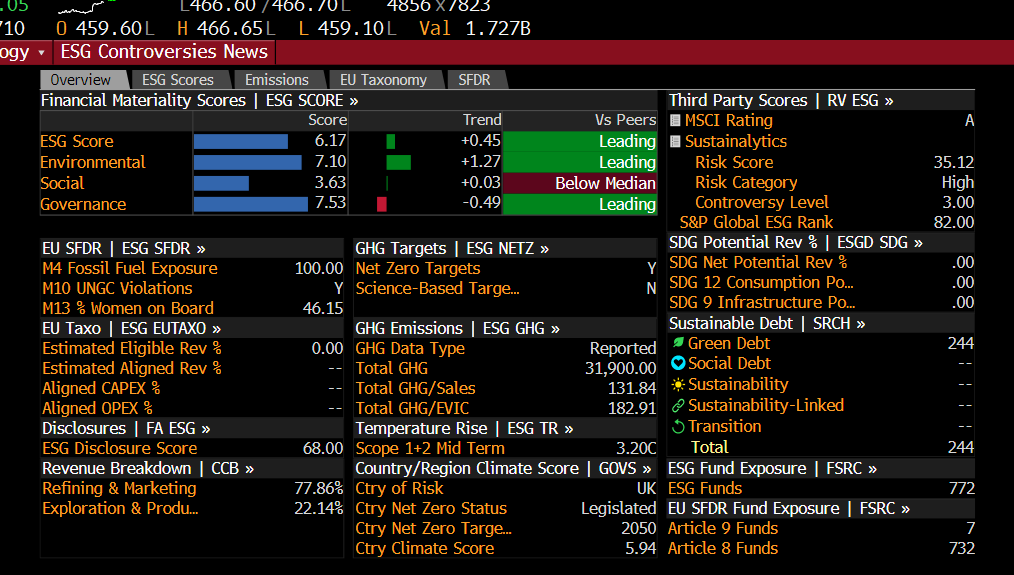
Importantly, Bloomberg’s ESG offering is tightly coupled with the Bloomberg Terminal.
In fact, the ESG data offerings flow directly into the core Terminal functions, enabling teams to view ESG data and scores alongside features and workflows that portfolio managers and financial analysts use daily.
Source: Cranfield
So, Bloomberg puts ESG metrics in context with market data, which makes it best for CFO orgs, treasury, corporate development, and investment/asset-management style teams inside large enterprises.
In short, for enterprises where ESG decisions are inseparable from capital allocation and market exposure information, Bloomberg is a great option.
EcoVadis is a supplier-centric sustainability ratings ecosystem used heavily in enterprise procurement programs.
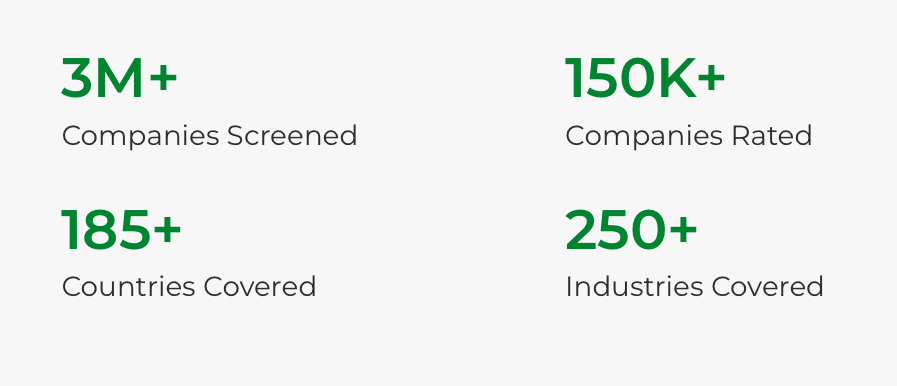
The platform features a database of 150,000+ companies with ESG ratings and over 3 million companies screened across more than 185 countries.
Source: EcoVadis
The core workflow offered by EcoVadis in terms of ESG data collection is structured and thorough.
A supplier completes a questionnaire tailored to its industry, size, and country, and supporting documents are verified.
The output is a shareable sustainability (and carbon) scorecard that benchmarks performance and flags improvement areas.
Of course, as we mentioned, the database for these rated companies is small.
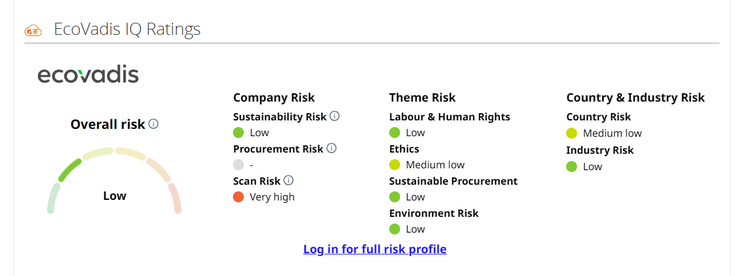
But, EcoVadis offers IQ Plus, which is an AI-powered solution for mapping ESG risks across entire supply bases without contacting suppliers directly.
Source: EcoVadis
It screens 3+ million companies through automated sustainability document mining, live news monitoring across 100,000+ public sources, and access to 27 ESG supplier documents with authenticity verification.
So, while standard EcoVadis ratings require weeks of supplier questionnaire completion, IQ Plus delivers risk profiles in hours.
This process is comparable to the approach used by platforms like Veridion, although the scope and database size remain more limited in EcoVadis’ case.
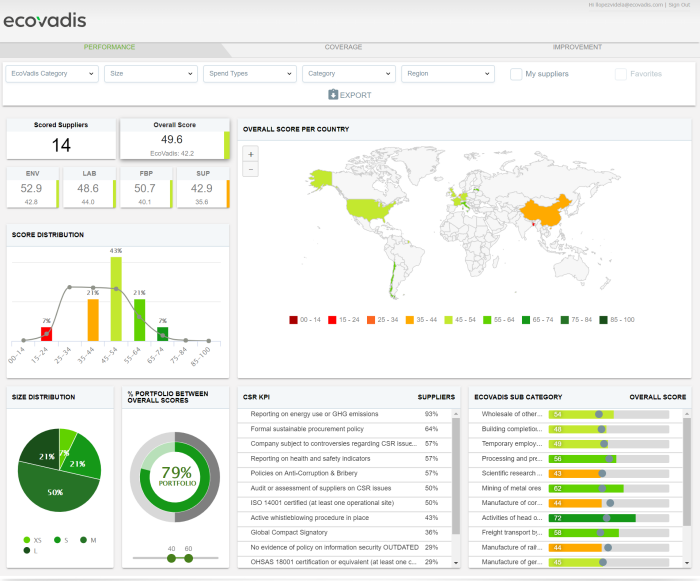
Still, EcoVadis is worth considering for procurement-heavy organizations, sustainable procurement leaders, and supplier relationship teams that need consistent assessments across global vendor networks.
Source: EcoVadis
This is due to the fact that the ESG assessments in EcoVadis involve 15+ hours of expert analyst review, combining company-submitted documents with external verification.
That means you get human-audited data that can supplement the information you may source through other platforms.
So, if you’re building or scaling a supplier sustainability program and need a repeatable way to benchmark and improve vendors, EcoVadis is a solution worth considering alongside others.
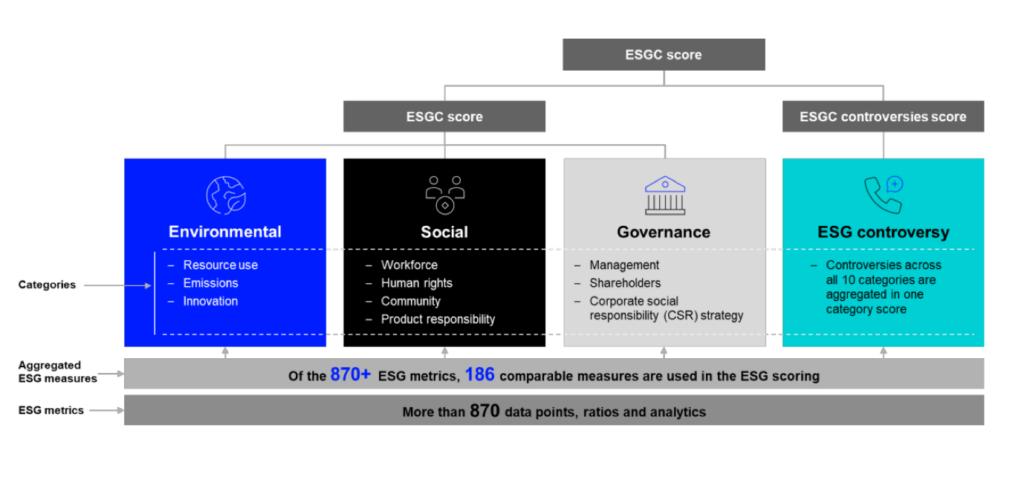
LSEG (London Stock Exchange Group) offers one of the industry’s most transparent ESG methodologies, covering 16,500 companies representing 90% of global market capitalization with granular raw data access.
LSEG’s five-step scoring process calculates percentile ranks across 10 categories within Environmental, Social, and Governance pillars, using 870+ ESG measures with 186 comparable metrics selected for materiality.
This transparency sets LSEG apart in an industry where many providers treat their methodologies as proprietary black boxes.
Source: LSEG
Environmental and Social category weights vary by industry based on materiality, while Governance weights remain consistent across sectors.
It’s worth noting that LSEG’s ESG scores refresh weekly.
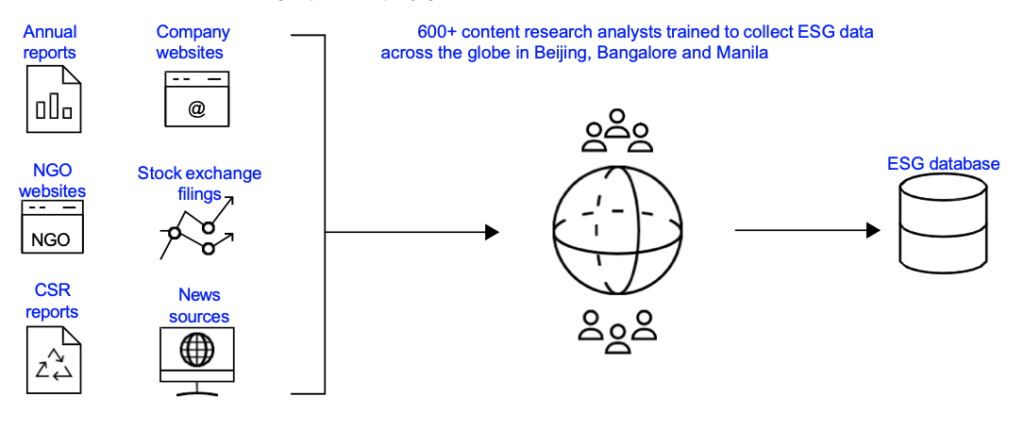
Importantly, over 600 content research analysts process 860+ ESG measures manually for each company’s score.
Source: LSEG
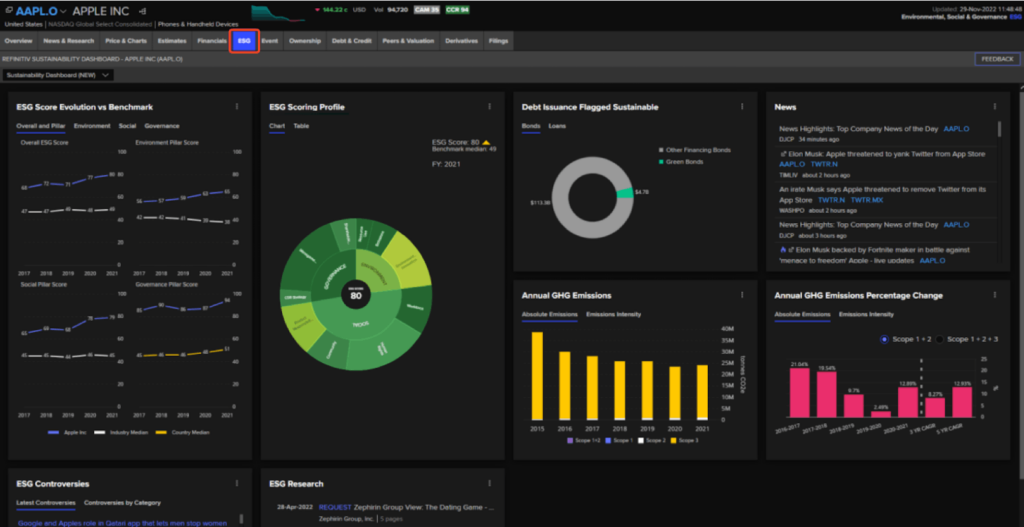
As both a financial market infrastructure operator and ESG data provider, LSEG offers multiple integration options.
These include direct integration with Workspace and Eikon for desktop analysis, Datastream for historical time series data, and supporting API delivery to cloud platforms.
Source: LSEG
Unlike Bloomberg, which optimizes for workflow integration within its proprietary Terminal, LSEG prioritizes open data access and methodology transparency.
This makes LSEG the stronger choice for firms that want to build rather than buy their ESG analytics.
So, LSEG’s data transparency and quantitative accessibility make it ideal for quantitative analysts building custom ESG models and asset managers wanting to apply proprietary weightings.
Finally, we have Datamaran, which claims to be the only software out there that provides a fully automated solution for identifying and monitoring material ESG risks and opportunities.
Source: Datamaran on YouTube
Datamaran monitors 68,000+ corporate reports from 7,000-9,000 companies, 6,000+ regulations across 190 countries, 1,000+ accredited news sources, and various social media platforms.
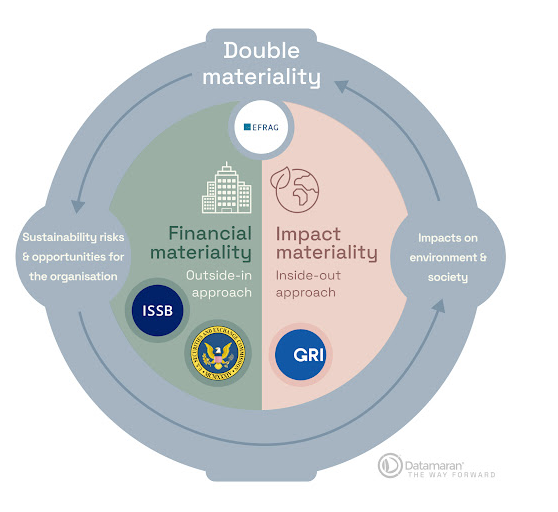
Datamaran’s AI-powered double materiality assessment (DMA) capability can be considered its flagship offering.
Source: Datamaran
The DMA Evaluate module automates assessments of both impact materiality, which measures a company’s effect on the environment and society, and financial materiality, which measures how ESG issues affect the business itself.
Using a proprietary LLM purpose-built for ESG, Datamaran enables quarterly monitoring refreshes, annual reassessments, and IRO (Impacts, Risks, Opportunities) library management.
Through this, it aims to replace static spreadsheets with continuous, defensible processes.
Beyond risk identification, the platform also helps companies set appropriate ESG goals.
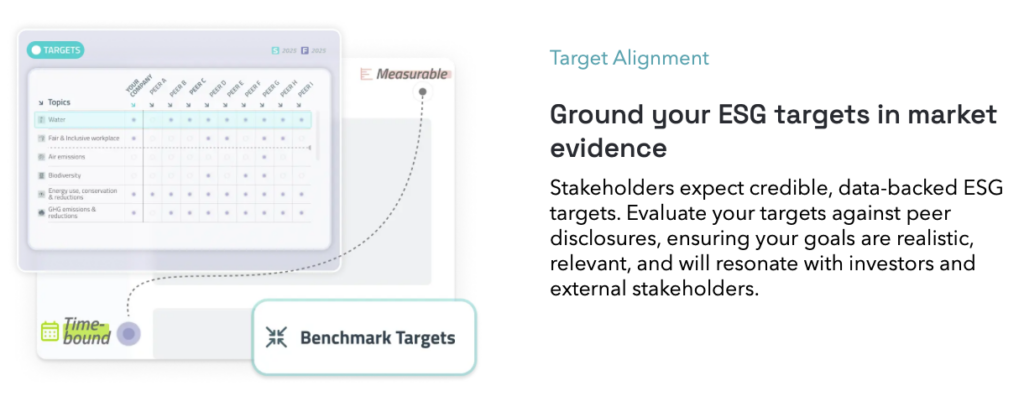
Datamaran’s Benchmark module helps companies define ESG goals that are grounded in external benchmarks, peer disclosures, and policy signals, ensuring targets are both realistic and aligned with risks and opportunities.
Source: Datamaran
The platform provides data-backed visibility into time-bound and measurable targets set by peers and competitors across over 100 ESG topics
This enables stakeholders to validate that their ESG targets are credible, and will resonate with investors and stakeholders alike.
Other key features include:
As you can see, while other tools on this list excel at company-level ESG data for company screening, Datamaran takes a strategic approach.
In fact, it’s focused on helping enterprises determine which ESG issues matter most and how to govern them.
That makes Datamaran a strong strategic intelligence layer, especially for enterprises navigating complex ESG regulatory requirements and needing automated, defensible materiality assessments that satisfy auditors and boards alike.
We’ve covered six sources of ESG market intelligence, each with different strengths and trade-offs.
As you saw, some may excel at financial data while others shine in company-level metrics or industry analysis.
Most importantly, you now have a clearer picture of where to look based on your specific requirements.
So, take some time to explore one or two sources that match your operations.
After all, the right intelligence source will save you hours of research time and help you make better-informed ESG decisions.