



Blog
7 Master Data Management Statistics You Need to Know
By: Stefan Gergely -
16 January 2026


We love our data, and now that you're here, you're one step closer to loving it too.
A wide sample of data, so you can explore what is possible with our data
Choose ->
built with procurement in mind. Focused on manufacturers, products and more
Choose ->
built with insurance in mind. Focused on classifications, business activity tags and more
Choose ->
built with sustainability in mind. Focused on sustainability commitments, and environmental and social governance insights.
Choose ->
built with strategic insights in mind. Focused on market trends, competitor analysis, and industry-specific data
Choose ->

Keep up to date with our technology, what our clients are doing and get interesting monthly market insights.

What if we told you that most companies are funding and structuring MDM programs in ways that almost guarantee sub-optimal results?
These insights emerge repeatedly in top industry surveys.
To save you from combing through them all, we’ve distilled the seven MDM statistics you can’t afford to miss.
From top data quality pitfalls to benefits, these numbers show how to build a smarter MDM strategy for your organization.
There’s growing demand for MDM, and recent research from MarketsandMarkets, a global market research firm, confirms it.
According to their analysis, the global MDM market is expected to more than double between 2022 and 2027, growing at a CAGR of 15.7%.
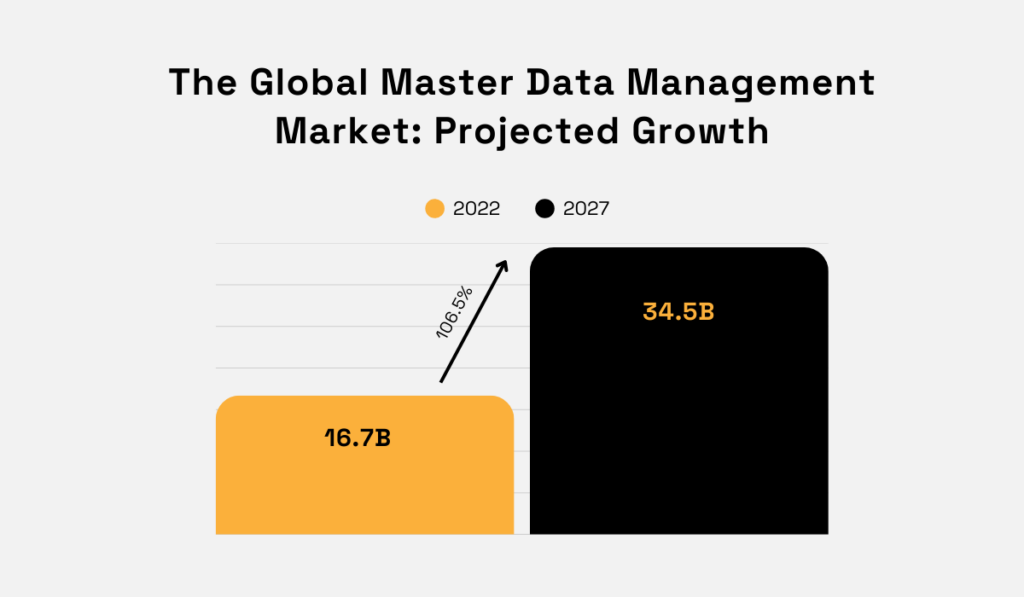
Illustration: Veridion / Data: MarketsandMarkets
This growth is mainly driven by rising demands for compliance, anomaly detection, and pattern recognition on one hand, and by the need for real-time, consistent data on the other.
Companies pursue the latter because it delivers tangible results, including greater efficiency and smarter decisions. This is especially true today with AI.
AI models can deliver unprecedented results when they have access to accurate data.
However, without accurate data, their impact can be just as large, but entirely counterproductive.
Deloitte’s Managing Director of Strategy and Analytics, Anjan Roy, echoes this point, explaining that feeding AI unreliable data causes errors to propagate across systems to a groundbreaking extent.
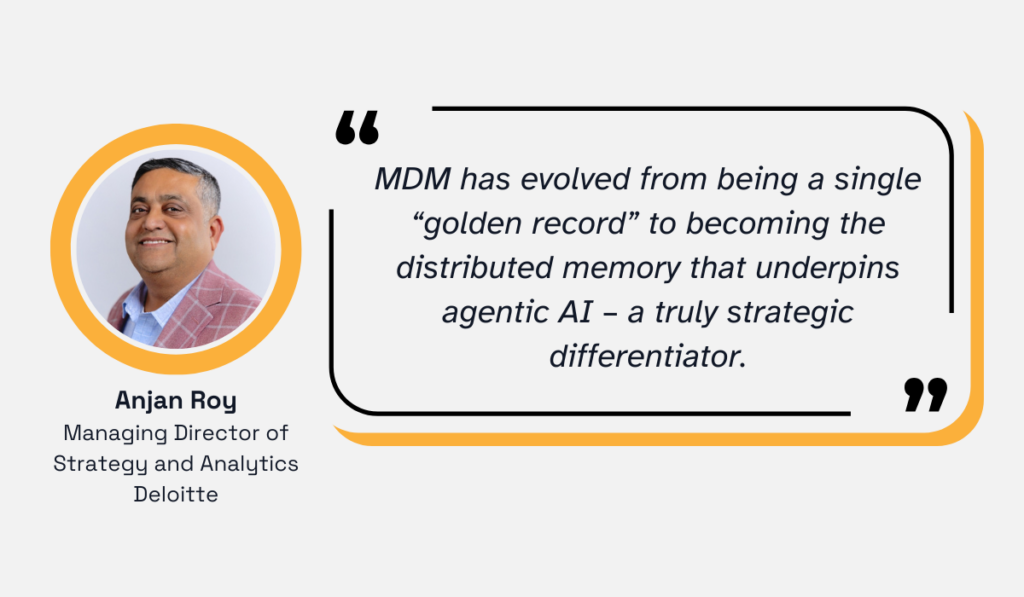
Illustration: Veridion / Quote: Deloitte
In short, for AI to work well, you need to feed it reliable, consistent, and context-rich data.
MDM provides exactly that, becoming even more crucial as AI takes on a larger role in business.
What is the most common quality issue companies face with their master data?
According to McKinsey’s 2023 Master Data Management Survey, it’s its incompleteness.
They asked 80 global organizations generating more than $100 million in annual revenue what their biggest master data challenge was.
71% of respondents cited missing or partially populated records.
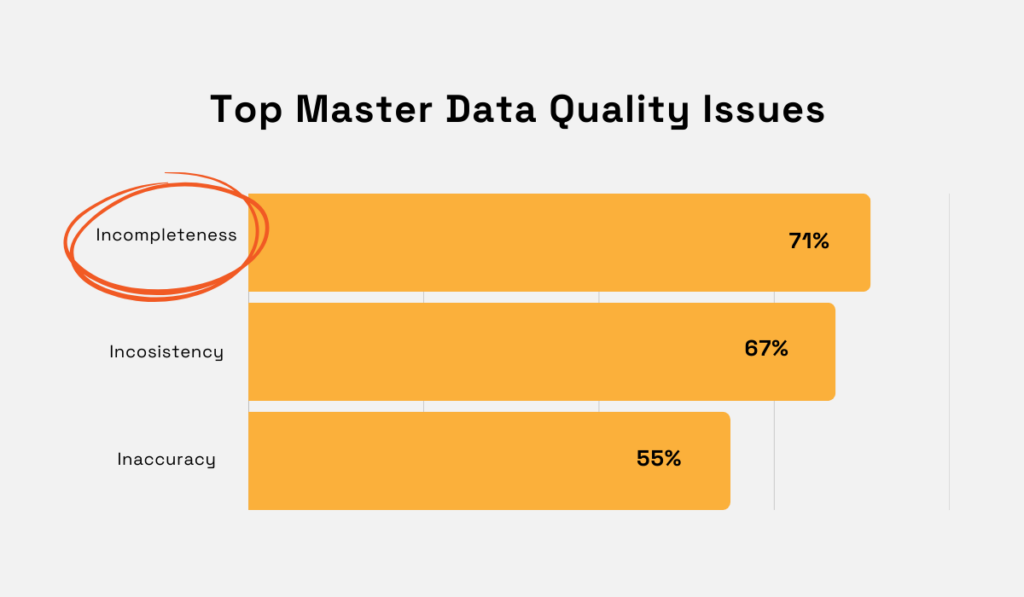
Illustration: Veridion / Data: McKinsey
The impact of incomplete data ripples across the organization.
It causes a number of operational challenges, such as delayed decision-making, inconsistent reporting, and inefficient customer-facing processes.
But even addressing these issues is problematic in itself, considering how much time it takes.
To be more precise, 82% of the surveyed respondents reported spending a minimum of one day per week resolving data quality issues.
That might be because many use outdated methods to do so: 66% still assess, monitor, and manage data quality entirely manually.
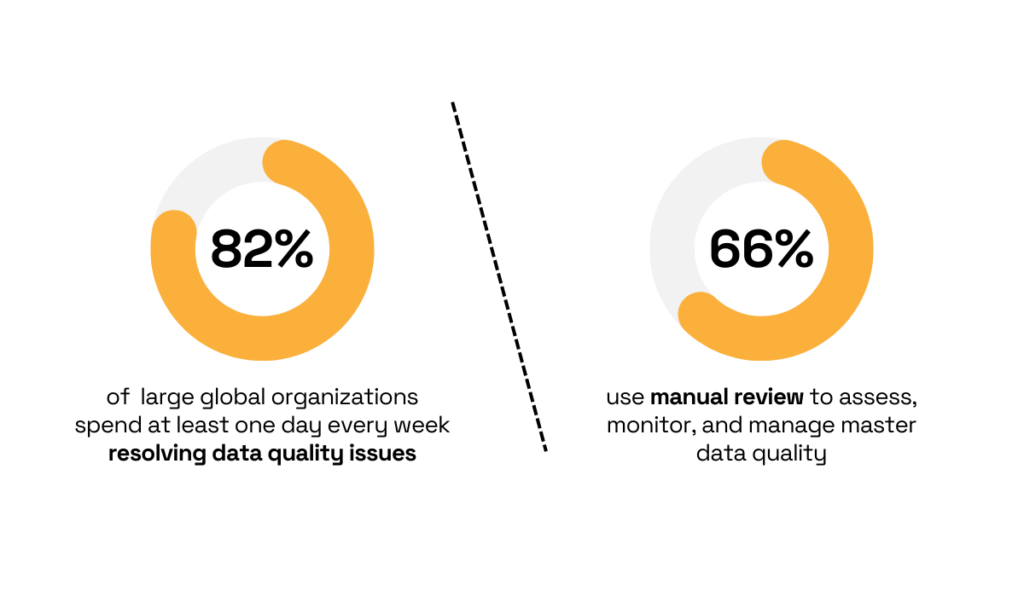
Illustration: Veridion / Data: McKinsey
So, how can you solve this issue?
The easiest, most reliable way is to get data from trusted third-party sources.
Take Veridion, for example.
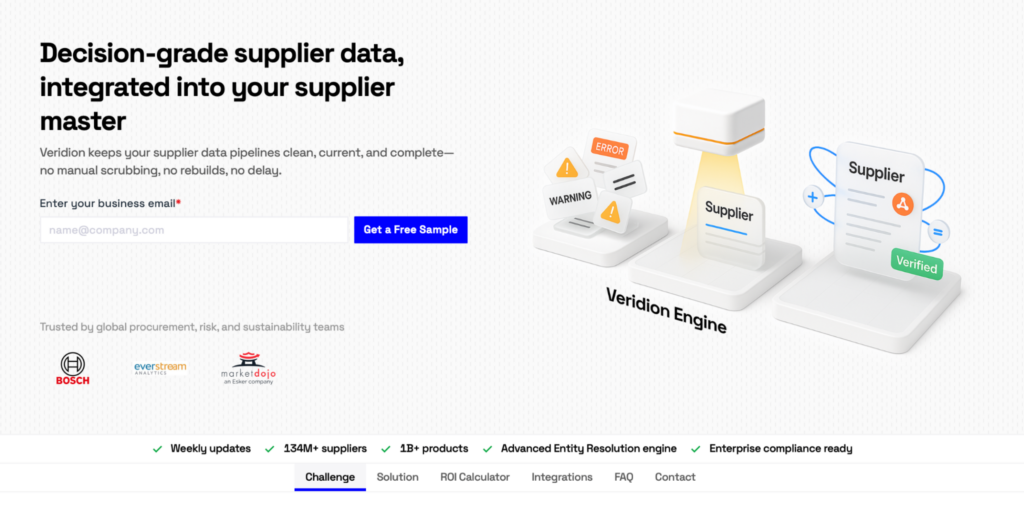
Veridion is a data provider that automatically collects over 220 attributes on over 134 million supplies worldwide, including everything from product to ESG data.
What’s more, this data is updated weekly to ensure even the most recent changes are accounted for.
Source: Veridion
To make this possible, Veridion relies on machine-learning models that monitor a wide range of sources around the clock, such as company websites, news outlets, and other relevant channels.
Integrating this data into your systems is far faster than collecting and refining it manually.
Plus, you don’t have to second-guess its accuracy or completeness. The provider guarantees it.
Despite clear benefits, most MDM initiatives lack broad organizational backing.
According to the same McKinsey survey, a mere 16% of MDM programs are funded as organization-wide, strategic initiatives.
The other 84% are not.
In fact, even though MDM programs benefit all departments, the majority are treated as the sole responsibility of IT or technical functions.
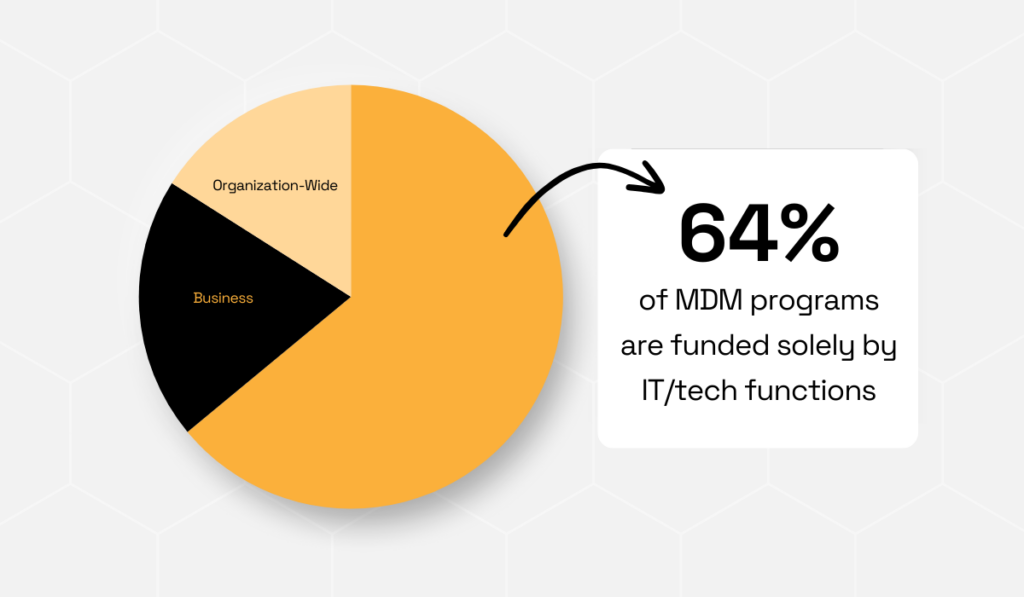
Illustration: Veridion / Data: McKinsey
This is problematic for several reasons.
For one, as Amy Cooper, Principal Data Management Strategist at Dun & Bradstreet, explains, organizations should avoid selecting technology first and then trying to adjust people, processes, and data to fit it.
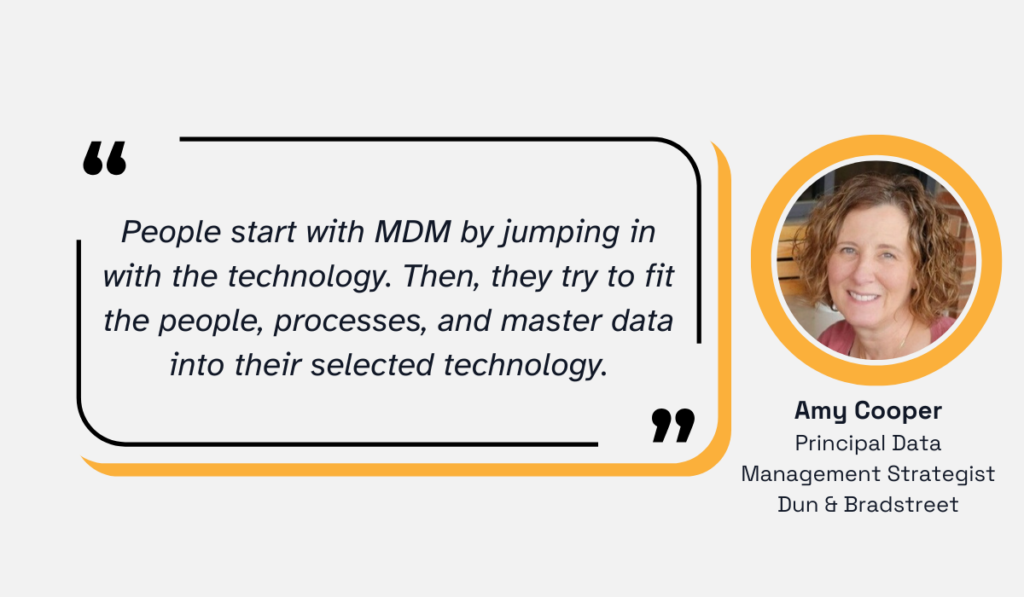
Illustration: Veridion / Quote: Dataversity
Yet, when MDM is handled solely by IT and tech teams, this tends to be the default approach.
Decisions are often driven not by real, organization-wide business needs, but by what IT and tech functions consider technically feasible or convenient.
Another challenge is that MDM should be about driving real business outcomes, not just implementing technology for its own sake.
That’s hard to achieve when the governing programs fall entirely on IT and tech teams.
In an ideal scenario, every team across the company would have a say in MDM decisions.
But if that’s not possible, IT should at a minimum work closely with business teams, and funding should come from both sides.
Beyond operational efficiency, risk reduction is a major driver for MDM.
In fact, McKinsey found that nearly half of the companies they surveyed are working to improve their MDM maturity specifically to reduce noncompliance risks.
This makes sense, especially since many industries are facing increasingly stricter data regulations, such as KYC/AML, data privacy laws, supply chain traceability requirements, and more.
McKinsey, for example, highlights sectors such as banks, insurance companies, government agencies, and hospital networks as being particularly affected.
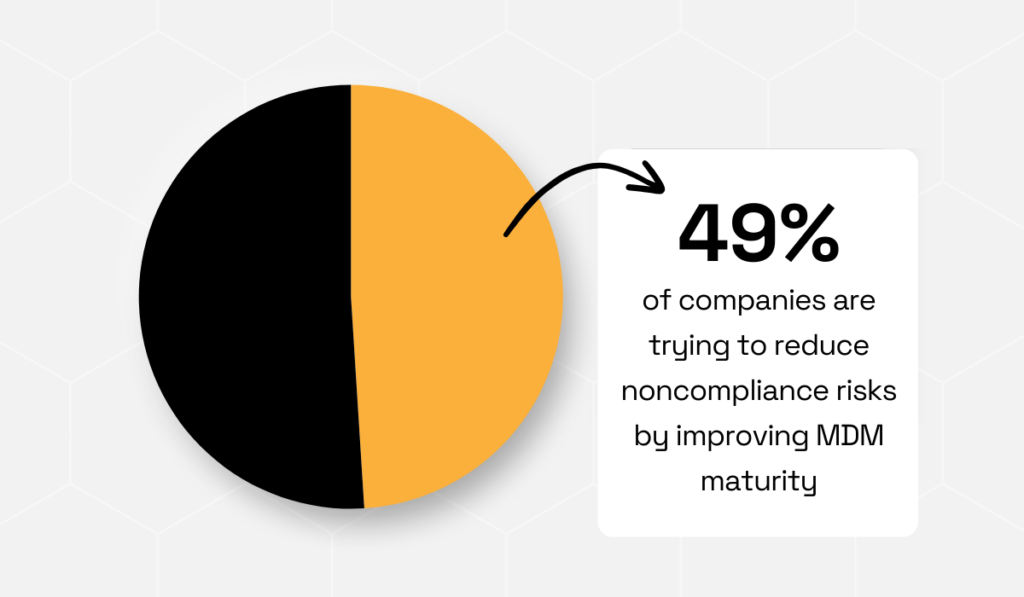
Illustration: Veridion / Data: McKinsey
But why does inconsistent and incorrect master data pose such a compliance risk?
Well, first, it can cause organizations to unknowingly violate regulations.
For example, if they have multiple versions of a client’s identity, they could miss a sanctions check or reporting requirement and subsequently face fines.
MDM helps prevent this by creating a “single source of truth” for critical data, ensuring that compliance checks are run on accurate, complete information across the enterprise.
Second, inaccurate master data makes it impossible to be a responsible corporate citizen.
In other words, you can’t provide regulators with reliable information if you don’t have it yourself.
David O’Connell, senior analyst at Aite Group, explains that this can hurt your credibility with regulators.
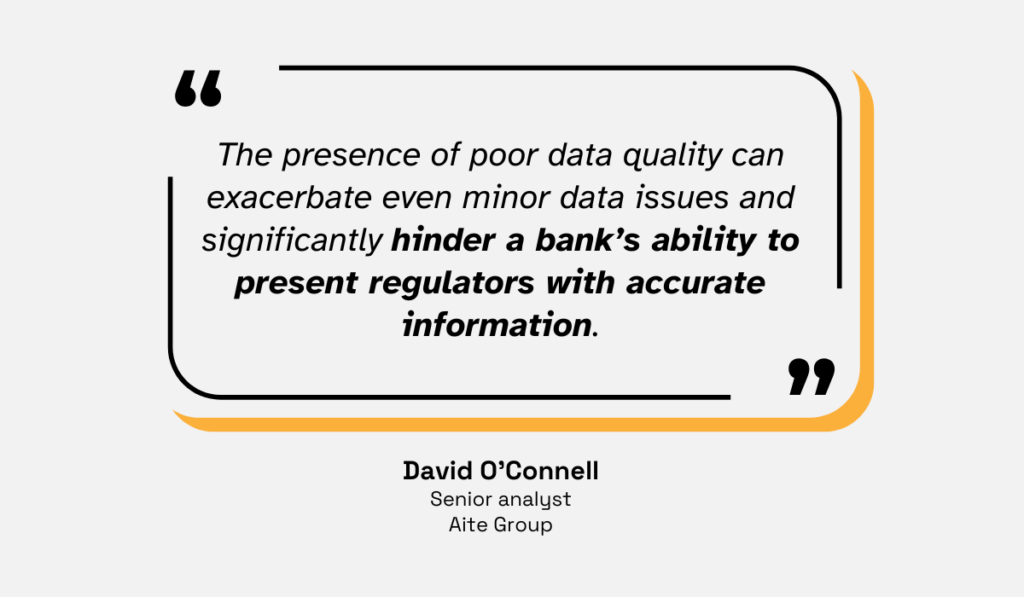
Illustration: Veridion / Quote: Master Data Management
So, mature MDM enables companies not only to operate compliantly but also to ensure that what’s reported to regulators is accurate and trustworthy.
In doing so, it reduces risk, builds credibility, and provides a solid foundation for confident decision-making.
Cloud-based MDM is on the rise, and two benefits stand out: greater flexibility and cost savings.
In Informatica’s recent global MDM survey, 66% of data leaders said these were the main reasons they’re moving MDM to the cloud.
In other words, about two-thirds were motivated by a seemingly more agile and more affordable way to manage their master data.
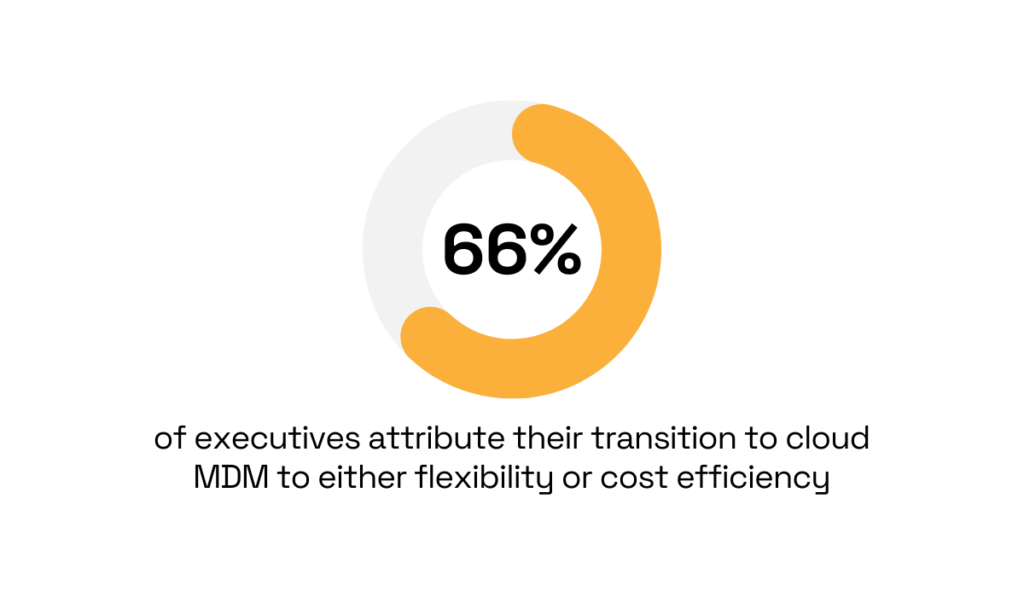
Illustration: Veridion / Data: Informatica
The flexibility aspect comes from cloud MDM solutions being easier to scale and update.
Companies can quickly add new data domains or integrate new sources without heavy on-premise infrastructure changes.
Cost efficiency often comes via reduced IT overhead, as there’s no need to maintain big servers for MDM.
Pay-as-you-go models can also be cheaper than large upfront licenses, emphasizes Vinay Simha, the Founder and Global Data Strategist at Strategic Business Networks.
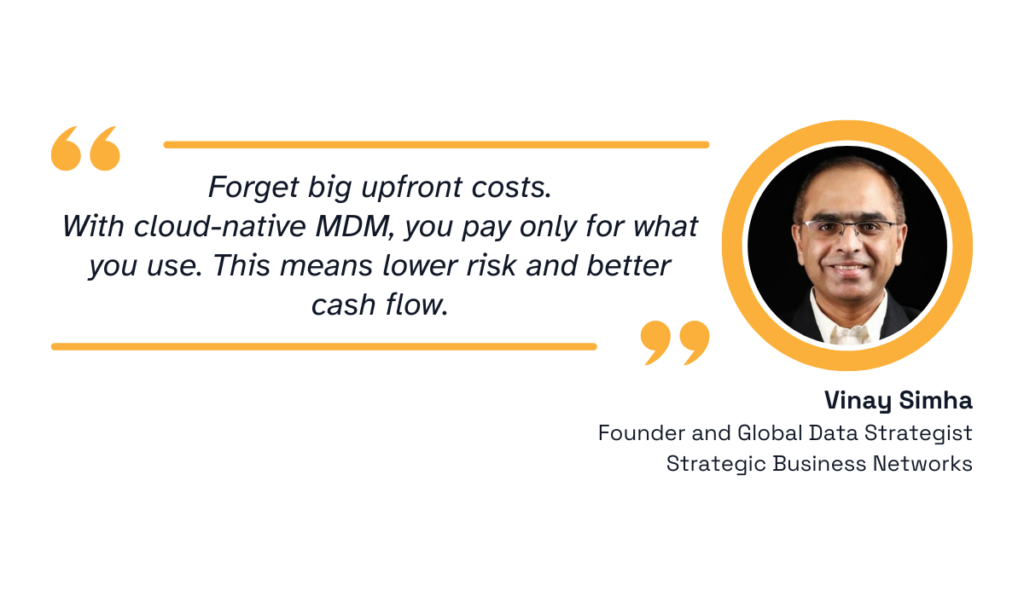
Illustration: Veridion / Quote: LinkedIn
Simha also mentions other advantages of cloud MDM over legacy systems.
Some of the top ones include scalability, built-in security, and disaster recovery.
As he notes, cloud-native MDMs back up and protect data continuously, as long as you’re online.
This makes it easier to recover your data in case of disruptions, like power outages and hardware failures, than with traditional on-premises systems.
So, in the long term, the benefits for data resilience are clear.
However, in the short term, many leaders anticipate that data can be lost during migration.
Moving master data to the cloud has clear benefits, but it’s not without concerns.
The same Informatica survey found that 28% of organizations anticipate data loss as a challenge when migrating to the cloud.
In fact, this was the top-cited concern, slightly ahead of other worries like a long, resource-intensive migration process (27%) or feature gaps in the new system (26%).
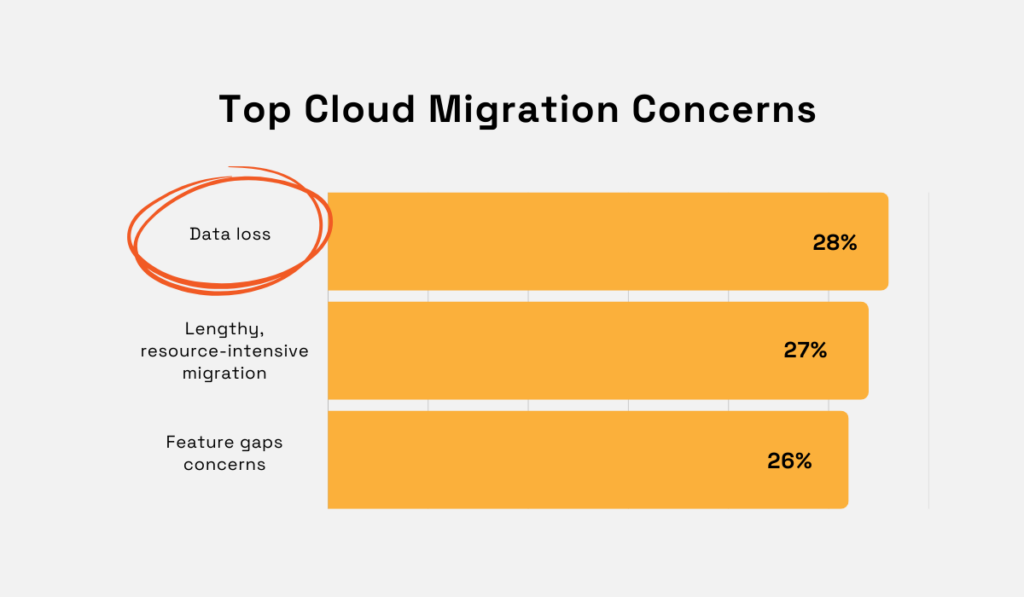
Illustration: Veridion / Data: Informatica
Essentially, more than a quarter of companies fear that in the process of transferring and
transforming massive master datasets, some data could be corrupted, dropped, or otherwise lost.
Such fear isn’t unfounded. A poorly executed migration could indeed result in missing records or degraded data quality.
Michael Segner, Product Marketer at the data quality software company Monte Carlo, explains why that’s the case.

Illustration: Veridion / Quote: Monte Carlo
However, these risks shouldn’t stop you from moving to the cloud.
The purpose of identifying them is simply to prepare and minimize their impact.
As Segner points out, robust backup strategies and thorough migration testing can significantly reduce potential losses.
In the end, the benefits of switching to the cloud far outweigh the risks. With a solid plan in place, migration can be smooth, secure, and well worth the effort.
Finally, when it comes to what’s managed in MDM, customer data reigns supreme.
The Informatica survey shows this is the most common master data domain that organizations manage.
Product comes next, followed by supplier data.
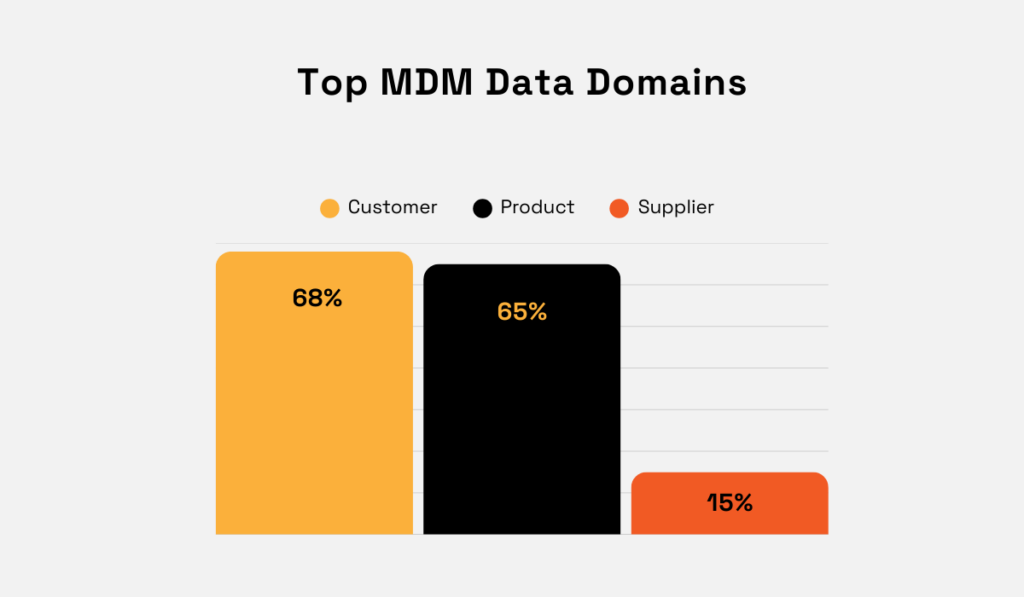
Illustration: Veridion / Data: Informatica
In other words, companies tend to start their MDM journey with customer information, consolidating records to get that coveted 360-degree customer view.
Product master data, like SKUs and catalogs, is a close second priority, while supplier data management significantly lags in current adoption.
This finding aligns with other research.
For example, McKinsey likewise found that a staggering 83% of organizations consider client and product data to be their most critical master domains.
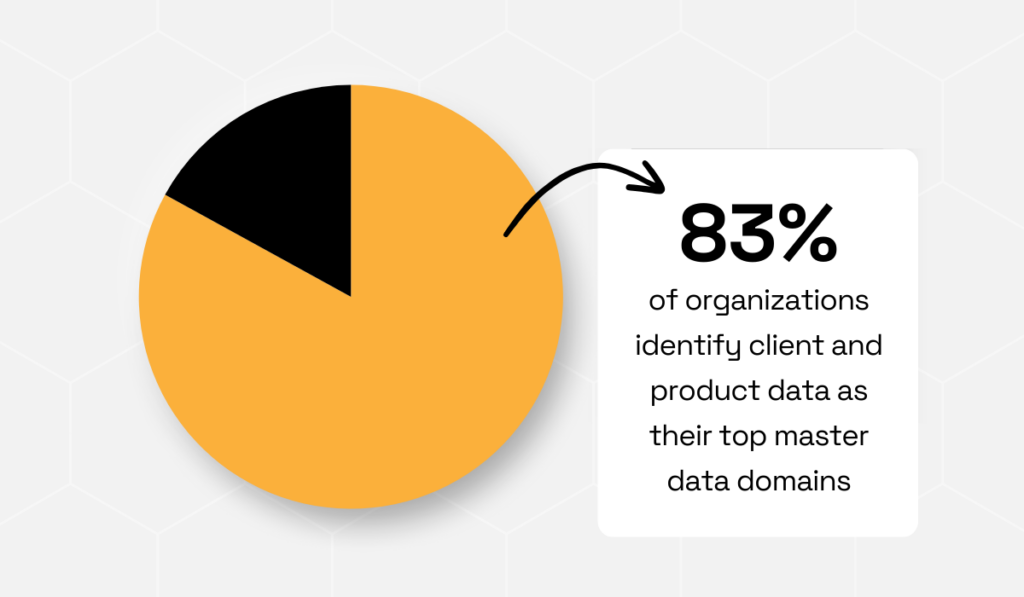
Illustration: Veridion / Data: McKinsey
Supplier MDM, by contrast, has often been neglected historically, perhaps because its benefits are less immediately visible on the top line.
However, Informatica’s survey suggests this is starting to change.
Many companies are planning to expand their MDM to new domains, especially location data and material and supplier data.
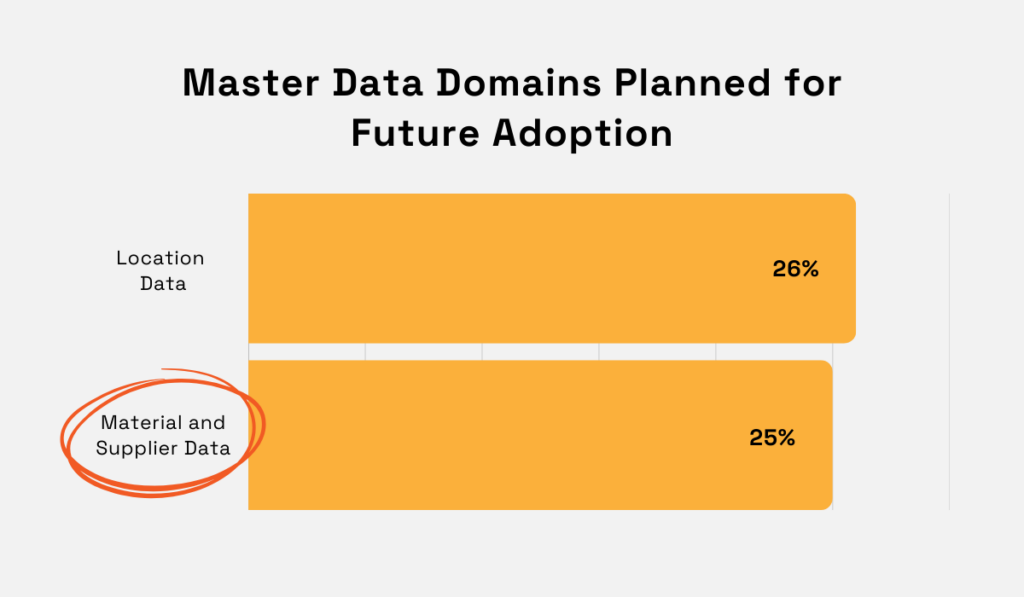
Illustration: Veridion / Data: Informatica
It’s important to note that the organizations planning to add those domains are generally not the ones already mastering them.
In other words, a broad wave of new adopters is eyeing supplier and location MDM, likely driven by growing awareness of their value.
These statistics paint a vivid picture of the current MDM landscape.
The market is growing fast, yet organizations are still working through fundamental challenges like incomplete data and securing organization-wide support.
On the upside, awareness of MDM’s importance is higher than ever.
Data leaders are pushing to modernize via the cloud and aiming for strategic programs. And those that are investing in master data now will gain a competitive edge in the future.
The sooner you recognize this, the sooner you can position yourself to get more value from every byte of data you collect.
Why not start today?