



Blog
Best Small Business Data Providers for B2B Insights
By: Stefan Gergely -
12 March 2026


We love our data, and now that you're here, you're one step closer to loving it too.
A wide sample of data, so you can explore what is possible with our data
Choose ->
built with procurement in mind. Focused on manufacturers, products and more
Choose ->
built with insurance in mind. Focused on classifications, business activity tags and more
Choose ->
built with sustainability in mind. Focused on sustainability commitments, and environmental and social governance insights.
Choose ->
built with strategic insights in mind. Focused on market trends, competitor analysis, and industry-specific data
Choose ->

Keep up to date with our technology, what our clients are doing and get interesting monthly market insights.

Whether you’re evaluating partners, assessing risk, expanding into new markets, or refining go-to-market strategies, the quality of your B2B insights determines your results at scale.
Yet many enterprise leaders still wonder:
Are the data providers we rely on giving us a complete and accurate view of small business data?
In this guide, we’re examining the leading providers of small business data, explaining what makes each one unique for different use cases, and how they support enterprise-level decision-making.
By the end, you’ll have a clearer framework for choosing data partners that align with your growth, risk, and market intelligence goals.
Let’s get started.
First on our list is Veridion, a data provider that leverages its proprietary machine learning to transform unstructured web data into structured business intelligence.
Veridion’s database currently covers over 130 million companies across 500 million locations worldwide.
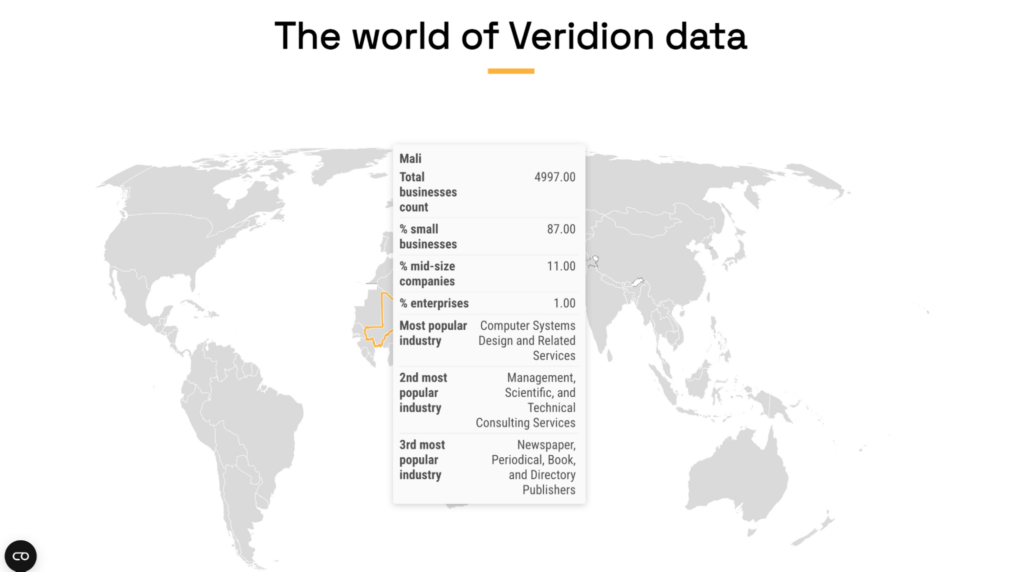
Source: Veridion
Veridion’s distinct advantage lies in its coverage of not just large enterprises but also the often hard-to-map SMB landscape.
Unlike many B2B data providers that skew toward Fortune 500 companies, Veridion delivers reliable visibility into small and mid-sized businesses, including startups, family-owned firms, and independent operators.
Veridion’s data taxonomy allows you to filter by employee count, revenue brackets, and business maturity.
On top of that, the platform updates its data weekly, maintaining a 95% accuracy across all records.

Source: Veridion
This near-real-time approach ensures you’re working with current information, not outdated profiles.
What sets Veridion apart is the depth of its data points: over 80 attributes per company.
These include comprehensive information such as:
The platform offers two primary access methods: the Search API and the Match & Enrich API.
Both integrate into existing systems, allowing you to pull data based on highly specific criteria.
For example, you could search for “sustainable packaging manufacturers in Europe with 10-50 employees” and get instant results.

Source: Veridion
You can also use Scout to search for specific business information.
This AI-powered feature lets you search for suppliers using natural language.
You simply describe what you’re looking for in plain English, and Scout translates your query into precise results.
Source: Veridion on YouTube
Now, while Veridion offers exceptional depth in supplier and product data, it’s worth noting that the platform is heavily optimized for procurement, supply chain, insurance, and risk management use cases.
If you’re primarily focused on contact-level data for outreach campaigns, you might find some of the other providers on this list offer more extensive email and phone coverage.
That said, for enterprises needing comprehensive business intelligence, especially when ESG compliance, product specifications, or corporate hierarchies are important, Veridion delivers unmatched granularity.
To explore how Veridion’s data could support your specific needs, you can download data samples or schedule a consultation.
Next up is Bright Data, one of the most established names in web data collection.
Unlike Veridion, which maintains its own proprietary databases, Bright Data extracts and structures publicly available data from across the web.
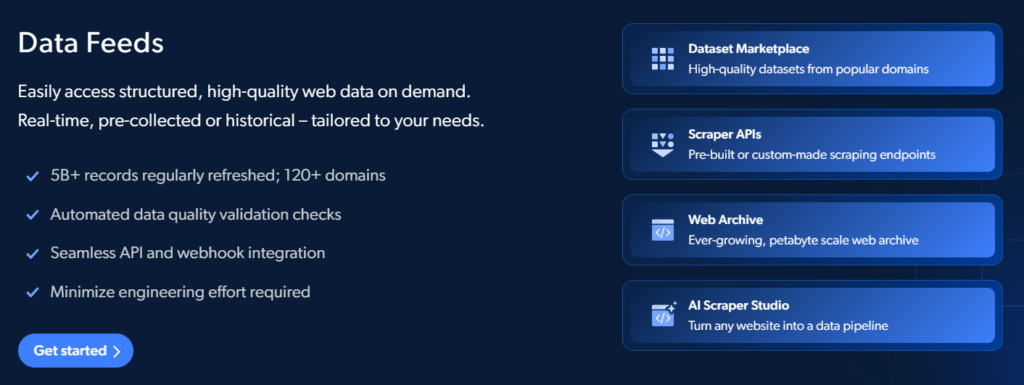
Source: Bright Data
Their millions of business data offerings include information across 100+ industries sourced from public databases.
The scale here is impressive: Bright Data serves over 20,000 customers worldwide, including Fortune 500 companies, academic institutions, and major tech firms.
Its approach is fundamentally different from traditional data providers.
Instead of building a single unified database, Bright Data offers pre-built datasets from specific sources.
For instance, you can purchase a LinkedIn Companies dataset with hundreds of millions of records, or an enriched companies dataset that combines multiple sources.
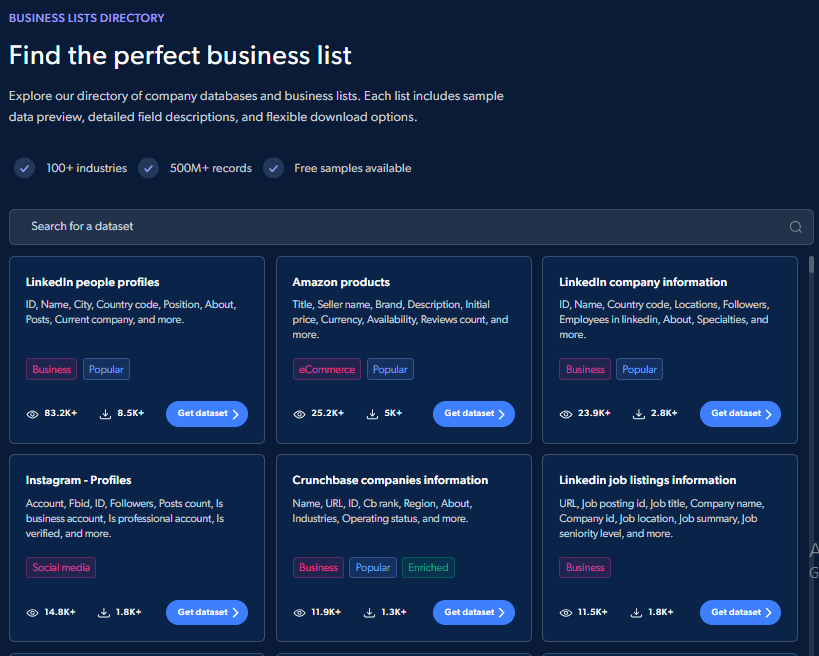
Source: Bright Data
This flexibility means you can choose exactly which data sources align with your targeting strategy.
For small business intelligence, Bright Data’s datasets are valuable when you need social media presence, employee reviews, or job posting data.
You get insights into company culture, hiring trends, and market positioning.
The data is delivered in multiple formats, including JSON, CSV, or Parquet, and can be integrated with cloud platforms like Snowflake, Amazon S3, Google Cloud, and Azure.
This makes it easy to incorporate their datasets into existing data warehouses or analytics pipelines.
Compared to Veridion’s API approach, Bright Data is more about “ready-to-use” lists: you browse a catalog and purchase a dataset.
That means less setup and integration, but also less customization.
Bright Data’s assets come largely from web-scraping and third-party sources, whereas Veridion uses its own AI curation.
This makes the platform ideal for use cases like social selling, recruitment, or competitive intelligence, where ready-to-use data is essential.
But if you need consistent firmographics across all records, you may need to combine multiple Bright Data datasets or supplement with another provider.
For reference, pricing starts at $250 for datasets of 100,000 records.
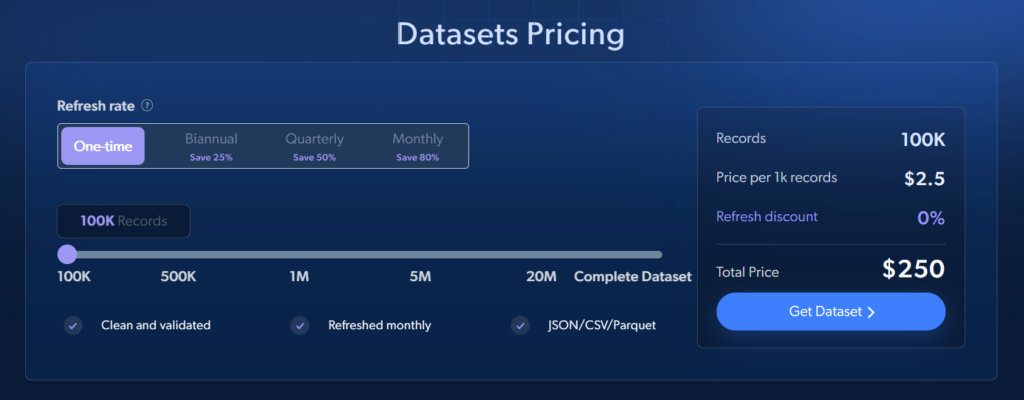
Source: Bright Data
Still, if you value data diversity and want to tap into specific online platforms, Bright Data’s web-scale collection capabilities are hard to match.
Success.ai takes a different approach to the small business data market by combining massive scale with a white-glove service model.
Their platform provides access to over 700 million global professional B2B profiles and 30 million verified company profiles spanning several countries.
Every contact in their database goes through AI-driven validation, and Success.ai achieves 99% accuracy.
This validation process checks email deliverability, phone number validity, and role verification before records enter the database.
The platform updates continuously, reflecting changes in ownership, staffing, and business status in real-time.
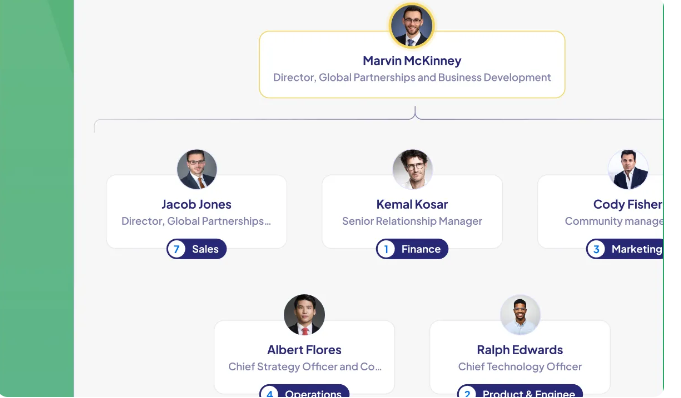
Source: Success.ai
Unlike traditional self-service data platforms, Success.ai assigns each customer a dedicated Success Manager.
This person handles everything from dataset curation to delivery, typically acting as an extension of your team.
The service model here is notably hands-off for the buyer.
You provide your criteria, and Success.ai handles the data selection, enrichment, and delivery.
This approach works well for marketing teams who want quality data without investing time in database management.

Source: Success.ai
By comparison, Success.ai excels in contact-level data—direct emails, phone numbers, LinkedIn profiles—while Veridion provides deeper firmographic and operational intelligence.
For example, if you’re running email outreach campaigns to small business owners, Success.ai’s verified contact data gives you high deliverability rates.
But if you need to understand a company’s product lines, ESG commitments, or supply chain relationships, Veridion’s data taxonomy offers more depth.
Pricing for Success.ai starts at $37/month, and includes:
Other plans include:
The platform also offers GDPR-compliant data processing, which is critical when targeting European small businesses.
For B2B marketers focused on high-volume outreach with strong contact data, Success.ai delivers both scale and service quality.
Data Axle brings multiple years of experience in business data, combined with extensive human verification.
Its database includes more than 90 million business profiles across the United States and Canada, with over 400 data attributes per company.

Source: Data Axle
What’s particularly impressive about Data Axle is its verification methodology.
It employs over 300 data experts who make approximately 25 million phone-verification calls annually.
This human touch supplements their automated data collection, ensuring accuracy that algorithmic approaches alone might miss.
Data Axle claims the industry’s most complete coverage of small- and medium-sized businesses.

Source: Data Axle
This extends to home-based businesses, contractors, freelancers, and other hard-to-spot business types often missed by other providers.
It’s significant because small businesses now operate outside conventional office locations.
The platform provides 19.5 million premium verified business profiles, which include enhanced data like key decision-maker contacts, verified phone numbers, and validated email addresses.
On top of that, they offer 183 million multichannel business contacts, giving you multiple ways to reach the same organization.
Data Axle is known for reliability and support. Its data underpins many marketing and analytics solutions.
The strong small-business focus means if your goal is to reach or analyze the U.S. SMBs, Data Axle is a top pick.
In contrast with Veridion, Data Axle has deeper historical depth in the U.S. market and human validation, but a narrower global footprint.

Source: G2
Ultimately, Data Axle suits companies needing high-quality in-depth U.S./Canadian SMB data with proven accuracy.
Pricing for Data Axle varies based on access method and data requirements, with solutions ranging from self-service platforms like Salesgenie for SMBs to enterprise-grade API access.
Finally, we have BoldData, which operates under the CompanyData.com brand and takes the most straightforward approach to business data.
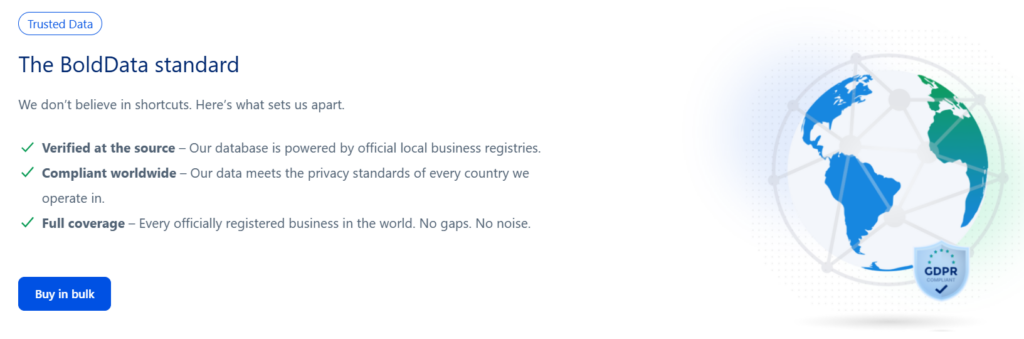
Their database spans 381+ million companies across more than 200+ countries, all sourced exclusively from official government registries and chambers of commerce.
This is BoldData’s defining characteristic: they don’t scrape websites or aggregate from multiple sources.
Source: CompanyData.com
Instead, they build direct relationships with official business registries in each country they cover.
For example, in the United States, they source from the Chamber of Commerce and various state registries.
In Canada, they pull from the Canadian Chamber of Commerce. In the UK, it’s Companies House.
This registry-first approach offers several advantages for small business data:
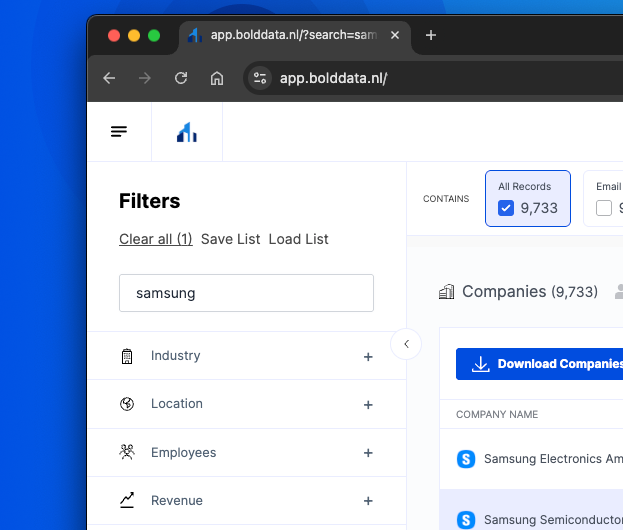
Source: CompanyData.com
They provide over 100 data points per company, including comprehensive firmographics, financial data (where available), contact information for key decision-makers, and complete corporate hierarchies.
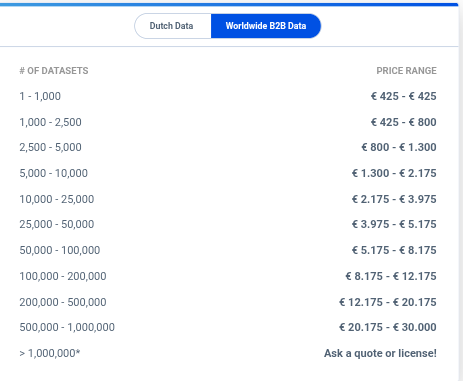
Their pricing starts at €425 for datasets between 1-1,000, making them competitive for bulk data purchases.
Source: Company Data
You can access BoldData’s information through several solutions:
In comparison to other providers on this list, there’s an interesting trade-off.
BoldData’s official-source approach means excellent data on company fundamentals: legal structure, registration details, locations, financials.
But it may lack some of the digital presence data that Bright Data specializes in, or the contact-level detail that Success.ai emphasizes.
For instance, BoldData provides 341+ million phone numbers and 100+ million emails across their database.
This is substantial, but Success.ai’s 700 million profiles suggest deeper contact data coverage.
Conversely, Bright Data pulls social media presence and platform-specific insights that might not appear in official registries.
The key advantage of BoldData is in regulatory compliance and data provenance.
If you’re in any industry requiring verified business information for KYC (Know Your Customer) purposes, official registry data is often mandatory.
Similarly, for market intelligence where you need to understand the total addressable market, BoldData’s complete coverage is valuable.
Where BoldData may fall short is in capturing very new businesses or those operating informally.
A business that incorporated last week might not appear in BoldData’s database until the next quarterly update, while weekly-updated providers like Veridion could find them through online presence much more quickly.
If you prioritize data compliance, official verification, and complete market coverage, BoldData’s registry-focused approach offers unique value.
These are the leading small business data providers that can help you gain B2B insights.
We’ve explored what each provider offers, their unique strengths, and the scenarios where they deliver the most value for large organizations.
Whether you’re already working with one of these vendors or evaluating new options, the goal is the same: gain better information and visibility into the small business ecosystem.
The right data partner goes beyond informing decisions.
It strengthens strategy, reduces uncertainty, and gives your business the confidence to make better decisions in competitive markets.