



Blog
Procurement Data Collection: Best Practices
By: Auras Tanase -
11 March 2026

We love our data, and now that you're here, you're one step closer to loving it too.
A wide sample of data, so you can explore what is possible with our data
Choose ->
built with procurement in mind. Focused on manufacturers, products and more
Choose ->
built with insurance in mind. Focused on classifications, business activity tags and more
Choose ->
built with sustainability in mind. Focused on sustainability commitments, and environmental and social governance insights.
Choose ->
built with strategic insights in mind. Focused on market trends, competitor analysis, and industry-specific data
Choose ->

Keep up to date with our technology, what our clients are doing and get interesting monthly market insights.

Key Takeaways:
With 99% of companies planning to invest in better data quality in the coming years, one thing is clear: accurate, timely, and complete information is king.
Procurement teams, in particular, spend significant time and resources collecting insights from multiple sources to optimize operations, drive cost savings, and mitigate supply chain risks.
But what if you could reduce the effort required to collect this kind of data, while still gaining more actionable, accurate insights than ever before?
That’s exactly what this article explores, outlining five best practices for more efficient procurement data collection and smarter decision-making.
Procurement data collection should always be driven by clear business outcomes.
This ensures your data foundation is strong and that insights are actionable, reliable, and capable of supporting better decisions.
According to the 2025 Anomalo survey, this matters more than ever.
As it turns out, nearly all companies agree that data quality is more important today than it was five years ago, and most plan to invest in data quality initiatives over the next two years.
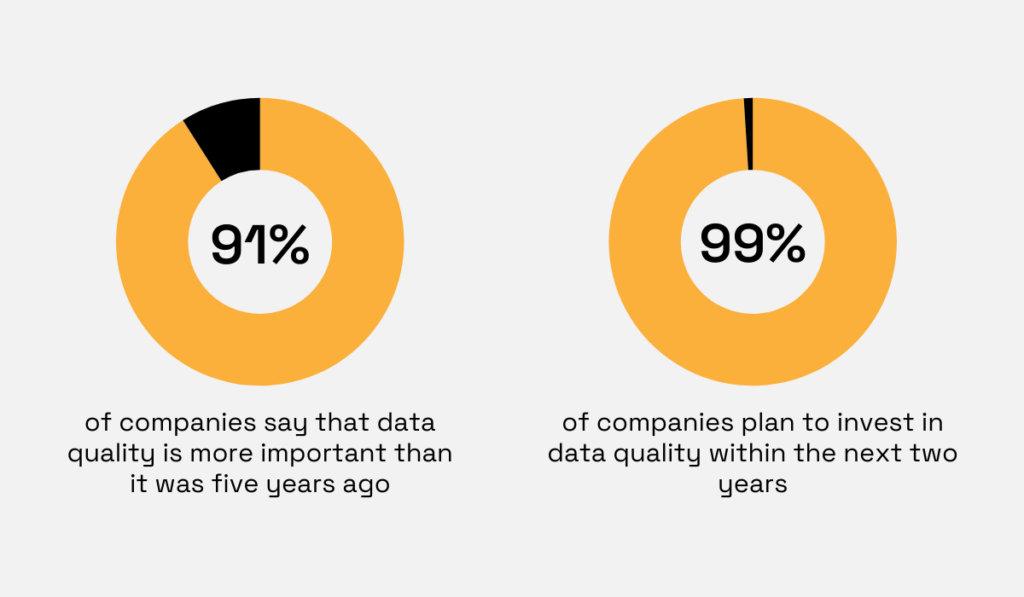
Illustration: Veridion / Data: Anomalo
Note that this isn’t just about investing in advanced technologies that help collect, manage, and analyze data.
You also need to invest time and effort into developing a strong data strategy, and effective goal setting plays a major role here.
When data collection is aligned with broader business objectives, it becomes much easier to define exactly what data is needed, at what level of detail, and how frequently it should be updated.
Without this, procurement teams often fall into the trap of collecting as much data as possible, resulting in excessive or irrelevant information that overwhelms rather than informs.
In other words, this kind of data overload typically does more harm than good.
Marius Ivanauskas, Chief Delivery and Operations Officer at Linklaters, a leading global law firm, explains:
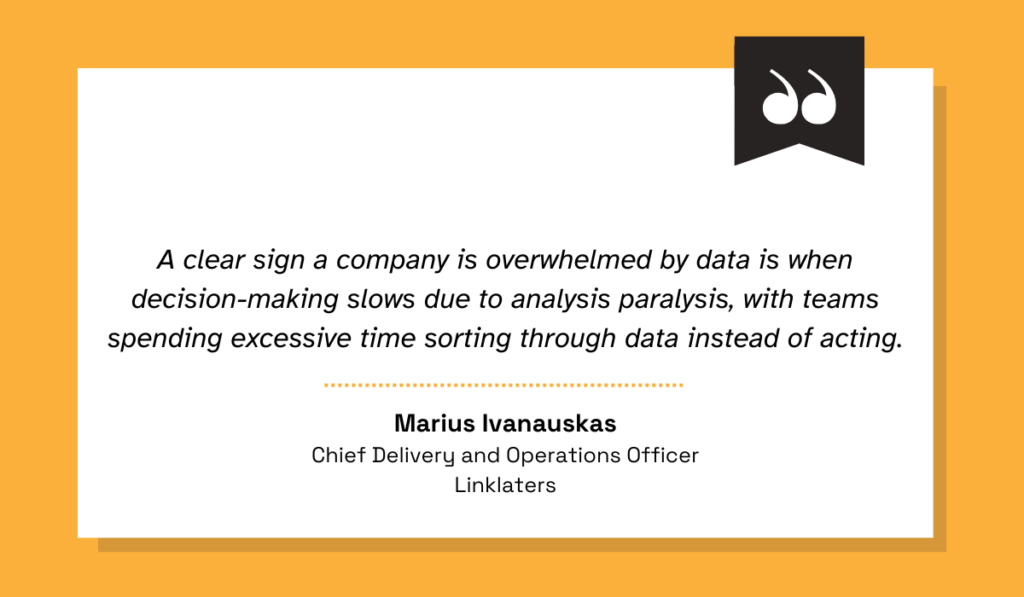
Illustration: Veridion / Quote: Forbes
Ivanauskas adds that this problem can be addressed by prioritizing key metrics aligned with business goals and fostering a culture that values actionable insights over sheer data volume.
So, start by clearly defining why data is being collected in the first place, while keeping broader company goals in mind.
For instance, the company may be focused on “reducing customer churn by 10%” or “increasing quarterly revenue.”
From there, you can perform goal-to-data mapping, explicitly linking each objective to the required data fields, data sources, and update frequency.
For example:
This ensures you collect all the data you need for strategic, data-driven decision-making without overwhelming the team with unnecessary information.
A standard data model establishes a common structure for how data is captured and stored, ensuring that the same data element means the same thing regardless of system, category, or user.
This helps prevent those small errors that often go unnoticed but can lead to confusion and unreliable insights.
Think, for example, the same supplier appearing under multiple names or IDs, or categories being applied inconsistently across regions.
According to Danny Thompson, Chief Product Officer at apexanalytix, a provider of supplier information software, such mistakes have been an industry-wide challenge for nearly 40 years:
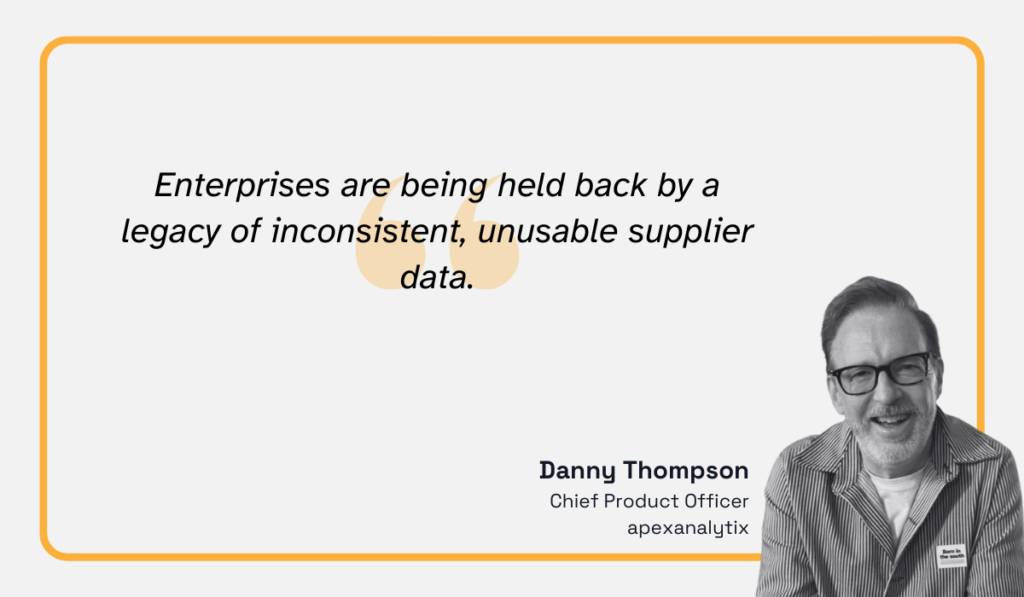
Illustration: Veridion / Quote: CFOtech
The issue is only now becoming fully apparent as more companies embark on digital transformation initiatives and implement advanced technologies like AI.
Since these systems are only as good as the data they rely on, they can quickly expose just how unreliable a company’s data foundation is.
In short, if your data is bad, automation will only result in poor or misleading outputs.
To prevent this problem, ensure effective digitization efforts, and unlock better decision-making, you need a strong data foundation.
And that can only be built with clear standards that keep data consistent over time.
So, consider creating a procurement data dictionary that defines all relevant rules for every core data category, such as spend data or ESG data.
Here’s what to include:
| Data fields | What data is captured (e.g., supplier legal name, payment terms, contract expiry date) |
| Definitions and rules | What each field means, how it is calculated, and when it is required |
| Data formats and values | Controlled vocabularies, drop-down lists, date formats, currencies, and units of measure |
| Ownership | Who is responsible for maintaining accuracy and approving changes |
These standards should be documented in clear, easily accessible SOPs so staff understand what’s required, why it matters, and the consequences of errors or omissions.
When everyone follows the same process, consistency becomes the default.
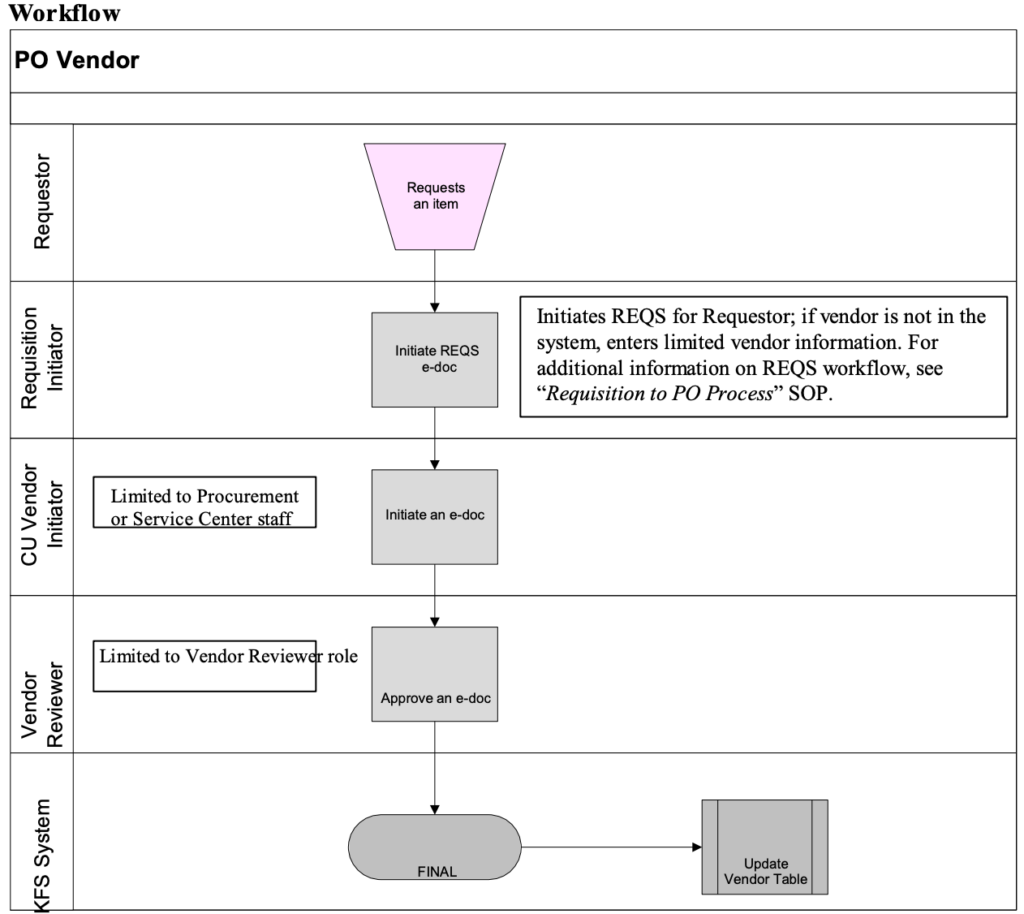
A good example of an effective SOP comes from Cornell University.
It clearly outlines scope, purpose, and responsibilities, then walks through procedures in detail.
Each data field is explained: what it’s for, whether it’s required, which vendors it applies to, and in some cases, who is authorized to enter the information.
Examples are provided where helpful, and the document concludes with a fully illustrated purchase order workflow:
Source: Cornell University
By standardizing data at the point of entry, Cornell ensures the right data is captured, in the right way and in the right format, every time a document is submitted.
This eliminates inconsistencies early on and protects the integrity of the data foundation, preventing issues that could undermine analytics, automation, or AI further down the line.
Procurement data isn’t truly complete if it only offers visibility into your direct suppliers and fails to show sub-tier vendors, dependencies, and upstream risks in the supply chain.
Karin Meurk-Harvey, Board Advisor at Conquer AI, a UK-based technology consultancy that builds custom AI agents and software solutions for enterprises, explains:

Illustration: Veridion / Quote: Proxima
She’s right: many of the most disruptive supply chain events originate beyond Tier 1.
Natural disasters, the financial failure of a critical sub-supplier, or hidden single-source dependencies may not be immediately visible, but they can cause significant damage.
In fact, 2025 research from Sphera shows that the majority of risk and critical incidents occur within Tier 2–4 suppliers.

Illustration: Veridion / Data: Sphera
The only way to proactively address these risks and avoid being blindsided is to collect data beyond Tier 1.
As Meurk-Harvey puts it:
“The companies that succeed in volatile markets are those that treat transparency as an asset, rather than a mere due diligence requirement.”
Of course, this is far easier said than done.
Supply networks are incredibly complex. You may have 100 Tier 1 suppliers, each of which could rely on thousands of their own suppliers, making the network exponentially harder to map.
In many ways, your suppliers hold the key to solving this challenge, as they are the ones who can provide you with the insights you need.
But that requires strong, transparent relationships.
The 2024 HICX survey offers valuable insight here: many suppliers feel that buyer processes are overly complex and demand too much information.
At the same time, those same suppliers say they would be willing to share additional data if working with their customers were simpler.

Illustration: Veridion / Data: HICX
That’s the opportunity.
Build transparent relationships and make it easier for suppliers to work with you.
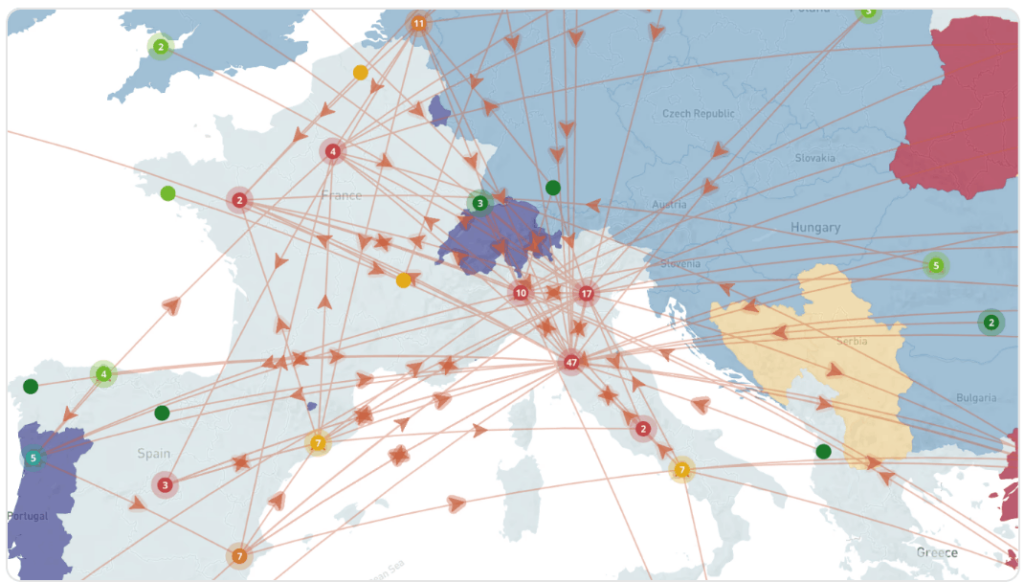
For the latter, try supply chain mapping portals, digital solutions that allow large numbers of suppliers to quickly and accurately identify and locate their own facilities, as well as those of their suppliers.
Source: Sourcemap
These portals provide a single point of access for responding to customer requests for mapping and traceability data, using standardized formats and eliminating duplicate efforts.
The goal is simple: reduce friction for suppliers while giving organizations the deeper visibility they need without overwhelming valuable partners.
Procurement data shouldn’t live in silos scattered across ERPs, finance systems, supplier portals, and other tools.
Gopinath Polavarapu, Chief Digital and AI Officer at JAGGAER, a global leader in enterprise procurement software, explains why:
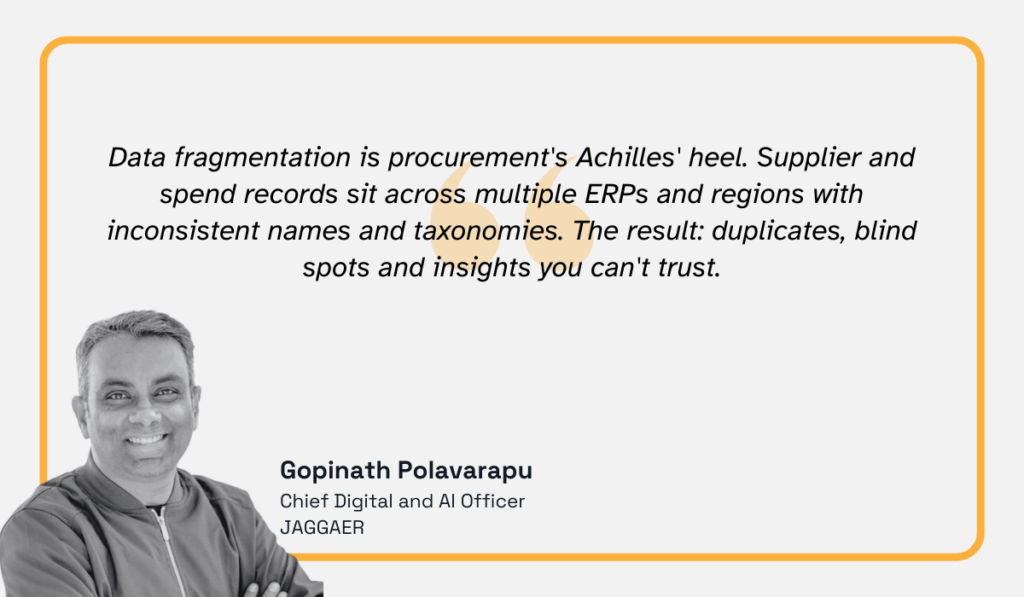
Illustration: Veridion / Quote: Procurement Magazine
Without a single source of truth, you end up with multiple versions of it, leading to conflicting reports, manual reconciliation between departments, and, in turn, a higher risk of errors.
By contrast, a designated system, repository, or framework for authoritative procurement data ensures that all stakeholders rely on the same verified information for decision-making, reporting, and analysis.
Lufthansa is a great example of why such a system is so beneficial.
Until 2022, the company managed its data across 14 separate ERP applications, leading to significant issues and oversights.
Holger Koenig, Enterprise Architect at Deutsche Lufthansa AG, recalls:
“Our data landscape is vast, complex, and distributed across systems. We wanted to break down data silos, simplify the delivery of trusted data faster across all our systems, and provide a single harmonized point of access to all our data sources.”
To achieve this, Lufthansa built an integrated system that connected all data sources, unlocking greater transparency across sourcing tools and simplifying data integration.
As a result, their decision-making process has become much more data-driven.
Their purchasing decisions are now informed not only by a complete view of external spend across the value chain, but also by near-real-time data on price volatility and carbon emissions.
Now, you don’t need to build an expensive, custom system to achieve similar results.
Integrating existing tools via APIs or scheduled data syncs can already deliver significant value.
Today, specialized procurement orchestration tools make this even easier.
These solutions don’t require organizations to abandon their current systems; instead, they connect them through a single, intuitive interface that surfaces the right information at the right time:

Source: ORO
Centralized supplier profiles, for example, pull data from ERP, CLM, sourcing, and risk systems into one unified view.
This ensures that everyone, from procurement to legal to finance, works from the same information.
The platform handles the heavy lifting, so you can focus on analyzing data without worrying that the records tell a different story in every system.
Even if you take every possible measure to ensure the highest data quality, relying solely on internal data is never enough.
That’s where data enrichment comes in, supplementing your internal records with external insights such as a supplier’s financial health, ESG performance, and more.
With enriched data, you get the full picture, extending visibility even beyond Tier 1 suppliers.
It’s no surprise, then, that 27% of CPOs say data enrichment has the greatest impact on improving the efficiency and effectiveness of their procurement operations.

Illustration: Veridion / Data: TealBook
Enriched data helps uncover hidden risks, like geographic concentration or financial instability, so you can manage issues proactively instead of constantly firefighting.
Take our own data enrichment platform, Veridion, for example.
It enables you to tap into a vast global database of businesses to keep your Supplier Master Record (SMR) accurate, de-duplicated, and up to date, giving you the most reliable view of your supplier landscape.
Here’s how our enrichment service works:
Source: Veridion on YouTube
Veridion’s data spans 135 million companies across 250 countries, covering 320+ company attributes, and is updated weekly.
This allows you to collect real-time data on virtually any aspect of your suppliers, and even their suppliers, no matter where they are located.
Some of the data points available in our supplier profiles include:
Simply put, if there’s a hidden risk in your supply chain, Veridion brings it to light.
You can quickly identify non-compliance or bankruptcy issues, geographic exposure to specific risks, and hidden dependencies or concentration risks you may not have been aware of.
And the best part?
You don’t have to spend hours manually researching and compiling this information.

Source: Veridion
Veridion does it all for you, and even alerts you when new risks emerge.
With a single platform, you save time, strengthen your data foundation, and improve supply chain resilience, all at once.
If there’s one thing you should take away from this article, it’s this: your goal should never be to collect as much data as possible.
It should be to collect data strategically, using standardized processes and making it easily accessible to all stakeholders.
That’s what enables truly data-driven decisions and better business outcomes.
Because when you have a strong foundation in place, everything you build on top of it, from sourcing tactics to digitization initiatives, becomes far more likely to succeed.