



Blog
Which Online Business Data Providers Stand Out in Today’s Market?
By: Auras Tanase -
21 June 2026


We love our data, and now that you're here, you're one step closer to loving it too.
A wide sample of data, so you can explore what is possible with our data
Choose ->
built with procurement in mind. Focused on manufacturers, products and more
Choose ->
built with insurance in mind. Focused on classifications, business activity tags and more
Choose ->
built with sustainability in mind. Focused on sustainability commitments, and environmental and social governance insights.
Choose ->
built with strategic insights in mind. Focused on market trends, competitor analysis, and industry-specific data
Choose ->

Keep up to date with our technology, what our clients are doing and get interesting monthly market insights.

Outdated records and incomplete company profiles cost your teams time and money, while also introducing all sorts of risk.
Is this really something you can afford?
Probably not.
Luckily, with the right business data provider, you don’t have to worry about data reliability ever again.
So, here are five of the top online business data providers, what each does best, and how they compare against each other.
Veridion is an AI-driven company data platform built for procurement, risk, and compliance teams.
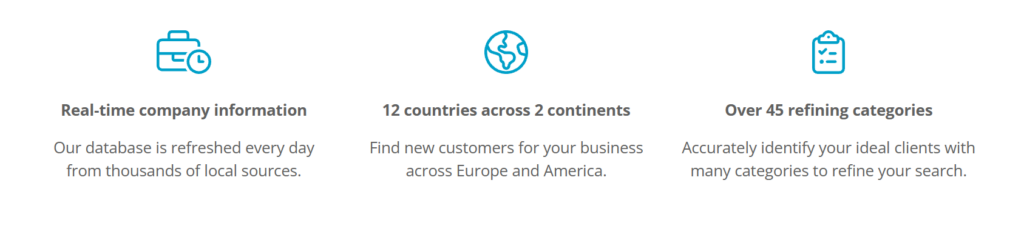
The platform’s database covers:
Veridion focuses on company-level data: what a business does, where it operates, how it is structured, and what products or services it offers.
You get structured business attributes including NAICS and NACE codes, employee count, revenue estimates, technology stack, certifications, and subsidiary relationships.
Additionally, you have access to multi-location tracking and product-service taxonomies that speed up your supplier segmentation.
What sets Veridion apart from most other providers is how it collects data.
Instead of relying on business registries or manually submitted company profiles, Veridion uses AI to read and extract information directly from company websites and official registries.
Then it validates the information against news, filings, and social feeds. That means the data reflects what companies actually say about themselves.
Further, the data is updated continuously rather than in batch cycles, so you get to work with the freshest data available.
It also conducts internal audits that ensure over 95% accuracy.
So, our platform also tells you what that company actually does, what markets it serves, and whether it has the operational footprint you need.
If supplier discovery and market mapping are your biggest data gaps, Veridion addresses those directly.
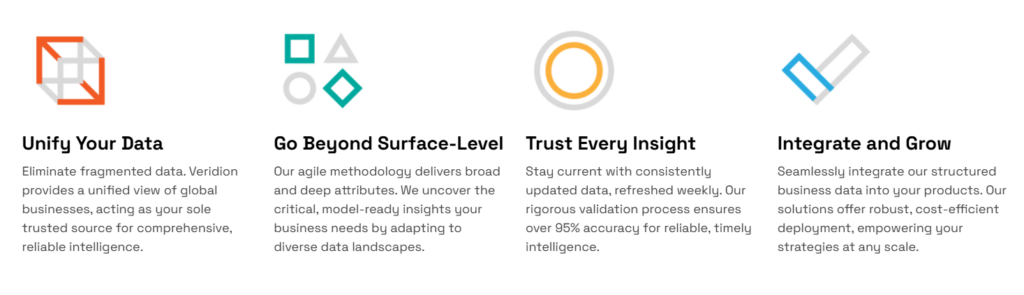
Our platform’s other core benefits include:
Source: Veridion
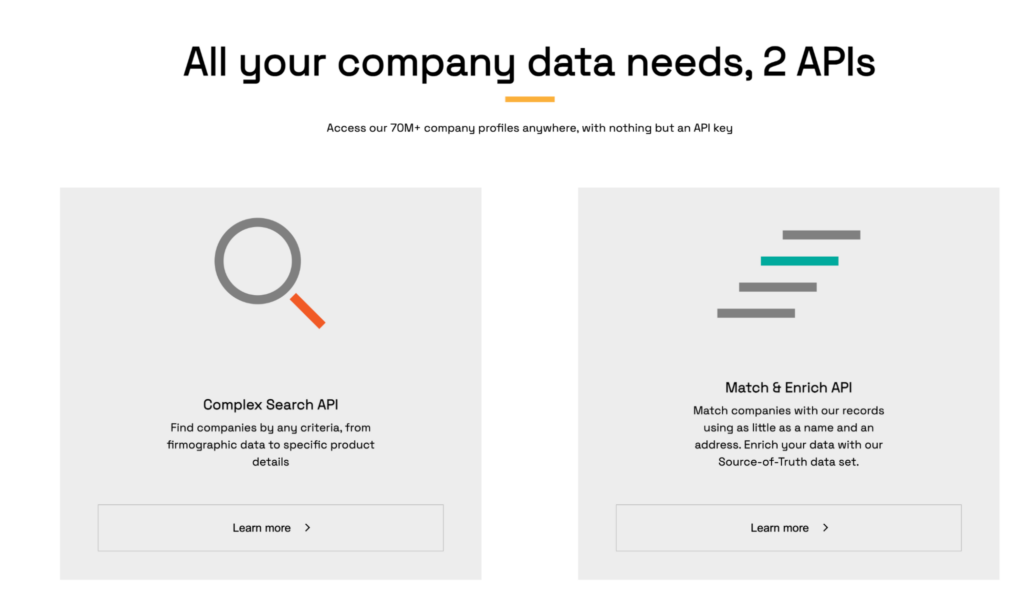
Veridion also integrates via APIs, so you can pull enriched company data into your procurement system, ERP, or supplier database without manual exports.
Source: Veridion
The Search API lets you perform complex, multivariate searches for companies that fit your precise needs. That could be industry classification, employee count, location, or technology stack.
The Match & Enrich API solves a different problem.
Say you already have a list of companies, but the data is messy. Names are inconsistent, addresses are incomplete, or all you have is a website domain.
Feed those details into the Match & Enrich API, and it matches each one to the correct, authoritative record in Veridion’s database. From there, you get the full company profile attached, ready to use.
In short, if you need a 360° company intelligence platform with breadth and freshness, Veridion delivers.
Its weekly updates and rich profiles provide your team with timely supplier insights, helping you make smarter procurement decisions.
Lusha is a B2B contact intelligence platform used by sales and recruitment teams to find verified phone numbers and email addresses for business professionals.
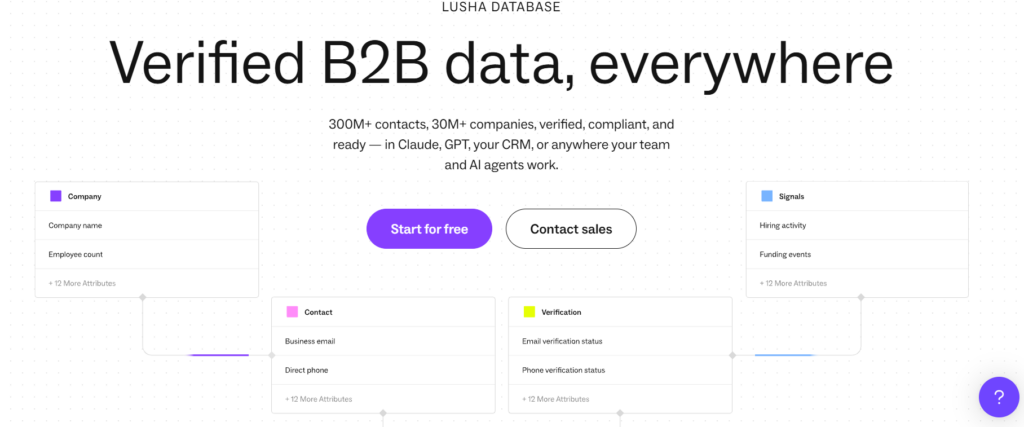
Currently, Lusha serves over 1 million users globally and maintains a database of more than 30M companies and 300M contacts.
Source: Lusha
The platform’s value is in contact-level data. You get direct dials, business emails, job titles, company affiliations, and LinkedIn profile data.
Users praise Lusha for simplifying the process of finding reliable contacts, making it easy to connect with vendors and suppliers.

Source: G2
Lusha integrates with CRM systems such as HubSpot, Salesforce, and Pipedrive, reducing manual data entry and keeping contact records up to date.
It also offers a Chrome extension that pulls contact data directly from LinkedIn profiles.
The distinction from Veridion is important. Lusha excels at the who, not the what.
It will not tell you much about a company’s financials, corporate structure, or product portfolio. But it will get you in front of the right contact faster than most other approaches.
Lusha is also GDPR- and CCPA-compliant, just like Veridion, which should matter for teams operating across the EU and North America.
That said, Lusha works best for large-scale outreach rather than deep intelligence.
If your main goal is speed-to-contact, Lusha helps you build outreach lists at low cost.
But it won’t give you financials or corporate linkages; you will need to combine Lusha with a platform that specializes in those areas.
Think of Lusha as a high-quality Rolodex: you get names and numbers, but not the full company dossier.
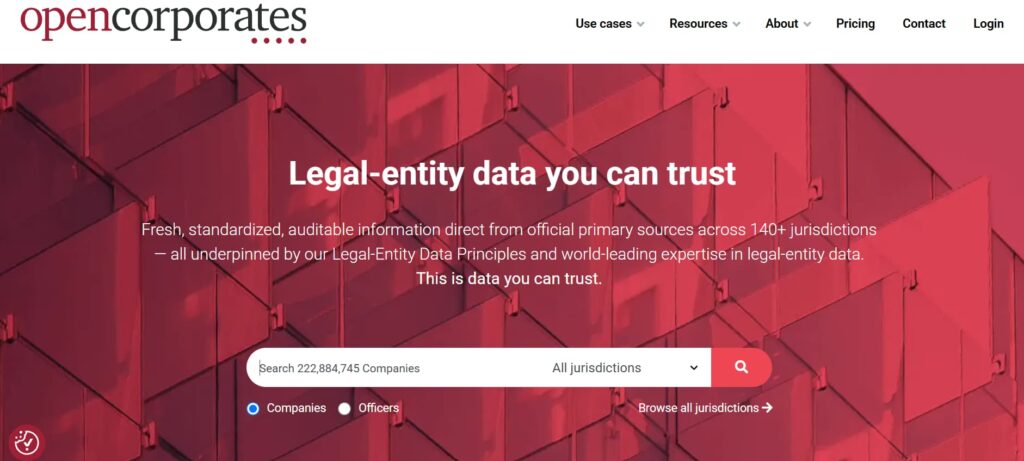
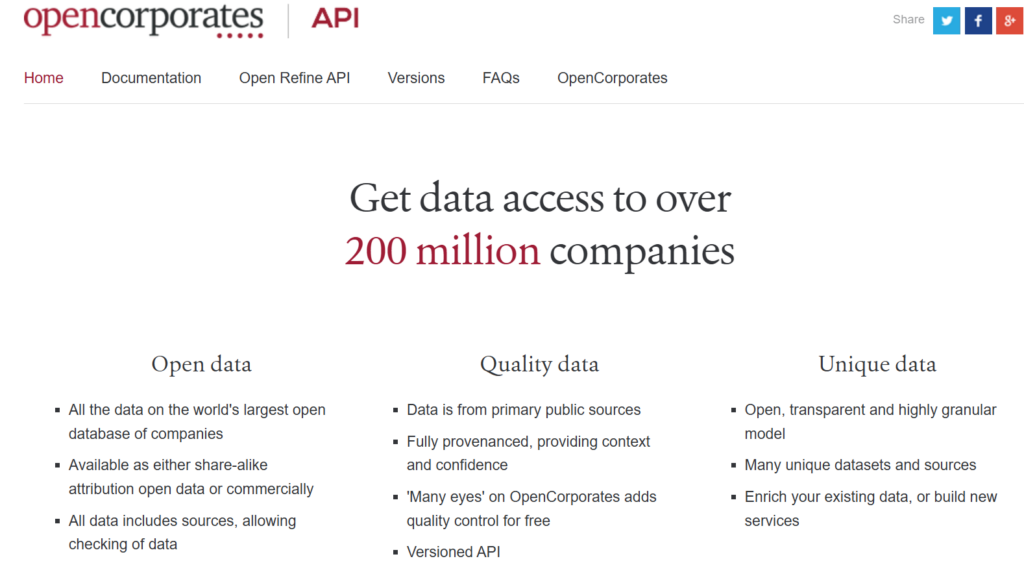
OpenCorporates boasts of being the world’s largest open database of companies and corporate entities, aggregated from official government and regulatory registries.
It covers over 200 million companies across more than 140 jurisdictions worldwide.
Source: OpenCorporates
The platform focuses on legal entity data, including:
The solution does not provide any intelligence on contact level, credit score, or firmographic enrichment. Instead, it provides authoritative, registry-sourced verification.
Because it’s open source, OpenCorporates lets you query corporate names, UBO structures, and officers at no charge (or at a low cost for bulk access).
You can trace shareholdings, see previous filings, and link related entities.
Nevertheless, be mindful of the platform’s drawbacks, such as country-specific updates that make timeliness inconsistent.
Also, smaller companies and private firms may be less complete.
The platform also offers free basic search and paid API access for higher query volumes or integration into compliance and risk systems.
Source: OpenCorporates
API access is useful for large-scale KYC procedures or supplier verification.
Imagine a procurement analyst receives a quote from an unfamiliar supplier.
Before progressing the engagement, a quick OpenCorporates check confirms whether the company is registered, who the directors are, and whether the filing history raises any concerns.
That process takes minutes rather than hours.
OpenCorporates also has a specific advantage for multi-jurisdictional procurement.
Because it aggregates directly from government registries across 147+ countries, you get consistent entity verification whether you are checking a German GmbH, a UK Ltd, or a US LLC.
No other platform on this list matches that breadth of official registry coverage.
Here is how it compares to Creditsafe, which also draws on registry data.
OpenCorporates is more transparent about its sources. Every data point traces back to an official filing, which makes it more reliable for due diligence documentation and audit trails.
Creditsafe, on the other hand, adds financial risk scoring on top of registry data, making it more useful for ongoing supplier monitoring.
OpenCorporates is the stronger choice when your primary need is legal entity verification rather than financial risk assessment.
It’s ideal as a first check in any screening process. If you need deeper analysis (like credit risk scores or contact data), you’ll need to add another provider.
Global Database is a B2B intelligence platform with a massive reach.
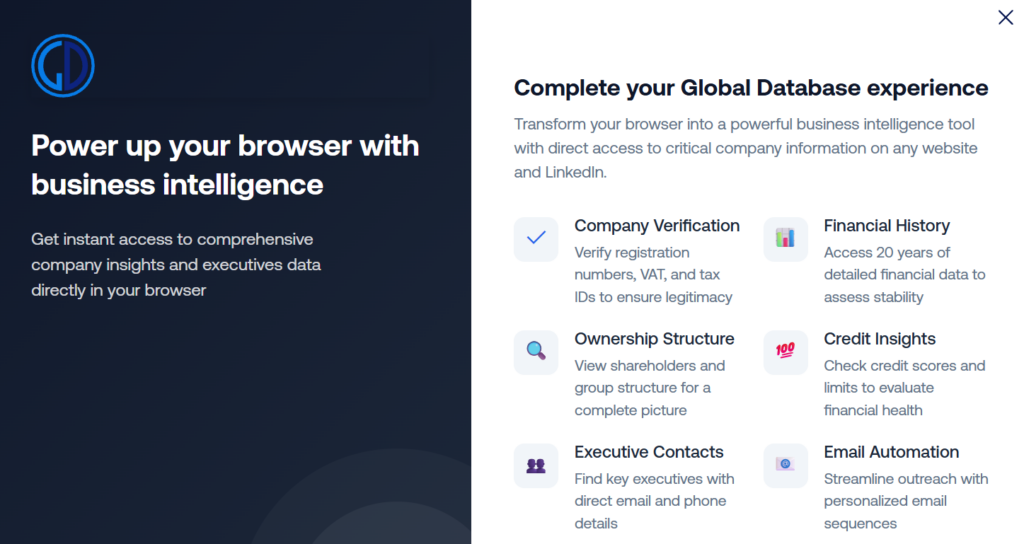
It combines company profiles, financial indicators, and contact data in a single interface, giving procurement teams a layered view of potential suppliers and partners.
Think of it as an all-in-one tool that gives you firmographics, financials, ownership, technographics, and GDPR-compliant contacts in one place.
Source: Global Database
The platform covers over 600 million businesses and includes:
It also tracks corporate group structures, which helps you understand ownership chains and identify related entities across a network.
For enterprises operating in Europe, Global Database offers specific value.
It pulls from local registry sources across multiple European countries, giving you more accurate data in markets where English-language platforms often have thin coverage.
If you are evaluating companies in Germany, Poland, or the Netherlands, Global Database typically delivers more complete profiles than platforms built primarily around US data.
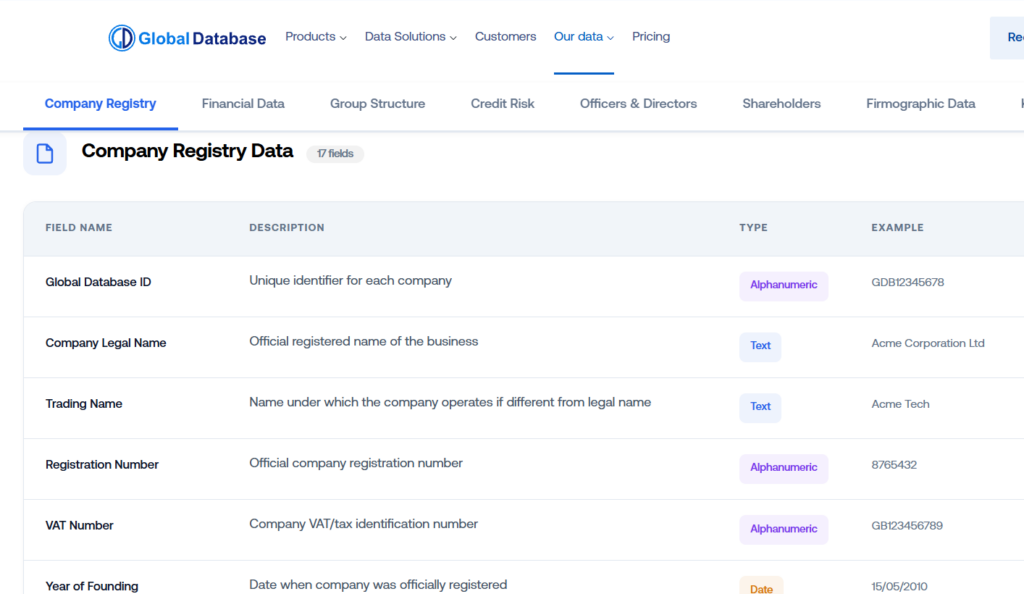
Global Database lets you filter and segment rigorously (by industry, revenue, location, etc.).
Source: Global Database
Moreover, it integrates with CRMs (Salesforce, HubSpot) and has an API for custom use.
Here is how it compares to OpenCorporates. Global Database adds commercial and financial context on top of registry-level data.
You are not just verifying legal existence; you are also viewing financial performance indicators and business contact details in one place.
In comparison, Global Database outperforms Creditsafe in contact enrichment and usability for procurement professionals who are not trained in finance and credit.
On the other hand, Creditsafe provides superior credit risk analysis tools and broader global coverage beyond Europe.
The choice between them usually comes down to your primary need. If financial risk scoring drives your company evaluation process, Creditsafe is the stronger choice.
If you need combined commercial intelligence and contact data for European companies, Global Database is worth a close look.
In short, for teams that require access to a comprehensive global corporate data registry, particularly for finance and ownership, Global Database cannot be beaten.
Its key strengths are its data from official sources and scalability.
Creditsafe is one of the most widely used business credit and risk intelligence platforms worldwide.
It covers over 365 million companies across 160 countries and is used by more than 110,000 businesses globally to assess company financial health, manage credit risk, and support compliance reporting.
Source: Creditsafe
The platform’s core product is the business credit report.
For each business entity, you get a credit score, credit limit, payment performance record, judicial rulings, management details, and key ratios.
These reports draw on official filings, trade payment data, and registry sources to provide a current picture of a supplier’s financial standing.
Put simply, Creditsafe helps you answer “Can this supplier pay its bills?” instantly.
There is provision for standard income and expense statements and scores, allowing you to assess businesses’ creditworthiness across countries.
Source: Creditsafe
The portfolio monitoring feature alerts you when a company’s credit score changes, a new court filing appears, or a company’s structure shifts.
That early warning capability helps you address financial risk before it becomes a major disruption.
The trade-off is scope. Creditsafe emphasizes the finances while ignoring marketing contacts and technology platforms.
Firmographics provided by Creditsafe are leaner than those from its peers.
It’s best to use it as a complementary tool. For instance, procurement teams might use Veridion or Global Database to identify suppliers, then add Creditsafe to vet their financial health.
Another limitation with Creditsafe is that data quality varies by region.
Coverage in North America and Western Europe is strong.
In some emerging markets, data may be sparser or less up-to-date.
If your supplier base spans regions with variable coverage, verify data availability in those specific markets before committing to a plan.
In summary, pick Creditsafe when financial insight is your priority. Having been in the credit info space for 25+ years means it delivers that data faster and more reliably than generalist providers.
You now have the facts on each platform.
Evaluate what your team needs most: ultra-comprehensive firmographics (Veridion, Global Database), executive contacts (Lusha), legal entity verification (OpenCorporates), or financial risk (Creditsafe).
With solid data in hand, your decisions get easier, faster, and better.
So, what’s your next step?
Start by reaching out to those that seem to fit your needs the most and ask for a demo or a consultation.
It’ll give you a clearer understanding of how these tools work and how they can support your workflows.