



Blog
E-Commerce Market Intelligence: Exploring Its Benefits and Challenges
By: Auras Tanase -
02 July 2026


We love our data, and now that you're here, you're one step closer to loving it too.
A wide sample of data, so you can explore what is possible with our data
Choose ->
built with procurement in mind. Focused on manufacturers, products and more
Choose ->
built with insurance in mind. Focused on classifications, business activity tags and more
Choose ->
built with sustainability in mind. Focused on sustainability commitments, and environmental and social governance insights.
Choose ->
built with strategic insights in mind. Focused on market trends, competitor analysis, and industry-specific data
Choose ->

Keep up to date with our technology, what our clients are doing and get interesting monthly market insights.

Key Takeaways:
Every e-commerce business wants to answer the same questions.
What do customers want? Which products are gaining traction? What are competitors doing differently? Where is the market heading next?
E-commerce marketing intelligence answers exactly that by turning large volumes of market data into actionable insights.
This enables e-commerce businesses to make better decisions around pricing, inventory planning, and growth.
Read how.
E-commerce market intelligence is the process of collecting and analyzing data about customers, competitors, products, suppliers, and broader market trends to make better business decisions.
For e-commerce businesses, this means:
This intelligence comes from multiple sources, including customer behavior data, marketplace activity, competitor websites, supplier networks, social media conversations, and third-party business databases.
Depending on the objective, e-commerce market intelligence typically includes:
| Competitive intelligence | Monitoring competitor pricing, promotions, product launches, and assortment strategies |
| Product intelligence | Identifying emerging product trends, fast-growing categories, and gaps in the market |
| Customer intelligence | Understanding purchasing behavior, preferences, reviews, and changing demand patterns |
| Supplier intelligence | Evaluating suppliers, discovering new sourcing opportunities, and monitoring supply chain risks |
As technology, consumer behavior, and market conditions shift rapidly, investing in good e-commerce market intelligence is no longer optional.
The real value of e-commerce or even B2B market intelligence lies in its ability to reduce uncertainty and to understand the overall direction of the industry.
Here are three areas where market intelligence delivers the most value for e-commerce businesses:
With e-commerce intelligence, businesses now track what’s selling, what’s being discounted, which products competitors are pushing aggressively, and where they are gaining or losing market share.
Take the case of Walmart and its Everyday Low Prices (EDLP) strategy.
Instead of reacting to every competitor discount, Walmart maintains a consistently low-price baseline.
It supports this through continuous monitoring of supplier costs, product availability, inventory movement, category performance, and competitor pricing across thousands of products.
This helps identify where costs can be optimized and where competitive pressure is building.
The result is a pricing system that reduces the impact of short-term promotional battles led by competitors like Amazon or Target, because customers already associate Walmart with consistently low prices.
John Furner, Walmart CEO, captures the essence of EDLP strategy perfectly:
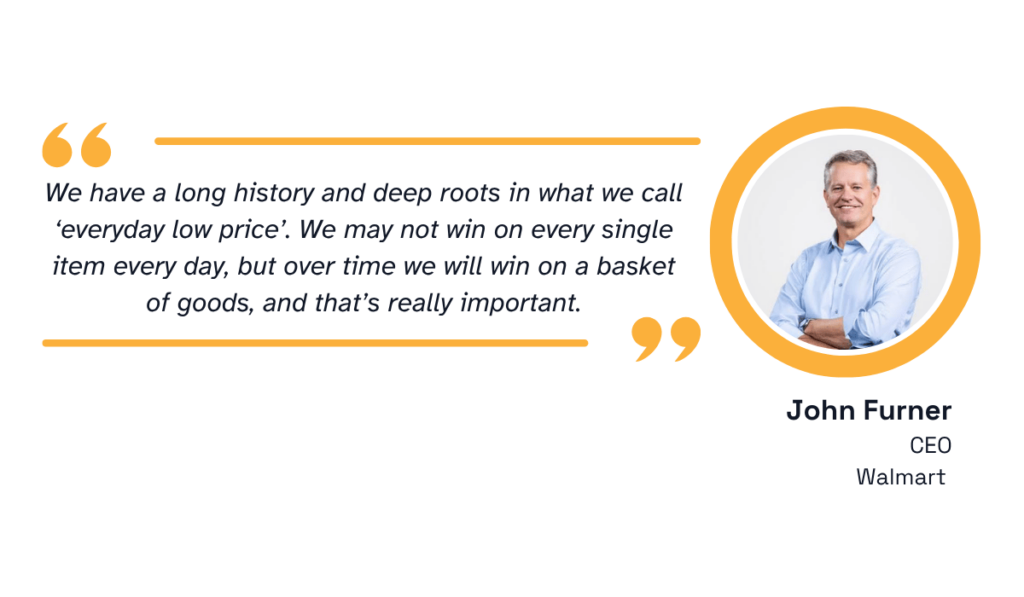
Illustration: Veridion / Quote: TheStreet
Walmart also uses rollback pricing to respond to specific market events.
When competitors launch aggressive seasonal campaigns, such as during back-to-school or holiday periods, it selectively lowers prices on high-traffic products to protect demand and draw customers back into its ecosystem.
Alongside this, this giant retailer also uses price matching as a defensive mechanism in competitor analysis.
In effect, Walmart operates a pricing system that assumes competitors are always moving and continuously adjusts to neutralize those actions before they influence customer behavior.
The broader takeaway is that competitive intelligence is no longer just about tracking prices.
It is about understanding the drivers behind competitor decisions and using that context to make faster, more informed strategic moves.
Customer intelligence helps e-commerce businesses understand what customers want, how they shop, and why they leave.
This matters because retention is often cheaper than acquisition.
Sephora is an excellent example here.
The global beauty and cosmetics retailer noticed that many shoppers standing inside its stores were using their phones to compare products, read reviews, and look for recommendations before making a purchase.
Using this intelligence, Sephora launched its mobile app to address these behaviors directly, giving customers access to reviews, product recommendations, pricing information, and AI-powered virtual try-ons in one place.

Illustration: Veridion / Quote: a-bots
More importantly, Sephora integrated data from its app, website, and physical stores to create a 360-degree view of the customer journey.
This allowed the company to track how online browsing influenced offline purchases and identify the pathways customers followed before buying.
For example, Sephora could determine whether a shopper researched products online, interacted with the mobile app, and later completed the purchase in-store.
The insights proved valuable.
Sephora found that 70% of customers who visited its website before making an in-store purchase completed the transaction within 24 hours, and more than half of those shoppers used mobile devices during their research.
When the retailer included in-store purchases in its attribution analysis, it uncovered a 3.9x higher return on ad spend (ROAS) and a 3x increase in conversion rates from its digital campaigns.
Customers who visited the website within a day of purchasing also spent 13% more on average in-store.
Many e-commerce companies, along with the so-called click-and-mortar businesses like Sephora, rely on customer intelligence to power product recommendations, personalized offers, abandoned cart campaigns, and loyalty programs.
This helps improve customer engagement and drive repeat purchases.
By the time a trend appears in sales reports, competitors may have already acted on it.
Zara built its entire business model around solving this problem.
While most fashion retailers commit to seasonal collections months in advance, Zara’s systems scan social media, fashion blogs, influencer content, and cultural signals in real time to detect trend shifts before they show up in traditional market research.
Each of Zara’s 6,000+ stores streams real-time data back to headquarters: items sold, returns, inventory levels, app interactions, and staff feedback.

Source: ChiefAIOfficer
That data feeds into a centralized intelligence where designers, product managers, and logistics teams monitor live dashboards.
Corporate reports are updated hourly, and designers work from data-driven dashboards.
The result: Zara brings new products from concept to store shelves in 10 to 15 days, against an industry average of around 150!
Zara also sells 85% of its items at full price, far above the industry norm of 60%. And only 10% of Zara’s inventory goes unsold annually, compared to 17–20% for most competitors.
That’s what early trend intelligence actually delivers: better margins and more customers who find what they were looking for.
In other words, market trend intelligence helps businesses spot such trends and changes sooner, allowing them to adjust products, pricing, marketing, and customer experiences before competitors do
While the benefits of market intelligence are significant, putting it into practice is not always straightforward.
Here’s why.
The core challenge with market intelligence in e-commerce is finding data that’s accurate, current, and detailed enough to actually drive decisions.
A dataset that was accurate six months ago could misguide business decisions today. In other words, acting on bad data is often worse than having no data at all.
This is exactly the problem Veridion solves.
Veridion is an AI business intelligence platform that tracks over 134 million companies across 250+ countries, with each company profile updated weekly.
The depth of the data matters just as much as the freshness.
Veridion’s profiles include 320+ structured attributes per company, covering everything from product and service portfolios to ESG metrics, corporate hierarchy, location intelligence, technographic data, and financial signals.
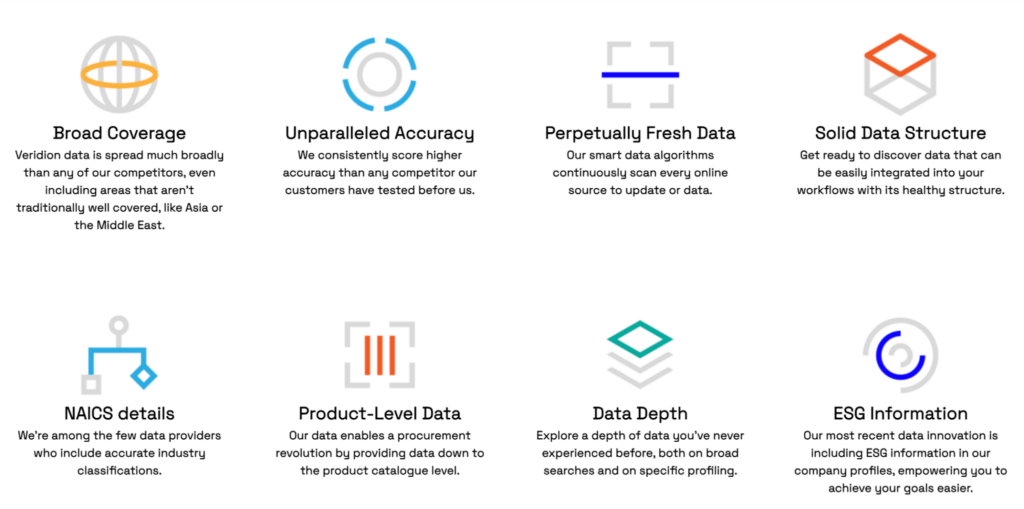
Source: Veridion
For e-commerce teams specifically, Veridion’s market intelligence data supports two critical workflows:
| Competitor monitoring | Understanding who sells what, where, and at what scale, so your team can spot gaps and threats before they show up in your revenue |
| Supplier sourcing | Finding reliable suppliers across geographies, with visibility into product-level detail that most data providers simply don’t offer |
In other words, not only does Veridion present you with a rich, fresh list of potential candidates in mere minutes, but it also lets you keep your eye on the existing suppliers.
That way, you’re the first to know about any changes in their business operations and potential risks or disruptions in your supply chain.
Fines for severe GDPR violations can reach €20 million or 4% of global annual turnover, whichever is higher.
But GDPR is only the beginning.
Take a glance at some other EU regulations e-commerce businesses need to navigate:
| Regulation | What It Requires |
|---|---|
| General Product Safety Regulation (GPSR) | Requires businesses to maintain product traceability, monitor safety risks, share accurate product information, and take swift action when unsafe products are identified. |
| Digital Services Act (DSA) | Requires online platforms to improve transparency around advertisements, recommendations, seller information, and the handling of illegal or harmful content. |
| Digital Markets Act (DMA) | Restricts anti-competitive practices by large digital gatekeepers and promotes fair access, visibility, and data usage rights for third-party businesses. |
| European Accessibility Act (EAA) | Requires digital commerce experiences, including websites, apps, and customer-facing services, to be accessible to people with disabilities across the EU. |
| Packaging and Packaging Waste Regulation (PPWR) | Requires businesses to reduce packaging waste, improve recyclability, increase material traceability, and meet stricter packaging design, labeling, and sustainability standards. |
And it’s not just regulations.
Third-party cookies, the backbone of behavioral tracking, are being phased out by most major browsers.
As of 2025, Safari, Firefox, Brave, and DuckDuckGo all block third-party cookies by default.
Chrome has delayed its phase-out, but the direction is clear.
Businesses will have to move toward first-party data strategies:
Interestingly, a study of GDPR’s impact on e-commerce companies found that while compliance did increase operational costs, it also improved data security and measurably increased customer trust.
That’s a worthwhile trade.
So, what does compliant market intelligence actually look like in practice?
It means being clear about what data you’re collecting and why.
It means working with providers that hold proper certifications and can explain, precisely, how their data is sourced.
And most importantly, it means building good data practices before regulators ask questions, not after.
In the e-commerce industry, consumer preferences can shift quickly, and trends can emerge from virtually anywhere.
The explosive growth of social commerce illustrates this perfectly.
Social commerce sales have already exceeded $1.17 trillion globally, proving that platforms once used primarily for product discovery are now major sales channels.
For instance, consider how quickly trends take off on platforms like TikTok or Instagram.
CeraVe’s rise from a relatively ordinary drugstore skincare brand into one of the world’s fastest-growing beauty companies is a perfect example.
Much of the brand’s growth was fueled by an unexpected shift in consumer behavior: dermatologists, skincare experts, and TikTok influencers began recommending CeraVe products at scale.

Source: Nylon
The trend accelerated so quickly that some retailers reportedly struggled to keep popular products in stock during peak demand periods.
But viral trends are only one part of the challenge.
E-commerce businesses often operate across multiple markets where consumer behavior, pricing expectations, and purchasing patterns can vary significantly by region.
At the same time, competitors are continuously adjusting prices, launching promotions, expanding product lines, and experimenting with new sales channels.
Tracking these changes manually is both time-consuming and prone to errors.
Seasonality adds another layer of complexity.
Shopping behavior during Black Friday, Cyber Monday, or festive seasons can differ dramatically from normal purchasing patterns, creating sudden spikes in demand that are difficult to predict without real-time visibility.
Fun Fact: Did you know 2025 Cyber Monday hit ~$14 billion in sales?

Source: Adobe News
This is why modern market intelligence cannot rely just on static reports or annual industry studies.
E-commerce businesses today need continuous intelligence flows: automated monitoring of competitor activity, supplier movements, pricing shifts, and demand signals, so they’re seeing change as it happens, not weeks after.
Whether it’s evaluating suppliers, monitoring competitors, identifying market opportunities, or responding to shifting customer demand, better decisions start with better data.
That’s why market intelligence has become a critical capability for modern e-commerce businesses.
The challenge is no longer access to information. It’s access to information that is accurate, current, and complete.
E-commerce businesses that build their strategies on reliable market intelligence will be far better equipped to uncover opportunities, reduce risk, and make confident decisions in a constantly changing market.