



Blog
5 Common Myths About Master Data Management
By: Stefan Gergely -
21 January 2026


We love our data, and now that you're here, you're one step closer to loving it too.
A wide sample of data, so you can explore what is possible with our data
Choose ->
built with procurement in mind. Focused on manufacturers, products and more
Choose ->
built with insurance in mind. Focused on classifications, business activity tags and more
Choose ->
built with sustainability in mind. Focused on sustainability commitments, and environmental and social governance insights.
Choose ->
built with strategic insights in mind. Focused on market trends, competitor analysis, and industry-specific data
Choose ->

Keep up to date with our technology, what our clients are doing and get interesting monthly market insights.

Key Takeaways:
In the complex world of enterprise procurement, your decisions are only as good as the data on which they’re based.
Master Data Management (MDM) promises a single source of truth for critical entities like suppliers, materials, and contracts.
Yet, persistent misconceptions prevent many organizations from realizing its transformative potential.
For procurement executives navigating supplier risk, cost optimization, and digital transformation, these myths aren’t just theoretical.
They actually create tangible barriers to efficiency, compliance, and strategic value.
Let’s dismantle five of the most common and costly MDM myths, replacing fiction with actionable, evidence-based insights.
Many organizations relegate Master Data Management to the IT department, viewing it as a technical software implementation akin to upgrading a server or installing a new CRM, or just a box for the IT team to tick off.
This mindset frames MDM as a backend technical fix, disconnected from core business operations.
McKinsey finds that only 16% of MDM programs are funded as true organization-wide initiatives.
The rest are shoehorned into IT budgets, which leaves business users out.
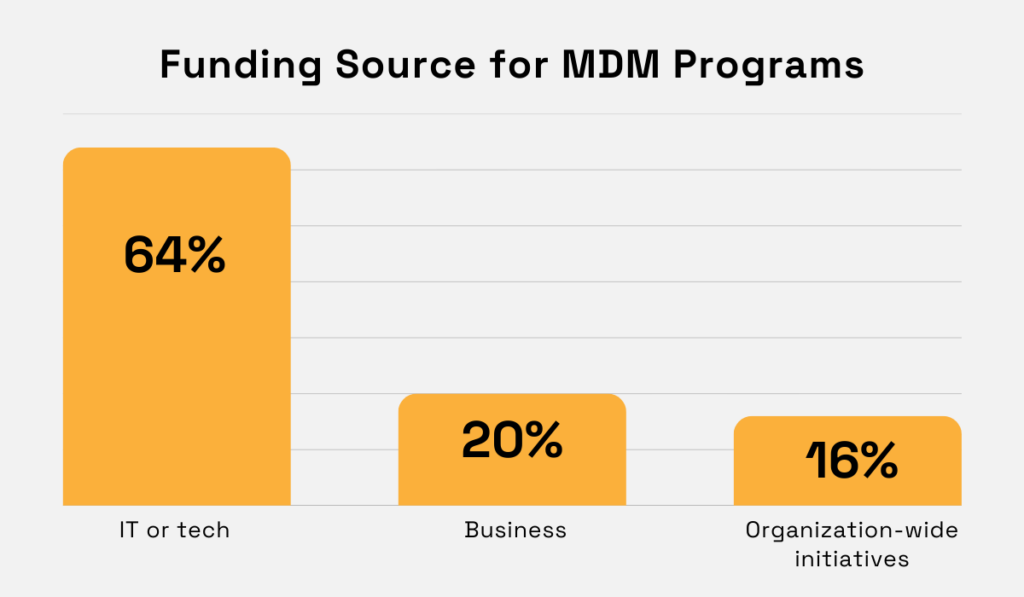
Illustration: Veridion / Data: McKinsey
This is a recipe for failure, because without business ownership, governance falters and adoption stalls.
In reality, MDM is a business-driven discipline that spans procurement, finance, sales, operations, compliance, and beyond.
It is a cross-functional business discipline with profound strategic implications, especially for procurement.
Graeme Thompson, CIO at Informatica, a cloud data management solutions provider, stresses that MDM has very real business consequences.
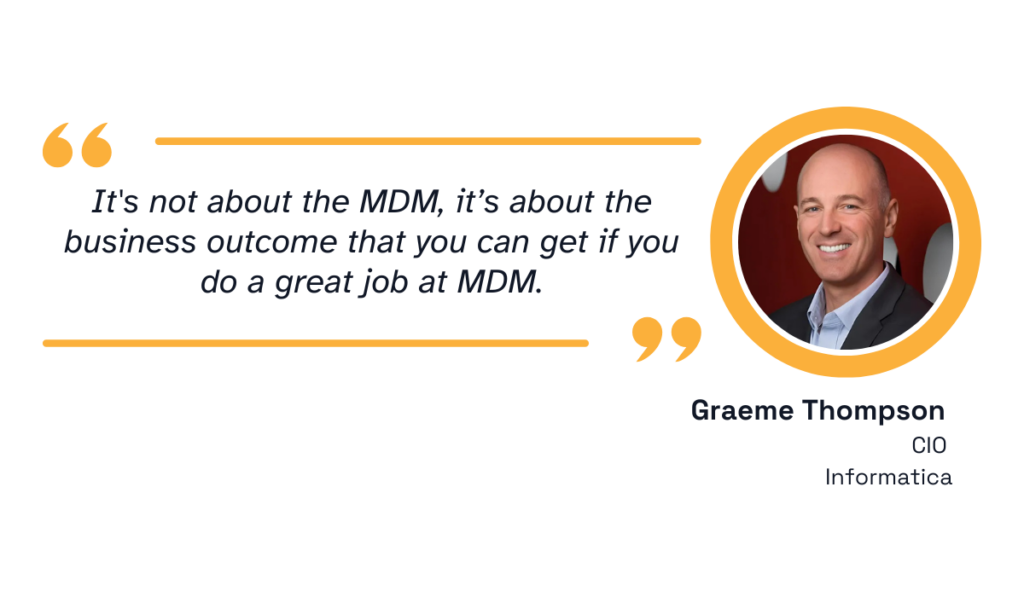
Illustration: Veridion / Quote: Information Week
Therefore, business leaders should start talking about the business outcomes because they are so severe.
In other words, to drive ROI, you must tie data initiatives to clear business goals.
While IT provides the enabling technology, the program’s ownership, rules, and success metrics must be driven by the business.
Procurement, finance, operations, and compliance are not just end users, but also essential stewards of the data.
When treated as IT-only, MDM programs lack business buy-in, data stewardship, and clear goals.
To succeed, make MDM cross-functional.
Assign clear data-owner roles (e.g., procurement owns supplier data, finance owns customer billing data) and involve those teams in planning and governance.
Establish a steering committee with both IT and business reps.
When business users see how a “single source of truth” enables them to make faster, better decisions, you’ll get stronger buy-in.
It’s easy to assume MDM is only for Fortune 500s, with vast IT budgets and sprawling data landscapes, but smaller organizations face the same data chaos.
In fact, smaller organizations often feel the pain more acutely because they lack the large teams needed to clean and reconcile data spreadsheets manually.
Mid-market organizations and even scaling startups face the same core challenges:
One survey found that nearly 39% of organizations have no formal governance and lose about $12.9 million per year due to bad data.
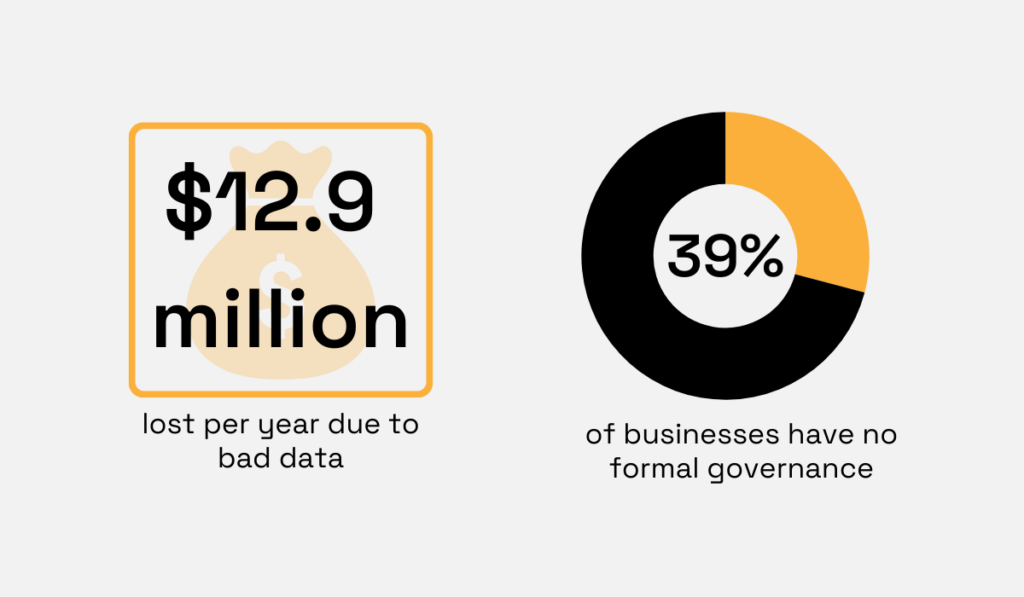
Illustration: Veridion / Data: Gartner
Plus, it’s important to take into account that companies run on data, so even a 5-person startup can suffer from duplicate vendor records or misclassified items.
The complexity of the modern B2B ecosystem data competency is an equalizer, making MDM a scaling necessity.
The initial MDM investment may be smaller and focused, but the payoff scales as you grow.
Consider your own vendor base: companies merge, relocate, change their names, or shift their operational focuses.
Maintaining an accurate view manually is unsustainable, but implementing MDM early prevents problems later.
In short, any company with multiple systems or locations should consider MDM.
So, take the time to assess your data pain points.
If you’re struggling with supplier onboarding time, spend aggregation, or compliance reporting, you have an MDM use case.
Start with a focused domain, like supplier data, to demonstrate value and build a scalable framework.
Start early, scale MDM iteratively, and you’ll avoid the chaos that eventually derails rapid growth.
Some view an MDM platform as a silver bullet that magically cleanses all bad data.
They believe that, once implemented, it will automatically cleanse inconsistent, duplicate, and incomplete data, magically delivering perfect “golden records.”
An MDM platform is a powerful tool, but it won’t magically cleanse bad data on its own.
It provides the structure—the rules, workflows, and a hub—to manage data, but it can’t replace disciplined processes and good data habits.
Dun & Bradstreet strategist Amy Cooper agrees.
MDM, she explains, only provides structure and matching rules, but it requires organizational commitment to data quality.
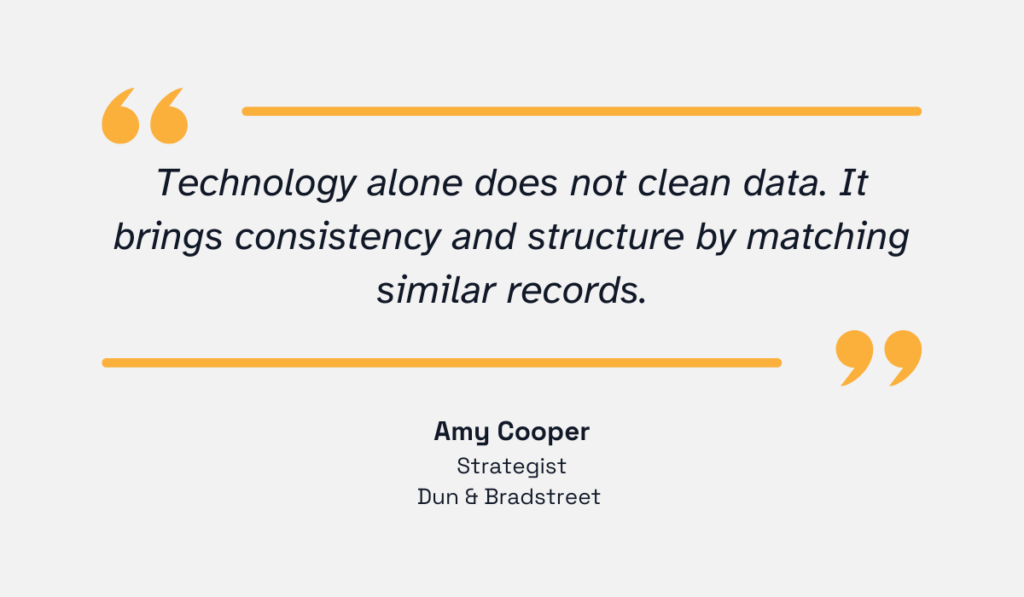
Illustration: Veridion / Quote: Dataversity
Think of it as building a state-of-the-art library.
MDM installs the shelves, the catalog system, and the check-out process.
However, if you fill it with damaged, mislabeled, or outdated books, the library’s value is lost.
Achieving high data quality and integrity requires organizational commitment and the right tools.
The early stages of MDM involve steady work: defining data standards, aligning business rules, and cleaning up legacy issues.
Over time, with each improvement cycle, benefits grow.
But if you simply “flip a switch” on an MDM hub without governance, you’ll end up with organized garbage, and expert insights reinforce this.
Doug Gilbert, CIO at Sutherland Global, a business and digital transformation service and solutions provider, warns about the dangers of skipping the basics.
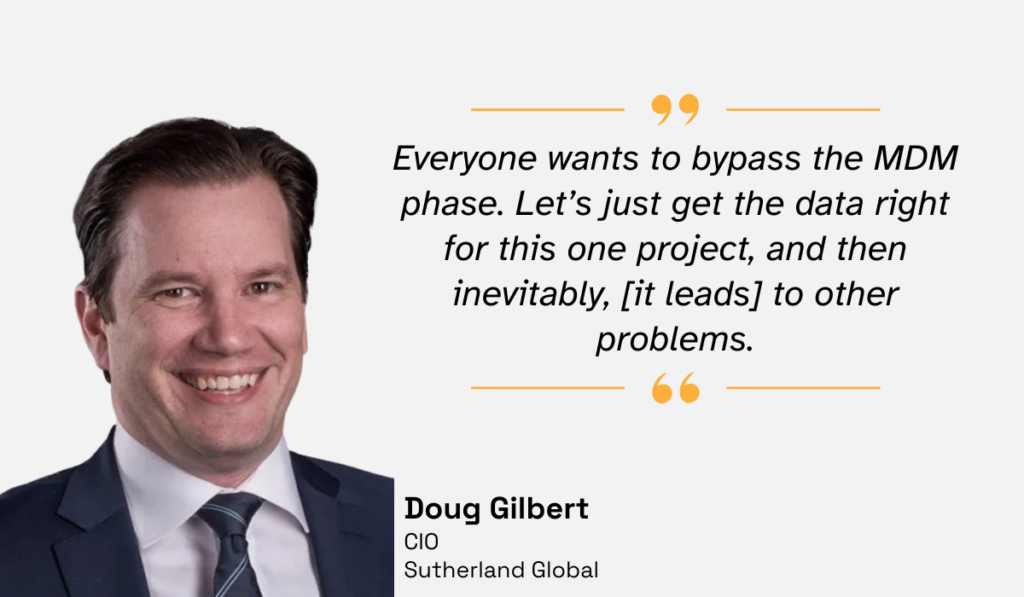
Illustration: Veridion / Quote: Information Week
Deploying MDM is less about the tool and more about redesigning workflows and organizational structure.
So, treat MDM as a continuous program with clear policies and quality checks, not a one-off tool deployment.
Some organizations believe MDM should only manage and harmonize data from internal systems like ERPs, CRMs, and procurement software.
In reality, third‑party data is crucial for accuracy.
Relying solely on internal data is a critical mistake that guarantees the decay of your master data over time.
Why?
Because internal systems often contain outdated, conflicting, or incomplete information, especially in the dynamic B2B world where companies constantly evolve.
For example, a supplier’s legal name, headquarters address, or industry classification might be incomplete or outdated internally.
MDM systems routinely integrate external sources, such as public records, data vendors, and partner feeds, to enrich and validate master records.
By matching your vendor list with reliable external firmographic sources, you correct errors and fill gaps.
For procurement, this is paramount.
Consider the following:
| Data Enrichment | Append missing info (e.g., company size, NAICS code, geographic coordinates) from sources that specialize in business data. |
| Validation | Use external services (like address validators or public registries) to verify key fields. For instance, linking an address to a postal database improves delivery accuracy. |
| Freshness | B2B relationships change rapidly. Companies merge, rebrand, or relocate. Live enrichment ensures your golden record stays up to date with the latest hierarchy and risk data. |
Without this continuous refresh supported by external data sources, your “golden record” can become outdated the moment it’s created, leading to failed deliveries, compliance breaches, and missed risk signals.
Your MDM strategy should, therefore, include a plan for integrating trusted external data streams to maintain accuracy and relevance.
This is where specialized data partners add immense value.
For instance, Veridion provides continuously refreshed vendor firmographics and operational data to enrich your MDM.
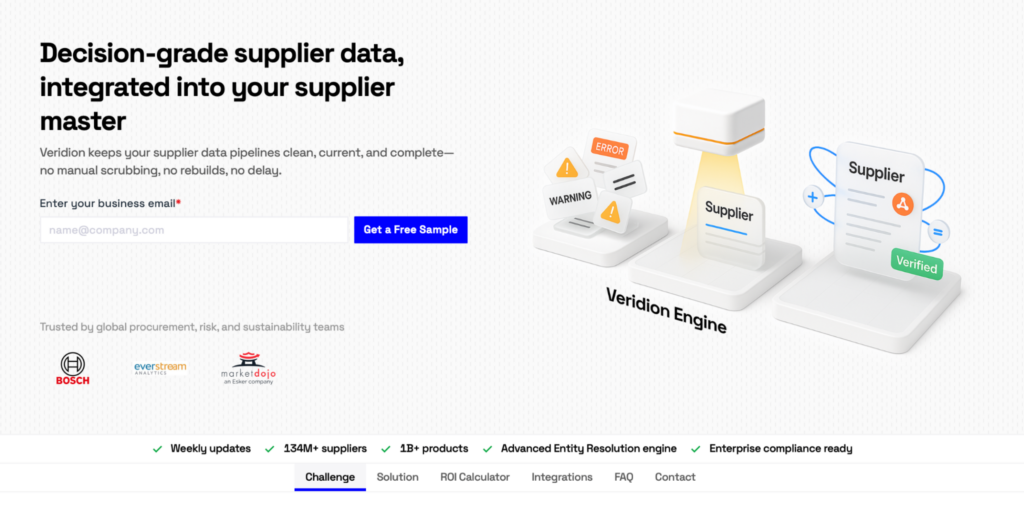
Source: Veridion
It can automatically update changes such as mergers, address shifts, industry reclassifications, or risk signals, preventing your supplier records from going stale.
By integrating this kind of real-time external intelligence, procurement teams gain a more accurate, compliant, and proactive view of their entire vendor ecosystem.
Integrating such a source into your MDM ecosystem can automate the enrichment and continuous updating of supplier records, ensuring your procurement team works with the most current and comprehensive information available.
Historically, yes, MDM projects could drag on.
This persistent belief stems from the early 2000s, when MDM projects were monolithic, multi-year enterprise transformations requiring massive custom coding and complex integrations, often failing to show ROI.
But, gone are the days when MDM deployments required year-long, enterprise-wide overhauls.
Today’s MDM tools and approaches are much more agile.
You can start small and see quick wins.
Modern cloud MDM platforms let you start with a single domain (such as vendor or product data) and scale out.
In other words, you don’t need to overhaul all domains at once.
The prevailing best practice is an incremental, use-case-driven approach.
Instead of attempting to master all data entities (customer, product, supplier, location) at once, organizations start with a single high-value domain.
In practice, the MDM implementation process could look like this:
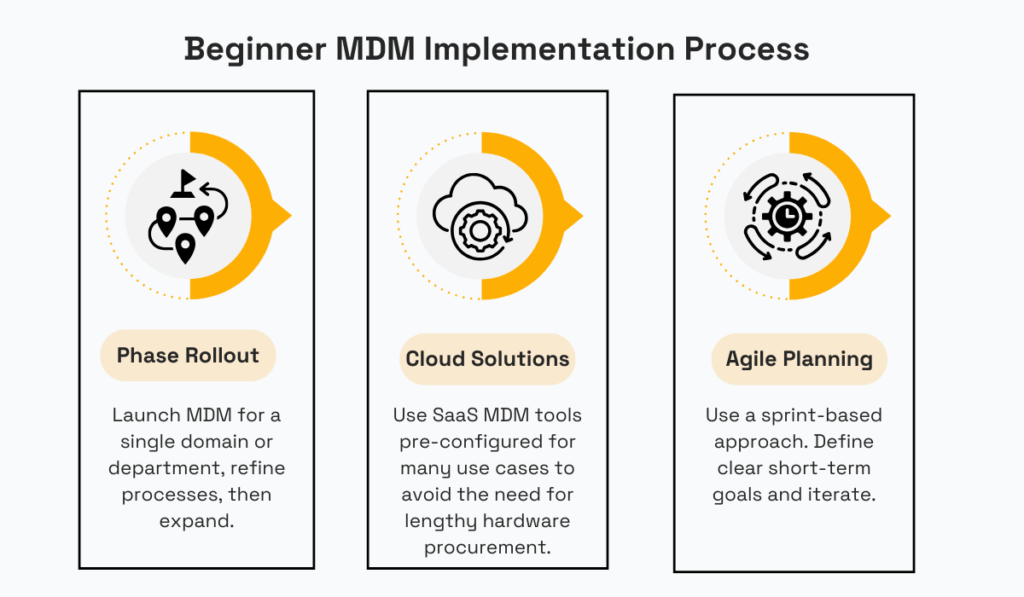
Illustration: Veridion
In short, MDM programs should deliver business value in phases, allowing for adjustments and building organizational buy-in along the way.
Meanwhile, you can continue improving, adding governance layers and new domains over months rather than starting with a “big bang.”
The bottom line is: properly scoped MDM projects don’t have to drag on.
By setting achievable milestones, you demonstrate immediate ROI. Then you build on those wins.
You’ll start seeing measurable improvements in data quality and reporting within weeks, not years.
Master data management isn’t a magic bullet, but it is powerful when approached strategically.
Remember that MDM is a business initiative, not just a tech project.
Any company—large or small—can and should use MDM to prevent costly data errors.
The system itself won’t automatically fix your data; strong governance and clear stewardship are the keys.
And don’t forget, leveraging vendor and reference data ensures your golden records stay accurate.
Finally, take an iterative approach and deliver value in weeks.
By debunking these myths and treating MDM as an ongoing journey, you can build trust in your data and unlock real value.