Insights / Articles
A Closer Look at the Top B2B Data Enrichment Companies Businesses Rely On
Struggling to find reliable firmographic data providers? Uncover the top B2B data enrichment companies that businesses trust to fuel growth.
Your records are likely full of all sorts of data. But how much of it is actually complete, accurate, and up to date?
No matter how hard you try, B2B data decays, gets lost, or becomes full of small yet impactful errors, and over time, it becomes unreliable.
For enterprise teams running large-scale account-based strategies, that translates directly into missed opportunities and increased operational risk.
The fix?
Well, it starts with choosing the right enrichment partner.
Here are five of the best B2B data enrichment companies worth your attention.
Veridion
Veridion is an AI business intelligence platform built for enterprises that need deep, global company intelligence at scale.
Most enrichment providers give you the same handful of firmographic fields: company name, industry, headcount, and revenue range. That is table stakes.
The real pain point for enterprise buyers in procurement, risk, and insurance is that standard providers cannot answer the questions that actually matter.
Who owns this supplier? Has their leadership changed? What do they actually sell, not just their industry classification? What sanctions exposure do they carry?
When those questions go unanswered, your sourcing, underwriting, and risk decisions rest on incomplete foundations.
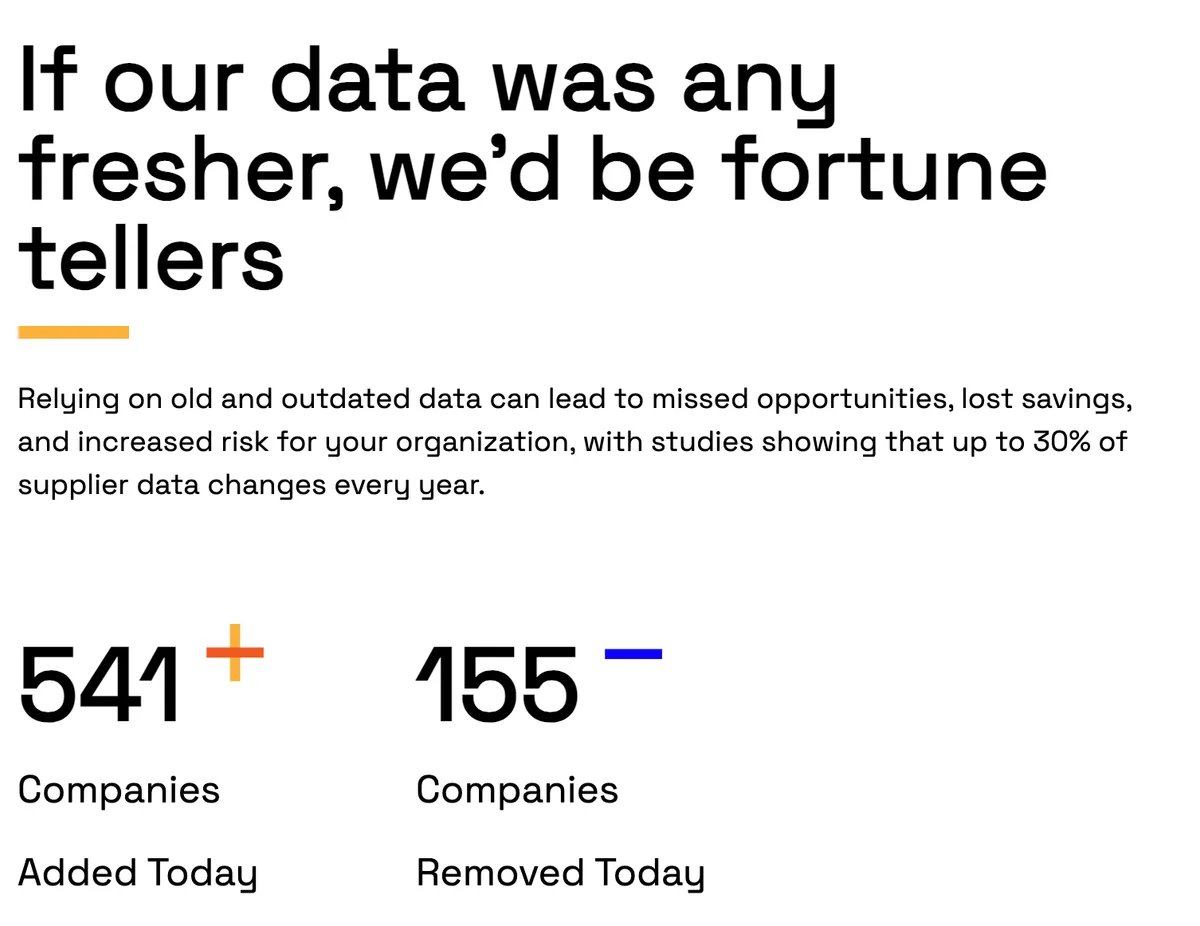
Veridion addresses this by sourcing 461 attributes per company profile from websites, news, social media, and filings.
Source: Veridion
This data is refreshed weekly, so it reflects the current reality rather than a stale snapshot.
And the best part? It’s incredibly easy to use.
With as few as two data inputs, like a company name and country, you get back a full, structured business profile within seconds.
What sets Veridion apart from standard enrichment providers is its depth of data.
It delivers over 461 data points per company record, including:
- firmographics
- employee count
- estimated revenue
- industry classifications (NAICS, SIC, ISIC)
- location intelligence
- ESG scores
- technographic stacks
- corporate hierarchies
- product or service portfolios
The platform uses AI to continuously crawl and update company profiles, so you are not working from static snapshots.
Veridion also handles one of the messiest data problems in large organizations: entity resolution.
Our proprietary models identify subsidiaries, brand aliases, and corporate families, giving you clean hierarchies with transparent confidence scores.
This makes it directly useful for master data management (MDM), deduplication, and supplier risk workflows.
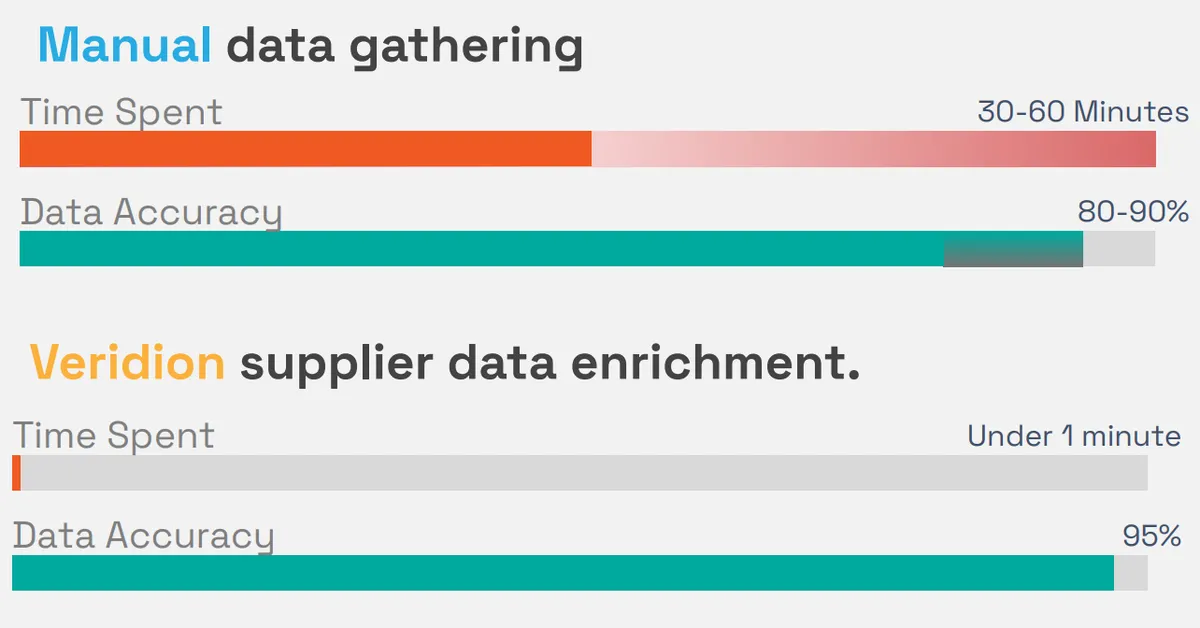
The platform also provides confidence scores for each matched attribute.
You can set thresholds, flag low-confidence records for human review, and build validation rules directly into your workflow.
That approach, combining automation with targeted human oversight, is one of the best strategies for avoiding data enrichment mistakes.
Source: Veridion
Where Veridion stands apart from other providers on this list is in the depth of its company-level taxonomy and supplier intelligence.
For instance, Explorium gives you more people-level signals and intent data; Crustdata gives you more real-time event triggers.
But for procurement teams, insurance underwriters, and MDM workflows that need to understand what a business actually does, its certifications, materials, product lines, and operational structure, Veridion’s structured company profiles deliver a level of context the others do not.
On the downside, Veridion doesn’t provide contact-level data (e.g., emails, phone numbers) and doesn’t offer a self-serve UI. It is API-only infrastructure.
So, if your team’s primary challenge is sales pipeline coverage, other tools on this list will better serve you.
But if you’re in the market for the freshest, deepest procurement, insurance, risk, ESG, or market intelligence, Veridion is hard to match.
Explorium
Explorium is mainly built for teams building AI-driven GTM workflows.
Source: Explorium
The biggest pain point for teams building AI agents for sales, marketing, or recruiting is that no single provider covers all the signals their models need.
You end up stitching together five vendors, managing five contracts, and reconciling five schemas.
That complexity slows model development, increases error rates, and significantly raises the total cost of ownership.
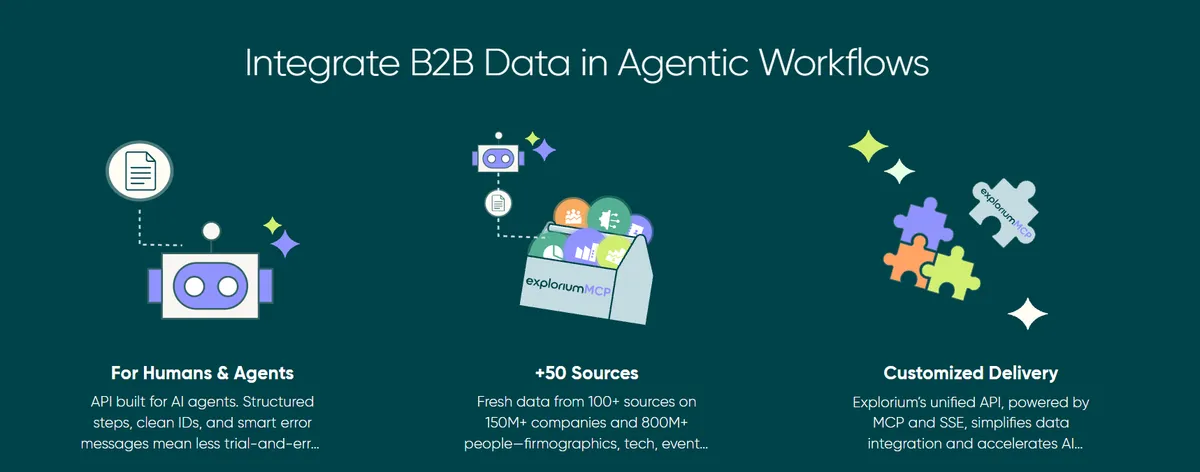
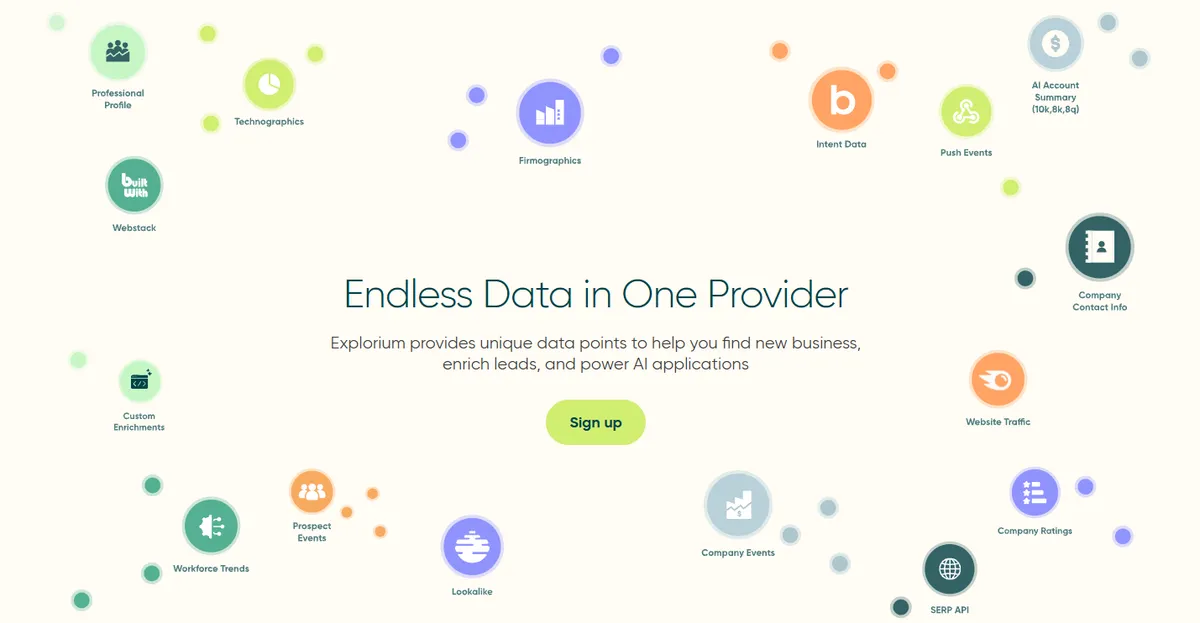
Explorium answers this with a single API covering 150 million companies, 800 million people, and 4,000+ data signals aggregated from 50+ providers.
The platform reports 98% company accuracy and 95% people accuracy, backed by ML-based deduplication across its source network.
The unified schema is a practical advantage: your AI agents query a single endpoint with a single authentication layer and a single response format, regardless of whether they need firmographic data, intent signals, technographic details, or contact information.
Here is what makes this platform different from every other provider on this list.
Most enrichment tools give you static attributes: company size, industry, revenue estimate, and headquarters address.
Explorium provides a dynamic, multi-signal context by combining firmographics, technographics, Bombora intent topics, hiring velocity, funding events, and executive changes in a single API call.
For revenue teams that score accounts on behavior, not just firmographic fit, that multi-signal depth is the difference between a model that predicts in-market buyers and one that just filters by company size.
Source: Explorium
Explorium also supports natural language queries (just like Veridion), MCP server delivery, and SSE streaming, enabling AI agents to query business data in structured steps without returning messy or mismatched results.
This makes Explorium the best choice for teams wiring together AI sales agents that need multi-source data delivered cleanly at volume.
Furthermore, the platform integrates with data warehouses such as Snowflake and CRMs, but complex CRM syncs may still require custom engineering, depending on your stack.
Compared to, say, Crustdata, which is another tool on this list, Explorium scores significantly higher on signals depth, with a score of 5.0 versus Crustdata’s 3.2 in a published benchmark comparison.
Crustdata pulls ahead in freshness thanks to its specific real-time signals.
Compared to Veridion, Explorium covers more signal categories but provides less depth per company for compliance and risk attributes.
Data Axle
Data Axle is one of the most established B2B data providers in North America.
Source: Data Axle
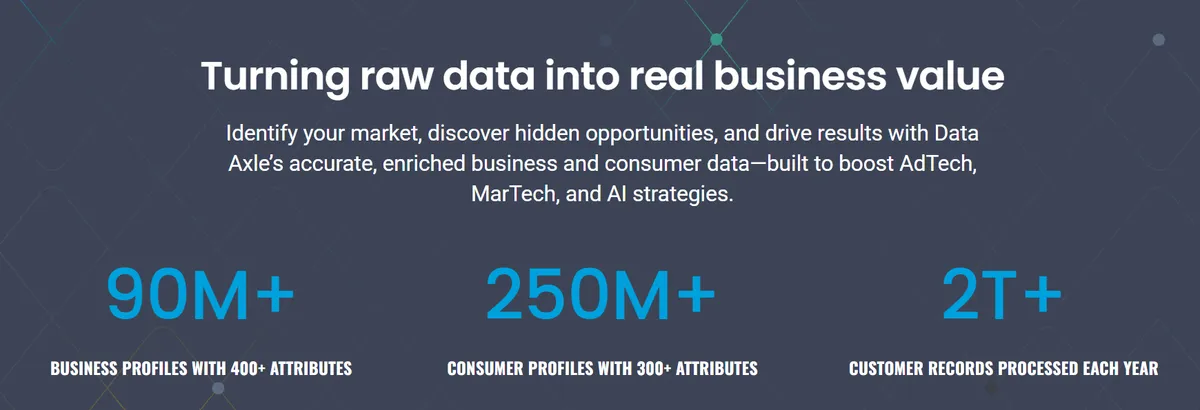
Its database covers over 90 million business profiles and 250 million consumer profiles, with more than 400 data attributes per business record.
The platform solves a problem that pure enrichment providers do not: combining enrichment and activation on a single platform.
Most enterprise data vendors give you better records. Data Axle gives you better records and the ability to act on them across marketing channels immediately.
That combination matters for teams where the gap between data quality and marketing performance is the core problem, not just CRM hygiene.
The feature that most distinguishes Data Axle from the other tools on this list is human verification.
Data Axle makes millions of phone calls per year to manually verify business records.
No other platform on this list does this at scale.
The data is continuously verified and refreshed in real time, which keeps your integrations current rather than relying on a snapshot from the last quarterly update.
For industries where accuracy is tied to compliance or financial decisions, such as insurance, healthcare, or financial services, that verification layer is a meaningful differentiator.
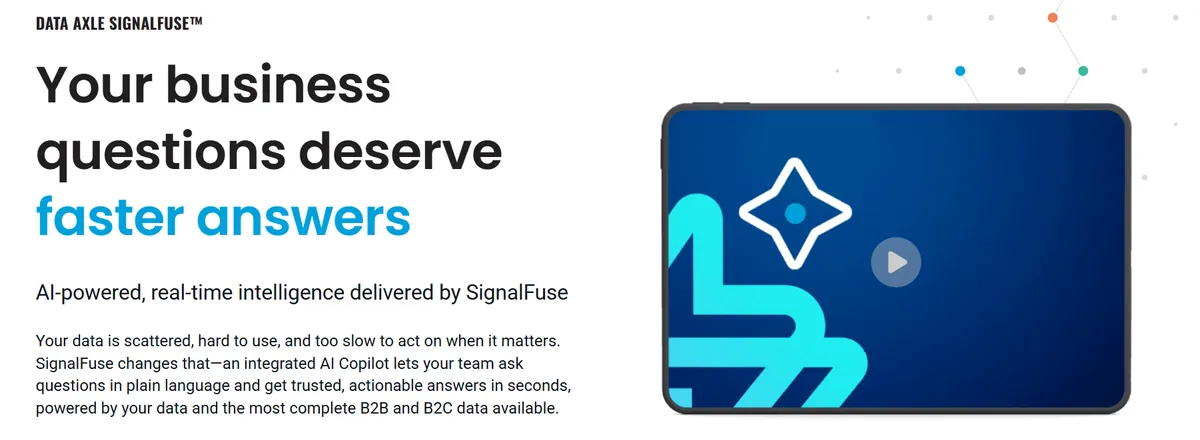
Data Axle’s flagship product, SignalFuse, is also a great differentiator.
Source: Data Axle
This AI-powered intelligence layer connects your first-party data with Data Axle’s B2B and B2C profiles.
You query it in plain language. An integrated AI Copilot surfaces the drivers of each answer and recommends next steps.
The Audience360 product lets you integrate, analyze, and activate zero- to third-party data in a single environment, with native connectors to Salesforce, Microsoft Dynamics, DMPs, DSPs, and major cloud platforms.
Compared to Veridion and Explorium, Data Axle’s emphasis is narrower on the enrichment depth side, particularly for non-US markets.
Its global and enterprise contact coverage is less comprehensive than that of vendors focusing on sales intelligence.
If you need global reach or live data signals, other platforms on this list serve that better.
Where Data Axle wins is when you need a vendor who closes the loop between data and campaign performance, rather than a standalone enrichment API.
This tool fits organizations where the marketing and sales teams share ownership of the data problem, and both need to act on enriched records without building custom activation pipelines.
Crustdata
Crustdata is a Y Combinator-backed platform that specializes in real-time company and people data enrichment.
The platform covers over 60 million companies and 1 billion people, with a static bulk dataset of 12 million companies and 250 million people profiles.
What differentiates Crustdata is not coverage or depth. It is recency, and that changes who it is right for.
The pain point it targets is trigger-based workflows: sales teams that need to know the moment a prospect changes jobs, raises a round, starts hiring for specific roles, or when web traffic spikes.
Most enrichment providers give you a static snapshot that ages from the moment it is delivered.

Source: Crustdata
When we talk about “real-time” here, this is what it actually means with Crustdata: if a prospect raised a funding round yesterday or a key contact changed jobs this morning, Crustdata returns the current state.
Most competitors, in contrast, batch-refresh data every 30 to 90 days.
Crustdata’s API delivers 250+ live company data points and 90+ live people data points, updated in real time rather than on weekly or monthly batch cycles.
For trigger-based outreach, the difference between a week-old signal and a same-day signal is often the difference between a warm response and a dead lead.
The signals Crustdata tracks in real time include:
- executive role changes
- new job postings by department
- fundraising closes
- significant shifts in web traffic
You can filter companies by headcount growth rate, funding raised within a defined timeframe, and year-over-year performance, then export directly to your workflow.
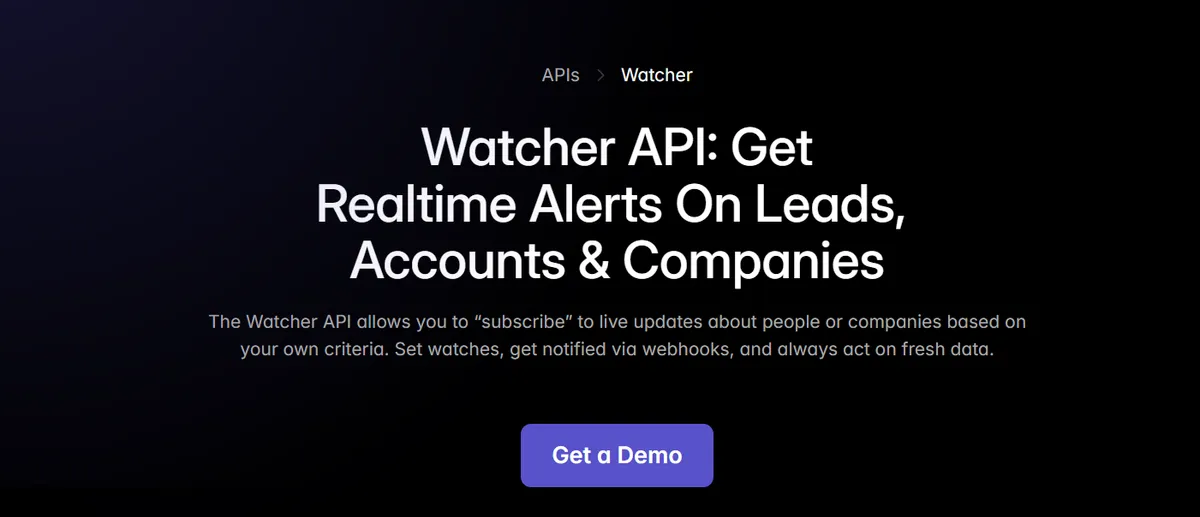
The platform also includes a Watcher API that sends webhook alerts when tracked contacts or companies change.
Source: Crustdata
You do not have to schedule re-enrichment jobs or manually check for updates.
For instance, when a target account hires 40 engineers for a new department or closes a Series B, the signal is automatically sent to you.
That is the key use case where Crustdata outperforms Data Axle (which lacks live signals) and complements platforms like Explorium (which aggregates more sources but updates fewer data points as often).
Crustdata also scores higher on freshness for its real-time signals than Explorium does.
Explorium leads in overall signal depth, with 4,000+ data points, compared to Crustdata’s 250+ firmographic data points.
The tradeoff is clear: Explorium is better for breadth-driven AI pipelines; Crustdata is better for time-sensitive, trigger-based execution.
Markaaz
Markaaz is purpose-built to solve a compliance problem that most enrichment providers are not equipped to address.
Source: Markaaz
The core pain point for financial institutions, fintechs, and regulated enterprises is verifying business customers at scale, especially for SMBs.
These organizations run onboarding, KYB, and vendor risk workflows in which incomplete or unverifiable business records are not considered data quality issues.
They pose compliance and regulatory risks.
Standard data enrichment providers work on firmographic matching.
Markaaz provides sanctions screenings, AML and PEP screenings, and real-time adverse media notifications right in their enrichment API.
This contrasts with Data Axle (highly accurate phone number verifications, high-quality contact information, no compliance capabilities) or Veridion (firmographic information for many companies, no compliance technology).
For banks and fintechs that need to verify and onboard business customers quickly without having to route through multiple vendor contracts, this integration offers a meaningful time and cost advantage.
The Markaaz Directory holds over 542 million global business records across 200 countries and jurisdictions, drawn from 65,000+ public and private sources.
Each enriched record can include up to 240+ attributes: firmographics, officer information, business credit risk scores, corporate hierarchy, and diversity indicators.
Markaaz is the only tool on this list that enriches and de-risks data in a single workflow.
The platform also partners with identity and compliance infrastructure players in a way that the other providers here do not.
In late 2025, it partnered with Signicat, Europe’s largest digital identity provider, to enable KYB verification and onboarding within Signicat’s orchestration engine.
Source: Fintec Finance News
If you are building compliance infrastructure across multiple jurisdictions, that kind of embedded partnership signals a different tier of enterprise readiness.
Markaaz also offers Markaaz 360, a proprietary matching and stewardship engine that ingests your internal, external, and third-party business data and standardizes it into a single enriched Golden Record.
For enterprises managing large portfolios of business customers across heterogeneous data sources, that consolidation layer removes the manual reconciliation work that typically falls on ops teams.
If your team handles business onboarding, KYB compliance, or vendor risk management, Markaaz covers use cases that Veridion, Explorium, Crustdata, and Data Axle are not designed to address.
Conclusion
The global data enrichment market is already worth billions and will only continue to grow.
That growth reflects a simple reality: clean, current data is a must-have asset.
What does that mean for you?
It’s time to identify where incomplete data is actually costing your team the most, whether that is in failed entity matches, missed sales signals, poor CRM quality, or regulatory exposure, and start there.
The right tool for that gap is on this list.
Start with the use case, pick the tool that fits, then run a match test on your hardest segment before you sign.
Articles
Discuss how these trends affect your organization.
Our analysts are available for a short call. Bring a specific question and we will ground it in the data.