Insights / Articles
How Aerospace Companies Use Data Analytics to Improve Fuel Efficiency
How can aerospace companies slash fuel costs? Dive into how aerospace data analytics is revolutionizing flight efficiency and sustainability.

- Fuel is an airline's highest controllable cost, and every lever on it is data.
- Flight plans run on forecasts. Real-time data corrects them in flight.
- Route, compliance, maintenance, and supplier delays all land in one fuel bill.
Fuel is among an airline's highest costs. The International Air Transport Association (IATA) has put the worldwide 2025 fuel bill at $252-253 billion.
Fuel prices swing week to week, and airlines that can't see their own consumption in detail have no way to react when they move.
Even a small cut in fuel can save money.
But fuel can be hard to save because of imperfect routes, unnoticed usage inefficiencies, and imprecise maintenance. Without the right tools, airlines can't always see the problems happening in real time.
However, real-time data fixes that. Airlines can spot errors with it and act even mid-flight.
Here are six ways they do it.
Data-Driven Route Optimization
Finding the most fuel-efficient path is no longer a manual exercise.
Modern flight planning systems combine live weather feeds, jet stream data, real-time air traffic information, and aircraft-specific performance profiles to calculate the optimal route before every flight.
The goal is not simply a shorter line on the map.
It's a flight path that adjusts as it goes. It rides tailwinds, dodges headwinds, and picks the best altitude for each flight and load.
Pilots and dispatchers receive updated plans mid-flight if conditions shift, enabling real-time adaptations that neither add time nor compromise safety.
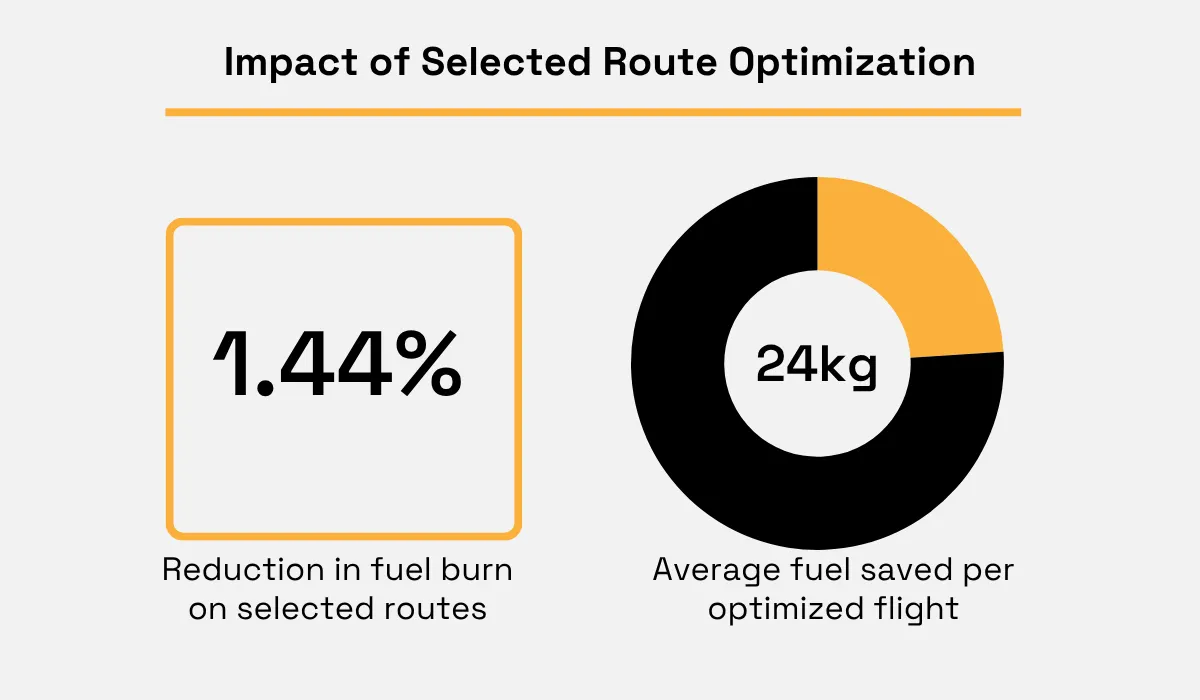
Scandinavian Airlines (SAS) is a clear example of this in practice.
After deploying ClearPath, an AI-powered system developed by AVTECH Sweden using high-resolution weather data from the UK Met Office, SAS saw optimized flights save an average of 24kg of fuel.
This resulted in a 1.44% reduction in burn on selected routes.
LATAM Airlines has since signed on to the same system, citing both operational efficiency and improved passenger comfort.
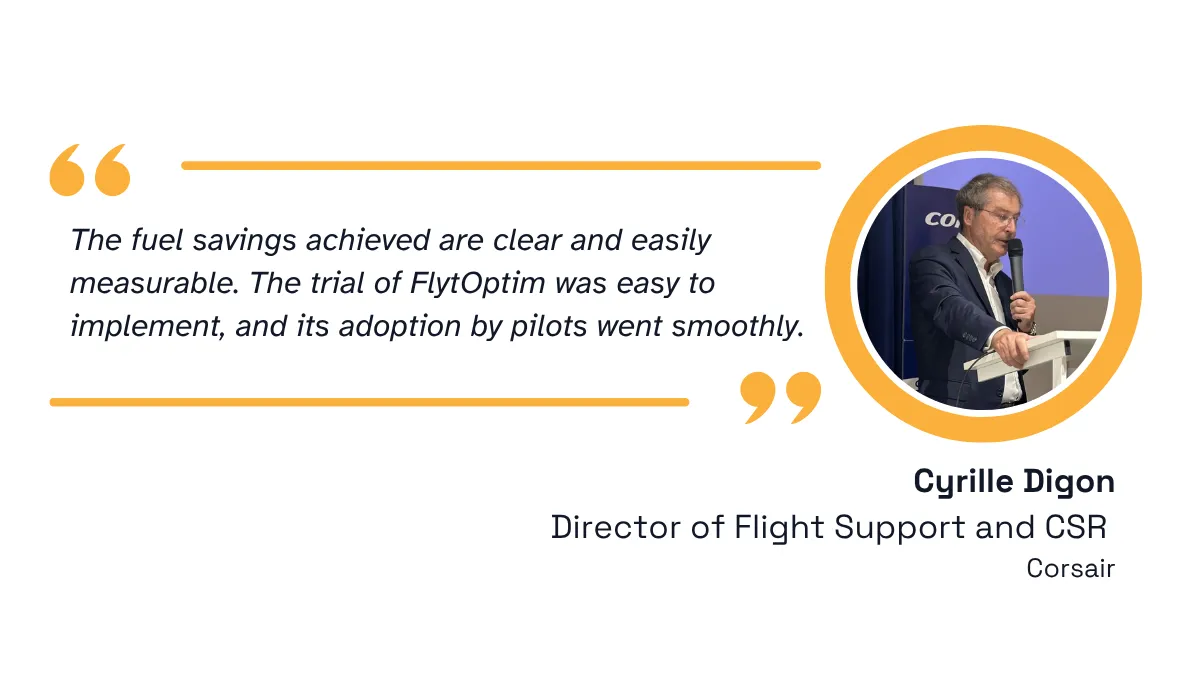
French carrier Corsair achieved similar results through Thales' FlytOptim platform.
The system analyzes live aircraft and weather data mid-flight and suggests vertical trajectory adjustments that can cut fuel consumption by up to 2% per flight.
Trials on Corsair's long-haul routes to Africa and the Caribbean showed savings of several hundred kilograms per flight.
Adoption is accelerating beyond European carriers.
In September 2025, Air India deployed SITA OptiFlight and SITA eWAS across its Airbus A320 and Boeing 737 fleets.
The deployment was expected to cut the airline's carbon emissions by 35,000 tonnes annually.

All three systems share a critical advantage. They integrate with existing flight management computers, requiring no hardware changes.
That ease of deployment is one of the main reasons adoption is accelerating.
Airspace congestion is the other driver.
Route optimization used to be a nice-to-have; with global traffic recovering past pre-pandemic levels and controllers rerouting flights around weather, conflict zones, and no-fly corridors more often, the aircraft that adapts fastest is the one that burns least.
Getting the route right sets the efficiency baseline.
But monitoring what happens in real time during that flight reveals an entirely different layer.
What makes real-time optimization different from ordinary flight planning is that it never stops recalculating. A plan is built against a forecast hours before departure and then fixed.
Real-time optimization keeps matching the aircraft's live weight and position against updated forecasts after pushback, and hands the crew a revised cruise profile in the air.
That distinction matters because an airline has blunter ways to cut fuel, and both cost it the market. It could fly less often, or it could raise fares. Route optimization is the only lever that takes fuel out of a flight without touching the schedule, the fare, or the aircraft, which is why carriers reach for it first.
Other carriers are landing on the same answer through different services. Corsair runs Thales' FlytOptim, which reads live aircraft and weather data mid-flight and proposes vertical trajectory changes worth up to 2% of fuel per flight. Trials on its long-haul routes to Africa and the Caribbean saved several hundred kilograms a flight.
Air India reached the same conclusion in September 2025, deploying SITA OptiFlight and SITA eWAS across its A320 and 737 fleets, a rollout expected to take 35,000 tonnes of carbon a year out of its operation.
Every one of these services reads from the flight management computer the aircraft already carries, so there is nothing to install and nothing to certify.
Removing that hardware barrier removes the usual reason a fuel-saving measure stalls, since it asks the airline for no capital and the crew for no new procedure.
Congestion sharpens the case rather than just coinciding with it. As controllers reroute traffic around weather, conflict zones, and closed corridors more often, the plan filed at the desk is wrong more often, too, and the aircraft that recalculates fastest is the one that burns least.
Getting the route right sets the efficiency baseline. Watching what happens during the flight itself reveals the next layer.
Live Fuel Consumption Tracking
Not all fuel inefficiency is visible at the route planning stage.
Real-time fuel tracking catches the rest.
The scale of what is at stake is significant. According to IATA, fuel costs are expected to rise by nearly 40% in 2026.
Even a 1% improvement in fuel efficiency across the industry translates into billions saved.
Real-time monitoring is how those gains get found.
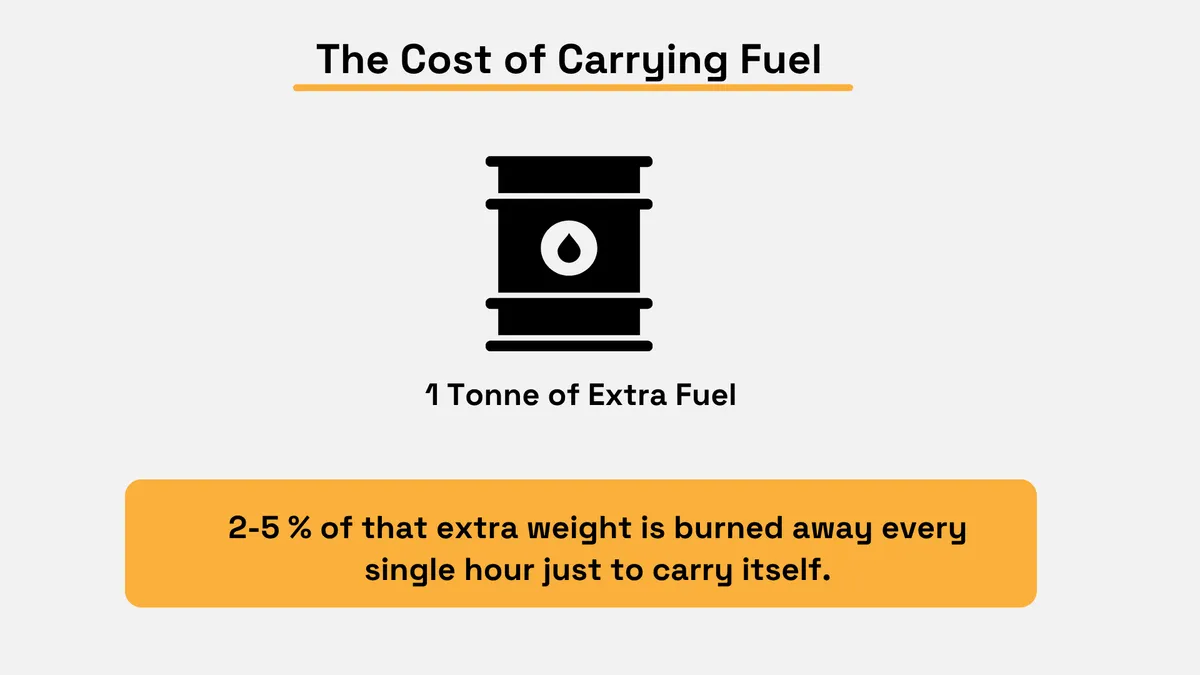
IATA has also shown that for every extra tonne of fuel an aircraft carries, approximately 2-5% of that weight per hour is burned simply from the extra load it carries.
Ground operations are a similarly quiet source of waste.
Aircraft burn fuel while taxiing, and their auxiliary power units keep running at the gate to power onboard systems before departure.
Real-time data helps operators cut both. Airlines using single-engine taxi procedures, guided by data on ground movement times and pushback delays, can reduce taxi fuel burn by roughly 30-40%.
Replacing auxiliary power unit usage with ground power at the gate, where infrastructure allows, cuts another meaningful slice of the pre-flight fuel bill.
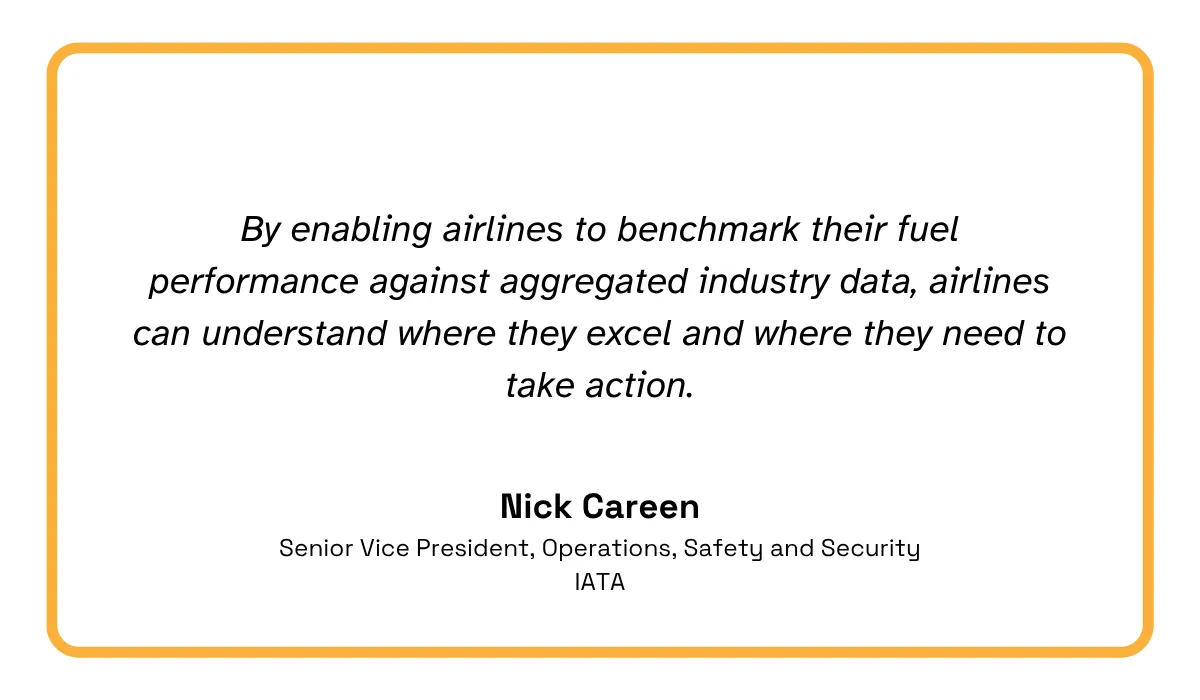
In June 2024, IATA launched FuelIS, an advanced analytics platform that draws on aggregated and anonymized fuel and flight data from 215 airlines worldwide.
Airlines on the platform can compare their fuel burn to industry averages. They can break it down by route, aircraft type, and airport.
A flight that burns more than expected stands out. It shows up as a clear data point, tied to a specific route, crew, and tail number.
Over time, patterns start to appear. Those patterns point to the inefficiencies worth fixing.
Original equipment manufacturers (OEMs) can use FuelIS, too. It helps them see how their aircraft or engines perform against industry norms, across different markets and fleet types.
Patterns that previously took months to identify can now surface within days.
That visibility also creates an audit trail that regulators are starting to use.
Compliance with Fuel Efficiency Standards
Regulatory pressure on emissions is turning fuel efficiency into a legal requirement, not just a business choice.
The Carbon Offsetting and Reduction Scheme for International Aviation (CORSIA), is the main driver behind that shift.
Administered by the International Civil Aviation Organization (ICAO), CORSIA requires airlines on international routes to monitor, report, and offset their CO₂ emissions above 2019 baseline levels.
The scheme entered its first mandatory phase in 2024, with 126 states participating voluntarily.
From 2027, compliance will become mandatory for virtually all ICAO member states.
CORSIA is not the only framework adding pressure.
The European Union's Emissions Trading System (EU ETS) already requires airlines on flights within and departing the European Economic Area to surrender carbon allowances for each tonne of CO₂ they emit.
Together, CORSIA and the EU ETS are creating a regulatory environment where every kilogram of unoptimized fuel burn carries a measurable financial consequence.
Non-compliance with CORSIA specifically carries defined penalties already.
The UK has set a fine of £100 per tonne of carbon for airlines that fall short of their obligations.
Independent analysis from Marsh, the insurance broker and risk management company, puts potential penalties in some jurisdictions at up to $125 per tonne, meaning a large carrier's annual exposure could reach tens of millions of dollars before offsets are even factored in.
Airlines that delay acting face compounding costs.
The international management consulting firm Roland Berger estimates that last-minute procurement of CORSIA-eligible carbon credits in 2027 could cost the industry between $3.6 billion and $9.0 billion, potentially cutting into 5-12% of airline profits.
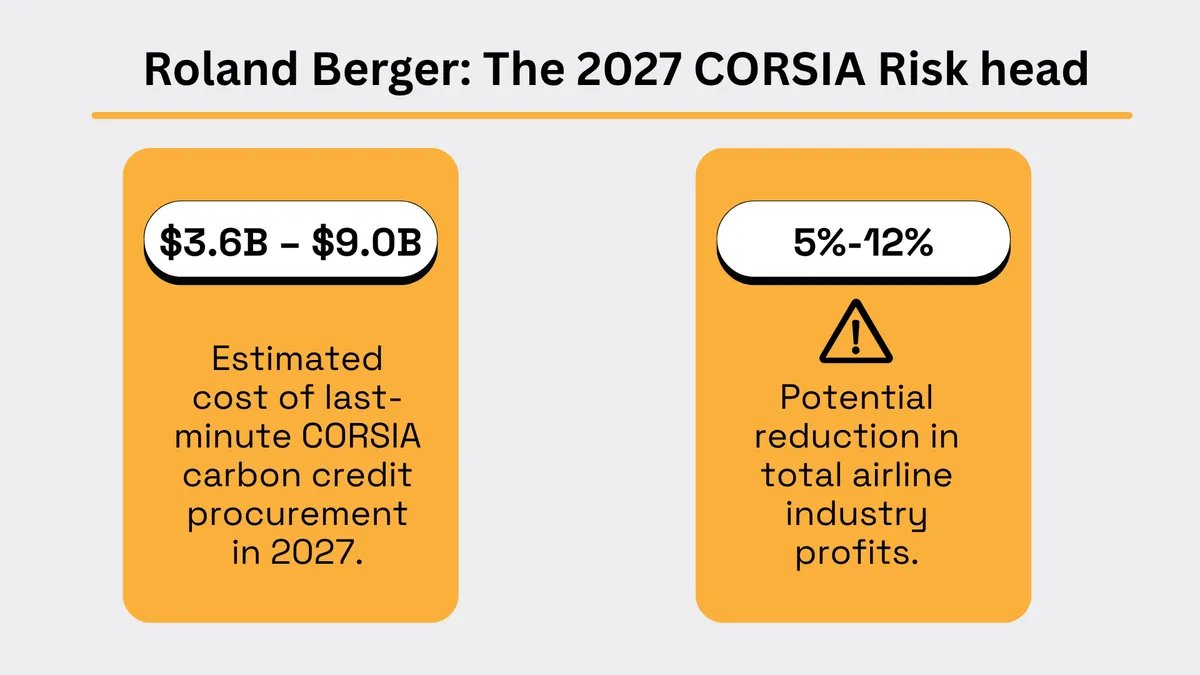
Illustration: Veridion / Data: Roland Berger
Data analytics helps airlines manage compliance costs early.
Monitoring platforms track fuel burn per flight. They calculate CO₂ output in CORSIA's required format. They flag problems before they become violations.
This also has a side benefit. Chasing compliance uncovers inefficiencies airlines missed before.
Compliance used to be focused on an audit trail of what already happened.
Now, data analytics shapes decisions before a part is even built.
A fuel gauge already tells a crew how much they are burning. CORSIA asks for something a gauge cannot give: a whole year of fuel use, in tonnes, from every international flight and every station the airline touched, assembled into one figure an auditor will sign.
Assembly is the hard part.
Fuel is uplifted in litres at the ramp and reported in tonnes to the regulator, so every record carries a density conversion that has to be documented and traced back to a flight log. The same reconciliation has to hold across every airport, in local formats and units.
Accredited verifiers name that mismatch as a routine source of material misstatements and delayed sign-off.
Data platforms do the reconciliation that a gauge and a spreadsheet cannot. They pull flight records and fuel records into one dataset, match them flight by flight, and surface the disagreements before a verifier finds them.
Whether chasing compliance also uncovers inefficiency depends on CORSIA and the airline measuring the same thing, and they do.
CORSIA does not measure carbon at the tailpipe; it multiplies the mass of fuel burned by a fixed factor of 3.16 kg of CO₂ per kilogram of Jet A-1, and nothing else enters the equation.
So the compliance number and the fuel number are the same.
A kilogram saved is 3.16 kg that never has to be reported, verified, or offset. The dataset built to satisfy a verifier is the same one that shows which routes and tails burn more than they should.
Improved Aircraft Design
Data analytics is changing how engineers make foundational decisions.
Digital twin technology lets engineers build a virtual replica of an aircraft.
They can run thousands of simulations across aerodynamics, structural integrity, propulsion efficiency, and material performance, all without constructing a physical prototype.
What once required years can now be compressed into weeks.
Failure modes that would only appear during physical testing are caught and corrected before a single component is manufactured.
The result is an aircraft that is better optimized for fuel efficiency from the first flight.
Rolls-Royce applies the same principle to its Trent XWB engine, which powers the Airbus A350 XWB.
The engine's digital twin models aerodynamic performance and propulsion dynamics, and continuously feeds those insights back to engineers.
It helps them improve fuel burn across different flight conditions.
Dr. Markus Fischer, Division Board Member for Aeronautics at the German Aerospace Center (DLR), explains what this can make possible.

The commercial payoff of this design discipline is visible in current-generation aircraft. The Airbus A350, powered by the Rolls-Royce Trent XWB, delivers around 25% better fuel efficiency than the previous generation of widebody aircraft it replaced.
The gains built in at the design stage are permanent. They are embedded in the aircraft before its first commercial flight.
But even the most efficiently designed aircraft gradually loses that efficiency without proper maintenance.
It’s another part of the process where data analytics can improve performance and efficiency.
Proactive Maintenance for Peak Performance
Engine degradation is among the most consistent and avoidable causes of excess fuel burn in commercial aviation.
Predictive maintenance is the data-driven answer. Knowing about a problem before it happens and acting decisively will save you time and money.
Modern commercial aircraft carry thousands of sensors tracking temperature, pressure, vibration, fuel flow, and component wear simultaneously.
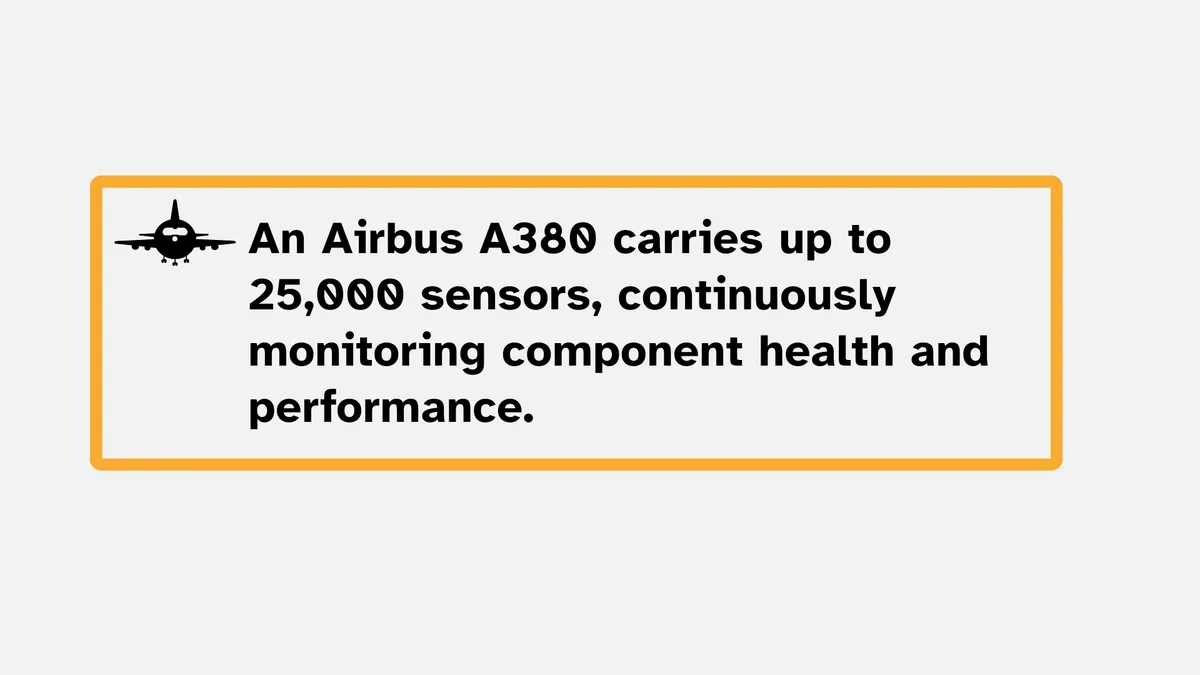
An Airbus A380 is equipped with up to 25,000 sensors, all continuously feeding data into analytics systems running both onboard and on the ground.
Machine learning models scan that stream for early signatures of degradation: an engine running above its thermal baseline, a compressor stage with abnormal vibration, or a bearing showing wear patterns that historically precede failure.
These signals can appear weeks or months before they would be visible through manual inspection.
Why does early detection matter for fuel specifically?
A degraded engine burns more fuel to produce the same thrust.
Catching the problem early and scheduling a proactive intervention prevents the compounding fuel cost of flying on an increasingly inefficient system.
Airbus's Skywise platform, built in partnership with Palantir, brings this predictive capability to fleet management at scale.
Delta Air Lines, in its first year on the platform, mitigated more than 2,000 operational disruptions.
easyJet, another Skywise user, avoided 35 technical cancellations in a single month using the platform's predictive alerts.
Boeing takes a complementary approach through its own AnalytX platform.
Machine learning is applied to data from aircraft sensors, maintenance records, and historical performance logs across its customers' fleets. This enables both airlines and OEMs to spot degradation patterns before they affect operations or fuel efficiency.
Aircraft running as designed, without undetected degradation or unplanned grounding, burn fuel the way engineers intended.
Maintenance depends on having the right components arrive on time.
That is a supply chain question, and it carries a direct fuel efficiency consequence.
easyJet shows what that capability looks like once it has been built out over a decade, and the airline got there because its old approach had run out of room.
Until 2014, it ran a reactive reliability model that worked but could not predict failures, and it had stopped delivering new gains.
Airbus tested the idea before easyJet committed to it. In 2015, it ran three years of the airline's flight and maintenance data through a study to see whether component faults could be caught ahead of the alerts already in place, and they could.
The rollout followed that evidence rather than a sales pitch. easyJet trialled low-volume data capture across 80 aircraft in 2016, switched automated alerts on in 2017, and signed with Airbus in 2018 to fit FOMAX.
That box changed what the airline could see.
Before it, easyJet's aircraft sent roughly 390 parameters to the ground. On Skywise, they now send up to 24,000 on the platform Airbus built with Palantir.
An engine fuel actuator shows what the difference buys. The models flagged the part on 14 September, flagged it again on 21 September when it breached its threshold a second time, and engineers replaced it on 10 October at a slot that suited the schedule.
Left to fail on wing, the same repair would have grounded the aircraft for more than three hours. Instead, the part came off early, in a hangar, on a day somebody chose.
The workflow changed with the visibility. easyJet now runs 22 live predictive models with another 60 in calibration, and they sit inside its Maintenance Control Centre as a function of their own rather than an add-on to the old reliability process.
Between January 2019 and September 2025 the airline attributes 1,343 avoided cancellations, 171 major delays, and 662 minor delays directly to predictive maintenance, holding availability and dispatch reliability at 98.63% and 99.57% across a fleet that kept growing.
The gain its head of maintenance operations keeps returning to is not the aircraft but the people.
Better oversight of insourced and outsourced work gives sharper reads on the fleet, which produce better contracts and better use of engineers, the resource he calls the most precious in the business.
Fuel is where all of it lands.
A compressor drifting out of tolerance pushes more fuel through the engine to hold the same thrust, every hour it stays on wing, and nothing on the flight deck reports it as a fault.
Predictive maintenance takes that hidden burn off the aircraft weeks before a failure would have forced it off anyway. Every one of those interventions still depends on one thing the data cannot supply: the part has to be on the shelf.
An alert with no component behind it is a grounded aircraft with a longer notice period. Getting the part there on time is a procurement problem, and it carries a fuel cost of its own.
Supply Chain and Supplier Optimization
Fuel efficiency depends on the quality of what suppliers deliver, and with how reliably that supply chain holds together.
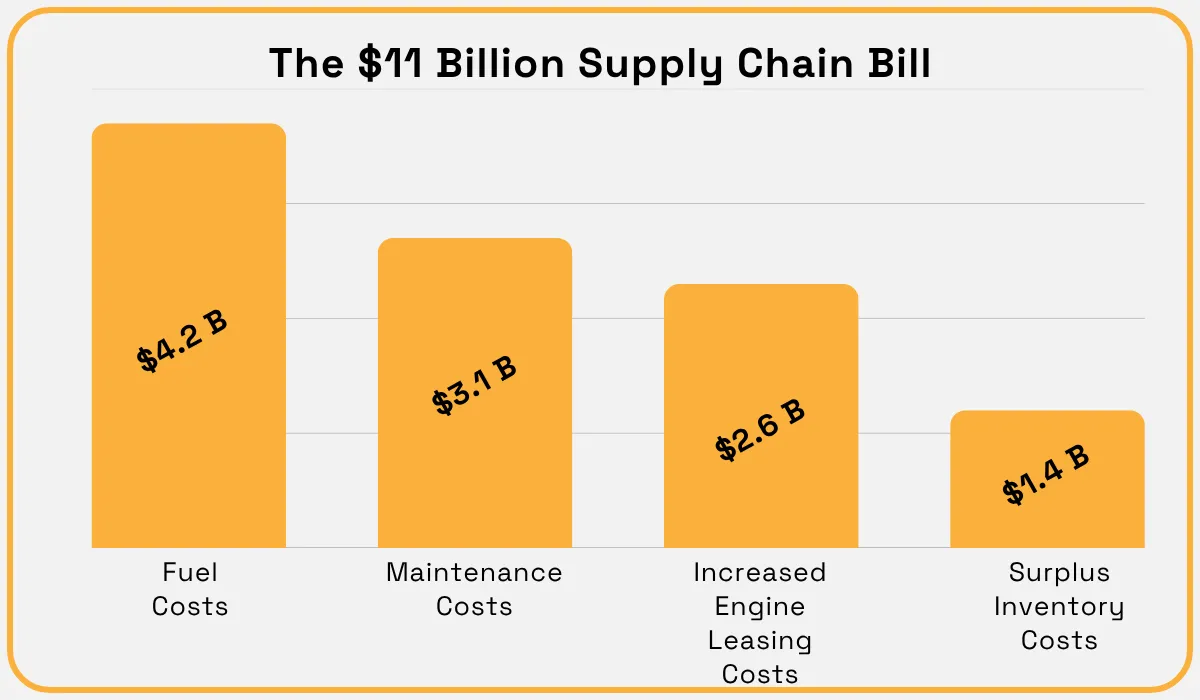
The link between supply chain performance and fuel efficiency is now quantified. IATA's October 2025 report, produced in collaboration with Oliver Wyman, found that supply chain challenges are costing the airline industry more than $11 billion annually.
The single largest contributor to that total, $4.2 billion, comes directly from excess fuel costs.
Airlines are operating older, less fuel-efficient aircraft because new aircraft deliveries get delayed.
Every extra year they fly an aging fleet instead of a modern one is a year of avoidable fuel spend.
A single delayed titanium shipment two tiers deep can push an engine delivery back by months.
The airline waiting on that engine ends up flying an older aircraft longer than planned, burning measurably more fuel per flight in the interim.
Willie Walsh, IATA's Director General, said,
"Airlines depend on a reliable supply chain to operate and grow their fleets efficiently. Now we have unprecedented waits for aircraft, engines and parts and unpredictable delivery schedules. Together these have sent costs spiralling by at least $11 billion for this year and limited the ability of airlines to meet consumer demand."
Aerospace procurement spans thousands of suppliers across multiple tiers: fuel providers, raw material suppliers, component manufacturers, and MRO vendors.
Most organizations have real insight only into their first-tier relationships.
What is happening further down the chain, where disruptions typically originate, is often completely invisible.
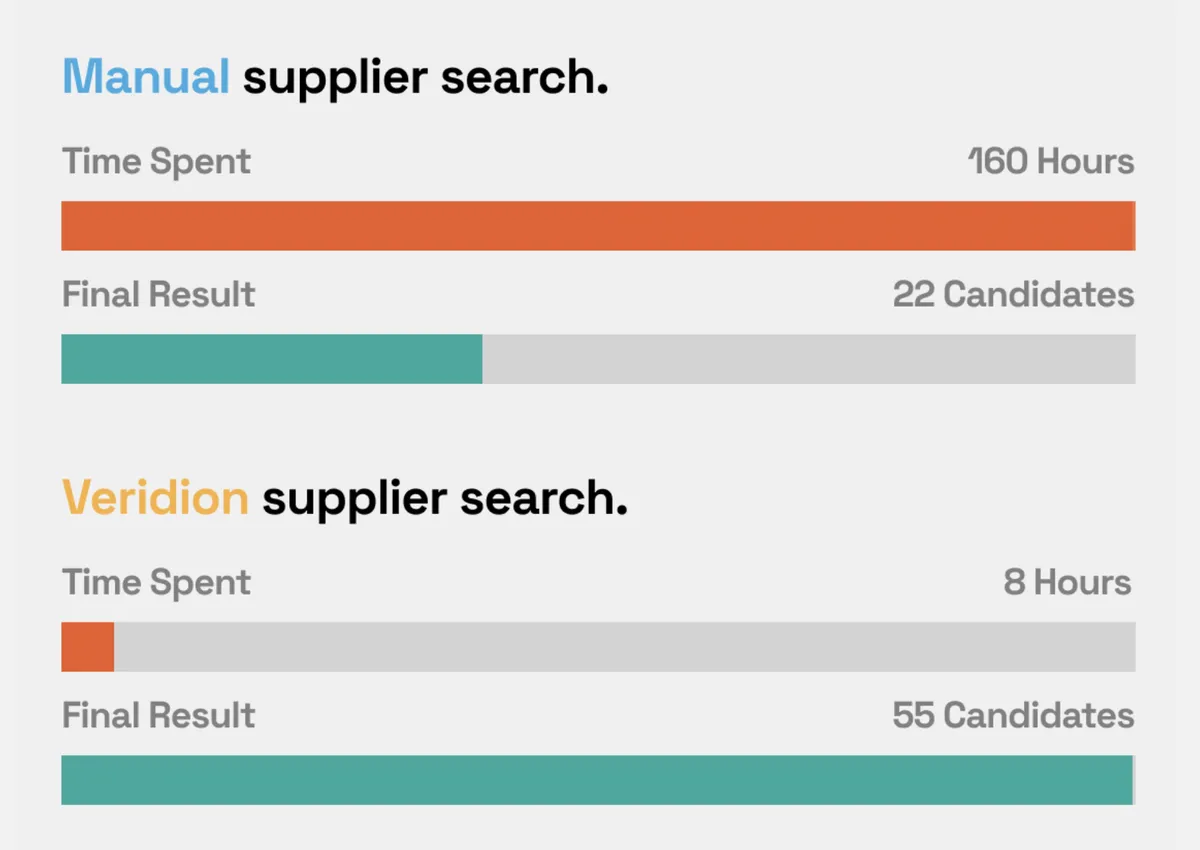
These are the connections that surface only when procurement data reaches beyond the first-tier suppliers most companies can already see.
Source: Veridion
Data-driven supplier intelligence platforms are built to close exactly that gap.
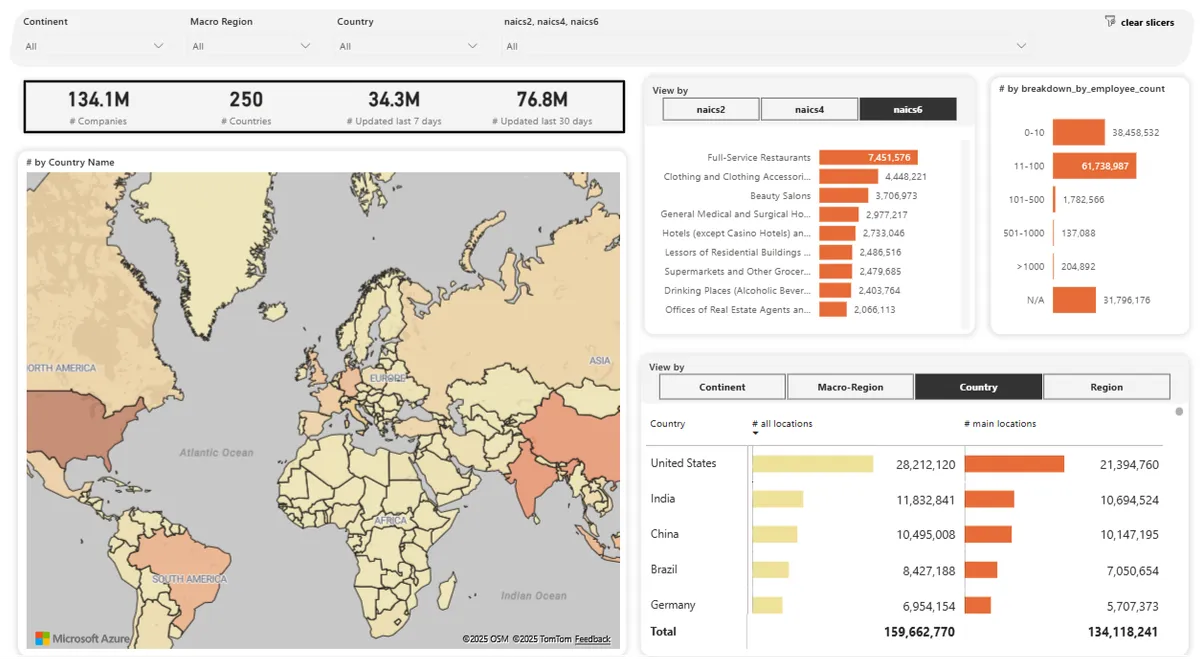
Veridion's platform gives aerospace procurement teams access to continuously refreshed data on companies across 250 countries.
It covers firmographic profiles, product-level data classified by UNSPSC taxonomy, corporate family linkages, and financial and ESG risk signals.
Source: Veridion
Procurement teams can identify qualified fuel and component suppliers they had no prior visibility into through the supplier discovery service.
They can monitor their existing supply base for early warning signals through the third-party risk management platform. This helps track changes in supplier financial health, regulatory exposure, and operational capacity before those issues affect delivery.
And they can keep supplier profiles accurate and current across their vendor management workflows. So, procurement decisions reflect what is true today and not what was true at onboarding.
A supply chain that is properly mapped, monitored, and sourced from verified partners means the right materials, components, and fuel reach operations on time.
That directly supports the route efficiency, maintenance performance, and design quality that the other five methods in this article depend on.
Conclusion
Start where this article started: the fuel bill. It is an airline's highest controllable cost, and for most carriers, it is also the largest number they cannot fully explain.
Every method here is the same move made at a different point in the operation.
Each one takes fuel spend that was invisible and turns it into a figure someone can act on this week, and each one drops to the bottom line, because fuel saved is margin kept.
The plan built on a stale forecast becomes a live cruise profile.
The engine drifting out of tolerance becomes an alert weeks before it becomes a grounded aircraft.
The delivery slipping two tiers down becomes a year of avoidable burn; a team can now forecast and price.
None of these lives on its own, and none has to. The visibility compounds, because the dataset that satisfies an auditor is the same one that shows which tail is drifting and which route is being flown at the wrong altitude.
Fuel prices will keep moving, and they will keep moving against somebody. The airlines that come out ahead are the ones that see their own consumption clearly enough to respond within the week instead of the quarter, turning a volatile cost into a managed one.
Articles
Discuss how these trends affect your organization.
Our analysts are available for a short call. Bring a specific question and we will ground it in the data.
Insights
Keep reading
More analysis, research, and outcomes grounded in live company intelligence.
What Is Climate Intelligence
This article will help you understand climate intelligence, including its definition and why it matters for modern businesses.
6 Most Important Market Intelligence Metrics
Discover six must-track market intelligence metrics that can sharpen your competitive edge and support data-driven growth.
What Is the Difference Between Business and Market Intelligence?
Not sure whether you need business intelligence or market intelligence? This article compares them and shows when to choose each.