Insights / Articles
What Do You Really Get in a Bulk Company Data Download?
Uncover what's truly inside a bulk company data download. Get the essential details you need to make informed decisions and gain a competitive edge.

- A company’s registered industry may no longer reflect what it actually does.
- A registered address may tell you surprisingly little about where a business operates.
- Bulk delivery doesn’t have to mean static or shallow company data.
A bulk company data download can contain millions of records, but coverage, attribute depth, freshness, and source transparency vary considerably by provider.
Registry downloads can contain legal identities, filings, addresses, and more. But that’s still not a complete picture of what companies actually do.
Below, we’ll unpack what’s really inside these files and where they fall short.
What Does a Registry Bulk Download Actually Contain?
If you search for company data in bulk, official registries are an obvious starting point. They are authoritative sources for registered legal information and, in some jurisdictions, offer free bulk access.
But registry data is also easy to misunderstand.
These databases are there to make legally required company information publicly accessible. The SEC’s companyfacts.zip archive aggregates structured XBRL facts submitted by filers, including reported revenue, assets, liabilities, and other disclosures where available.
That distinction becomes very clear when you look inside the files.
Legal Filings, Not Business Intelligence
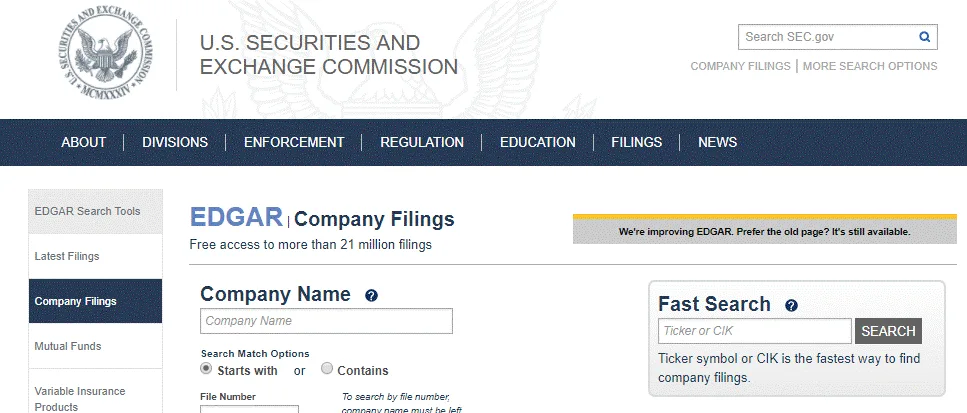
Take the U.S. Securities and Exchange Commission’s EDGAR system.
Source: Wall Street Prep
Its companyfacts.zip archive contains structured XBRL facts reported by SEC filers: revenue, assets, liabilities, and other financial disclosures.
Its separate submissions.zip archive contains filing histories and company metadata, including current and former names, ticker symbols, exchanges, filing types, and filing dates.
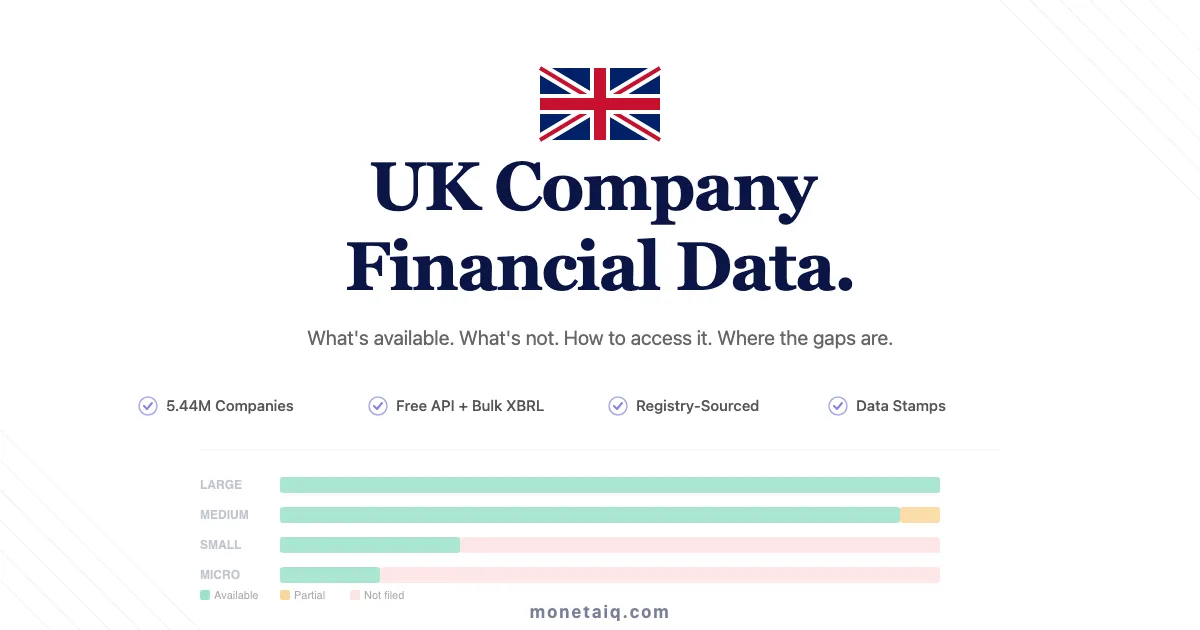
Companies House offers something similar in the UK.
Source: MonetaiQ
Its monthly company snapshot includes fields like:
- Company type
- Registered office address
- SIC code
- Company status
- Previous names
- Dates for accounts and confirmation statements.
Separate bulk products give you electronically filed accounts and information on people with significant control.
That can be extremely valuable when you need to figure out a company’s legal identity or analyze its filings.
But notice what these datasets were designed to describe: what the company has disclosed to a regulator.
So they generally do not provide a consistent, current view of products, served markets, positioning, or recent operational changes.
The table below illustrates this contrast:
What the bulk download gives you & what it’s good for | What it doesn’t give you & why you might need to look elsewhere |
|---|---|
Legal identity and status | Current products and services |
Regulatory filings and financial facts | Current business activity |
Registered address | Operational footprint |
Industry classification codes | Detailed market positioning |
So, a registry bulk file can contain plenty of data while still leaving major business-intelligence questions unanswered.
Self-Reported Codes, Rarely Updated
Industry classification is a good example of that gap.
If you need to register a UK company, you select a Standard Industrial Classification (SIC) code that describes your economic activity. Companies House allows up to four, and businesses can change them through a confirmation statement if their activities evolve.
The problem is that the classification depends on the company keeping it accurate.
Companies House itself recently warned businesses about this.
Source: Gov.uk
Their guidance is clear: businesses should review and update their SIC code rather than treating the code selected at incorporation as permanent
One common discrepancy it identified is companies that are actively trading but remain classified as 99999 (Dormant Company) or 74990 (Non-trading Company).
Even when the code was correct initially, the business may pivot. A consultancy can become a software developer, a manufacturer can add direct-to-consumer sales, or a distributor can expand into new product categories.
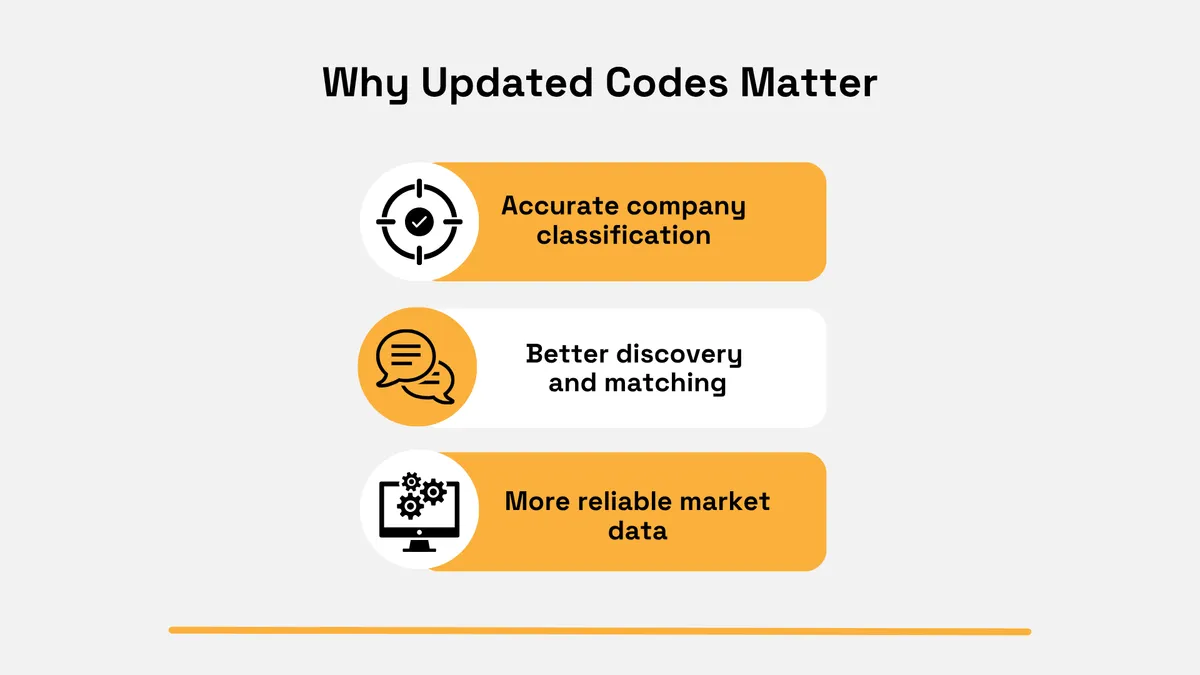
That matters when you use bulk registry data for discovery or segmentation.
Here are three main benefits of updated codes:
Source: Veridion
But even a technically valid SIC code can still give you an incomplete or outdated picture of the business you’re trying to classify.
Built for Compliance Access, Not Developer Workflows
Here’s another hurdle.
Registry data wasn’t necessarily structured around the pipelines your data team uses today.
EDGAR illustrates the problem well, again.
Every filer receives a permanent Central Index Key (CIK), then SEC filing indexes organize records around identifiers including:
- CIK
- Form type
- Filing date
- File path
Historical filings can then sit within directory structures combining CIKs and accession numbers.
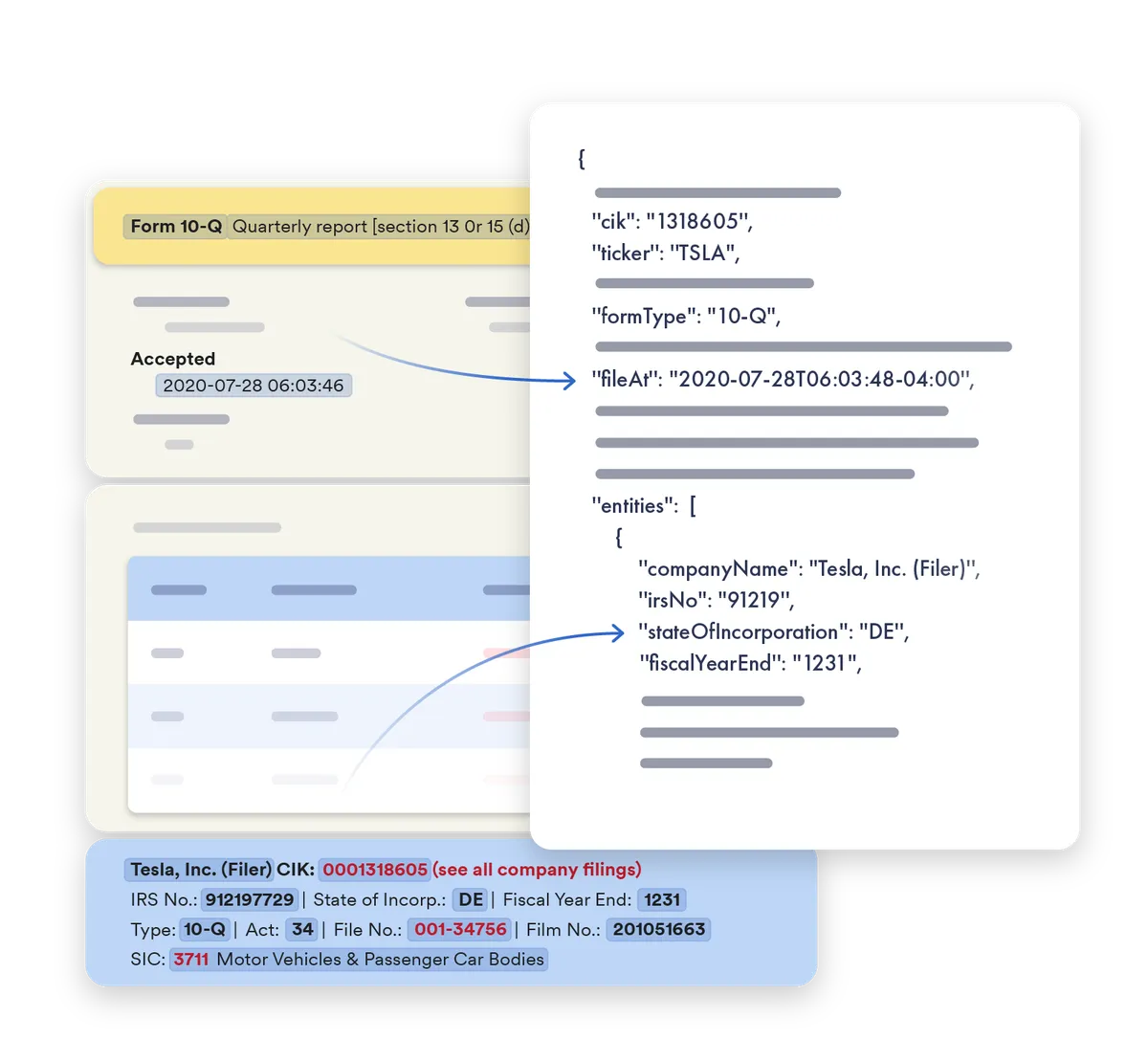
Even the SEC’s newer JSON APIs use this filing-centric logic.
Source: SEC API
Say you have to get to a company’s submissions or XBRL company facts. You have to construct requests using its 10-digit CIK, including leading zeros.
That makes sense for a regulatory disclosure system. But it’s less convenient when your internal records identify companies using domains, names, addresses, proprietary IDs, or several identifiers at once.
Companies House bulk products similarly center on statutory company records, including incorporation details, status, officers, and filed accounts, rather than a complete current commercial profile.
Its company snapshot comes as a CSV file, while accounts are provided separately in XBRL formats and people-with-significant-control data comes as JSON.
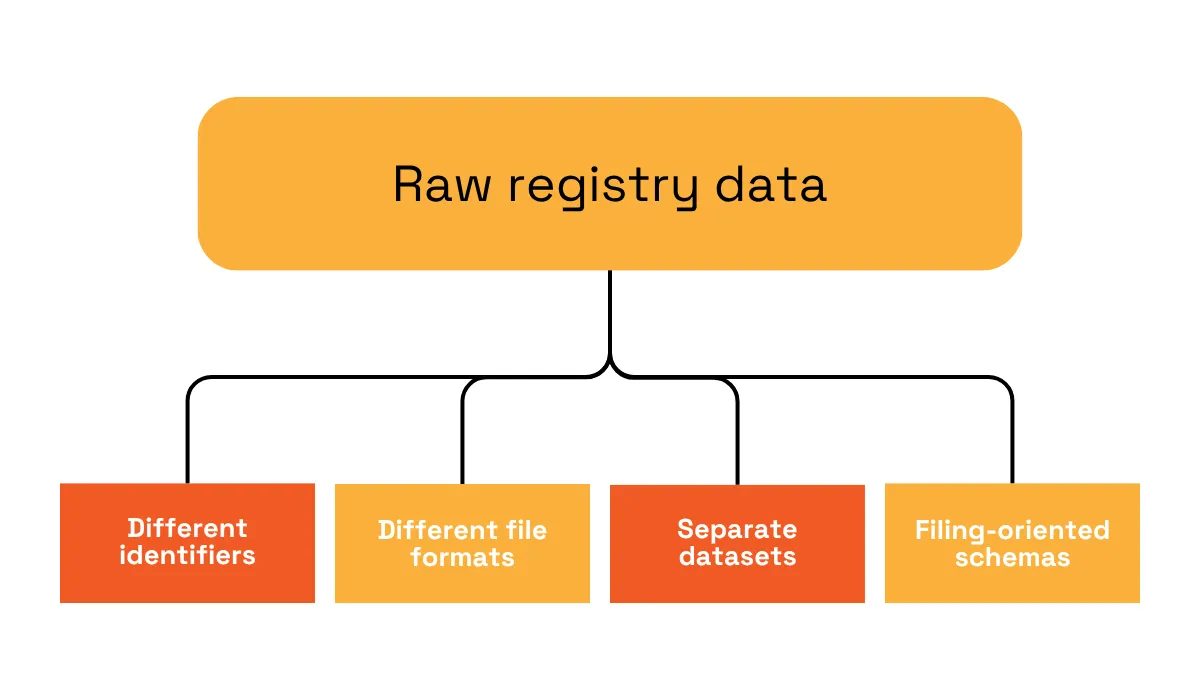
So even when all the information comes from the same registry, you may need to pull together and standardize several files and formats before you have one usable company profile.
In a nutshell, downloading the archive is often the easy part.
Source: Veridion
Turning regulatory records into a consistent, company-level schema you can actually use is where the engineering work begins.
What's Missing From Most Bulk Company Data Downloads?
Registry bulk files can answer good questions about a company as a legal entity.
But many enterprise use cases require another layer of information: what the business does, where it operates, its scale and market relevance, and how recently those signals were verified.
You rarely see those in regulatory filings. To get them, you have to combine multiple sources and continuously observe companies as they change.
Activity Classification Based on Real Behavior
A classification code tells you how a company was categorized when that information was submitted. Activity intelligence asks a more useful question: what does this business actually do now?
Answering that requires evidence that filings just don’t deliver.
That can include a company’s:
- Website
- Product catalog
- Service pages
- Locations
- Other digital signals
These are meaningful activities that a broad SIC or NAICS category can’t capture.
And those signals change, too. Companies launch products, enter new markets, discontinue services, and pivot their business models all the time.
That’s why activity classification needs to be refreshed against current evidence and not treated as a permanent attribute.
Here are a few things that can go wrong when activity data is outdated:
If activity data is outdated… | What can go wrong |
|---|---|
Supplier discovery | You may miss relevant suppliers or include companies that no longer offer what you need. |
Market sizing | You may count companies that have left the market or miss businesses that recently entered it. |
Segmentation | Companies may end up grouped by outdated activities rather than what they actually do today. |
This distinction is crucial in supplier discovery.
Imagine you need to identify European manufacturers of biodegradable food packaging. A registry search can narrow the market using industry codes, but those codes may group companies producing very different packaging materials or with different roles in the supply chain.
Product and service data lets you classify those businesses based on what they demonstrably offer instead.
The same problem affects market sizing.
If companies have moved into or out of your target category since their classifications were recorded, counting static codes can distort the market you think you're measuring.
This 2025 study found that 12% of company observations were industry classification “misfits.” That shows you how easily classification errors can introduce noise into industry-level analysis.
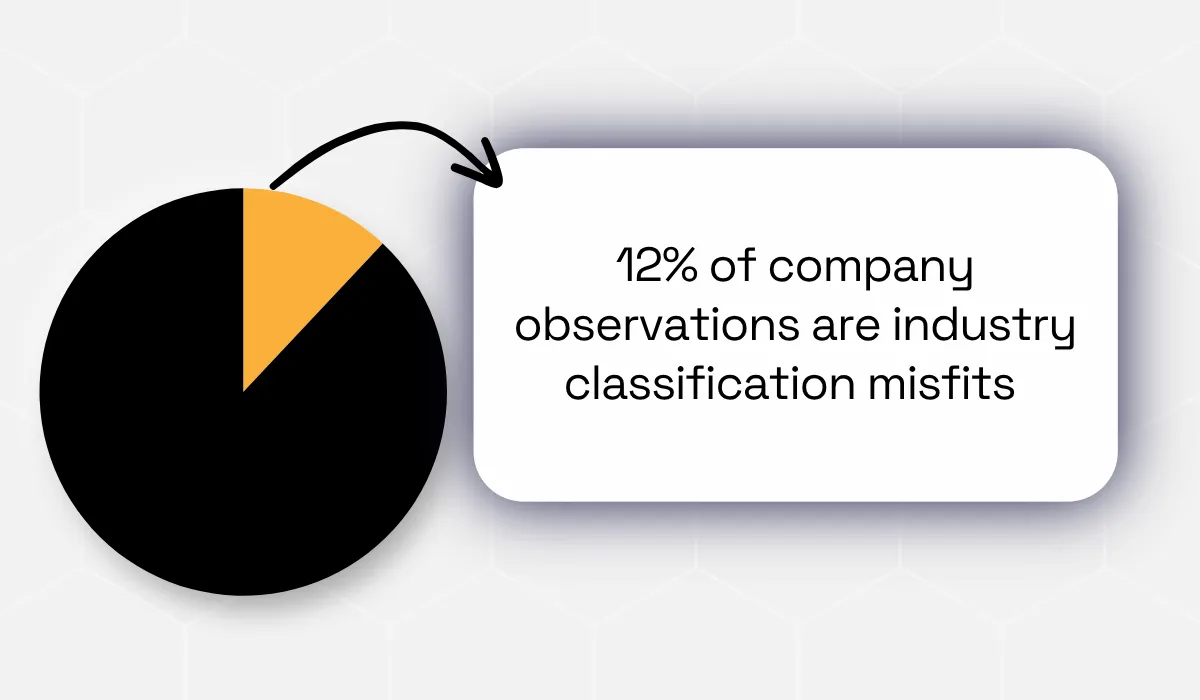
Classification thus becomes more useful when it describes observed commercial activity, not just a regulatory label.
Location Intelligence Beyond a Registered Address
A company address can be perfectly accurate and still tell you very little about where the business actually operates.
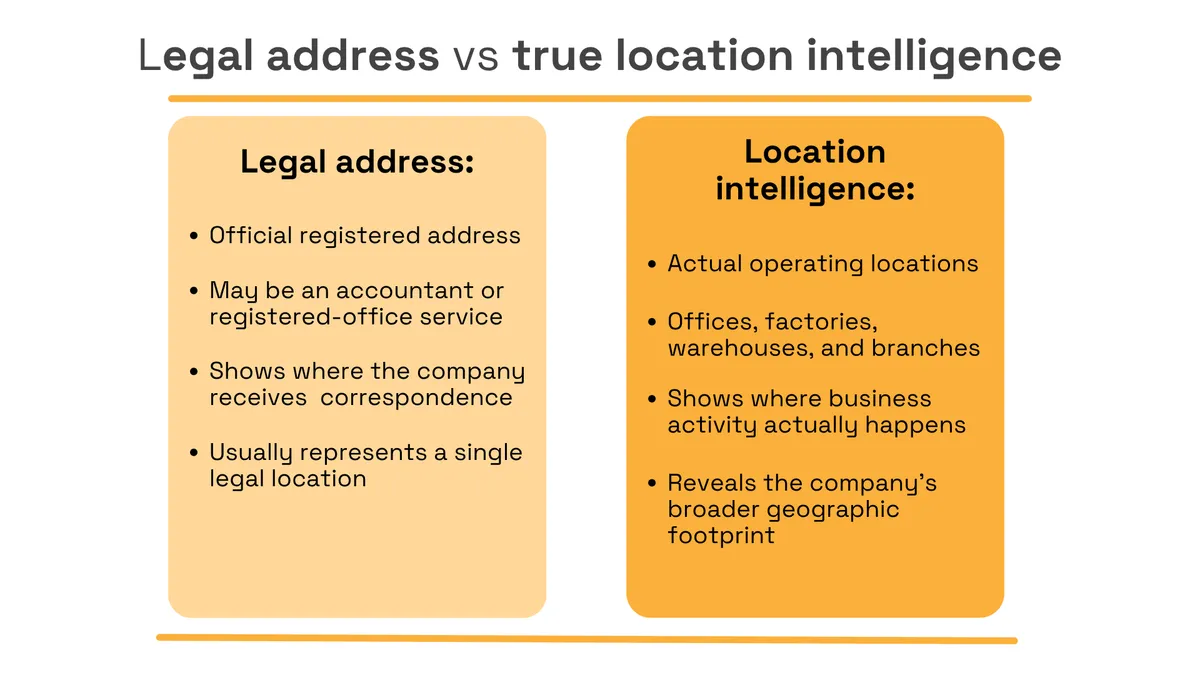
Companies House states that a registered office is the company's official address for receiving correspondence. You can even use an accountant, solicitor, or registered-office service provider rather than an operating location.
That creates a serious limitation for bulk registry data.
Source: Veridion
For example, a manufacturer may use its accountant’s London address as its registered office while operating facilities in Birmingham, Manchester, and elsewhere.
So if your dataset contains only the registered office, all that operational geography disappears.
The scale of the distinction is visible in official statistics.
The UK's Office for National Statistics counted 2.7 million VAT/PAYE businesses but 3.2 million local operating units in 2025, including 58,000+ businesses operating from multiple sites.
For territory planning, those locations can determine where customers, suppliers, or competitors are actually present.
For risk analysis, they can be even more important.
Knowing that a supplier is legally registered in one city won't tell you that its production facility sits in a region exposed to flooding, geopolitical disruption, or transport bottlenecks.
True location intelligence therefore needs to map the operational footprint behind the legal address.
Financial Signals for Companies That Don't Disclose
Financial data creates another major blind spot because comprehensive public financial statements simply don't exist for many private and small businesses.
But missing financial statements do not eliminate every useful indicator of company scale, activity, or potential financial risk.
In the context of supplier financial risk, the Executive Chair at RapidRatings International explains:

Illustration: Veridion / Quote: RapidRatings
That makes access to reliable financial signals vital when traditional financial statements aren't available.
But in the US, SEC reporting requirements mainly apply to public or otherwise qualifying reporting companies. Those businesses must submit ongoing reports. But many smaller private companies get left out.
The coverage gap is even clearer when you look at the UK.
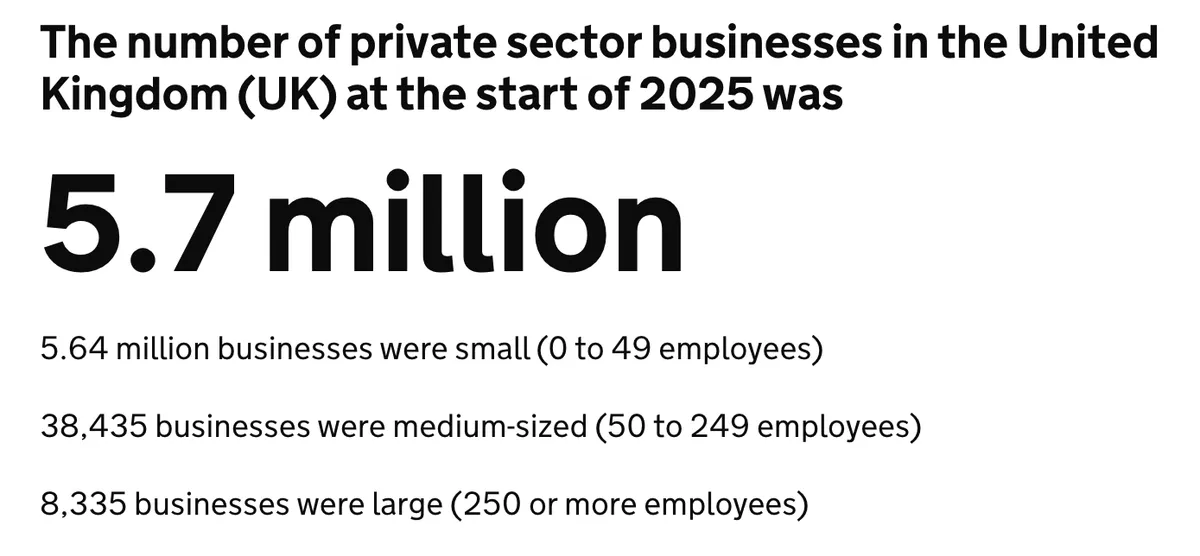
The Department for Business and Trade estimated 5.7 million private-sector businesses in the UK in 2025.
Source: Gov.uk
About 46% were registered for VAT and/or PAYE. The remainder were mainly non-employing sole proprietorships and partnerships captured through estimation rather than the business register.
Basically, there isn’t any single administrative database that captures the complete financial picture of the business population.
In fact, the UK government has to estimate parts of it itself. For unregistered businesses, its Business Population Estimates combine survey and tax-return data.
Commercial company datasets can use the same broader principle: Where reported revenue is unavailable, providers may estimate selected metrics from observable signals, provided the estimate is clearly labeled and withheld when confidence is insufficient.
However, an estimated financial attribute should be clearly labeled as an estimate, and its methodology understood.
That won't turn modeled revenue into an audited filing.
But for market sizing, segmentation, supplier screening, and other large-scale analyses, a defensible estimate can be far more useful than no financial signal at all.
When Does Bulk Download Make Sense Instead of API-Based Enrichment?
Bulk downloads aren't inherently worse than APIs.
The right choice depends on your workflow. In particular, when, how often, and at what scale you need company data.
As PredictLeads explains, bulk enrichment is great for warehouse refreshes and quarterly account list rebuilds.
When you’re refreshing thousands of records on a known schedule, flat-file delivery can be cheaper and easier to manage than individual API calls.
The same applies to large backfills, market mapping, and periodic database enrichment.
Real-time APIs solve a different problem.
If a new supplier enters your procurement platform and needs to be classified immediately, an API can enrich that record when it appears rather than waiting for the next bulk refresh.
Freshness matters here.
As Amplemarket shows, B2B data is estimated to decay by around 2–3% every month. So even a recent bulk export gradually becomes outdated.
Some workflows thus combine both approaches: load large datasets in bulk, then use APIs to refresh individual records when needed.
Here’s what each option excels at:
Bulk Delivery | Real-Time API |
|---|---|
Warehouse refreshes | On-demand enrichment |
Quarterly account list rebuilds | New supplier classification |
Large backfills | Immediate record updates |
Market mapping | Time-sensitive decisions |
Periodic database enrichment | Point-of-use data refreshes |
But the more important question isn't bulk or API. It's what data sits behind either delivery method.
A provider can package registry records into a convenient CSV without adding any new intelligence.
So, when evaluating bulk data, check:
- Where the attributes come from
- How frequently they're refreshed
- If the provider uses sources beyond registries
- If reported and estimated data are clearly distinguished.
This is where Veridion comes in.
Source: Veridion
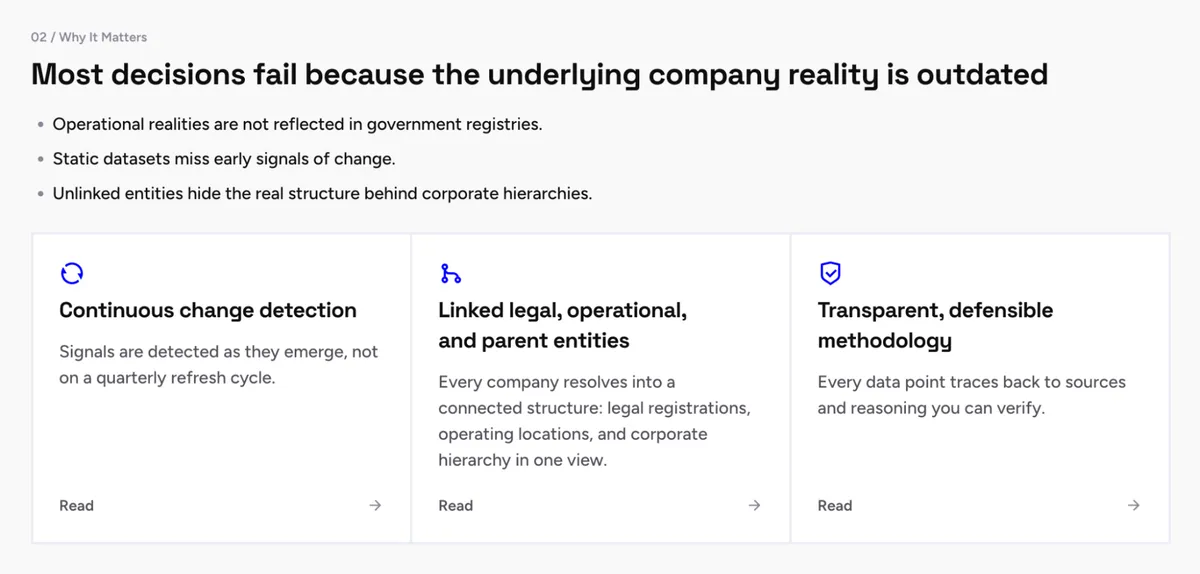
Veridion offers both bulk delivery and API access, including flat files and warehouse integrations. But there’s something that sets it apart.
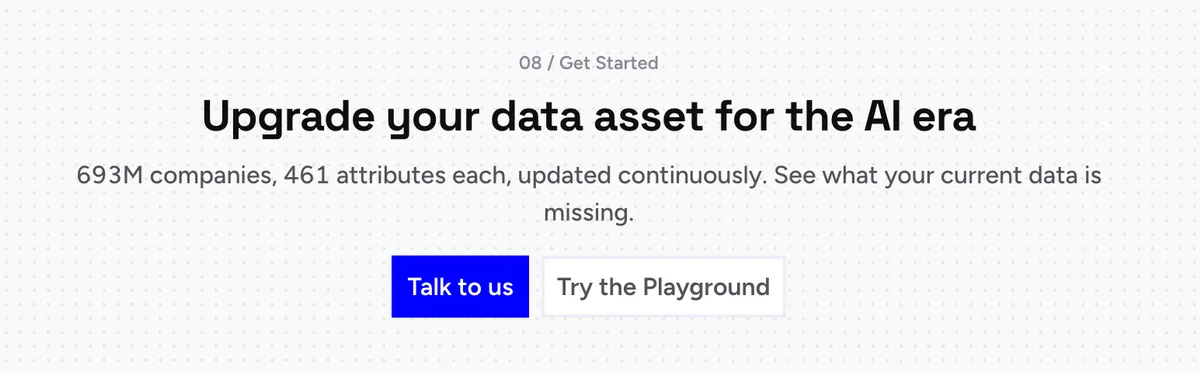
Our current company data includes over 461 attributes derived from hundreds of global registries and ~1.4B web pages per month. These cover everything from firmographics and locations to products, financials, and ESG information.
Source: Veridion
That breadth is backed by a data methodology designed to continuously discover, verify, and enrich company information from multiple sources.
Each attribute also comes with confidence scores and source trails. These help you understand where the data came from and how reliable it is.
So choosing bulk doesn't have to mean sacrificing depth.
At the end of the day, the most important question is what you need: enriched company intelligence at scale, on demand, or both. And whether your data provider can deliver the same depth whichever method you choose.
Conclusion
A bulk company data download is only as useful as the intelligence inside it.
So before comparing file formats or delivery costs, look at what each company record actually tells you. And of course, how recently that information was verified.
Once you've established that, choosing between bulk delivery and API enrichment becomes much simpler. Match the delivery method to your workflow, and you can turn millions of company records into data your teams can use with confidence.
Articles
Discuss how these trends affect your organization.
Our analysts are available for a short call. Bring a specific question and we will ground it in the data.
Insights
Keep reading
More analysis, research, and outcomes grounded in live company intelligence.
5 Trends Shaping the Future of Market Intelligence
Want to future-proof your business strategy? Explore the top trends defining the future of market intelligence.
How to Gather Market Intelligence In 5 Steps
In this guide, we're breaking down the five key steps you need to take to gather market intelligence that drives real action.
How Is AI Revolutionizing Market Intelligence?
Explore the key ways AI is transforming market intelligence workflows and helping businesses stay ahead of the competition.