Insights / Articles
The Importance of LEI (Legal Entity Identifier) and Official Codes in Commercial Insurance Underwriting

- LEIs give underwriting teams a consistent way to identify the correct legal entity across jurisdictions.
- In October 2025, 93.13% of LEI records contained complete parent information.
- One commercial insurer increased its submission match rate from 15% to 60% with automated entity resolution.
How confident are you that every commercial insurance policy in your portfolio is tied to the correct legal entity?
For large enterprises with layered ownership structures and cross-border operations, establishing this confidence is rarely straightforward. Yet it is essential, because every underwriting decision is only as reliable as the business identity data behind it.
Legal Entity Identifiers (LEIs) help close that gap by giving each legal entity a standardized, globally recognized identity.
This article explains why LEIs matter in commercial underwriting, how to validate them and what benefits you get by automating their validation.
What Makes the LEI Different From Other Identifiers
A Legal Entity Identifier (LEI) is a globally unique 20-character alphanumeric code used to identify legal entities participating in financial transactions.
Established under the ISO 17442 standard, it gives insurers, regulators, and financial institutions a consistent way to recognize the same organization across jurisdictions.
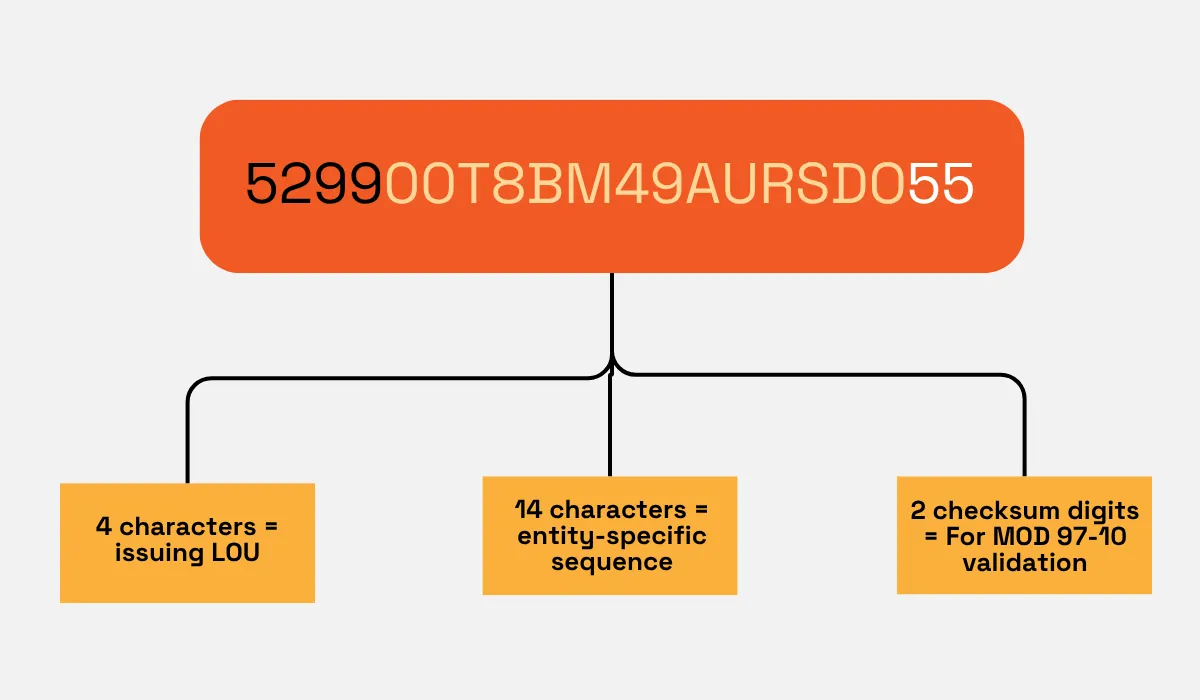
The LEI contains three parts:
- A 4-character prefix identifying the issuing Local Operating Unit.
- A 14-character entity-specific sequence.
- 2 final check digits used for data validation.
Source: Veridion
It links to standardized enterprise data, including the entity’s legal name, registered address, jurisdiction and, where available, its direct and ultimate parent company.
But LEI is different from other business identifiers.
LEI vs. DUNS Number
A DUNS Number is a nine-digit identifier issued exclusively by Dun & Bradstreet. It’s widely used for supplier onboarding and commercial relationships.
An LEI serves a different purpose.
It is issued through GLEIF-accredited Local Operating Units (LOUs) and follows a globally standardized framework. LEI records are freely searchable through the GLEIF Global LEI Index, whereas DUNS data is maintained within Dun & Bradstreet’s proprietary commercial ecosystem.
LEI vs. National Company Registered Number
A national company registered number confirms that a business legally exists within a specific country, such as Companies House in the United Kingdom or a Secretary of State registry in the United States.
While this is essential for domestic legal recognition, it won’t be helpful if the organization is operating across multiple jurisdictions. For that, an LEI is required.
For example, consider a US manufacturer purchasing global commercial insurance. Its Secretary of State number readily confirms its legal status within the US but provides little context to an underwriting team in Canada.
An LEI bridges that gap by assigning the same globally unique identifier regardless of where the business operates.
As of July 12, 2026, more than 3.37 million LEIs have been issued globally, which reflects the identifier’s growing importance.
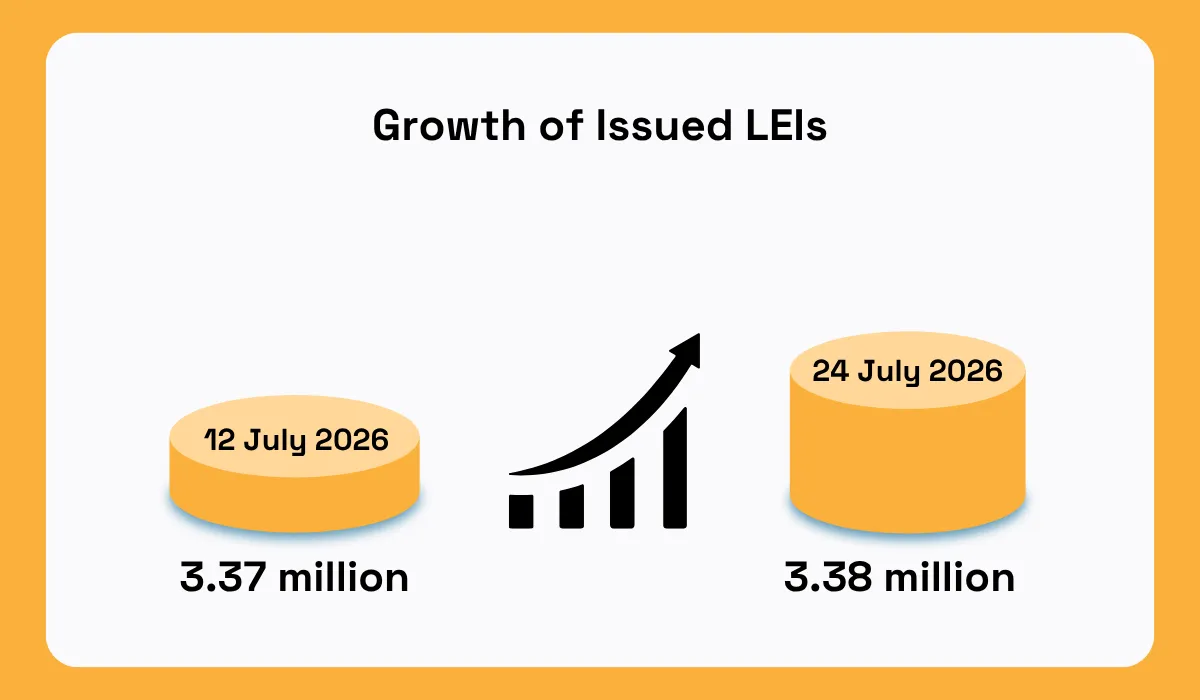
This growth shows that organizations increasingly see the LEI as more than a compliance requirement.
Steven Beck, Head of Trade & Supply Chain Finance at Asian Development Bank, explains this shift
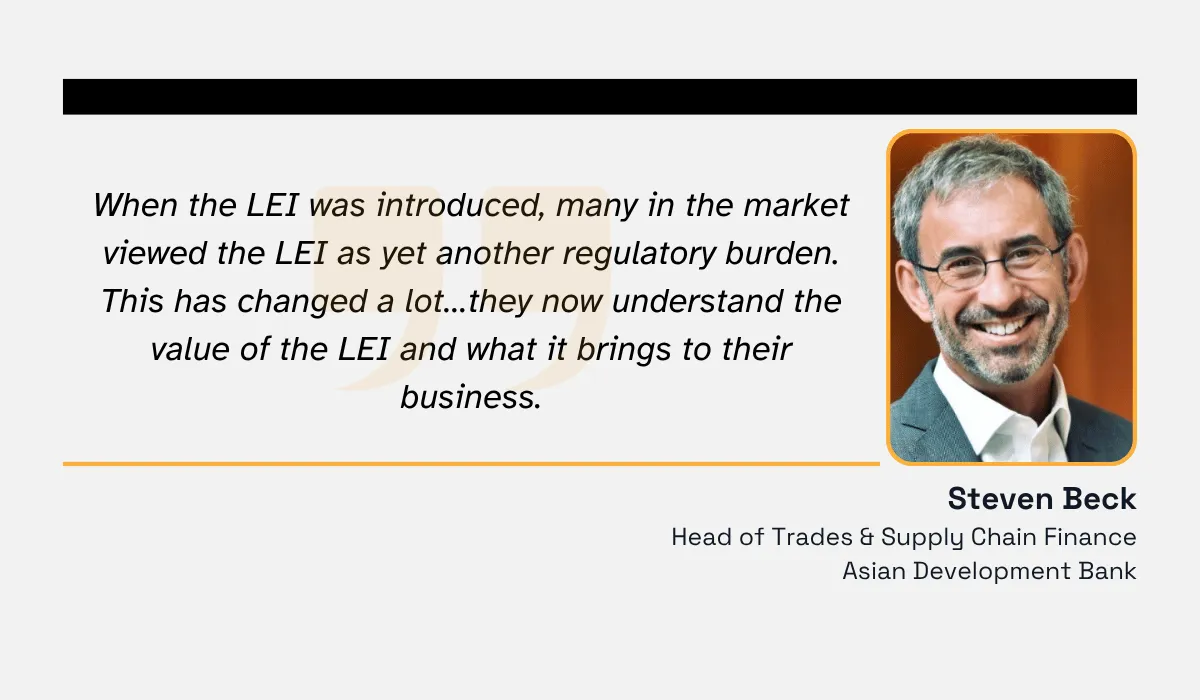
That value extends directly to commercial underwriting. The LEI provides a reliable identity layer that helps teams validate a company’s profile and assess risk against the correct legal identity.
Why a Reliable, Verifiable Identifier Matters for Underwriting Triage
As underwriting triage becomes more automated, insurers need a reliable way to confirm which legal entity sits behind every submission.
Algorithms can classify risks, enrich enterprise data and route applications within seconds, but they cannot make sound decisions when identity records are ambiguous.
A verified LEI provides that anchor. Here’s where that matters most.
Preventing Duplicate Entity Records
Duplicate records usually enter underwriting systems in one of two ways.
- The same company may enter an underwriting system under variations of its name or address, creating several customer profiles.
- Separate subsidiaries within a corporate group may share near-identical names and be incorrectly merged into one record.
Simple name-based entity matching alone struggles with both scenarios.
For example, consider a group containing “ABC Holdings Ltd,” “ABC Holdings American Ltd” and “ABC Holdings Insurance Services Ltd.”
A fuzz-matching model may interpret these names as duplicates, even though each represents a separate legal entity with its own exposures and regulatory obligations.
The LEI removes this guesswork.
Every code points to one specific legal entity and connects to standardized reference data such as its legal name and ownership information.
Underwriting platforms can therefore use the LEI as the primary matching key, then attach submissions, claims and policies to the correct record.
The danger of relying on names alone is not theoretical.
A well-known example occurred during the early months of the COVID-19 pandemic: demand for Zoom Video Communications surged. Some investors mistakenly bought shares in Zoom Technologies, an unrelated company with a similar name and the ticker ZOOM.

Source: Nathan Crooks on Time
Zoom Technologies’ share price doubled in February 2020 as investors backed the wrong business. The confusion became serious enough for the U.S. Securities and Exchange Commission to suspend trading in Zoom Technologies.
The incident involved public-market data rather than commercial insurance, but the underlying failure is the same: a familiar name was mistaken for a verified identity.
In underwriting, the same mistake can create duplicate records or link a policy to the wrong subsidiary. Verifying each submission against an LEI helps stop errors before they affect policy issuance.
Surfacing Ownership Structures
A company registration number identifies a legal entity. It doesn’t show the wider corporate group behind it.
For commercial underwriters, that missing context matters. Separate subsidiaries may look independent on paper while sharing the same parent company, supply chain or counterparty exposure.
Without visibility into those relationships, a portfolio can appear more diversified that it really is.
LEI data helps close that gap.
It not only answers the Level 1 data “who is who” but Level 2 data as well, “who owns whom.”
It identifies both the direct parent and the ultimate parent. The direct parent is the lowest-level company that consolidates the entity’s financial accounts, while the ultimate parent is the highest consolidating company with no parent above it.
Where the parent also has an LEI, the relationship record connects both entities through standardized identifiers. This makes it easier for underwriting systems to move beyond basic entity verification and map the wider ownership structure.
That structure directly affects the risk assessment.
An insurer may underwrite several subsidiaries as separate businesses, only to discover later that they all depend on the same parent company. Ownership-aware entity matching helps surface that concentration before it affects policy issuance.
And this type of analysis is becoming more practical as Level 2 coverage improves. In October 2025, GLEIF reported that 93.13% of the total LEI population contained complete parent information.
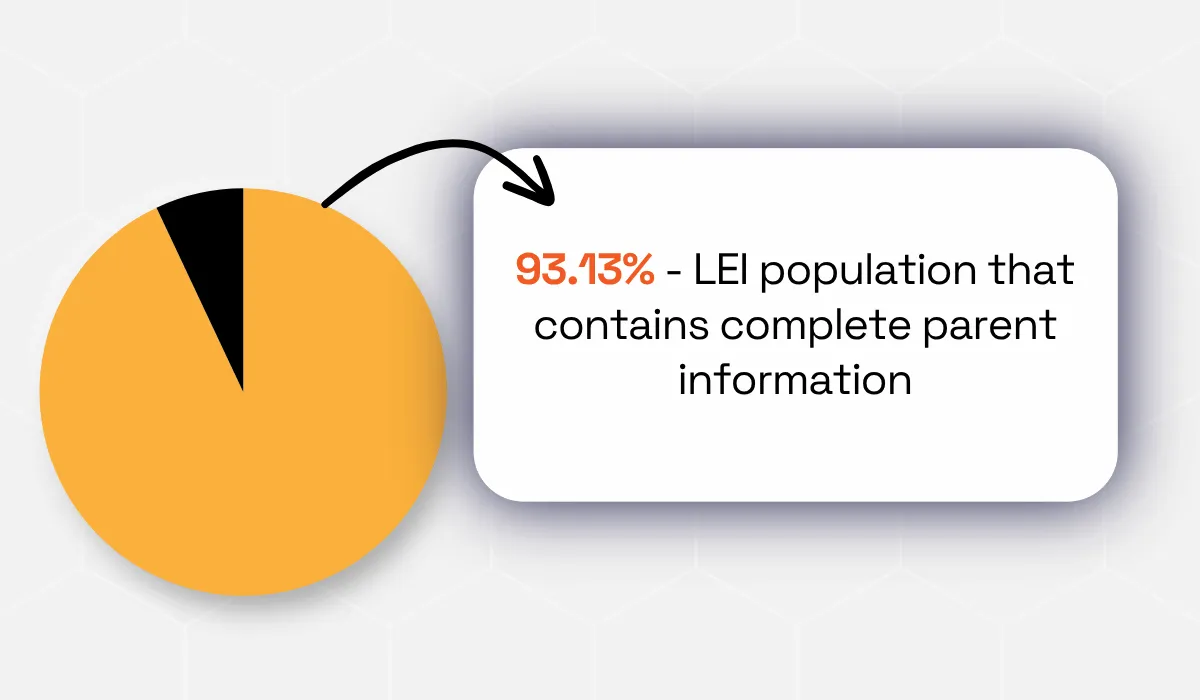
With that level of coverage, LEI-based data enrichment can help insurers and reinsurers connect subsidiaries to their parent companies, and see more clearly where the risk ultimately lands.
Enabling Straight-Through Processing
Straight-through processing means moving a commercial insurance submission from intake to finalization without human intervention (provided it falls within low-risk parameters).
However, that automation cannot begin with an unresolved identity.
A verifiable, machine-readable identifier such as the LEI gives an underwriting system a precise entity record to validate.
Without an LEI, systems often rely on legal names and trading addresses to determine who is applying for coverage. These fields may contain abbreviations, spelling variations and translated characters.
That makes automated entity matching less reliable. The system may produce false positives, connect the submission to the wrong company or send an otherwise straightforward submission for manual review.
The LEI removes much of that uncertainty.
Instead of relying on approximate name matching, the system can submit the exact 20-character code to the GLEIF API, verify its status and retrieve standardized data. That data can then be checked against underwriting rules and enriched with internal policy, claims and exposure records.
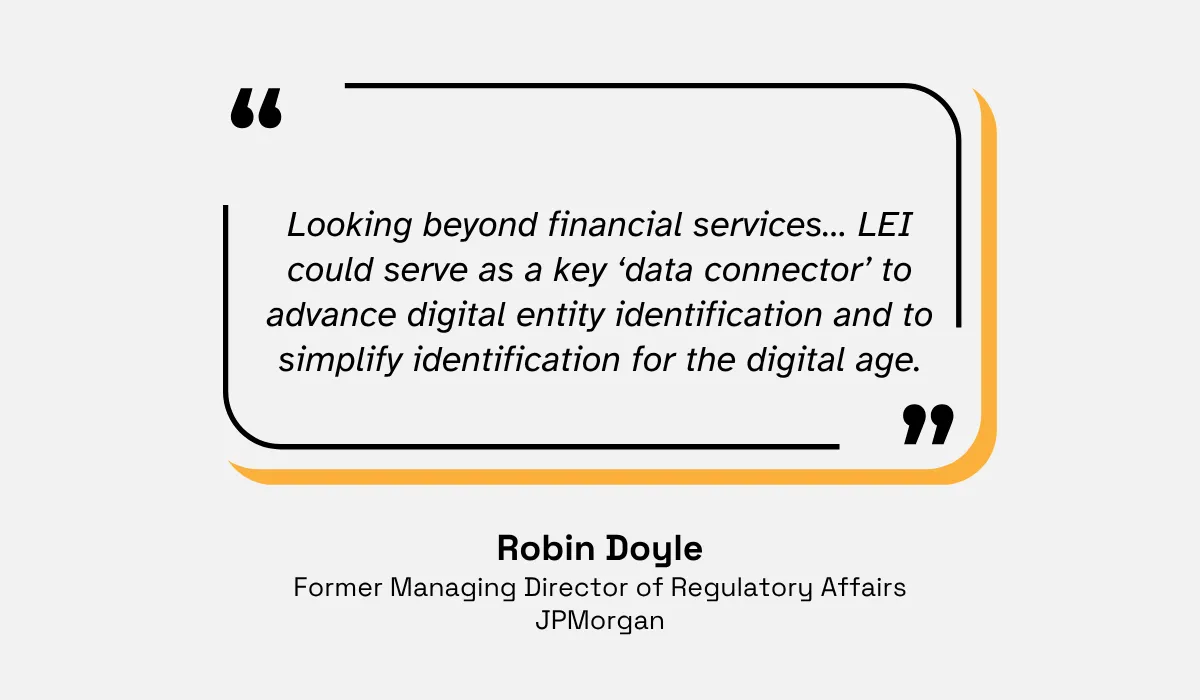
Robin Doyle, former Managing Director of Regulatory Affairs at JPMorgan, describes the LEI as a potential “data connector” for digital entity identification.
That role becomes clear in onboarding workflows.
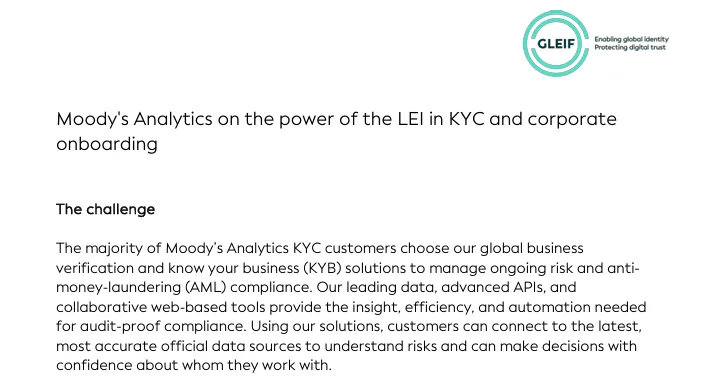
Moody’s Analytics KYC, a financial intelligence provider, uses LEI-based verification to support faster entity onboarding.
Source: GLEIF
Its customers report that onboarding a basic merchant can take just a few minutes, whereas larger organizations with complex ownership hierarchies may require a longer review.
The same principle applies to the underwriting triage. Once the applicant’s identity is verified, low-risk submissions can move forward automatically, while only exceptions are routed for human review.
Recognizing and Validating an LEI
An LEI should not be trusted simply because it appears in an application.
Before using it for legal underwriting triage, the code must pass two basic checks.
Only then should the system proceed to deeper validation against the Global LEI Index.
Checking Format and Check Digits
The first check is structural.
A valid LEI contains exactly 20 alphanumeric characters with no spaces, punctuation or missing positions. It follows the ISO 17442 standard and ends with two check digits designed to detect common data-entry errors.
The next step is to recalculate those digits using the ISO/IEC 7064 Mod 97-10 algorithm, the same checksum method used to validate IBANs.
At a conceptual level, the system converts the letters in the LEI into numerical values and processes the resulting sequence. If it doesn’t produce the required remainder, the code fails validation.
That makes the checksum a useful first-pass filter.
A mistyped, transposed, or malformed character changes the result immediately. The test does not confirm that the LEI is active or belongs to the applicant, but it helps underwriting systems nip obvious errors in the bud before unreliable enterprise data enters entity matching.
Suppose a broker enters one character of an LEI incorrectly while transferring thousands of commercial accounts from a spreadsheet.
The code may still appear legitimate to a human reviewer. An automated platform, however, can immediately validate its length, allowed characters, and checksum.
When the LEI fails, the submission can be rejected or routed for correction instead of being connected to the wrong parent company.
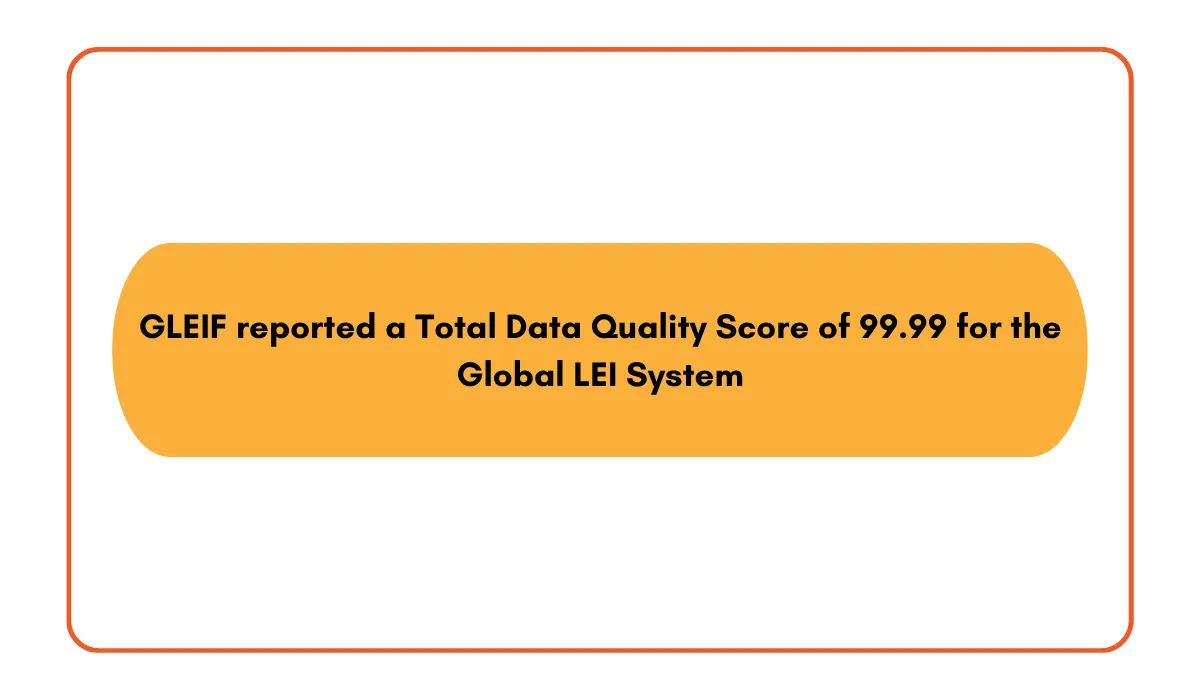
This type of automated discipline supports data quality at scale. GLEIF reported a Total Data Quality Score of 99.99 for the Global LEI System in December 2025.
Format and checksum validation establish that an LEI is structurally well formed. The next step is verifying whether the reference data linked to the legal entity is current or not.
Confirming Active LEI Status
A structurally valid LEI is not automatically a current one.
After checking its format and check digits, an underwriting triage system must query the Global LEI Index to confirm the identifier’s registration status.
LEIs have multiple statuses, but the 3 most relevant to underwriting triage are the following:
Issued status | means the LEI has been validated and identifies an entity that was operating when its record was last updated |
|---|---|
Lapsed status | means the LEI was not renewed by its scheduled renewal date, but the organization is not known to have ceased operating |
Retired status | means the legal entity has stopped operating without being merged into another entity |
These distinctions matter because LEI reference data is generally revalidated at least annually against authoritative sources. GLEIF explains that renewal helps confirm details such as the entity’s legal name, address, and ownership information are accurate.
A lapsed LEI, therefore, doesn’t automatically indicate fraud or incorrect data, but it means the information has not been verified recently enough to support straight-through processing without a second look.
In practice, an issued LEI may allow the submission to move forward, while a lapsed record should trigger additional checks. A retired status, meanwhile, should stop the workflow until the applicant’s current legal identity is established.
All of this ensures the right level of scrutiny is applied before the risk assessment proceeds.
Automating Validation at Scale
Manually checking every LEI against the Global LEI Index may work for individual submissions, but it quickly becomes a bottleneck across a high-volume commercial underwriting pipeline.
The answer is automated triage.
But automation needs more than a valid identifier. It must confirm official identifiers, resolve the applicant to the correct legal entity and enrich the record before an underwriter steps in.
An LEI provides a reliable identity anchor. What it doesn’t provide is the full operational picture required for risk selection. Underwriting teams also need to understand how the business operates, including its products, locations and technologies.
Veridion’s entity resolution engine adds that operational context. It matches official identifiers and registry-sourced records with real-world business signals.
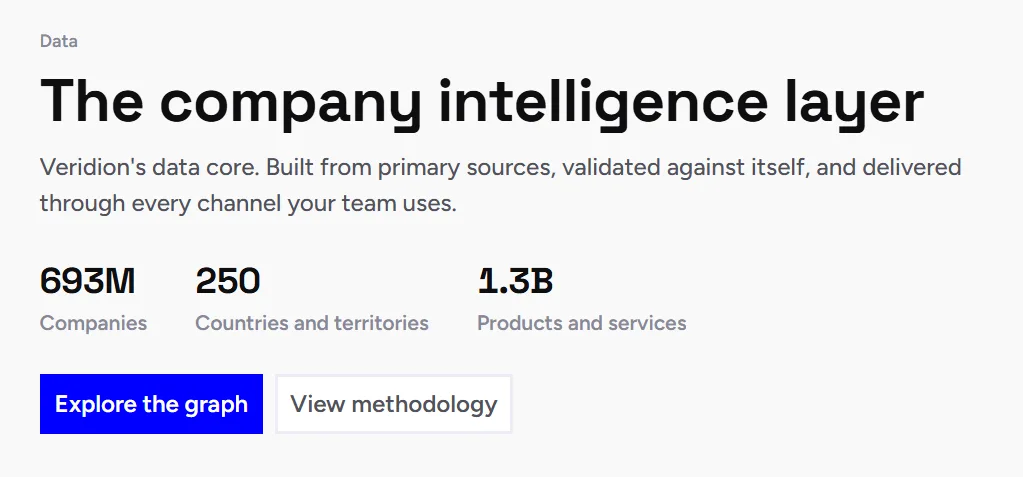
Its database covers 693M companies across 250 countries, with each profile containing hundreds of attributes spanning locations, products, ownership structures and financial indicators.
Source: Veridion
Its Match & Enrich layer then uses 461 fields to resolve each submission against this global company knowledge graph. The result is a standardized company profile returned with confidence scores, giving underwriting teams a clearer view of both legal identity and actual business activity.
In other words, the process doesn’t put all its eggs in one basket. It combines authoritative identity data with continuously refreshed operating evidence.
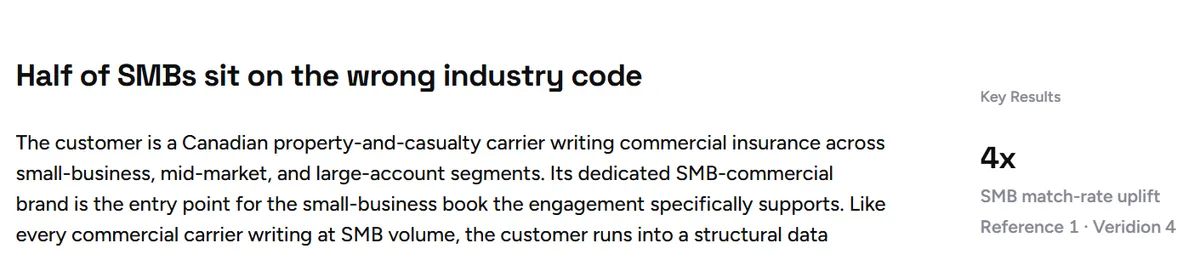
A Canadian P&C carrier integration shows what this looks like in practice. After integrating Veridion in its SMB underwriting workflow, the carrier increased its submission match rate from 15% to 60%.
Source: Veridion
Each business was resolved, classified and scored in approximately 1.5 seconds, while prohibited activities were routed out of the automated path.
This is the difference automation makes at scale.
By combining LEI validation with broader data enrichment, you can process large submission volumes without sacrificing accuracy and auditability.
Conclusion
LEIs were once treated as another compliance field to store. That view no longer holds as commercial underwriting becomes faster and more dependent on reliable enterprise data.
A verified LEI gives insurers a dependable way to identify the correct legal entity, prevent duplicate records, and move suitable submissions through triage with less manual intervention and greater accuracy.
When that validation is embedded directly into underwriting workflows, those benefits become scalable; thus, insurers can make cleaner, more consistent decisions across large submission volumes.
Articles
Discuss how these trends affect your organization.
Our analysts are available for a short call. Bring a specific question and we will ground it in the data.
Insights
Keep reading
More analysis, research, and outcomes grounded in live company intelligence.
6 Steps of the Data Enrichment Process
In this article, you will learn data enrichment process steps and how businesses transform raw data into valuable insights.
Underwriting Data Analytics: A Guide
Learn what underwriting data analytics is, how it’s being used, and the best practices to keep in mind when implementing it.
The Data Enrichment Techniques Businesses Use to Build More Valuable Datasets
In this article, you will learn data enrichment techniques that businesses use to improve data quality and build more valuable datasets.