Insights / Articles
Ghost Brokers & Shell Companies: Why Traditional Firmographics Fail in Commercial Lines
Commercial insurance fraud thrives on ghost brokers and shell firms. Learn to detect them faster and protect your business.

- Shell companies can pass a paperwork check while having no real operating business.
- A certificate of insurance can still be part of an elaborate insurance fraud scheme.
- Small data inconsistencies can reveal risks that basic firmographic checks miss.
Imagine a mid-sized general contractor hires a new electrical subcontractor for a commercial build-out.
The subcontractor provides a certificate of insurance.
The policy number checks out, the carrier is legitimate, and the business is properly registered.
Every standard verification check is passed.
Then a worker on the job is seriously injured, and investigators discover that the crew was never covered under the policy.
The company whose certificate cleared underwriting had no employees, no equipment, and no meaningful business operations.
It existed solely to rent out its insurance paperwork.
This is the blind spot traditional firmographics struggle to detect.
In this article, you'll learn why traditional firmographics often miss shell companies and ghost brokers, and how modern verification models help commercial insurers verify operational substance alongside legal registration.
Why Traditional Firmographics Miss Shell Companies
Traditional firmographic data is designed to verify a company's legal identity, not its operational substance.
It confirms information such as registration status, incorporation date, address, industry classification, and tax identifiers, but it can't tell you whether the business genuinely operates as represented.
For commercial insurers, that distinction creates an important blind spot.
Shell companies are specifically designed to pass these surface-level checks while concealing the risks that matter most during insurance underwriting.
Built to Look Legitimate on Paper
The biggest challenge with shell companies is that they often look like legitimate businesses.
The Association of Certified Fraud Examiners (ACFE) defines a shell company as a legal entity with little or no independent economic activity.
While shell companies can serve legitimate corporate purposes, they're also widely used to conceal ownership, move funds, or facilitate fraud because they resemble ordinary businesses in public records.
That resemblance is exactly what makes them difficult to detect through traditional firmographics.
On paper, a shell company can possess many of the same characteristics as a legitimate business, including:
- Basic corporate filings
- Tax registration records
- A valid incorporation filing
- A registered mailing address
- A legally registered business name
- Even a small payroll or bank account
Viewed solely through conventional firmographic data, these attributes suggest a legitimate commercial entity.
In reality, the company may have no physical office, few or no employees, little measurable business activity, and no meaningful products or services.
A registered address may simply belong to a mail-forwarding service, virtual office, or registered agent representing hundreds of unrelated companies.
Likewise, an industry classification code says nothing about whether the business is actively engaged in that line of work.
According to the ACFE, shell companies used in fraud schemes often have little or no independent economic value, existing primarily to conceal ownership or facilitate financial transactions.
Instead of relying solely on incorporation data, investigators examine indicators such as physical business locations, employee presence, customer activity, supplier relationships, and other signs that the company genuinely conducts business.
Traditional firmographics capture few, if any, of these operational signals.
Certificates Can Be Forged or "Rented" in Minutes
Certificates of insurance (COIs) are a cornerstone of commercial underwriting and vendor onboarding because they demonstrate that a business carries the required insurance coverage.
The challenge is that a certificate, by itself, proves little.
Fraudsters can create convincing fake COIs using publicly available templates and basic PDF editing software.
Because most certificates follow standardized formats, a forged document can appear authentic enough to pass a visual review, especially when underwriting teams process large volumes of submissions.
Unless the certificate is verified directly with the issuing broker or carrier, alterations to the policy number, coverage limits, effective dates, or named insured may go unnoticed.
One example comes from a telecom company that relied on its broker to collect and verify vendor COIs.
A fraudulent certificate slipped through the verification process, and when a vendor accident occurred, the company was left with a $162,000 uninsured claim.
But forged certificates aren't the only challenge.
In many commercial lines, the certificate itself is genuine, but the fraud lies in who it supposedly covers.
In a scheme known as certificate renting, fraudsters establish a shell company, purchase a workers' compensation policy covering only a small payroll, and then allow unrelated subcontractors or work crews to use that company's COI to qualify for projects.
The certificate is legitimate, the policy is active, and the shell company is legally registered.
What isn't legitimate is the relationship between the insured company and the workers performing the job.
A federal prosecution in Florida illustrates how these schemes operate.

Source: Construction Citizen
Two individuals created a shell construction company and purchased a workers' compensation policy based on an annual payroll of roughly $175,000.
They then "rented" the company's certificates of insurance to dozens of unrelated construction crews across multiple states, allowing contractors to present proof of coverage for workers who were never employed by the insured business.
Prosecutors alleged that nearly $19 million in payroll flowed through the scheme before it was uncovered, leaving contractors relying on certificates that never covered the people actually working on their job sites.
Traditional firmographic data offer little protection against either scenario.
A business registry can confirm that the company exists, and a certificate review can confirm that an insurance policy is in place.
Neither verifies that the insured entity actually employs the workers named in the application or that the business is operating in a manner consistent with its reported risk profile.
Registered Agents Add a Layer of Obfuscation
Even when a company passes every registration check, you might still not know who owns or controls the business.
Many companies are formed through registered agents or incorporation services that file formation documents, maintain the official registered address, and receive legal notices on the company's behalf.
These intermediaries provide a legitimate and widely used service for businesses of all sizes.
However, they can also make it more difficult to determine who ultimately controls a company based on registry data alone.
When you retrieve a company's registration records, the listed address and point of contact often belong to the registered agent rather than the individual or organization directing the business.
In many jurisdictions, an owner can establish a company online in a matter of minutes without their name appearing prominently in publicly available records.
Attorneys, nominee directors, or other intermediaries may add additional layers between the legal entity and its beneficial owner.
This is a structural limitation of traditional firmographics rather than an isolated edge case.
Registry data accurately reflects the information submitted during incorporation, but it does not necessarily reveal the individual who ultimately owns, controls, or benefits from the company; the beneficial owner.
As a result, a company can appear fully compliant in public records while providing little visibility into who is actually behind it.
The challenge becomes even greater in cross-border commercial relationships.
Certain jurisdictions, including the British Virgin Islands, Panama, and the Cayman Islands, have historically been associated with greater corporate secrecy because their legal frameworks have provided limited public disclosure of beneficial ownership.
In some cases, multiple legal entities can be layered across different jurisdictions, each registered through separate intermediaries, making ownership structures significantly more difficult to trace.
Advanced Verification Models That Catch What Firmographics Miss
Addressing these blind spots doesn't require abandoning firmographic data.
It requires building on it.
Modern verification models go beyond asking, "Does this company exist?" to ask a more meaningful question: "Does this company actually operate as it claims?"
That shift, from confirming paperwork to verifying operational substance, is what separates modern verification models from a basic registry lookup.
Flagging Shell Company Indicators
While shell companies are designed to blend into legitimate business registries, they often leave behind inconsistencies that become visible when you look beyond incorporation records.
Rather than asking only whether a company exists, advanced verification models compare registry data with operational, digital, and commercial signals to determine whether it functions as a genuine business.
Compliance platforms and financial crime investigators commonly monitor indicators such as:
Indicator | What It May Suggest |
|---|---|
Shared registration address | The company may be registered through a virtual office, registered agent, or incorporation service rather than operating from a genuine business location. |
Business activity mismatch | The company's claimed industry or size isn't supported by observable facilities, employees, customers, or supply chain activity. |
Limited digital footprint | A business claiming significant operations has little or no independent online presence, customer references, or other evidence of commercial activity. |
Minimal economic activity | The company shows few signs of generating value through products, services, employees, or business relationships. |
These indicators should never be evaluated in isolation. Many legitimate businesses, particularly startups, holding companies, and small firms, may exhibit one or more of these characteristics.
Instead, fraud detection models look for patterns across multiple data points.
For example, Moody's identified a single strip mall in South Africa associated with more than 61,000 registered businesses, while one address listed as "the Pyramids" in Egypt was linked to over 22,000 companies.
These examples do not prove fraud, but they illustrate why shared registration addresses often warrant additional investigation.
No single indicator proves that a company is a shell.
Many legitimate startups, holding companies, and small businesses may exhibit one or more of these characteristics.
Instead, modern verification models evaluate multiple signals together, assigning greater weight to patterns that consistently suggest a lack of genuine business operations.
Ownership transparency has also become a growing focus of regulators worldwide.
In the United States, the Corporate Transparency Act (CTA) requires many companies to report their beneficial owners to help law enforcement identify entities used to facilitate money laundering.
Similarly, the United Kingdom’s Registrar of Overseas Entities requires overseas organizations that own UK property to disclose their beneficial owners, making it more difficult to conceal ownership through opaque corporate structures.
While these initiatives improve transparency, they don’t eliminate the need for operational verification.
A company may satisfy beneficial ownership reporting requirements yet still present elevated underwriting risk if its claimed business activities don't align with observable operations.
For commercial insurers, combining firmographic data with operational intelligence and ownership verification provides a much clearer picture of whether a company is genuinely operating as it claims, or simply appears legitimate on paper.
Verifying Digital Footprint Against Registry Claims
Registration data tells you what a company claims to be.
Digital footprint verification tells you what a company actually appears to do.
Comparing the two is one of the most effective ways to identify shell companies before they enter your book of business.
Shell companies can satisfy incorporation requirements, but they struggle to fabricate the consistent operational signals that legitimate businesses generate over time.
While incorporation documents can be filed in hours, establishing a genuine commercial presence typically takes months or years.
Modern verification models therefore compare registry data with independent digital and commercial evidence to determine whether a company's observable activities align with its stated business profile.
For example, an insurer might compare:
Registry Claim | Evidence to Verify |
|---|---|
Industry classification | Website content, products or services, customer references, supplier relationships |
Business size | Hiring activity, employee profiles, office locations, workforce information |
Physical location | Business directories, maps, local listings, operating hours |
Geographic markets | Regional offices, customer base, distributors, multilingual website content |
Years in business | Archived websites, news coverage, partnership announcements, regulatory filings |
The objective isn't to verify that every company has an extensive online presence since many legitimate small businesses operate with modest digital footprints.
Instead, the goal is to determine whether the available evidence is consistent with the company's claimed operations.
For example, a business describing itself as a regional industrial equipment manufacturer with hundreds of employees could leave evidence such as manufacturing facilities, product catalogs, distributor relationships, recruitment activity, or customer references.
If none of those signals exist, the discrepancy deserves additional review.
By contrast, a family-owned contractor with a simple website and limited online presence may be entirely consistent with its size and line of business.
When a company’s registration data and its digital footprint tell different stories, underwriters gain an early warning that additional due diligence may be necessary before accepting the risk.
Veridion: Verifying Substance, Not Just Registration
Throughout commercial underwriting, the challenge isn't determining whether a company exists, but determining whether it genuinely operates as the business it claims to be.
That's where Veridion extends beyond traditional firmographics.
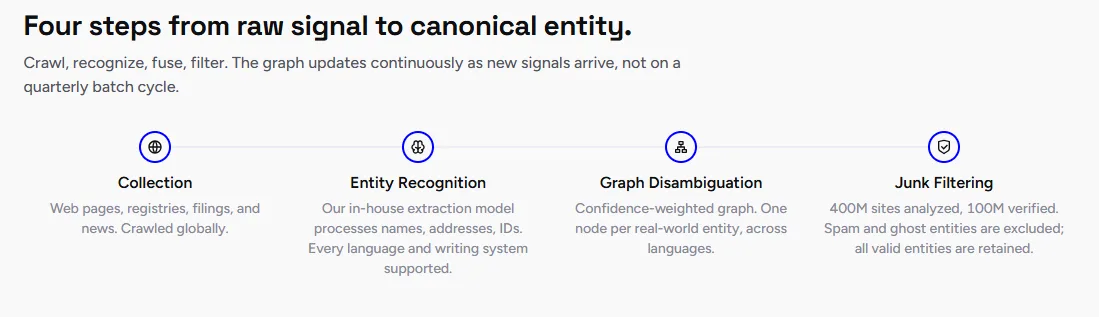
Rather than relying solely on registry data, Veridion's Entity Resolution Engine combines legal registration records with continuously refreshed operational evidence drawn from a company's digital footprint.
It cross-references information from business websites, products and services, locations, ownership data, industry classifications, and other publicly available sources to build a unified company profile.
Source: Veridion
Each attribute is linked to its source and assigned a confidence score, giving underwriters greater visibility into both the data and its reliability.
This multi-source approach helps identify discrepancies that conventional firmographics often miss.
A company may appear active in a corporate registry yet show little evidence of ongoing operations, while another with a relatively modest registry profile may demonstrate consistent business activity through its website, locations, hiring patterns, and commercial offerings.
Evaluating these data points together provides a more complete picture of whether a business is operating as claimed.
The verification process also fits naturally into existing underwriting workflows.
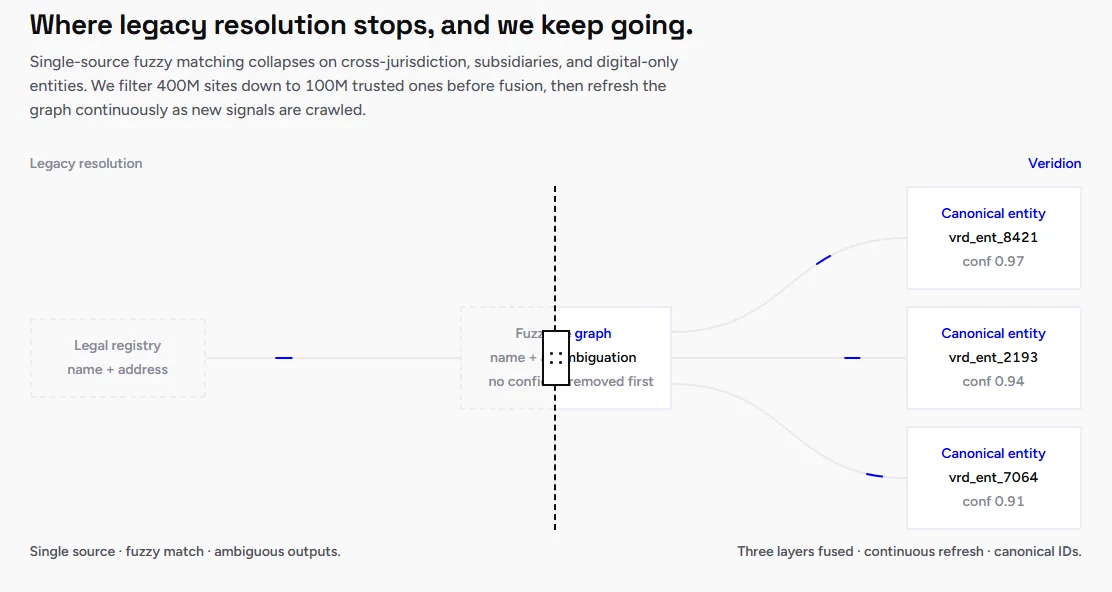
Instead of requiring investigators to manually validate every submission, Veridion enriches company records during intake and assigns confidence scores to matched entities and individual attributes.
Applications supported by consistent, high-confidence data can move through underwriting more efficiently, while records containing ownership inconsistencies, gaps in operational evidence, or other anomalies can be routed for additional review.
Source: Veridion
This risk-based triage helps fraud and underwriting teams focus their attention where it's needed most without creating unnecessary friction for legitimate applicants.
For commercial insurers, the result is a stronger foundation for underwriting and fraud detection.
Traditional firmographics verify that a business has been legally incorporated, while Veridion helps verify that the business is actively operating, accurately represented, and consistent with the commercial risk it presents.
Conclusion
In commercial underwriting, registration status tells you that a business exists, not whether it truly represents the risk you're underwriting.
The good news is that closing that gap no longer requires choosing between speed and scrutiny.
Modern verification models combine shell company indicators, digital footprint analysis, ownership verification, and continuous monitoring to reveal operational substance, not just registration status.
The result is stronger due diligence without creating unnecessary friction for legitimate applicants.
You don’t have to treat every application with suspicion to protect your business from the ones that deserve it.
With the right data behind you, you can move confidently and efficiently for legitimate businesses while identifying shell companies and ghost brokers before they become costly risks.
Articles
Discuss how these trends affect your organization.
Our analysts are available for a short call. Bring a specific question and we will ground it in the data.
Insights
Keep reading
More analysis, research, and outcomes grounded in live company intelligence.
Types of Vendor Fraud You Need to Know About
In this comprehensive guide, we'll explore the six forms of vendor fraud and provide actionable strategies to fortify your defenses.
5 Best Practices for Effective Insurance Underwriting
Want to improve your insurance underwriting process? This guide covers five essential best practices to boost accuracy and efficiency.
How to Build a Strong Market Intelligence Strategy
Learn how to build a strong market intelligence strategy that helps you track trends, understand competitors, and make smarter decisions.