Insights / Articles
Point-in-Time Credit Estimates vs. Monitored Private Ratings: Different Data Requirements
We will explore point-in-time credit estimates vs monitored private ratings and show how data collection, updates, and monitoring needs will change.

- Point-in-time estimates need to be built around a defensible snapshot.
- Monitored ratings need infrastructure that can detect meaningful change.
- The initial assessment is only the starting point when the rating is expected to remain active.
- The data architecture should follow the rating's lifecycle.
Two credit products can produce a rating for the same company and still require very different data behind the scenes.
The difference comes down to what the product is expected to do with that rating after it is issued.
A point-in-time credit estimate is designed to answer a question about a company at a particular moment. A monitored private rating has a longer lifespan, with the expectation that the assessment remains relevant as the company and its circumstances change.
That difference is easy to overlook when you view the two products only through their final output.
But once you look at what each one needs from the underlying data, the question shifts from how to produce the rating to how much the data must do before, during, and after the rating is issued.
Why Do These Two Analytical Products Need Different Data Architectures?
A point-in-time credit estimate and a monitored private rating look similar on paper.
They both assess a company's creditworthiness and output a score or grade you can act on.
But the resemblance ends at the output.
Moody's Analytics recalculates its EDF-based credit measures daily, generating hundreds of thousands of valuations across its coverage universe.
But every one of those outputs is still tied to what the model calls an "as-of-today" snapshot mapping, a fixed observation point baked into the process regardless of how often the underlying calculation reruns.
One is a single judgment timed to a specific date, while the other is a standing commitment to keep watching that judgment for as long as it stays active.
Think of it this way. A point-in-time estimate has to answer one question well: what did the available data say about this company on this date? Once that question is answered and documented, the product's job is done.
Its data requirements are built around being correct at a single moment, not staying current after that moment passes.
A monitored rating carries that same initial burden, then it has to keep answering the question "has anything material changed since the last review?" for as long as the rating stays live.
That means it needs infrastructure for detecting change, not just infrastructure for capturing a snapshot.
One process and infrastructure is closed the moment it's delivered. The other stays open, with a recurring loop of detection, review, and potential action built into its lifecycle.
That asymmetry is why the two products can't share a single data blueprint.
Building a monitored rating on point-in-time infrastructure leaves it blind between reviews.
Building a point-in-time estimate on monitoring-grade infrastructure means paying for ongoing detection capacity the product will never use.
What Does a Point-in-Time Estimate Require?
A point-in-time estimate only has to hold up for one moment. It doesn't need infrastructure for tracking change after delivery, because it isn't promising to track anything after delivery.
What it does need is enough precision at that single moment to survive scrutiny long after the moment has passed.
That precision starts with two things: a clearly defined baseline and an explicit effective date.
Evidence Retention for a Single Observation
A point-in-time estimate doesn't watch anything after it's delivered. But it does need to prove, potentially years later, exactly how it arrived at its conclusion.
That's a retention requirement, and it's easy to underestimate, because nothing about the workflow feels ongoing.
The engagement, on the surface, looks finished. But the evidence behind it, including the source documents, the calculations, the working notes that justified the final number, has to survive long after the delivery date because the estimate itself can still be challenged, audited, or reviewed well into the future.
This isn't a theoretical concern in the credit industry.
Nationally recognized statistical rating organizations, the entities the Securities and Exchange Commission (SEC) regulates for issuing credit ratings, are bound by Rule 17g-2, which requires them to retain the internal records and working papers used to form the basis of a rating for a minimum of five years.
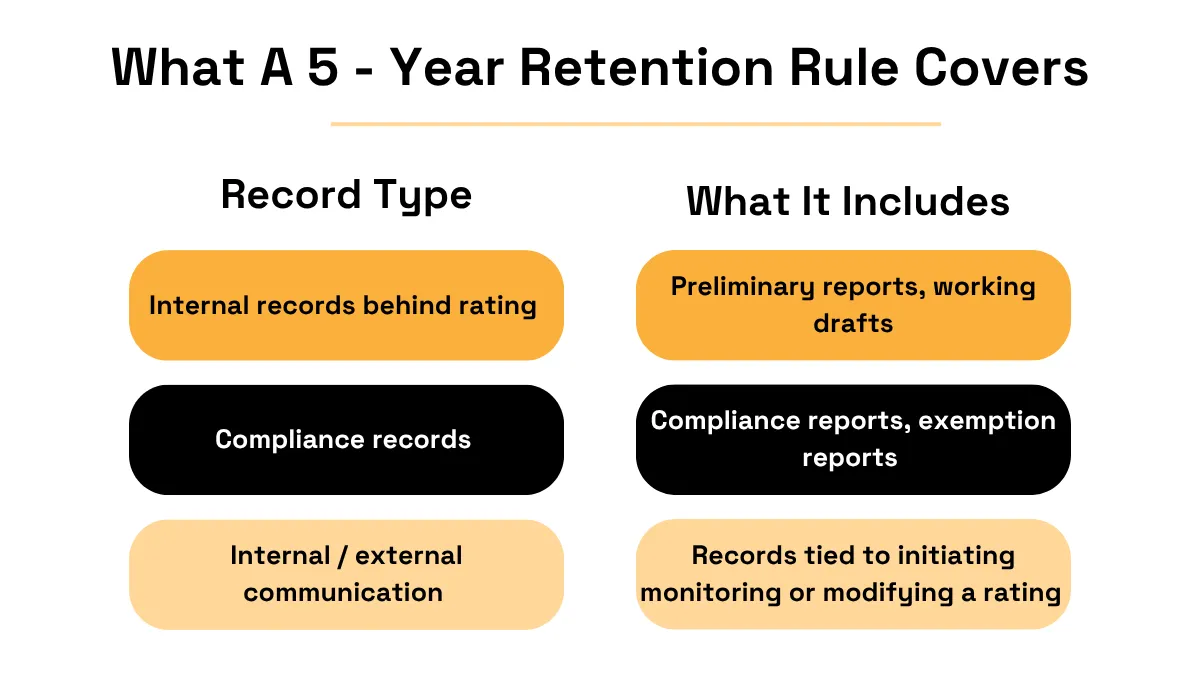
Five years might sound generous until you consider how the SEC uses that requirement.
Its oversight staff has flagged cases where rating organizations, asked to produce these records during an examination, came back with summaries instead of the original documentation, or records missing key information entirely.
The rule exists precisely because "we made a defensible call at the time" is not a claim regulators, clients, or auditors are expected to take on faith.
It has to be provable, and provable means retrievable.
This is also where the distinction from monitored surveillance becomes more concrete.
This is also where a point-in-time product's use ends. Once the retention window closes, the file can too.
A monitored rating doesn't get that same end point, since the questions it has to keep answering don't stop just because a calendar year does.
What Does a Monitored Rating Require Beyond the Baseline?
A monitored rating starts from where a point-in-time estimate ends.
It still needs the same defensible baseline, clearly stated effective date, and retained evidence.
What changes is what happens after delivery.
A point-in-time product is finished the moment the product ships. A monitored rating, on the other hand, is just getting started.
It now has to answer a second, ongoing question for as long as it stays active: has anything changed since the last time someone looked?
Answering that question well requires two things a point-in-time product can’t provide: a way to detect that something changed, and a way to decide if the change even matters.
Detecting Events That Trigger a Refresh
Between one scheduled annual review and the next, almost anything can happen to that company.
European banking regulators have made closing that review window a formal requirement.
Under the guidelines set out by the European Banking Authority (EBA) on loan origination and monitoring, in force since mid-2021, institutions must maintain early warning indicators built on IT and data infrastructure, complete with defined trigger levels and clear escalation procedures for flagging rising credit risk before the next scheduled review arrives.
But "monitor for change" only means something once you know which changes really count.
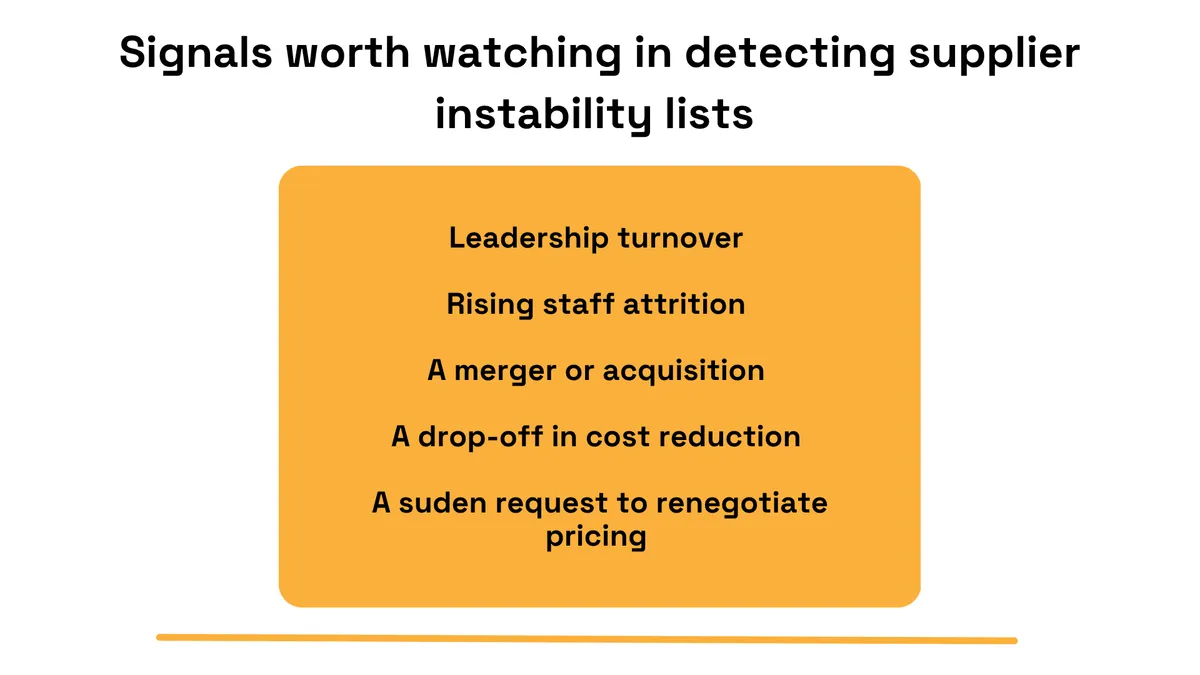
If you're filling in for detecting supplier instability lists, for example, the kind of concrete signals worth watching are:
Source: Veridion
These are the behavioral and structural signals that tend to surface well before a balance sheet does.
Getting these signals accurately is crucial. This is where a live company data source like Veridion is needed in the pipeline.
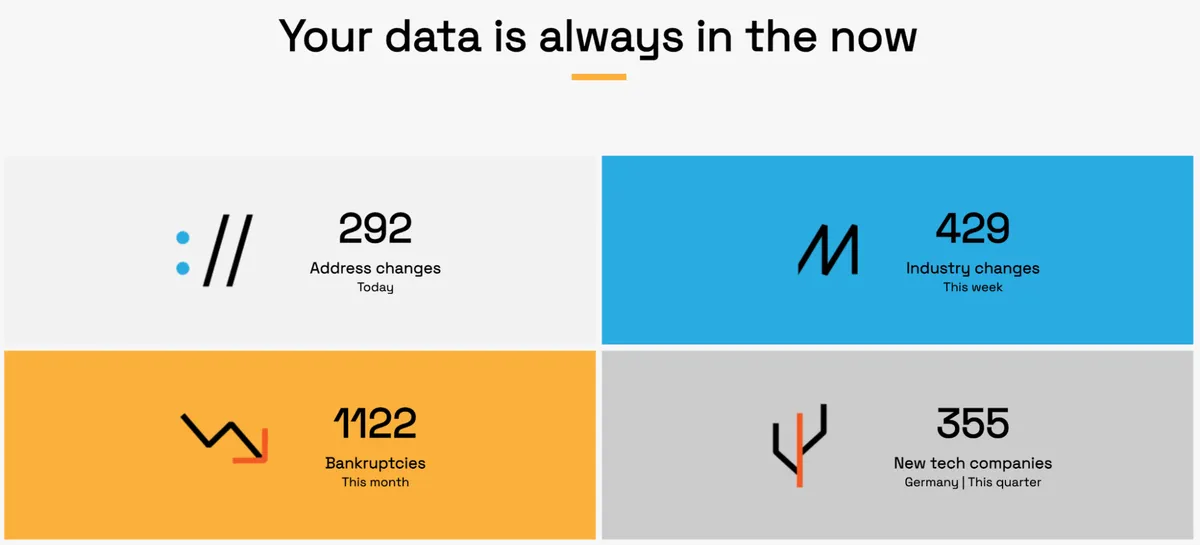
Veridion continuously re-evaluates its coverage of millions of companies against new evidence as it appears, which means any changes in a company's digital footprint, leadership, or activity can surface between scheduled reviews.
Source: Veridion
For a monitored rating, that's a standing feed of real-world change, not a single data pull frozen at one moment.
Separating Changed Data From an Actual Rating Action
Detecting a change is not the same as deciding it matters.
If every flagged data point triggered an automatic rating change, the monitored product would spend most of its time reacting to noise.
Treating "the data moved" and "the rating should move" the same is how your surveillance system starts producing false triggers instead of useful ones.
Instead, build a human judgment step into the process specifically to prevent this.
According to S&P Global Ratings' description of its process, analysts exercise judgment through a formal rating committee process before any rating determination is finalized.
That committee step exists because raw data and a rating decision are not interchangeable.
One is an input while the other is a conclusion, reached only after someone has weighed if the input is significant enough to act on.
When this step is directly skipped, you move too fast on every flagged signal and erode trust in your alerts, or you move too slowly, and you're back to the same blind spot a monitored product was supposed to solve.
S&P describes its formal reviews as happening annually or whenever significant developments occur, which is really a description of two tracks running side by side.
These are a scheduled check and an event-driven one, both feeding into the same judgment layer before anything gets published.
This shows you that the review step isn't a bottleneck to engineer around and instead is the part of the system that turns a raw detection signal into something to either act on or not.
Conclusion
The difference between these two is ultimately a difference in what they promise the data can support.
A point-in-time estimate needs a defensible snapshot, a clear effective date, and enough retained evidence to support the judgment later.
A monitored rating needs all of that, plus the infrastructure to detect meaningful changes and route them through a review process.
So the right architecture depends on the product's lifecycle.
If the judgment ends with delivery, build for defensibility at that moment. If the judgment stays live, the data system has to stay live with it.
Articles
Discuss how these trends affect your organization.
Our analysts are available for a short call. Bring a specific question and we will ground it in the data.
Insights
Keep reading
More analysis, research, and outcomes grounded in live company intelligence.
How to Build a Strong Market Intelligence Strategy
Learn how to build a strong market intelligence strategy that helps you track trends, understand competitors, and make smarter decisions.
9 Essential Sources of Market Intelligence
Want to boost your market knowledge? These 9 market intelligence sources will show you where to look and how to apply the insights.
Market Intelligence vs Market Research: What's the Difference?
Not sure whether you need market research or intelligence? Learn the key differences and when to use each.