Insights / Articles
What is a Match Score? Understanding the Waterfall Methodology in Company Data Enrichment
Tired of inaccurate company data? Understand the data enrichment API match score and fuzzy company name matching with the Waterfall Methodology.

- Match scores reveal far more than whether a company record matches.
- The strongest match isn't always the one with the highest confidence.
- Every company attribute can tell a different matching story.
- Low confidence doesn't always mean the match is wrong.
You send a company name to an enrichment API, and it returns a company match plus a number attached to it.
Maybe it’s 0.95.
Maybe it’s 0.40.
What those numbers actually mean for your integration, and how much you should trust them, isn't always obvious.
Is 0.95 reliable enough to accept automatically?
Is 0.40 a poor match, or simply a match supported by less evidence?
That number is the match score.
And behind every score is the waterfall methodology that evaluates different types of evidence and progressively refines the match before calculating its confidence.
This article explains how this data methodology works, what contributes to a match score, and how to use confidence scores to build more accurate and transparent enrichment workflows.
How the Waterfall Methodology Scores a Match
When you enrich company data, the matching engine rarely relies on a single pass to determine whether two records represent the same business.
Instead, it follows a waterfall methodology that applies multiple matching strategies in sequence.
The process begins with the strictest rules and gradually relaxes the criteria only if a high-confidence match can’t be found.
This layered approach balances precision with coverage.
Straightforward records are matched immediately using exact identifiers, while incomplete, outdated, or inconsistent records move through increasingly sophisticated matching stages.
Each stage is designed to reduce ambiguity while maximizing the chances of finding the correct company, even when the input data contains errors or missing fields.
Rather than treating matching as a binary yes-or-no decision, the waterfall method continuously evaluates the evidence until it can confidently identify a company or determine that no reliable match exists.
Exact Matching Comes First
Every waterfall methodology starts with exact matching because it provides the strongest possible evidence that two records represent the same company.
If the incoming record already contains a unique company identifier or a perfectly matching combination of business attributes, there’s no need to apply more computationally intensive matching techniques.
Starting with exact matching also improves efficiency.
Enterprise datasets often contain millions of company records, and many incoming businesses can be resolved immediately using unique identifiers or standardized attributes.
By processing these straightforward cases first, the matching engine reduces unnecessary computation and reserves more advanced matching techniques for records that genuinely require additional analysis.
After applying basic normalization, such as standardizing letter case and removing extra whitespace, the matching engine typically looks for one of two types of exact matches:
Exact Match Type | How It Works | Why It's High Confidence |
|---|---|---|
Identifier match | Your input includes a registry ID, VAT number, Data Universal Numbering System (DUNS) number, Legal Entity Identifier (LEI), or another unique business identifier that maps directly to a single company record. | These identifiers are designed to uniquely identify a business, making them the strongest available evidence that two records represent the same company. |
Exact string match on name and location | Your input's company name and location match a record in the underlying dataset character-for-character after basic normalization, such as standardizing letter case and removing extra whitespace. | When the source data is already clean and standardized, this method produces a high-confidence match with little ambiguity. |
Exact matching is intentionally conservative.
It delivers the highest-confidence results when unique identifiers or standardized business attributes align perfectly, minimizing the risk of false positives.
When those strict conditions aren't met, the waterfall methodology simply progresses to the next stage, applying more flexible matching techniques to evaluate additional evidence rather than treating the record as unmatched.
Fuzzy Matching Fills the Gaps
The next stage of the waterfall methodology is fuzzy matching.
Instead of requiring identical values, fuzzy matching measures how similar two records are, allowing the matching engine to recognize companies despite minor differences in spelling, formatting, abbreviations, punctuation, or other minor inconsistencies.
This makes it possible to identify likely matches that would otherwise be missed by strict character-for-character comparisons.
Fuzzy matching compares one or more business attributes, typically company names, addresses, website domains, and other identifying fields, using similarity algorithms designed to account for common variations in real-world data.
For example, a matching engine can recognize that “International Business Machines Corp.”, “IBM Corporation”, and “IBM Corp.” likely refer to the same business, while also tolerating typographical errors, missing legal suffixes, and inconsistent abbreviations.
You can then configure similarity thresholds to balance precision and recall based on the requirements of their application.
These techniques are widely used beyond company enrichment wherever organizations need to match imperfect data at scale.
For example, the Federal Aviation Administration (FAA) developed a fuzzy matching system to automatically correct misspelled medication names in aeromedical certification records.
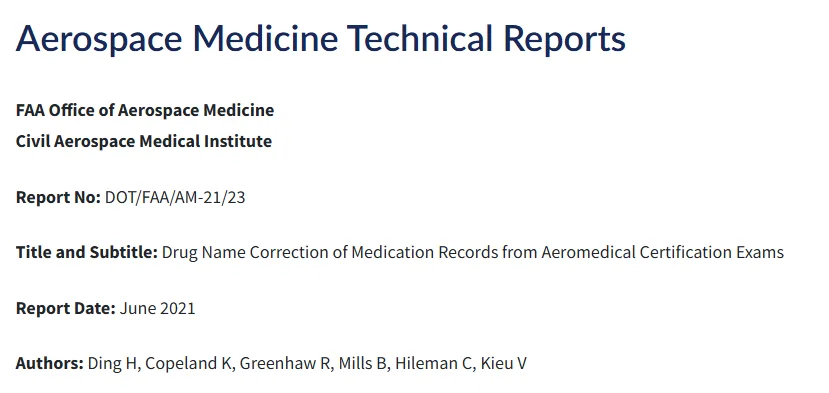
Source: FAA
By combining linguistic and context-based algorithms with a confidence index to rank candidate matches, the system achieved more than 96% correction accuracy on validation data, demonstrating how confidence-based matching can reliably handle imperfect real-world inputs.
Despite its effectiveness, fuzzy matching is fundamentally probabilistic rather than deterministic.
Two businesses may have nearly identical names while operating in different countries, or a parent company and its subsidiary may differ by only a single word.
As a result, similarity alone cannot prove that two records represent the same business.
Instead, the matching engine expresses its confidence based on the strength of the available evidence.
The closer the match, the higher the confidence score; the greater the uncertainty, the lower the score.
Rather than accepting fuzzy matches at face value, the waterfall methodology treats them as additional evidence in the overall matching process.
Every Attribute Gets Its Own Confidence Score
An overall confidence score tells you whether two records are likely to represent the same company, but it doesn't explain why.
If one attribute matches perfectly while another introduces uncertainty, a single score alone doesn't reveal which field deserves closer inspection.
Veridion’s Match & Enrich API addresses this by assigning confidence scores to individual attributes, including company name, location, website, phone number, legal identifiers, and other business fields, along with metadata describing how each attribute was matched.
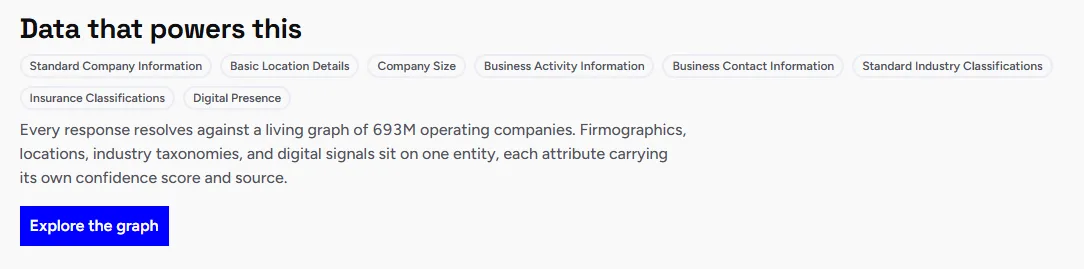
Source: Veridion
This gives you a clearer view of the evidence behind the overall result instead of relying on a single blended score.
A lookup for “Nordic Service Group” in Denmark illustrates this approach.
The API returns an overall confidence score of 0.92, indicating a highly reliable company match.
The individual attribute scores reveal how that result was reached: the company name receives a confidence score of 1.0 with an Exact match type, while the location receives 0.4 because the supplied location only partially aligns with the resolved company profile.
Attribute | Confidence Score | Match Type | What It Means |
|---|---|---|---|
Company name | 1.0 | Exact | The input company name matched the Veridion record without ambiguity. |
Location | 0.4 | Partial | The supplied location only partially matched the resolved company profile. |
Overall match | 0.92 | Composite | The API combined evidence from multiple attributes to determine that the records represent the same company. |
This level of transparency gives you much greater control over how matches are used.
Different workflows rely on different evidence.
A CRM enrichment workflow may require an exact company name before updating an existing account while accepting a lower-confidence location if the business has recently relocated.
By contrast, a Know Your Business (KYB) or compliance workflow is more likely to prioritize legal identifiers and registered addresses over phone numbers or website URLs.
Because each attribute is scored independently, validation rules can be tailored to the needs of the application rather than relying on a single global threshold.
Attribute-level confidence scores also simplify troubleshooting.
Instead of manually comparing multiple records to understand why a match succeeded, you can immediately identify which field introduced uncertainty, making it easier to refine validation rules, handle exceptions, and determine when a record should be accepted automatically or routed for manual review.
The benefits extend beyond implementation
For example, a Canadian commercial insurance carrier uses Veridion’s Match & Enrich API to validate business applicants before underwriting, combining confidence scores with source evidence to automate straightforward cases while routing more ambiguous matches for review.
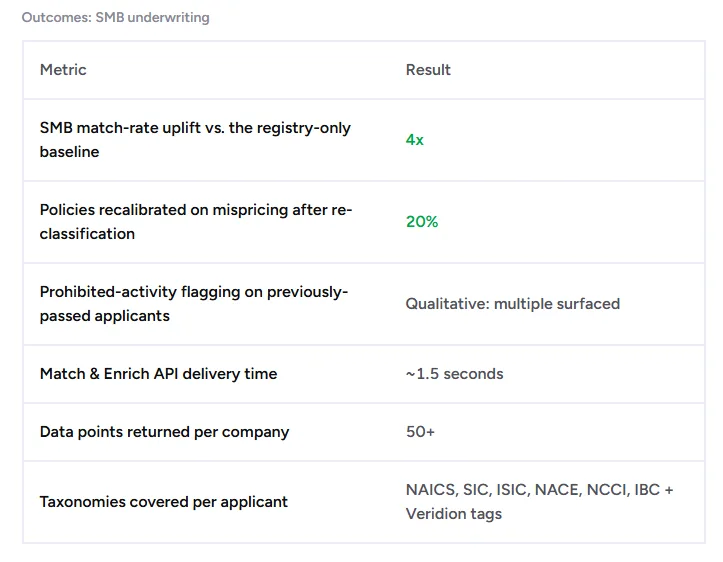
Source: Veridion
The result is a matching process that is not only more accurate but also easier to explain and audit.
Why a Single Match Isn't Always a Clean Match
Matching a company record sounds simple: provide a company name, website, or address, and an enrichment API returns the corresponding business profile.
In practice, however, company data is constantly changing and rarely arrives in a perfectly standardized format
Businesses relocate, rebrand, merge with other organizations, launch new websites, and update their legal registrations over time.
The challenge is compounded by the fact that business data rarely stays static
Research cited by the EDM Council estimates that master data changes by about 2% each month, meaning nearly 27% of core business information can change over the course of a year.
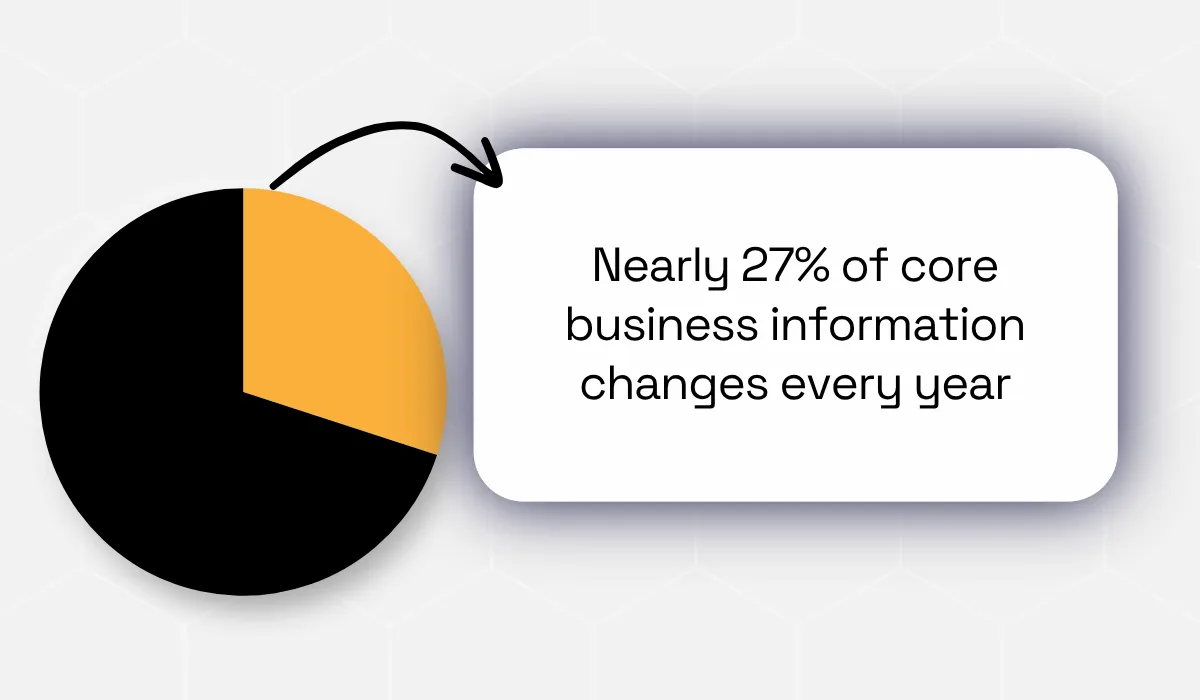
Illustration: Veridion / Data: EDM Council
Even when the underlying data was once accurate, it often reaches an enrichment API with missing, outdated, or inconsistently formatted information.
Common examples include:
Input | Challenge |
|---|---|
IBM Corp | Missing the full legal name ("International Business Machines Corporation"). |
Acme Ltd | Legal suffix differs from the source record ("Acme Limited"). |
123 Main St | Address uses an abbreviated street designation. |
Nordic Service Group | Multiple companies may share a similar name across different countries or industries. |
Old company headquarters | The business has relocated, but the source system still contains the previous address. |
Traditional deterministic matching requires identifiers or text strings to match exactly.
While this approach is highly accurate when the input is complete and standardized, even small differences in spelling, formatting, or business information can cause legitimate matches to be missed.
Probabilistic or fuzzy matching takes a different approach by evaluating the similarity between multiple attributes to estimate whether two records represent the same company, even when they are not identical.
Rather than producing a simple match-or-no-match decision, modern company enrichment platforms evaluate multiple signals, including company name, location, website, legal identifiers, and other firmographic attributes, to determine how likely it is that two records refer to the same business.
The result is a match score: a measure of confidence that helps you decide whether a match can be accepted automatically, routed for manual review, or evaluated further using additional matching techniques.
Putting Match Scores to Work in Your Integration
A match score delivers the most value when it drives decisions within your application rather than simply appearing as another field in an API response.
Instead of treating every match the same, you can use confidence scores to determine which records should be accepted automatically, which require additional validation, and which should be rejected altogether.
This approach helps reduce manual effort while maintaining the level of accuracy appropriate for each business process.
Setting Confidence Thresholds
One of the most common ways to operationalize match scores is by defining confidence thresholds.
Records that meet or exceed this threshold can be accepted automatically, while lower-confidence matches are routed for manual review before entering downstream systems such as a CRM, ERP, or supplier database.
There’s no universally correct threshold.
A 2023 study published in The VLDB Journal evaluated more than 700 entity-resolution scenarios and found that the optimal similarity threshold varied from 0.05 to 0.95, depending on the characteristics of the data and matching approach.
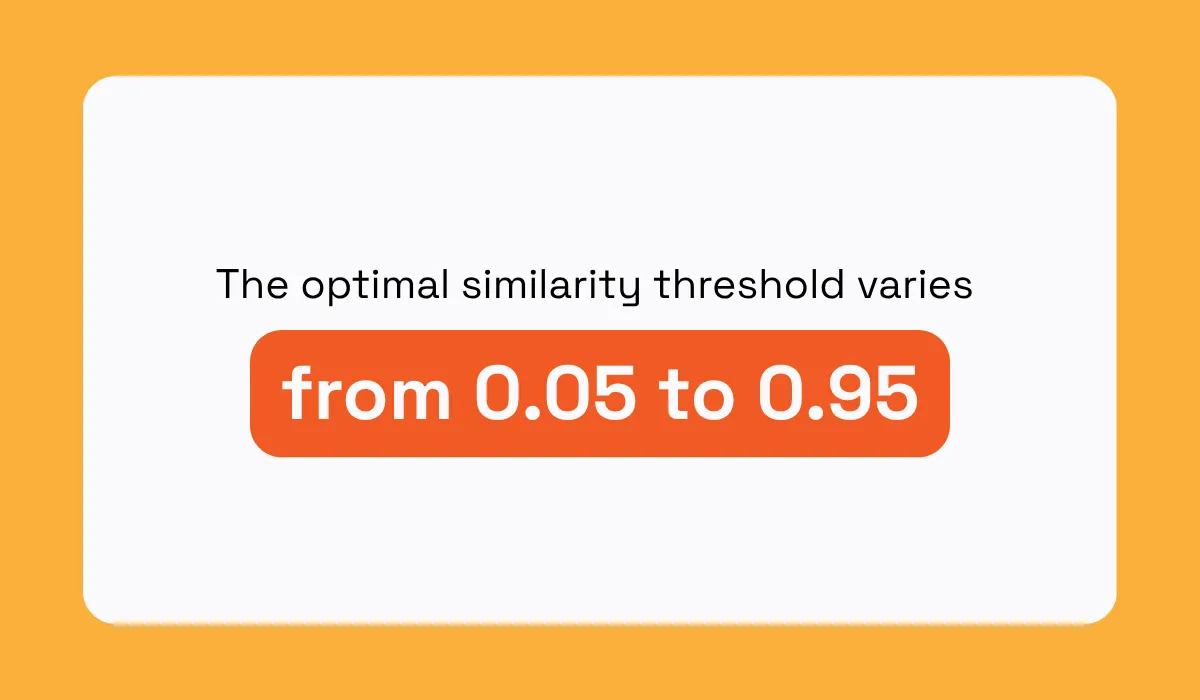
Illustration: Veridion / Data: Springer Nature
The researchers also identified the similarity threshold as one of the most influential configuration parameters because it directly affects both matching accuracy and computational performance.
The reason is simple: every threshold represents a trade-off between false positives (accepting the wrong company) and false negatives (rejecting a legitimate match).
Lower thresholds maximize match coverage but increase the likelihood of incorrect matches entering your system.
Higher thresholds improve precision but require more legitimate matches to be reviewed manually.
As a result, confidence thresholds should be tailored to the business workflow rather than treated as a universal setting.
A marketing team enriching prospect records may prioritize broader coverage and accept lower-confidence matches to maximize lead volume.
By contrast, a Know Your Business (KYB), supplier onboarding, or compliance workflow generally requires much higher confidence because a single incorrect match could introduce regulatory, financial, or operational risk.
The same confidence score can therefore lead to different decisions depending on the application.
A threshold that is perfectly acceptable for name-and-location matching in a lead generation workflow may be too permissive for due diligence or compliance screening.
The confidence score may be identical, but the cost of acting on it isn't.
Accounting for Sparse-Data Regions
A lower confidence score doesn’t always indicate a poor match.
In many cases, it reflects the amount of supporting evidence available to support the match rather than the quality of the matching process itself.
Businesses operating in regions with limited public records, smaller private companies, or organizations with a minimal digital footprint naturally provide fewer signals for an enrichment engine to validate.
When less supporting evidence is available, the system assigns confidence scores more conservatively to reflect the greater uncertainty.
This distinction is important when working with global company data.
Public companies in mature markets often publish extensive information through regulatory filings, corporate websites, business registries, and news coverage.
By contrast, many privately held businesses disclose only the information required by local regulations, while companies in some regions may have fewer accessible public data sources or less frequently updated registries.
The result isn’t necessarily a less accurate match, but simply a match supported by fewer independent data points.
Modern enrichment platforms account for these differences by evaluating both the quality and quantity of the available evidence rather than assuming every company should produce the same level of confidence.
This reflects a broader principle in enterprise data management.
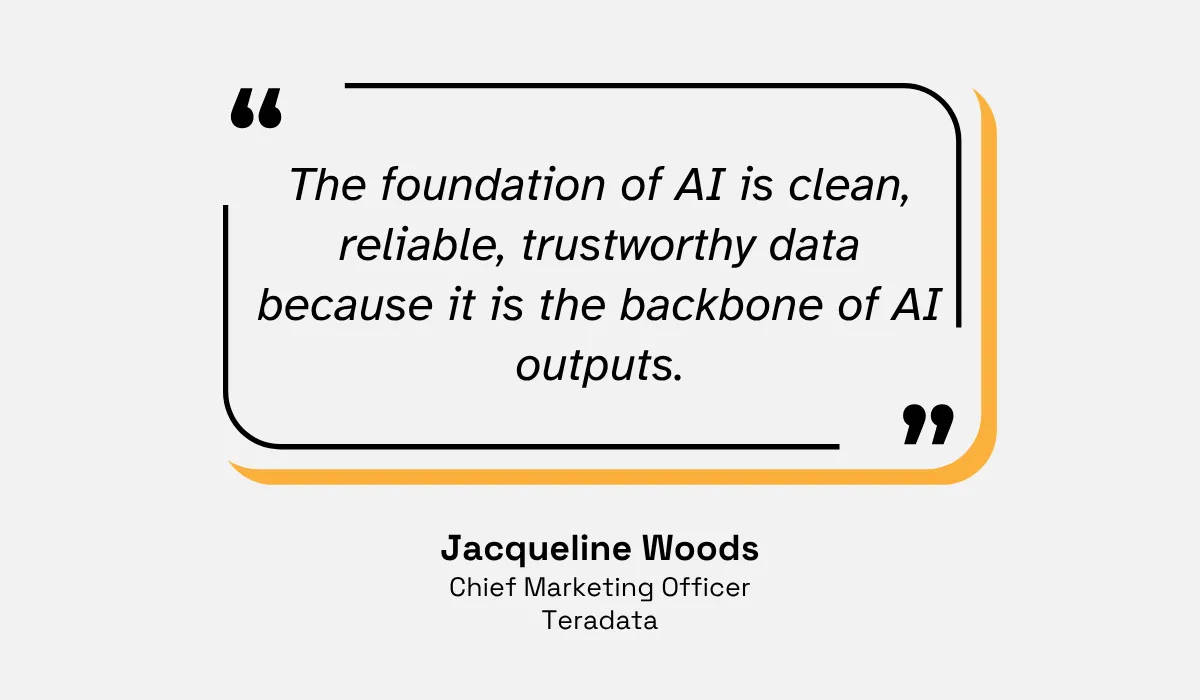
As Jacqueline Woods, Chief Marketing Officer at Teradata, a cloud analytics and data platform, notes:
Confidence scores help surface where the evidence is strong and where limited source data warrants a more conservative assessment rather than a false sense of certainty.
In other words, a confidence score reflects the strength of the available evidence, not the importance or legitimacy of the business being matched.
For developers, the key is to interpret confidence scores in context.
A slightly lower confidence score for a privately owned manufacturer in an emerging market may simply reflect limited publicly available information, not an incorrect match.
Reviewing attribute-level confidence scores alongside source provenance gives you the context needed to distinguish between a genuinely uncertain match and one that simply has limited supporting evidence.
That makes it easier to build workflows that respond to the quality of the evidence rather than expecting every company profile to contain the same depth of publicly available information.
Conclusion
The value of a match score isn’t in the number itself, but in what you do with it.
A high confidence score creates value only when it's backed by the right decision logic: setting appropriate thresholds, prioritizing the attributes that matter most to your use case, and deciding when uncertain matches deserve additional review.
Treat confidence scoring as part of your system’s decision-making logic, not as a black-box output that’s accepted without question.
By understanding how confidence is calculated and what contributes to it, you can build enrichment workflows that are both more accurate and more explainable.
Done well, confidence scoring transforms messy, incomplete company data from a liability in your pipeline into information your applications can use with confidence.
Articles
Discuss how these trends affect your organization.
Our analysts are available for a short call. Bring a specific question and we will ground it in the data.
Insights
Keep reading
More analysis, research, and outcomes grounded in live company intelligence.
6 Steps of the Data Enrichment Process
In this article, you will learn data enrichment process steps and how businesses transform raw data into valuable insights.
6 Best Data Enrichment APIs
Looking for the best data enrichment APIs? This article will introduce six powerful tools to enhance and validate your data.
6 Data Enrichment Tools You Need to Know About
Explore six standout tools that transform data enrichment capabilities and can help guide your decision-making and go-to-market strategy.