Insights / Articles
Data Lineage for Credit Ratings: Building a Traceable Evidence Chain
How credit rating data lineage works in practice: capturing provenance, entity identifiers, transformations and overrides.

- Only 27% of respondents believe regulatory protections have improved CRA transparency.
- Versioning and manual overrides must be tracked separately to distinguish between model improvements and bias.
- CRAs need to prove they can reconstruct a decision path for any rating during an audit.
Imagine an auditor asks you to justify a rating decision from two years ago.
Could you trace every number back to its true source?
For Credit Rating Agencies (CRAs), a traceable evidence chain is essential not just for compliance, but for building trust, catching errors, and ensuring that every rating is backed by verifiable, transparent data.
What is a Traceable Evidence Chain?
A traceable evidence chain connects every material input to the evidence behind it. In the context of CRAs, it shows the source, observation date, company, transformation, model, and any human decision that affected the credit rating value.
For CRAs, this chain is a critical risk and compliance tool. It connects the original evidence (e.g., a financial filing) to the legal entity it describes; the specific value extracted from it (e.g., revenue); and every calculation, model version, and human decision that subsequently affected that value.
Crucially, an effective chain preserves the context of change. It allows an analyst or auditor to start with a final rating and systematically work backward through the pipeline to the exact evidence that produced it.
If a company’s revenue was used in a rating model, for example, the record should show:
Source | Where did this revenue figure come from? (e.g., an SEC 10-K filing) |
|---|---|
Temporal context | When was the information originally collected and when was it entered into our system? |
Verification | was this figure ever changed or corrected? |
Definitive value | Which version was ultimately used as the input to the model? |
For instance, look at the illustration below that uses fictional company data to show how a traceable evidence chain records the original figure, subsequent changes, and the final value used.
It also shows how an analyst can follow a number from its source through every correction or adjustment.
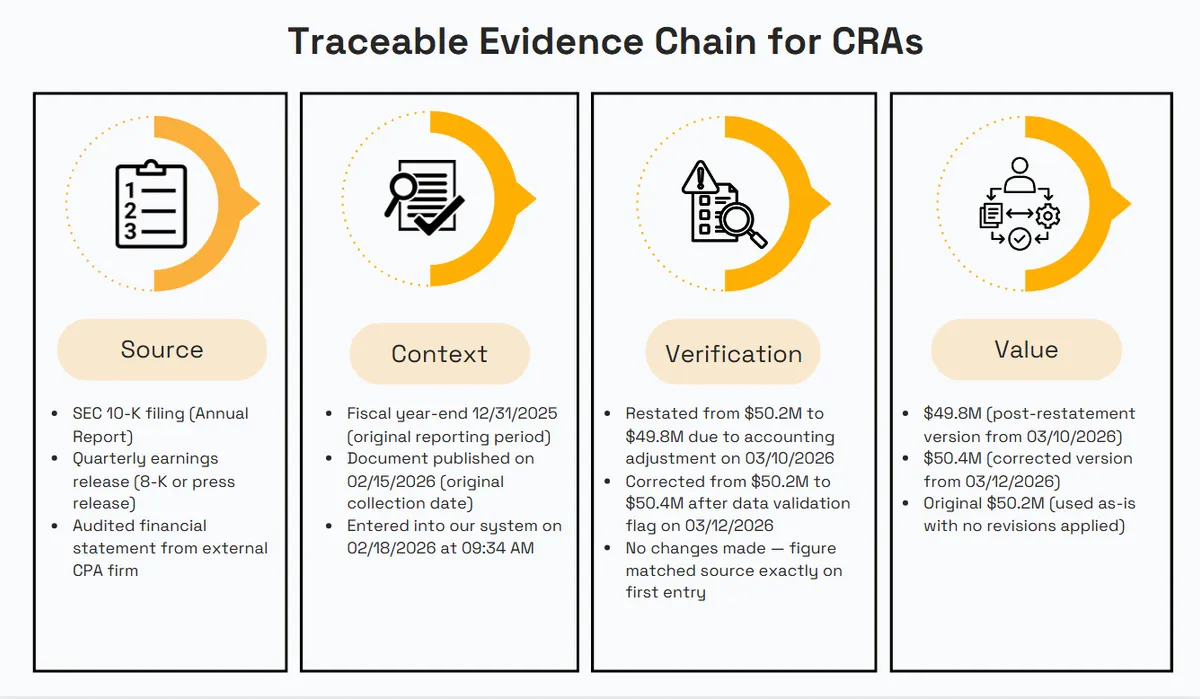
Illustration: Veridion
But a traceable chain is only as strong as the information captured at its starting point.
That makes the quality, context, and provenance of each data point at collection just as important. We explore more on this below.
What Must Be Captured at the Point of Collection?
A traceable chain starts when the information is first collected. If the source, date, entity, or collection method is missing at that point, later teams have to reconstruct the history from incomplete records.
And if you have ever tried to explain an old data point during an audit, you know how difficult that can become.
Provenance and Source Hierarchy
Start with a simple question: if an auditor challenges a rating input six months from now, can you show exactly where it came from?
A source name alone is not enough. A company website tells you very little.
A stronger record would identify the specific filing, URL, registry entry, page, publication date, collection date, and method used to capture the information.
The same applies when sources disagree.
Suppose a company's website reports $500 million in revenue, while its latest filing reports $470 million. Which number should be entered into the rating workflow?
You need a source hierarchy before that conflict appears. A regulatory filing might take priority for reported financials, while a corporate registry could be the preferred source for legal entity information.
Research shows why this matters.
In a 2020 Journal of Information Systems study, J. Efrim Boritz and Won Gyun No compared financial data from 105 companies' 10-K filings with XBRL data and three commercial aggregators (Compustat, Google Finance, and Yahoo! Finance).
6.5% to 7.7% of the amounts supplied by aggregators differed from the corresponding XBRL figures, depending on the provider.
The researchers found that many differences were material, and that using the differing figures changed results in bankruptcy-prediction and earnings-quality models.
So, without provenance, an analyst can see the value but cannot reliably determine which version was used, why it was selected, or what changed when the underlying source was different.
The issue extends beyond whether a number is technically correct. Lesetja Kganyago, Governor of the South African Reserve Bank, made a similar point while speaking after the G20 finance chiefs' meetings in Washington, DC:
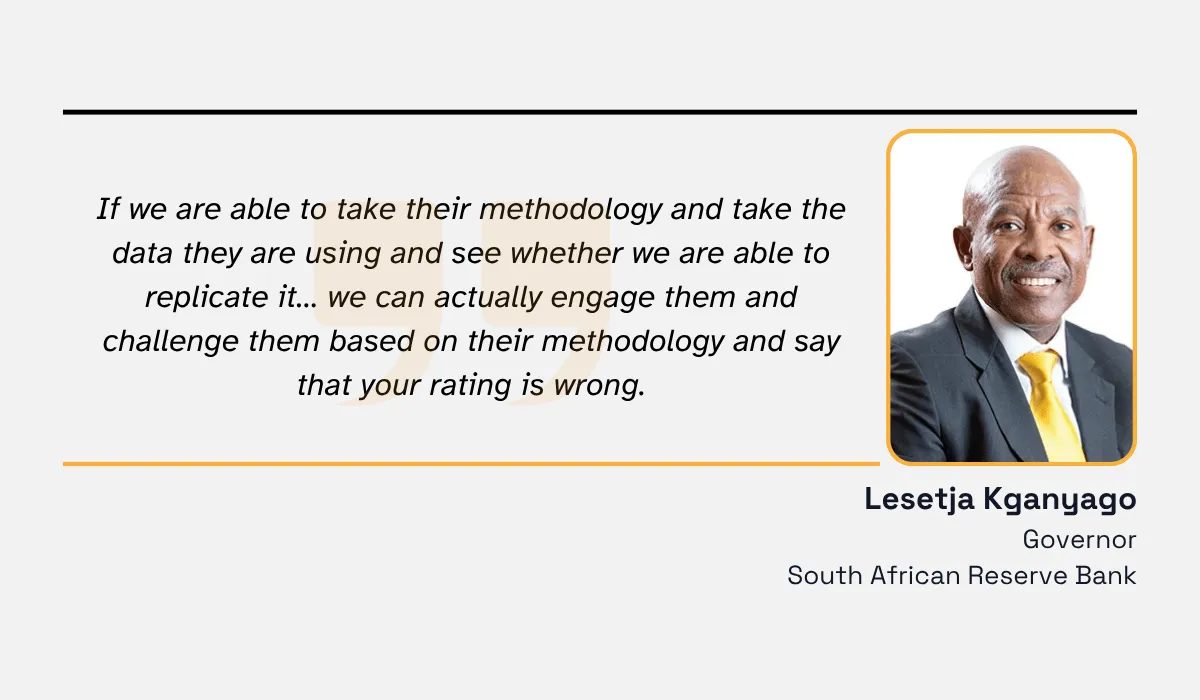
Kganyago’s point neatly captures what a traceable rating input should make possible: follow the evidence, reproduce the reasoning, and challenge the result when necessary.
Entity Identifiers Across Joins and Enrichment
A source can be accurate and still produce the wrong rating input if it is attached to the wrong company. This becomes a real problem when a CRA combines financial statements, ownership data, market information, and external company databases.
A parent and subsidiary may have almost identical names. A company may also have several legal entities across countries.
If a data pipeline joins records using names alone, information from one entity can quietly ‘bleed’ into another.
European CRA reporting rules recognise this risk.
EU rules require CRAs to maintain a unique internal identifier for each issuer unchanged over time. Where the rated company is a subsidiary, it must also report the parent's Legal Entity Identifier (LEI) and internal identifier.
Think about a group with a parent in France, a financing subsidiary in Luxembourg, and an operating company in Germany. A debt instrument may belong to the Luxembourg entity, while financial information comes from the wider multinational group.
Without stable identifiers and parent-subsidiary relationships, an enrichment process could attach group-level information to the wrong issuer.
This is where your data engineering team must enforce a canonical identifier strategy. Before joining another dataset to a rating record, your system must be able to answer a fundamental question: can we prove these two records refer to the same legal entity?
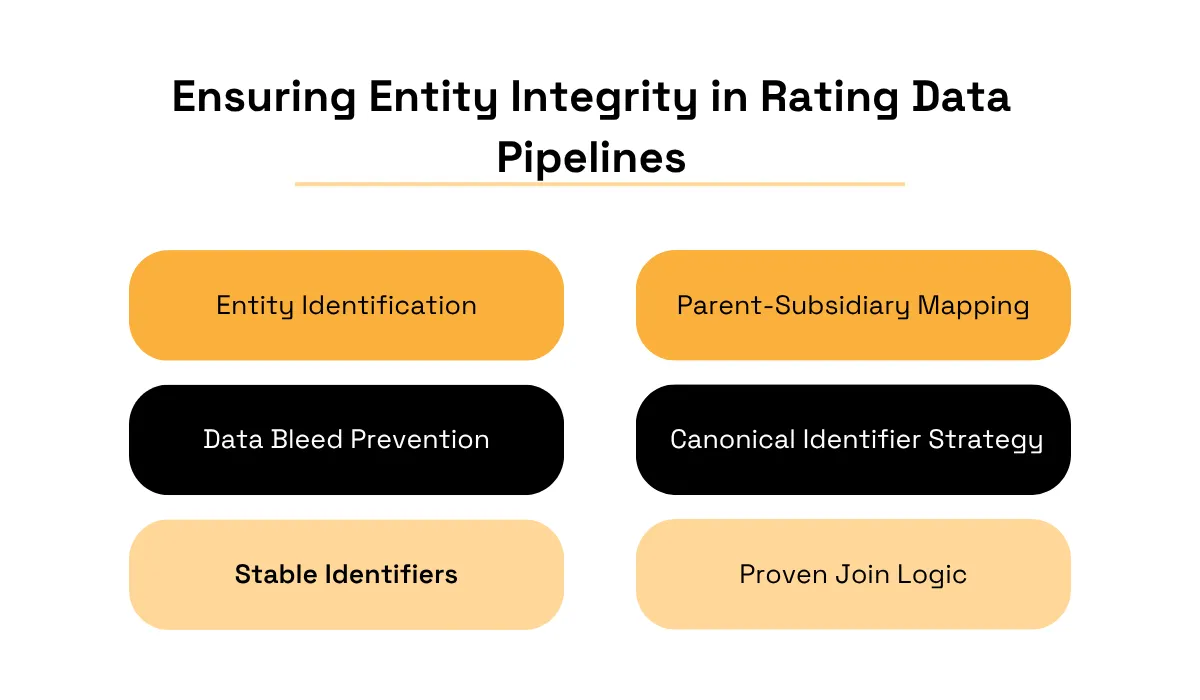
Illustration: Veridion
A stable, immutable canonical identifier (not a name or a ticker symbol) must survive enrichment, mergers, corrections, and transfers between systems.
How Do Values Change Without Breaking the Chain?
A rating input does not stay still. Companies publish new financials, take on debt, sell subsidiaries, enter distress, or correct previously reported information. Models also change. Analysts may challenge outputs too.
So, what happens to the evidence chain when the value itself changes?
Transformation Logic
A raw source value rarely goes directly into a credit rating.
Revenue may be converted into a standard currency. Financial ratios may be calculated. Several inputs may be combined. A private company's financial position may need to be estimated when no direct figure is available.
Every transformation adds another place where an error can enter.
This is exactly why you need to distinguish an observed value from a modeled value.
If a filing reports revenue of $200 million, the evidence might look like:
$200M → annual filing → published date → extracted value
If the company does not report revenue and the system estimates it, the chain should look different:
Estimated $200M → source inputs → model → methodology → confidence
The final numbers may look identical. The evidence behind them is not.
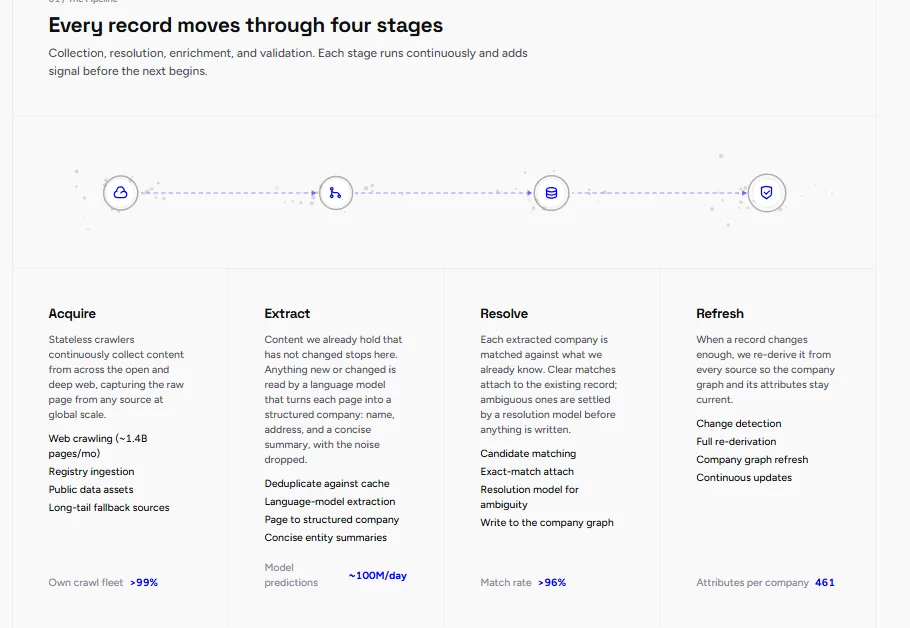
Veridion identifies this problem and provides a solution through its methodology. Its approach distinguishes extracted information that comes directly from a source from modeled information inferred when a direct value is unavailable.
The platform’s methodology also uses provenance and confidence information to distinguish the strength and origin of an attribute.
Source: Veridion
That distinction becomes especially important in credit ratings.
Would you give the same weight to a revenue figure taken directly from a filing or one that is transformed according to models deployed?
Take Fitch Ratings’ December 2024 to June 2025 Corporate Rating Criteria.
In one illustration, Fitch starts with €840 million of reported EBITDA and applies a €190 million lease-related adjustment, resulting in €650 million of Fitch-adjusted EBITDA.
The adjusted figure then feeds into other credit metrics, including EBIT and cash flow measures.
That €650 million does not appear as a reported figure in the company's accounts. It is the product of a methodology and an analytical decision.
If a rating file stores only the final €650 million, an analyst reviewing the rating later cannot see what changed between the original figure and the number used in the assessment.
So, the evidence chains must ideally preserve the transformation. Final numbers matter, but so do the inputs and reasoning that produced them.
Versioning and Manual Overrides
A model will not always get every rating right.
Credit experts may change proposed ratings when they see information the model has missed. But how can one know if those overrides are actually improving the decision?
The European Central Bank (ECB) sheds light on this subject in its 2025 Supervisory Review and Evaluation Process (SREP), showing why the same evidence-chain principle matters when banks use models and analyst judgement in their internal credit-risk assessments.
The ECB identified outdated financial data, frequent rating overrides, and unclear risk identification criteria as persistent concerns in some small and medium-sized enterprise (SME) portfolios. According to the ECB, these issues can undermine the quality of risk assessments.
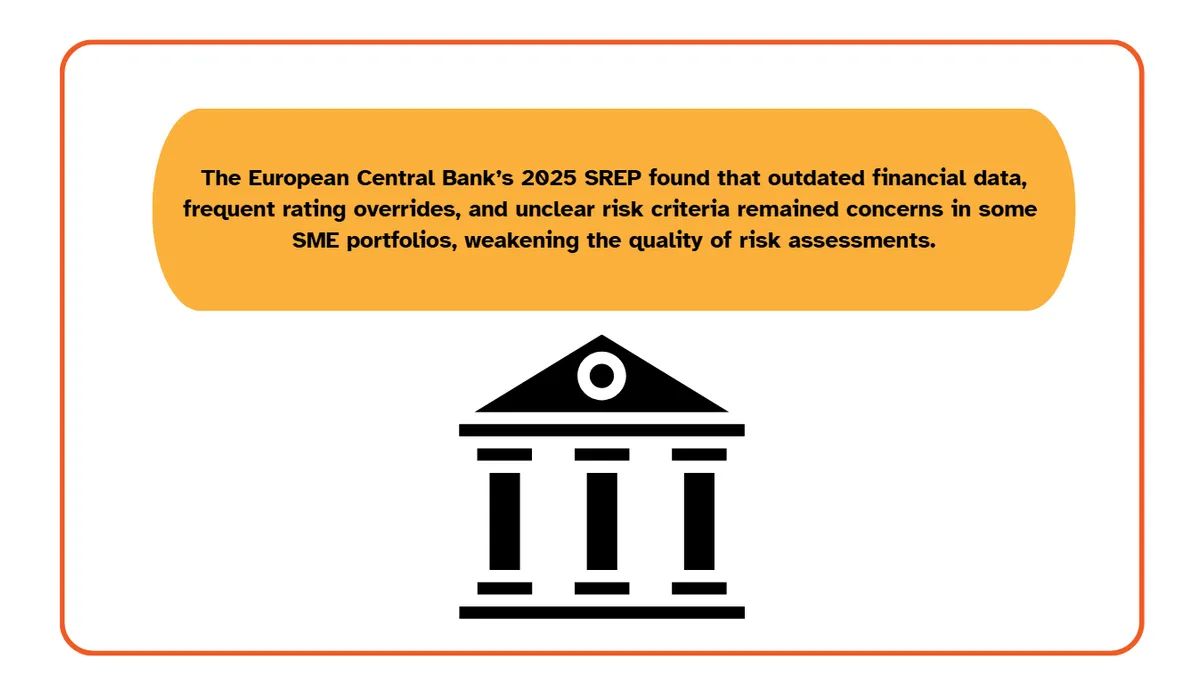
Illustration: Veridion
Suppose a model assigns a company a BBB rating, but an analyst changes it to BB after reviewing new financial information. The credit rating system should preserve:
- The original BBB
- The final BB
- The date of the change
- The analyst who made it
- The evidence or reason behind the adjustment
This creates an important use for versioning. Teams can see not only what the final rating was, but how it changed and why.
If analysts repeatedly override a model in the same direction, that pattern may point to information the model is missing or a weakness in the underlying rating process. If overrides become unusually frequent, teams can investigate the model and the judgement being applied to it.
The goal is not to prevent analysts from overriding models. It is to make every important override visible, explainable, and measurable over time.
Can the Chain Be Reconstructed for an Audit?
Here is a simple test: Start with a rating and work backward. Can you reconstruct the decision?
You should be able to move from the rating to the model, from the model to its inputs, and from each input to its source. You should also be able to see which methodology version was used and whether an analyst changed the result.
Regulatory history shows why this matters.
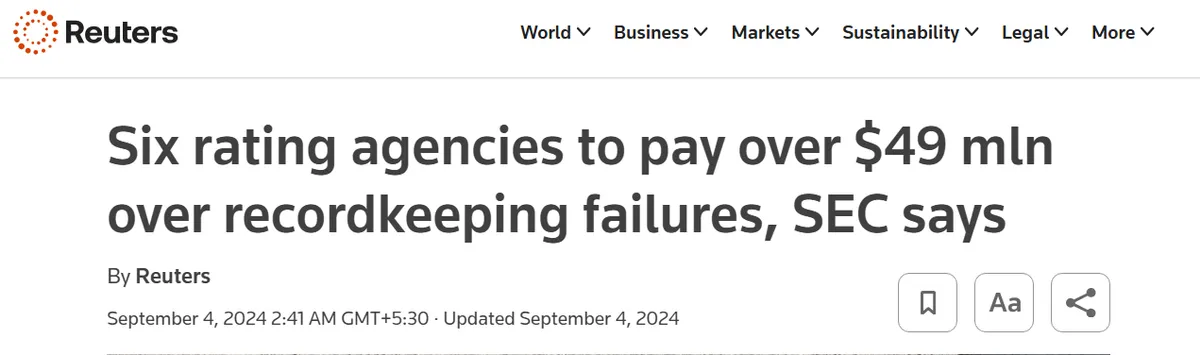
In September 2024, the SEC charged six credit rating agencies with recordkeeping failures. The firms agreed to pay more than $49 million in combined penalties. Moody's paid $20 million, S&P paid $20 million, and Fitch paid $8 million, with the remaining $2 million split among three other agencies.
Source: Reuters
The SEC said failures to maintain required records can make it harder for regulators to determine whether firms are complying with their obligations and hold them accountable.
This is where your choice of data provider becomes critical.
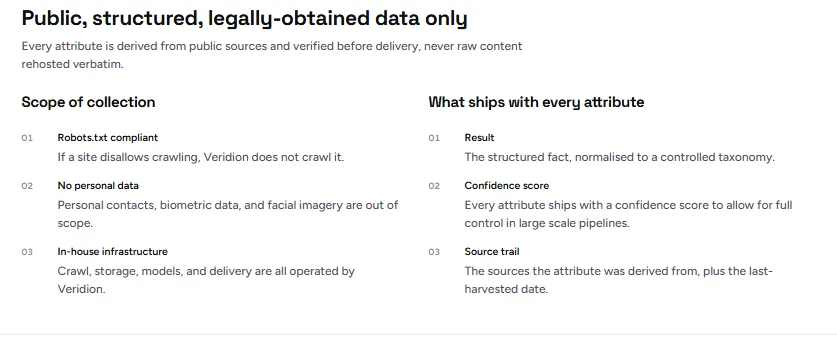
A partner like Veridion can explain the source hierarchy, how often different signals are refreshed, and how company records are matched for a particular use case.
Source: Veridion
Veridion’s methodology also maintains a link between changes in conclusions and the evidence behind those changes. For audit reconstruction, that link matters because the team can identify not only what changed, but what evidence caused the change.
The goal is simple: every important input should have an evidence trail that can be reviewed later.
Conclusion
Building a traceable evidence chain is about more than just passing an audit.
It ensures accountability, improves model accuracy, and helps identify biases in human overrides.
By capturing provenance, entity identifiers, and transformation logic, data teams can transform their pipelines into reliable, transparent systems that both regulators and internal teams can trust.
Articles
Discuss how these trends affect your organization.
Our analysts are available for a short call. Bring a specific question and we will ground it in the data.
Insights
Keep reading
More analysis, research, and outcomes grounded in live company intelligence.
How Market Intelligence Drives Smarter Business Decisions
Want to improve your decision-making process? This guide will show you how to leverage market intelligence for business growth.
How to Gather Market Intelligence In 5 Steps
In this guide, we're breaking down the five key steps you need to take to gather market intelligence that drives real action.
6 Mistakes to Avoid when Gathering Market Intelligence
Think your market intelligence is on point? Check out these five frequent mistakes and how to avoid them before it’s too late.