Insights / Articles
Peer Group Drift: When Static Industry Classification Breaks Credit Comparability
We will explore peer group drift in credit analysis and show how outdated industry classifications can distort issuer benchmarking and comparability.

- Dynamic, continuously updated classification data produces better-specified benchmarks than static data.
- Static schemes drift further from reality the longer a company goes unreviewed.
- GICS reclassifies a company once one activity passes 60% of revenue.
- SIC hasn't had a substantive revision since 1987 and stopped being maintained in 1997.
While classification makes a rated company look stable on paper, the business may have changed months ago. Analysts keep comparing companies to the same peer group they used years ago because they've never needed to reclassify it.
This mismatch has a name: peer group drift. When it goes undetected, it corrodes the peer benchmarks your credit models depend on.
Today we discuss what peer group drift is, why it breaks credit comparability, and how to detect it.
What Is Peer Group Drift, and Why Does It Break Credit Comparability?
Peer group drift happens when a company's industry classification stays fixed while its actual business activity changes.
A manufacturer adds a services arm. A retailer builds out a logistics network large enough to serve other retailers. A software vendor pivots from on-premise licensing to a subscription platform.
And nothing obliges anyone to request such a reclassification. The code assigned at onboarding remains in place, describing a company that no longer exists.
Consequently, credit comparability is fundamentally broken. Peer groups assume that all companies in one classification code share a similar demand cycle, margin structure, capital requirements, and so forth.
Once the code no longer reflects the current situation, peer group comparisons become invalid as well. No one reports an error, since there are no errors in the system, just the wrong comparison of numbers.
The rating or benchmark you build on that peer set simply inherits the distortion, and every company compared against the drifted peer absorbs a small, invisible error.
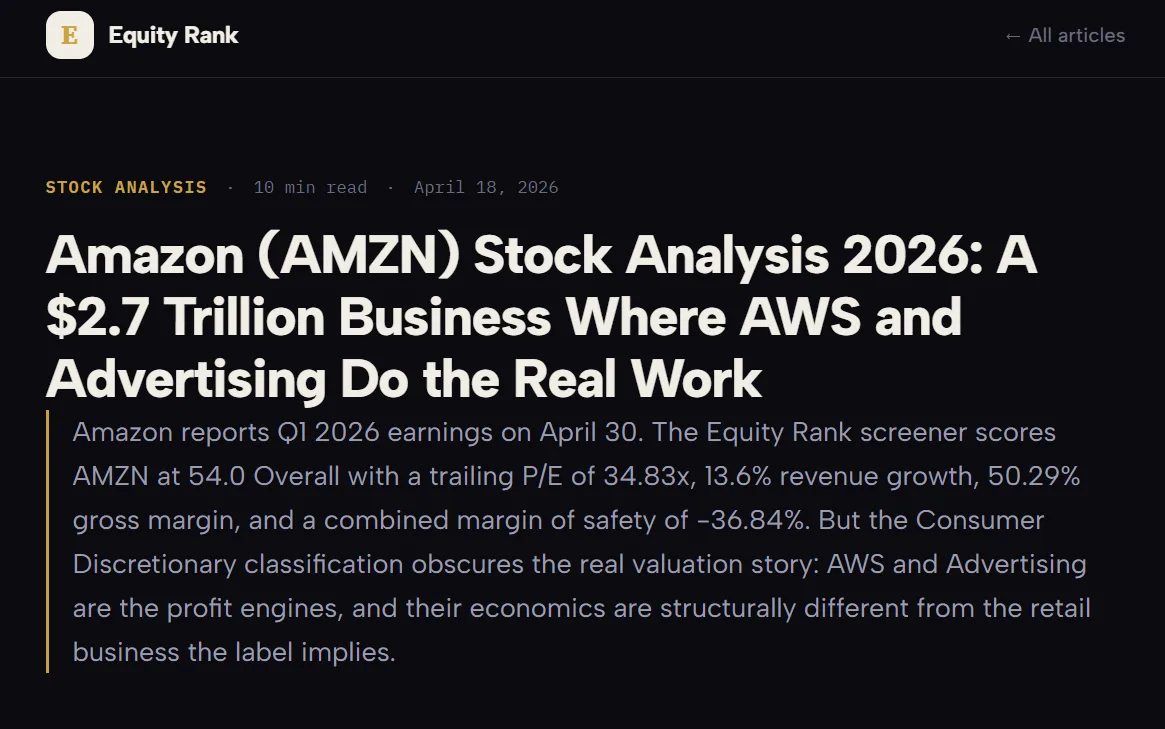
Amazon is the clearest illustration. Global Industry Classification Standard (GICS) assigns it to “Consumer Discretionary” because retail still generates the largest share of revenue by volume, roughly 38% to 40% of the total.
But Amazon Web Services (AWS) drives an estimated 60% to 70% of operating income, with margin economics that look nothing like a retailer's.
Source: Equity Rank
Analysts who benchmark Amazon against Home Depot or Target for credit purposes are comparing a cloud infrastructure business to a big-box retailer and calling it a like-for-like match.
Netflix is a similar story from the other direction. Before 2018, GICS placed Netflix in “Consumer Discretionary” under “Internet & Direct Marketing Retail”.
The 2018 sector overhaul moved it, along with Meta and Alphabet, into the newly broadened “Communication Services” sector.

Source: Reuters
That reclassification required a full structural review by MSCI and S&P Global, and it happened only because the drift had become too large to ignore.
Static classification schemes make this problem worse. The U.S. Standard Industrial Classification (SIC) system was last revised in 1987 and has not changed since, even though it still underpins SEC filings, credit bureau records, and legacy CRM systems.
A scheme frozen since the Reagan administration cannot capture how much services have grown relative to manufacturing, or how software has absorbed activity that once sat across half a dozen separate categories.
GICS, by contrast, is reviewed annually by MSCI and S&P Global, with structural overhauls when the economy shifts enough to warrant one.
That difference in review cadence is the whole story: one scheme updates on a fixed calendar regardless of what happens in the economy, and the other updates because something in the economy actually changed.
Establishing Dynamic Classification to Detect Business-Model Drift
Detecting drift is not a one-time classification decision you make at onboarding and revisit at annual review.
Business models shift continuously, and if your process only checks in once a year, you spend most of the year working off a stale peer set without knowing it.
Building a successful framework means treating classification as an ongoing diagnostic, not a static database field.
The four steps below give you that framework.
1. Establish a Baseline Industry Classification
Every company needs a documented starting point before you can measure its drift.
Set an initial classification using an established scheme, whether that is GICS, SIC, or the North American Industry Classification System (NAICS), rather than relying on an informal internal label that one analyst assigned from memory.
Each classification scheme serves a different use case. GICS was designed for public equity analysis and benchmarking, and it classifies companies based on their principal business activities within a four-tier hierarchy: sector, industry group, industry, and sub-industry.
NAICS and SIC serve operational and economic reporting functions instead, and most credit bureaus, government databases, and legacy CRM systems still run on one of the two.
Here’s a side-by-side comparison table of GICS, NAICS, and SIC:
GICS | NAICS | SIC | |
|---|---|---|---|
Structure | 8-digit code: 11 sectors, 25 industry groups, 74 industries, 163 sub-industries | 6-digit hierarchical code, sector down to national industry | 4-digit code, division down to individual industry |
Review cadence | Reviewed at least once a year, by MSCI and S&P Dow Jones Indices | Revised on a 5-year cycle by the US Census Bureau | Last substantively revised in 1987; unmaintained since 1997 |
Primary use case | Public-equity analysis, sector benchmarking, peer comparison | Economic reporting, government statistics, market sizing | Legacy operational segmentation, sales and CRM targeting |
Knowing which scheme your data sources use, and why, prevents you from comparing a GICS-based peer set against a NAICS-derived one and assuming the codes line up.
However, the scheme you choose matters less than the discipline of using one consistently.
It is crucial to document the classification method, just as it is to get the code right. If your baseline record only shows "SIC 6199" with no note on who assigned it, when, and what business description justified it, you have no way to audit the decision later or explain to a regulator why a company sat in a given peer group for three years.
A strong baseline includes the classification scheme used, the classification date, the primary revenue driver that justified the classification code, and the entity that assigned it.
Use this as your reference point whenever you consider whether there has been any drift since then.
2. Monitor Business Activity for Classification Drift
For a baseline classification to remain meaningful, you must regularly check whether it still describes the business correctly. Continuously monitor the company's products and revenues, not just during annual reviews.
This is vital because business-model drift rarely announces itself. A company expanding into a new segment, or gradually shifting revenue toward a different activity, can spend a year or more moving away from its assigned classification before anyone formally revisits the code.
If you only check business activity at that annual checkpoint, you miss months, sometimes years, of drift that already happened.
The academic evidence on this point is direct. A 2019 study published in the Accounting and Finance journal by Dean Katselas, Baljit Sidhu, and Chuan Yu compared industry matching using time-series GICS data against matching on static classification sources.
Performance benchmarks were better specified when firms were matched using dynamic, continuously updated data rather than a static snapshot, and the study's power tests reinforced the same conclusion.
Simply put, benchmarking a firm against a peer group based on its current state sends a stronger signal than benchmarking it against its former state at the time of initial classification. Moreover, this problem will continue to worsen as long as a static code system remains untouched.
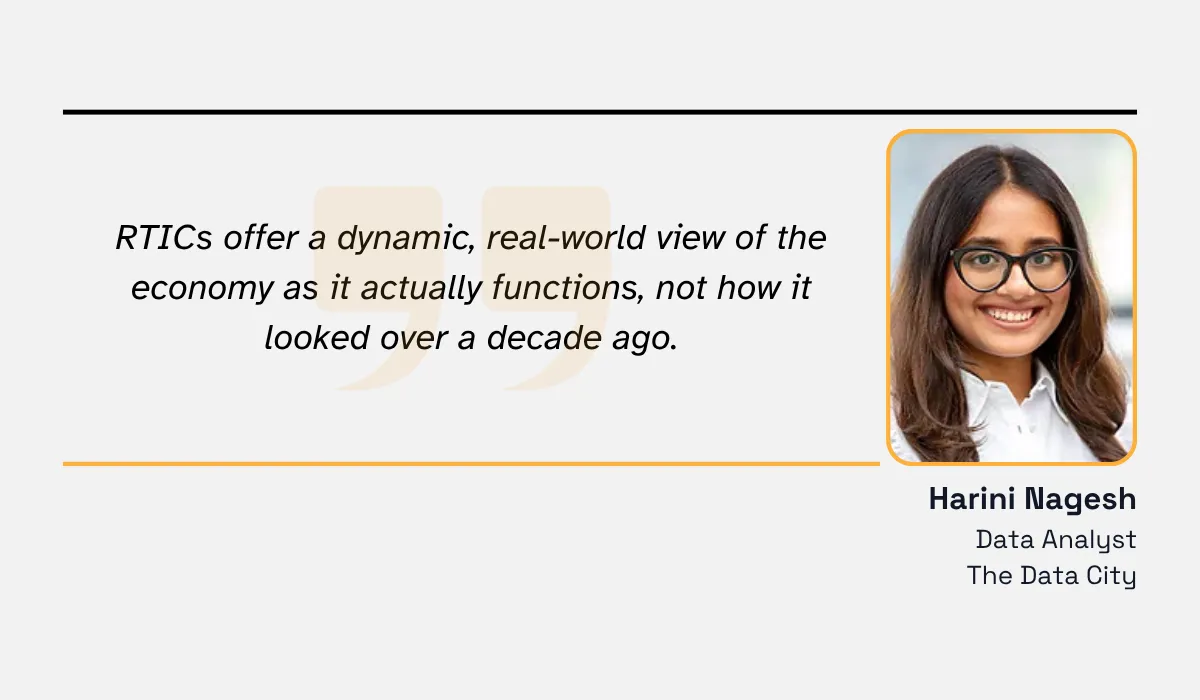
Harini Nagesh, a data analyst at Data City, a data-as-a-service company, recommends using Real-Time Industrial Classifications (RTICs) built on how companies describe themselves online. She notes:
A credit analysis data team should therefore check scheduled filings and track new product announcements, revenue segments, recruitment for emerging business lines, and geographic expansion.
A company that quietly grows a software subscription arm inside a hardware business is drifting long before that shift shows up in an annual 10-K segment breakdown.
Set up recurring checks, monthly or quarterly at minimum, against a defined set of activity indicators rather than waiting for the next scheduled classification review to surface a change that started months earlier.
3. Flag Material Changes That Signal Drift
Not all minor changes in a company's operations require reclassification. You should have a certain threshold for a material change.
It might be a shift of revenue mix above a certain percentage, a new product line of a certain size, or a certain share of a segment within total operating income.
Without a threshold, you either flag every minor fluctuation and drown your team in noise, or you flag nothing and miss real drift until it is too late to catch cleanly.
GICS offers a useful reference point for setting that threshold. Under the current GICS methodology, a company is placed into the sub-industry whose definition matches the activity generating more than 60% of its total revenue.
When no single activity clears that bar, the classification falls to whichever sub-industry accounts for the largest combined share of both revenue and earnings.
The 2018 GICS overhaul that moved Netflix, Meta, and Alphabet into Communication Services was itself a response to internet-platform revenue growing large enough, across enough companies, that the existing sector structure no longer reflected reality.
But 60% doesn't necessarily have to be your cutoff number. However, it is a concrete, publicly documented number to benchmark against instead of building a cutoff from scratch.
Companies also stay under continuous surveillance for major corporate actions between scheduled reviews, so a threshold breach doesn't have to wait for a fixed calendar date to be flagged.
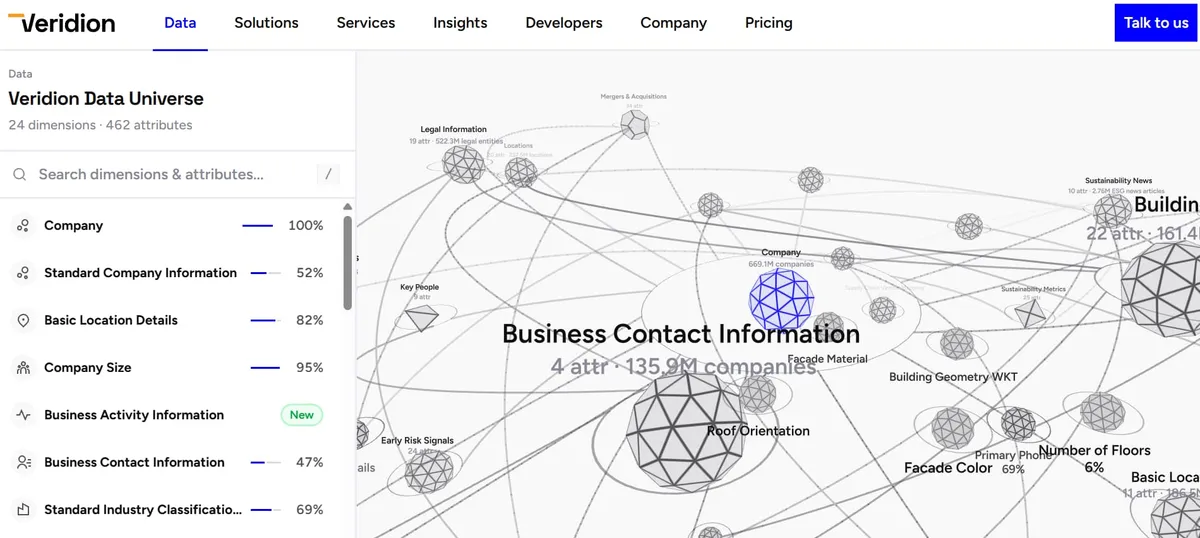
This is where continuously refreshed classification data changes what is operationally possible. Veridion's knowledge graph continuously tracks a company's real-world activity and product signals.
Source: Veridion
This means material shifts appear as they happen rather than waiting for an annual or ad hoc review to catch drift that may have started months earlier.
Instead of relying on a company's next scheduled filing to reveal a pivot, you get a signal closer to the moment the pivot occurs.
That directly fixes the gap steps two and three describe: dynamic classification by design, not classification updated on a fixed calendar.
Set your threshold in writing before drift occurs, not while you are debating a specific company's case.
An explicitly stated rule like "flag any segment growing to 25 percent or more of total revenue within 12 months" helps create a standard and a basis for reviewing future decisions.
4. Review Peer-Group Membership After a Classification Change
A confirmed classification change is not an endpoint. As soon as you detect a drift, review your peer group. This is because the drifted classification influences comparability across the whole benchmark group, not just a company's rating.
If a company's peers no longer share its actual business economics, every multiple, ratio, and benchmark built from that peer set carries a hidden error.
Peer set composition gets more legal and regulatory scrutiny than most credit teams expect. Building a defensible comparable set typically starts with a documented screen:
- Industry classification cross-referenced against a second scheme
- Business-mix overlap pulled from segment disclosures
- A size band relative to the target
- A check on trading liquidity
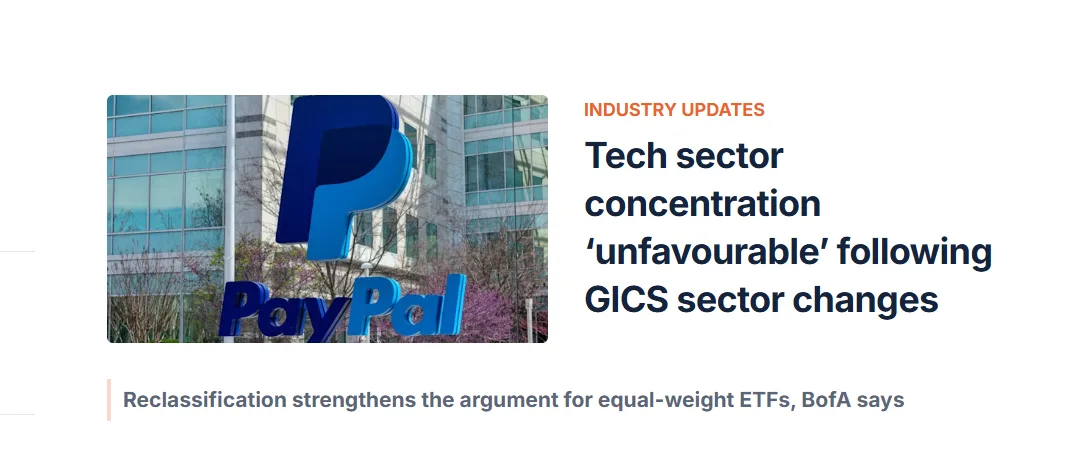
Here's a clear example of how crucial it is to get that screen right. In March 2023, S&P Dow Jones Indices and MSCI changed Visa, Mastercard, and PayPal from Technology to Financials in the GICS system. This removed the sub-industry that had housed payments companies alongside software makers for years.
Just one day after the change, Technology's weight in the S&P 500 dropped from 28% to 25%. In contrast, Financials increased from 12% to 15%, and Visa, Mastercard, and PayPal collectively represented about 17% of the financials sector, more than Berkshire Hathaway (which was the largest component at the time).
Source: ETF Stream
Index funds focused on these sectors would need to adjust accordingly, and analysts covering the firms would need to reconsider which peer group they belonged to overnight.
The opposing valuation experts in that case could not agree on the peer set. One used seven comparable companies for the valuation and nine for a separate beta calculation; the other used six.
This single disagreement, along with other valuation factors, led to differences in equity values by tens of dollars per share depending on the peer group and percentile used.
These were legal disputes, not academic exercises, and the outcomes turned on whether the peer group still reflected the target company's actual business.
Reviewing peer-group membership post-flagging a drift requires the same screening process used to create the group originally: similar business mix, similar size, similar geographic exposure, similar profitability profile.
If a peer has drifted enough to trip your materiality threshold, check whether it still belongs in the same peer set, and check whether other companies previously excluded now fit better.
This is not a one-way process. Drift can pull a company out of a peer group just as easily as it can reveal that a previously excluded company now belongs in it.
For portfolio teams working in private markets, this principle applies directly to the due diligence workflow, including private equity sourcing, where an outdated peer group comparison may incorrectly price the whole deal before term sheets are even prepared.
Document all peer group revisions the same way as the initial one, including sourcing information, date, justification, and the specific trigger signal.
This documentation allows you to defend the benchmark later, whether internally, externally, or even judicially.
Conclusion
Static classification codes were never meant to keep up with how quickly companies change.
If you treat classification as a dynamic process, your benchmarks will reflect what companies do today, not what they did yesterday.
As a result, you can spot drift while it's still cheap to fix.
Articles
Discuss how these trends affect your organization.
Our analysts are available for a short call. Bring a specific question and we will ground it in the data.
Insights
Keep reading
More analysis, research, and outcomes grounded in live company intelligence.
Market Intelligence: Use Cases Across Departments
Want to make better decisions across departments? Learn how market intelligence use cases apply to your entire organization.
9 Essential Sources of Market Intelligence
Want to boost your market knowledge? These 9 market intelligence sources will show you where to look and how to apply the insights.
How Market Intelligence Drives Smarter Business Decisions
Want to improve your decision-making process? This guide will show you how to leverage market intelligence for business growth.