Insights / Articles
How to Find Local B2B Suppliers in Turkey Using AI Taxonomies
Tired of endless searching? Find local B2B suppliers in Turkey with AI supplier finder Turkey. Unlock efficient sourcing now!

- An AI taxonomy helps you produce more reliable, verifiable supplier shortlists.
- By programming it to your business needs, you can significantly reduce the sourcing time.
- Changes in supplier certification, ownership, and other shifts can disrupt supply chain stability.
Turkey sits at the crossroads of European, Middle Eastern, and Central Asian supply chains, which is exactly why its manufacturing base is so hard to dig through.
Unrefined, generic search queries gloss over details that make or break a potential fit, such as the applicable certification regime, specific location, and whether the supplier already exports where you need it to.
AI taxonomies can help your purchasing teams narrow down results and save time.
Today, you’ll learn exactly how they function and how to implement them to maximize benefit.
1. Build an AI Supplier Taxonomy
An AI taxonomy is a structured vocabulary for an industry, a defined set of categories an AI model uses to interpret a request instead of just scanning for matching text.
Rather than treating a request as one flat string of words, it breaks it into dimensions the system can actually query against, such as:
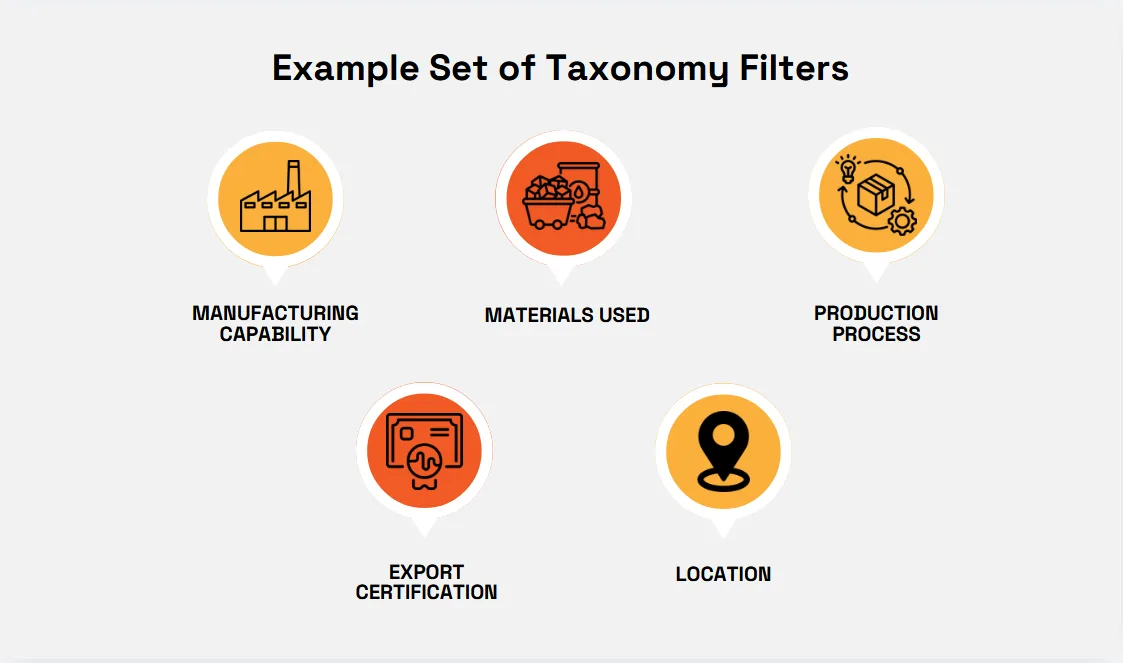
Source: Veridion
Why does this matter? Because a supplier can look “certified” in a keyword search and still not have the certification you actually need.
For instance, “find Turkish machinery suppliers with CE certification” returns matches without telling you whether a given supplier genuinely holds CE, the standard required by EU importing regulations, or a TSE certification, which is Turkey’s own domestic standard for goods sold and inspected within Turkey.
In other words, a supplier fully compliant to sell inside Turkey isn’t automatically compliant to sell into your market, making the “certified” tag dubious on its owns and not 100% reliable.
Regional quirks like this leave your supply chain open to disruptions, and the fix starts with calibrated research.
Using an AI taxonomy, you can give your model a structured vocabulary for an industry, effectively teaching it how to vet search results better.
This adds structure to your search efforts, and we’re only at step one. The benefits go significantly further.
But even just this element of groundwork means AI stops matching on words and starts matching based on the criteria that determine a fitting supplier.
McKinsey’s research on generative AI in procurement found that detailed, taxonomy-aligned prompting yields three times as many results as traditional keyword searches.
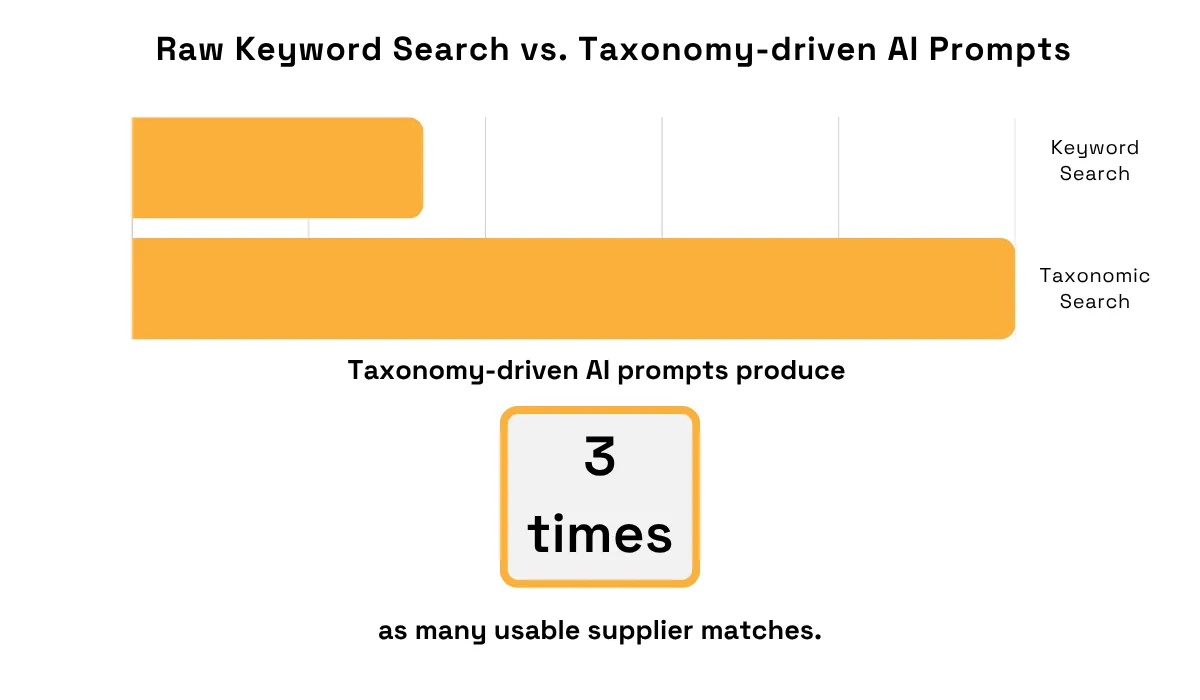
In short, taxonomies greatly reduce the effort needed to browse through the available suppliers, laying the bedrock for the next steps.
As you’ll see in a moment, navigating the country’s complex manufacturing landscape is no easy task. At this point, doing it without AI-powered assistance only adds needless complexity to an already time-consuming task.
2. Map Turkey’s Manufacturing Clusters and Industrial Zones
A regional peculiarity that remains relevant today for supplier sourcing is that Turkey’s manufacturing regions grew by law.
In practice, this means location isn’t something you have to infer from a city name only – it’s directly verifiable.
Turkey’s Organized Industrial Zones (OIZs) are a formal legal structure. They were built to organize scattered manufacturing into planned zones with shared roads, power, and water, and since the program began in 1962, Turkey has replicated that model nationwide.
A 2025 UNDP assessment of Turkey’s OIZ network, citing the official OSBÜK registry, counted 369 zones under the Ministry of Industry and Technology and another 44 under Agriculture and Forestry. Together they house over 68,000 businesses and roughly 2.7 million workers, close to 40 percent of Turkey’s entire industrial workforce.
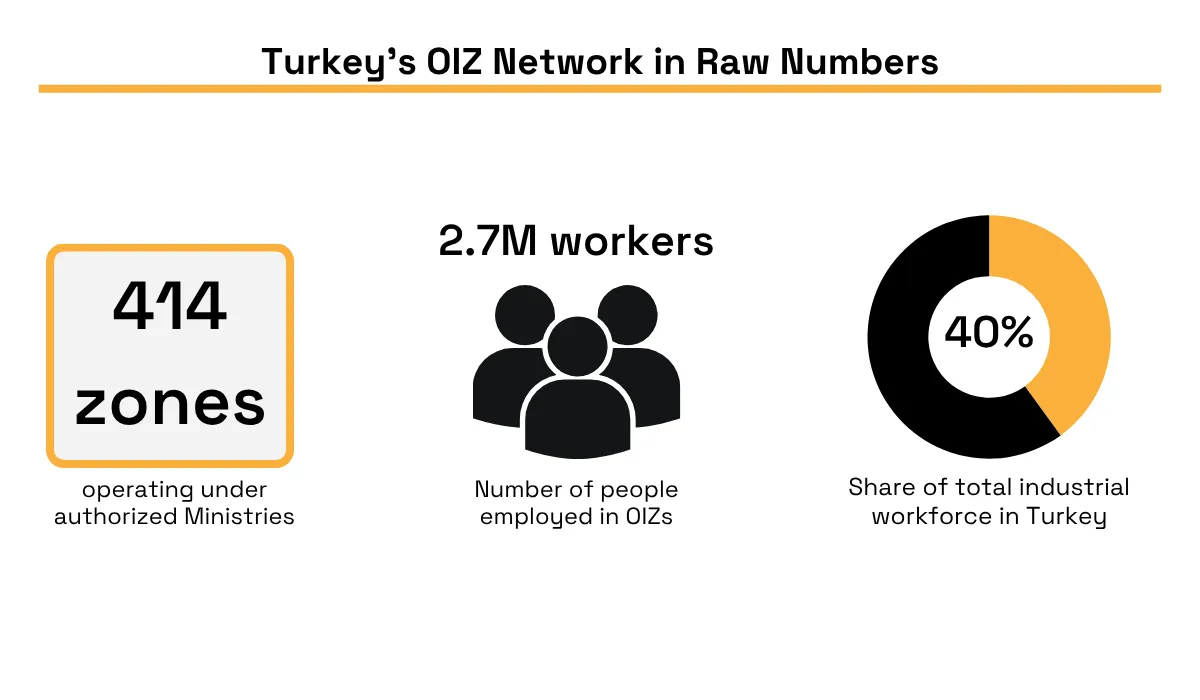
Illustration: Veridion / Source: United Nations Development Programme
That scale makes zone-level data a useful default, but OIZs aren’t the only formally registered option. Turkey’s 19 Free Zones run through a separate, centralized licensing system under the Ministry of Trade, and skew toward export-oriented manufacturers specifically.
Between the two, formal zone registration covers most of what your AI taxonomy should search against.
For the country’s major manufacturing hubs, you’ll have to go a level deeper, though.
Ankara’s OSTIM Organized Industrial Zone hosts more than 6,200 companies spanning 17 primary sectors, everything from defense subcontractors to electronics, inside one zone with one shared administration.
The same pattern repeats with different specialties in other regions:
Istanbul and the Marmara region | Automotive, machinery, textiles, and electronics |
|---|---|
Bursa | Automotive, textiles and machinery |
Izmir | Food processing and chemicals, textiles, and machinery |
Gaziantep | Textiles, carpets, food manufacturing, and plastics |
Konya | Agricultural machinery, automotive parts, and metalwork |
But simply knowing each region’s specialization won’t help you tick off suppliers that can’t meet your volume, or which export to your market.
That’s why, for an effective model, you need to combine location with capability data.
Your AI model will treat a hub’s specialization as the first filter. Then it will layer in production capacity, certification, and logistics reach for that zone, which it can source from the platforms we cover in the next step.
3. Extract Supplier Intelligence with AI
Once you’ve got a list of supplier prospects, you need to start digging deeper. But you can't find a Turkish supplier’s registration details in one central repository.
Instead, they are stored regionally, by whichever regional Chamber of Commerce (CoC) processed that company’s filing.
Manually cross-referencing those details for each supplier is tedious. You have to know which regional authority handled a company’s registration before you can even look it up. As mentioned, there are dozens of CoCs, so forget about a unified search.
McKinsey found that a typical supplier search takes around three months and over 40 hours of a sourcing professional’s time, and even then, only a few dozen suppliers get considered out of a much larger population.
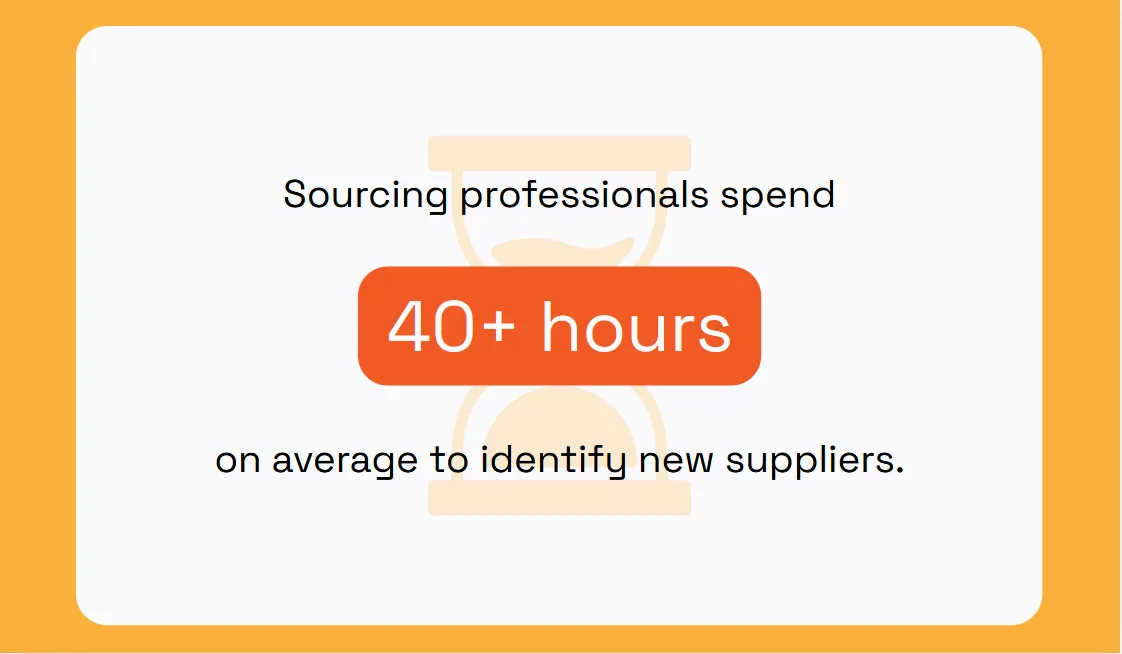
The time hurdle isn’t everything. A 2026 survey of 60 procurement leaders, conducted by supplier management platform Graphite Connect, found that 50% considered duplicate or inconsistent records one of their major challenges.
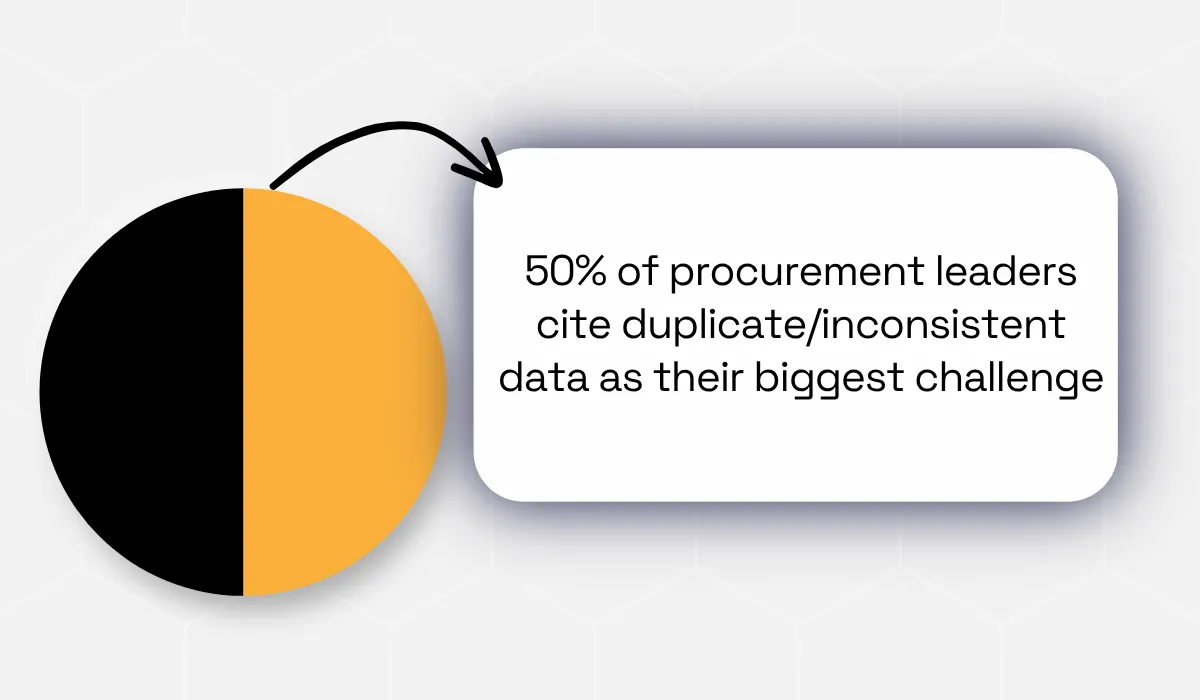
Illustration: Veridion / Data: Graphite Connect
Manual search is inefficient, slow, and prone to inaccuracies. The problem is clear – but so is the solution.
AI can discover relevant suppliers faster than a manual, Chamber-by-Chamber search ever could. Not only that, but it also verifies whether a company is actually active and doesn’t score it solely off of a company’s presence in an old, possibly outdated filing.
Then, the data gets enriched with operational details and keeps continuous watch to catch significant changes that surface in market reports, press releases, and noteworthy changes in legislation.
How do you unlock this kind of tool?
That’s where Veridion comes in.
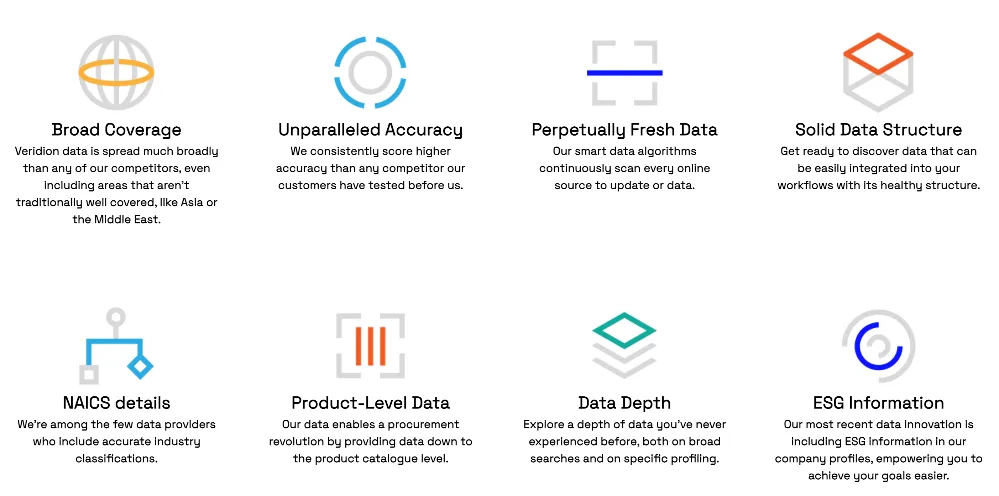
Our database sources live information on suppliers, maintaining fresh records on businesses globally without forcing anyone to spend precious time manually tracking down which Chamber holds a given company’s file.
Source: Veridion
With Veridion, you’ll find, verify, and monitor suppliers at every turn at a fraction of the time, and safeguard your supply chain proactively against third-party risks.
4. Create AI Supplier Scoring
Two suppliers can clear the same stringent taxonomy filter and still not be equally usable. That’s because many dependencies affect their viability, including legal background.
For example, partnering with a Turkish steel exporter without verified emissions data versus one with it means navigating different hurdles.
Since January 1 2026, the EU’s Carbon Border Adjustment Mechanism (CBAM) has charged a real carbon cost on imports of steel, aluminum, cement, fertilizers, electricity, and hydrogen. Turkey is the largest single source of CBAM-covered steel imports into the EU, at roughly 6 million tons a year.
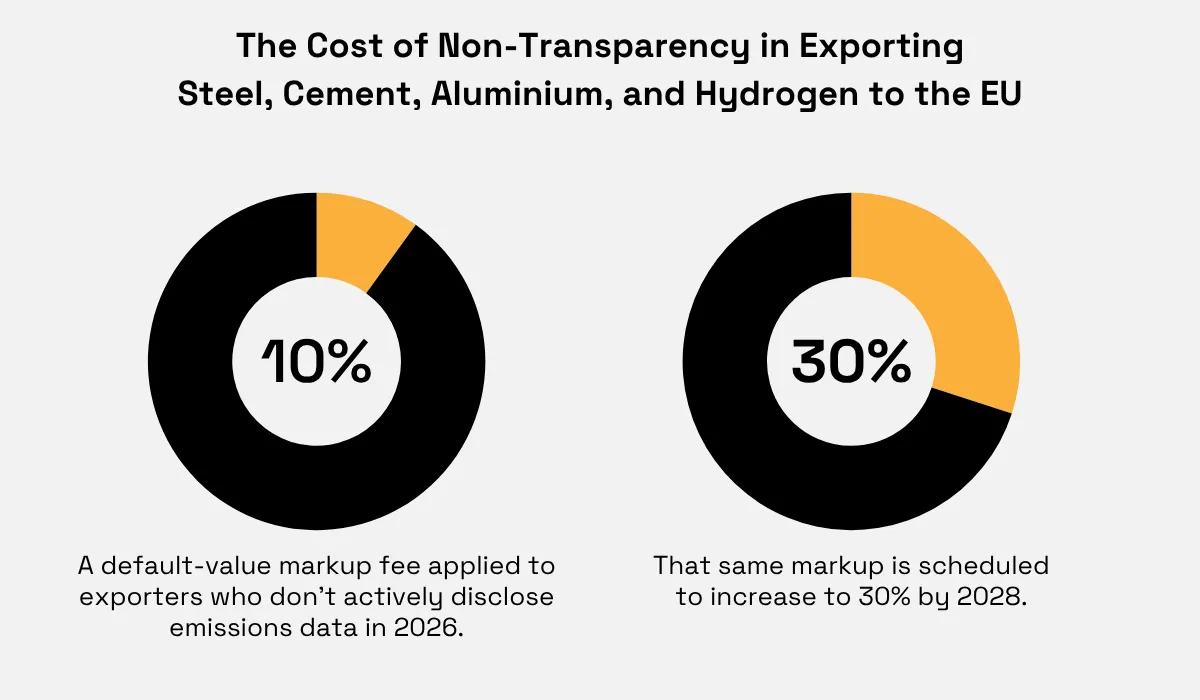
CBAM’s own compliance guidance states that exporters who measure, verify, and transmit actual embedded-emissions data let their EU buyer avoid a default-value markup, 10 percent in 2026, rising to 30 percent by 2028, applied automatically whenever that data isn’t available.
This is one extremely particular illustration of a problem that underpins supplier selection generally: no single factor reliably picks the right supplier on its own. You need to weigh them first.
The way to do this is to define your priorities, such as:
- Manufacturing capability
- Certifications
- Export experience
- Production capacity
- Location
- Financial stability
- Sustainability/ESG
Then, AI scoring ranks every supplier on your shortlist against that exact set of weights, all at once, instead of you comparing suppliers one attribute at a time.
Notice, however, that in the above list, “cost” doesn’t appear as a typical, reliable criterion for weighting.
A literature review of 78 supplier-selection studies published between 2000 and 2008 found that scoring models used quality as an evaluation criterion in 87 percent of them, ahead of delivery performance (82 percent) and price (81 percent): close, but never the deciding factor on its own.
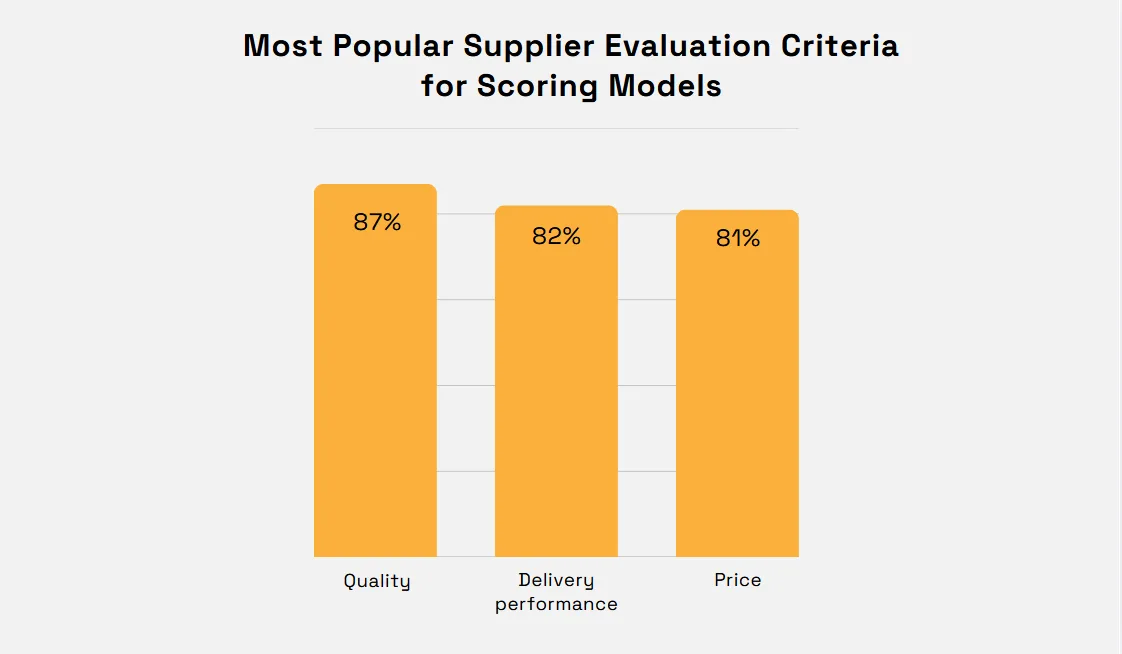
Illustration: Veridion / Source: ResearchGate
The paper’s own conclusion states plainly that cost alone “is no longer supportive and robust enough in contemporary supply management.”
Some criteria are more straightforward to score than others. A certification either exists or it doesn’t. Sustainability, for instance, is a composite judgment built from labor practices and other ESG-related aspects, all heavily bound in legislation.
Unless you have a dedicated team or an expert on board, understanding all the minutiae adds heaps of work right back into your process.
Fortunately, dedicated rating tools help you disambiguate data for weighting purposes.
Rating agency EcoVadis built an AI assistant into its platform to compare supplier scorecards and benchmark ESG performance across a buyer’s network. Integrating it into your stack lets your AI scoring model pool all the data and weight it according to the instructions you’ve provided for a streamlined process.
5. Initiate Autonomous Outreach
Say your taxonomy and scoring narrowed a search down to 40 qualified suppliers, spread across three different OIZs. Reaching all 40 with a properly tailored RFQ, then following up, then handling whatever comes back, is not a task any single procurement person does well by hand.
Something has to give: either the shortlist shrinks to reduce manual workload, or the outreach gets sloppy and generic.
AI can once again help take care of the burden. Once a shortlist is approved, it drafts an RFI or RFQ for each supplier individually, adjusts it to what that specific supplier’s researched profile shows, and sends it without forcing anyone on your team to retype the same request 40 times.
As two scholars working for MIT’s Supply Chain Management Masters Program, Dr. Elena Revilla and Dr. Maria Jesus Saenz, put it, “reviewing dozens of repetitive contracts doesn’t necessarily make someone a better negotiator.”
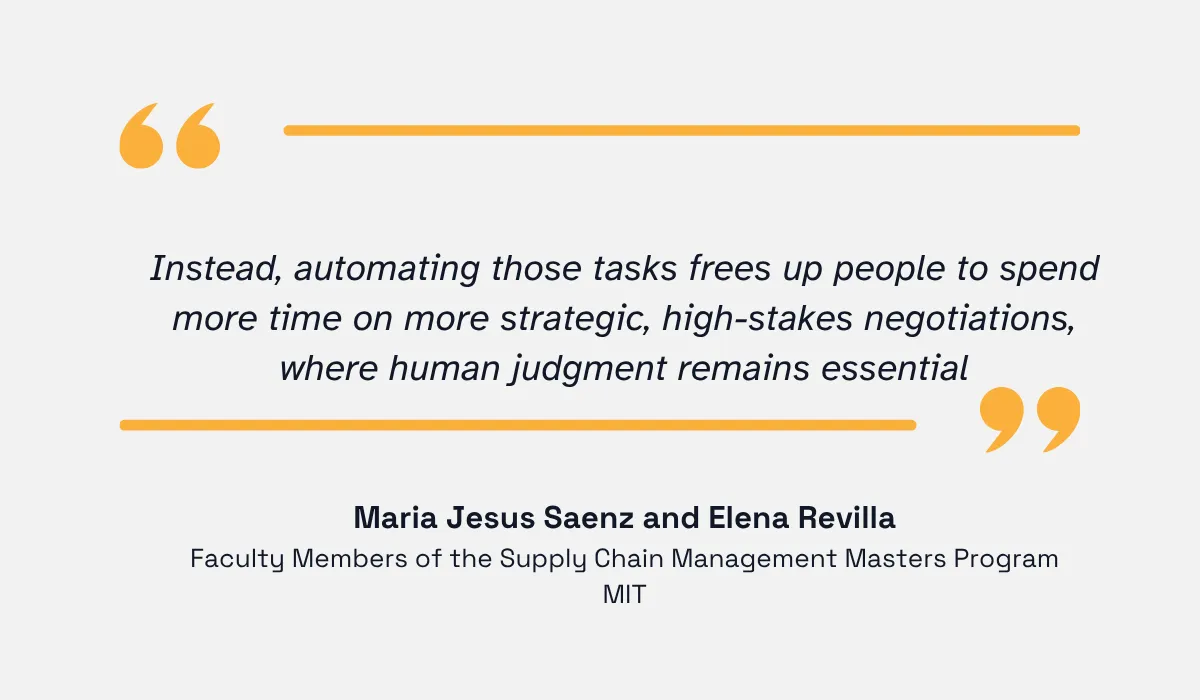
Illustration: Veridion / Quote: MIT Center for Transportation and Logistics
Procurement software company Zycus describes how the negotiation can run once responses to the automated outreach start coming in: the agent reads what each supplier proposed against the criteria set in advance, and where a response falls short on price or terms, it can open a counter-offer round on its own, staying inside limits a person defined upfront rather than escalating every gap to a human.
Here, it’s worth highlighting that the limits configured at the outset function as the key guardrails that are largely responsible for the efficiency of the process.
You define the route; the AI just gets you from point A to point B.
Letting it take over decision-making and setting limits would create a leaky pipeline, so this is very much a human-in-the-loop operation.
6. Build an AI Supplier Monitoring System
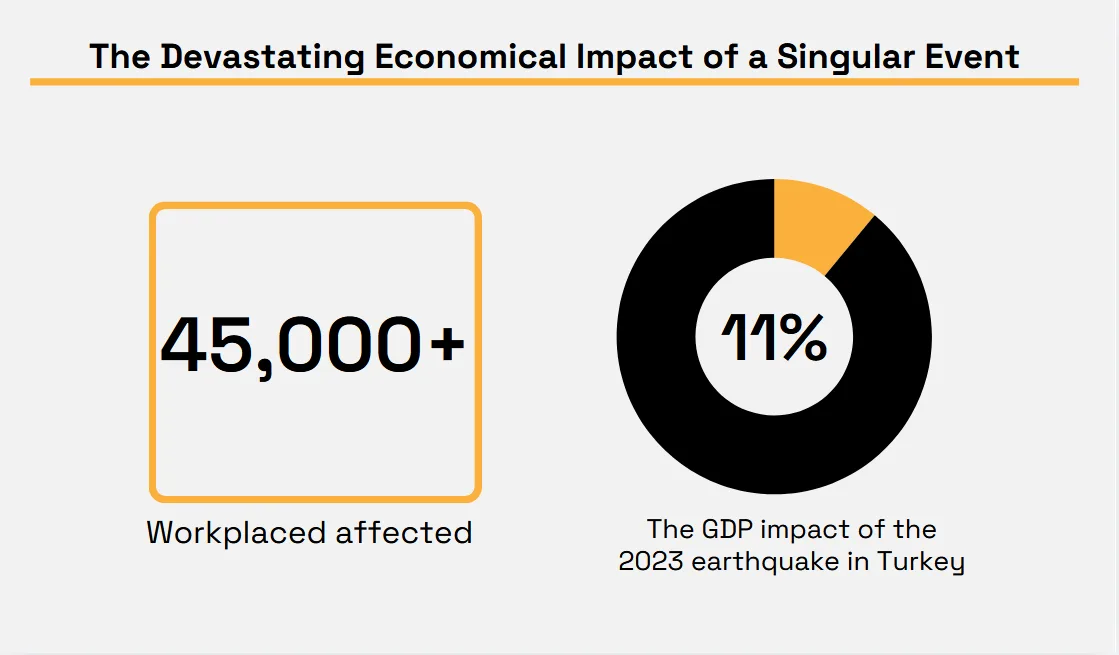
In February 2023, an earthquake hit ten provinces in southeast Turkey, including Gaziantep, one of the manufacturing clusters we mentioned earlier on.
SPARK, a humanitarian NGO, assessed the country’s economy one year later, and put the toll at more than 45,000 affected workplaces and estimated an 11 percent hit to national GDP.
A supplier that was a strong fit in January 2023 could have been unreachable by February.
This kind of scenario is exactly why you need a continuous monitoring system.
Think back to the OIZs we introduced in section 2. Turkey’s business and manufacturing landscape is already complicated enough, and tracking everything all at once would place enormous strain on your teams.
AI can track activity across the country at scale to keep you up to date on the latest information in the zones where your suppliers operate.
There are multiple risk factors that are worth monitoring, including:
- New manufacturers entering an OIZ
- Suppliers gaining or losing a certification
- Changes in export activity or ownership
- Pertinent Trade Registry Gazette filings
The first time you analyze a supplier’s fit, their situation might make them an appealing choice, so you reach out with an RFQ and eventually sign a deal.
Six months later, that snapshot could be the furthest thing from the truth. Stranger things have happened.
A system built to catch these changes keeps watch after the deal is signed to let you react swiftly and accordingly.
Conclusion
Turkey’s manufacturing base is dense and exportable, but that density comes with an added challenge: supplier scouting.
A simple keyword search might lead you to believe that your chosen supplier can clear customs and meet your needs, but without in-depth verification, you’re running considerable risk.
Utilizing an AI taxonomy can help you identify proper leads while minimizing the likelihood of things going awry at any stage. Plus, automating outreach and monitoring saves you time.
Between the certification nuances, the zone system, and the pace at which suppliers can change, these are benefits you can’t afford to skip if Turkey’s where you’re expanding next.
Articles
Discuss how these trends affect your organization.
Our analysts are available for a short call. Bring a specific question and we will ground it in the data.
Insights
Keep reading
More analysis, research, and outcomes grounded in live company intelligence.
Market Intelligence: Use Cases Across Departments
Want to make better decisions across departments? Learn how market intelligence use cases apply to your entire organization.
9 Essential Sources of Market Intelligence
Want to boost your market knowledge? These 9 market intelligence sources will show you where to look and how to apply the insights.
How Successful Companies Use Market Intelligence for Business Growth
Discover how successful companies use market intelligence to unlock new growth opportunities. Learn more in our latest guide.