Insights / Articles
How to Find Local B2B Suppliers in the US Using AI Taxonomies
Tired of struggling to find local B2B suppliers in the US? Discover how AI taxonomies can revolutionize your search for reliable partners.

- A detailed AI supplier taxonomy turns a vague sourcing prompt into a set of searchable dimensions.
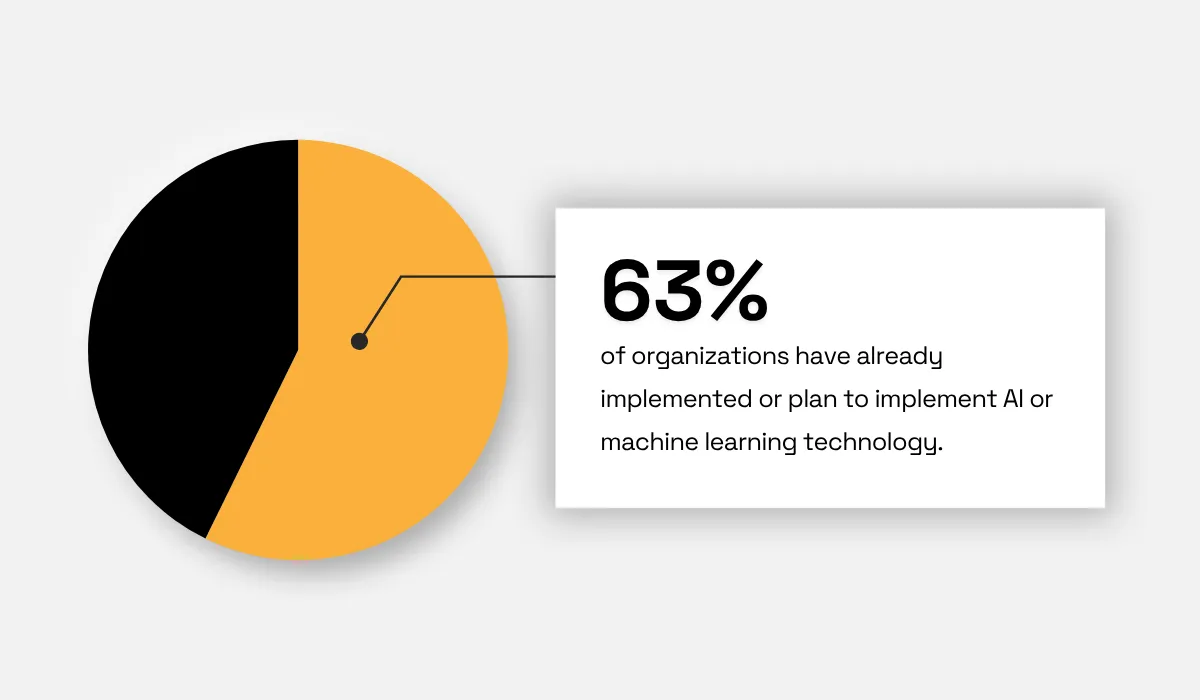
- 63% of organizations have already implemented or plan to implement AI or machine learning in procurement and supplier management.
- AI agents are moving into supplier outreach, and 53% of executives expect them to negotiate supplier or customer deals within a year.
Trade tensions and tariff changes have pushed many companies to rethink where they buy from, and localization is a common answer.
Deciding to source locally in the US pays off, but only when the sourcing process behind it holds up.
And finding the right suppliers and reaching out at scale is where that work starts.
This article covers six steps for doing that with AI, and how to keep the process efficient and accurate throughout.
1. Build an AI Supplier Taxonomy
Working with a capable model makes it tempting to hand the whole problem over and wait for a shortlist to come back.
What usually happens instead is that the input is a vague prompt, and vague prompts return generic results.
Ask for US packaging suppliers, and you get large, well-indexed companies that already rank on the open web, while the specialist manufacturer you need never surfaces.
The model needs a structure telling it which dimensions matter before it can be useful.
Seth Earley, founder and CEO of Earley Information Science, has written about this exact problem in the context of ontologies and information architecture.
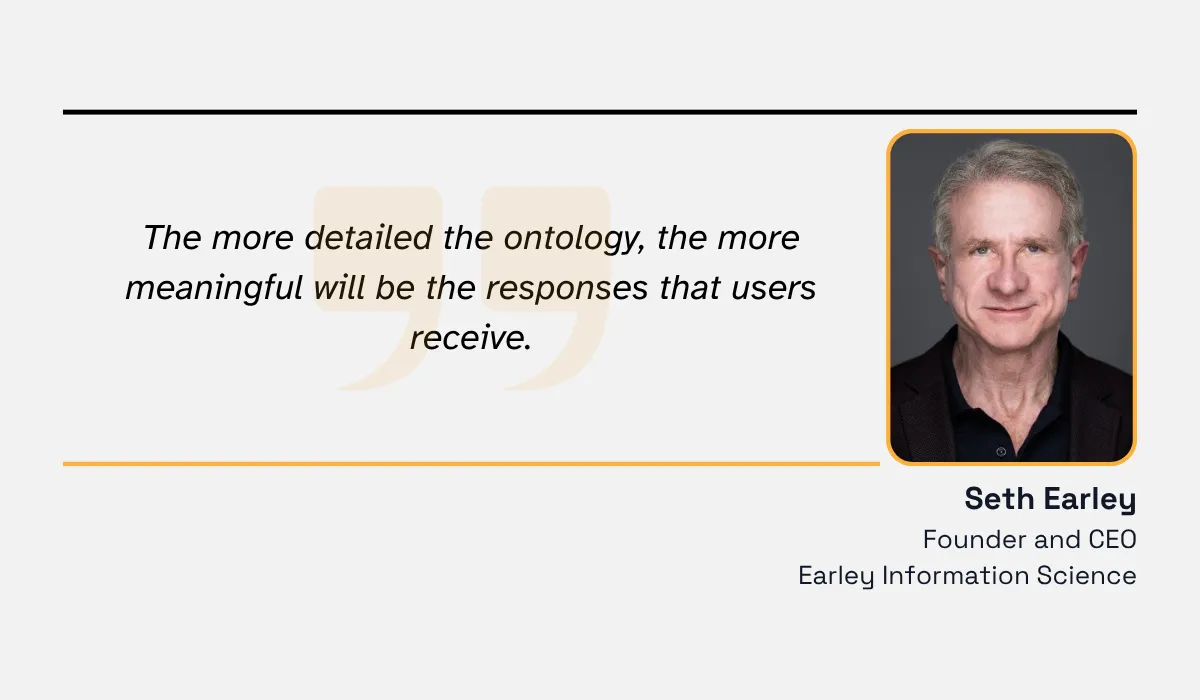
By ontology, Earley means a formal description of the concepts in a domain and the relationships between them.
His broader argument is that AI systems reason only as precisely as the structure underneath them allows, so that structure sets a limit on the output.
A supplier taxonomy is a narrower application of the same idea. It’s a hierarchical, “parent–child” relationship between categories.
It breaks a buyer requirement into searchable dimensions, so a single fuzzy request becomes a set of filters a system can act on.
It functions as an instruction set, directing AI tools toward one defined part of the market instead of the whole of it.
The comparison below shows what that looks like in practice.
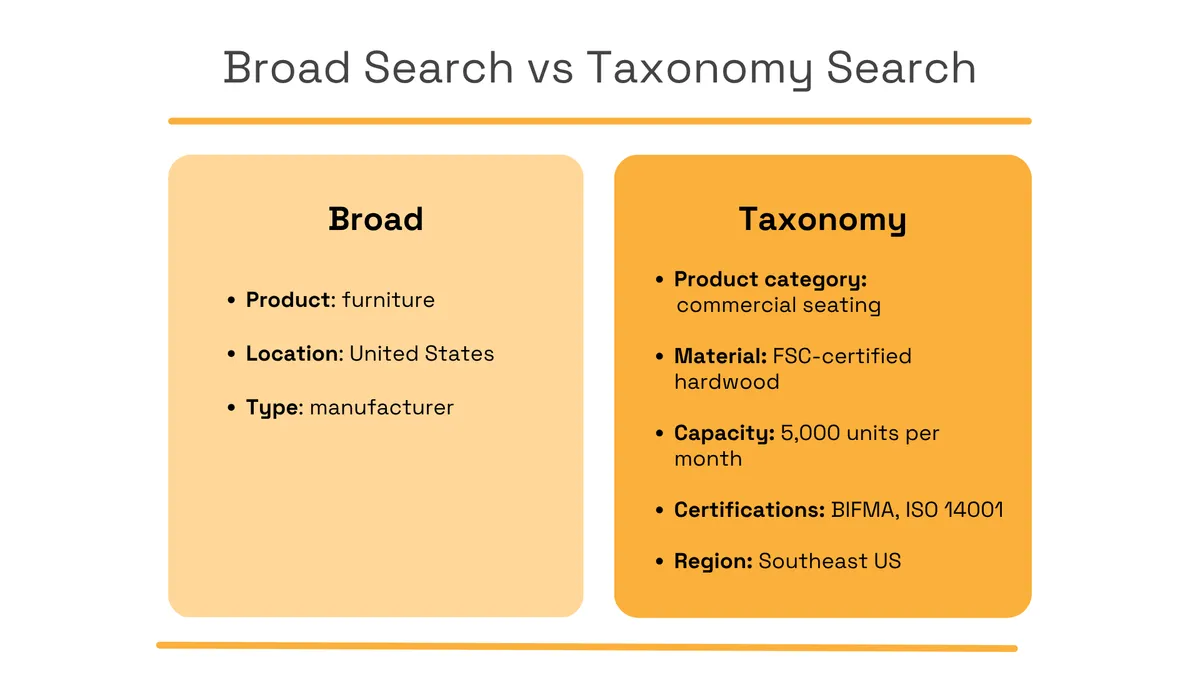
Illustration: Veridion
Of course, which dimensions you include depends on what you are sourcing.
Some of the more useful ones include:
- Product category and specification
- Materials and inputs
- Production process and capacity
- Certifications and compliance regimes
- Geography and facility type
- Business function, such as manufacturer or distributor
Not every dimension carries equal weight, and part of building the taxonomy is deciding which ones are non-negotiable.
Getting this layer right is what makes the following sourcing steps worth automating, as everything downstream inherits the precision you set here.
2. Identify the Right Supplier Region
A detailed taxonomy narrows the field, though it still leaves a large number of US suppliers in play.
The country has one of the largest supplier and manufacturing bases in the world, which is part of why the shortlist stays long.
According to data from the National Association of Manufacturers, 2025 closed with nearly a quarter of a million manufacturers operating across the country.
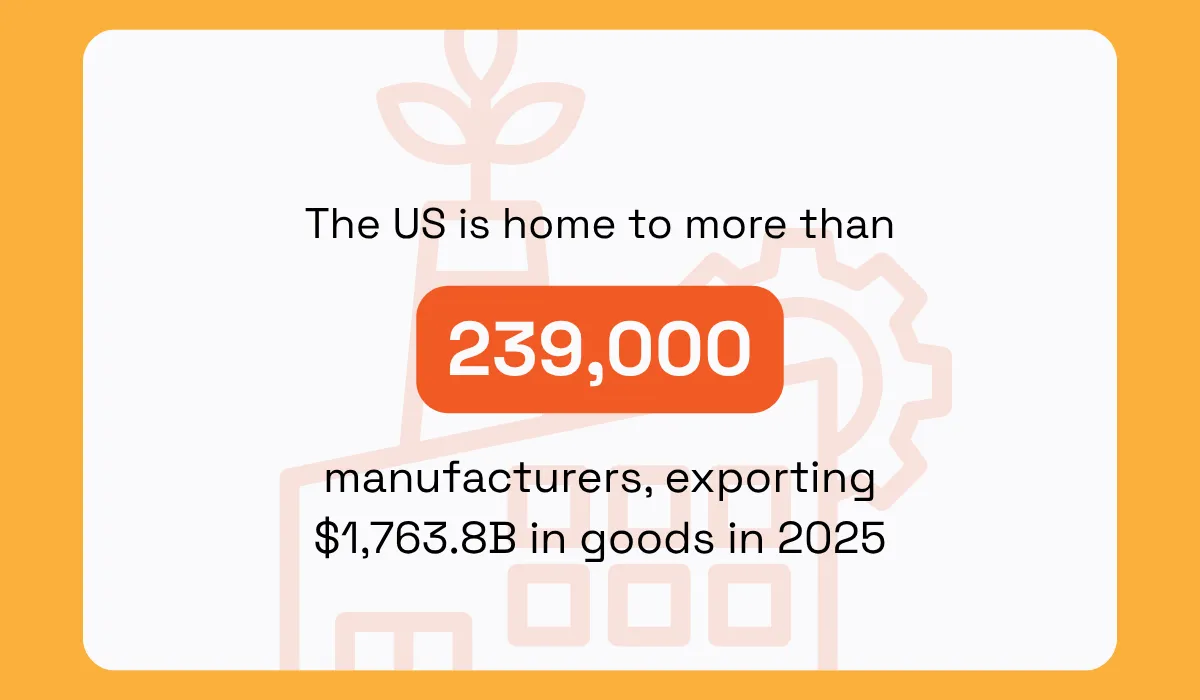
That count covers manufacturers alone, so distributors and service providers sit outside it entirely. Adding those in pushes the total higher again.
What all of this points to is the value of limiting your search geographically before you go any further.
Proximity to your own operations is the most obvious starting point.
Logistics costs, lead times, and tariff exposure all shift with distance, and a supplier three states away can be cheaper to work with than one across the country even at a higher unit price.
On top of that, US regions differ in what they’re good at, so the right geography depends on the industry as much as on the map.
Rothbaum Consulting analyzed US industry clusters state by state and sorted them into four categories of region.
As one example, their analysis of the chemical industry produced the breakdown below.
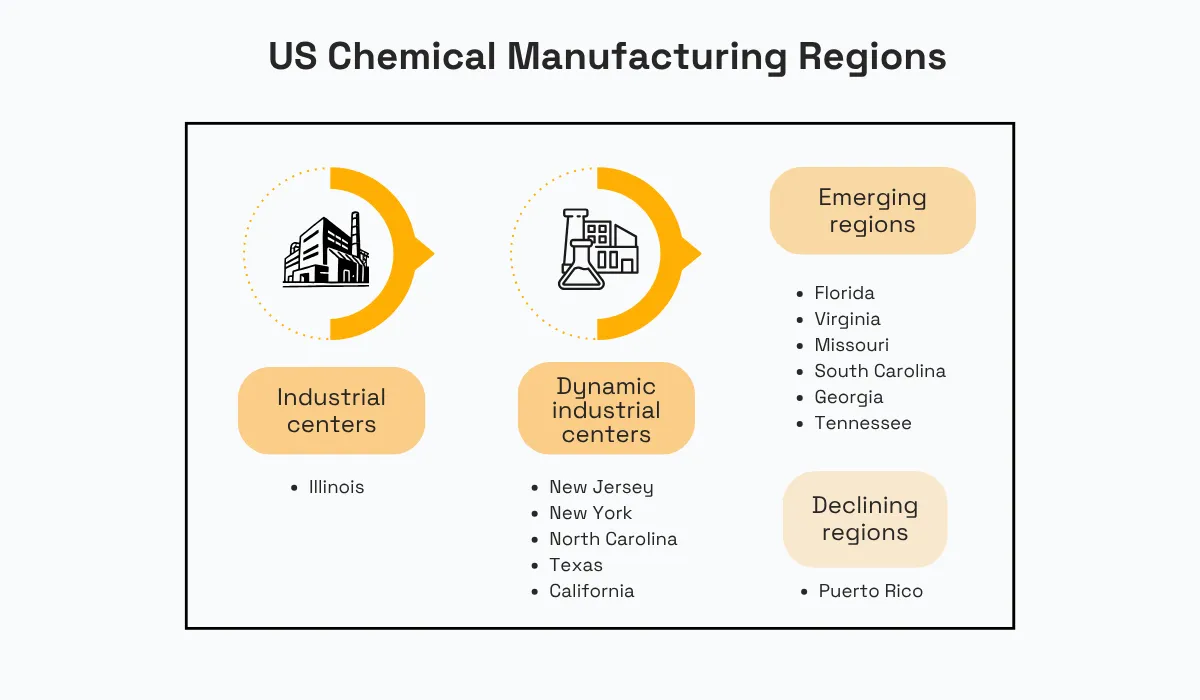
Illustration: Veridion / Data: Rothbaum Consulting
The categorization rests on two dimensions: employment growth in that industry over five years, and each state's share of national employment in it.
A state with high share and falling growth sits in a different quadrant from one with low share and fast growth, and each implies its own trade-off between depth of supply and cost.
Overall, whether it’s through insights like these or your own research, every industry will have similar categorizations, with the same states landing differently depending on the sector.
Region selection is therefore a judgment about which state is the optimal one for your category.
3. Extract Supplier Intelligence with AI
With the taxonomy and region set, the question is how to gather usable information on the companies inside that scope.
Doing it manually means working through directories and supplier websites, then compiling everything into a spreadsheet by hand, which does not hold up at scale.
Plus, you may end up with a partial picture, and the suppliers you never found will stay invisible.
Supplier intelligence is one of the areas where AI is already displacing that manual effort, and the adoption numbers reflect it.
Research from procurement software company Ivalua, based on a survey of 850 procurement leaders, points to how far this has spread.
What decides the depth of AI supplier intelligence analysis is the data underneath, since a model reasoning over incomplete records returns confident answers that happen to be wrong.
Veridion is one example of how that data layer works.
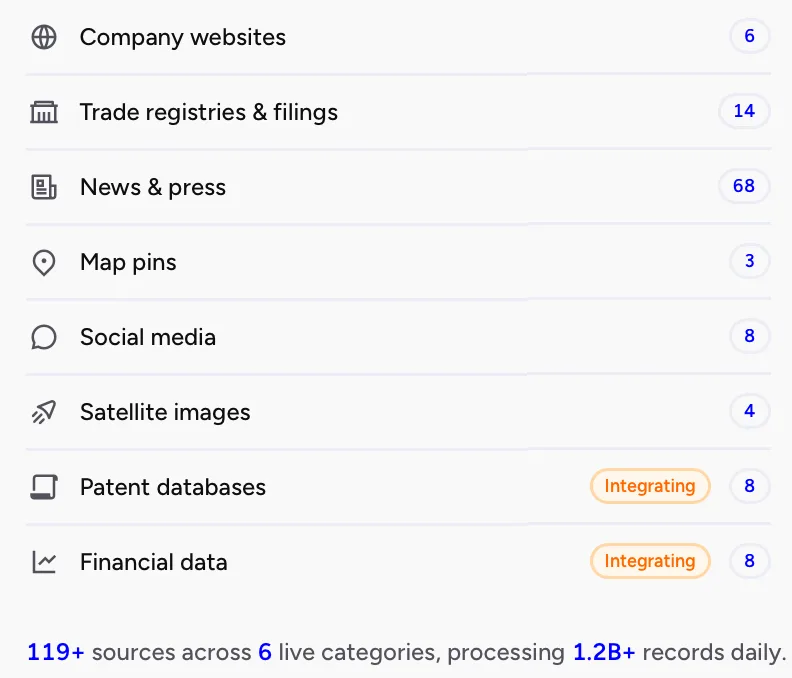
It’s an AI-powered company data service whose machine learning models read the unstructured web and turn it into structured records covering every active company in the world.
The image below groups the source types feeding that graph, with over 119 total sources.
Source: Veridion
The point worth drawing out is that you do not receive scattered fragments about the same supplier from these separate sources.
Veridion’s entity resolution capabilities reconcile legal filings, digital footprint, and corporate relationships into one record, so a manufacturer trading under three names resolves to a single company profile.
That removes the deduplication work normally sitting between raw data and a usable supplier sourcing process.
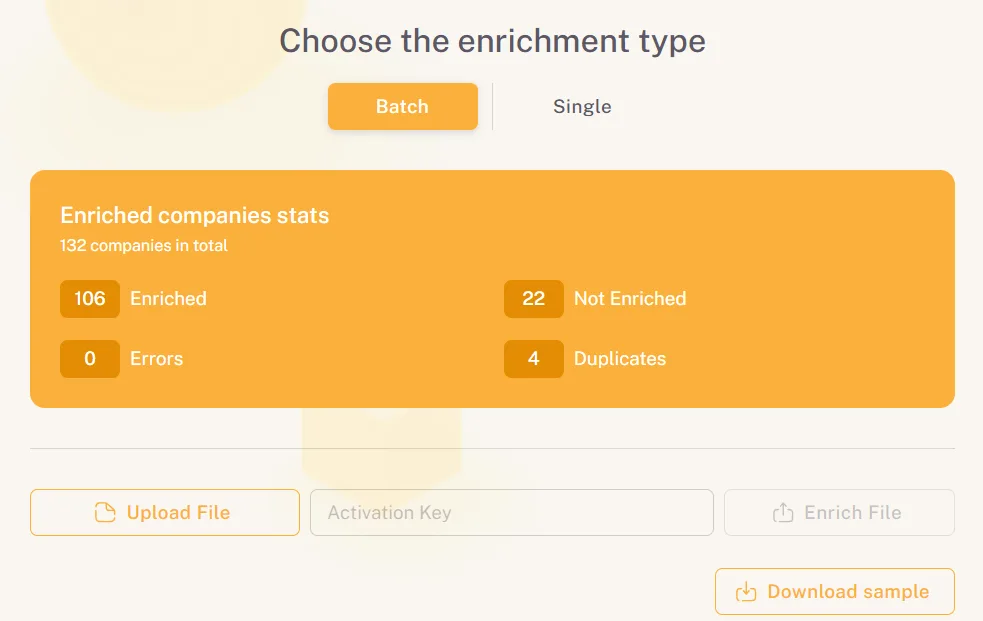
What’s more, records refresh continuously rather than annually, with the enrichment service keeping your existing supplier list updated.
Source: Veridion
For supplier intelligence, that means the shortlist will reflect the market as it stands rather than as it looked when someone last exported it.
With these functionalities, gathering supplier intelligence becomes something you can query for confidently rather than something you manually check and assemble.
4. Create AI Supplier Scoring
Gathered data still needs structuring and prioritizing before anyone can act on it.
After all, not every supplier that clears your filters will be a strong match, so you need a way to rank what came back.
Before involving AI, the thing to settle is your ranking criteria.
These should tie to what determines success in your category rather than defaulting to cost metrics.
Some workable options are shown below.
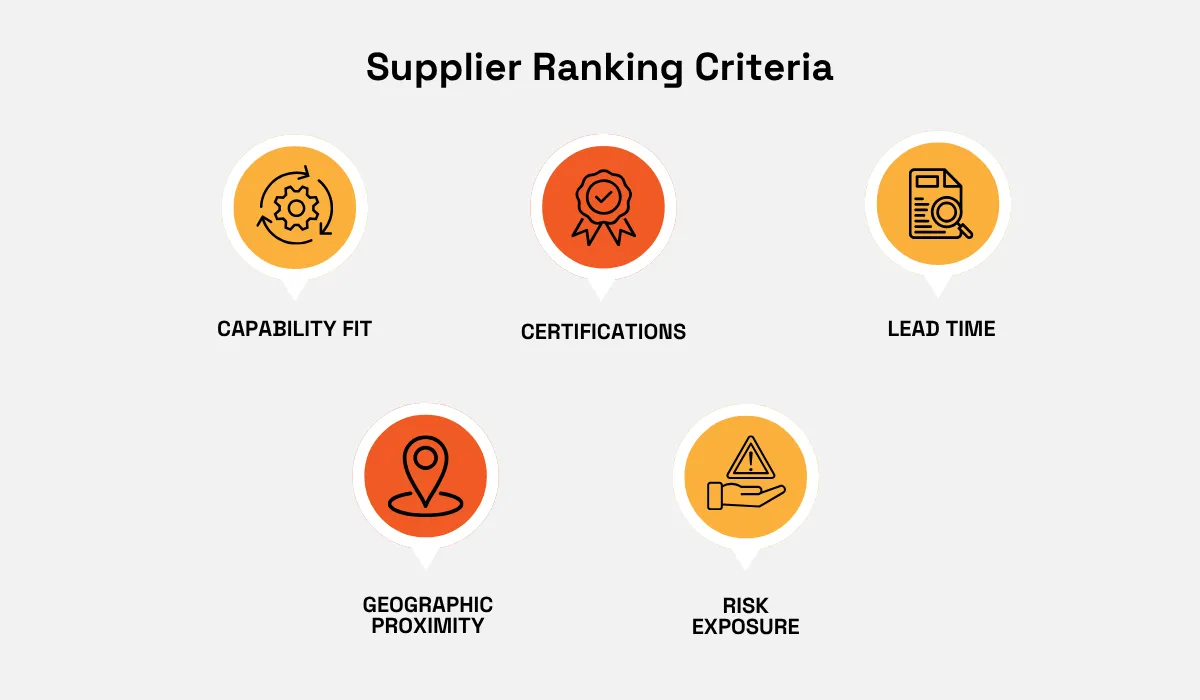
Illustration: Veridion
Criteria like these can be applied alone or in combination, each weighted by how much it matters to you.
Once the model has the criteria and their relative weights, it can score a supplier list against them.
That might take the form of a weighted total, where every supplier receives one composite number and the list sorts from high to low.
Another approach is tiering, which groups suppliers into bands rather than ranking them individually.
A supplier failing a required certification lands in a rejected tier regardless of how it scores elsewhere, which keeps hard requirements from being averaged away.
Several supplier sourcing tools now build this scoring in.
For instance, EcoVadis, a supply chain sustainability company, is strongest on sustainability ratings, scoring suppliers against environmental and ethical criteria.
Beyond the ratings themselves, the service includes an AI assistant for working through scorecard data.
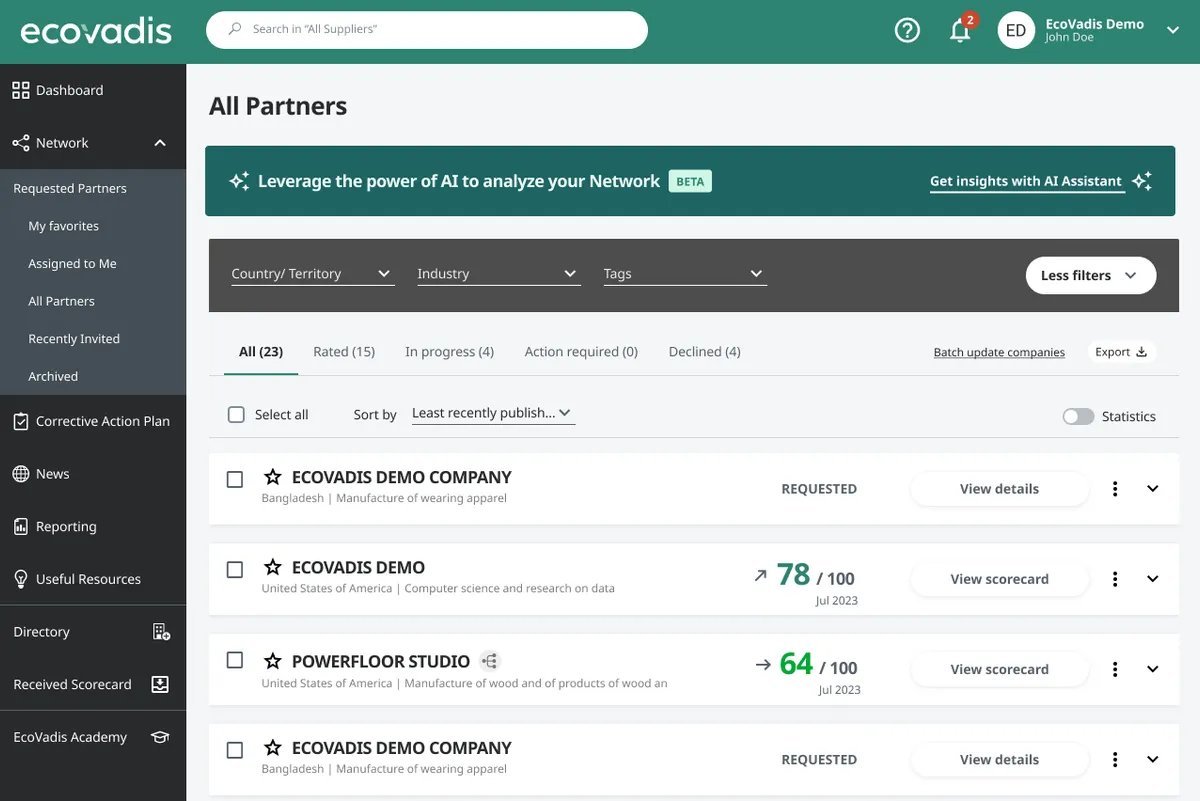
Source: EcoVadis
While their assistant does not currently generate the rating itself, you can ask it which high-priority improvements matter most for a given supplier.
In other words, AI tools can both rank suppliers and directly answer questions for those scores, before any contracts are signed.
Scoring this way gives you a defensible shortlist rather than a long list of possibilities.
5. Initiate Autonomous Outreach
With top matches identified, the next step is contacting them.
Manual outreach absorbs a lot of time, since each supplier needs a tailored message and someone to chase the ones who never reply.
What ends up happening: teams contact fewer suppliers than their shortlist justifies, with promising matches dropping out for no reason other than capacity.
Automation saves considerable time here, which is why autonomous sourcing has become a serious topic in procurement.
The industry is already moving this way. Icertis asked over 1,000 C-suite executives at large enterprises where they expect AI agents to operate.
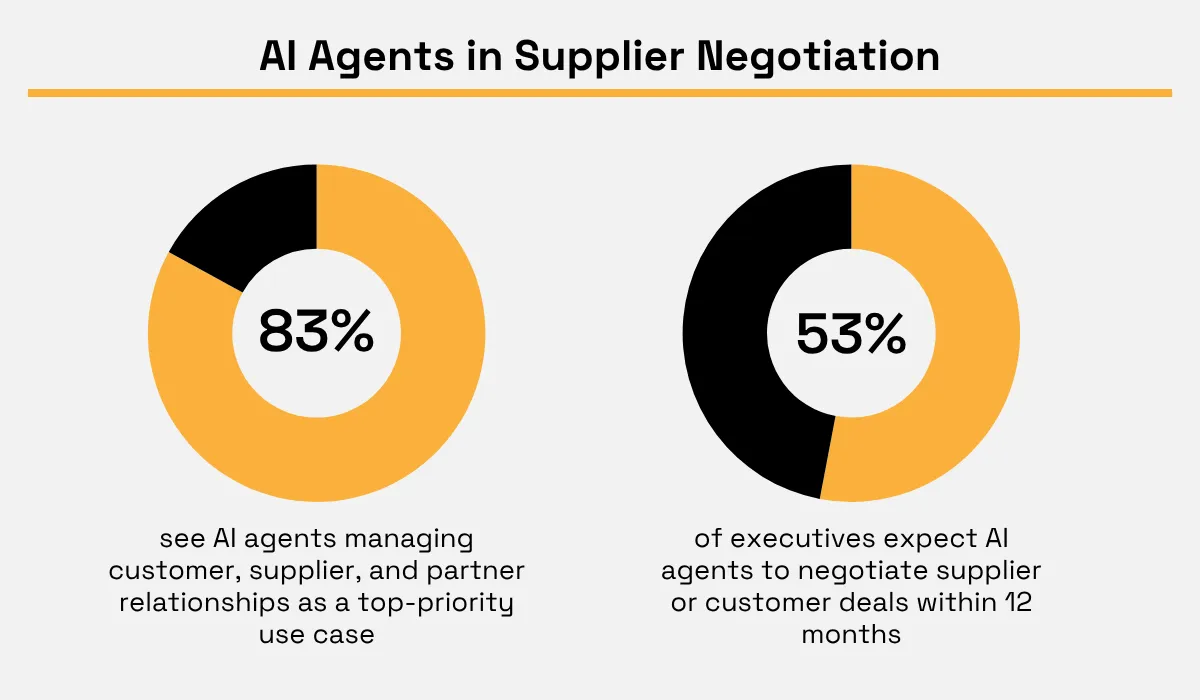
Statistics like these suggest the constraint for AI implementation in this area is no longer capability so much as time.
Still, for agentic outreach and negotiation to run smoothly, a defined structure also has to sit underneath it.
That structure can carry as much or as little human involvement as your risk tolerance allows.
Shown below is a straightforward agent-run outreach sequence with a single human review at the end.
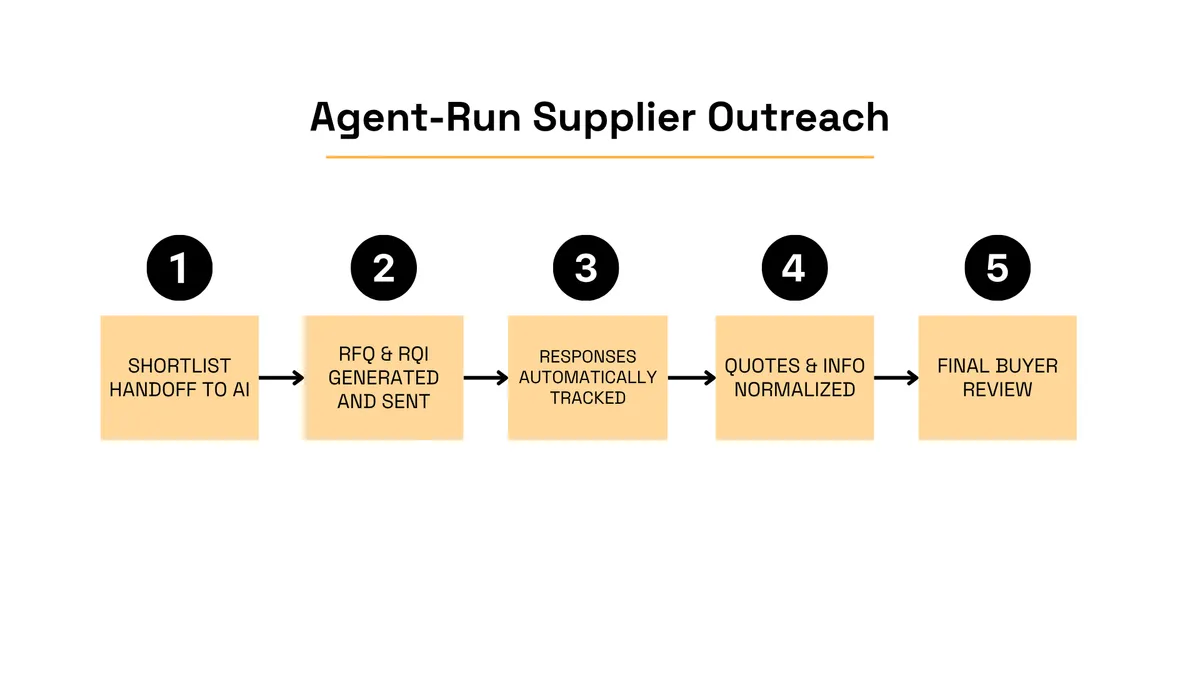
Illustration: Veridion
Setting this up is less complex than it sounds, since the agent mainly needs a mail connector and somewhere structured to write results.
From there, it can send requests for quotation, track responses, and normalize incoming replies into one comparable format.
The final decisions always stay with the buyer, with a review layer before a contract is awarded.
The process does not have to stop at outreach, and some companies have extended it into back-and-forth supplier communication.
Walmart ran a negotiation chatbot across a pilot group of suppliers, described by Harvard Business Review.
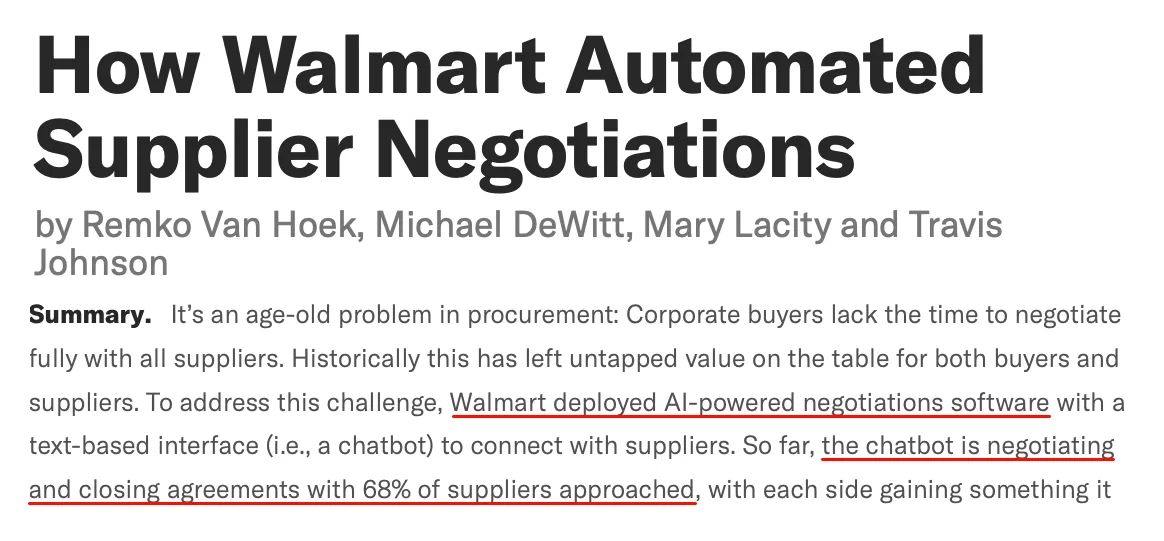
Source: HBR
The chatbot closed agreements with the majority of suppliers it approached, well past the threshold the team had set for the pilot to be worthwhile.
Results like that suggest the technology can already go beyond simply finding a supplier.
Outreach, then, is a reasonable place to hand work over, provided the key decisions stay human-verified.
6. Build an AI Supplier Monitoring System
Supplier discovery is rarely a one-time task, and continuous monitoring after contracts are signed is where AI removes a steady stream of manual work.
Suppliers change constantly, gaining and losing certifications, opening facilities, and drifting in financial health.
That makes your existing base worth reassessing against those changes.
Amazon Quick is a practical example.
The AI assistant automates routine business tasks, and alongside general functions it carries several procurement use cases.
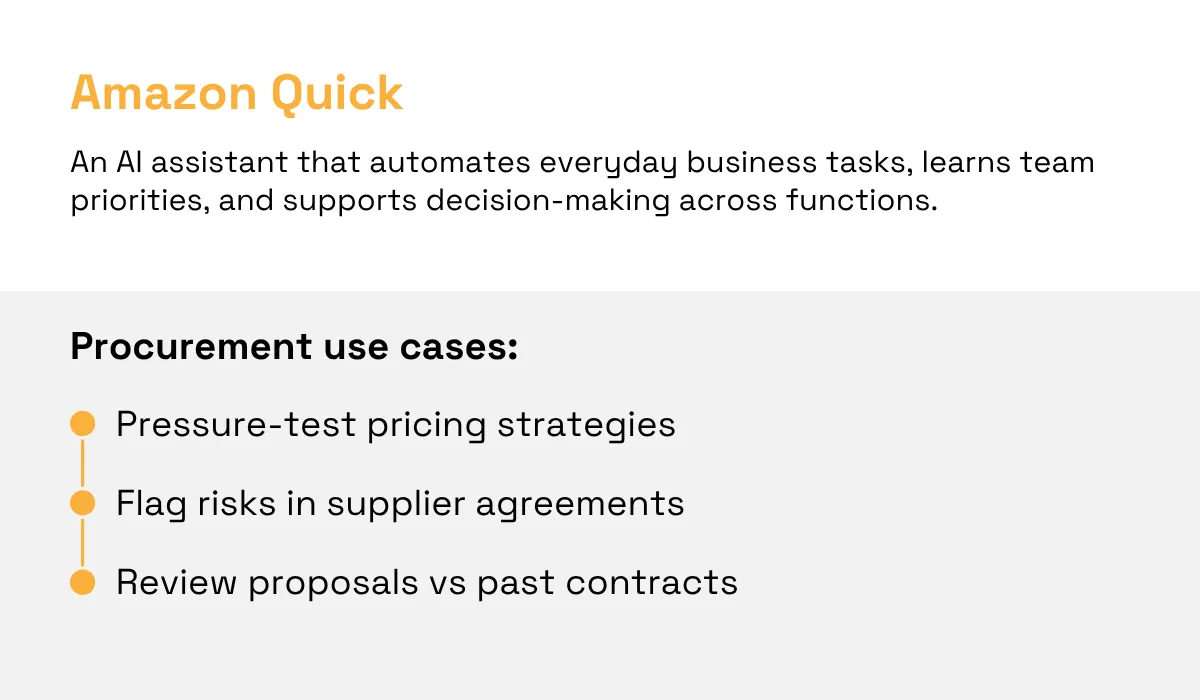
Illustration: Veridion / Data: Supply Chain Outlook
Tools like these can compare a new supplier proposal against historical agreements, which tells you whether the terms beat what you already signed.
Plus, the AI can test pricing against external cost data, which tells you whether a quote is defensible before you respond.
These features are just the start.
AI-driven data services that scrape the web continuously can monitor a wider set of signals, some of which are shown below.
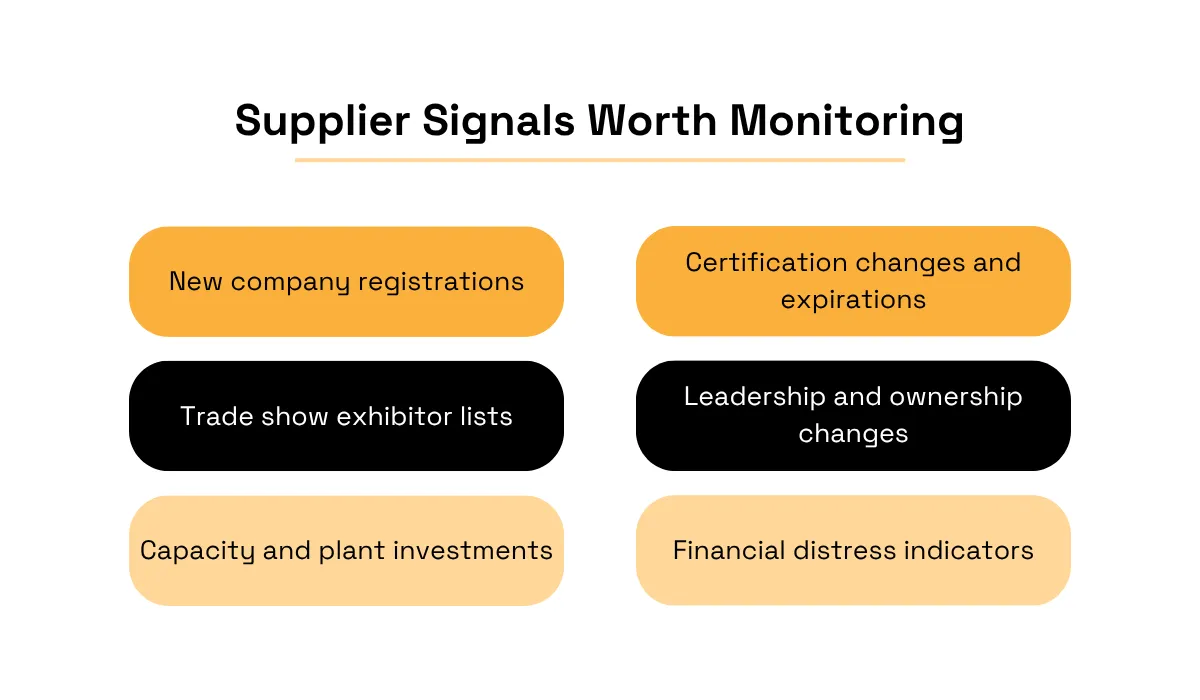
Illustration: Veridion
Each signal points toward a different decision.
A trade show exhibitor list might surface a fabricator you have never contracted with, and enrichment against it returns certifications and plant locations within the day.
If it holds a certification your incumbent lacks and sits closer to your assembly site, that is enough to add it to the next sourcing event.
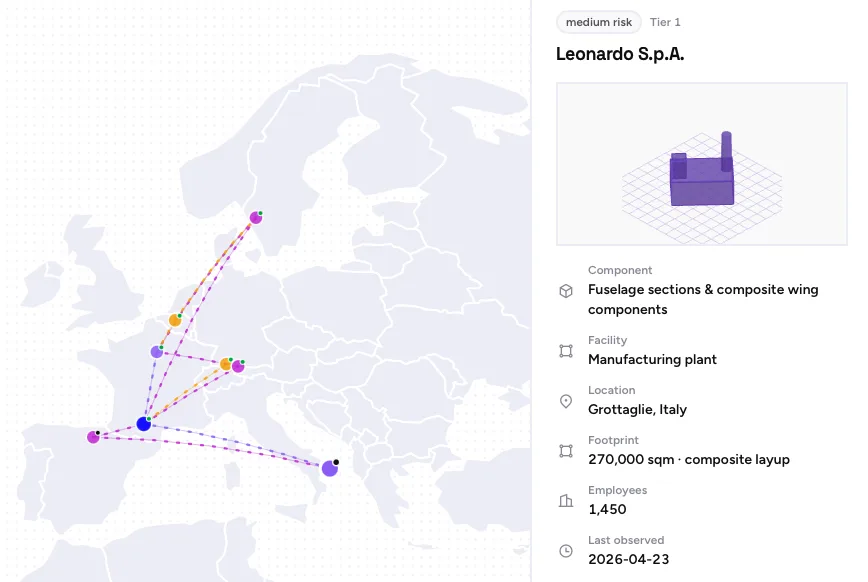
The same enrichment applies to suppliers already in your base, which is where it feeds third-party risk management.
Source: Veridion
Resolving a tier-one supplier down to component, plant, and footprint is what makes the tiers behind it visible, and the observation date shows how current that picture is.
Regional disruption, unethical practices, or ownership changes further down the chain get caught while they’re still someone else's problem.
Monitoring keeps the first five steps from decaying, and it extends naturally into any supplier management routine.
Treated that way, sourcing becomes a standing capability rather than a project repeated from scratch.
Conclusion
That wraps up the six steps to sourcing suppliers locally in the US with AI.
Handled the right way, supplier sourcing becomes a structured, repeatable process rather than one-off searches.
The main takeaway is that each stage only holds up if the one before it was solid, since AI is only as good as the structure it's given to work with.
So, take a look at where your own process needs work, and start there.
Articles
Discuss how these trends affect your organization.
Our analysts are available for a short call. Bring a specific question and we will ground it in the data.
Insights
Keep reading
More analysis, research, and outcomes grounded in live company intelligence.
7 Key Steps of Successful Supplier Sourcing
Want to optimize your supplier sourcing process? Get better at each of the key seven steps we outlined and you'll get there.
Supplier Sourcing: What CPOs Need to Know
Supplier sourcing is not just about finding the cheapest suppliers. It’s about building long-term partnerships that move you forward.
Supplier Sourcing Software Solutions to Know About
Discover top supplier sourcing software solutions that streamline procurement and enhance supplier diversity.