Insights / Articles
Beyond Static Data: What Growth Signals Reveal That Traditional Firmographics Miss
Tired of relying on outdated firmographic data? Uncover hidden growth signals that traditional firmographic data providers miss.

- Traditional firmographics show where a company stands, not where it's heading.
- Hiring patterns can reveal which capabilities a company is preparing to build.
- A new location or product launch can signal bigger strategic changes.
- The value of a growth signal depends heavily on how quickly you detect it.
Imagine you pull a firmographic profile before a big call.
The industry, headcount bracket, revenue range, and headquarters location all check out.
But three weeks later, the deal falls apart.
The company had quietly cut a third of its team the month before, and nobody on your side saw it coming because nothing in the data said so.
This isn’t necessarily a data quality problem; it’s a data type problem.
Static firmographics can tell you what a company looks like. They can't always tell you what’s changing inside it.
That's where growth signals come in.
Traditional Firmographic Data: A Photograph, Not a Film
Traditional firmographic data gives you a structured description of a company, including its industry, employee count, revenue, headquarters, geographic footprint, and other attributes used for ICP definition, segmentation, territory planning, and account scoring.
But even when those attributes are accurate, they describe a company at a particular point in time.
Think of a traditional firmographic record as a photograph.
Even if every field was verified yesterday, it tells you what the company looked like yesterday, not what happened after the picture was taken.
The company might now be:
- Hiring aggressively
- Raising a funding round
- Opening offices in new markets
- Building an engineering team to support a new product
The problem is that business data doesn't sit still between refreshes.
Research cited by the EDM council and Informatica estimates that master data changes at roughly 2% per month, compounding to 27% over a year.
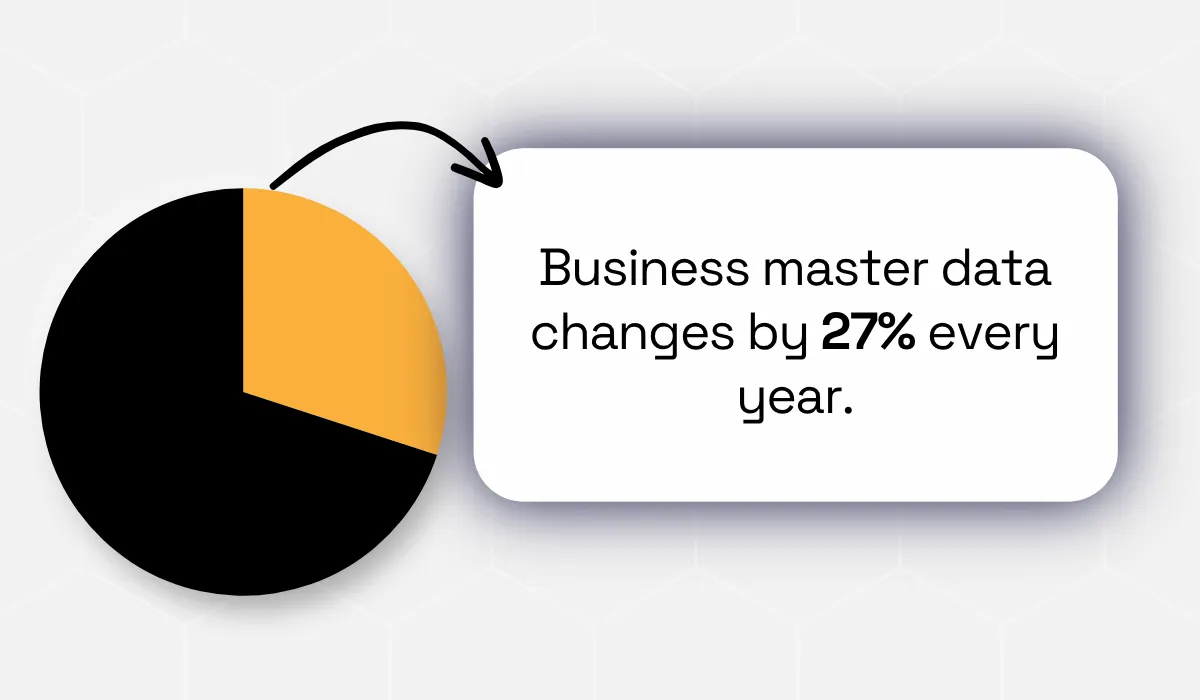
Illustration: Veridion / Data: EDM council
Not every attribute changes at the same rate.
Headcount, technology usage, funding status, and leadership can shift considerably faster than a company's headquarters address.
That’s why the issue isn’t simply accuracy, but temporal relevance.
A database can contain technically accurate information and still give you the wrong picture of an account's current trajectory.
As Jonathan Maurin, Founder & CEO of Derrick App, a B2B data-enrichment platform, puts it:
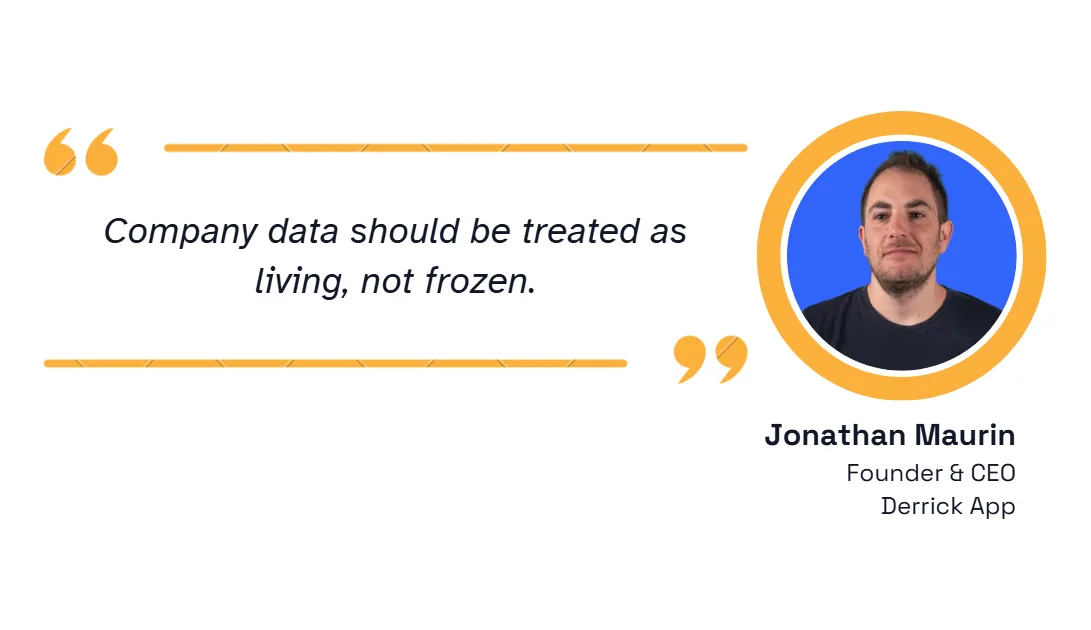
Illustration: Veridion / Source: Derrick App
More frequent refreshes reduce the lag, but they don't eliminate the underlying problem.
A monthly database is still a series of snapshots of something that changes continuously.
A company can announce a funding round, launch a hiring push, close an office, acquire another business, or reorganize a department between refreshes.
When those changes aren't captured quickly, teams can end up prioritizing accounts that have downsized, missing companies that have crossed a growth threshold, or underestimating risk at suppliers whose workforce, ownership, or operating footprint has changed.
What Growth Signals Actually Reveal
If a firmographic profile is a photograph, growth signals are the film reel: a sequence of frames showing which direction a company is actually moving.
Growth signals are observable changes in a company’s behavior, workforce, footprint, funding, technology, or operations that indicate a shift in its trajectory.
Several signals can provide that forward-looking view.
Hiring Velocity
A single job posting tells you that a company wants to fill one position.
Hiring velocity tells you how quickly a company's hiring activity is changing.
You can measure it by tracking the volume of open roles over a rolling period, ideally relative to the company's existing workforce.
A company with 100 open positions isn’t necessarily growing rapidly, since those roles could have been sitting open for months.
A company that increases its openings from 20 to 60 in 30 days presents a very different signal.
The distinction is change versus volume.
Hiring velocity shows whether recruitment is accelerating, holding steady, or slowing down, rather than simply counting open positions.
Where that hiring happens can tell you even more.
Consider a 5,000-person enterprise whose headcount grows by 4%. Overall headcount tells you the company is growing, but not where it's directing that investment.
If most of the new roles are in data engineering, machine learning, and infrastructure, you have a much stronger indication that the company is building out its technology capabilities.
The following hiring patterns can reveal where a company's next phase of investment is taking shape:
Hiring pattern | What it can reveal |
|---|---|
Engineering and data | Investment in technology or data infrastructure |
Sales and business development | Go-to-market expansion |
Regional operations | Geographic expansion |
Specialized roles | Investment in a new capability or strategic priority |
The key is to look for clusters and patterns rather than isolated postings.
A single job opening may be a routine replacement, but a sustained increase in hiring within a specific function suggests that the company is directing resources toward a particular capability.
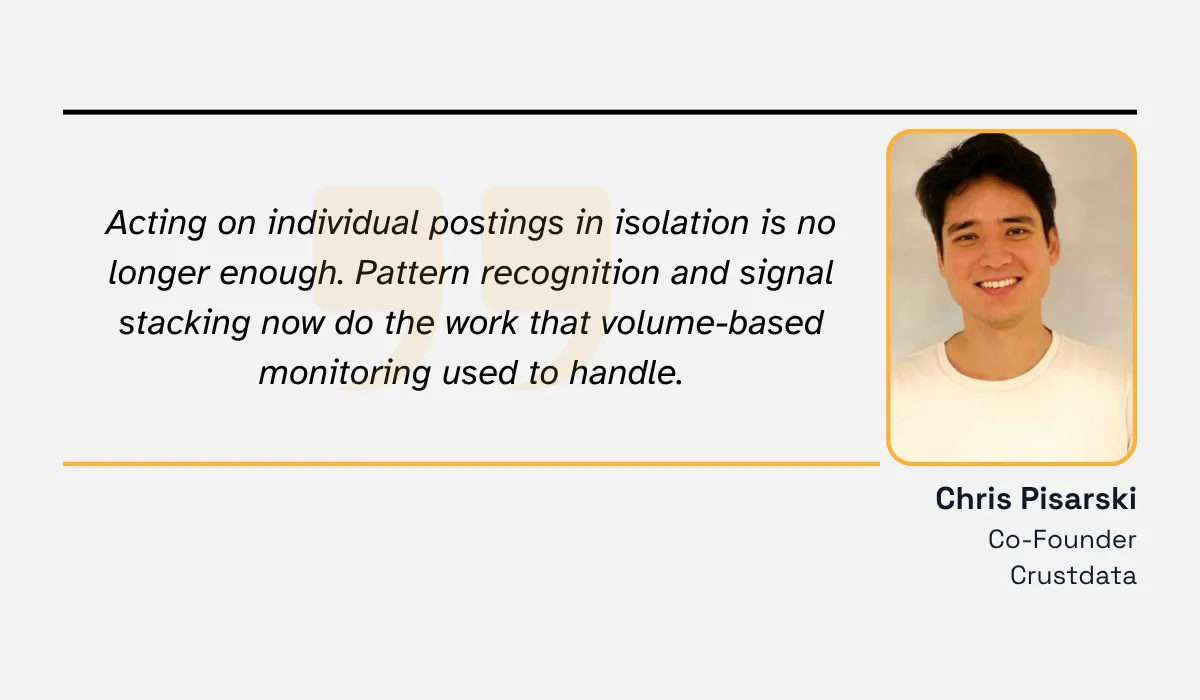
Chris Pisarski, co-founder of Crustdata, a B2B data platform, argues:
Job descriptions add another layer of context.
The technologies, processes, and qualifications they mention can reveal what the company intends to build, implement, or scale.
Hiring velocity is also highly time-sensitive. A hiring wave becomes less useful as a timing signal the longer it sits undetected.
That's why signal platforms commonly analyze hiring activity across rolling 30-, 60-, and 90-day windows.
A company that started hiring aggressively six months ago may still be growing, but the original trigger may no longer represent its immediate priorities.
Geographic Expansion
A new location can reveal something a job posting alone cannot: the company is committing resources to a physical market presence.
Hiring one employee in a new city could simply reflect a remote or distributed workforce.
Opening an office or establishing an operating location typically requires a more deliberate commitment to premises, infrastructure, and local operations.
That makes geographic expansion a useful growth signal.
Entering a new region can create demand for:
- Local vendors
- Localized marketing
- Regulatory and legal support
- Sales and customer support teams
- Additional technology or infrastructure
But not every new address represents expansion.
Companies relocate headquarters, consolidate offices, establish registered addresses, and restructure their legal entities.
In 2024, for example, global marketing and distribution company DKSH announced a new Phnom Penh office, but described it as a relocation of its existing office.

Source: DKSH
By contrast, architecture and engineering firm Pond’s new Cobb County location involved 48 employees, a planned $2 million investment, and ongoing recruitment, with all providing stronger evidence of operational expansion.

Source: SelectCobb
The distinction becomes clearer when a new location appears alongside other expansion signals, such as local hiring, increased sales activity, or new operational investment.
Funding Activity
A funding round is more than a financial milestone.
Its recency can reveal when a company is entering a new spending cycle and reassessing its priorities.
A company that raised $50 million last month gives you a much more timely buying signal than one that raised the same amount three years ago.
The older round may tell you something about the company's size or maturity, but the recent one provides stronger evidence about what it may be preparing to invest in now.
The timing matters because the signal decays.
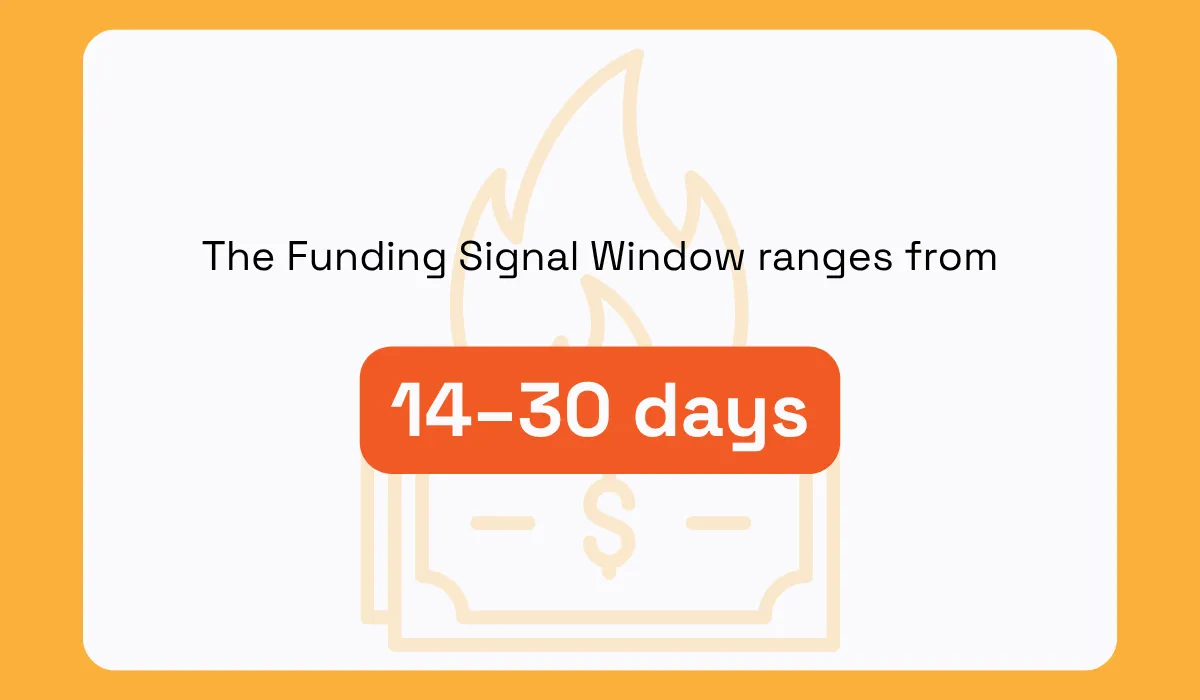
Recent B2B buying-signal research places the most actionable window within the first few weeks after a funding announcement, with recommended response windows ranging from roughly 14 days for mid-market companies to 30 days for enterprises.
Move too early, and the company may still be deciding where the new capital will go.
Move too late, and budgets may already be allocated, vendor shortlists established, or purchasing decisions made.
The funding stage adds another layer of context.
Early-stage funding often supports the initial product, team, and infrastructure, while Series B and later rounds may support scaling operations, entering new markets, strengthening technology infrastructure, or replacing early-stage tools.
These patterns aren't universal.
A funding round tells you that new capital is available; other growth signals help you infer where it's going.
For example, a recently funded company that is also hiring data engineers and expanding into new markets provides a much stronger indication of impending infrastructure and operational needs than a company whose last funding round occurred several years ago.
Executive Leadership Changes
A new executive can change an organization’s priorities faster than a new headcount figure would.
When a company appoints a new CIO, CMO, CFO, VP of Sales, or another decision-making leader, the appointment can signal a mandate to improve performance, replace outdated processes, or build new capabilities.
That can trigger evaluations of existing vendors, technology, and operating processes.
The timing matters too.
The first 30–90 days of a new executive's tenure are often treated as a critical period for assessing the organization and setting priorities.
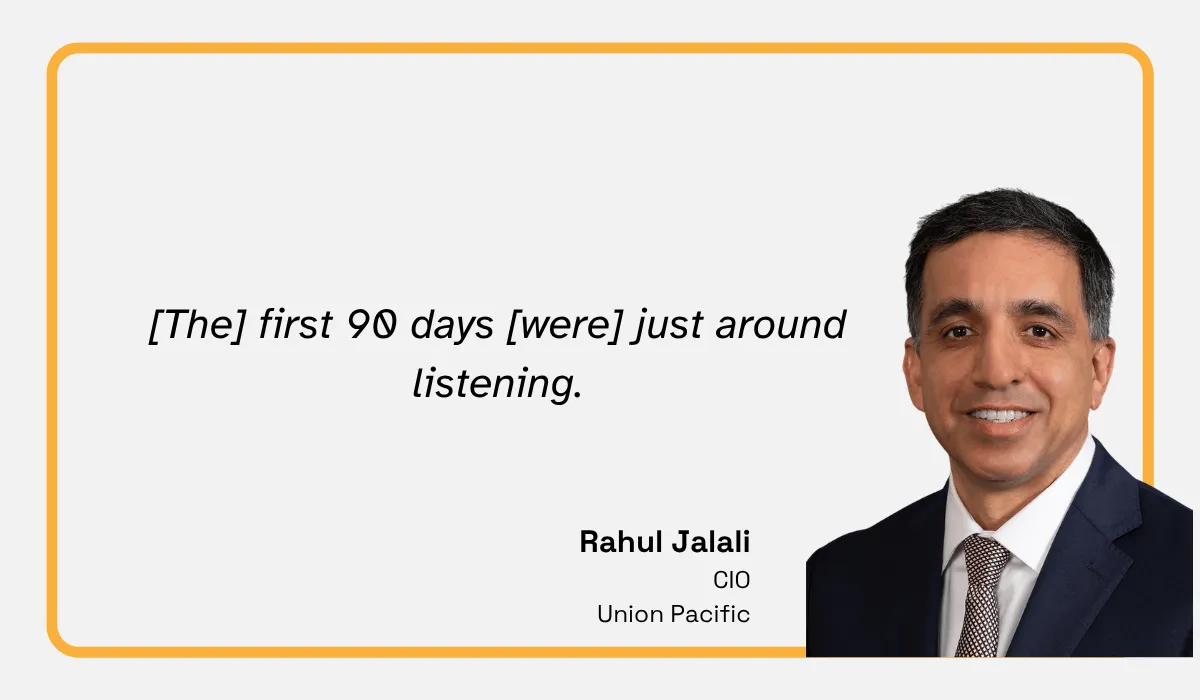
Deloitte’s research on CIO transitions found that the first early months are typically focused on listening, understanding the organization, and assessing its environment.
Rahul Jalali, CIO of Union Pacific, describes his own transition more bluntly:
A leadership change is therefore more actionable when detected close to the appointment than months later.
The executive’s previous experience can provide further context.
If a newly appointed VP of Marketing previously used a particular marketing platform, that vendor may already have credibility with the executive.
Familiar tools and processes can become attractive options when a new leader needs to make changes quickly.
Leadership history can therefore help you move from “something may change” to “this is what may change.”
Product Launches
A new product or service line can reveal a strategic shift that traditional firmographics won’t capture.
When a company expands its offering, it may be entering a new market, targeting a different customer segment, or investing in capabilities it didn’t previously need.
The launch can therefore create new operational requirements alongside the product itself.
Those requirements may include new regulatory or compliance obligations, certifications, supporting technology and infrastructure, or supplier and partner relationships.
For example, when Stripe launched Stripe Tax in 2021, it positioned tax compliance as a growing constraint for businesses expanding across products and jurisdictions.

Source: Stripe
The launch reflected the operational complexity that comes with that expansion.
The signal becomes more informative when it appears alongside other changes.
A new product, accompanied by increased hiring of engineers, product managers, or compliance specialists, can reveal what the new product will require going forward before those needs appear in conventional firmographic data.
Technology Adoption
When a company adopts a new technology platform, the change can reveal an operational shift that its firmographic profile cannot.
A new CRM, cloud platform, analytics stack, or other core system may indicate that the company is scaling an existing operation, replacing an incumbent, or building a new capability.
The signal can be interpreted in three ways:
Opportunity | What the technology change can reveal |
|---|---|
Competitive displacement | The company may be replacing an incumbent platform. |
Integration or complementary tools | The new platform may create demand for adjacent technologies, integrations, data infrastructure, or services. |
Category gap | The technology stack may reveal a capability the company still lacks. |
Technology adoption isn’t automatically a growth signal.
Companies also replace systems to cut costs, consolidate their stack, meet new requirements, or restructure operations.
Context is what makes the signal useful.
A new platform, accompanied by hiring, a product launch, funding, or geographic expansion provides stronger evidence of broader operational change than technology adoption alone.
You can detect these changes through several public sources.
Job postings often mention the platforms and technologies teams are expected to use, while technology detection tools can identify changes in a company’s publicly visible stack.
Company announcements, implementation case studies, and social posts can provide additional confirmation.
High Refresh Frequency: The Key to Consistently Reliable Signals
Growth signals are most valuable when you catch them early.
A hiring surge, new location, or recent funding event can reveal where a company is heading.
But the longer the gap between the event and when your data captures it, the less useful the signal becomes as a timing indicator.
That's different from more stable firmographics.
An industry classification that's a few months old may still work for segmentation. A hiring surge that started three weeks ago is different.
If your data doesn't capture it quickly, the opportunity may already have passed.
For growth signals, refresh frequency determines whether information remains actionable.
The difference is clear across refresh cadences:
Refresh cadence | Implication for growth signals |
|---|---|
Weekly | Better positioned to detect emerging changes |
Monthly | Can introduce several weeks of lag |
Quarterly | More likely to miss short-lived buying or expansion windows |
Annual | Better suited to stable attributes than fast-moving signals |
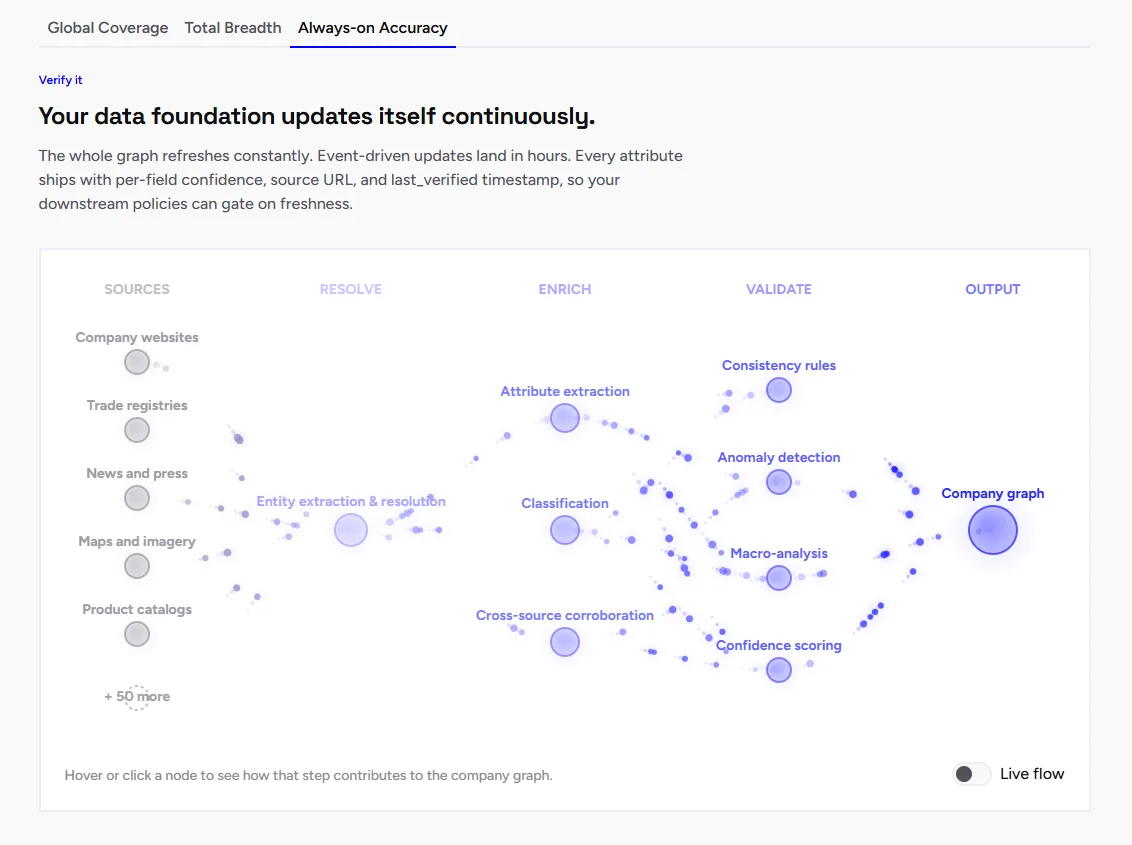
This is the problem Veridion Market Intelligence solution is designed to address.
Veridion refreshes its business data weekly across employee counts, operating locations, and other operational attributes.
Source: Veridion
That means changes captured in its data are more likely to reflect what a company is doing now rather than what a previous quarterly or annual snapshot recorded months ago.
The advantage becomes even clearer when you connect multiple signals.
A new office recorded last quarter provides historical context.
A new office detected this week alongside accelerating hiring and a recent product launch provides a much stronger view of current momentum.
The same principle applies beyond sales:
- Sales teams can act on emerging account signals while buying priorities are still forming.
- Underwriting and risk teams can incorporate recent changes into assessments of a company's operational trajectory.
- Procurement teams can identify changes in supplier locations, capacity, or operating footprint sooner.
A growth signal can tell you what is changing. Refresh frequency determines how close you are to that change when you see it.
Conclusion
Traditional firmographics give you the foundation for defining markets, segmenting accounts, and assessing fit.
But they only tell you where a company stands, not where it's heading.
Growth signals close the gap.
Hiring velocity, geographic expansion, funding activity, leadership changes, product launches, and technology adoption reveal direction and momentum rather than a single frozen frame.
The real value comes from connecting these signals and catching them while they’re still fresh.
The goal isn't simply to know where a company is today.
It's to recognize where it's heading while there's still time to act.
Articles
Discuss how these trends affect your organization.
Our analysts are available for a short call. Bring a specific question and we will ground it in the data.
Insights
Keep reading
More analysis, research, and outcomes grounded in live company intelligence.
Looking for a Global Data Collection Partner? These Companies are Worth Considering
Looking for a global data collection partner? This guide will introduce companies worth considering and explain what sets them apart.
Which Online Business Data Providers Stand Out in Today's Market?
This article will highlight online business data providers that businesses trust for accurate company information and actionable insights.
A Closer Look at the Top B2B Data Enrichment Companies Businesses Rely On
Struggling to find reliable firmographic data providers? Uncover the top B2B data enrichment companies that businesses trust to fuel growth.