Insights / Articles
How the 'Activity Extractor' Finds Hidden Gems in Open-Ended Niches
Struggling with niche market research tools? Uncover hidden companies with poor SEO using the 'Activity Extractor' and find untapped opportunities.

- Google ranks companies by SEO spend, so skilled niche suppliers stay buried.
- Keyword search fails when buyers and suppliers describe one niche in different words.
- AI that reads full websites turns hidden specialists into searchable, comparable data.
Somewhere out there is the perfect supplier for your hardest sourcing brief. You will never find it on Google.
Search engines rank pages by SEO strength, and many brilliant specialists have almost none. So the deeper your niche, the worse your results get.
In this article, you will learn why keyword search fails niche discovery. You will also see how AI that reads websites surfaces the companies Google buries.
Why Google Isn't Built for Niche Company Discovery
Google feels like the natural starting point for any supplier search. For niche work, though, its results can mislead you badly. The engine was designed to rank popular pages, and popularity is a poor proxy for capability.
SEO strategist Linda Handley sees this gap constantly in manufacturing. Skilled companies, she warns, can end up “essentially invisible to search engines.”
Their work is excellent, yet buyers never get to see it. Two flaws in search explain why, and the first one is about money.
SEO Investment, Not Quality, Determines Rankings
Search rankings reward signals like domain authority, backlinks, and content volume. Each one tracks marketing investment far more than production skill. A superb supplier with a neglected website scores near zero on all of them.
Domain authority mainly reflects a site's age, inbound links, and traffic. None of it measures the quality of the work itself. The metric rewards visibility, and visibility is something companies buy.
Small specialists rarely buy it, since their attention goes to the shop floor and to existing customers. Meanwhile, rivals with bigger marketing budgets claim page one.
Buyers make the problem worse without meaning to. Few ever scroll past page one of the results. A stronger maker on page three never even gets considered.
Paid placements squeeze organic results further down. The top of the page often belongs to whoever bids highest. Genuine relevance gets pushed toward the fold.
The neglect compounds over time. A quiet site attracts fewer inquiries, which leaves even less reason to invest in it. So the most capable firms often have the weakest online presence.
Handley shares a case that shows the stakes. A Pennsylvania manufacturer she profiled had strong products, a skilled team, and a debt-free operation. Its domain authority stood at 2 out of 100.
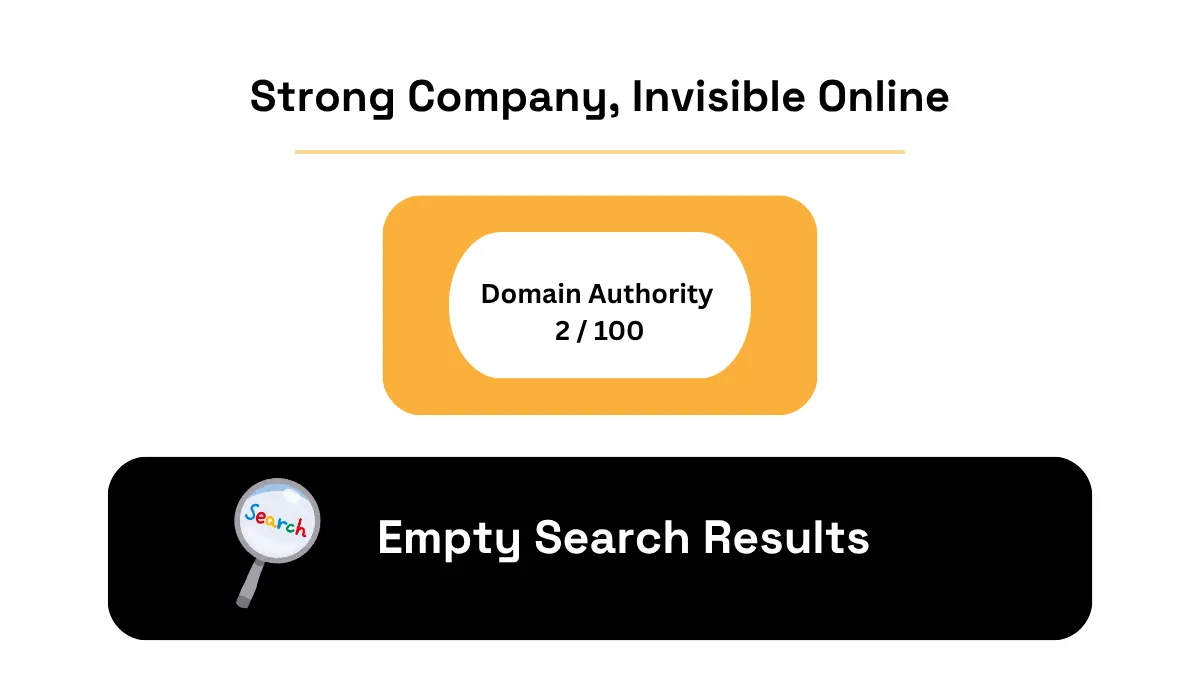
Illustration: Veridion / Source: Linda Handley
To search engines, the company barely existed. Buyers typed exact phrases its site never used, so Google could not connect them. Decades of capability counted for nothing on the results page.
Technical issues quietly deepen the damage. Many small-manufacturer sites carry crawl errors that block search engines entirely. A firm can vanish for reasons unrelated to its work.
The fix required clarity, and no extra ad spend. Once the site described its real capabilities, visibility followed. Still, most hidden specialists never get that makeover.
The pattern holds far beyond one state or industry. Handley notes that many owners recognize themselves in the story, yet quality alone never earns the click.
Multiply that one factory across an entire category. For every narrow requirement, strong candidates hide beyond page one. Budget explains part of the problem, and vocabulary explains the rest.
Keyword-Based Search Doesn't Match How Niches Are Described
Keyword search works only when you guess the exact words a supplier uses. In niche markets, the guess usually fails. One firm says "micro-molding" while another calls the same work "precision tooling."
You may not even know the standard term yourself. Buyers entering a new category guess like everyone else. Both sides describe one capability in two different languages.
Picture yourself sourcing a coating that resists saltwater corrosion, where one vendor labels it marine-grade passivation. Another skips the process name and only lists the industries it serves.
New and blended niches raise the difficulty further. A company mixing two disciplines may coin its own vocabulary. You cannot search for a term the market has not settled on yet.
A query built on last year's vocabulary slowly falls out of sync. The market keeps renaming itself as it grows, so yesterday's search terms stop matching today's suppliers.
A query built on last year's vocabulary slowly falls out of sync. The market keeps renaming itself as it grows. Yesterday's search terms stop matching today's suppliers.
The numbers confirm how scattered demand gets. Ahrefs found that about 93% of keywords get fewer than ten searches a month. SEO specialists call this pattern the long tail.
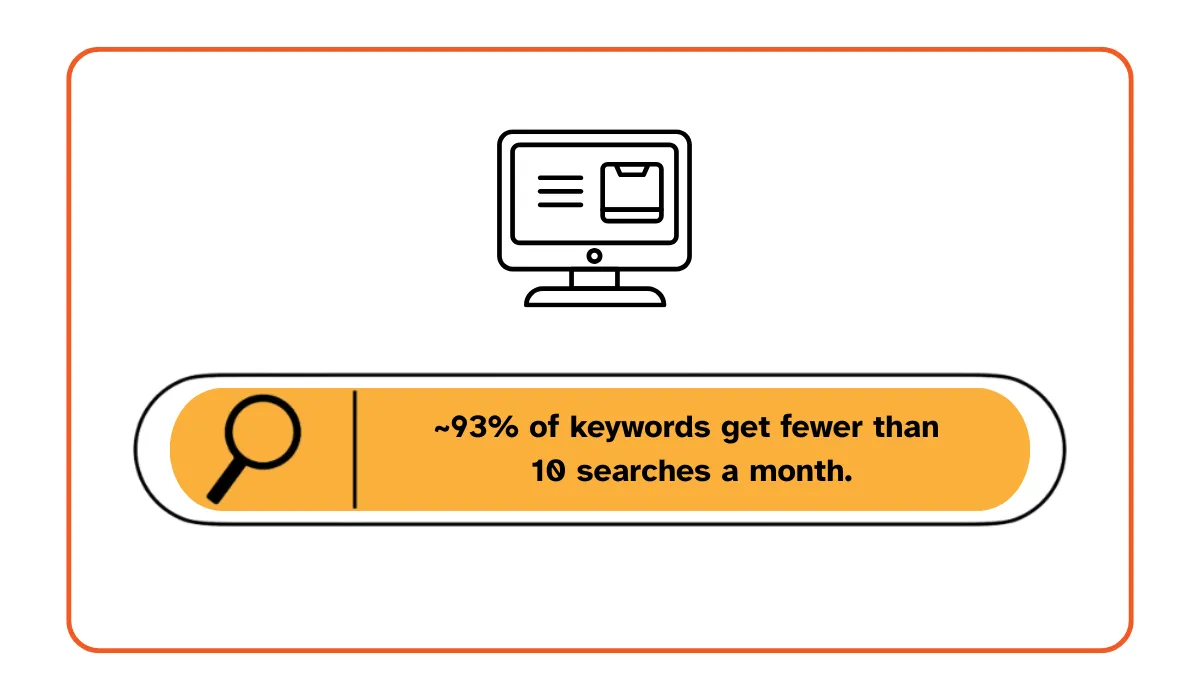
Niche sourcing terms live deep inside this tail. Most never repeat often enough to register as a pattern. A term can show zero volume for months, then spike when a new standard lands.
Guessing your way through this tail wastes hours. Each material, process, and region becomes its own rare query. Stacking filters only buries the right supplier deeper.
Google offers no field for capability, certification, or location either. Every requirement gets crammed into one small search box.
Skilled searchers cope with synonyms, operators, and trade directories. The tricks help at the margins, yet they still rest on guessing. A vendor with unusual wording stays out of reach.
Regional wording adds another layer of friction, as British and American terms differ for the same part. A foreign supplier may not describe its work in English at all.
The cost goes beyond lost time. Teams that cannot find niche suppliers keep reusing one short list, and supply chains stay narrow. A method that reads content instead of matching words can break the cycle.
How AI Reads Unstructured Web Content Instead
A better approach flips the question entirely. Instead of asking how findable a page is, an activity extractor asks what the page says. It reads the content, structures it, and turns any website into searchable data.
Reading Full Pages, Not Just Matching Keywords
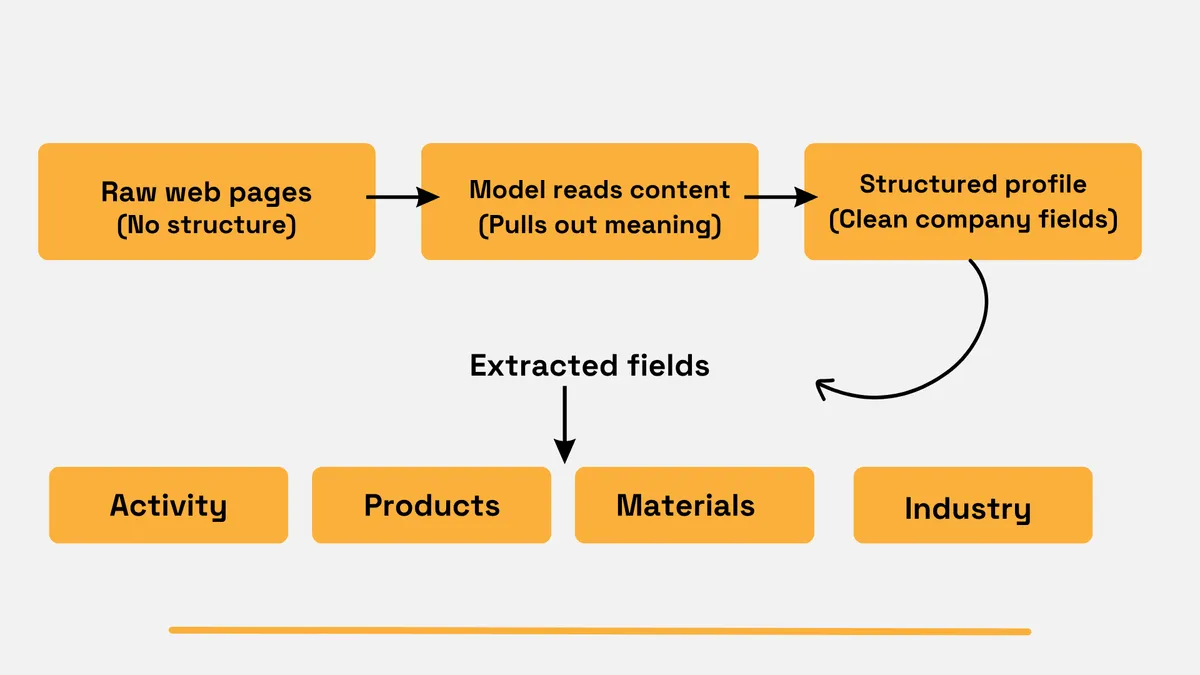
A large language model can read a company's pages much like a person would. It scans the homepage, product listings, and service descriptions for meaning. What comes out is a structured record of what the business does.
Structured means the messy text becomes tidy fields. Activities, products, materials, and served industries each get a slot. A detail buried on page four becomes something you can filter.
The same extraction methodology applies to every site, whatever its shape. Real pages are uneven, cluttered, and inconsistently formatted. A model reads past the mess to the meaning underneath.
Source: Veridion
Language stops being a barrier during extraction, too. A model can read Mandarin, German, or Portuguese pages with equal ease. The output lands in one consistent format either way.
One pass can capture dozens of details at once. Products, materials, certifications, and locations come out together. A single read replaces a stack of manual lookups.
The reading goes beyond plain paragraphs, since tables, captions, and spec sheets all carry extractable meaning. Even a detail hidden in a product PDF reaches the record.
Reading for meaning also untangles mismatched vocabulary. The model recognizes that micro-molding and precision tooling can describe one process. Both map onto a shared category you can search.
Context clues get captured as well, and a medical case study hints at regulated-industry experience. A certification list shows exactly which standards a supplier meets.
Because the model reads content, SEO stops deciding the outcome. A plain website with zero optimization still yields clean data. Poor rankings no longer hide what a company can do.
Each extracted field can carry its evidence, too. A record can show its source page and a confidence score. You can trust the match and still check the proof behind it.
Websites change, so the reading never stops. When a page updates, the model reads it again and refreshes the record. Your view keeps pace with the company itself.
Scale multiplies the value of every read. No human team could read millions of supplier pages with one consistent lens. A model can, and it never changes its standards.
Consistency is the quiet superpower here. Every company comes back in the same shape, field for field. Once records line up, search itself starts to change.
Matching Activity Descriptions, Not Domain Authority
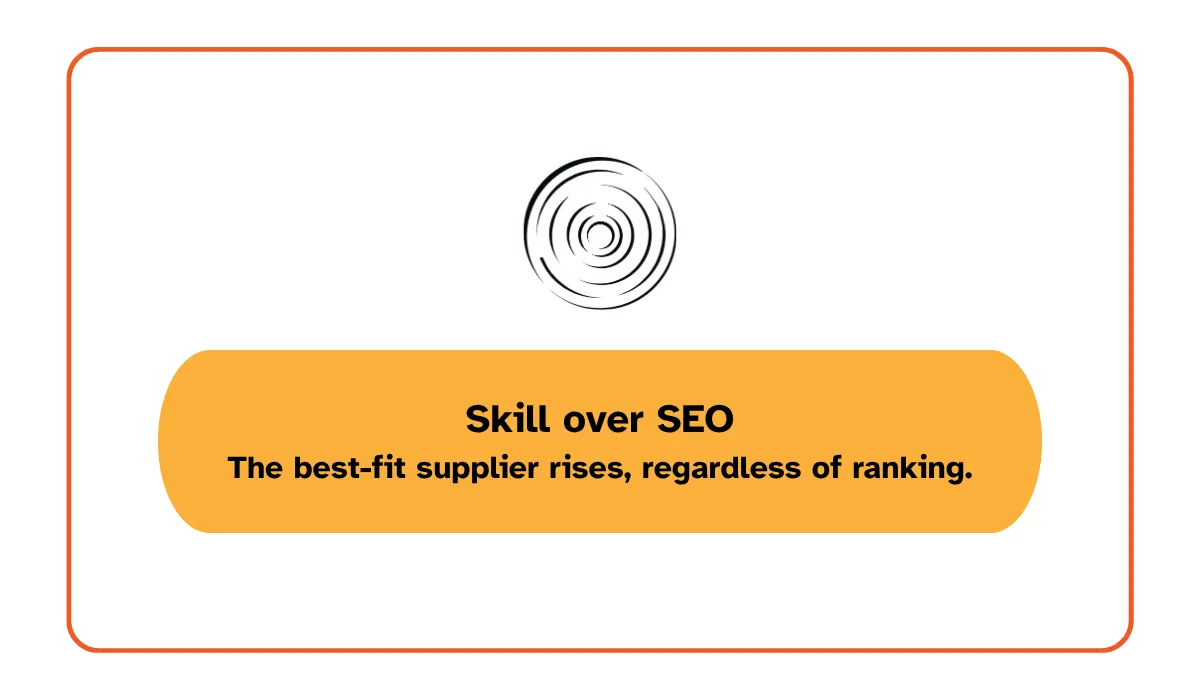
Structured records transform how you query. You search by what a company does, using activity, material, or capability. Domain authority never enters the ranking.
Source: Veridion
The shift sounds small, yet it changes everything. You describe the work you need in plain terms. The best match rises because it fits, never because it ranks.
Keyword search matches strings on a page, while activity search matches meaning the model has already extracted. Two firms describing one job in different words now both appear.
Precise filters stack cleanly on top. Ask for a plastics maker serving medical clients in a chosen region. The list narrows on capability instead of on marketing budgets.
Results can also rank by depth of fit. A supplier whose core business matches your ask rises above a passing mention. So the shortlist starts strong instead of noisy.
Refining costs seconds instead of hours. Change one filter and a fresh, fitting set appears. Exclusions work the same way, so unwanted materials or markets drop out instantly.
Extracted activities also map onto standard industry codes like NAICS or NACE. Both are classification systems many industries use to sort companies by work type. The formal code and the plain description live side by side.
More than one team gains from this setup. A sourcing manager builds a shortlist by capability rather than brand recall. An underwriter can vet an unfamiliar firm by what its site reveals.
The wider net also restores fairness, as a low-authority website no longer sinks a good supplier. And the real payoff arrives when the reading covers the whole web.
Finding the Companies Google Misses
Reading one website is useful, and reading the whole web is decisive. Veridion's platform runs this activity extraction continuously across the open internet. The output is structured, current company data built for exactly this kind of discovery.
Coverage reaches deep into the long tail of small and private firms. A supplier with no SEO and a thin web presence still lands in the data. You can find it by activity the moment its work goes online.
Registry-first databases miss much of this tail, since they lean on filings and self-reported listings. Reading the open web catches firms those records never mention.
B2B marketplaces have the same blind spot. They only show firms that registered and paid to appear. The open web holds far more companies than any curated list.
Source: Veridion
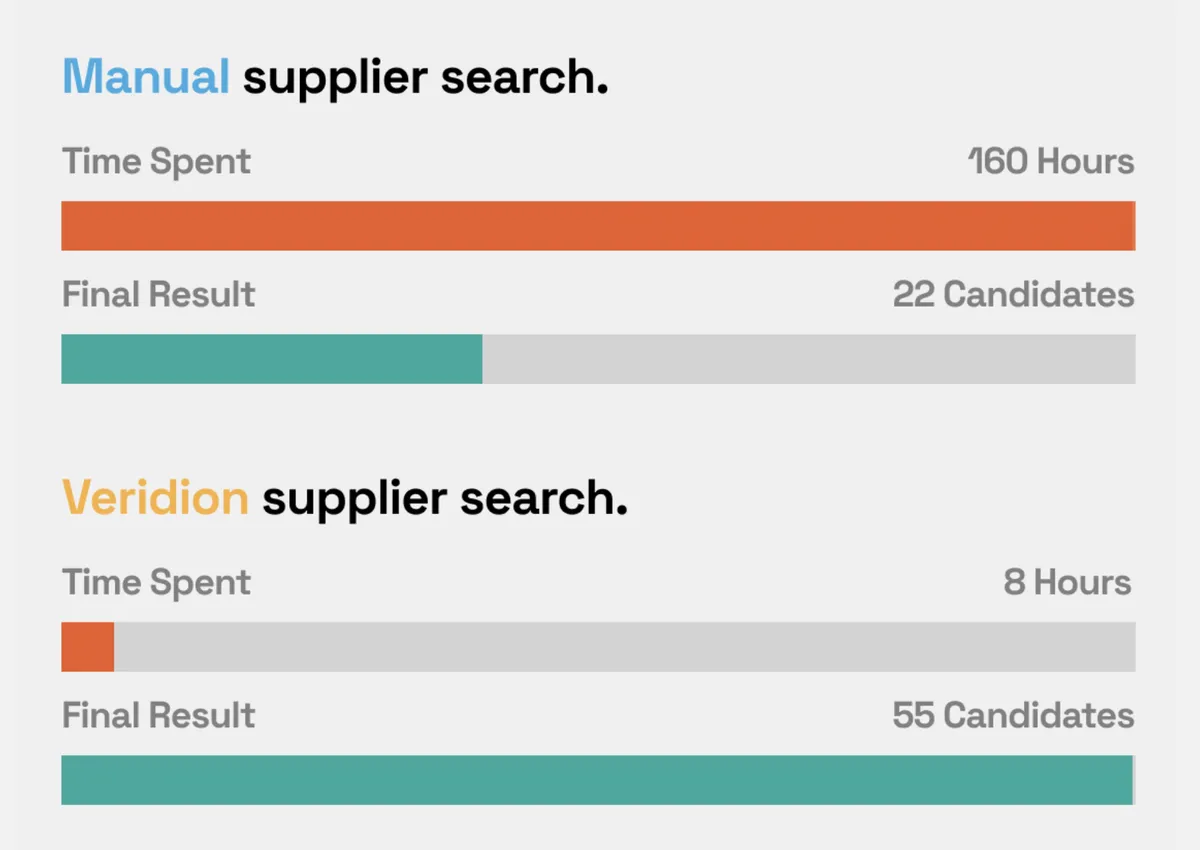
The gap shows up in the hours, too. A manual search can consume a working month and still return a thin shortlist. Activity-based search returns a broader one in a fraction of the time.
The long tail is where advantage hides. Big names are easy for you and your rivals to find. The edge lies in the specialist nobody else has spotted.
Finding what rivals cannot find becomes a compounding edge. While competitors recycle the same visible vendors, you reach the overlooked ones. The gain repeats across every category you source.
Borders fade from the equation as well. A specialist abroad appears the moment its site gets read. Language and distance no longer decide who you can find.
Zoom out, and you can map an entire category at once. You see where suppliers cluster and where coverage runs thin. A search bar never shows that shape, since it answers one query at a time.
Freshness keeps the picture honest, because companies pivot and launch products faster than filings record. Continuous reading captures those changes within days instead of years.
The data also flows into market intelligence tools your teams already run. Procurement, risk, and research can pull from one shared source. A supplier surfaced for sourcing gets vetted for risk in the same view.
None of it replaces your judgment, but it hands you a wider, fresher pool to judge. Your time goes toward weighing fit instead of hunting for names.
Conclusion
Niche discovery breaks when you rely on an engine built for popularity.
The supplier you need often exists, capable and ready, yet buried under better-optimized pages. Reading what companies do, then structuring it, flips those odds in your favor.
So describe the capability you need and let the closest match rise.
The hidden gems in your category are one activity-based query away.
Articles
Discuss how these trends affect your organization.
Our analysts are available for a short call. Bring a specific question and we will ground it in the data.
Insights
Keep reading
More analysis, research, and outcomes grounded in live company intelligence.
Market Intelligence: Use Cases Across Departments
Want to make better decisions across departments? Learn how market intelligence use cases apply to your entire organization.
5 Types of Market Intelligence You Need to Know About
Explore five different types of market intelligence that can shape your competitive edge. Find out which ones your team should prioritize.
How to Build a Strong Market Intelligence Strategy
Learn how to build a strong market intelligence strategy that helps you track trends, understand competitors, and make smarter decisions.