Insights / Articles
Choosing a KYB Data Enrichment Provider: The Platforms Worth Knowing
Tired of unreliable KYB data? Find the best KYB data providers to streamline your onboarding and compliance. Discover the platforms.

The quality of your Know Your Business (KYB) process will be directly proportional to the quality of the data it relies on.
Garbage in, garbage out: bad data leads to long onboarding times, incorrect rejections, and backlogs on your analysts' desks.
Pick the right data enrichment provider, though, and those problems diminish.
This guide compares five platforms worth knowing so you can match the right one to your verification workload, regions, and risk appetite.
Veridion
If your team needs to enrich and verify company-level data across global markets, Veridion is built for that job.
The platform focuses on fresh company intelligence for enterprise teams that need to understand what a business does, where it operates, and how it changes over time.
Source: Veridion
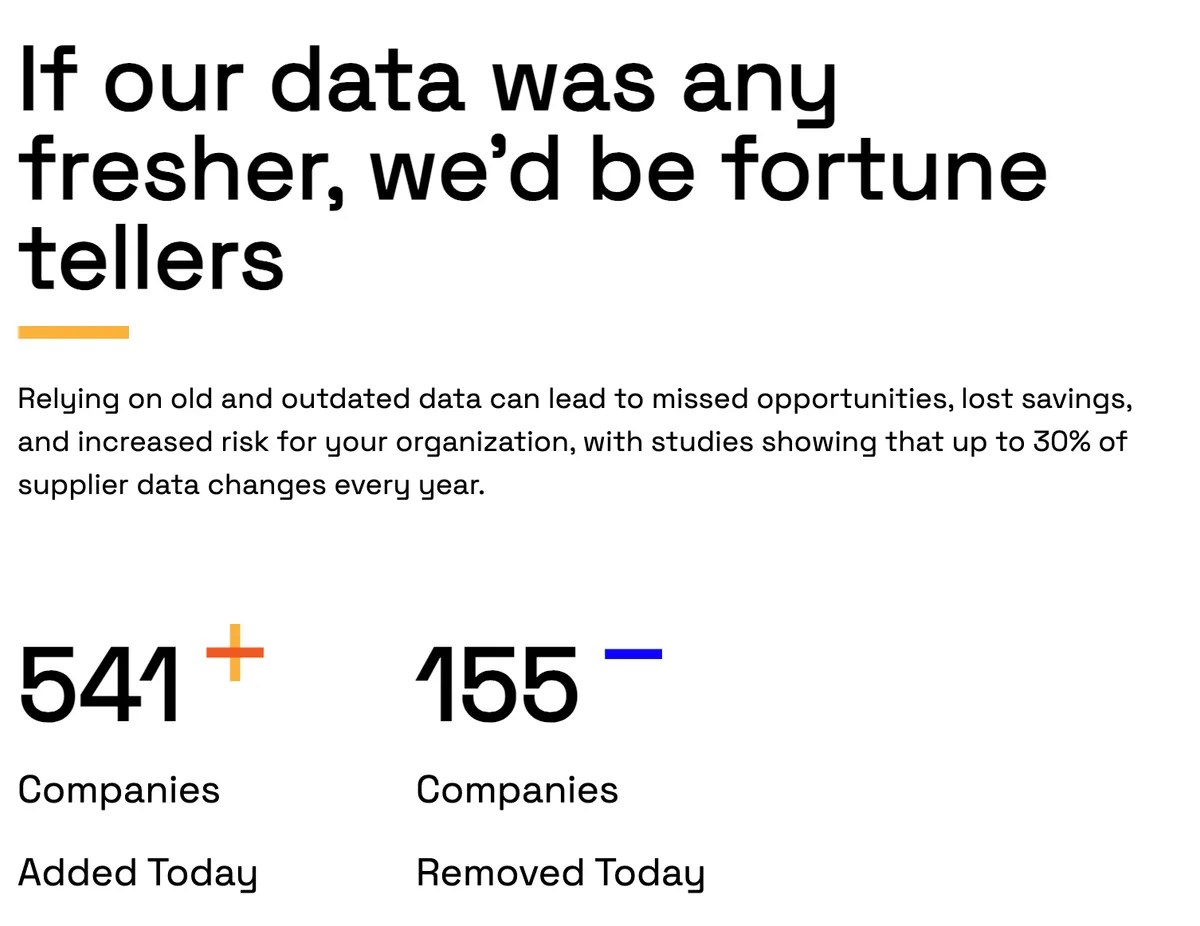
Veridion refreshes company profiles weekly, and its validation process delivers over 99.7% accuracy.
That matters when your KYB workflow depends on current business activity.
A registry can confirm that a company exists, but it may not indicate whether it is a manufacturer, distributor, reseller, contractor, software vendor, or local service provider.
Veridion is strongest on company-level enrichment.
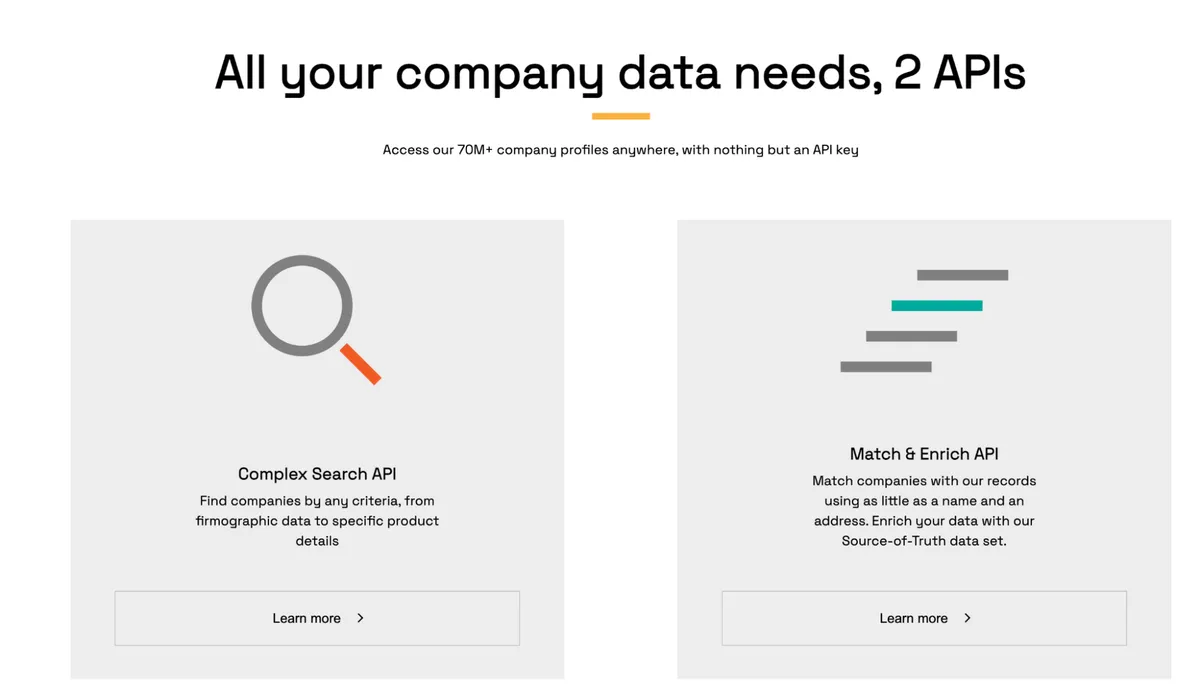
Its Match & Enrich API covers more than 693M companies across 166M physical addresses, returning structured profiles with up to 461 attributes per record. Those attributes include:
- Firmographics
- Employee count
- Revenue estimates
- Industry classifications across NAICS, SIC, ISIC, NACE, and IBC insurance codes
- Location intelligence
- Corporate hierarchies
- Product portfolio
- ESG signals
That deep company enrichment gives data, risk, procurement, and insurance teams a precise profile to work with.
Source: Veridion
Veridion is the strongest option when your workflow needs a more comprehensive business profile, not just a registry extract.
Unlike Kyckr (which we discuss next), Veridion is not a registry-retrieval tool. It is an enrichment layer.
You can trigger a match with as few as two inputs, like a company name and address, and get a full profile back in seconds.
Each match produces a confidence score that helps you determine a cut-off point for businesses that are to be accepted automatically, while others can be routed for review with an indication of why.
The system uses registration records, website information, and business activity data to verify that the business is genuine and active.
This added verification layer filters out the "ghost" companies that appear in registries but never trade.
That matters if your team needs to know what a business does, not only whether it exists.
For example:
- an insurer may need to classify a business by products and activities
- a procurement team may need to find suppliers based on capabilities, location, and services
- a risk team may need to monitor changes across a large commercial portfolio
Veridion helps you do all that.
Additionally, you can use Veridion's enriched business attributes to classify suppliers, improve commercial underwriting, support market mapping, or strengthen master data management.
If your team is trying to understand real-world business activity, generic industry codes are often too broad. Product and service-level data give you more context.
If your KYB workflow requires a source of truth for filings or built-in AML monitoring capabilities, you will need to complement Veridion with another tool dedicated to these functions.
Veridion will work well if your KYB process requires depth and constant updates.
This is the provider to start with if you perform entity screening and want more details about each business entity.
Kyckr
Kyckr is designed for KYB operations that require registry data, auditable evidence, and beneficial ownership processes.
It provides you with company information that your regulator can consider authoritative.
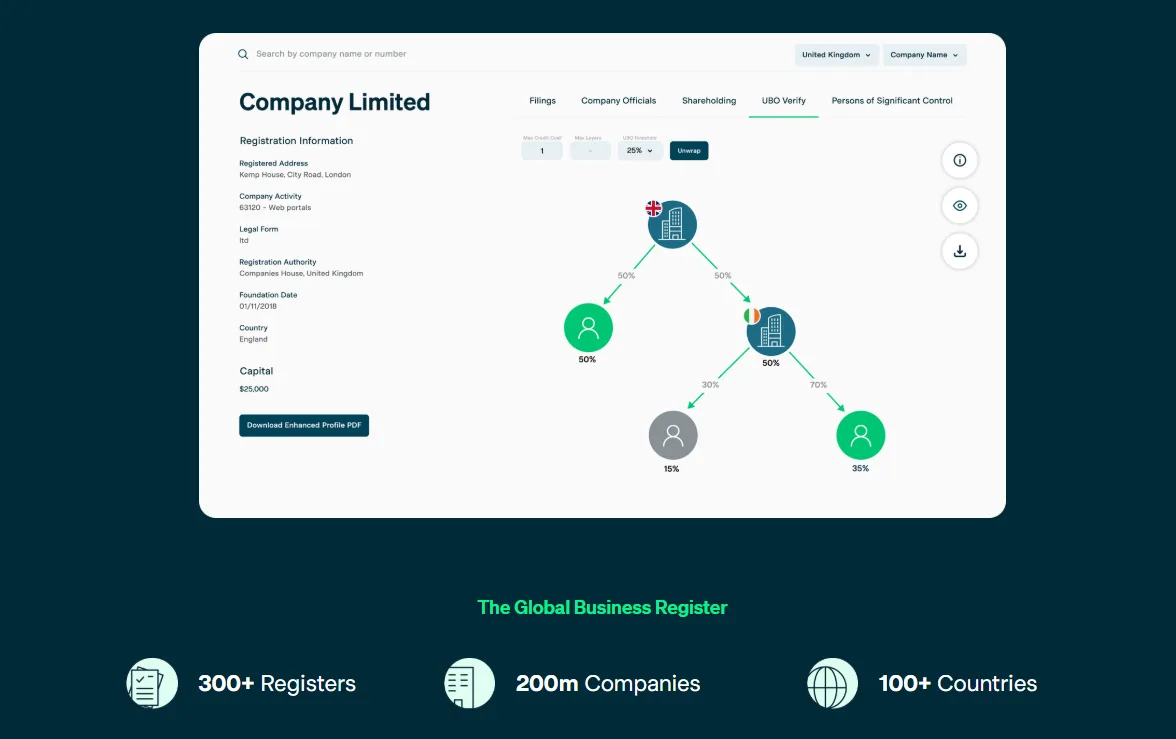
This tool connects directly to more than 300 official company registers across 100-plus countries, covering roughly 200 million companies, and it retrieves and normalizes that data live at the point of request.
Source: Kyckr
Kyckr available profile elements include:
- Registration information
- Registered address
- Legal form
- Legal status
- Company activity
- Officials, shareholders
- Share capital structure
- Ultimate beneficial owner declarations
One thing that makes Kyckr stand out from other providers on this list is that the platform pulls data directly from government registries rather than a cached copy.
Every record arrives timestamped and tied to a named primary source.
In a regulated workflow, it is crucial to trace the provenance of each field. The legal name, address, director, shareholder, or status will become more valuable if an analyst can trace it back to the registry record.
When an auditor asks how you verified an entity, you can point to the official filing rather than a vendor's interpretation.
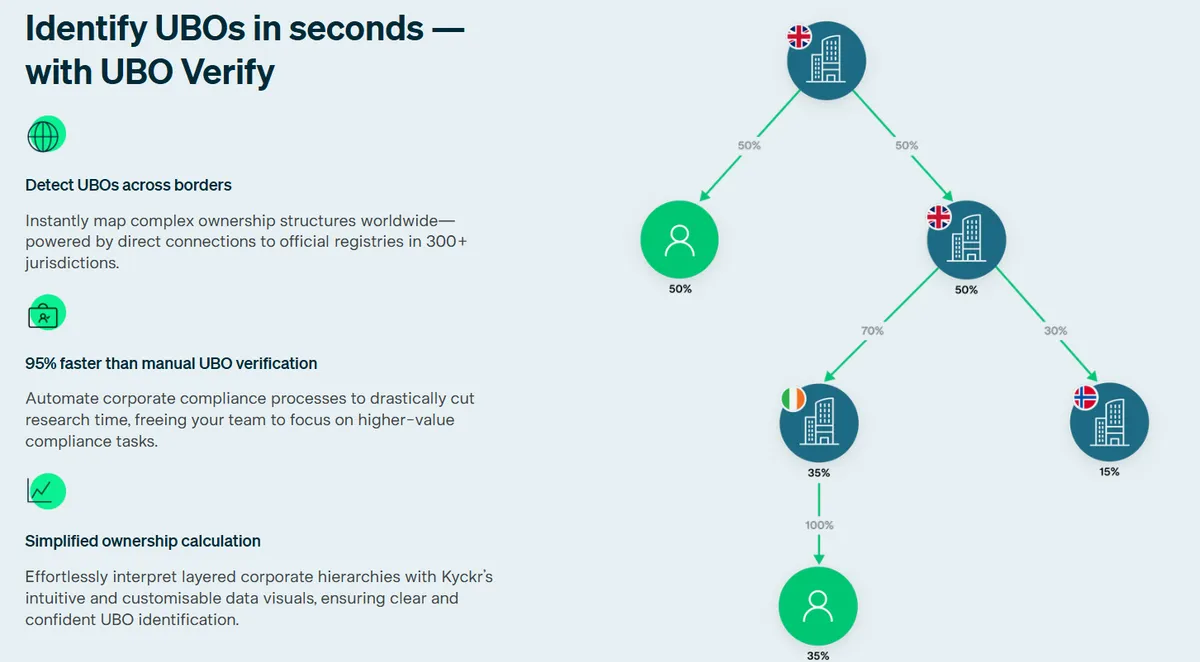
Kyckr also resolves ultimate beneficial owners across borders, visualizes ownership structures, and reports an 80% reduction in business verification time.
It also claims to have UBO verification that is up to 95% faster than manual research, where shareholding data is available.
Source: Kyckr
This is where Kyckr and Veridion diverge most clearly.
Veridion enriches data with modeled and extracted attributes on a massive scale, while Kyckr fetches the authoritative document on demand.
For high-stakes onboarding involving offshore jurisdictions like the Cayman Islands or the British Virgin Islands, Kyckr's live-registry model provides a paper trail you can defend.
For broad operational enrichment across millions of companies at once, registry-by-registry retrieval feels narrow by comparison.
Some organizations conduct both processes: enrichment for context and registry data for proof.
Kyckr falls short compared with Veridion because it gives you exactly what is in the registry. If the jurisdiction registry contains poor-quality information, you will receive poor-quality information. It lacks the operational, product, and location data layers that an enrichment platform like Veridion provides.
Additionally, it offers limited screening coverage. Unlike most others on this list, Kyckr does not currently provide AML screening for PEPs, sanctions, or adverse media, although it can connect customers with partners.
So, you may need a separate screening provider if your KYB process requires those checks inside the same workflow.
Middesk
Middesk is one of the most automated KYB platforms for the US market.
The platform cross-references more than 400 government and authoritative sources, aggregating and continuously refreshing them into a single record per business.
It handles verification, fraud detection, registration, and monitoring in a single system.
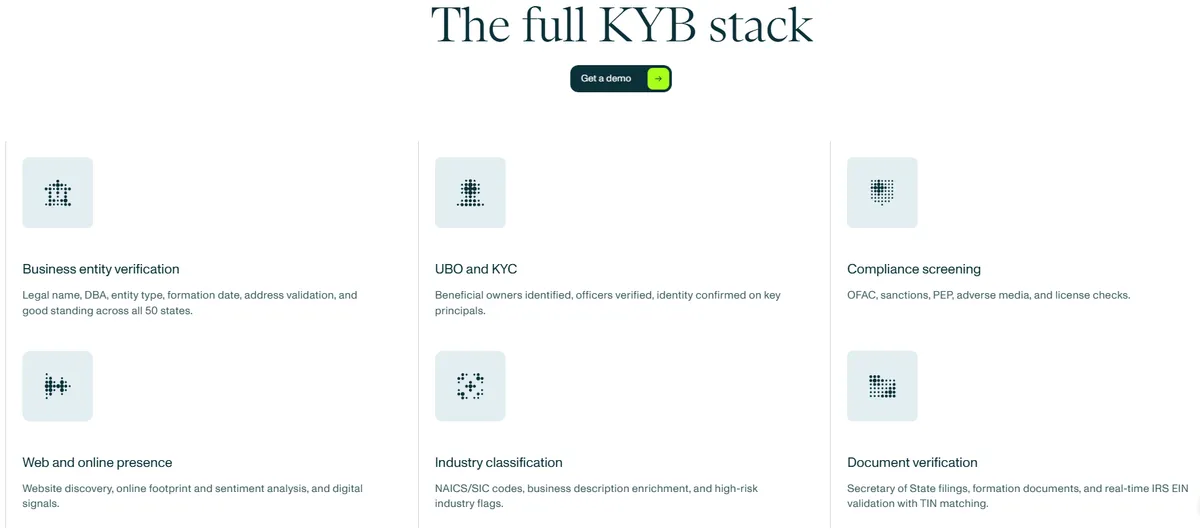
It also offers business entity verification, UBO and KYC, compliance screening, web and online presence, industry classification, and high-risk industry checks.
Source: Middesk
Other entities include:
- Beneficial owner identification
- Officer verification
- Identity confirmation for key principals
- OFAC
- Sanctions
- PEP
- Adverse media
- License checks
- Website discovery
- NAICS and SIC codes
- High-risk industry flags
- Secretary of State filings
- Formation documents
- Real-time IRS EIN validation with TIN matching
That depth of data matters because US business verification often fails to close gaps across state records, tax IDs, addresses, owners, licenses, websites, and screening data.
If you run a fintech, marketplace, payroll platform, lender, or B2B SaaS product, you may need to verify thousands of businesses quickly.
Your problem is not only data collection: it is queue size, approval speed, missing evidence, and analyst time.
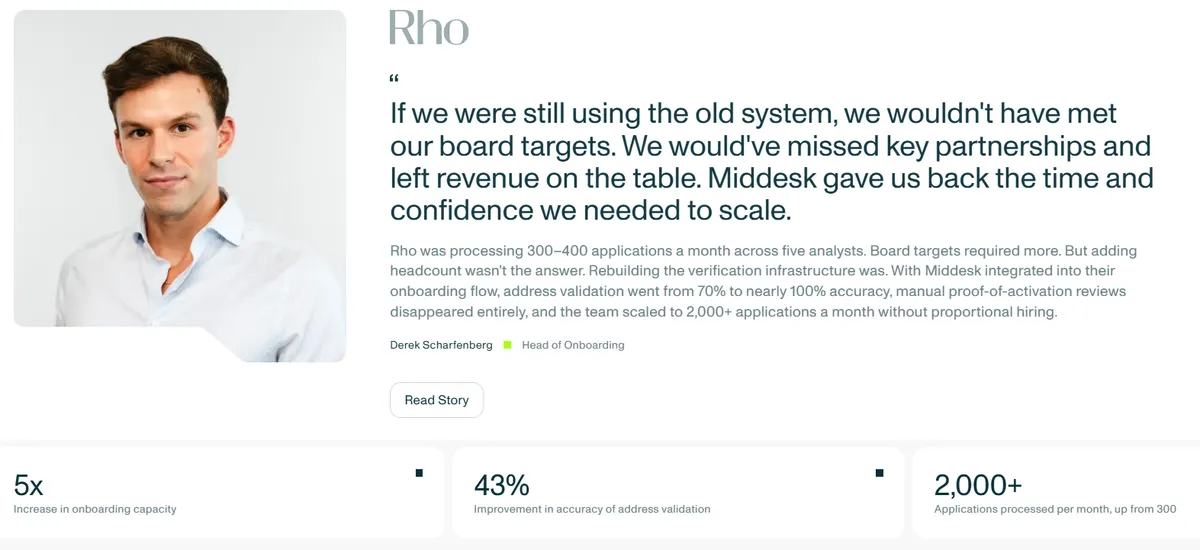
Middesk states that 70% of its verifications resolve without analyst intervention, citing customer results including a 5x increase in onboarding capacity and more than 2,000 applications processed per month, up from 300.
Source: Middesk
These numbers point to Middesk's aim of turning business verification into an operational workflow rather than an additional research task for your teams.
The feature that most distinguishes Middesk is decisioning, not just data.
As a result, it uses customized machine learning algorithms and AI bots to solve cases rather than just score them, ensuring that exceptions forwarded to a real person are valid.
What sets Middesk apart from other services like Veridion and Kyckr is its geographic specialization. Because its information comes from American state and government organizations, it is particularly effective at checking US business and merchant risks, connecting to Secretary of State information, TINs, and watchlists required by CIP and CDD regulations.
While Veridion covers the entire globe, Middesk specializes in American information, which can be beneficial if you deal mainly with US companies.
But if you onboard businesses in Europe, Asia, or emerging markets, you will need to supplement Middesk with a provider that reaches beyond American registries.
Middesk is ideal for US-based fintechs, lenders, and marketplaces that require automated, straight-through business verification with a decisioning layer.
InfobelPRO
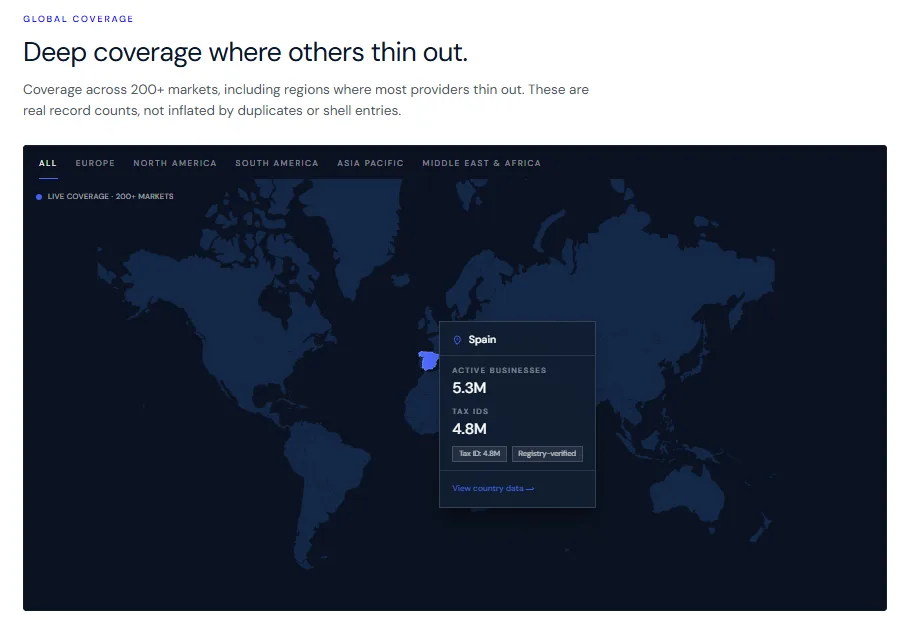
InfobelPRO is built for teams that need broad company and location data through APIs.
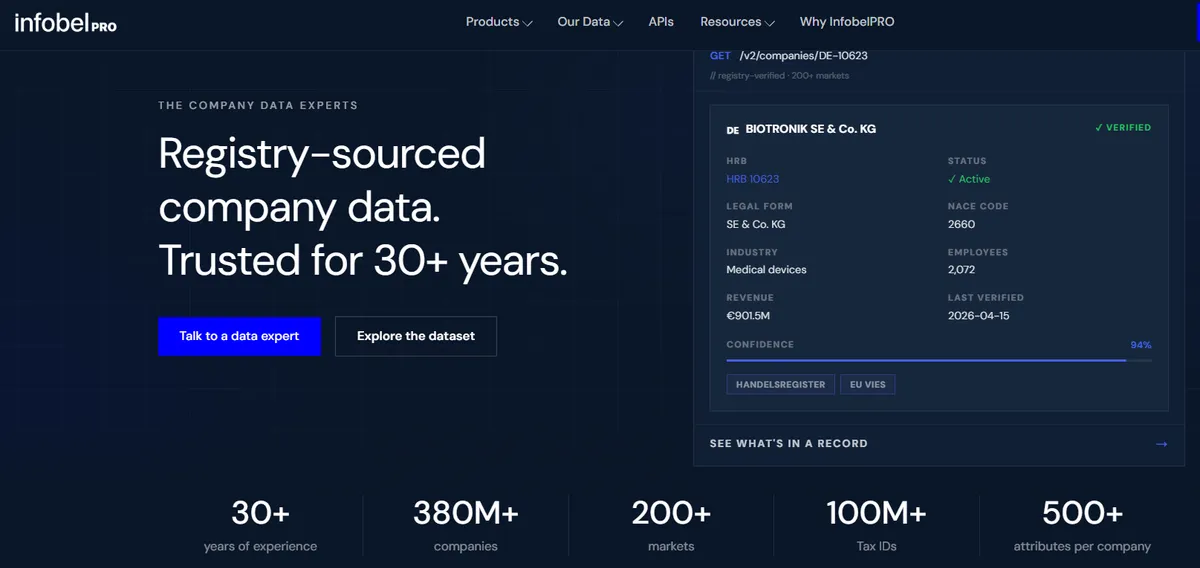
The provider maintains data on more than 380 million companies, with over 500 attributes drawn from more than 1,100 data sources, delivered through flat files, APIs, or a search engine.
Source: InfobelPRO
The company data endpoint supports lookup by company name, registration number, VAT ID, or domain. It returns legal identity, classification, address, contacts, financials, and employee data.
VAT validation is also applicable for KYB and tax purposes.
InfobelPRO verifies the VAT number against tax authority databases and provides a response that includes the registration information, the company name, the timestamp, and the source.
That breadth makes InfobelPRO useful for large-scale enrichment projects, but its location-first value is the stronger reason to review it.
Many enterprise workflows need to know a lot more than just what a business is.
They need to know where that business operates, which site belongs to which company, and how branch, store, office, or point-of-interest data should map into internal systems.
That matters in local search, territory planning, routing, market mapping, vendor onboarding, and customer data management.
A bank may need to verify a merchant's operating location. A marketplace may need to map service providers by coverage area. A logistics or field sales team may need clean addresses and business categories before assigning territories.
InfobelPRO's company and location data can support those use cases through a consistent API.
Source: InfobelPRO
While Middesk auto-resolves a KYB decision, and Kyckr returns a legally authoritative filing, InfobelPRO is closer to a broad firmographic and location dataset that you can feed into the checks you already run.
The tool also serves purposes such as POI, marketing, and risk, making it more diverse than just KYB. It can be used as an additional compliance tool rather than being a standalone verification engine.
Where it falls short compared to Middesk or Kyckr is that it lacks a native decisioning layer and does not fetch live registry documents, so you supply the verification logic and the audit trail yourself.
InfobelPRO is worth considering when your main problem is scalable company enrichment across many markets.
It is especially relevant for data engineering, revenue operations, customer data platforms, and location intelligence teams that need broad coverage through APIs.
Moody's Orbis
Moody's Orbis focuses on enterprise company reference data, ownership structures, financials, and risk intelligence.

Source: Moody's
The capability that most distinguishes Orbis is ownership resolution.
The database holds about 1.7 billion ownership links, including 218 million active links, and renders full corporate trees, allowing you to trace beneficial owners through layered structures.
That rich database supports AML, KYC, CDD, and enhanced due diligence, and it flags companies “sanctioned by extension,” meaning entities may not appear on a sanctions list.
However, they may still create exposure through remote links to sanctioned companies or individuals.
For complex multinational onboarding, that connective view answers questions a flat registry lookup cannot.
Orbis also standardizes financials across borders and adds Bitsight cyber-risk ratings on more than 6 million entities.
The platform's strength lies in figuring out exactly who owns what and comparing financials across jurisdictions, making it the choice for enterprise due diligence on large private companies and cross-border groups.
Source: Orbis
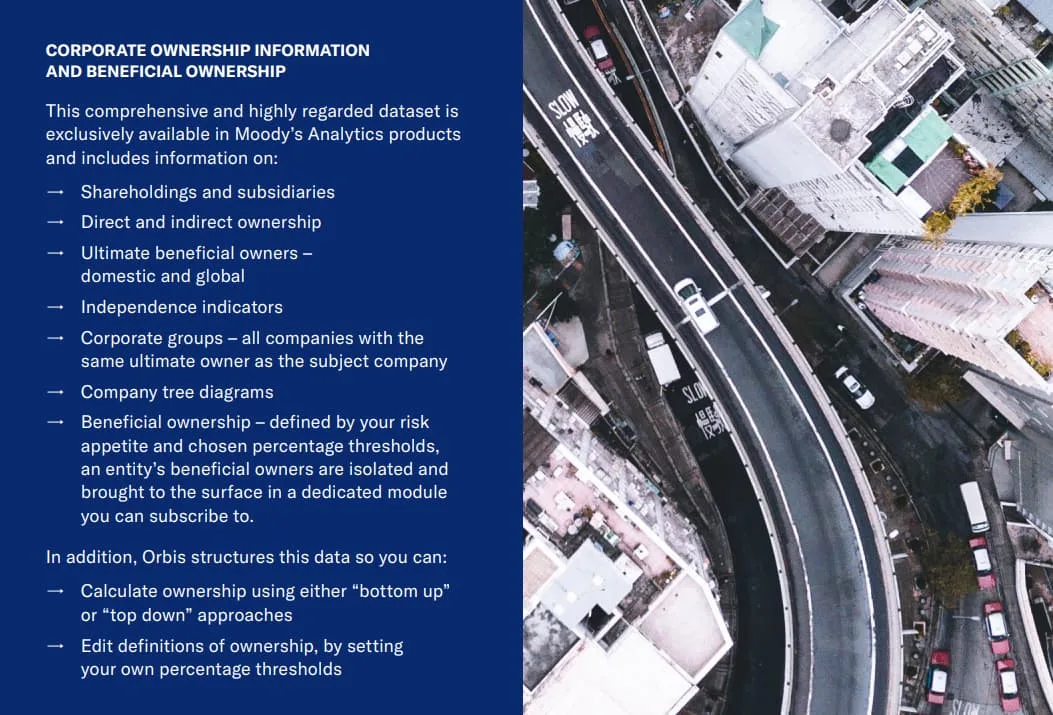
This strong feature makes Orbis a resource for corporate and beneficial ownership structures. It offers corporate trees that help customers understand ownership of potential and existing business partners and third-party associates.
That matters because ownership chains, historic links, and corporate trees are often where simple company verification tools stop short.
Orbis also supports cross-border company analysis. Users can search company information across regions using standardized formats, including financials, growth rates, estimates, and mapped industry codes.
You can also review corporate groups and screen them for adverse news, PEPs, and sanctions through additional modules.
Compare that to Middesk's fast US decisioning or Veridion's continuous operational enrichment, and the difference is clear: Orbis is a deep reference database, not a lightweight real-time verification API.
That power comes with weight in both integration effort and cost.
However, it falls short of Middesk or Veridion in terms of speed and simplicity for high-volume, low-complexity onboarding. If you approve thousands of small businesses a day and need a fast yes-or-no, a leaner tool moves quicker.
Orbis works best for enterprise due diligence, AML, and credit teams that investigate complex ownership structures and require cross-border financial comparability.
Conclusion
The best KYB data enrichment provider is the one that fits your workflow, risk level, and data architecture.
Evaluate each provider on this list with your own entities, measure evidence and match quality, and choose the platform that helps your teams make faster, cleaner decisions.
The right platform will reduce manual work, improve confidence, and give your team data it can actually use.
Articles
Discuss how these trends affect your organization.
Our analysts are available for a short call. Bring a specific question and we will ground it in the data.
Insights
Keep reading
More analysis, research, and outcomes grounded in live company intelligence.
Where to Find Data on Businesses
Looking for where to find data on businesses? This guide will show key sources for company information, insights, and market intelligence.
6 Big Data Companies to Know About
Compare 6 big data companies transforming how businesses collect, analyze, and leverage large-scale datasets.
6 Best Data Enrichment APIs
Looking for the best data enrichment APIs? This article will introduce six powerful tools to enhance and validate your data.