Insights / Articles
Feeding Clean B2B Firmographic Data into LLMs to Prevent AI Hallucinations in Market Intelligence
Tired of AI hallucinations in market intelligence? Learn how feeding clean B2B data into LLMs prevents inaccurate insights.

- An LLM will give you the most plausible answer instead of saying it doesn't know the answer.
- LLM hallucination is first a data problem, then a prompting problem.
- The quality and structure of what a model retrieves determines the answers it gives you.
- Clean B2B firmographic data first prevents hallucinations and improves market intelligence.
Your market intelligence team just asked an LLM to summarize a competitor's headcount and revenue. It responded instantly and seemed very sure of its numbers.
The thing is, most of those numbers came out of thin air.
That is not an occasional bug. It's what happens when you feed messy business data into a model built to always produce an answer.
Let's learn more about why AI hallucinations happen, and how clean, structured firmographic data stops it.
Why LLMs Hallucinate on Messy Business Data
LLMs do not verify facts the way an analyst does. They predict the most likely continuation from the context available to them.
When that context is incomplete, contradictory, or outdated, the model still tries to complete the pattern. That is why hallucination is best treated as a data problem first, then a prompting problem second.
Three specific data failures drive most business hallucinations, and each one traces back to how your company data is collected, stored, and maintained.
Filling Gaps With Plausible Fabrications
When grounding data is missing, the model rarely stops on its own and admits it doesn't have the correct answer. It fills the gap with the most plausible answer.
OpenAI explains that hallucinations persist in part because many evaluation systems reward the model for answering, not for admitting uncertainty.
Google Cloud makes the same point from another angle, noting that a lack of proper grounding leads models to generate outputs that seem plausible but are factually incorrect or irrelevant.
Here is why that happens. An LLM predicts the next likely word based on patterns, not verified facts. Nothing in that process tells it to stop and say it does not know.
So when you ask it to summarize a company's growth rate and the underlying number was never captured, the model does not leave a blank. It generates a plausible figure and presents it with the same confidence as a verified one.
It's quite common for models to invent growth rates that were never calculated, create benchmarks that were never defined, and cite non-existent market research.
The results look polished and ready for the executive review. No one suspects anything wrong with them because nothing is inconsistent about the language used.
In mid-2025, Deloitte Australia ran into exactly this problem. The firm used AI to draft a compliance review report for Australia's Department of Employment and Workplace Relations.
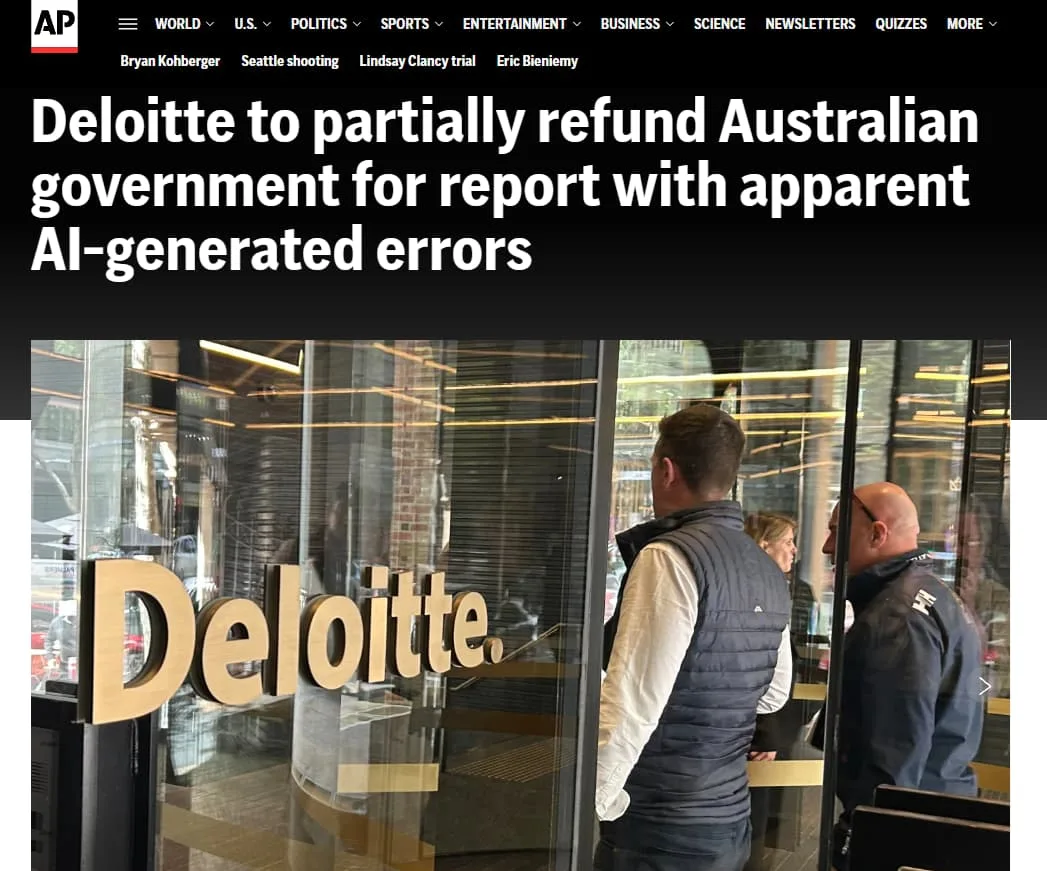
Source: AP News
The published report cited academic papers that never existed, attributed a fabricated publication to a real law professor at the University of Sydney, and quoted a federal court judgment that was never handed down.
Deloitte had to refund $290,000 paid by the Australian government for the report.
The business risk from hallucinations compounds when such fabrications look identical to real analysis.
Bryan Reynolds, CEO of Baytech Consulting, which develops enterprise business applications, frames the root failure this way:
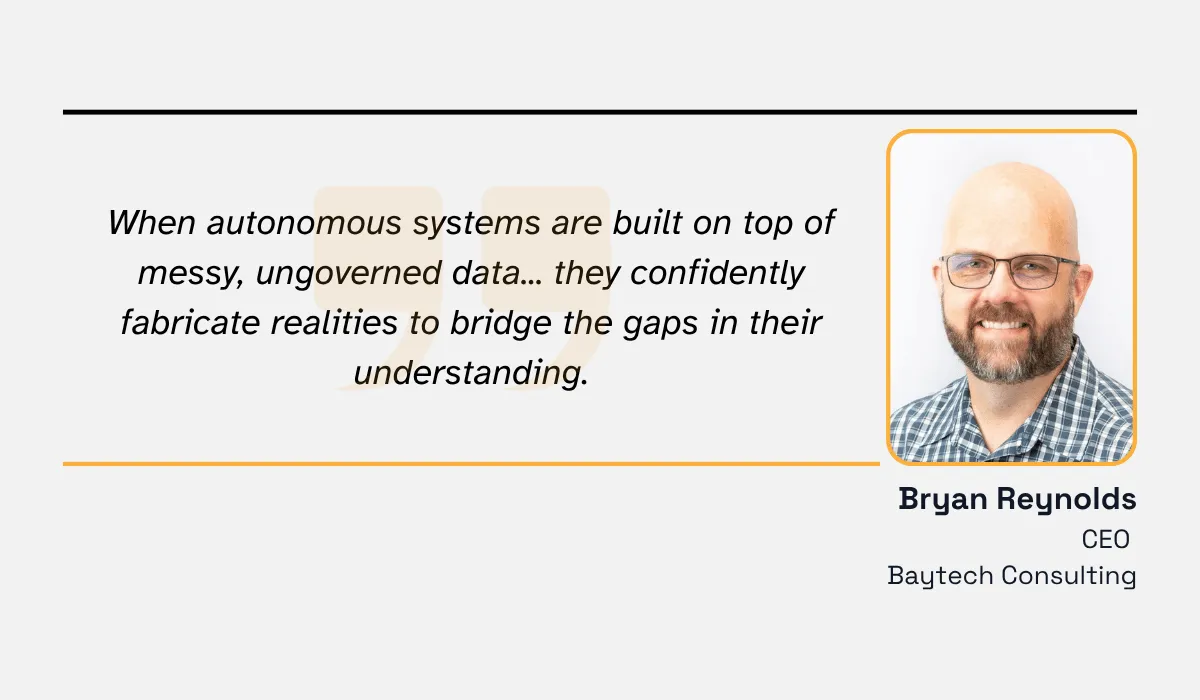
Illustration: Veridion / Quote: Baytech Consulting
To combat hallucinations, create a gap check within your process before sending the information to a reader. If a field in your source data is empty, flag it as unknown rather than allowing the machine to make assumptions.
Require the AI software to cite a source for any metric presented, and treat any uncited numbers as drafts, not facts. Following this one step alone will prevent most fictitious numbers from showing up in your report.
Duplicate and Conflicting Records Confuse Retrieval
Duplicate business records occupy your database space, but most importantly, misrepresent retrieval.
Think of a CRM system that is storing the same company in four different variations: one using its official name, another as an abbreviation, a third as a formerly known name, and lastly through its subsidiary.
These duplicate entries have slightly different revenues, number of employees, or industrial classification.
When an AI system retrieves context for that company, it has no reliable way to know which record is current. It might blend fields from two contradictory sources into one fabricated answer, or pick a version at random.
In practice, this means a company listed as "Acme Corp," "Acme Corporation," and "ACME Corp Ltd" across three data sources gives you three different results for the exact same question. Then you have to debug the AI's false hallucinations due to deduplication issues.
That is not a prompt issue; it's an entity confusion, and Gartner names inconsistency across data sources as the single most challenging data quality problem organizations face, a direct result of records living in disconnected silos with overlapping and conflicting values.
The bill for that confusion runs deep: poor data quality costs organizations at least $12.9 million a year on average.
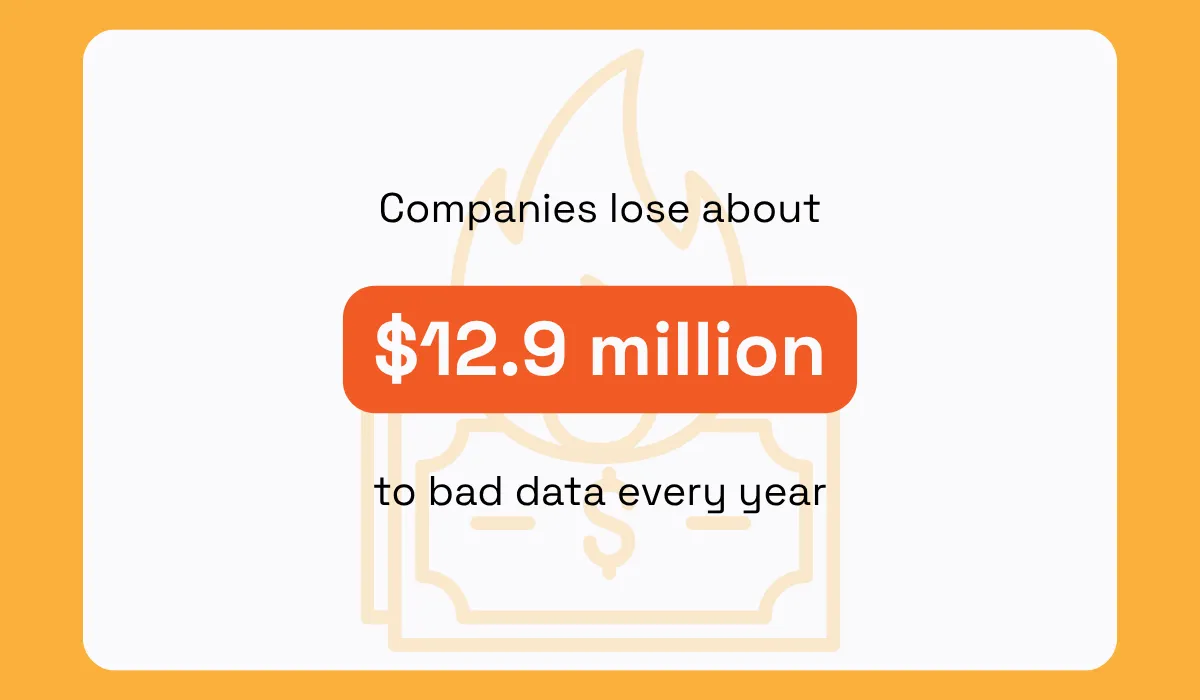
As such, you must first fix identity before fine-tuning retrieval. Use aliases, domains, registry IDs, parent/subsidiary relationships, and geolocation information to tie all the duplicate entries to one business.
Once your AI can search for the same company ID, conflicting responses disappear.
Stale Data Produces Confidently Wrong Answers
An LLM has no built-in sense of time. It will state information from a record updated two years ago with the exact same confidence as a fact verified this morning. Nothing in its output signals which is which.
This matters more than most teams realize, because firmographic details change constantly. Companies merge, relocate, change leadership, and shift business models weekly, not annually.
Experian reports that 68% of organizations say their contact data is decaying faster than ever. Additionally, 42% of leaders say they lack confidence in AI outputs because those outputs draw from disconnected or out-of-date data.
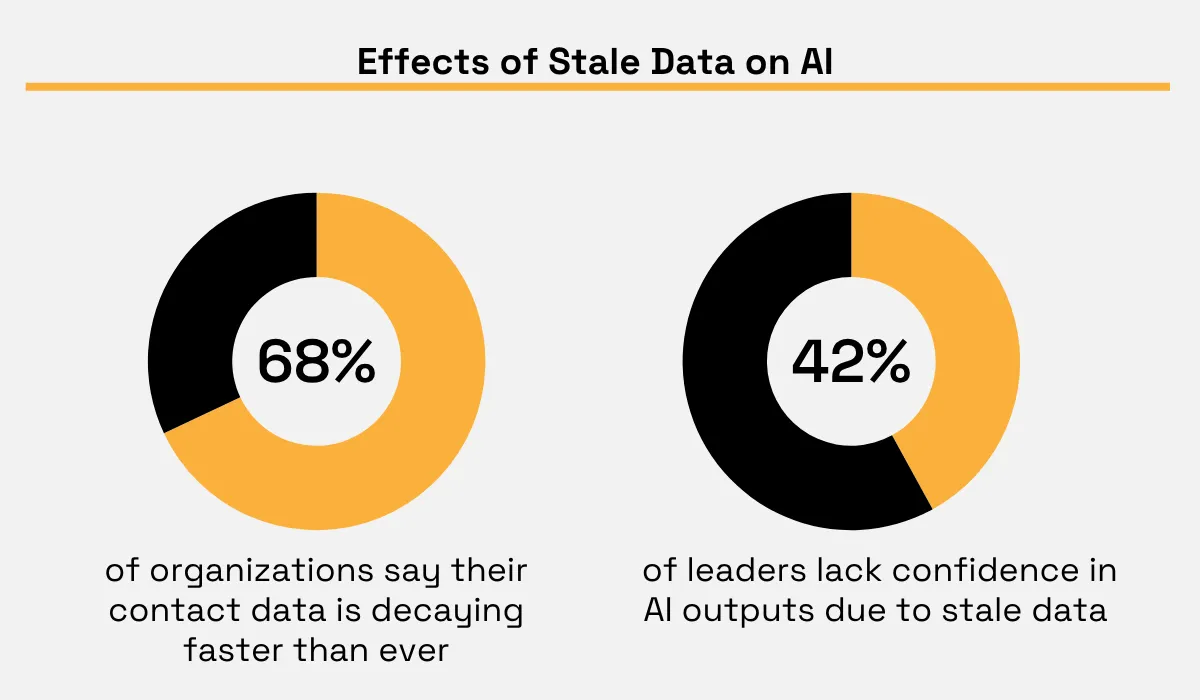
The fix is operational, not theoretical. Put fresh metadata into the grounding layer by setting refresh intervals that match how fast each data type actually changes.
Review stable fields like incorporation details once a year and refresh volatile fields like technology stack, headcount, and leadership on a monthly or quarterly cycle.
Also, flag any record that has aged past its refresh window so your AI system treats it with less confidence, or skips it entirely.
How Clean, Structured Data Grounds AI Responses
What separates a reliable internal AI system from a hallucination-prone one isn't a smarter model. It's the quality and structure of what that model retrieves before it answers.
The following three practices make the biggest difference.
Retrieval-Augmented Generation Needs Governed Sources
Retrieval-augmented generation, or RAG, is supposed to fix hallucinations by grounding the model in retrieved facts instead of pure prediction. But RAG only works as well as the data it retrieves from.
The statistics are compelling.
When a RAG system uses ungoverned data, it creates fake data in 52% of cases, whereas giving that same retrieval system access to governed content brings that number down to nearly zero, according to Atlan.
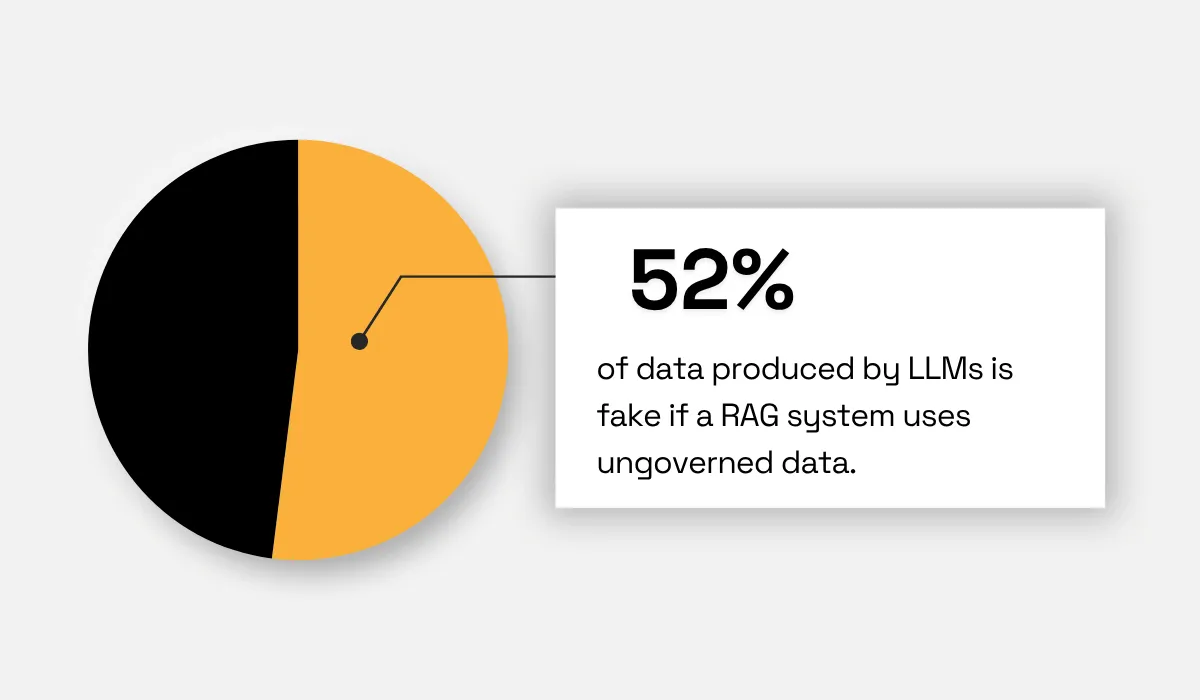
The same model and the same retrieval stack. The only variable that changed was the quality of the source data.
If your team is optimizing batching strategies and embedding models while ignoring how your underlying company data is governed, they are fixing the wrong layer.
What you should do is audit your source data for accuracy and ownership before you touch your retrieval pipeline. Begin by classifying all your data sources and tag each source with a confidence level and a freshness date. Then exclude anything you cannot verify.
Do not treat a raw CRM export or an unvetted web scrape as the same as a validated, tracked data set. Filter by trust first, then relevance in your retrieval process.
Structured Fields Beat Unstructured Text
Structured, tagged fields give an AI system far less room for ambiguity than unstructured text does. Typed fields are easier for both retrieval systems and humans to interpret consistently.
That is why metadata and ontology work matter so much. Microsoft Research reports that its ontology-grounded RAG approach increased recall of accurate facts by 55% and improved response correctness by 40% across four LLMs.
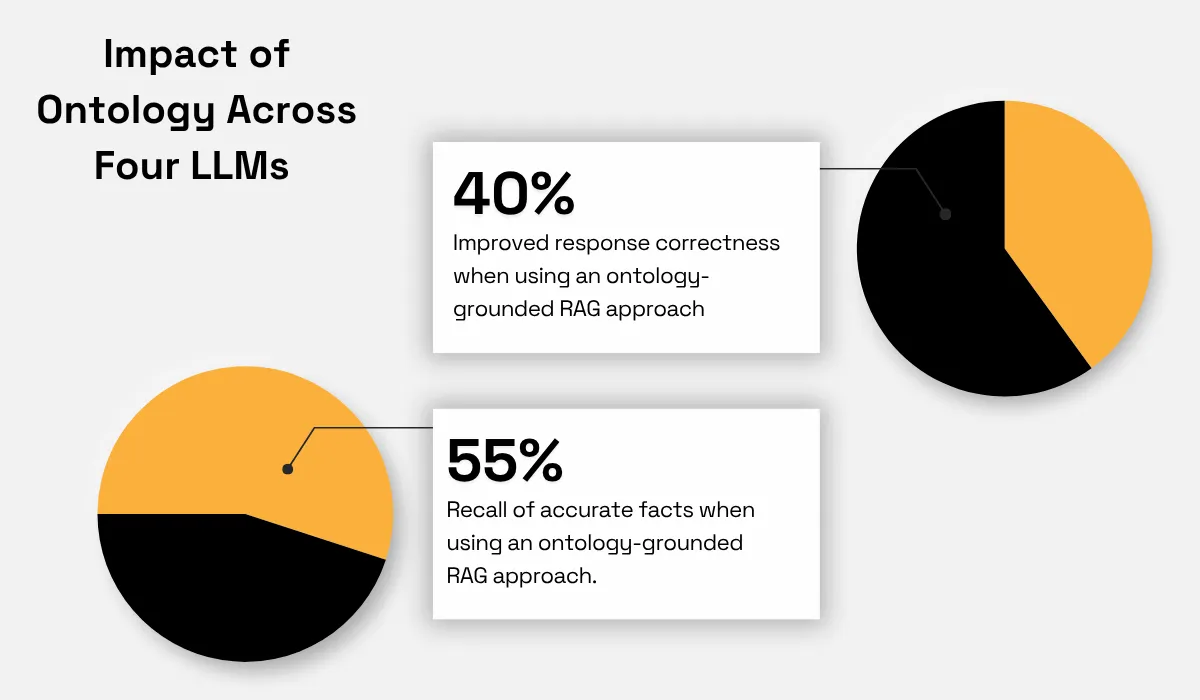
That has a direct implication for market intelligence. A tagged field like operating_status=active is stronger grounding than a sentence buried in a scraped profile.
The problem is that many businesses now run some form of CRM, and most of those systems carry fields that add no value to an AI model, such as internal IDs and legacy migration tags.
Meanwhile, the fields that actually help a model reason well—industry taxonomy, technographic signals, headcount by department—often go unaudited.
If such a business asks a model to compare two companies tagged inconsistently, one under "SaaS" and one under "Software," for the same business model, it will treat them as unrelated markets. That is not a model failure but a schema failure.
To make sure you don't make the same mistake, validate your schema field by field. Standardize taxonomies so all like fields have the same name and remove any that were created just for system logic and not business meaning.
Moreover, keep the fields that do have meaning, such as industry, technology focus, and investment stage, and feed those to your AI.
A well-curated taxonomy for industry, business model, target markets, certifications, and geography will help the model find its anchor points and give you better results.
One Canonical Record Prevents Contradictory Answers
A canonical record does more than tidy the database. It keeps an AI system from generating conflicting answers about the same business.
Using master data management (MDM) helps create and maintain a single, trusted view of a company's most critical business data across systems. AI outputs become inaccurate when models run on inconsistent, incomplete, or duplicate master data.
This is the golden record concept applied to AI grounding. So instead of five versions of a company floating across your CRM, ERP, and marketing platform, you resolve them into one entity with one confidence-scored profile.
Without a golden record, Alexej Freund, Director of AI & Data at Deloitte, warns that using AI will be more detrimental than useful. He notes:
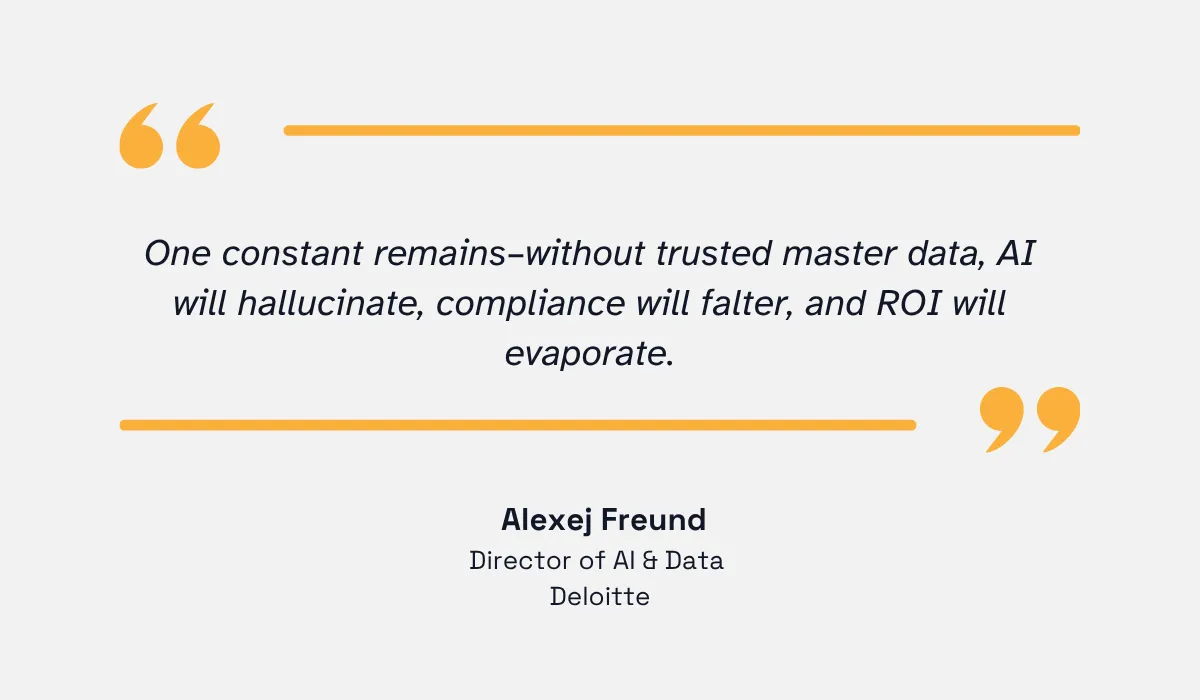
It's therefore crucial to make the canonical ID the entry point to every answer. First resolve, then retrieve, and lastly, generate.
If your system skips that order, you should expect contradictory outputs, especially when the same company appears across multiple systems and jurisdictions.
Building one canonical record means every downstream system (CRM, BI dashboard, AI assistant, etc.) queries the same source of truth.
Structured Company Data as the AI Grounding Layer
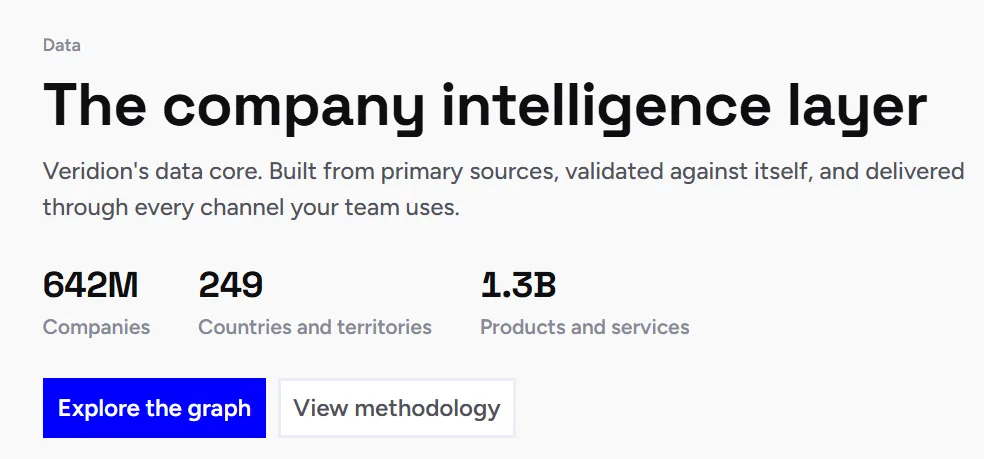
This is where the case for continuously governed firmographic data becomes concrete. Veridion's company intelligence layer, company enrichment, entity resolution, and market intelligence solution line up closely with what a market intelligence LLM actually needs.
Source: Veridion
Veridion's company intelligence layer provides access to the company graph, which contains 693M companies in 250 countries and territories and 1.3B products and services indexed. There are 186M operating companies, 507M legal entities, and 173M locations in the system, which is updated constantly.
That breadth matters, but the structure matters more. Veridion's company enrichment service provides over 461 attributes sourced from 400-plus registries and about ~1.4B web pages per month, refreshed continuously, with a confidence score and source trail on every field.
The platform uses several independent sources and consolidates them into one verified entry; this level of trust, along with last-seen timestamps, comes with every attribute.
The delivery options for the data include APIs, batch delivery, warehouses, and marketplaces. The enrichment layer is refreshed weekly, while the entire graph is updated constantly.
The same graph handles duplicates and conflicting company records via entity resolution and by collapsing a company's mentions into one canonical entry before the information reaches your AI workflow.
This way, the market intelligence team developing AI-enabled research and competitive analysis gets the grounding layer of their answers, which is governed, verified, and up-to-date- just the kind of environment where hallucinations don't exist at all.
A generic model can hallucinate a fact with no way to check it, no source trail, and no correlation across sources to catch the error. Veridion's classification model, however, attaches evidence to every attribute instead, and refreshes continuously rather than on a quarterly export cycle.
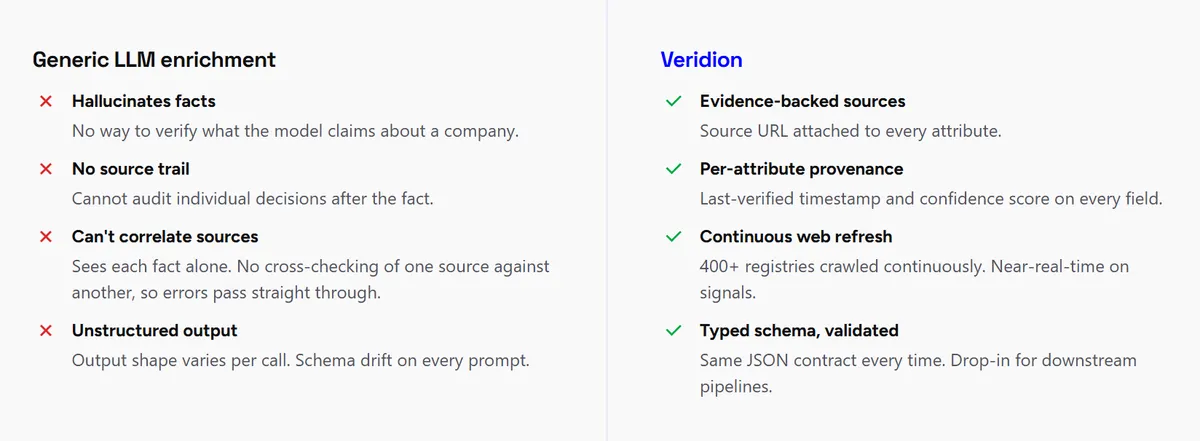
Source: Veridion
With Veridion, you are not asking a generic model to synthesize market truth from scattered text. You are letting the model speak from a governed company record that was built for downstream use.
Conclusion
LLMs hallucinate because they are forced to respond amidst contradictions, gaps, and outdated context. You can't prompt yourself out of that for long.
You must have governed sources, structured fields, current data entries, and a single canonical company identity to beat hallucinations.
When you feed your AI with clean B2B firmographic data first, you avoid hallucinations and improve your market intelligence efforts in speed, defensibility, and most importantly, trustworthiness.
Articles
Discuss how these trends affect your organization.
Our analysts are available for a short call. Bring a specific question and we will ground it in the data.
Insights
Keep reading
More analysis, research, and outcomes grounded in live company intelligence.
5 Trends Shaping the Future of Market Intelligence
Want to future-proof your business strategy? Explore the top trends defining the future of market intelligence.
Key Differences Between Competitive and Market Intelligence
Discover the key distinctions between market and competitive intelligence - so you can apply the right approach in your strategy.
5 Types of Market Intelligence You Need to Know About
Explore five different types of market intelligence that can shape your competitive edge. Find out which ones your team should prioritize.