Insights / Articles
Why RAG (Retrieval-Augmented Generation) Systems Require Decision-Grade Company Data
Tired of inaccurate AI outputs? Learn why decision-grade data is crucial for RAG business data integration and unlock reliable insights.

- RAG can fail even when the LLM works fine.
- Poor data quality costs businesses $5 million every year.
- Splitting records the wrong way caps your answer quality.
- A recent bug shows what happens without retrieval-level permissions.
In theory, RAG systems sound ideal.
Supplement an LLM model’s input with an external knowledge base, and you get the best from both worlds each time you ask your LLM a question.
But in practice, when the external data isn’t up-to-date or correct or it’s missing, these systems can still produce hallucinations, incomplete or even incorrect answers.
The problem is these faults are hard to miss, and companies notice the damage when they pile up.
But when you feed your RAG systems with high-quality, decision-grade company data, only then can you reap the benefits of AI for your business.
In this article, we’ll first explain how RAG quality breaks down.
Then we’ll show you how to design a robust system based on the most accurate and relevant data.
Where Retrieval Quality Actually Breaks Down
The “garbage in, garbage out” adage from the early days of computer science was never more true than in RAG systems.
If you feed your system with low-grade data or use misaligned retrieval techniques, even the best model will generate outputs hardly sturdy enough to base decisions on.
That's why building a reliable RAG system starts with building a better data layer.
Here’s what you need to keep an eye on.
Chunking Strategy Determines the Ceiling
LLMs are behemoths, capable of ingesting unprecedented amounts of data.
But if they “bite off more than they can chew," the retrieval quality goes down.
This is where chunking, or breaking large amounts of source data into smaller and more manageable pieces, comes in.
However, chunking can be done in different ways, depending on the type of source data and overall goals.
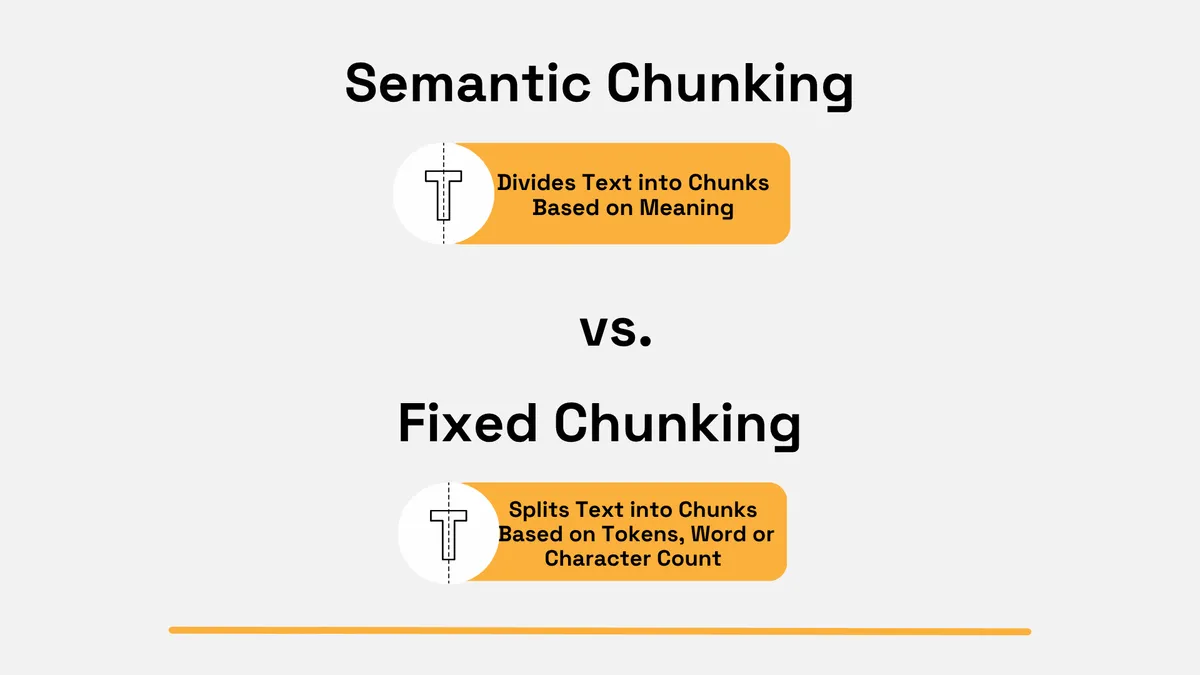
In our case, if we want to chunk entity-based data, it’s better to choose semantic rather than fixed-size chunking.
Fixed-size chunking splits information according to character count, token count, or word count. Also, it uses overlap to prevent information loss at chunk boundaries.
Source: Veridion
But this deterministic technique doesn’t work well with unstructured or loosely structured data.
For example, if you split a company record mid-context, the retrieval quality will suffer no matter how large the context window or good the embedding model is.
The solution to issues like this is semantic chunking.
As the name says, this technique uses meaning and context to group related information while ensuring that each chunk makes sense on its own.
When the algorithm recognizes a change in meaning or similarity between pieces of data, it splits them into different chunks.
Unlike fixed-size chunking, this technique improves retrieval relevance.
Or in simpler terms, it improves the chance of an LLM answering in a way that’s more aligned with a query’s intention.
This way, the main context of a dataset remains complete - company records stay intact while attributes remain connected.
And most importantly, retrieval becomes more accurate.
Use semantic chunking for cases when quality of retrieval and context accuracy are more important than speed.
In any case, having a clear chunking strategy from the get-go for structured business data is the foundation for outputs that’ll boost your business decisions.
Flat Chunk Retrieval Loses Relationships
When it comes to structured business data, each data point is a part of a bigger context and carries meaning when its relationship with other data points is clear.
However, traditional RAG treats each text chunk as an independent piece of information and retrieves them based on semantic similarity.
This can miss relationships that span multiple chunks.
So when a user writes a query like “Who owns the parent company of this supplier?", a standard vector search might retrieve two chunks: one describing the supplier and another describing a holding company.
Consequently, when the model doesn’t see connections between these two data points, it can return a false or incomplete answer to the above query.
To offset these types of issues, Microsoft developed the GraphRAG technique.
Source: Microsoft
In simple terms, graphRAG preserves these relationships by linking related entities in a graph, making the model better at answering queries that require connecting information across documents or chunks.
That means the retrieval system can follow ownership links, supplier networks, or corporate hierarchies before generating an answer.
Let’s go back to the “Who owns the parent company of this supplier?” query.
GraphRAG works by following the relationships stored in its knowledge graph rather than searching for isolated text chunks.
First, the system recognizes Supplier X as the main entity in the query.
Then, instead of retrieving only semantically similar text, it follows the connected relationships in the graph like this:
Supplier X → owned by → Company A
Company A → parent company → Company B
Company B → owned by → Holding Company C
The next step is retrieval of relevant documents or text passages that support each relationship in the chain.
Finally, the correct answer is generated using both the relationship path and the supporting text.
Structured Facts Need Precise Retrieval, Not Just Similarity
Let’s say you need to check the total amount in a specific invoice.
You type into your company’s RAG system, "What's the total amount in invoice 1-2025-23?”
The system may retrieve invoices with similar identifiers or content.
So you waste more time going through all of the results until you find the right one.
That’s because similarity-based retrieval is designed to find relevant information, not necessarily exact matches.
Structured retrieval works differently.
It queries indexed attributes directly through structured databases or knowledge graphs.
For example, if a company’s headcount is stored as a verified field, retrieval will return the exact value rather than whichever chunk happens to be most semantically similar.
However, the best scenario is when you combine structured retrieval with semantic similarity.
Because using only structured retrieval might give the correct number but lack explanation.
On the other hand, relying on semantic retrieval only might find relevant documents but risk extracting an incorrect or outdated figure.
That’s why you need to combine both approaches. That way, the RAG system provides answers both precise and informative.
Designing for Decision-Grade Retrieval
Now that we’ve shown you the challenges of using RAG, let’s take a look at how you can design a RAG system that powers the right business decisions.
Freshness as a Retrieval Parameter
Company information changes on a day-to-day basis.
Employee turnover rises during market volatility; companies change headquarters or update classification codes
In any case, each change in the outside world should be reflected in an LLM output.
Otherwise, companies risk not only outdated outputs but also a decline in user satisfaction or even financial issues.
They’re aware of this issue.
A 2026 report by Precisely and Drexel University's LeBow College of Business showed that 51% of business leaders cite data quality as the most common priority when it comes to data integrity.
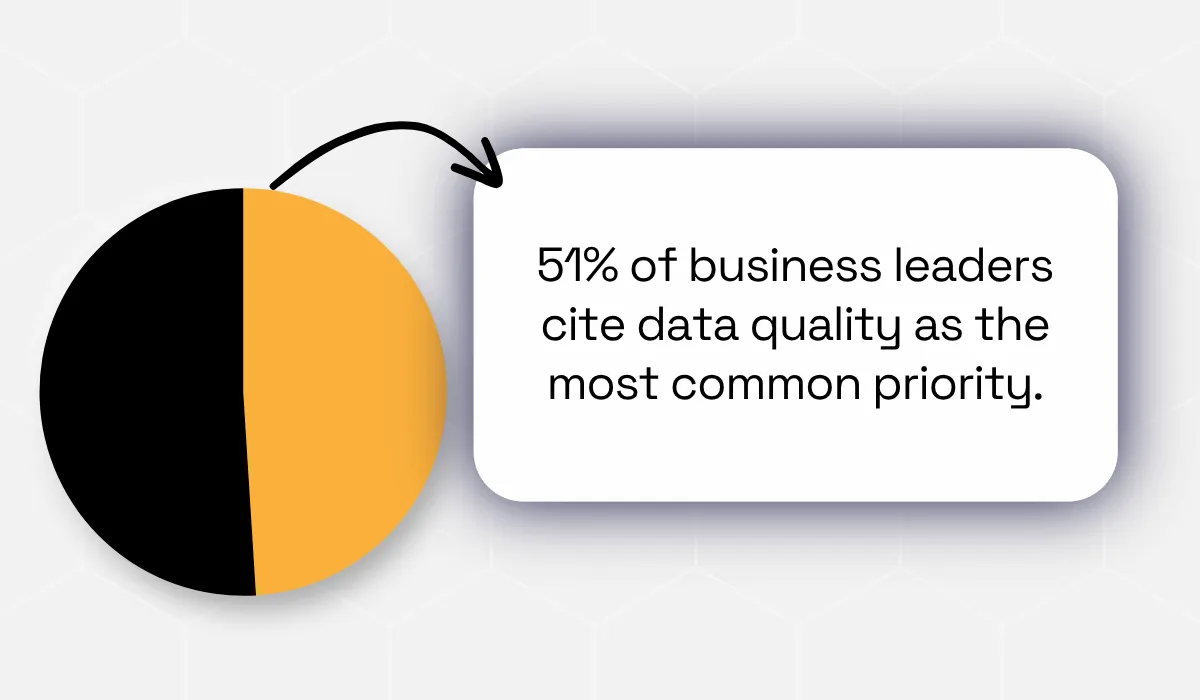
Yet, in reality, there’s a mismatch.
Separately, a Forrester survey found that companies lose $5 million annually due to poor data quality.
So if you use a RAG system that retrieves from stale source data, it will confidently surface outdated facts, which can lead to mistakes in decision-making.
Just imagine the consequences of basing a financial report not on this year’s data but on the year before.
However, in many retrieval systems, freshness is stored only as metadata.
Unless that metadata is explicitly incorporated into filtering or ranking, retrieval is driven almost entirely by semantic similarity.
As a result, older documents may be selected simply because they are a better semantic match than newer ones.
For example, if a user asks:
"What are the current cybersecurity regulations for financial institutions?"
a vector search might retrieve a highly relevant document from 2021 instead of a less semantically similar regulation from 2025.
By contrast, when freshness is treated as an active retrieval parameter, the retrieval process explicitly considers recency alongside relevance.
This ensures that the most up-to-date information is prioritized.
Per-Attribute Confidence Changes What You Retrieve
When it comes to reliability, not every data point is the same.
For example, some attributes are verified directly from authoritative sources like banks or public records.
Others can only be estimated through statistical models or inferred from multiple datasets.
If these differences in reliability are ignored, a retrieval system may present estimated values with the same authority as verified facts, increasing the risk of misleading or incorrect responses.
The solution is to incorporate confidence scores into the retrieval process.
Instead of treating every attribute as equally reliable, the retriever can prioritize high-confidence information and suppress or flag uncertain values.
You can do that with tools like our very own Veridion.
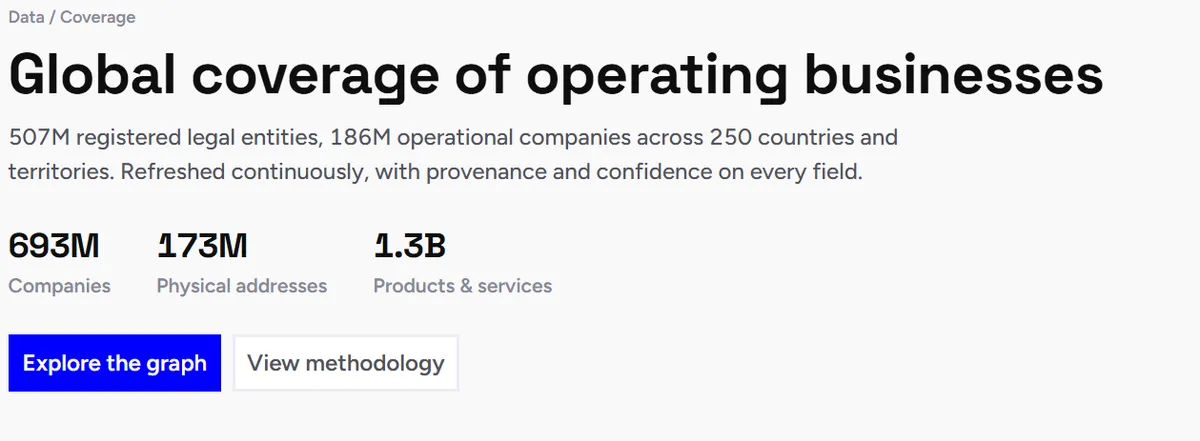
Our database covers more than 507M registered legal entities and 186M operational companies across 250 countries and territories.
Source: Veridion
Derived from public sources and verified before delivery, these attributes contain confidence scores and source attribution.
This makes it easier for engineers to assess and filter indexed data as needed, rather than treating all of it as equally reliable.
As a result, LLMs are less likely to rely on uncertain or inferred data and, most importantly, will improve the accuracy and trustworthiness of their responses.
Access Control Has to Reach Into Retrieval
Naturally, not every piece of data should be accessed by anyone.
It’s easy to imagine what would happen if an unauthorised employee, contractor or hacker retrieved a piece of data they’re not allowed to see.
This could lead to sensitive data leaks and industry regulation breaches and, with it, loss of trust in the LLM system.
Just remember what happened to paying customers of Microsoft 365 earlier this year.
A bug allowed the system to access and summarize confidential emails already protected by data loss prevention policies.
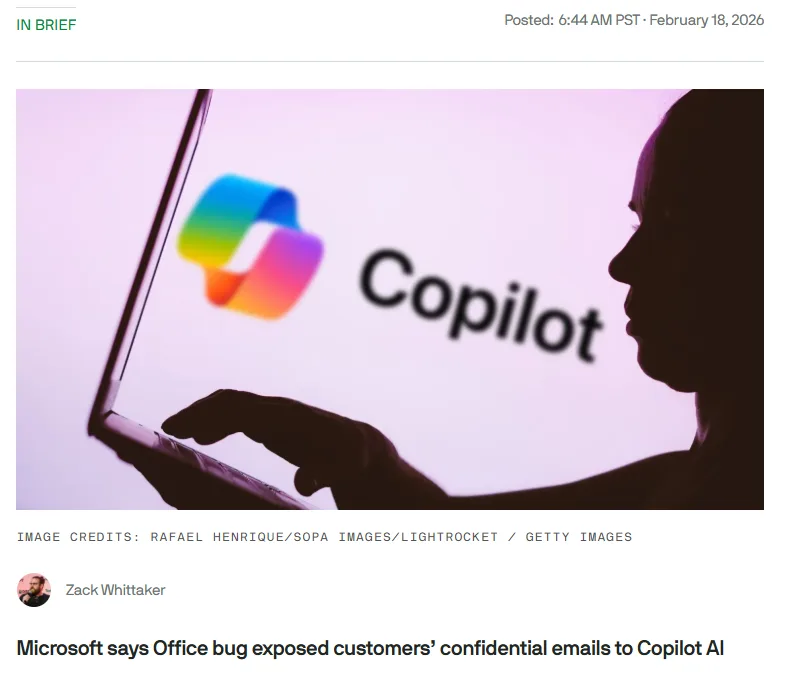
Source: TechCrunch
Microsoft did roll out a fix, but the damage was done—an undisclosed number of customers are now exposed to bad-faith players.
To prevent cases like Microsoft’s, permission boundaries need to be enforced at the retrieval layer itself.
This is where permission-aware retrieval comes in.
When an employee searches for data, the system will first check the user's identity and permissions (e.g., role, department, project, or tenant).
Then it’ll retrieve only information the user is authorized by the company to access.
Let’s say the CMO types in the following query: “What’s the budget for next year?”.
This could mean the budget for their marketing department but also for other company departments like HR or finance.
Without permission guardrails in place, the system would have retrieved the most relevant document, not necessarily the one this hypothetical CMO has permission to access.
The result is both a security breach (the user gains access to unauthorized data) and irrelevant answers for the user (they wanted access to another document).
On the other hand, when chunks are stored with permission metadata (user roles, departments, security classifications, etc.), the system will exclude unauthorized data before retrieving it and show only results that correspond to the permission metadata.
So, you don’t only protect sensitive data from being seen by users, but you also protect it from being retrieved by the LLM model.
Conclusion
RAG is touted as one of the most effective ways to minimize the downsides of LLMs like hallucinations.
But if your source data isn’t high-quality, RAG won’t make a difference.
That’s why you need to take the time to make sure company data is as robust as possible. Both in terms of its accuracy, freshness, and security.
Another must is to use context-appropriate RAG techniques to get to the best outputs that will guide you to confident and informed business decisions.
It may not be fast, but it still remains the foolproof way to success and relevance in the market.
Articles
Discuss how these trends affect your organization.
Our analysts are available for a short call. Bring a specific question and we will ground it in the data.
Insights
Keep reading
More analysis, research, and outcomes grounded in live company intelligence.
5 Trends Shaping the Future of Market Intelligence
Want to future-proof your business strategy? Explore the top trends defining the future of market intelligence.
Best Practices for Leveraging Market Intelligence
Not sure how to apply market intelligence effectively? Learn which practices top businesses rely on and how you can too.
How to Build a Strong Market Intelligence Strategy
Learn how to build a strong market intelligence strategy that helps you track trends, understand competitors, and make smarter decisions.