Insights / Articles
How to Run SaaS Competitive Analysis That Teams Actually Use
Struggling with SaaS competitive analysis? Uncover actionable insights that your team will actually use to outperform the competition.

- 70-80% of enterprise feature requests shockingly never make it into the product.
- 45% of B2B buyers trust review-site citations most when evaluating software.
- Strong positioning helps customers remember your product for value.
- Update your SWOT regularly to spot emerging AI disruptors.
What if your SaaS product could be replaced by the next version of Claude or maybe an AI-powered spreadsheet?
It may sound extreme, but the way SaaS products are being built, found, and bought has changed completely.
That's why SaaS companies can no longer rely on assumptions about their competitors.
Structured competitive analysis helps you and your team identify threats early and make smarter product, pricing, and positioning decisions.
In this blog, we explain how.
Identify Your Competition
Most SaaS companies do not lose deals to obvious competitors.
They lose to overlooked alternatives like spreadsheets, internal tools, or AI-native startups.
And if you think about it, these alternatives are often cheaper and easier to use.
But have you wondered why these threats were not identified earlier? It’s because they did not look like threats until it was too late.
Let us look at Adobe right now.
Adobe’s stock has been on a rollercoaster over the past few months.
Investors are worried about AI eating into the business, especially around Adobe's big AI product, Firefly, which lets you create and edit images and videos through text prompts.
But it is competing against Sora, Runway, Stable Diffusion, and Midjourney, and analysts are not convinced Adobe can monetize it fast enough.
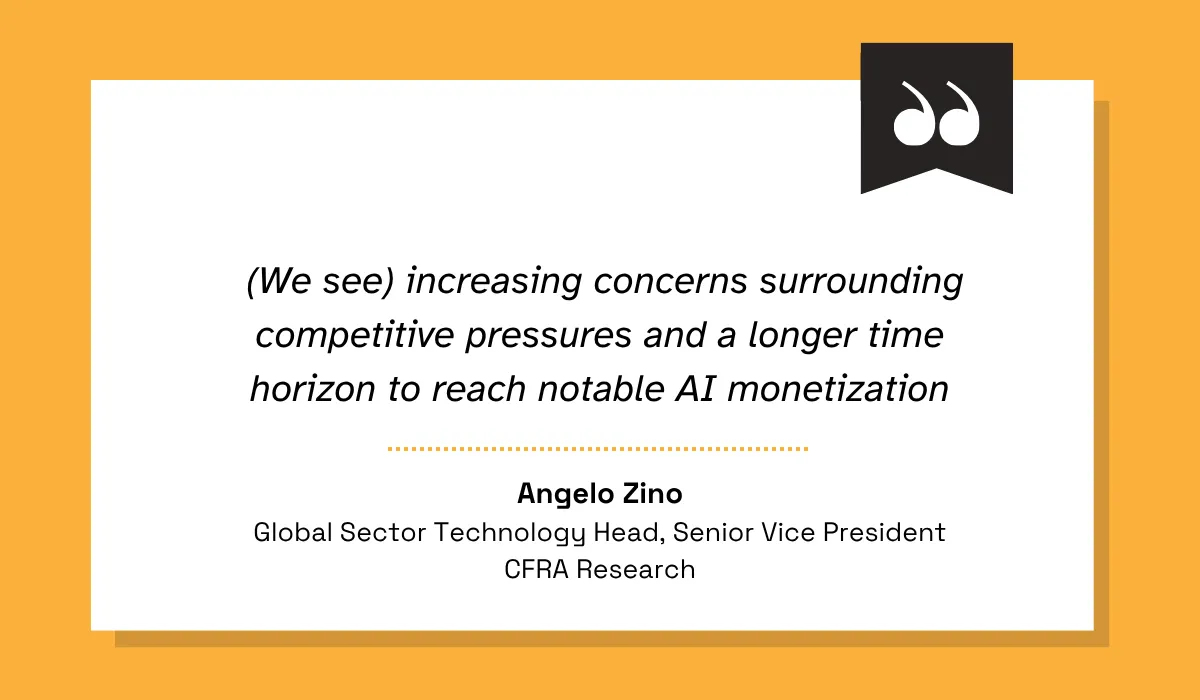
Angelo Zino, Global Technology Head at CFRA Research, a major independent investment research firm, raises his concerns;
No, it’s not just Adobe.
AI is now a competitor for almost every SaaS company, whether you're building design software, customer support tools, coding platforms, marketing products, or project management solutions.
That's why today, identifying competitors should go far beyond companies selling a similar product.
Here’s a quick table to help you categorize competitors:
Competitor Type | What It Means | Examples |
|---|---|---|
Direct Competitors | Companies that solve the same problem for the same target audience using a similar product or business model. | Asana vs. Monday.com, HubSpot vs. Salesforce, Zoom vs. Google Meet |
Indirect Competitors | Products that solve the same underlying customer problem but in a different way. They may not belong to the same software category, yet customers often choose them instead of a dedicated SaaS solution. | Notion, Microsoft Excel, or Google Sheets replacing project management software for smaller teams |
Emerging Competitors | New technologies or business models that can reshape the market before they're recognized as traditional competitors. | AI-native startups, ChatGPT, Claude, open-source software, or custom internal tools built with low-code platforms |
The biggest competitive threats quietly change how customers solve problems, making established SaaS products feel less essential over time.
And that's why your competitor list should evolve as quickly as the market itself.
Analyze Their Positioning
Positioning is about understanding how competitors present themselves to the world: their messaging, target audience, value proposition, and differentiation.
It determines who they attract.
It also explains why customers choose them even when the features look nearly identical to yours.
Take the case of Canva.
Its positioning wasn't built around having the most advanced design features.
It was, in fact, the opposite.
Canva recognized that traditional design software was too complex for most people and positioned itself as a platform that made design accessible to everyone.
Its simple interface, ready-made templates, and drag-and-drop editor removed the steep learning curve that kept non-designers away.
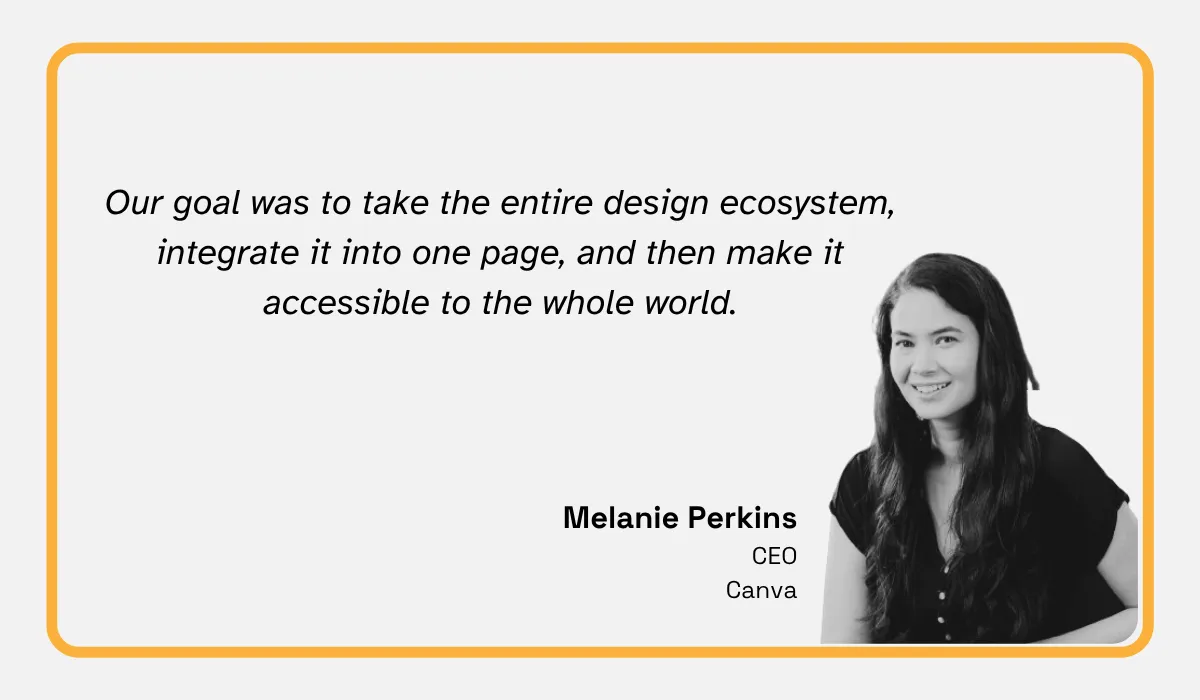
As CEO, Melanie Perkins put it clearly:
That clear positioning helped Canva grow from a tool for individuals into a platform used by more than 220 million monthly users across over 190 countries, including more than 95% of the Fortune 500.
Today, even as Canva competes with established players like Adobe Express and newer platforms such as Figma, Notion, and CapCut, it continues to stand out because its positioning has always centered on making design simple and accessible.
Canva clearly depicts that if a competitor owns a category in the buyer's head, copying them won't work.
You will need a different angle and positioning to succeed.
If your positioning doesn't answer 'why you, specifically' in one glance, you're leaving that decision to price or luck.
Study your competitor's homepage headline, their stated audience, and their core promise.
That one exercise will tell your team exactly how they want the market to see them and where the open space is for your product.
Compare Features
Comparing features isn't about building a bigger set of capabilities than your competitors.
It's about understanding which ones truly create value.
This is why feature comparison should go deeper than asking, ‘Do they have this feature?’
Rather, ask why it exists.
- Which customer problem does it solve?
- Is it frequently requested?
- Does it improve adoption, retention, or expansion? Or is it simply another checkbox added to match competitors?
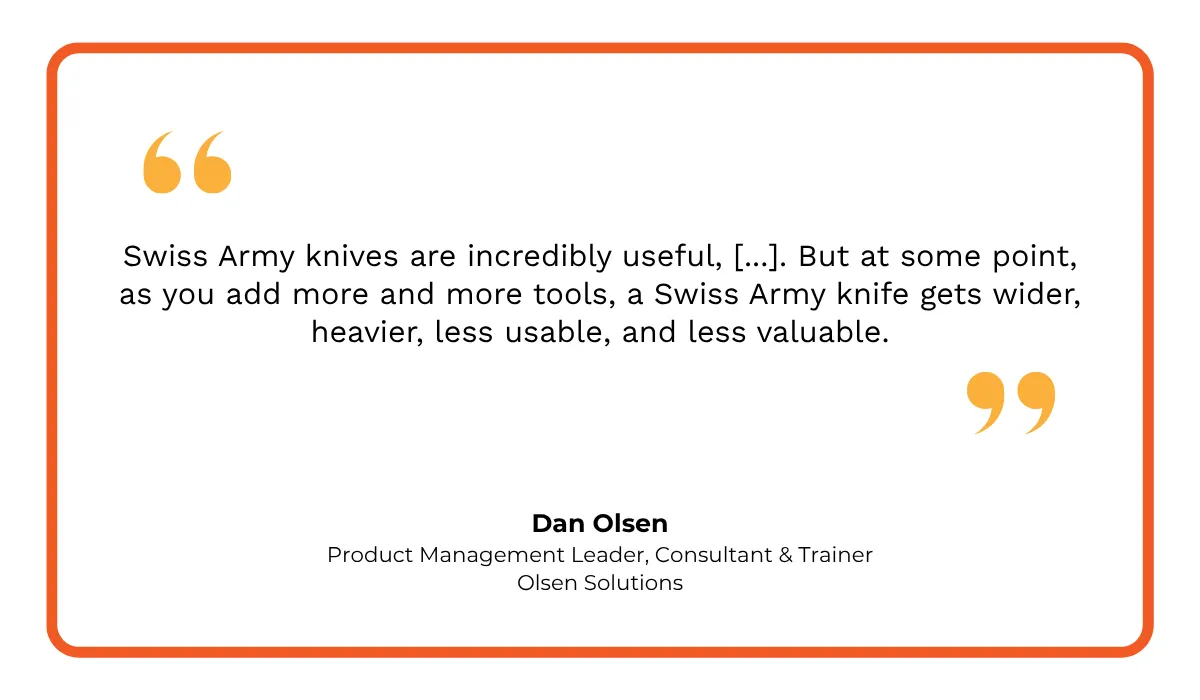
Dan Olsen, Product Management Leader, Consultant & Trainer at his consultancy, Olsen Solutions, is all about sticking only to the features that create real value.
He perfectly illustrates the point in his book The Lean Product Playbook:
But what does value even mean when it comes to software features?
Well, that’s what competitive analysis tries to find out.
If multiple competitors receive similar requests around reporting, integrations, approvals, or workflow customization, there's a good chance the market has an unmet need.
Studying review sites, community forums, product changelogs, and customer feedback can help your team uncover these recurring pain points.
You should also compare how competitors evolve their products, not just what they ship.
Look at release frequency, AI capabilities, integrations, customization options, and the direction of their roadmap.
These reveal where a company is investing and how it expects customer needs to change.
Analyze Pricing
SaaS pricing is highly competitive.
You cannot just guess what to charge anymore.
To analyze pricing properly, you need to look beyond the pricing page. You need to understand how they package their features.
- Do they charge per user?
- Do they charge by usage?
- Do they offer a free tier to get people hooked?
Consider Slack’s popular pricing strategy.
When Slack entered the market, workplace communication tools were already crowded.
Instead of trying to win with lower prices, Slack changed how customers paid for the product.
The free plan gave teams enough functionality to use the platform every day, but practical limits such as searchable message history, storage, and app integrations encouraged growing organizations to upgrade naturally as collaboration became more complex.
Slack's pricing wasn't based on what it cost to build the software.
It was based on the value customers received from faster communication and better teamwork.
As former Slack CPO April Underwood explained:
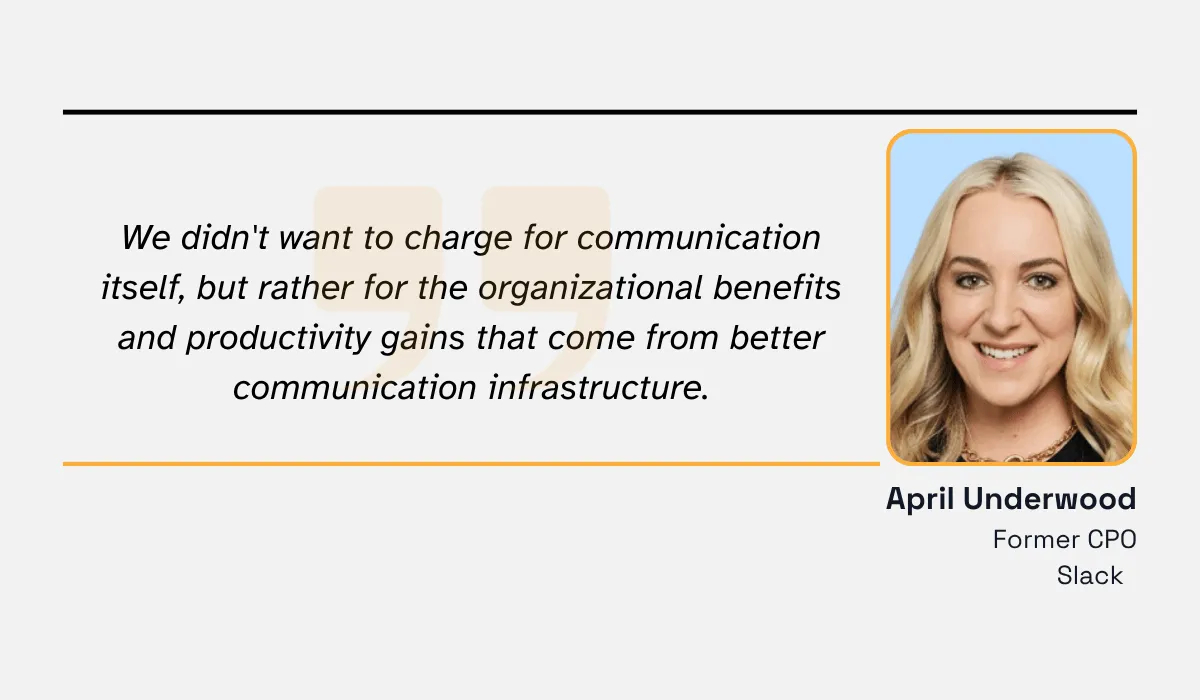
Illustration: Veridion / Quote: Monetizely
That strategy worked.
As reported by Monetizely, Slack’s S-1 filing showed its freemium model achieved an 8.6% free-to-paid conversion rate, significantly higher than the typical 2–5% conversion rate across SaaS products.
There's also the psychology of pricing to consider.
Price sends a signal about value.
If your product is dramatically cheaper than every competitor, buyers may question its quality before they even evaluate its features.
So, whether you price per user, by usage, through feature tiers, subscriptions, credits, or a freemium model, your pricing should match the value customers receive, not just what competitors charge.
Ask your team to map every competitor's entry-level and enterprise pricing, note hidden costs like implementation or premium support fees, and understand where you sit.
Don't treat pricing as a finance decision alone. Treat it as part of your product strategy, positioning, and overall customer perception.
Study Customer Reviews
Customer reviews are one of the most overlooked sources of competitive intelligence.
They don't just tell you whether customers like a product; they reveal why buyers trust one solution over another, what repeatedly frustrates users, which features create loyalty, and where competitors continue to fall short.
That matters because software purchases are driven as much by psychology as they are by functionality.
Buyers naturally place greater trust in the experiences of people like themselves than in vendor claims.
This Reddit account sums it up perfectly:

Source: Reddit
After all, users had the chance to test the product in the real world and, at the same time, didn’t have any incentive to lie about their experience.
Of course, potential buyers will turn to them. There’s even research that backs this up.
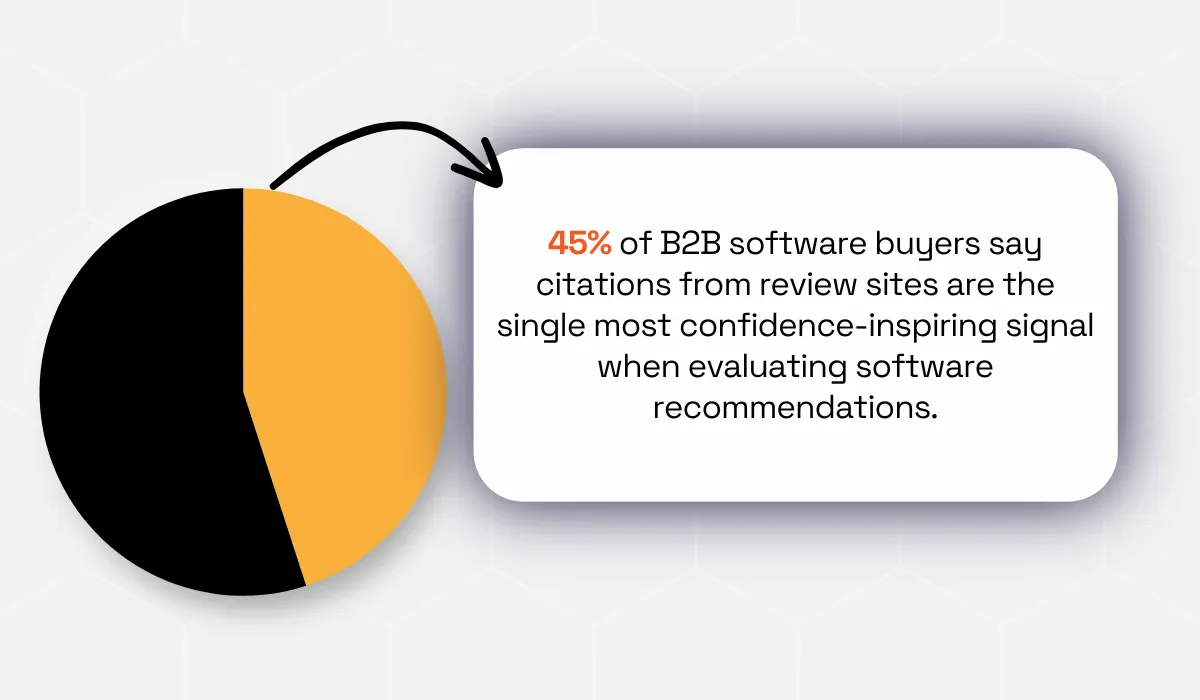
According to G2's 2026 AI Search Insight Report, 45% of B2B software buyers say citations from review sites are the single most confidence-inspiring signal when evaluating software recommendations.
So, if customer reviews influence buying decisions, then understanding the sentiment behind those reviews becomes a competitive advantage.
Sentiment analysis helps uncover the themes that shape purchase decisions, revealing what customers consistently value, what frustrates them, and where competitors repeatedly fall short.
SaaS company TechSmith applied a similar approach by categorizing open-ended customer feedback into common themes before prioritizing product improvements.
The insights helped its UX team validate design decisions with real customer data, uncover usability issues that analytics alone couldn't explain, and reduce costly guesswork throughout the product development process.
The same approach can be applied to competitive research too.
If users across G2, Reddit, Trustpilot, Capterra, and other communities repeatedly complain about a competitor's onboarding process, limited integrations, poor support, or confusing pricing, you've uncovered valuable insights into feature gaps, positioning opportunities, and unmet customer needs.
Companies that consistently analyze customer reviews gain a deeper understanding of buyer expectations, refine their positioning faster, and spot competitive opportunities long before they appear in analyst reports or market research.
Enrich Your Existing Data
SaaS research cannot be confined to the first 10 pages of Google or just some internal reports.
Competitor data and research need to be enhanced with external structured business intelligence like company firmographics, technographics, funding, hiring signals, and market relationships for a more complete picture.
Veridion was built for exactly this.
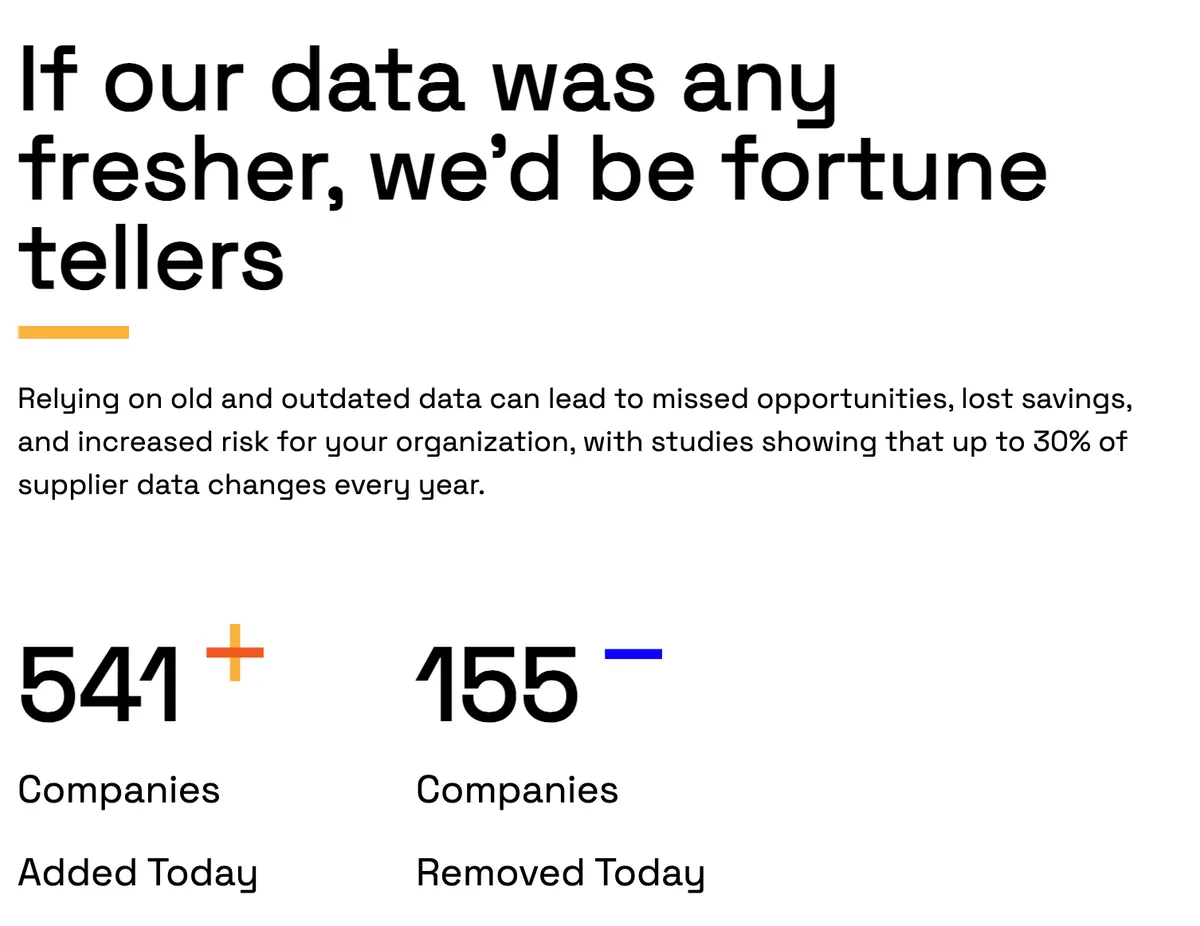
Veridion tracks more than 693M companies across 250 countries, refreshing its data weekly, with each profile carrying over 461 attributes.
These include technographics, funding signals, hiring activity, market relationships, and more.
Source: Veridion
This kind of data helps in two specific ways.
Competitor discovery
Instead of manually searching for every company in your category, you can extract entire lists of businesses that match your criteria, then surface adjacent players that a normal search would never turn up.
Profile enrichment
Once your core competitor list exists, you can expand each entry with details that a spreadsheet or a sales call would never surface, like employee count trends, technology stack, and recent business activity.
Enrichment especially matters if your existing research is thin.
If you've only found three companies in a category, structured data can tell you whether there are fifteen more you missed entirely.
And data decays fast: a competitor's funding, headcount, or tech stack today may look completely different next quarter.
So, the goal isn't to replace the research you already have but to check that research against a wider, constantly refreshed picture of the market, so your competitor list doesn't go stale with time.
Perform a SWOT Analysis
SaaS is a dynamic industry. Funding, features, and entire categories can shift overnight.
And that’s why SaaS companies must regularly perform SWOT (Strengths, Weaknesses, Opportunities, and Threats) analyses to understand:
- How the industry is moving
- How competitors are moving
- What trends are emerging, and more
This is especially critical given the heavy advancement of AI.
Take Claude Code, for instance, and how it has completely changed the industry.

Source: Fortune
Earlier this year, CNBC journalists recreated a fully functional Monday.com clone using Claude Cowork, despite having no software engineering background.
Following weaker-than-expected quarterly guidance, softer full-year revenue projections, and the widely publicized AI experiment (showing how easily its core product could be replicated), Monday.com's stock fell by nearly 20%.

Source: Yahoo Finance
The bigger story here is how quickly the barriers to creating software have collapsed.
What once demanded dedicated engineering teams, months of development, and significant capital can now be assembled through conversational prompts, AI agents, and low-cost APIs.
In other words, the cost of entry and experimentation has effectively fallen to near zero.
If AI and vibe coding can generate customized internal tools on demand, organizations may begin questioning whether they need to license another SaaS platform at all.
Lex Zhao, General Partner at One Way Ventures, a Boston-based venture capital firm, captures the current market sentiment to the point:
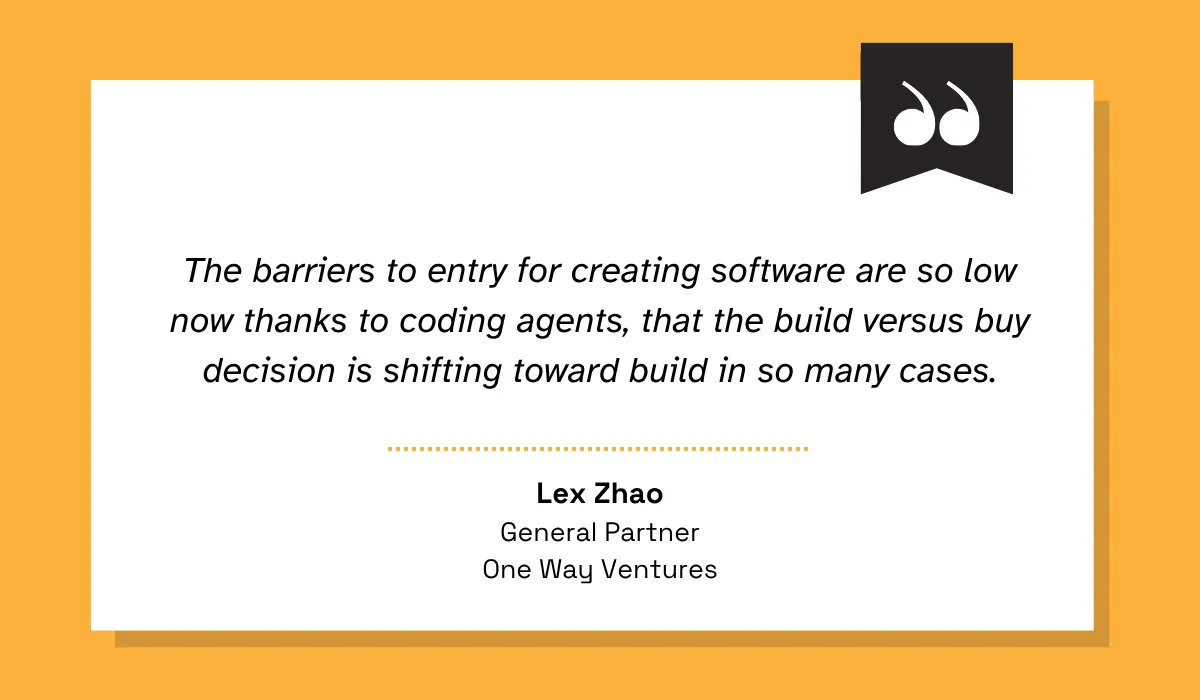
Illustration: Veridion / Quote: TechCrunch
In such an environment, regularly and rigorously performing a SWOT analysis is a must.
Threats don't always look like threats until it's too late.
Your SWOT should be updated as market dynamics shift to ensure you aren't caught off guard by the next Claude Code or AI-native disruptor.
Conclusion
Competitive analysis should never be a one-time project.
Markets evolve, AI reshapes industries, and customer expectations change constantly.
SaaS companies that consistently monitor competitors, validate assumptions with data, and adapt their strategy are far more likely to stay relevant and build lasting competitive advantages.
Articles
Discuss how these trends affect your organization.
Our analysts are available for a short call. Bring a specific question and we will ground it in the data.
Insights
Keep reading
More analysis, research, and outcomes grounded in live company intelligence.
5 Types of Tools for SaaS Competitive Analysis
Explore 5 types of tools you can use to enhance your competitive intelligence, with a focus on specific platforms and their key features.
Want to Get Started with SaaS Competitive Analysis? Here's What You Need to Know
Struggling with SaaS competitive analysis? Uncover the essential strategies to understand your rivals, and identify market gaps.
9 Essential Sources of Market Intelligence
Want to boost your market knowledge? These 9 market intelligence sources will show you where to look and how to apply the insights.