Insights / Articles
Sector-Specific ESG: Adjusting Pillar Weightings for High-Risk Industries
This article will explain how sector-specific ESG pillar weightings help account for different risk exposures across high-risk industries.

- Different industries require different ESG scoring priorities to accurately reflect their risks.
- The same ESG score can tell very different stories depending on the sector.
- Real-time controversy monitoring can uncover risks before traditional ESG scores change.
- Comparing companies to industry peers leads to more meaningful ESG insights.
If you're responsible for Environmental, Social, and Governance (ESG) risk across a multi-sector portfolio, you've probably encountered the same problem: a scoring model that treats a mining company and a healthcare provider as if they should be measured by the same ESG yardstick.
The result isn’t a fair comparison.
It can overstate risk in some industries, understate it in others, and make it harder to identify the companies that deserve the closest attention.
Leading ESG frameworks address this challenge by tailoring pillar weightings and material issues to each industry’s risk profile instead of relying on a one-size-fits-all model.
In this guide, you’ll learn how to build a sector-specific ESG scoring model by identifying high-risk industries, adjusting pillar weightings, monitoring relevant controversies, and benchmarking companies against their peers.
1. Identify Your High-Risk Industries
Effective ESG weighting starts with understanding that material risks vary by industry.
Applying the same ESG weighting across every company can obscure the issues most likely to affect enterprise value.
For example, climate transition and emissions dominate ESG exposure for electric utilities, while governance risks such as anti-money laundering (AML), board oversight, and business ethics are typically more material for financial institutions.
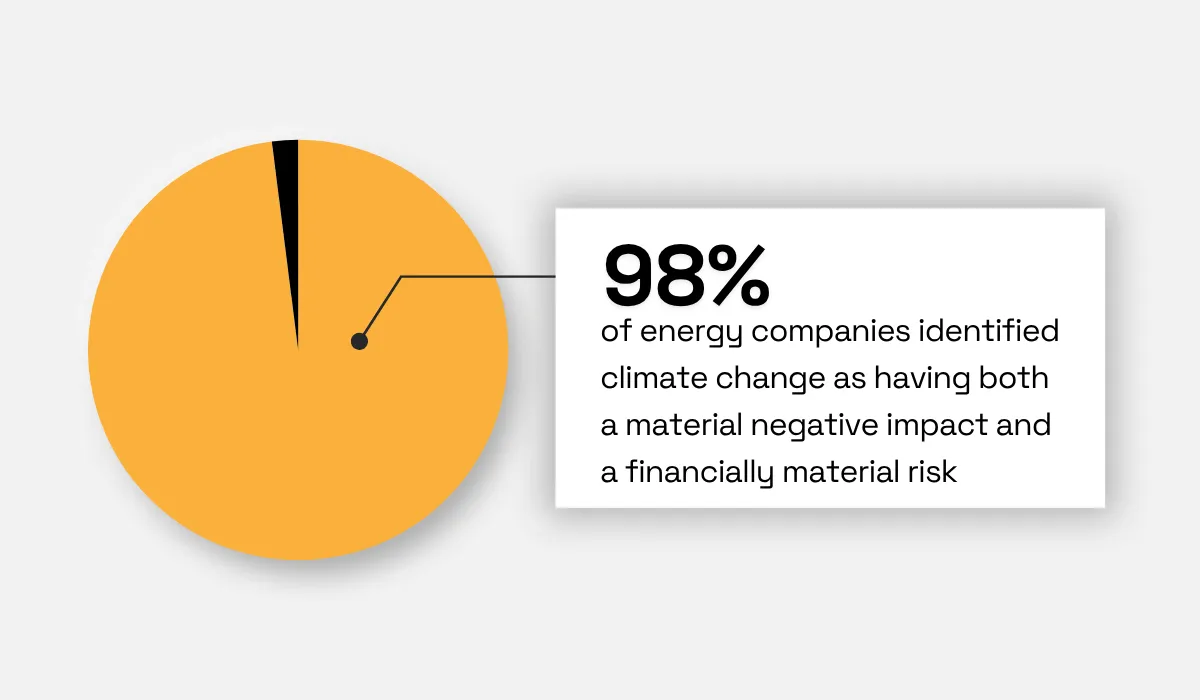
According to the 2025 Global Corporate Sustainability Report by the Organisation for Economic Co-operation and Development (OECD), 98% of energy companies reporting under the Corporate Sustainability Reporting Directive (CSRD) identified climate change as having both a material negative impact and a financially material risk, underscoring the sector's heavy environmental exposure.
Rather than building your model around a universal ESG formula, start by identifying the industries in your portfolio and the risks that matter most to each.
Established ESG frameworks provide a strong foundation for making these decisions.
1a. Map Which Pillars Matter Most Per Sector
For each industry in your portfolio, identify the ESG pillar that carries the greatest financial and operational risk.
Rather than assigning equal importance to Environmental, Social, and Governance factors, established ESG frameworks prioritize the pillars that are most financially material for each sector.
The table below provides a practical starting point for mapping industries to their dominant ESG priorities:
Industry | Dominant ESG pillar(s) | Key ESG risk drivers |
|---|---|---|
Utilities & Energy | Environmental | Greenhouse gas emissions, climate transition, pollution, water management, resource efficiency |
Mining & Materials | Environmental | Biodiversity impacts, tailings management, emissions, water use, community impacts |
Financial Services | Governance | Business ethics, AML, regulatory compliance, board oversight, financial transparency |
Healthcare | Governance & Social | Product safety, patient welfare, data privacy, ethical business conduct, regulatory compliance |
Manufacturing & Apparel | Social | Labor rights, worker safety, supply chain conditions, human rights |
Software & Technology | Social & Governance | Data privacy, cybersecurity, responsible AI, product governance |
Materiality is not a one-size-fits-all concept.
The ESG issues that matter most depend on a company's industry, business model, and risk profile.
Use these priorities as a starting point rather than fixed rules.
Adjust them to reflect each company's business model, geographic footprint, regulatory environment, and specific risk profile.
1b. Pull Sector-Specific Material Issue Lists
Once you've identified the dominant ESG pillar for each sector, determine the specific issues you'll measure within it.
Rather than creating your own list of "important" ESG topics, start with an established materiality framework.
For example, Morningstar Sustainalytics, an ESG research and data company, begins with a standardized universe of 20 Material ESG Issues (MEIs) but identifies only the five most relevant issues for each industry based primarily on its level of exposure.
An electric utility is therefore assessed against a different combination of ESG risks than a software provider or investment bank.
Using an established framework makes your scoring model easier to explain and benchmark because it is grounded in financially material risks rather than internal assumptions.
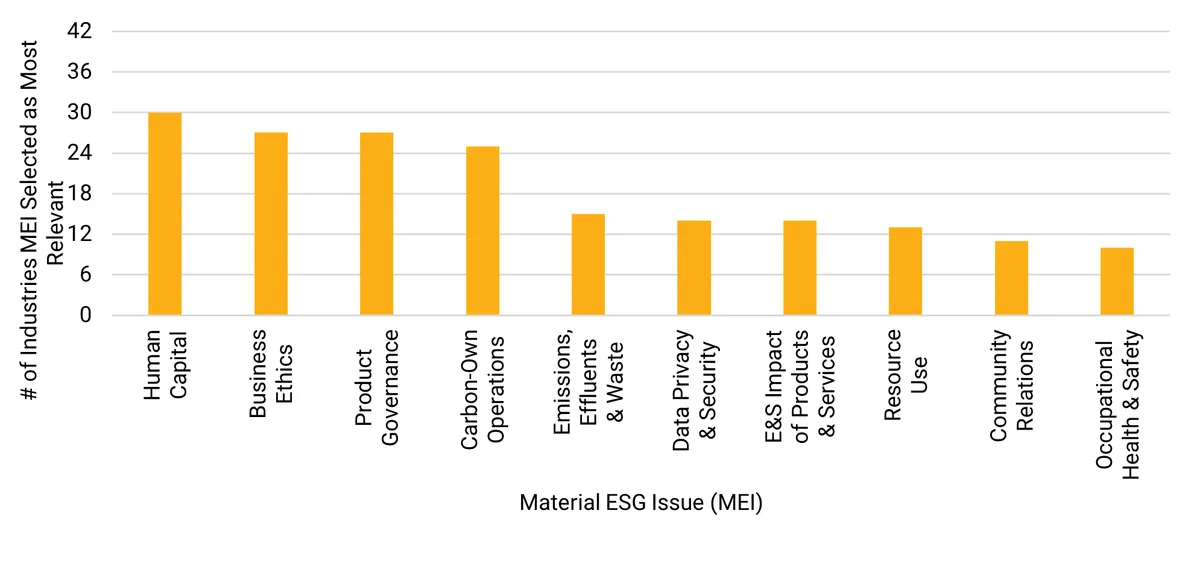
Sustainalytics' own research also shows that while human capital, business ethics, and product governance appear among the five most material issues for the majority of industries, every sector still has its own unique mix of ESG risks.
Source: Sustainalytics
That balance between consistency and sector specificity is what makes established materiality frameworks a stronger foundation than a one-size-fits-all checklist.
2. Adjust Pillar Weightings to Match Sector Risk
Once you’ve identified the ESG issues that matter most to each industry, translate those priorities into your scoring model.
Increase the influence of the pillars that represent the greatest sources of risk instead of assigning equal weight to Environmental, Social, and Governance factors by default.
This creates ESG scores that better reflect how companies are actually exposed to sector-specific risks.
2a. Increase Weight on the Dominant Risk Pillar
Assign greater weight to the ESG pillar that carries the greatest financial and operational risk for each industry.
Established ESG frameworks already follow this principle, increasing Environmental weighting in sectors such as utilities, energy, and materials, while giving greater emphasis to Governance or Social factors in industries such as financial services and healthcare.
The table below illustrates how pillar weighting typically shifts across major industries:
Industry | Higher-weighted pillar(s) | Why it receives greater emphasis |
|---|---|---|
Utilities & Energy | Environmental | Emissions, climate transition, pollution, water management |
Mining & Materials | Environmental | Biodiversity, resource extraction, tailings, community impacts |
Financial Services | Governance | Business ethics, AML, regulatory compliance, board oversight |
Healthcare | Governance & Social | Product safety, patient welfare, regulatory compliance, data privacy |
Manufacturing & Apparel | Social | Labor rights, worker safety, supply chain conditions |
Software & Technology | Social & Governance | Data privacy, cybersecurity, responsible AI, product governance |
The exact percentages vary by industry, but the principle remains consistent: weight ESG pillars according to financial materiality rather than applying a fixed formula across every company.
Data and research company MSCI’s 13-year study comparing equal-weighted, statistically optimized, and industry-specific ESG weighting approaches found that the industry-specific methodology delivered the strongest long-term financial performance, even though equal weighting appeared competitive over shorter investment horizons.

Source: MSCI
If you encounter an industry outside your existing framework, search for “[sector] material ESG issues” using trusted sources such as Sustainalytics, MSCI, the Sustainability Accounting Standards Board (SASB), or relevant industry regulators.
Building on an established materiality framework is faster, easier to justify the methodology, and more consistent than estimating pillar weightings from scratch.
2b. Keep Governance Weight Consistent Across Sectors
While Environmental and Social weightings often shift significantly between industries, Governance typically remains a consistently important part of the scoring model.
Weak board oversight, bribery, corruption, financial misconduct, poor executive accountability, and ineffective risk management can destroy enterprise value regardless of what a company produces or the markets it serves.
Established ESG frameworks reflect this by adjusting Environmental and Social weightings more aggressively while maintaining Governance as a stable foundation across industries.
A utility and a bank face different operational risks, but both depend on effective governance to manage compliance, oversee strategy, and respond to emerging ESG challenges.
Recent events reinforce this point.
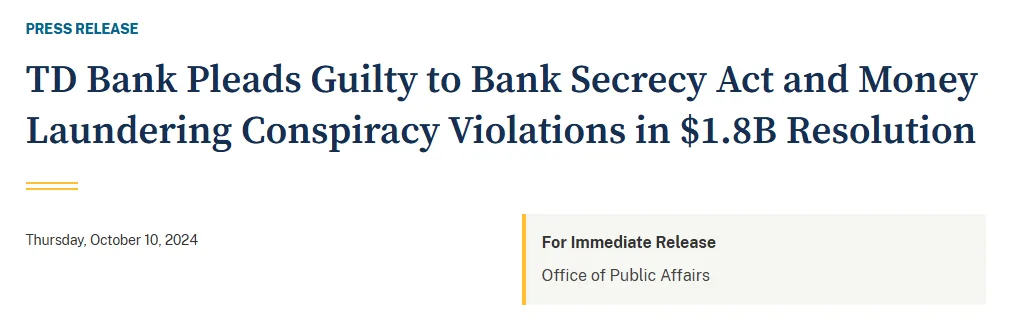
In 2024, TD Bank pleaded guilty to anti-money laundering violations after U.S. authorities found long-standing failures in its governance and compliance controls.
Source: U.S. Department of Justice
The case resulted in billions of dollars in penalties and demonstrated how governance failures can create material financial, operational, and reputational consequences regardless of industry.
That doesn't mean Governance should receive identical weighting everywhere.
Highly regulated sectors or industries with elevated corruption risk may still warrant modest adjustments.
However, maintaining a meaningful governance weighting helps ensure that systemic leadership and oversight failures remain visible, even when Environmental or Social risks dominate a particular sector.
3. Set Up Controversy Signal Tracking by Category
A well-designed ESG weighting model should be complemented by continuous controversy monitoring.
While ESG scores capture a company's underlying risk profile at a point in time, controversies reveal how that risk is changing between assessment cycles.
Tracking both gives you a more complete view of current ESG performance and emerging risks.
3a. Define the Controversy Categories to Monitor
Not every controversy deserves the same level of attention.
Focus your monitoring on the categories that pose the greatest risk to each industry rather than tracking every possible ESG incident equally.
This reduces noise and helps your teams respond to the events most likely to affect enterprise value.
Use the table below as a starting point for aligning controversy categories with each industry's primary ESG risks:
Industry | Priority controversy categories |
|---|---|
Utilities & Energy | Environmental incidents, emissions, pollution, regulatory non-compliance |
Mining & Materials | Environmental damage, community impacts, bribery, human rights |
Financial Services | Fraud, AML, corruption, governance failures |
Healthcare | Product safety, patient privacy, clinical ethics, regulatory violations |
Manufacturing & Apparel | Labor rights, worker safety, forced labor, supply chain conditions |
Software & Technology | Data privacy, cybersecurity, responsible AI, product governance |
Greenwashing has also become a growing controversy category for organizations making sustainability claims.
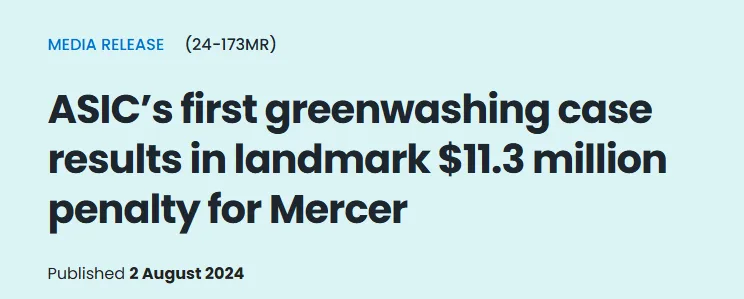
In 2024, the Australian Securities and Investments Commission (ASIC) secured an A$11.3 million penalty against Mercer Superannuation after the Federal Court found the company had made misleading statements about the sustainability characteristics of certain investment options.
Source: ASIC
The case illustrates how overstated ESG claims can quickly evolve into material governance and reputational risks.
Rather than creating your own controversy taxonomy, build on an established framework.
Standardized categories such as environmental impact, labor and human rights, business ethics, product governance, corporate governance, and community relations make your monitoring process easier to scale, benchmark, and justify to stakeholders.
3b. Tag Signals by Severity and Confidence
Assign every controversy signal two attributes: a severity level and a confidence score.
This helps distinguish genuinely material events from the constant stream of ESG-related news.
Severity measures impact.
It estimates how much a controversy could affect a company's operations, finances, legal exposure, or reputation.
A high-severity event, such as a major corruption investigation or a large-scale environmental incident, should receive greater attention than an isolated compliance violation with limited business consequences.
Confidence measures certainty.
Early media reports or single-source allegations should generally receive lower confidence scores until additional evidence emerges, while findings from regulators, court rulings, or multiple independent and credible news outlets warrant much higher confidence.
This distinction matters because credible controversy signals can influence markets quickly.
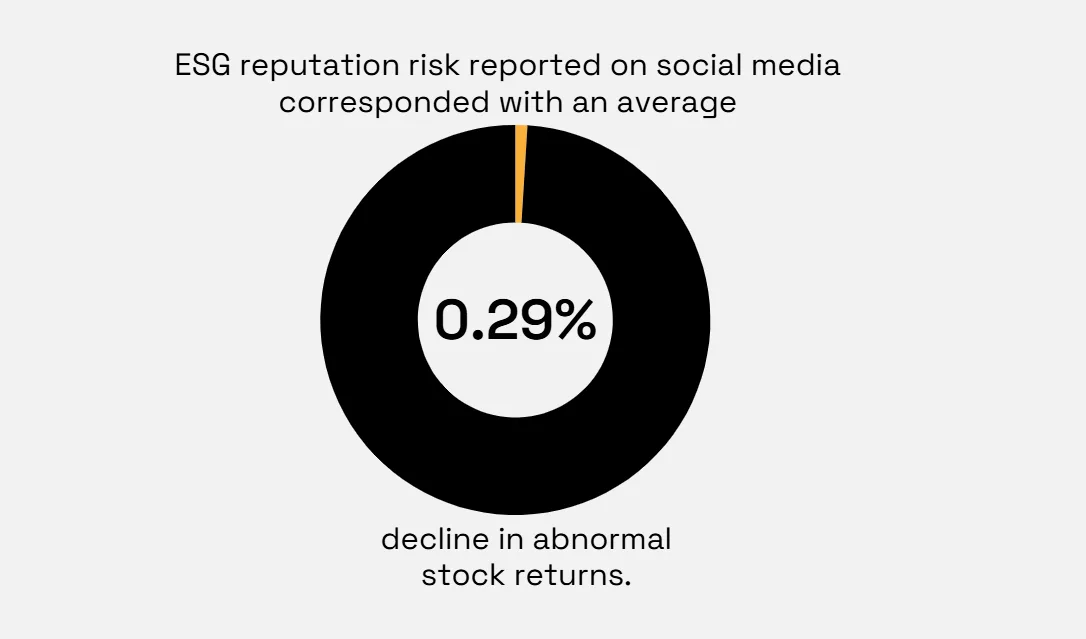
A 2023 event study found that ESG reputation risk events identified through social media were associated with an average 0.29% decline in abnormal stock returns, suggesting that investors quickly incorporate significant ESG controversies into company valuations.
A practical way to apply this framework is to treat controversy signals as dynamic rather than binary.
A report alleging labor violations at a manufacturing supplier may initially receive a medium-severity, low-confidence classification while investigations are ongoing.
If regulators later confirm widespread abuses and impose penalties, the same signal can be upgraded to high severity and high confidence, triggering enhanced due diligence, supplier reviews, or risk mitigation measures.
The goal is not to eliminate uncertainty, but to manage it systematically.
Pairing severity with confidence allows your ESG program to respond proportionately as new information emerges instead of treating every controversy as equally urgent or equally credible.
4. Apply Industry-Relative Benchmarking
An ESG score only becomes meaningful when viewed in context.
Rather than comparing every company against a single cross-industry benchmark, evaluate organizations against peers operating under similar regulatory, operational, and market conditions.
This ensures that ESG performance reflects how effectively a company manages the risks that are most material to its own industry.
4a. Compare Companies Within Their Own Sector, Not Across All Industries
Benchmark every company against others in the same industry rather than against the entire market.
A score only becomes actionable when it reflects how a business performs relative to organizations facing similar ESG challenges.
For example, knowing that a manufacturer scores 72 out of 100 provides limited insight on its own.
Knowing that the same score places it in the top quartile of manufacturers or below the industry median immediately puts that performance into context.
Likewise, an energy producer and a software company may receive similar overall ESG scores for entirely different reasons because they face fundamentally different ESG risks.
Sector-relative benchmarking becomes even more valuable when combined with structured controversy data.
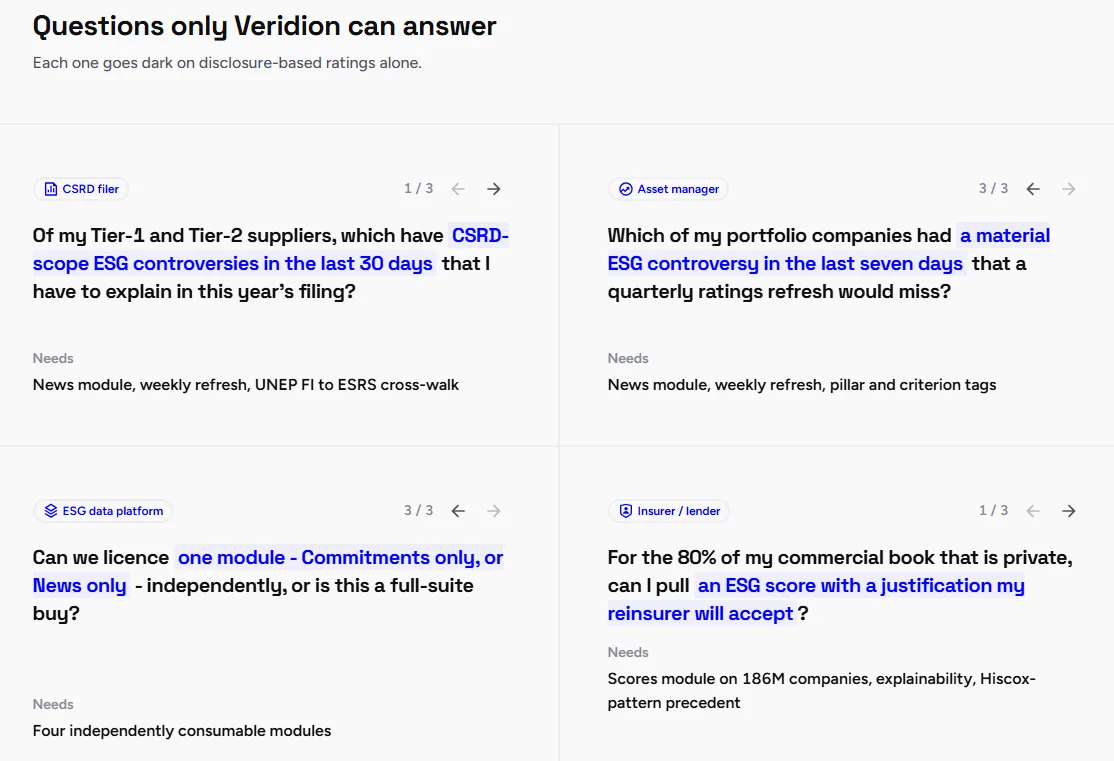
Veridion's ESG News module enriches each controversy signal with pillar tags, theme tags, sentiment classification, confidence scores, and source URLs, giving analysts the context needed to compare companies within their own sectors rather than relying on generic news alerts.
Source: Veridion
For example, a corruption investigation involving a mining company can be evaluated alongside similar incidents affecting other extractive firms, while a data privacy breach can be assessed against peers in the technology sector.
The result is a more evidence-backed view of ESG risk grounded in industry context rather than broad cross-sector comparisons.
4b. Recalibrate as New Controversy Data Comes In
Review your sector weightings regularly rather than treating them as a one-time exercise.
Industries evolve, regulations change, and recurring controversy patterns can shift which ESG issues are most financially material.
A weighting model that accurately reflects today’s risk landscape may become outdated if it isn’t reviewed on a structured basis.
Recent developments illustrate why.
The rapid adoption of artificial intelligence has elevated responsible AI, data governance, and cybersecurity from emerging concerns to material ESG issues for many technology companies.
At the same time, growing regulatory scrutiny of greenwashing has increased the importance of governance, disclosure quality, and environmental claims management for organizations making sustainability claims.
Established ESG frameworks follow a similar approach.
MSCI continuously monitors companies for controversies and governance events, while conducting comprehensive annual ESG Ratings reviews that refresh industry-specific materiality assessments and key issues. Significant controversies can also trigger analyst review and re-rating between annual updates.
Likewise, Morningstar Sustainalytics introduced the first major enhancement to its ESG Risk Ratings methodology since 2018 in 2024, strengthening its corporate governance assessment, refining several material ESG issues, and continuing the evolution of how companies' ESG exposure and unmanaged risk are evaluated.
Both examples reinforce the same principle: even mature ESG methodologies evolve as markets, regulations, and business risks change.
Use controversy trends to inform those reviews.
If companies across a sector repeatedly experience the same category of controversy, such as product safety failures, corruption investigations, labor rights violations, or climate-related litigation, it may indicate that those issues deserve greater emphasis in future ESG assessments.
Looking for patterns across an industry, rather than reacting to isolated incidents, helps identify structural risks before they become embedded in traditional ESG ratings.
As a best practice, review your sector weightings and peer benchmarks at least annually, and sooner if major regulatory changes, technological developments, or recurring controversy trends materially reshape the industry's risk profile.
Combining scheduled methodology reviews with continuously updated controversy intelligence creates an ESG model that remains relevant and aligned with changing business realities.
Conclusion
A single ESG scoring model can't accurately evaluate a portfolio that spans utilities, financial services, apparel manufacturing, and defense contracting.
Each of those sectors faces a fundamentally different mix of environmental, social, and governance risks.
Treating them as identical doesn't produce a neutral assessment: it produces a distorted one, overstating some risks while overlooking others.
Without the right sector context, even a well-designed ESG score can be misleading.
The strongest ESG models are built on industry-specific risk.
Articles
Discuss how these trends affect your organization.
Our analysts are available for a short call. Bring a specific question and we will ground it in the data.
Insights
Keep reading
More analysis, research, and outcomes grounded in live company intelligence.
10 ESG Statistics You Need to Know
Learn how ESG is influencing decisions across industries with these 10 eye-opening statistics. Stay informed and ahead of the curve.
ESG Reporting Frameworks vs Standards: Differences Explained
In this post, you’ll learn the core distinctions between ESG reporting frameworks and standards and when to use each.
How to Gather Market Intelligence In 5 Steps
In this guide, we're breaking down the five key steps you need to take to gather market intelligence that drives real action.