Insights / Articles
The Signals Are There: Reading Early Warning Signs Hidden in Supplier Data
Are you missing crucial signals in your supplier data? Learn to identify emerging market risks before they impact your business.

- Only 42% of organizations can see risk once past Tier 1.
- Product recall costs between US$10 million and US$50 million.
- N-tier suppliers' data is often inaccurate and outdated.
When your suppliers stagger, your entire operation can grind to a halt.
Yet the warning signs are often buried in the data long before a disruption strikes.
A shipment lands two days late. A defect rate creeps up half a point. A payment term request shifts from net 60 to net 30.
None of these appear to be crises on their own.
But, when taken together, they tell a story that no procurement team would ever know, as the information is in five separate locations and nobody makes a connection until something goes wrong.
Here is where those signals hide, and how to act on them before a crisis hits.
Key Early Warning Signs Hidden in Supplier Data
Supplier risk rarely announces itself. It shows up first as small, easy-to-dismiss changes in delivery, quality, finances, and pricing.
Track any one of these on its own, and you will miss the pattern. Track issues together, and you get an early view of which suppliers are drifting toward real trouble, often months before that trouble reaches your production line.
Declining On-Time Delivery Performance
On-Time, In-Full (OTIF) delivery is one of the primary measures of supplier viability. When an organization repeatedly fails to meet its deadlines, there may be a number of underlying issues that need to be addressed.
Major buyers treat OTIF seriously. Walmart, for example, set a 98% OTIF requirement and fines shippers 3% of the cost of goods sold for every missed order.
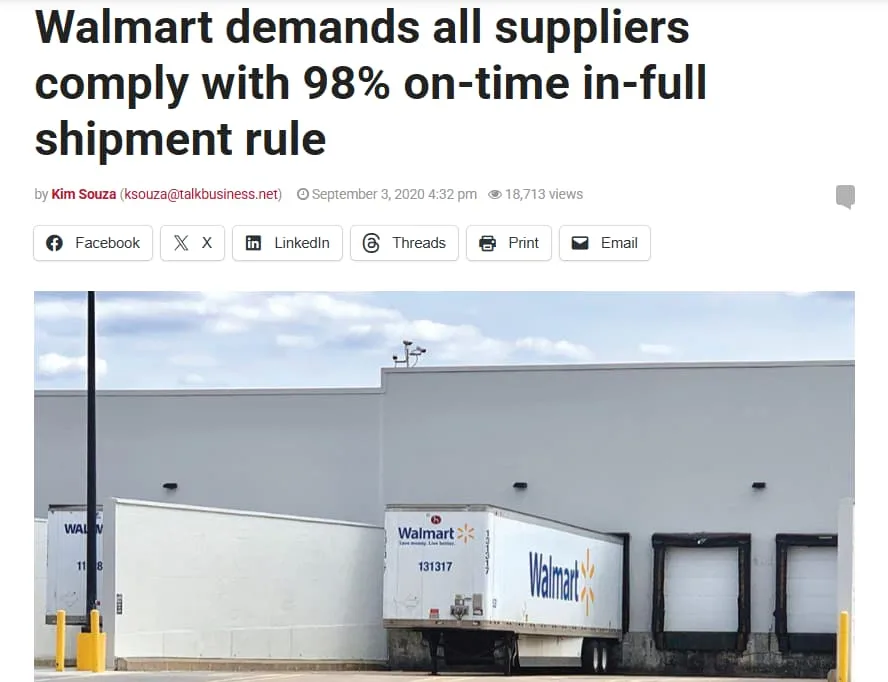
Source: Talk Business & Politics
Most industries now treat a score between 95 and 99% as healthy. A supplier who slides from 97% to 89% over two quarters is telling you something about their operations.
Delivery problems can quickly escalate.
For instance, the 2021 global semiconductor shortage cost the global auto industry an estimated 210 billion dollars in lost revenue in a single year, as major automakers idled plants waiting on parts that were, on paper, simply running late.
When tracking delivery performance, however, what matters is not a single late shipment. What matters is the trend.
Suppose a supplier delivered 98% of orders on time last quarter. This quarter, performance falls to 96%. Next quarter it reaches 93%.
Nothing catastrophic has happened yet. But something inside that supplier's operation has changed.
Perhaps production capacity is stretched. Perhaps skilled workers have left. Maybe raw materials are arriving late. Whatever the cause, declining OTIF often appears weeks or months before a major disruption.
Track delivery performance as a trend line rather than a scoreboard of individual misses.
Pull OTIF by supplier over a rolling four-to-six quarters and watch where the trend is heading. Observe:
- Monthly OTIF percentages
- Average lead times
- Expedited shipments
- Promised dates against actual delivery dates
Then separate the causes of the delay. Is the delay coming from the supplier's production floor, a carrier, or changes on your side of the order?
Each cause points to a different fix.
The earlier you detect those patterns, the more options you have.
You can discuss recovery plans, diversify sourcing, temporarily increase inventory, or qualify alternative suppliers before production is affected.
Increasing Product Quality Issues
Rising defect rates or inspection failures are another early warning. They are usually the first visible sign of a supplier's quality system breaking down and, by the time a recall occurs, the warning signs have often been there for months.
If a supplier's defect count, customer returns, or warranty claims start to climb, it signals their process is degrading.
Expert surveys show that supplier faults cause a large share of recalls.
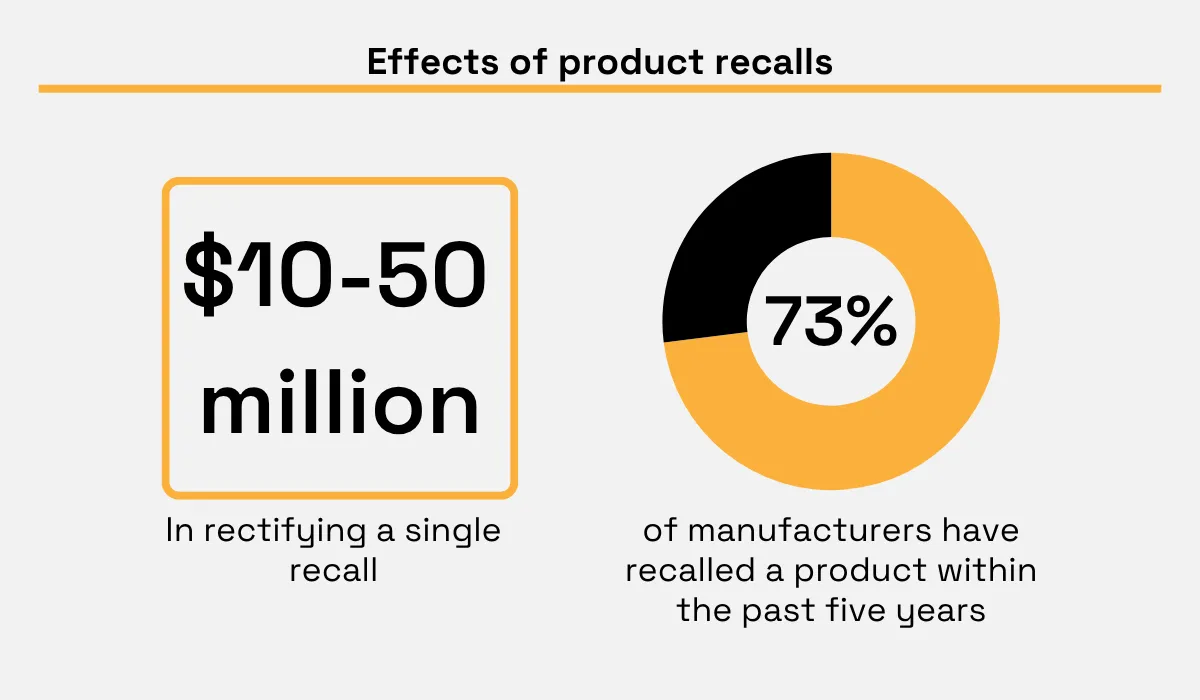
An ETQ 2024 survey of more than 750 senior quality professionals across the US, UK, and Germany found that 73% of manufacturers had recalled a product within the past five years and 48% said there have been more recalls today than there were five years ago.
As for the cost effect of recalls, 39% of US organizations estimated a single product recall costs between US$10 million and US$50 million, excluding reputational damage, lost customers, and regulatory penalties.
The same research revealed a gap in awareness: 70% of manufacturers believed they had control over their suppliers, while 61% admitted supplier issues were behind as much as half of their recent recalls.
Develop a supplier quality scorecard that tracks defect rates, inspection failures, and warranty claims over time, and review it on a set schedule rather than only after a customer complains.
A steady uptick in defects or inspection rejections is a sign to act.
Treat outside signals such as lawsuits, regulatory findings, and trade press coverage about a supplier as inputs to your own risk file, not someone else's problem.
Collecting this information across your buying organization will reveal the trend long before a defect reaches your hands.
Financial Stress Indicators
A supplier rarely goes from stable to insolvent overnight. Financial distress usually shows up first in smaller signals.
Slower payments to their own vendors, requests to renegotiate your payment terms, executive departures, or a wave of layoffs tend to arrive long before a bankruptcy filing makes the news.
Recent history offers a clear warning. Bohai Trimet, a German maker of gearboxes and body components that supplies Volkswagen, filed for bankruptcy in 2025.
Volkswagen was already navigating rough waters and had reported a 15% decrease in revenue in 2024 compared to 2023.
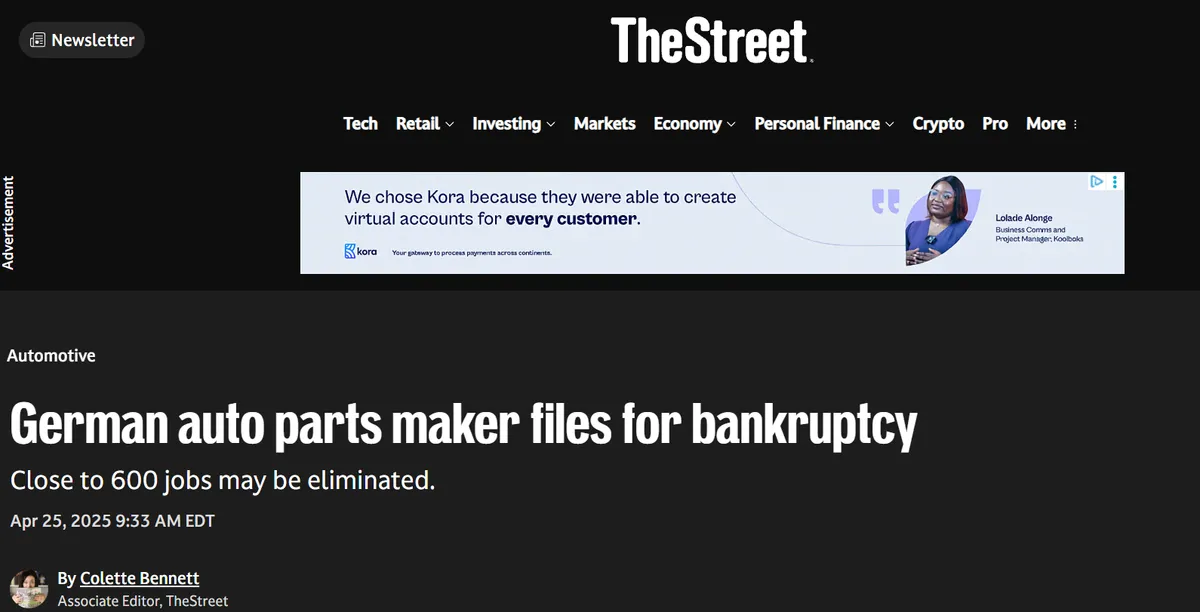
Source: The Street
Automotive bankruptcy filings across the industry climbed to decade-high levels by the end of 2025, driven by weak demand, rising costs, and tariff pressure on already-thin margins.
Cases like this highlight why financial monitoring should become a routine part of supplier management rather than something reserved for critical vendors.
Monitor the financial stability of the supplier by subscribing to credit-reporting agencies or risk-score dashboards that signal downgrading.
For publicly held suppliers, monitor stock performance and analyst warnings.
For privately held ones, request regular financial statements or have third-party agencies like Dun & Bradstreet, Moody's, and others assign credit ratings.
Where you can, track credit ratings, covenant news, and leadership changes for critical suppliers the way an investor tracks a public company.
By the time a bankruptcy filing appears in the news, the lead time you needed to react is usually gone.
Watch out if the supplier's profit margin changes drastically or its debt-to-equity ratio increases sharply.
Behavior patterns such as unusually strict payment deadlines or price discounts could also signal cash problems.
Additionally, a supplier demanding payment in a rush, showing up late in its credit report, or postponing an expansion program tells you something.
Once you have identified a problem, respond quickly by negotiating, placing orders, and switching suppliers.
Remember, timely action on a late-pay signal could prevent a major shipment halt.
Frequent Pricing Changes
Repeated, unexplained price hikes from a supplier can signal trouble too.
A supplier who renegotiates pricing once might be responding to a genuine shift in the market.
A supplier who does it every quarter is signaling something less stable, whether that is thin margins, exposure to volatile inputs, or a business under pressure to protect cash flow at your expense.
Commodity volatility is high: according to Aon's 2025 Global Risk Management Survey, commodity price risk ranked sixth among organizations' top global business risks and is expected to become even more significant over the next three years.
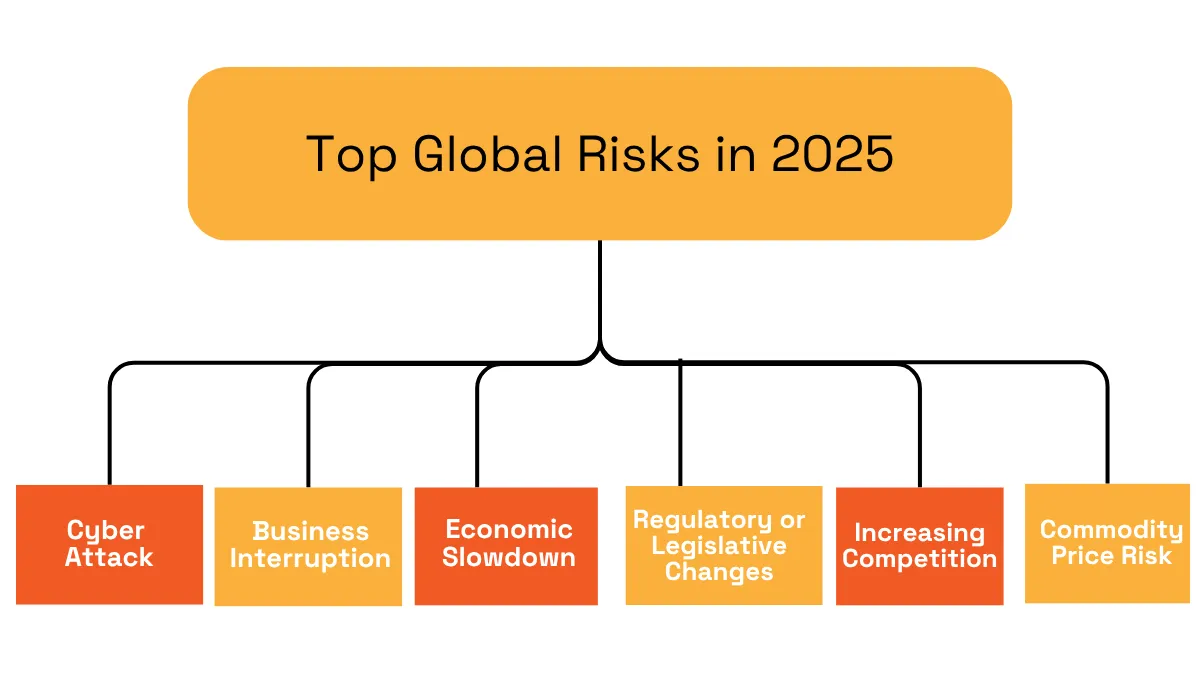
Nearly half of surveyed organizations also reported experiencing financial losses due to commodity price volatility.
If one supplier keeps raising prices or adding new surcharges, it may reflect supply constraints or cost inflation rather than normal market shifts.
Keep track of any discussion on price changes with your supplier. You need to document when this happens, how much the price changes, and what reasons are given for it.
Over time, this creates a pattern that you can compare with public commodity indexes. When a supplier experiences rising input costs while the commodity index remains stable, ensure you address this discrepancy immediately.
Where possible, negotiate contracts with clear escalation clauses and defined review periods up front, rather than leaving pricing open-ended.
You should also include clauses in contracts to address inflation or commodity price swings (e.g., index-based pricing).
If a supplier starts spiking prices, ask for data on their raw material costs. Compare their price changes against market indices (many trade associations track commodity trends).
If multiple suppliers in the same category are hiking, consider it a market trend. But if only one is erratic, interview them. It may be better to switch to a more stable vendor.
That structure gives you visibility into changes before they crop up as a surprise on an invoice.
Why Businesses Miss These Early Warning Signs
None of the indicators described above are secret. All of them exist in some form in your organization, whether it's the ERP system, a procurement tool, a spreadsheet made by a category manager two years ago, or an email chain that was never stored correctly.
The problem is not a lack of data. The data never sits in one place long enough for anyone to see the pattern.
The scale of this fragmentation is significant.
That’s supported by a Sphera survey, which asked 250 chief procurement and supply chain officers about how well they understand their lower tiers.
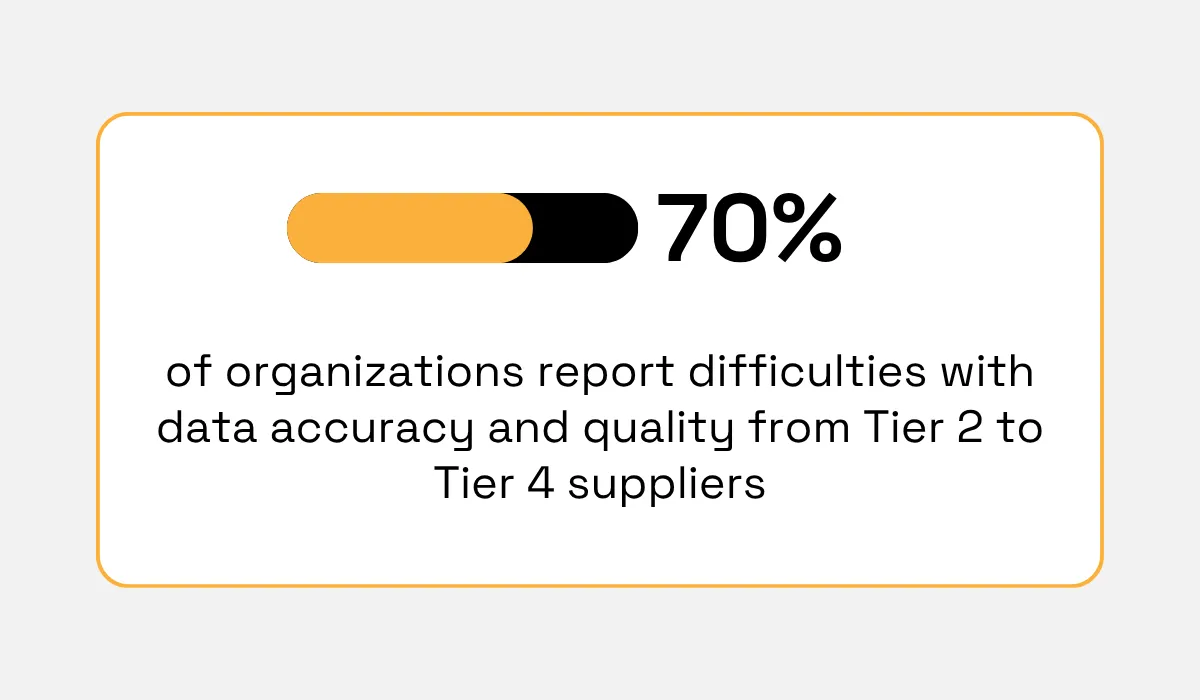
Visibility tends to drop off sharply past a company's direct suppliers.
McKinsey's 2025 Supply Chain Risk Pulse Survey found that just 42% of organizations can clearly see risk once you move past Tier 1 into Tier 2 and beyond.
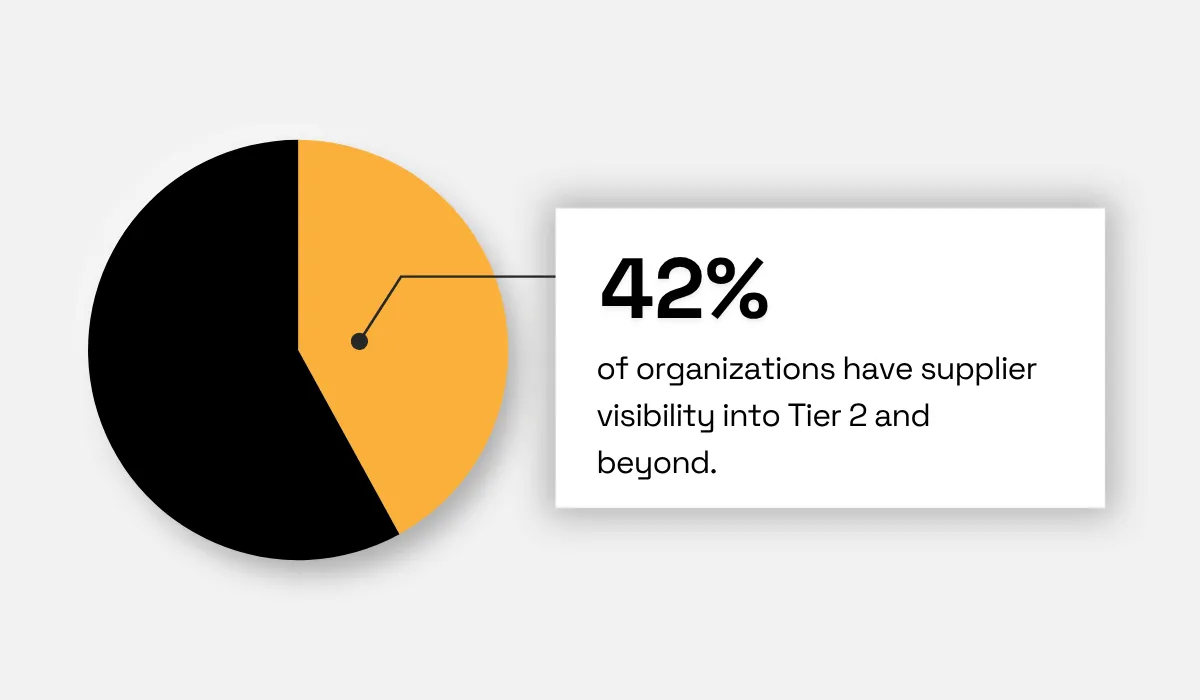
This means that most companies are effectively blind to the layer of the supply chain where much of the operational and financial risk actually starts.
Break down information barriers. Start by mapping where supplier data resides: your enterprise resource planning (ERP) purchase orders, the quality team's spreadsheets, finance's payment logs, and so on.
Adopt tools that centralize data. Even low-tech improvements help. You can require all departments to update a shared supplier record in your ERP or source-to-pay (S2P) system.
Make sure to standardize formats, such as always using the same supplier ID across systems.
Most importantly, automate by integrating APIs or purchasing a supplier risk platform.
For example, some teams use collaboration portals so suppliers can confirm POs directly, updating your system. Others feed news and credit feeds into an alert engine.
The goal is a "single source of truth" for each supplier. That way, when data is integrated, even subtle trends (like a two-month dip in OTIF or a series of small price hikes) will trigger dashboards or alerts, rather than being lost in email chains or spreadsheets.
Connecting Disconnected Data into Actionable Supplier Intelligence
When it comes to supplier intelligence, what you need is not more data but fewer places to find it.
Once all the information on delivery, quality, financials, and pricing is brought together in one place and connected in a single view, the pattern becomes clear, and you have enough time to react.
A centralized supplier intelligence platform continuously ingests diverse data (internal and external) and uses it to alert you to trouble.
For instance, AI-driven tools can pull financial filings, credit scores, news reports, and internal performance logs for every vendor.
The result is a dynamic view of risk that replaces a stale quarterly snapshot.
You'll see not just that Supplier X is struggling, but exactly which contracts or categories are implicated so you can act where it matters.
Automated alerts mean you never have to manually chase reports.
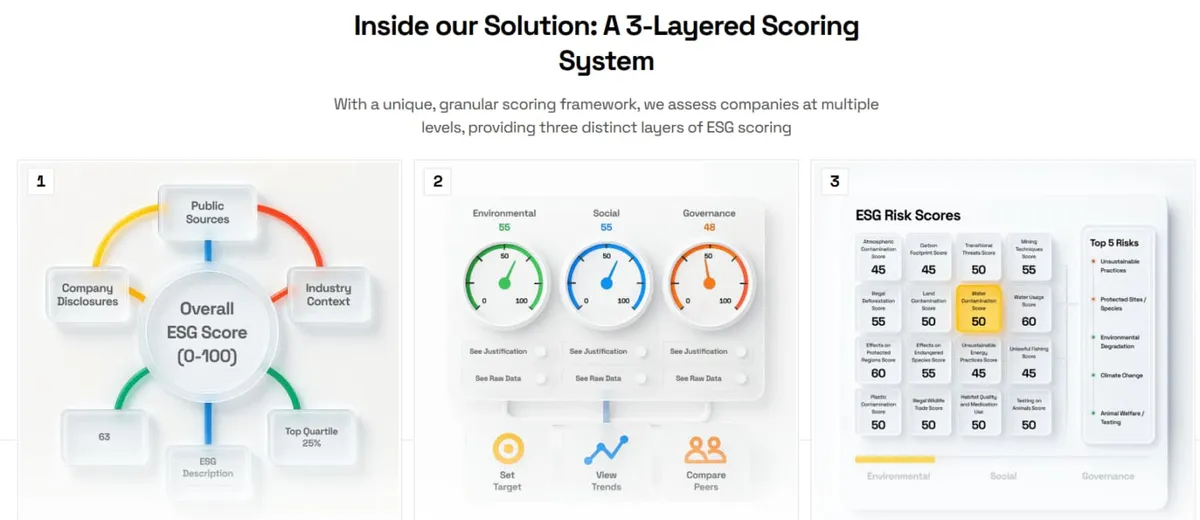
For example, Veridion consolidates all known data on each supplier into unified supplier profiles, from financial filings to product catalogs.
It provides procurement and risk teams with a single, continuously updated source of supplier data covering over 693M companies worldwide, useful in two distinct ways.
Source: Veridion
During sourcing, it helps you find and qualify alternative suppliers quickly once a current one starts showing risk signals, instead of losing weeks to manual research.
During ongoing monitoring, it supports dynamic watchlists and real-time alerts, so a change in a supplier's risk profile surfaces as it happens rather than at the next scheduled review.
Whichever approach you take, the goal stays the same. Fewer blind spots, and enough lead time to act while a supplier's warning signs are still small.
The faster you close the loop between data and decision, the fewer surprises you'll face.
In short, moving from fragmented spreadsheets to a unified intelligence system is how top organizations pre-empt crises.
Conclusion
Each and every disruption you've faced has left a footprint behind: the failure of a shipment, an increase in the rate of defects, the modification of a payment term, an unexplained change in price.
To you, these disruptions are data points your suppliers are already generating, and reading them together, rather than in isolation, buys you something most procurement teams never have: time.
With the right data integration and alerting in place, you'll turn those hidden signals into your competitive advantage and stay ahead of supplier risk.
Articles
Discuss how these trends affect your organization.
Our analysts are available for a short call. Bring a specific question and we will ground it in the data.
Insights
Keep reading
More analysis, research, and outcomes grounded in live company intelligence.
Supplier Intelligence: The Ultimate Guide
Struggling with supplier management? This Supplier Intelligence guide will help you optimize relationships and improve procurement decisions!
How to Build a Strong Market Intelligence Strategy
Learn how to build a strong market intelligence strategy that helps you track trends, understand competitors, and make smarter decisions.
How Successful Companies Use Market Intelligence for Business Growth
Discover how successful companies use market intelligence to unlock new growth opportunities. Learn more in our latest guide.