Insights / Articles
How to Verify Business Addresses and Company Status in India
Tired of unreliable business data? Learn how to find business addresses and verify company status in India with our expert guide.

- India has more than 2 million active companies.
- To verify an Indian business, start with legal records, then move outward.
- Verifying business addresses and status tells you whether the company is what it claims to be.
A new company is registered in India every few minutes, and just as many lie dormant, get struck off, or remain fictitious.
Should you enter into a contract, onboard a vendor, or give credit to an unverified Indian entity, you are bringing that risk into your own organization.
Verifying a company's address and legal status isn't a formality, but a very crucial step for fraud prevention and protection from dealing with non-existent entities.
Here's how to do it in seven steps.
1. Confirm the Company's Legal Registration Status
Your first step is to find out whether the entity in question exists in any official corporate registry. In India, each company or LLP registered in India exists in one single government registry: the Ministry of Corporate Affairs (MCA).
That registry is your starting point for any verification, because it's the one source that ties a business name to a legally enforceable identity.
The MCA's Corporate Data Management portal lists more than 3.1 million companies on its registry, but only about 2 million of them are currently active.
The rest sit dormant, are under liquidation, or have been struck off entirely. A quick registration check tells you which category your counterparty falls into before you sign anything.
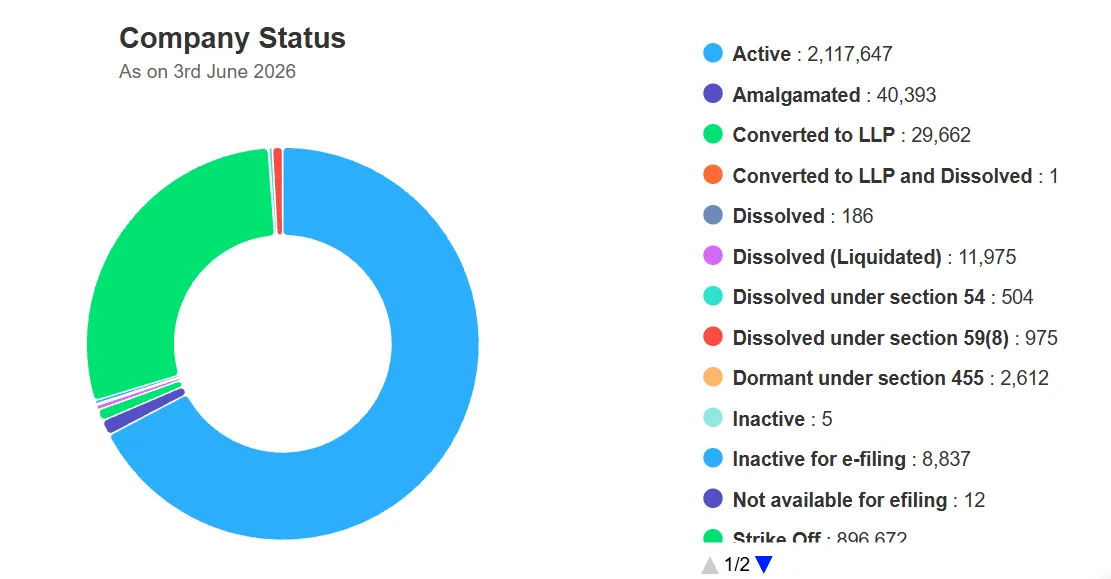
Source: Ministry of Corporate Affairs
You can search the MCA portal by company name or by Corporate Identification Number (CIN) to view:
- the legal company name
- CIN or LLP Identification Number (LLPIN)
- incorporation date
- current status (active, dormant, under liquidation, or struck off)
- registered office address
- names of current directors
This single search answers the most basic question you need answered before signing anything:
Does this company legally exist, and is it still in good standing?
To run the check yourself, go to the MCA's Find CIN tool, enter the company name or CIN, and review the master data that comes back.
Compare the legal name shown on the MCA record against what appears on invoices, contracts, and the company's website.
Small mismatches, an extra "Pvt Ltd," a dropped word, a different spelling, can point to an unrelated entity trying to borrow a reputable name.
Keep in mind that the MCA registry only includes companies and LLPs. The majority of Indian companies are organized as sole proprietorships, partnerships, or Hindu Undivided Families. Such structures are not included in the MCA registry at all.
In such cases, you will need another identifier, which brings us to the tax registry.
2. Verify the Company's Tax and Business Registration Details
After verifying the MCA, move on to tax registration information. The Goods and Services Tax Identification Number (GSTIN) is one of the most reliable secondary identifiers you can get, as virtually any company with substantial turnover in India will have one.
The GSTIN number verifies if the company is registered for indirect taxes and whether its legal and operational identity corresponds to the company's claims.
India had over 15 million active GST registrations by April 2025, according to government statistics. Roughly 80% of these registered businesses were proprietorships that contribute only about 13% of total GST revenue.
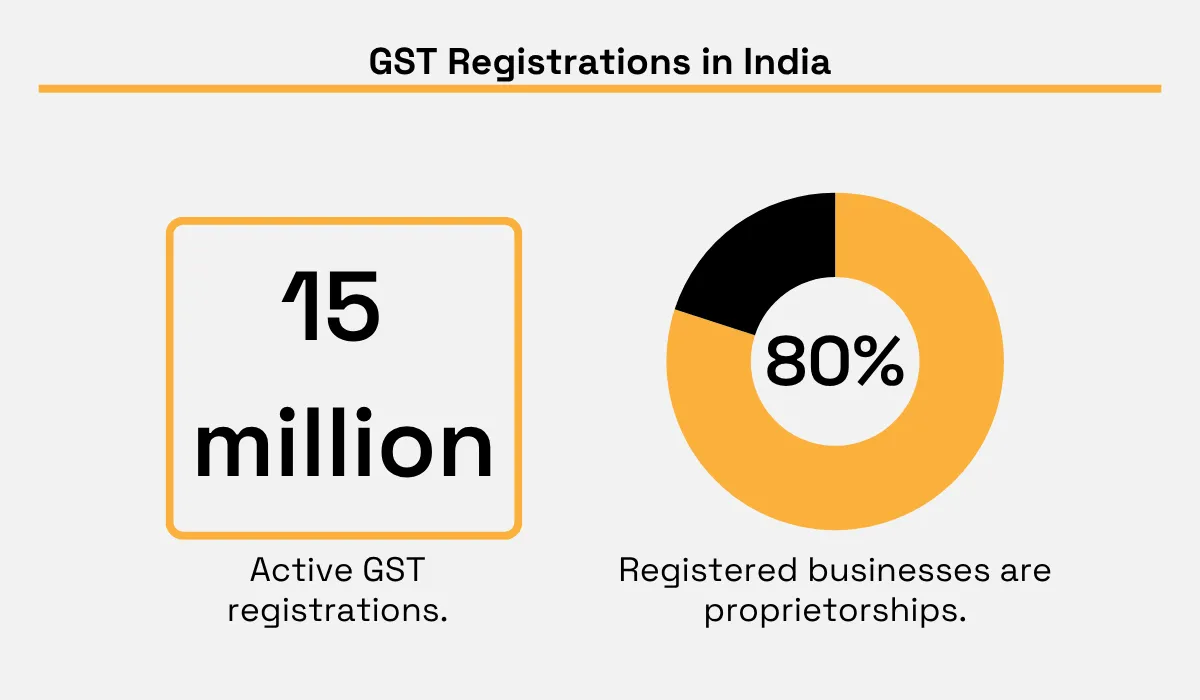
Illustration: Veridion / Data: Press Information Bureau
In other words, most small Indian businesses you'll encounter show up in GST records long before, or instead of, MCA records.
If a supplier only appears in one dataset, that's a reason to check the right register for their entity type, not a reason to panic.
A GSTIN verification helps you check three:
- If the company is registered for GST.
- If the legal name and registered address correspond to what the company claims elsewhere.
- If the taxpayer is active, canceled, or suspended.
To verify the GSTIN of any business in India, do a search on the official GST portal using the 'Search Taxpayer' function. Enter the fifteen-digit number, then check whether the legal name matches your invoice exactly, as well as the registration status and the principal place of business.
Compare the information you get from the above process with the company's website and business directories. Any mismatch in the legal name or address should be a red flag.
3. Verify the Registered Business Address
Once you have legal and tax records, verify the registered address line by line. This is the part many teams rush.
A registered address that looks legitimate on one document can look completely different somewhere else. Unfortunately, most reviewers check one source and stop.
Pull the address from every source you can find: the MCA record, the GST registration, the company's own website, industry directories, and any online business listings such as Google Business Profile or Justdial.
Then line them up side by side. You're checking for three specific things:
- If the company name matches exactly across every listing.
- Whether the address itself is consistent from source to source.
- Whether the postal information, PIN code, state, and district actually resolve to a real, deliverable location.
It's vital to check these three things because there are many Indian companies that use fake or symbolic addresses to hide shell structures. Investigators looking into shell companies in India found that more than 13,500 companies shared an address with at least 19 other companies, a pattern that's rarely innocent at that scale.
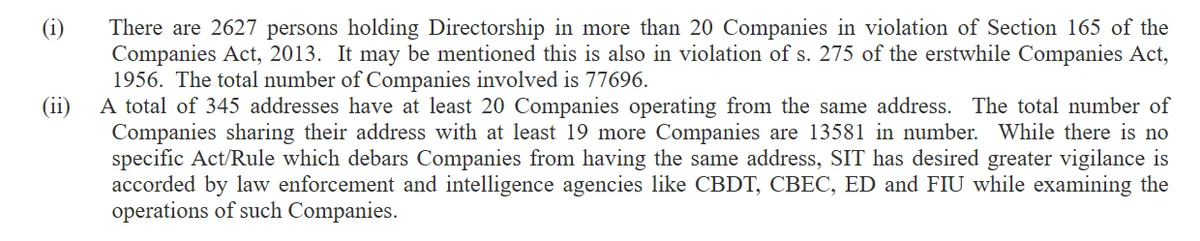
Source: Press Information Bureau
A single mismatched digit in a PIN code or a building number that changes between two filings is a smaller version of the same warning sign.
When you spot inconsistencies, don't assume fraud immediately, but don't ignore it either. Companies legitimately update addresses when they move offices, so check the filing date on the MCA record to see whether the address you're looking at is current.
If a supplier's invoice shows one city and its MCA filing shows another with no update on record, ask directly for an explanation and documentation.
Remember that a registered office is a legal address, not necessarily where the company actually does business.
4. Verify the Actual Operating Location
A registered address shows where a company's legal mail should be sent. It does not show where business takes place.
Many businesses run their operations from a separate site entirely, which is exactly why address verification alone isn't the finish line.
For instance, a company could have registered its office in Mumbai for tax and compliance convenience, but it runs its manufacturing in an industrial area in Gujarat or Tamil Nadu.
If you're evaluating supply capacity, lead times, or logistics costs, you need to know the real operating footprint, not just the legal one.
A simple illustration comes from Maruti Suzuki. Its official office page lists the head office at 1, Nelson Mandela Road, Vasant Kunj, New Delhi.
The same official source lists manufacturing facilities in Gurugram, Manesar, and Hansalpur in Gujarat, and Maruti's 2026 press material adds the Kharkhoda manufacturing facility.
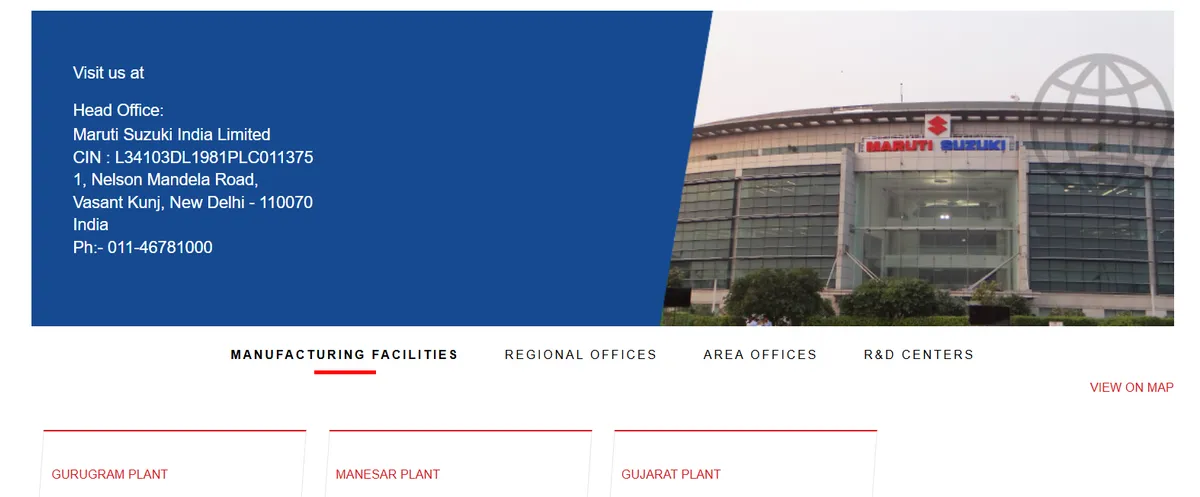
Source: Maruti Suzuki
This is quite normal and is not necessarily an indication of any problem. The issue is different. If you only verify the legal or head office address, you can miss the facilities that actually produce, store, or ship the goods.
If you need to know what the company can actually do, move beyond the registered address. Look for the real operating footprint. That includes offices, factories, warehouses, branches, service centers, and additional business sites.
To confirm the real operating footprint, check Google Maps and business listings for the company's offices, warehouses, or manufacturing units.
Satellite imagery can also confirm whether a facility physically exists and roughly how large it is, which matters if a supplier claims industrial-scale capacity.
Company photos, references to specific industrial parks or SEZs, and press coverage of a facility opening all add supporting evidence.
You should also search the company's own site for branch pages, plant pages, regional office pages, and hiring pages.
If the facility sits in an industrial estate, search the park operator, state industrial development corporation, or manufacturer association for tenant records.
None of this replaces an in-person visit for high-value relationships. But for most verification needs, this combination gives you an accurate picture of where a company genuinely operates rather than where its paperwork says it does.
5. Confirm the Company's Industry and Business Activities
A valid business record is more than a name and address. You also need to know whether the company does what it says it does.
Companies routinely list broad or outdated activity descriptions in their MCA filings, GST registration, or old directory listings, and none of that necessarily reflects current business.
A firm registered under general trading codes might now operate in a narrow, specialized niche, or the reverse.
If your due diligence stops at registration paperwork, you may end up dealing with a company whose actual capabilities look nothing like what you assumed.
To be sure, start by comparing the stated industry, products, services, and customer types across the website, catalogs, brochures, filing language, marketplace pages, and certification claims.
Go further and also compare them against its listings on business directories such as IndiaMART, TradeIndia, or sector-specific industry databases.
Verify sector-specific certifications through official sources. The BIS Care and BIS online tools let you verify license details and product authenticity. At the same time, FOSCOS provides commodity- and category-based search and verification of food business licenses and registrations.
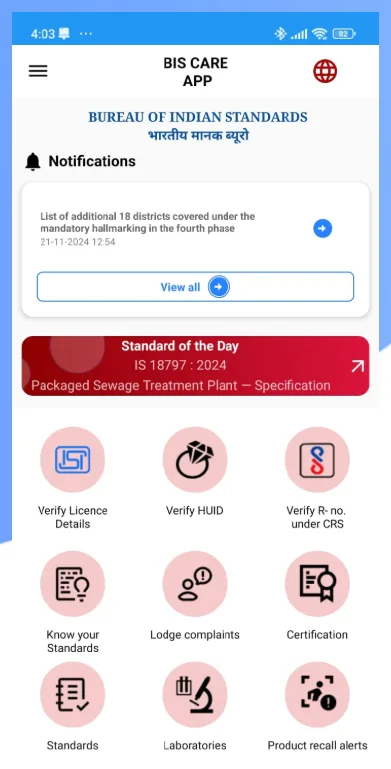
Source: BIS Care
Additionally, look at customer references or case studies where available, and note whether its stated areas of operation line up with what its address footprint suggests is realistic.
Consistency is the signal you're looking for. A company whose website, directory listings, and product claims all tell the same story is more credible than one where each source paints a different picture.
When these things differ, mark the profile as trading, distribution, or unconfirmed until the evidence improves.
6. Check Whether the Company Is Still Active
Registration status indicates that the company legally exists. However, it says nothing about whether the company is actually trading today.
A business can sit on the MCA register as "active" for years after it has quietly stopped operating.
This is the step where you move a business entity from "registered" to "operating" or "inactive."
This distinction matters because dormancy in India is common. According to the Ministry of Corporate Affairs' own data, only about 65% of registered companies in the country are currently active, meaning over a third sit inactive, dormant, or unaccounted for.
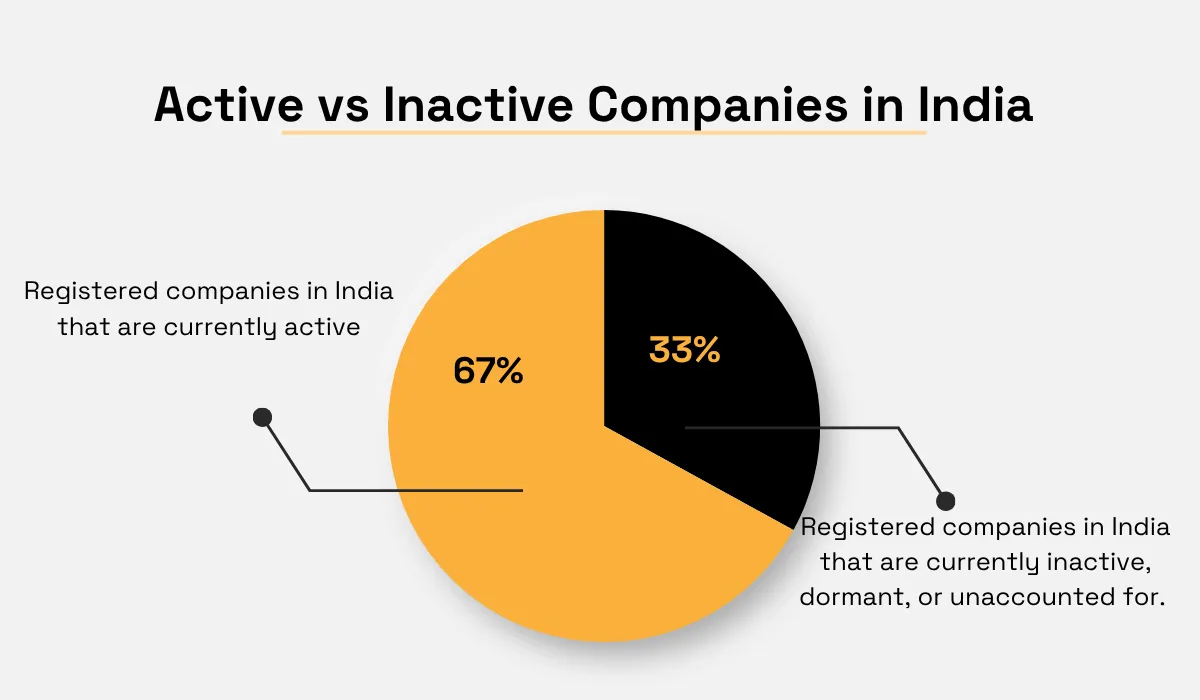
Illustration: Veridion / Data: Ministry of Corporate Affairs
Both legal and tax signals are vital when determining current operations. On the legal front, MCA status remains your starting point. On the tax front, GST status matters because the portal will tell you if a GSTIN is active or inactive.
There are also operational signals that you can look out for. For example, an active business will have left some recent signals. These include a website with recent updates, job openings, recent product launches, recent social media activities, and recent customer reviews. Such signals suggest a business that's genuinely operating.
The absence of these signals doesn't automatically mean a company is defunct, but their combined absence is worth noting.
Look out for the opposite pattern too. An outdated website with broken links, a phone number that no longer connects, social profiles that haven't posted in over a year, or company details that shift depending on where you look are all warning signs.
None proves a company is inactive on its own, but together they build a picture worth investigating before you extend credit, sign a contract, or ship goods.
7. Use AI to Cross-Check and Enrich Business Data at Scale
Manual verification works well when you have ten records. It becomes unworkable once you're verifying hundreds or thousands of vendors, suppliers, or customers across India.
At enterprise scale, the hard part is not finding one source. It is resolving conflicts across many sources, collapsing duplicates, standardizing names and addresses, classifying activity, and retaining a traceable reason for every decision. That is exactly where AI-based company intelligence becomes useful.
For instance, Veridion's Entity Resolution service is designed to turn messy records into one canonical company profile, with confidence scores, parent and subsidiary linkage, and resolution logic.
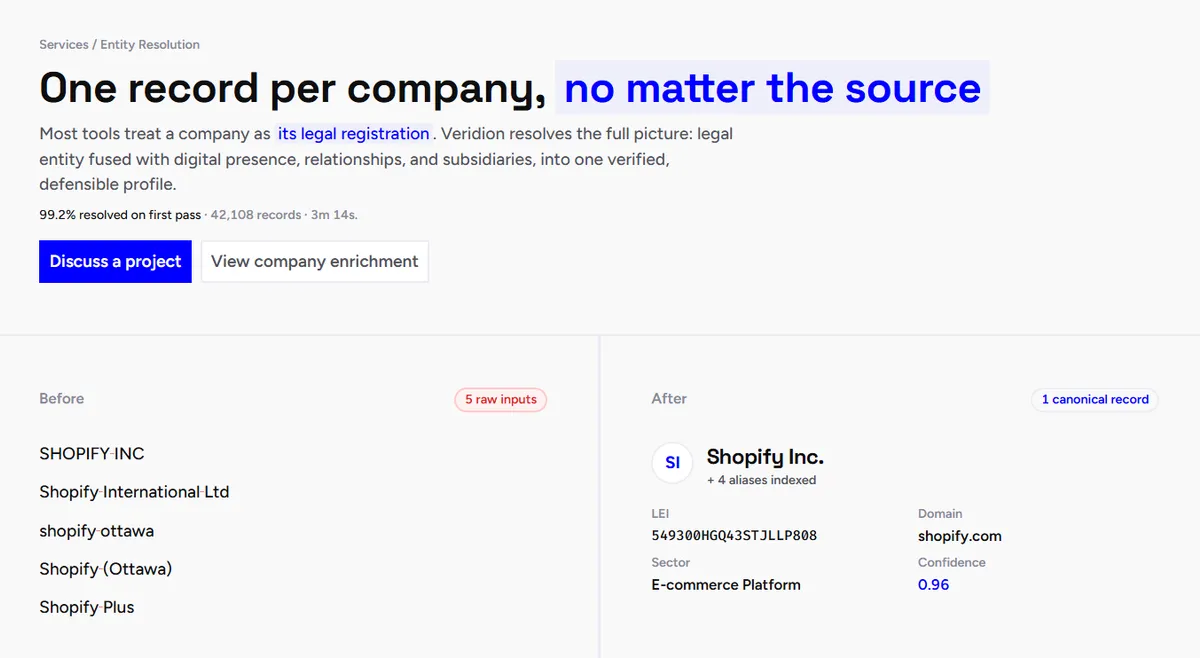
Source: Veridion
So, instead of your team stitching together MCA data, GST records, and website scraping by hand for every vendor, the platform builds one unified business profile that combines registration data, verified locations, business activity, and other signals into a single record you can trust and audit.
Our Company Enrichment service further adds structured attributes such as company status, legal form, industry, ownership, operating footprint, website domain, products, certifications, and other business signals with source trails.
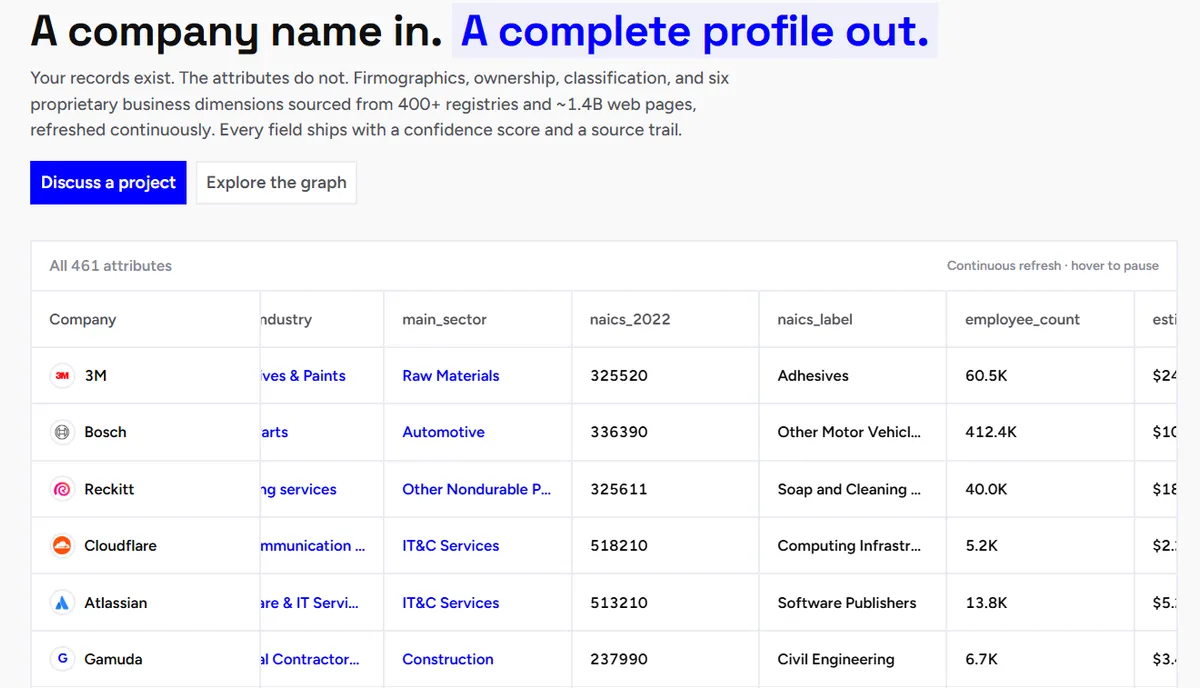
Source: Veridion
The Match & Enrich API shows how partial records can be resolved and standardized at scale, giving your teams a programmatic workflow.
For enterprise teams managing large vendor or supplier lists, this Veridion shifts verification from a reactive, case-by-case task into a continuous process that flags changes as they happen—a company going inactive, an address changing, a status shifting to struck off—without waiting for the next manual review cycle.
Conclusion
Verifying a company is not a single search process. It is a step-by-step procedure that ensures legal verification, tax compliance, address verification, operations, business activity, and status alignment before you can start building a business relationship.
Each check alone will give you vital information about a business. Together, they tell you whether the company in front of you is the company it claims to be.
Build that habit into every new Indian business relationship, and you protect your contracts, your shipments, and your reputation before problems ever reach you.
Articles
Discuss how these trends affect your organization.
Our analysts are available for a short call. Bring a specific question and we will ground it in the data.
Insights
Keep reading
More analysis, research, and outcomes grounded in live company intelligence.
Find and Identify Reliable Suppliers: Our Guide
In this guide, you’ll discover proven steps to identify reliable suppliers and minimize procurement risks.
Market Intelligence: Use Cases Across Departments
Want to make better decisions across departments? Learn how market intelligence use cases apply to your entire organization.
6 Mistakes to Avoid when Gathering Market Intelligence
Think your market intelligence is on point? Check out these five frequent mistakes and how to avoid them before it’s too late.