Insights / Articles
Why Legacy SIC and NACE Rev. 2 Codes Miss Modern Niche B2B Companies
Struggling with niche industrial product sourcing? Legacy industry codes fail modern B2B companies. Find out why and how to adapt.

- 11.5% of registered SIC codes don't match companies' reported business activities.
- Searching by business activity helps identify niche suppliers.
- Cross-referencing SIC, NAICS, NACE, and ISIC improves coverage.
A new B2B industry can emerge long before it has a name in an official classification system.
Companies are continually launching products, winning customers, and entering supply chains, while Standard Industrial Classification (SIC) and Nomenclature statistique des activités économiques dans la Communauté européenne (NACE) codes continue to point to categories created years earlier.
This creates a growing challenge for enterprise data teams trying to identify suppliers, map emerging markets, or build accurate company datasets.
In this article, we'll look at why legacy classification systems, with a focus on the UK's SIC system and the EU's NACE, struggle to keep pace with today's business landscape and what it takes to find niche B2B companies they often miss.
Why These Codes Fall Behind the Real Economy
New industries do not wait for new codes to exist. A company can form, hire, and start generating revenue in months.
A classification system, on the other hand, cannot move that fast by design. Every code is a shared category that can apply to hundreds or thousands of companies doing broadly similar work rather than a unique identifier for any single business.
And, it has to be proposed, reviewed, and coordinated across multiple government and statistical bodies, and formally adopted before it's usable.
This process was not built for speed, and it comes down to three specific reasons, starting with how rarely these systems get touched at all.
Built on a Slow Revision Cycle
The UK's SIC system, tracing back to 1937, had revisions almost every decade:
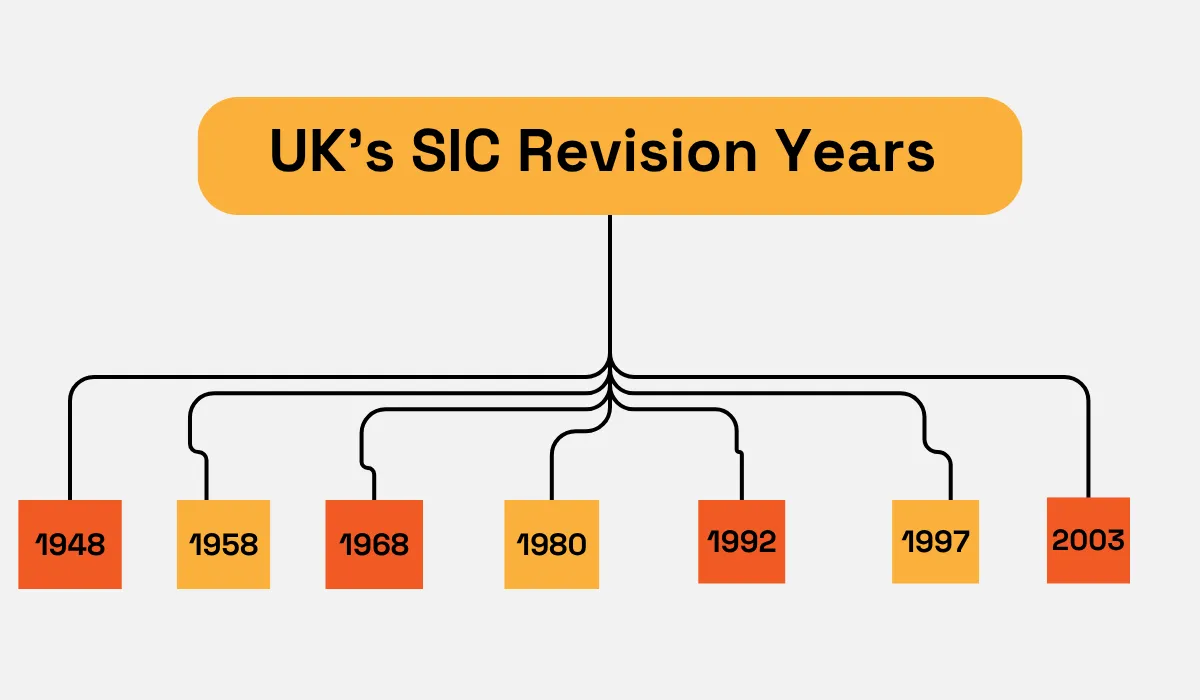
Then came SIC 2007, which took effect on the same date as the EU's NACE Rev. 2, a coordination the UK's statistics office carried out deliberately because the UK’s law requires SIC to stay identical to NACE down to the four-digit class level.
So, whenever Brussels revises NACE, the UK has to revise SIC in step with it.
After that, the pace collapsed entirely.
The next full revision, SIC 2026, was only published this April, a full 19 years after the one before it, which is the longest gap in the system's history.
EU’s NACE's own most recent update, Rev. 2.1, left its existing four-level hierarchy of sections, divisions, groups, and classes standing and built onto it instead.
Under NACE Rev. 2, that hierarchy held 21 sections, each identified by a single letter like "C" for Manufacturing, then 88 divisions, 272 groups, and 615 classes underneath them.
The clearest example of that addition is Section J, "Information and Communication," which previously covered everything from publishing to telecoms to IT consulting under one heading.
Rev. 2.1 split it in two: Section J now covers publishing, broadcasting, and content production, while a new Section K covers telecommunications, computer programming, consulting, and computing infrastructure.
When you measure the pace of these revisions against how fast many industries form, you'll see that these codes can barely keep up.
Search SIC or NACE for a newly formed industry, and you will not get a small or imperfect result.
You will get nothing, or you will get a code so broad that a real target company sits in the same bucket as businesses doing something else entirely.
A faster revision cycle would narrow this problem, but it wouldn't remove it. Even a revision done every two years still leaves a newly formed industry uncoded for up to two years after it starts generating real revenue.
That's not something your team controls.
The UK and the EU decide when SIC and NACE get revised, on their own timeline.
Either way, the team searching by code has no way to tell "this industry doesn't have companies yet" apart from "this industry has companies, but were never assigned a code specific enough to describe them."
That affects you building a supplier list, assessing new entrants, or sizing an emerging sector because the absence of search results looks identical to the absence of a market, when it usually just means the classification isn't updated.
Forced Into the Wrong Broad Category
Companies registering under legacy SIC and NACE codes do not have the luxury of describing themselves.
To register, you have to pick from a fixed list of existing codes, with no option to request a new one or write in something that isn't already there.
So when no code accurately describes what your company does, you either get filed under whatever's closest or a generic catch-all.
An example of this is code 82990 for "Other business support services n.e.c." under the Search SIC.
In it, we have:
- Amazon UK Services
- Sony Interactive Entertainment Network Europe
- Santander UK
- Google UK
- Facebook UK
All of these are sitting under a single label that describes none of them specifically.
Anyone browsing that code for a genuine business support services provider has to wade through a search engine and a social media platform to find one.
Anyone searching specifically for a bank or a social media company by code won't reliably find these at all, since nothing in the code name points to what they actually do.
This isn't just for the UK alone.
NACE has the same structural feature built directly into it.
Eurostat's own classification documentation confirms that "not elsewhere classified" categories run throughout NACE, marked by the digit 9.
It has the same limitations as SIC's 82990, just under a different numbering system.
New industries coming in also get vaguely classified.
Natural Hydrogen Consultants Limited, a UK company built around exploration for naturally occurring hydrogen deposits underground, was incorporated in 2023 and is currently registered under SIC code 72190; "Other research and experimental development on natural sciences and engineering," a generic code shared by more than 13,000 other UK companies working in entirely unrelated fields of scientific research.
That fragmentation makes Natural Hydrogen Consultants Limited hard to find, and anyone trying to estimate how many companies work in fields like this one has no clean way to count them, since the businesses are scattered across whatever adjacent codes happened to be available when they registered.
Self-Reported and Rarely Corrected
A SIC or NACE code isn't checked against what a company actually does, both at the registration and afterward.
You pick a code when your company is formed, and the only requirement after that is an annual confirmation that the code still exists on the list, not that it still matches reality.
Updating this SIC code is a totally different ballgame. It takes a visible, immediate, and deliberate filing, unlike the cost of the mismatch itself.
When a buyer searches by industry code and a company doesn't appear because its code no longer matches what it actually does, the business never sees that mismatch happen.
There's no notification on the company itself, so nothing ever pushes the business to go back and fix it.
So, the business keeps changing regardless, while the code chosen accurately on day one sits there, describing a version going extinct.
The UK's Office for National Statistics tested this directly, comparing the SIC codes on the country's business register against how companies described their own activity in a separate government survey.
The mismatch reached 11.5% at the most detailed classification level, and 8.7% even at the broader division level, government data confirming the drift the system allows.
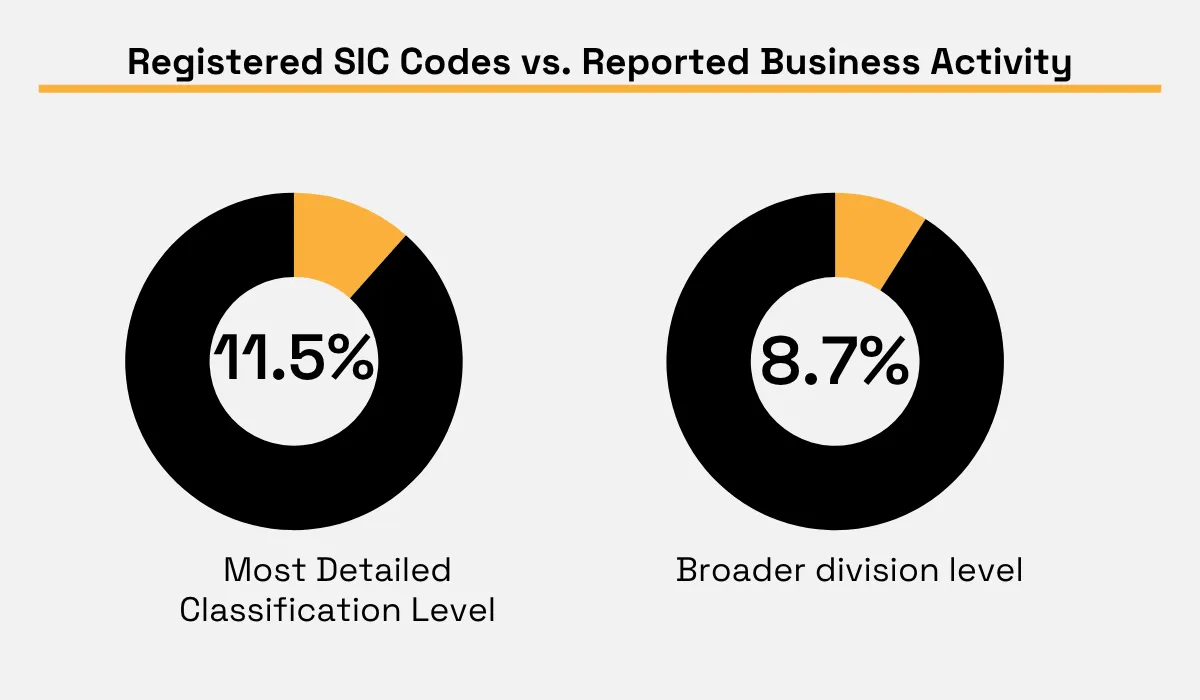
Illustration: Veridion / Data: UK's Office for National Statistics (ONS)
Companies House, the UK government agency that registers all limited companies, has itself acknowledged that this isn't a minor issue.
In its own words, an inaccurate SIC code:
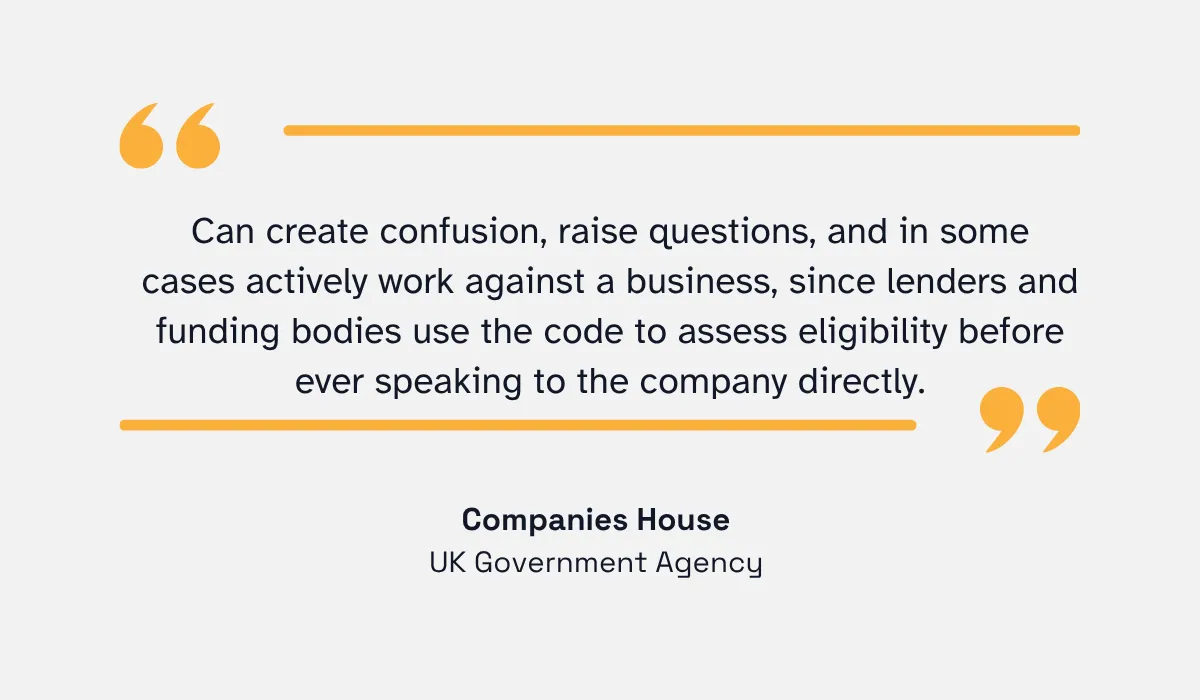
Illustration: Veridion / Data: Companies House
In other words, building a supplier list, a risk model, or a targeting strategy off SIC or NACE alone is just a starting point, and can’t be the only information used.
How to Find Niche Companies Codes Can't Surface
The limitations of SIC and NACE don't make them useless. They still provide a common language for grouping broad industries and comparing economic activity across regions.
However, the main challenge begins when you need to identify companies operating in a niche market that either didn't exist when those systems were designed or has evolved far beyond its original classification.
In those cases, relying on a single industry code can leave relevant suppliers hidden among thousands of unrelated businesses or miss them altogether.
Finding those companies requires looking beyond static classifications and using other ways to identify what a business does today.
The approaches below are a good way to get started.
Search by Activity, Not Category
Rather than asking which classification code covers an industry, start by identifying the specific capability you're trying to source.
For example, if you're looking for battery separator suppliers, searching manufacturing codes alone can return companies producing everything from industrial chemicals to plastic films.
Instead, search for terms like “battery separators”, “lithium-ion components”, or “EV battery materials”.
These are the phrases companies use to describe their products across their:
- Websites
- Product pages
- Technical documentation
- Case studies
Unlike SIC or NACE codes, businesses update these descriptions as their products, services, and expertise evolve.
For emerging industries where no dedicated classification exists, those descriptions often become the clearest way to identify companies with the capability you're looking for.
That means your team spends less time filtering broad industry lists and more time evaluating suppliers that already match the capabilities your sourcing project requires.
Combine Multiple Classification Systems
No single classification system was designed to capture every business equally well.
SIC, NACE, the North American Industry Classification System (NAICS), and the International Standard Industrial Classification of All Economic Activities (ISIC) were created by different organizations, for different regions, and at different points in time.
As a result, each group classifies industries differently and follows its own revision schedule.
Relying on just one classification system can leave part of the market out of view, especially when you're sourcing suppliers across multiple countries.
Even official statistical bodies recognize that a single classification rarely captures economic activity on its own.
The European Commission's ESCO project mapped 3,039 occupations to 4,632 relationships within NACE, showing that economic activity often spans multiple industry categories rather than fitting neatly into a single classification.
This same principle applies when sourcing niche B2B companies.
Looking across multiple classification systems helps reduce these blind spots by giving you more than one way to identify the same business.
It also helps when supplier databases, government registries, and commercial datasets rely on different classification standards.
A company classified under a broad manufacturing code in SIC may appear under a more specific industry in NAICS or be mapped differently within NACE, giving you another route to discover it.
However, cross-referencing classifications won't eliminate every limitation because SIC, NAICS, NACE, and ISIC are all still static systems that depend on periodic revisions.
But using them together provides a broader view of the market than relying on any one system alone, making it easier to build a more complete supplier shortlist.
Discovering Niche Companies Through Real-World Signals
Combining multiple classification systems improves coverage, but it doesn't solve the underlying problem of working with static taxonomies that depend on periodic revisions.
As new industries emerge between those revision cycles, you're still left trying to identify companies whose activities have evolved faster than the classifications describing them.
That's where continuously updated business classification becomes valuable.
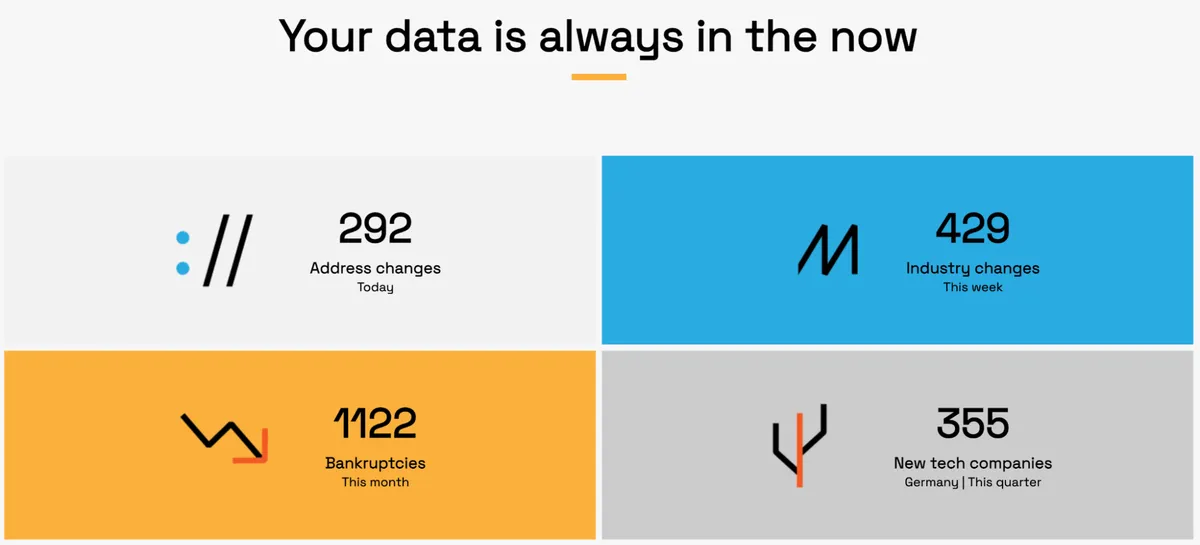
Veridion applies this approach by using machine learning models to classify every active company in the world into roughly 120 industries and 584 business categories based on continuously updated real-world signals, including their web presence and publicly described business activities.
Source: Veridion
Because those classifications refresh weekly, you can identify businesses operating in emerging markets or developing new capabilities before traditional industry classifications introduce dedicated codes.
For enterprise data teams, the advantage is that company classification doesn't stop at registration.
As companies launch new products, enter new markets, or shift their business focus, their classification can evolve with them.
That makes it easier to identify emerging suppliers and monitor fast-changing markets without waiting years for an official classification update.
Instead of adapting your search to the limitations of legacy classification systems, you work with data that evolves alongside the businesses you're trying to discover.
Conclusion
Legacy classification systems aren't going anywhere, and they don't need to.
But when you're trying to find companies in newly formed B2B markets, they're no longer enough on their own.
Building accurate supplier and market intelligence now depends on data that evolves as quickly as the businesses you're trying to understand.
Articles
Discuss how these trends affect your organization.
Our analysts are available for a short call. Bring a specific question and we will ground it in the data.
Insights
Keep reading
More analysis, research, and outcomes grounded in live company intelligence.
6 Data Enrichment Tools You Need to Know About
Explore six standout tools that transform data enrichment capabilities and can help guide your decision-making and go-to-market strategy.
How Is AI Revolutionizing Market Intelligence?
Explore the key ways AI is transforming market intelligence workflows and helping businesses stay ahead of the competition.
How to Build a Strong Market Intelligence Strategy
Learn how to build a strong market intelligence strategy that helps you track trends, understand competitors, and make smarter decisions.