Legal / ESG disclosures
ESG Ratings - Regulatory Disclosures
Disclosures on the methodology and governance of Veridion ESG ratings.
Veridion is the trading name of Dataworks Research SRL. This page sets out the information that Regulation (EU) 2024/3005 on ESG rating activities (Art 23 and Annex III point 1) requires ESG rating providers to publish.
Regulatory status. Dataworks Research SRL has notified the European Securities and Markets Authority (ESMA) under Article 5 of Regulation (EU) 2024/3005, the temporary regime for small ESG rating providers.
Scope. Veridion ESG Scores is Veridion's only ESG rating product. Veridion's other ESG data products (ESG Commitments, ESG News, ESG Metrics, and group, location and supplier data) are raw ESG data with no rating or score. They are outside the scope of the Regulation.
Contact. Rated companies and users of ESG Scores can request more detailed information about the methodology, or report a factual error, at esg-ratings@veridion.com.
(a) Rating methodology
Methodology. Veridion ESG Data and Scores – Methodology Deep Dive, Version 1.01, October 2026. Available to clients, prospects and regulators on request.
Rated items. Companies, both legal and operating entities, public and private, of all sizes, in more than 250 geographies.
What the score is. An industry-anchored, evidence-based assessment of a company's ESG performance, on a scale of 0 to 100 (higher is better). Each company receives:
- an overall ESG score
- Environmental, Social and Governance pillar scores
- up to 26 risk-criteria scores, each with a written justification
- the industry average and the company's industry quartile
How it is produced.
- The company is matched to a Veridion company profile.
- Its primary industry is identified and that industry's ESG baseline is applied.
- Company-specific evidence is assessed against the baseline. This covers published ESG commitments, third-party ESG news and extracted climate disclosures.
- The overall and pillar scores are assessed, and each risk criterion is assessed in a separate workflow.
- The company's score is placed in a quartile of its industry's score distribution.
Key assumptions.
- Actions outweigh stated commitments.
- Controversies are weighted by severity.
- Commitments raise a score only where there is evidence they are being implemented.
- Recent evidence comes first.
Backward- or forward-looking. Mainly backward-looking: the score is based on observed actions, controversies and disclosures. Published targets and commitments add a limited forward-looking element.
Time horizon. The score uses evidence from the last 2 years. Where recent coverage is sparse, this is extended to up to 5 years, and the extension is noted in the justification.
Score refresh.
- Batch deliveries are refreshed at the time of delivery.
- Through the API, a score not refreshed in the last 30 days is updated automatically when requested. Otherwise it is served from cache.
- All public companies, and private companies that are significant players in their markets, are tracked weekly and refreshed more often.
- Industry averages are refreshed quarterly.
Score | Band |
|---|---|
75 - 100 | Excellent |
60 - 74 | Good |
45 - 59 | Neutral |
0 - 44 | Poor |
Data-quality measures. See (c).
Latest changes. October 2026 (Version 1.01): Documentation aligned with these disclosures. Clarified that risk-criteria scores are produced in a workflow separate from the pillar assessment; published typical E/S/G weight ranges by industry group; specified NAICS 2022 and the quarterly industry-baseline refresh; stated the objective and risk materiality of the scores; added the correspondence with ESRS and the treatment of climate targets. No change to how scores are calculated.
(b) Industry classification
Veridion benchmarks every company against its primary industry, using NAICS 2022. Proprietary models identify each business activity from the company's locations, products, services and own description. They map each activity to an industry code and estimate its share of the business (Multi-NAICS). The activity with the largest share becomes the primary industry. Ties go to the activity most representative of the company's operations.
Veridion maintains ESG baselines for more than 1,000 NAICS industries. Each baseline has an average score and a measure of score variation and is refreshed quarterly. Classifications are also produced in SIC, ISIC and NACE, and are checked against reference datasets.
(c) Data sources, processes and update frequency
Sources. Publicly available, first-party and authoritative sources only:
- company websites and official social media profiles
- company sustainability, CSR and climate reports
- news from thousands of outlets in many languages
- map and location listings
- global and local company registries
Third-party directories and review sites are not used to build company profiles. Veridion never collects information about individuals, personal accounts or login-protected content. It does not use non-public information from rated companies. Lists of companies that clients provide are used only to identify those companies, never as scoring evidence.
CSRD and SFDR. Published sustainability reports are used, and these may include CSRD sustainability statements. Veridion doesn't require CSRD statements or SFDR disclosures as inputs, and most scored companies are outside CSRD scope.
Processes. Proprietary large language models find the relevant passages, classify them to the ESG taxonomy and attribute them to the correct company. Every evidence record keeps its source URL. Before release, data passes quality checks at column, row, dataset and cross-package level, plus fill-rate monitoring and a comparison with the previous delivery. Reference checks against more than 12,000 benchmark companies run daily.
Estimation where data is missing. Without company-specific ESG evidence, the score is based on the industry baseline and the company's firmographic profile. No risk-criteria scores are produced in that case, so the reduced detail shows that evidence was limited.
Update frequency. ESG news, commitments, company profiles and classifications are updated weekly. Scores are refreshed as described in (a).
Data-quality thresholds. Platform-wide thresholds include a minimum match confidence of 0.5 (high-quality matches are typically above 0.85), 95%+ batch matching accuracy and a validation success rate above 99.5%.
Collection practices. Veridion crawls transparently, respecting robots.txt, and honours data-removal and do-not-crawl requests within 7 days.
(d) Ownership structure
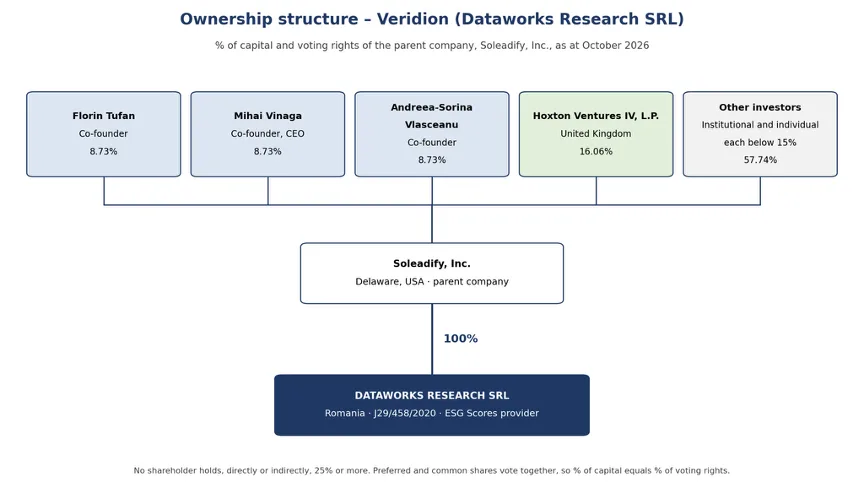
Veridion is the trading name of Dataworks Research SRL, a Romanian limited liability company (societate cu răspundere limitată).
- Registered office: 14 Gheorghe Grigore Cantacuzino Street, Ploiești, Prahova, Romania
- Trade Register no. J29/458/2020
- VAT no. RO40694467
- CEO: Mihai Vinaga
Dataworks Research SRL is wholly owned (100% of capital and voting rights) by Soleadify, Inc., a Delaware (USA) corporation. Soleadify, Inc. has no other subsidiaries.
The shareholders of Soleadify, Inc. are indirect shareholders of Dataworks Research SRL:
Shareholder | Capital and voting rights |
|---|---|
Hoxton Ventures IV, L.P. (United Kingdom) | 16.06% |
Florin Tufan, co-founder | 8.73% |
Mihai Vinaga, co-founder and CEO | 8.73% |
Andreea-Sorina Vlasceanu, co-founder | 8.73% |
Other institutional and individual investors, each below 15% | 57.74% |
No shareholder holds 25% or more of the capital or voting rights, directly or indirectly, and no single shareholder controls Soleadify, Inc. or Dataworks Research SRL. Preferred and common shares vote together, so each shareholder's share of capital equals its share of voting rights.
(e) Scientific evidence
Veridion ESG Scores rely on evidence, not on scientific models or scientific datasets. The taxonomy follows the themes of the UNEP FI Principles for Sustainable Insurance, and its risk criteria were developed with members of the insurance industry. Industry baselines reflect the typical environmental, social and governance risks of each sector, such as emissions intensity, impact on land and water, workforce hazards and regulatory exposure. They draw on publicly available ESG information and industry performance benchmarks. Emissions figures are used as the company reports them. They are not modelled or restated.
(f) Objective and materiality
Objective. To give a consistent, wide-coverage screening view of a company's ESG performance compared with its industry. The score supports risk segmentation and prioritisation across suppliers, counterparties, portfolios and insured companies.
Materiality. ESG Scores assess ESG risk. They don't assess impact materiality, and they aren't a double-materiality rating. The score combines two elements:
- Inherent exposure: the ESG risk profile of the company's industry.
- Observed conduct: the company's actions, controversies and adverse events. These are used as evidence of the company's ESG risk.
ESG Scores are not a credit rating. They don't give a view on any security or financial obligation.
(g) Scope
Veridion provides:
- an overall ESG score that combines the three pillars
- separate Environmental, Social and Governance pillar scores
- 26 risk-criteria scores: 16 Environmental, 5 Social and 5 Governance
The specific issues covered include transition threats, carbon footprint, contamination, deforestation, human rights and labour practices, controversial weapons, bribery and corruption, competition practices, product safety and pay equity. See (i) for the full list.
Only ESG Scores is an ESG rating. Veridion's ESG data products are raw ESG data without a rating or score, and they fall outside the scope of Regulation (EU) 2024/3005.
(h) Weighting of E, S and G
The overall score is not a fixed-weight average of the three pillars. Pillar and overall scores are weighted by how relevant and material each ESG factor is to the company and its industry. That takes into account:
- industry relevance
- how significant the identified risks are
- how important the company's demonstrated actions or outcomes are
For example, for a professional services firm, workforce practices, ethics and governance carry more weight than energy efficiency. The overall score is assessed together with the pillar scores and checked for consistency with them. Risk-criteria scores are produced in a separate workflow.
Typical weights by industry group. The table gives the typical range of E, S and G weights for each industry group, grouped by NAICS sector. A company's actual weights can fall outside these ranges where its own risk profile calls for it.
Industry group (NAICS sectors) | Environmental | Social | Governance |
|---|---|---|---|
Agriculture, mining, oil & gas (11, 21) | 45–55% | 25–30% | 20–25% |
Utilities & construction (22, 23) | 40–50% | 40–50% | 20–25% |
Manufacturing (31–33) | 40–50% | 25–35% | 20–30% |
Wholesale, retail & transport (42, 44–45, 48–49) | 35–45% | 30–35% | 25–30% |
Information, finance & real estate (51–53) | 20–30% | 30–35% | 40–45% |
Professional, admin & other services (54–56, 81) | 25–35% | 35–40% | 30–35% |
Education, health, hospitality & public admin (61, 62, 71, 72, 92) | 25–35% | 35–45% | 30–35% |
(i) Topics covered and correspondence with ESRS
The taxonomy has 3 pillars, 11 themes and 26 risk criteria, following the themes of the UNEP FI Principles for Sustainable Insurance.
Pillar | Theme | Risk criteria |
|---|---|---|
Environmental | Climate change | Atmospheric Contamination; Carbon Footprint; Transitional Threats |
Environmental | Environmental degradation | Mining Techniques; Illegal Deforestation; Land Contamination; Water Contamination; Water Usage |
Environmental | Protected sites and species | Effects on Protected Regions; Effects on Endangered Species |
Environmental | Unsustainable practices | Unsustainable Energy Practices; Unlawful Fishing; Plastic Contamination |
Environmental | Animal welfare and testing | Illegal Wildlife Trade; Habitat Quality and Medication Use; Testing on Animals |
Social | Human rights | Child Exploitation and Human Trafficking; Involuntary Displacement; Worker Rights; Misbehavior by Security Staff |
Social | Controversial weapons | Sensitive Weapons Involvement |
Governance | Bribery and corruption | Corrupt and Unethical Transactions |
Governance | Corporate governance | Monopoly Practices |
Governance | Product safety and quality | Immoral Behaviour or Adverse Health Influence on Consumers |
Governance | Diversity and pay | Inclusivity; Wage Disparity |
Correspondence with ESRS. The taxonomy isn't built on the European Sustainability Reporting Standards (ESRS), but it partly corresponds to them:
ESRS topic | Veridion risk criteria |
|---|---|
E1 Climate change | Climate change criteria; Unsustainable Energy Practices |
E2 Pollution | Plastic Contamination; Water Contamination |
E3 Water and marine resources | Water Usage; Water Contamination |
E4 Biodiversity and ecosystems | Effects on Protected Regions; Effects on Endangered Species; Illegal Deforestation; Illegal Wildlife Trade; Unlawful Fishing |
E5 Resource use and circular economy | Mining Techniques; Plastic Contamination (partial) |
S1 Own workforce | Worker Rights; Inclusivity; Wage Disparity |
S2 Workers in the value chain | Child Exploitation and Human Trafficking |
S3 Affected communities | Involuntary Displacement; Misbehavior by Security Staff |
S4 Consumers and end-users | Immoral Behaviour or Adverse Health Influence on Consumers |
G1 Business conduct (includes animal welfare) | Corrupt and Unethical Transactions; Monopoly Practices; Testing on Animals; Habitat Quality and Medication Use |
Sensitive Weapons Involvement has no direct ESRS equivalent.
(j) Absolute or relative value
Scores are relative. They are given on a scale of 0 to 100 but are read against the company's industry. The industry average is the neutral reference point, and each company's score moves away from it based on company-specific evidence. The industry quartile places the score within its industry's distribution, considering the industry's average and how widely scores vary.
(k) Use of artificial intelligence
Veridion uses AI throughout the rating process. Proprietary large language models (LLMs):
- find ESG-relevant passages in web pages, reports and news
- classify those passages to the ESG taxonomy
- determine each company's industry classification
- generate the scores and their written justifications
- write the ESG description
Machine-learning models also match evidence to the right company.
Limitations and risks. LLM output can:
- misread evidence, or attribute it to the wrong company, such as one with a similar name
- give evidence too much or too little weight
- produce a justification that doesn't fully reflect the source
Model behaviour can also change from one version to the next.
How we reduce these risks.
- Cautious company matching: no fuzzy matching on legal names, and an explicit "no match" rather than a forced guess.
- A confidence value and the source URL on every evidence record.
- A required justification for every score, checked by automated data-quality rules.
- The overall score is checked against the pillar scores.
- Outlier detection.
- Human quality review.
- Daily benchmarking against reference companies.
(l) Fees and business model
Business model. Veridion is paid by the people who use its data, not by the companies it rates. Rated companies don't pay to be rated and can't pay to influence a score.
What determines fees. ESG Scores are licensed by subscription (annual or multi-year) or per project. Fees depend on:
- the number of companies assessed (volume tiers)
- the data packages included: scores alone, or with ESG News, ESG Commitments, GHG Metrics and group, location and supplier data
- how the data is delivered: API, batch files or platform
- the length of the licence
- usage and redistribution rights
Bespoke work has a minimum fee. ESG Scores are also distributed through partners and resellers on their own commercial terms.
Share of revenue from ESG rating activities. ESG Scores account for less than 10% of Veridion's revenue.
(m) Limitations of data sources and methodology
- Evidence varies. Companies with little online presence and media coverage are assessed mainly on industry context. They receive an overall score, industry average and quartile, but no risk-criteria scores. For these companies the score is an estimate, not a measurement.
- No news isn't proof of good practice. This is especially true where press freedom is limited or little local media is online.
- Emissions figures are used as the company reports them. They aren't audited or restated, and they may use non-standard boundaries or older reporting years.
- Pillar make-up varies by industry. Many environmental criteria don't apply to some industries, so pillars are made up differently across them. To compare across sectors, use the overall score and quartile.
- Scores aren't fixed-weight averages. Pillar and overall scores are each assessed on how material each factor is to the company and its industry, so the overall score isn't an arithmetic average of the pillar scores. See (h).
- Social and governance scores are correlated by design.
- Outside-in assessment. It can't check internal management systems or practices that leave no public trace, and it isn't an audit or assurance opinion.
- Proxies. Where company-specific evidence is missing, the industry baseline and the company's firmographic profile are used.
(n) Conflicts of interest
Veridion doesn't provide advisory, consulting, audit, investment or credit rating services to the companies it scores, and rated companies don't pay to be rated.
Main risks of conflicts of interest.
- A client, partner or data supplier is also a rated company, or part of the same group as one.
- Clients or resellers apply commercial pressure to change a score.
- Shareholders, directors or staff, or their close relatives, have interests in rated companies.
- Requests for bespoke scoring.
How we manage them.
- One standard methodology is applied to every company, whatever its relationship with Veridion.
- Scores change only when new evidence is processed or the methodology is updated. Individual scores are never adjusted at the request of clients, partners or rated companies.
- Scores are produced by the data and model teams. Commercial staff (sales, partnerships and customer success) can't edit scores or the scoring pipeline.
- Analyses for individual clients use existing scores and never change them.
- Investors and directors appointed by investors have no role in producing scores and don't see them before publication.
- Staff with a personal interest in a rated company don't work on that company's score.
- Potential conflicts are escalated to the CEO, who decides how they are handled.
(o) Paris Agreement and other environmental agreements
Veridion ESG Scores don't measure alignment with the Paris Agreement temperature goals, and they aren't Paris-aligned ratings. Climate evidence is taken from company disclosures and considered in the Environmental pillar and in the Carbon Footprint and Transitional Threats criteria. That evidence includes reported Scope 1, 2 and 3 emissions, decarbonisation targets and net-zero commitments. Net-zero targets and Science Based Targets initiative (SBTi) validation aren't scored directly. Where they exist, they are considered as evidence and can raise the score.
(p) International agreements on social and governance topics
The taxonomy follows the UNEP FI Principles for Sustainable Insurance. The social and governance criteria cover themes that international standards also address: child labour, forced labour and human trafficking, worker rights, involuntary displacement, controversial weapons, and bribery and corruption. The scores don't formally assess compliance with any specific agreement, such as the UN Guiding Principles on Business and Human Rights, the OECD Guidelines for Multinational Enterprises or the ILO conventions, and aren't formally mapped to them.
(q) Limits on the information available
Veridion relies only on publicly available information. It doesn't engage with rated companies during the rating process, doesn't receive non-public information from them and doesn't carry out site visits. Coverage depends on each company's online presence, media coverage and the language of its disclosures, so the information available varies by company size, sector and geography. Companies that can't be reliably identified, or whose industry can't be determined, aren't scored, and the reason is reported. Rated companies can report factual errors to esg-ratings@veridion.com. These reports are handled outside the rating process.
Legal
Other legal documents
The rest of Veridion's legal and compliance documentation.