Insights / Articles
The UNSPSC Pyramid: How AI Automates Product Classification for Global Sourcing
Struggling with product classification? See how AI and the UNSPSC system streamline global sourcing, offering a good source for NAICS codes.

- Standard classification systems tell you what industry a company is in, not what it actually sells.
- A single eight-digit code can reveal four different levels of detail about one product.
- AI struggles with accuracy as product classifications become more complex.
- Keeping a product catalog classified is an ongoing process.
Product classification doesn’t seem that complicated at all—until you have thousands of products to sort.
UNSPSC gives you a standardized structure for doing it, but applying that structure across a large, messy catalog is where it does get complicated.
You have different product descriptions, thousands of possible categories, and new items constantly entering the mix.
Luckily, AI can take much of that work off your team's plate.
What UNSPSC Actually Classifies
If you've worked with classification systems before, you've probably come across NAICS or SIC codes. These systems classify businesses based on the industries they operate in.
UNSPSC looks at something different: the products and services themselves.
That distinction matters when you're trying to understand what your suppliers actually offer.
A chemical manufacturer, for example, may operate within one industry but sell products that fall into dozens of different product categories.
UNSPSC gives you a standardized way to organize those products and services, regardless of the industry or supplier they come from.
That makes it easier to analyze spend, compare suppliers, organize catalogs, and find companies that provide a particular product.
So, how does it work?
UNSPSC uses a hierarchical structure that gets more specific as you move down the classification.
The familiar eight-digit code is divided into four levels: Segment, Family, Class, and Commodity.
Take Aromatic solvents (12191501) as an example:
Level | Code | Classification |
|---|---|---|
Segment | 12 | Chemicals including Bio Chemicals and Gas Materials |
Family | 1219 | Solvents |
Class | 121915 | Hydrocarbonated solvents |
Commodity | 12191501 | Aromatic solvents |
Each level gives you a different degree of detail.
You might want to analyze spending across the entire Chemicals segment, narrow it down to Solvents, or drill all the way down to a specific commodity such as Aromatic solvents.
Essentially, you can look at the same purchasing data at different levels without changing the underlying classification system.
However, the challenge comes when you have to apply those codes to thousands or millions of real-world product descriptions.
Why AI-Automated Classification Outperforms Manual Coding
Manually assigning UNSPSC codes works well enough when you have a small catalog and someone who knows the products.
But once you're dealing with thousands or millions of items, the process becomes harder to keep up with. Your team has to review each description, work through a large taxonomy, and decide which category fits best.
Product data is rarely clean or consistent, either. The same product can appear under different names, abbreviations, or levels of detail across your systems.
AI takes on much of that classification work by processing large batches of product descriptions, identifying likely UNSPSC categories, and flagging uncertain cases for human review.
And the benefits go beyond simply getting through the backlog faster.
Cuts Classification Time Dramatically
Think about a catalog with hundreds of thousands of products. Even if each classification takes only a minute or two, manually reviewing every item quickly turns into thousands of hours of repetitive work.
AI can process those items in batches and handle straightforward classifications automatically.
Your team can then spend its time where human judgment adds the most value:
- Reviewing ambiguous products
- Checking low-confidence predictions
- Resolving cases where the available information isn't enough
One Fortune Global 500 manufacturer illustrates the difference.
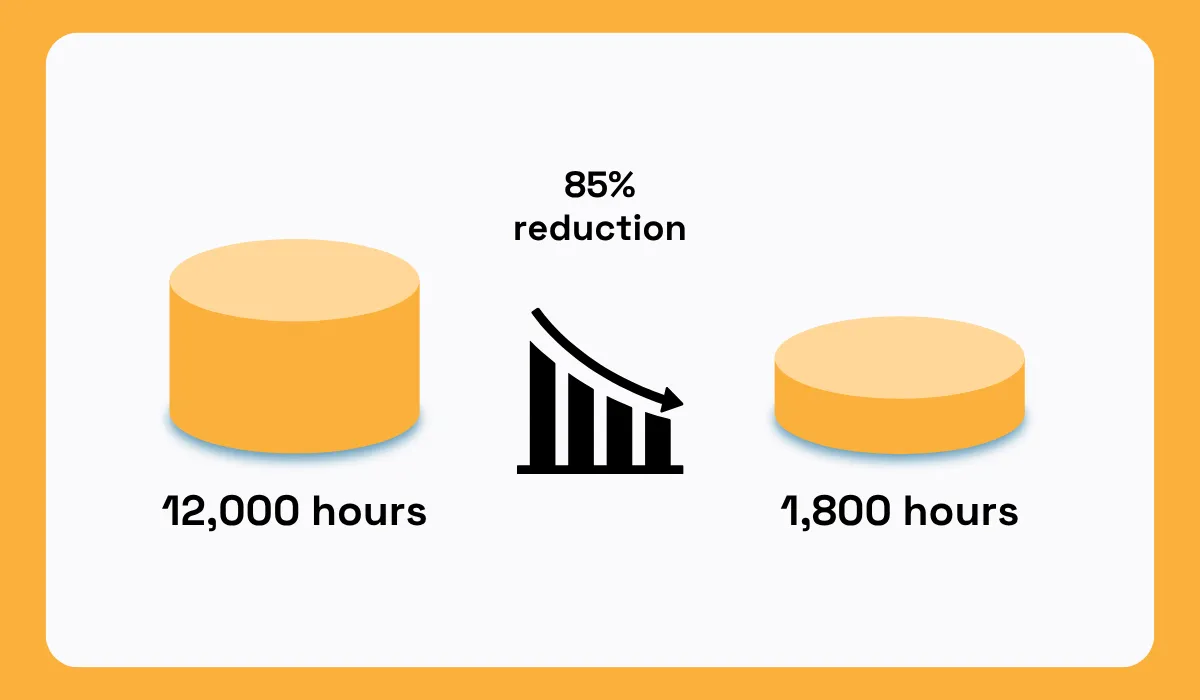
According to Oraczen, manually classifying millions of annual transactions required around 12,000 hours of work each year.
But after implementing an AI-based classification system with human oversight, that fell to 1,800 hours, an 85% reduction.
The point of AI isn't to remove people from the process. Use it to free your team from work that doesn't need their full attention.
Scales to Massive Catalogs
With over 150,000 active UNSPSC codes across four hierarchical levels, manually finding the single correct commodity code for each item in a large catalog is genuinely impractical at enterprise scale
One system might list an item as “M8 SS HEX BOLT,” another as “M8 stainless steel hex-head bolt,” and a supplier's catalog might call it “stainless hex bolt 8 x 40 mm.”
The wording changes, even when the underlying product is essentially the same.
A basic keyword-based system can struggle with those variations because it looks for predefined terms.
AI models can instead consider the meaning and context of the description to determine what the product actually represents.
That matters when you're mapping a product to UNSPSC. The goal isn't simply to find a matching word but to determine where the product belongs in a hierarchy that becomes increasingly specific at each level.
And that last part is not always easy.
Research testing LLMs on UNSPSC classification found that models performed much better at broader levels of the taxonomy than at the more specific Commodity level.
In the study's best-performing setup, accuracy reached 54.59% at the Segment level but only 10.8% at the Commodity level, as you can see below.

Source: Research Gate
The takeaway isn't that AI can't classify products. But the more specific the classification becomes, the harder the task gets.
A model may recognize that something is a chemical or a type of fastener, while determining the exact commodity requires much more product context.
So AI makes it possible to work through massive catalogs, but the quality of the classification still depends on the information available about each product.
Improves Consistency Across Systems
Your product data probably doesn't live in one neat system. It can be spread across ERPs, purchasing platforms, finance systems, supplier databases, and other tools, each with its own data structures and naming conventions.
The scale of that fragmentation can be surprisingly large.
Informatica's 2024 survey found that 41% of data leaders globally were struggling to manage more than 1,000 data sources, with the figure reaching 56% among APAC data leaders.
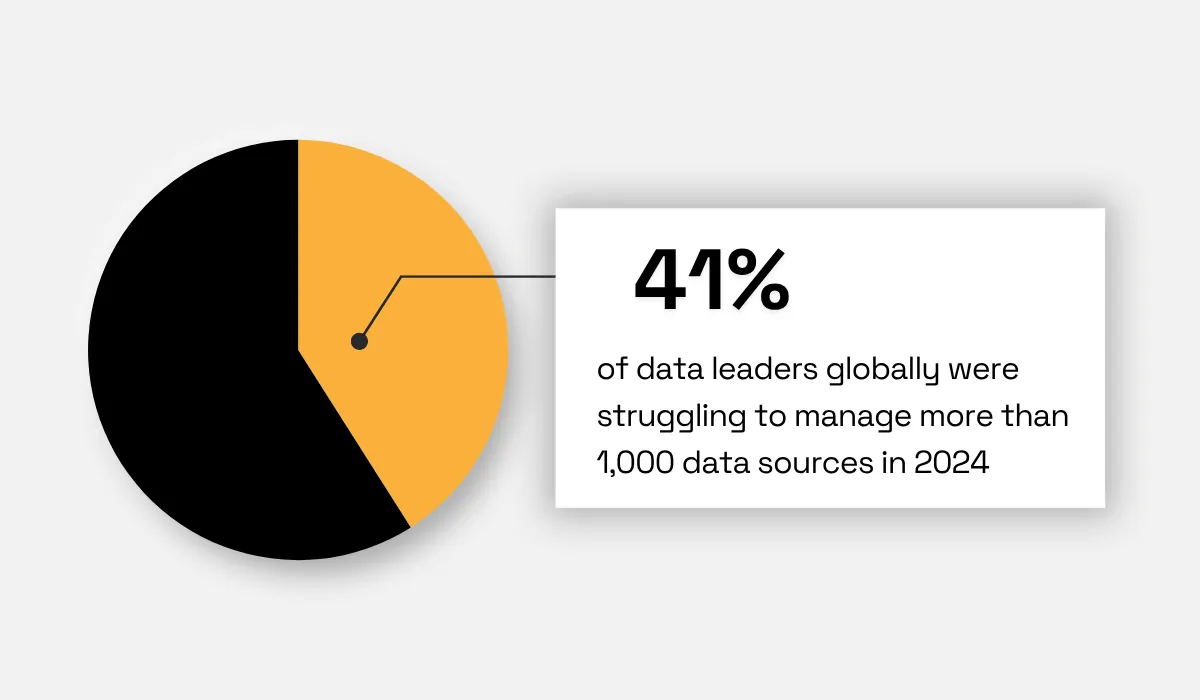
Illustration: Veridion / Data: Informatica
Now imagine trying to apply a product taxonomy consistently across all that data.
One business unit might describe an item one way, another might use a different name, and a third might classify it differently altogether.
UNSPSC gives everyone the same classification structure, but the structure only helps if you apply it consistently.
AI can use the same classification logic across large datasets instead of relying on individual decisions each time.
That gives your procurement team a much more consistent view of what you're buying, making it easier to compare spend across business units, consolidate similar purchases, and analyze supplier offerings using the same product categories.
Adapts as Catalogs Keep Changing
Your catalog keeps changing. Suppliers add products, descriptions get updated, and new purchasing records enter your systems.
AI allows classification to become an ongoing process rather than a cleanup project you repeat every few years.
New products can be classified as they appear, while low-confidence results can be sent to a person for review.
That human feedback can also become part of a continuous improvement loop. In the Oraczen case, for example, low-confidence classifications were routed to human reviewers, with corrections incorporated into subsequent model retraining.
Oraczen case study cited before reports that accuracy increased from 92% in the initial pilot to 95% after six-month retraining cycles.
Of course, that's just one implementation, not a universal benchmark for AI classification.
Still, it shows what a continuous classification loop can look like:
- AI handles the volume.
- People resolve the difficult cases.
- Those corrections can help improve future classifications.
The result is a classification process that can keep up with your data instead of waiting for the next manual cleanup project.
Veridion's Own UNSPSC-Coded Product Data
So far, we've looked at what AI can do once you have product data to classify. But there's a more basic question: where do you get that product data in the first place?
If you've ever tried to build a supplier database from company websites, you know the problem.
Every supplier presents its products differently. Some have structured catalogs, some have individual product pages, and others mention what they sell across their website without any standard format.
That's where Veridion, our business intelligence company, comes in.
Veridion’s graph brings together information about companies, their products and services, and other business details found across their digital presence, giving you a structured view of what each company actually does and offers.
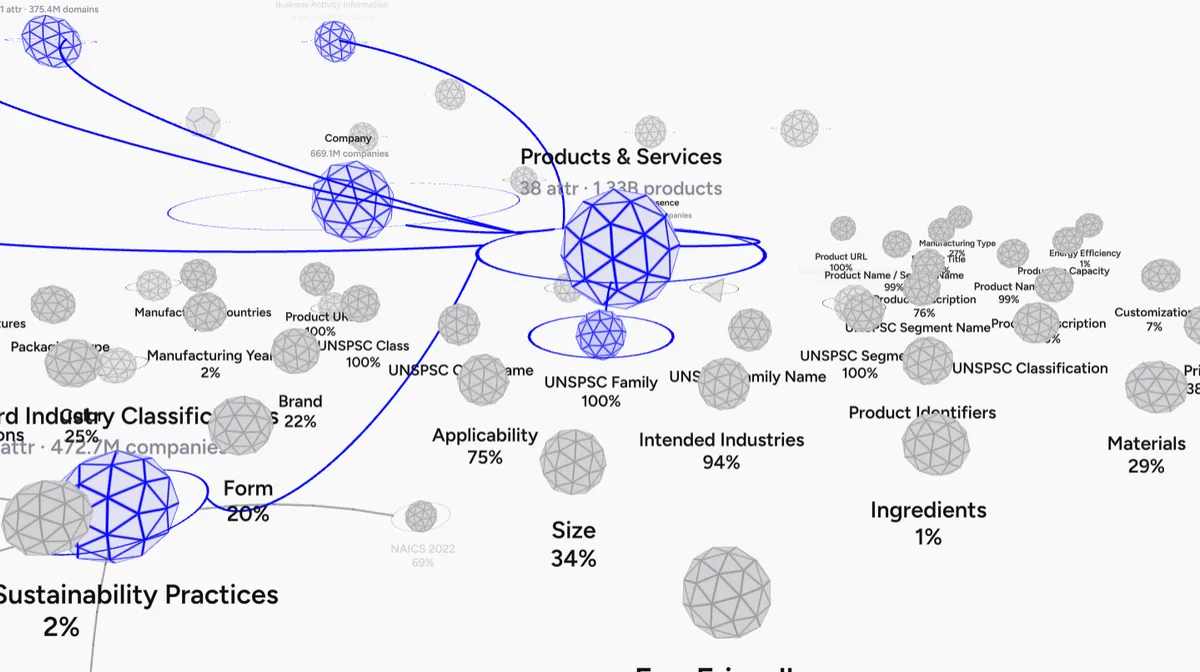
Source: Veridion
Veridion uses ML models to find company information across diverse web sources and turn it into structured product records.
Those records can include normalized product names and descriptions, materials, brands, applicability, industries served, and other product attributes.
This gives UNSPSC a structured dataset to work with. Rather than starting with a clean product catalog and simply adding a classification code, Veridion starts with fragmented information from the web, structures and enriches it, and can then apply UNSPSC to make products easier to categorize, compare, and search.
But product and services data is only a small part of the information Veridion provides for each company; there is also:
- Business contact information
- Business activity information
- Sustainability data
- Certifications
- Locations
- Building data
- Technology insights
- Risk signals
- And much more
And that broader context is becoming increasingly important, statistics show.
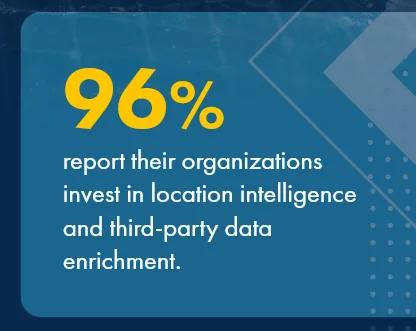
A 2026 survey of data and analytics leaders found that 96% of organizations invest in location intelligence and third-party data enrichment to add context to their data.
Source: LeBow
For sourcing teams, that context can tell you much more than a supplier's name or location.
It can help you understand what a company actually sells, where it operates, which industries it serves, what certifications it holds, how it approaches sustainability, and where its products fit within a common taxonomy.
Veridion currently reports 1.3B products and services indexed in its data, giving UNSPSC a much bigger role than simply organizing an internal catalog.
You're essentially going from messy web information to structured product data, standardized classification, and easier product and supplier discovery.
And that's where UNSPSC becomes a common language that helps you make sense of a much larger product landscape.
Conclusion
Yes, UNSPSC is a common language for organizing products, but applying it across a large, messy, constantly changing catalog is where things get difficult.
AI can take much of that work off your team's back by processing products at scale, interpreting inconsistent descriptions, and keeping classifications more consistent as your data changes.
When AI, UNSPSC, and rich, continuously updated business information work together, you gain a foundation for better product discovery, supplier comparison, and sourcing decisions.
Articles
Discuss how these trends affect your organization.
Our analysts are available for a short call. Bring a specific question and we will ground it in the data.
Insights
Keep reading
More analysis, research, and outcomes grounded in live company intelligence.
How Successful Companies Use Market Intelligence for Business Growth
Discover how successful companies use market intelligence to unlock new growth opportunities. Learn more in our latest guide.
How Is AI Revolutionizing Market Intelligence?
Explore the key ways AI is transforming market intelligence workflows and helping businesses stay ahead of the competition.
5 Types of Market Intelligence You Need to Know About
Explore five different types of market intelligence that can shape your competitive edge. Find out which ones your team should prioritize.